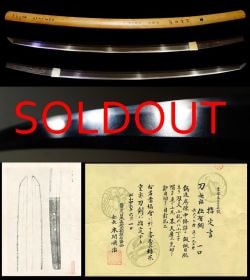
The curved, ridged tachi took its classic form in the Heian provinces while the court refined its culture in the capital. Its patrons were the military nobility whose feuds ended in the Genpei War, and whose blades became heirlooms almost at once.
This is a Heian period tachi by Aritsuna. It has been certified as Juyo.
 NihontoWatch
mei · Yowa (1181-1182)
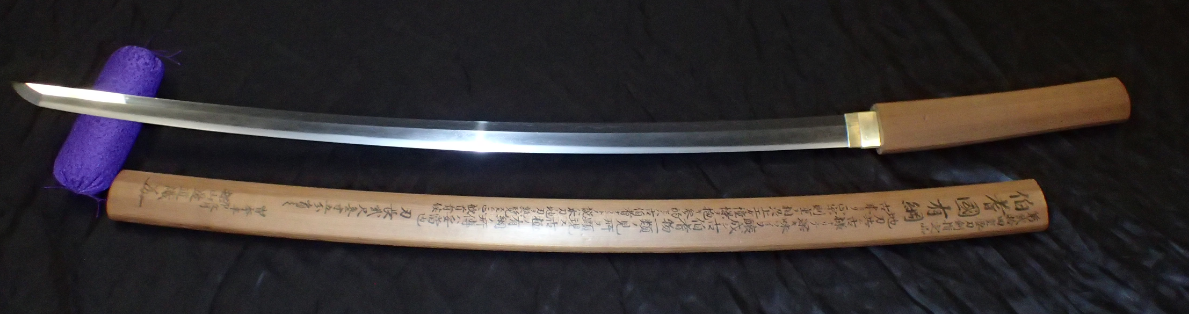
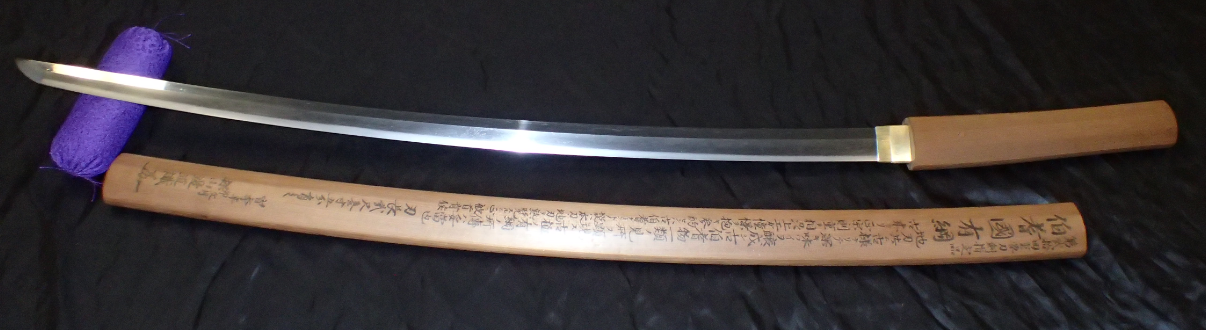
Hoki province, the Ko-Hoki (old Hoki) school of Yasutsuna's line · Hoki · around 1181-1182
Tōken Taikan top 8%
1 piece on the market now
Aritsuna is one of the Ko-Hoki masters of the late Heian to early Kamakura period, a smith of the old Hoki school that gathered around Yasutsuna. The signature compendia record him as the son of Moritsuna of Hoki, but the published sources set that aside on the evidence of the workmanship and confirm him, together with Yasuie and Sanemori, as belonging to Yasutsuna's line, the record stating plainly that he is confirmed as one of Yasutsuna's group[[c:1]]; a parallel tradition hands him down as a son of Yasutsuna himself. His signed works are very few, and almost all of them have been shortened in later ages, so the man is most often met not under his own signature but as a den attribution (伝有綱) on a greatly shortened tachi whose make the connoisseur is asked to read back to him.
That reading turns on a low, restrained temper. Over the body the published sources describe a small midare as the basis of the hamon, mixing into it ko-choji, ko-notare and small gunome, the temper kept low and the ko-ashi entering well; toward the monouchi the line tightens into a slender suguha tone. Across the whole run sunagashi and kinsuji appear frequently, the nioi lies deep, and on the unsigned katana from Ishikawa the nioiguchi is recorded sinking in a subdued, shizumi character with ko-nie attaching, the fine sunagashi and kinsuji together imparting an archaic flavor[[c:2]]. The boshi runs straight and turns back in a small ko-maru. It is a quiet, old manner, far from the showy choji of the later Bizen, and the low temper and the sunken habuchi are exactly what mark the work as old Hoki.
The jigane carries the same antiquity. The forging is an itame that stands slightly toward hada-dachi, mixed with a nagare tendency, fine ji-nie adhering to it and fine chikei entering. On the greatly shortened katana from Tokyo the published sources note the grain standing and the chikei fine and frequent, and it is this standing, nie-laden ji, rather than any one figure in the temper, that fixes the attribution. The koshizori tachi sugata survives the shortening: the build is shinogi-zukuri with an iori-mune, and though o-suriage the curvature stays relatively high, funbari remains at the base, and a chu-kissaki closes the point, the old high-waisted profile of a late Heian tachi still legible in a blade cut down for later wear.
He is met in two registers of this one early manner. The rarer is the signed tachi, where the bare two-character mei survives cut on the ha-ura: there the temper is a suguha-cho carrying ko-ashi and yo, with ko-nie adhering well, and in the notare portions choji and gunome enter and rise upward from around the middle of the omote, the bo-hi carved through both faces with a kaku-dome, while the boshi of this one blade is itself a suguha, restored. The more numerous is the o-suriage, unsigned katana handed down as Aritsuna of Hoki, and it is here that the kantei properly lives, the attribution resting on the workmanship rather than on any surviving signature. Of one such blade the published sources write that the traditional attribution to Aritsuna can be accepted, 「有綱の所伝は首肯し得る」, the ji and ha together judged good and old in tone.
His standing reaches well beyond Hoki. On the Tokyo katana the published sources draw the line forward to Sagami, recording that smiths such as Masamune and Norishige took just this manner of work as their ideal and on that basis established the Soshu tradition, 「相州正宗, 則重等はこうした作風を理想として相州伝を創始している」. The old Hoki hand, the standing nie-laden itame with its chikei and the small midare swept with sunagashi and kinsuji, is thus named among the acknowledged sources of the later nie-based Soshu style. He is set apart from the Bizen schools of his own age less by any borrowed comparison than by his own grounded features, the quiet ko-midare, the standing ji and the subdued nioiguchi that together carry the archaic air.
For the collector, Aritsuna is among the rarest names a Hoki student could hope to encounter. The reference texts place him in the Toko Taikan but record no Fujishiro grade, and there is no National Treasure or Tokubetsu Juyo among the work on record. His two Important Cultural Properties are held as patrimony, a signed tachi preserved at Oyamazumi Jinja on the inland sea, long the great repository of early sword dedications, and a second tachi in the Tokyo Fuji Museum. Beyond these the official record runs to a small handful of Juyo blades, three in all, the o-suriage mumei den works in which his hand is read, with no provenance to daimyo houses recorded among them. A privately held Aritsuna is therefore a thing seen only rarely, and a signed one rarer still; when one does come before a collector it is a landmark, one of the few honest ways to hold the old Hoki manner from which the Soshu tradition drew its ideal.
Where Aritsuna stands among comparable artisans: across all of nihontō, and within tradition, era, and period. The tiers (Foremost · Leading · Major · Notable) weigh official designations from the NBTHK and Japan's Agency for Cultural Affairs, together with historical honors of lasting repute such as the Sansaku and Meibutsu-chō.
Select a lens to see how it's measured.
Wakimono · Hoki
Phase: Ko-Hoki古伯耆· 966–1334
4 pieces on the market now
Ko-Hoki occupies the deepest stratum of the school, the chapter in which the Hoki name first enters the record at all. The published commentary places Yasutsuna roughly contemporary with Sanjo Munechika in the late Heian period, correcting the older reference-book dating that pushed him back to the Daido era (806 to 810), and the gap between that legend and the inferred reality is itself a measure of how far back this phase reaches. Gathered around Yasutsuna is the Ohara group: Masamori (read also as Sanemori), transmitted as his son, with Aritsuna, Sadatsuna, Yasuie and Masakage (Sanekage) named beside him, a circle the setsumei describes as flourishing from the late Heian into the early Kamakura period. Hoki Kunimune extends the manner toward the Kamakura age, his work judged to stand apart from Bizen Saburo Kunimune and possibly to predate him. Signed survivals at this antiquity are thin, more frequent under Yasutsuna than any other hand, and the meibutsu Dojigiri Yasutsuna fixes the period's highest reference. The style of this phase is read first in the steel. The setsumei return blade after blade to itame with standing grain, mixed with o-itame and mokume in large pattern, thick ji-nie, entering chikei and patchy jifu that rises into jifu-utsuri or midare-utsuri across a ground of darkish, blackish (kanai-iro) tone. The temper rests on a suguha base broken into ko-midare, with ko-choji, ko-gunome and shallow ko-notare mingled small in scale, the nie lying thick and the nioiguchi tending to urumi or shizumi; kinsuji and sunagashi run insistently, and many blades drop the edge above the machi in yakiotoshi.
The sugata keeps an archaic koshizori tachi form with funbari and a small kissaki, the boshi running straight to ko-maru or yakizume. Against the later Sue-Hoki the contrast is one of vigor and individuality: where the late phase settles this rustic register into something tamer and more regular, Ko-Hoki stands open, dark and forceful, each hand still distinct, Yasutsuna's midare running larger while Sadatsuna's finest signed work brightens unusually toward Bizen. For kantei the recurring task is to separate Hoki from Ko-Bizen, whose contemporaneous ko-midare it superficially resembles. The setsumei draw the line on close view: Ko-Bizen steel is bright and tight, while the Hoki ji stands open and dark with conspicuous large itame, a clouded nioiguchi, and kinsuji and sunagashi working through a softer provincial edge that carries an ancient fragrance (koko). A thread of Yamato spirit is read in certain pieces, such as the unsigned Yasutsuna long held in the Maeda house, and Sadatsuna's o-sujikai yasurime point toward Aoe even as judgment keeps him in Ko-Hoki. Yasutsuna and Masamori head the phase, and the signature habit of cutting tsuna (綱) larger than yasu (安) and shifted to the right is a noted diagnostic. The Dojigiri stands above the named works, with the Imperial Yasunori tachi and Sadatsuna and Kunimune blades transmitted through the Tokugawa, the Satake of Dewa, and the Hisamatsu-Matsudaira, the provenance running through the houses that held the country. Learn more →
| Smith | Era | Designated |
|---|---|---|
| Yasutsuna安綱 | 987-1150 | 35 |
| Ohara大原 | 987-1596 | 16 |
| Sadatsuna貞綱 | 1184-1185 | 19 |
| Hiroyoshi廣賀 | 1532-1565 | 6 |
| Aritsuna有綱 | 1181-1182 | 5 |
The Heian period (794 to 1185)
The curved, ridged tachi took its classic form in the Heian provinces while the court refined its culture in the capital. Its patrons were the military nobility whose feuds ended in the Genpei War, and whose blades became heirlooms almost at once.
A blade of top-grade workmanship and condition, formally judged to rank with a nationally recognized Important Art Object (Jūyō Bijutsuhin). Awarded only at the NBTHK’s competitive annual examination.
Of Japan’s roughly 2.5 million registered swords, only 12,307 (about 1 in 203) have ever attained Jūyō.
The NBTHK (Nihon Bijutsu Tōken Hozon Kyōkai, the Society for the Preservation of Japanese Art Swords) is a public-interest incorporated foundation founded in 1948 and supervised by Japan’s Agency for Cultural Affairs (Bunkachō); it is based at the Japanese Sword Museum in Tokyo. Its expert panels physically examine each submitted work (shinsa) and issue a certificate (kanteishō) ranking it by artistic and historical merit. NBTHK papers are the most widely recognized standard of authentication for Japanese swords and fittings.
NBTHK official sitePrice on request
This is a Heian period tachi by Aritsuna. It has been certified as Juyo.
NihontoWatchmei · Yowa (1181-1182)
Hoki province, the Ko-Hoki (old Hoki) school of Yasutsuna's line · Hoki · around 1181-1182
Tōken Taikan top 8%
1 piece on the market now
Aritsuna is one of the Ko-Hoki masters of the late Heian to early Kamakura period, a smith of the old Hoki school that gathered around Yasutsuna. The signature compendia record him as the son of Moritsuna of Hoki, but the published sources set that aside on the evidence of the workmanship and confirm him, together with Yasuie and Sanemori, as belonging to Yasutsuna's line, the record stating plainly that he is confirmed as one of Yasutsuna's group[[c:1]]; a parallel tradition hands him down as a son of Yasutsuna himself. His signed works are very few, and almost all of them have been shortened in later ages, so the man is most often met not under his own signature but as a den attribution (伝有綱) on a greatly shortened tachi whose make the connoisseur is asked to read back to him.
That reading turns on a low, restrained temper. Over the body the published sources describe a small midare as the basis of the hamon, mixing into it ko-choji, ko-notare and small gunome, the temper kept low and the ko-ashi entering well; toward the monouchi the line tightens into a slender suguha tone. Across the whole run sunagashi and kinsuji appear frequently, the nioi lies deep, and on the unsigned katana from Ishikawa the nioiguchi is recorded sinking in a subdued, shizumi character with ko-nie attaching, the fine sunagashi and kinsuji together imparting an archaic flavor[[c:2]]. The boshi runs straight and turns back in a small ko-maru. It is a quiet, old manner, far from the showy choji of the later Bizen, and the low temper and the sunken habuchi are exactly what mark the work as old Hoki.
The jigane carries the same antiquity. The forging is an itame that stands slightly toward hada-dachi, mixed with a nagare tendency, fine ji-nie adhering to it and fine chikei entering. On the greatly shortened katana from Tokyo the published sources note the grain standing and the chikei fine and frequent, and it is this standing, nie-laden ji, rather than any one figure in the temper, that fixes the attribution. The koshizori tachi sugata survives the shortening: the build is shinogi-zukuri with an iori-mune, and though o-suriage the curvature stays relatively high, funbari remains at the base, and a chu-kissaki closes the point, the old high-waisted profile of a late Heian tachi still legible in a blade cut down for later wear.
He is met in two registers of this one early manner. The rarer is the signed tachi, where the bare two-character mei survives cut on the ha-ura: there the temper is a suguha-cho carrying ko-ashi and yo, with ko-nie adhering well, and in the notare portions choji and gunome enter and rise upward from around the middle of the omote, the bo-hi carved through both faces with a kaku-dome, while the boshi of this one blade is itself a suguha, restored. The more numerous is the o-suriage, unsigned katana handed down as Aritsuna of Hoki, and it is here that the kantei properly lives, the attribution resting on the workmanship rather than on any surviving signature. Of one such blade the published sources write that the traditional attribution to Aritsuna can be accepted, 「有綱の所伝は首肯し得る」, the ji and ha together judged good and old in tone.
His standing reaches well beyond Hoki. On the Tokyo katana the published sources draw the line forward to Sagami, recording that smiths such as Masamune and Norishige took just this manner of work as their ideal and on that basis established the Soshu tradition, 「相州正宗, 則重等はこうした作風を理想として相州伝を創始している」. The old Hoki hand, the standing nie-laden itame with its chikei and the small midare swept with sunagashi and kinsuji, is thus named among the acknowledged sources of the later nie-based Soshu style. He is set apart from the Bizen schools of his own age less by any borrowed comparison than by his own grounded features, the quiet ko-midare, the standing ji and the subdued nioiguchi that together carry the archaic air.
For the collector, Aritsuna is among the rarest names a Hoki student could hope to encounter. The reference texts place him in the Toko Taikan but record no Fujishiro grade, and there is no National Treasure or Tokubetsu Juyo among the work on record. His two Important Cultural Properties are held as patrimony, a signed tachi preserved at Oyamazumi Jinja on the inland sea, long the great repository of early sword dedications, and a second tachi in the Tokyo Fuji Museum. Beyond these the official record runs to a small handful of Juyo blades, three in all, the o-suriage mumei den works in which his hand is read, with no provenance to daimyo houses recorded among them. A privately held Aritsuna is therefore a thing seen only rarely, and a signed one rarer still; when one does come before a collector it is a landmark, one of the few honest ways to hold the old Hoki manner from which the Soshu tradition drew its ideal.
Where Aritsuna stands among comparable artisans: across all of nihontō, and within tradition, era, and period. The tiers (Foremost · Leading · Major · Notable) weigh official designations from the NBTHK and Japan's Agency for Cultural Affairs, together with historical honors of lasting repute such as the Sansaku and Meibutsu-chō.
Select a lens to see how it's measured.
Wakimono · Hoki
Phase: Ko-Hoki古伯耆· 966–1334
4 pieces on the market now
Ko-Hoki occupies the deepest stratum of the school, the chapter in which the Hoki name first enters the record at all. The published commentary places Yasutsuna roughly contemporary with Sanjo Munechika in the late Heian period, correcting the older reference-book dating that pushed him back to the Daido era (806 to 810), and the gap between that legend and the inferred reality is itself a measure of how far back this phase reaches. Gathered around Yasutsuna is the Ohara group: Masamori (read also as Sanemori), transmitted as his son, with Aritsuna, Sadatsuna, Yasuie and Masakage (Sanekage) named beside him, a circle the setsumei describes as flourishing from the late Heian into the early Kamakura period. Hoki Kunimune extends the manner toward the Kamakura age, his work judged to stand apart from Bizen Saburo Kunimune and possibly to predate him. Signed survivals at this antiquity are thin, more frequent under Yasutsuna than any other hand, and the meibutsu Dojigiri Yasutsuna fixes the period's highest reference. The style of this phase is read first in the steel. The setsumei return blade after blade to itame with standing grain, mixed with o-itame and mokume in large pattern, thick ji-nie, entering chikei and patchy jifu that rises into jifu-utsuri or midare-utsuri across a ground of darkish, blackish (kanai-iro) tone. The temper rests on a suguha base broken into ko-midare, with ko-choji, ko-gunome and shallow ko-notare mingled small in scale, the nie lying thick and the nioiguchi tending to urumi or shizumi; kinsuji and sunagashi run insistently, and many blades drop the edge above the machi in yakiotoshi.
The sugata keeps an archaic koshizori tachi form with funbari and a small kissaki, the boshi running straight to ko-maru or yakizume. Against the later Sue-Hoki the contrast is one of vigor and individuality: where the late phase settles this rustic register into something tamer and more regular, Ko-Hoki stands open, dark and forceful, each hand still distinct, Yasutsuna's midare running larger while Sadatsuna's finest signed work brightens unusually toward Bizen. For kantei the recurring task is to separate Hoki from Ko-Bizen, whose contemporaneous ko-midare it superficially resembles. The setsumei draw the line on close view: Ko-Bizen steel is bright and tight, while the Hoki ji stands open and dark with conspicuous large itame, a clouded nioiguchi, and kinsuji and sunagashi working through a softer provincial edge that carries an ancient fragrance (koko). A thread of Yamato spirit is read in certain pieces, such as the unsigned Yasutsuna long held in the Maeda house, and Sadatsuna's o-sujikai yasurime point toward Aoe even as judgment keeps him in Ko-Hoki. Yasutsuna and Masamori head the phase, and the signature habit of cutting tsuna (綱) larger than yasu (安) and shifted to the right is a noted diagnostic. The Dojigiri stands above the named works, with the Imperial Yasunori tachi and Sadatsuna and Kunimune blades transmitted through the Tokugawa, the Satake of Dewa, and the Hisamatsu-Matsudaira, the provenance running through the houses that held the country. Learn more →
| Smith | Era | Designated |
|---|---|---|
| Yasutsuna安綱 | 987-1150 | 35 |
| Ohara大原 | 987-1596 | 16 |
| Sadatsuna貞綱 | 1184-1185 | 19 |
| Hiroyoshi廣賀 | 1532-1565 | 6 |
| Aritsuna有綱 | 1181-1182 | 5 |
The Heian period (794 to 1185)
The curved, ridged tachi took its classic form in the Heian provinces while the court refined its culture in the capital. Its patrons were the military nobility whose feuds ended in the Genpei War, and whose blades became heirlooms almost at once.
A blade of top-grade workmanship and condition, formally judged to rank with a nationally recognized Important Art Object (Jūyō Bijutsuhin). Awarded only at the NBTHK’s competitive annual examination.
Of Japan’s roughly 2.5 million registered swords, only 12,307 (about 1 in 203) have ever attained Jūyō.
The NBTHK (Nihon Bijutsu Tōken Hozon Kyōkai, the Society for the Preservation of Japanese Art Swords) is a public-interest incorporated foundation founded in 1948 and supervised by Japan’s Agency for Cultural Affairs (Bunkachō); it is based at the Japanese Sword Museum in Tokyo. Its expert panels physically examine each submitted work (shinsa) and issue a certificate (kanteishō) ranking it by artistic and historical merit. NBTHK papers are the most widely recognized standard of authentication for Japanese swords and fittings.
NBTHK official sitePrice on request