Around 1800 Suishinshi Masahide argued in his writings that the craft must return to the old masters’ methods: the fukkotō revival. His greatest successor Naotane worked convincingly in Bizen and Sōshū manners that had been dead for centuries.
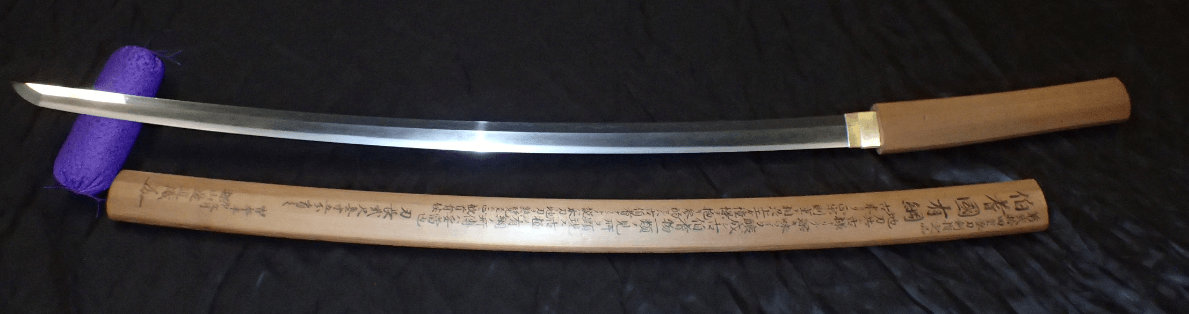
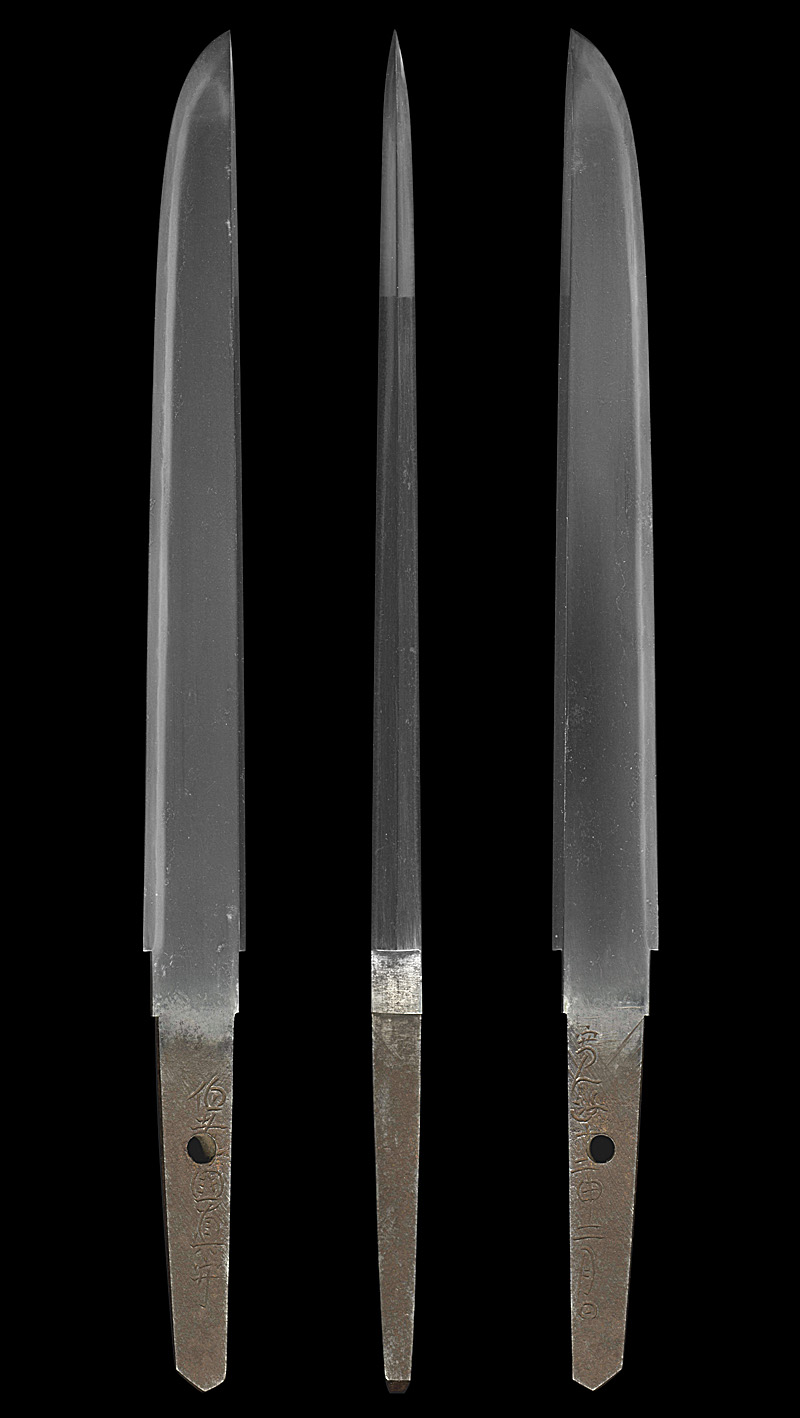
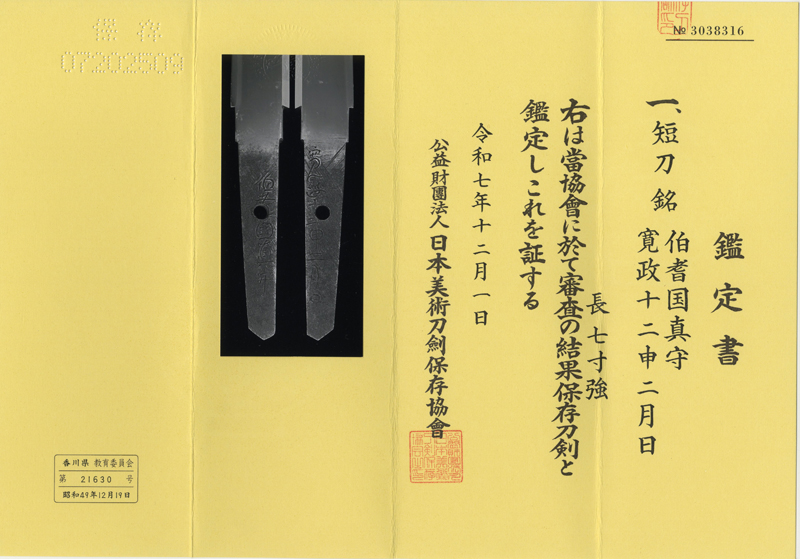
This is a tanto by Sanemori, likely the second generation of the Hamabe school, active in Yonago, Hoki Province (present-day Tottori Prefecture) during the late Edo period (Kansei 12, 1800). Sanemori, whose real name was Kawamura Genroku, was known for his exceptional skill among the Hoki smiths of his time. The blade comes with an aikuchi koshirae featuring a nunome-nuri saya and is accompanied by an NBTHK Hozon Token certificate.
Certificate reading — 銘 伯耆国真守 寛政十二申二月日
 NihontoWatch
mei · Hamabe · Shin-shinto · nagasa 21.5cm

Wakimono · Hoki · around 1175-1199
Tōken Taikan top 5%
2 pieces on the market now
Ohara Sanemori (大原真守) of Hoki Province is traditionally transmitted as a son of Yasutsuna, the founding figure of the Ko-Hoki school. Together with related smiths--Aritsuna, Sadatsuna, Yasuie, and Sanekage--this group flourished from the late Heian period into the early Kamakura period. Sanemori's signed works employ a comparatively long inscription, characteristically a six-character mei cut with a thick chisel, of which the variant closely resembling the tachi preserved at Wakayama Toshogu (Important Cultural Property) is the most frequently cited. Extant signed works are "exceedingly rare," and the several signature variants make definitive authentication a continuing subject of study.
The NBTHK consistently distinguishes Ko-Hoki from contemporaneous Ko-Bizen, noting that while both schools temper predominantly small-pattern midare, "upon closer examination their character differs somewhat." Sanemori's kitae is itame-hada mixed with mokume, with the grain tending to stand; fine ji-nie adheres, chikei enters, and jifu-like textures are intermingled with jifu-utsuri standing out. A defining feature is that "the steel often takes on a blackish tone." His hamon is based on suguha mixed with ko-midare, ko-choji, and ko-gunome--"overall a fine-patterned irregularity"--with ko-ashi and yo entering well. The nioiguchi tends toward urumi (a moist, soft quality) and at times shows shizumi (subdued character), while kinsuji, nie-suji, and sunagashi appear with frequency. The boshi is typically sugu to ko-maru, and carved works--placed characteristically at the koshi-moto--include bonji, suken, and koshi-bi, providing "valuable material for understanding the distinctive nature of Sanemori's carvings." Within the Ko-Hoki group, Sanemori's tempering is noted for presenting "somewhat smaller-scale patterns of irregularity" compared to Yasutsuna.
The setsumei repeatedly invoke an atmosphere of "archaic, artless dignity" and "rustic, provincial flavor" when describing these works, a quality that "in one vein recalls Awataguchi Kuniyasu and Ayanokoji Sadatoshi." The classical sugata--slender, with funbari, high koshizori, and ko-kissaki--is described as appearing "more frequently in this smith's work" than in his father's. Multiple blades bear the addendum character "Katsu" (勝) on the ura of the nakago, a feature of unknown meaning that is "valuable as documentary material," also recorded in the Tsuchiya Oshigata.
Wakimono · Hoki
Phase: Ko-Hoki古伯耆· 966–1334
4 pieces on the market now
Ko-Hoki occupies the deepest stratum of the school, the chapter in which the Hoki name first enters the record at all. The published commentary places Yasutsuna roughly contemporary with Sanjo Munechika in the late Heian period, correcting the older reference-book dating that pushed him back to the Daido era (806 to 810), and the gap between that legend and the inferred reality is itself a measure of how far back this phase reaches. Gathered around Yasutsuna is the Ohara group: Masamori (read also as Sanemori), transmitted as his son, with Aritsuna, Sadatsuna, Yasuie and Masakage (Sanekage) named beside him, a circle the setsumei describes as flourishing from the late Heian into the early Kamakura period. Hoki Kunimune extends the manner toward the Kamakura age, his work judged to stand apart from Bizen Saburo Kunimune and possibly to predate him. Signed survivals at this antiquity are thin, more frequent under Yasutsuna than any other hand, and the meibutsu Dojigiri Yasutsuna fixes the period's highest reference. The style of this phase is read first in the steel. The setsumei return blade after blade to itame with standing grain, mixed with o-itame and mokume in large pattern, thick ji-nie, entering chikei and patchy jifu that rises into jifu-utsuri or midare-utsuri across a ground of darkish, blackish (kanai-iro) tone. The temper rests on a suguha base broken into ko-midare, with ko-choji, ko-gunome and shallow ko-notare mingled small in scale, the nie lying thick and the nioiguchi tending to urumi or shizumi; kinsuji and sunagashi run insistently, and many blades drop the edge above the machi in yakiotoshi.
The sugata keeps an archaic koshizori tachi form with funbari and a small kissaki, the boshi running straight to ko-maru or yakizume. Against the later Sue-Hoki the contrast is one of vigor and individuality: where the late phase settles this rustic register into something tamer and more regular, Ko-Hoki stands open, dark and forceful, each hand still distinct, Yasutsuna's midare running larger while Sadatsuna's finest signed work brightens unusually toward Bizen. For kantei the recurring task is to separate Hoki from Ko-Bizen, whose contemporaneous ko-midare it superficially resembles. The setsumei draw the line on close view: Ko-Bizen steel is bright and tight, while the Hoki ji stands open and dark with conspicuous large itame, a clouded nioiguchi, and kinsuji and sunagashi working through a softer provincial edge that carries an ancient fragrance (koko). A thread of Yamato spirit is read in certain pieces, such as the unsigned Yasutsuna long held in the Maeda house, and Sadatsuna's o-sujikai yasurime point toward Aoe even as judgment keeps him in Ko-Hoki. Yasutsuna and Masamori head the phase, and the signature habit of cutting tsuna (綱) larger than yasu (安) and shifted to the right is a noted diagnostic. The Dojigiri stands above the named works, with the Imperial Yasunori tachi and Sadatsuna and Kunimune blades transmitted through the Tokugawa, the Satake of Dewa, and the Hisamatsu-Matsudaira, the provenance running through the houses that held the country. Learn more →
| Smith | Era | Designated |
|---|---|---|
| Yasutsuna安綱 | 987-1150 | 35 |
| Ohara大原 | 987-1596 | 16 |
| Sadatsuna貞綱 | 1184-1185 | 19 |
| Hiroyoshi廣賀 | 1532-1565 | 6 |
| Aritsuna有綱 | 1181-1182 | 5 |
The Shinshintō revival
Around 1800 Suishinshi Masahide argued in his writings that the craft must return to the old masters’ methods: the fukkotō revival. His greatest successor Naotane worked convincingly in Bizen and Sōshū manners that had been dead for centuries.
Certifies a genuine blade worth preserving: a signature confirmed correct, or, if unsigned, an era, province, and school that the NBTHK can reliably identify.
The NBTHK (Nihon Bijutsu Tōken Hozon Kyōkai, the Society for the Preservation of Japanese Art Swords) is a public-interest incorporated foundation founded in 1948 and supervised by Japan’s Agency for Cultural Affairs (Bunkachō); it is based at the Japanese Sword Museum in Tokyo. Its expert panels physically examine each submitted work (shinsa) and issue a certificate (kanteishō) ranking it by artistic and historical merit. NBTHK papers are the most widely recognized standard of authentication for Japanese swords and fittings.
NBTHK official siteCooling-off (returns or exchanges) is accepted within 3 days of the item's arrival. Return shipping and refund transfer fees are the customer's responsibility. Fees other than the item price (transfer fees, credit card fees, etc.) cannot be refunded. Returns and refunds are not available for overseas destinations.
¥280,000
This is a tanto by Sanemori, likely the second generation of the Hamabe school, active in Yonago, Hoki Province (present-day Tottori Prefecture) during the late Edo period (Kansei 12, 1800). Sanemori, whose real name was Kawamura Genroku, was known for his exceptional skill among the Hoki smiths of his time. The blade comes with an aikuchi koshirae featuring a nunome-nuri saya and is accompanied by an NBTHK Hozon Token certificate.
Certificate reading — 銘 伯耆国真守 寛政十二申二月日
NihontoWatchmei · Hamabe · Shin-shinto · nagasa 21.5cm
Wakimono · Hoki · around 1175-1199
Tōken Taikan top 5%
2 pieces on the market now
Ohara Sanemori (大原真守) of Hoki Province is traditionally transmitted as a son of Yasutsuna, the founding figure of the Ko-Hoki school. Together with related smiths--Aritsuna, Sadatsuna, Yasuie, and Sanekage--this group flourished from the late Heian period into the early Kamakura period. Sanemori's signed works employ a comparatively long inscription, characteristically a six-character mei cut with a thick chisel, of which the variant closely resembling the tachi preserved at Wakayama Toshogu (Important Cultural Property) is the most frequently cited. Extant signed works are "exceedingly rare," and the several signature variants make definitive authentication a continuing subject of study.
The NBTHK consistently distinguishes Ko-Hoki from contemporaneous Ko-Bizen, noting that while both schools temper predominantly small-pattern midare, "upon closer examination their character differs somewhat." Sanemori's kitae is itame-hada mixed with mokume, with the grain tending to stand; fine ji-nie adheres, chikei enters, and jifu-like textures are intermingled with jifu-utsuri standing out. A defining feature is that "the steel often takes on a blackish tone." His hamon is based on suguha mixed with ko-midare, ko-choji, and ko-gunome--"overall a fine-patterned irregularity"--with ko-ashi and yo entering well. The nioiguchi tends toward urumi (a moist, soft quality) and at times shows shizumi (subdued character), while kinsuji, nie-suji, and sunagashi appear with frequency. The boshi is typically sugu to ko-maru, and carved works--placed characteristically at the koshi-moto--include bonji, suken, and koshi-bi, providing "valuable material for understanding the distinctive nature of Sanemori's carvings." Within the Ko-Hoki group, Sanemori's tempering is noted for presenting "somewhat smaller-scale patterns of irregularity" compared to Yasutsuna.
The setsumei repeatedly invoke an atmosphere of "archaic, artless dignity" and "rustic, provincial flavor" when describing these works, a quality that "in one vein recalls Awataguchi Kuniyasu and Ayanokoji Sadatoshi." The classical sugata--slender, with funbari, high koshizori, and ko-kissaki--is described as appearing "more frequently in this smith's work" than in his father's. Multiple blades bear the addendum character "Katsu" (勝) on the ura of the nakago, a feature of unknown meaning that is "valuable as documentary material," also recorded in the Tsuchiya Oshigata.
Wakimono · Hoki
Phase: Ko-Hoki古伯耆· 966–1334
4 pieces on the market now
Ko-Hoki occupies the deepest stratum of the school, the chapter in which the Hoki name first enters the record at all. The published commentary places Yasutsuna roughly contemporary with Sanjo Munechika in the late Heian period, correcting the older reference-book dating that pushed him back to the Daido era (806 to 810), and the gap between that legend and the inferred reality is itself a measure of how far back this phase reaches. Gathered around Yasutsuna is the Ohara group: Masamori (read also as Sanemori), transmitted as his son, with Aritsuna, Sadatsuna, Yasuie and Masakage (Sanekage) named beside him, a circle the setsumei describes as flourishing from the late Heian into the early Kamakura period. Hoki Kunimune extends the manner toward the Kamakura age, his work judged to stand apart from Bizen Saburo Kunimune and possibly to predate him. Signed survivals at this antiquity are thin, more frequent under Yasutsuna than any other hand, and the meibutsu Dojigiri Yasutsuna fixes the period's highest reference. The style of this phase is read first in the steel. The setsumei return blade after blade to itame with standing grain, mixed with o-itame and mokume in large pattern, thick ji-nie, entering chikei and patchy jifu that rises into jifu-utsuri or midare-utsuri across a ground of darkish, blackish (kanai-iro) tone. The temper rests on a suguha base broken into ko-midare, with ko-choji, ko-gunome and shallow ko-notare mingled small in scale, the nie lying thick and the nioiguchi tending to urumi or shizumi; kinsuji and sunagashi run insistently, and many blades drop the edge above the machi in yakiotoshi.
The sugata keeps an archaic koshizori tachi form with funbari and a small kissaki, the boshi running straight to ko-maru or yakizume. Against the later Sue-Hoki the contrast is one of vigor and individuality: where the late phase settles this rustic register into something tamer and more regular, Ko-Hoki stands open, dark and forceful, each hand still distinct, Yasutsuna's midare running larger while Sadatsuna's finest signed work brightens unusually toward Bizen. For kantei the recurring task is to separate Hoki from Ko-Bizen, whose contemporaneous ko-midare it superficially resembles. The setsumei draw the line on close view: Ko-Bizen steel is bright and tight, while the Hoki ji stands open and dark with conspicuous large itame, a clouded nioiguchi, and kinsuji and sunagashi working through a softer provincial edge that carries an ancient fragrance (koko). A thread of Yamato spirit is read in certain pieces, such as the unsigned Yasutsuna long held in the Maeda house, and Sadatsuna's o-sujikai yasurime point toward Aoe even as judgment keeps him in Ko-Hoki. Yasutsuna and Masamori head the phase, and the signature habit of cutting tsuna (綱) larger than yasu (安) and shifted to the right is a noted diagnostic. The Dojigiri stands above the named works, with the Imperial Yasunori tachi and Sadatsuna and Kunimune blades transmitted through the Tokugawa, the Satake of Dewa, and the Hisamatsu-Matsudaira, the provenance running through the houses that held the country. Learn more →
| Smith | Era | Designated |
|---|---|---|
| Yasutsuna安綱 | 987-1150 | 35 |
| Ohara大原 | 987-1596 | 16 |
| Sadatsuna貞綱 | 1184-1185 | 19 |
| Hiroyoshi廣賀 | 1532-1565 | 6 |
| Aritsuna有綱 | 1181-1182 | 5 |
The Shinshintō revival
Around 1800 Suishinshi Masahide argued in his writings that the craft must return to the old masters’ methods: the fukkotō revival. His greatest successor Naotane worked convincingly in Bizen and Sōshū manners that had been dead for centuries.
Certifies a genuine blade worth preserving: a signature confirmed correct, or, if unsigned, an era, province, and school that the NBTHK can reliably identify.
The NBTHK (Nihon Bijutsu Tōken Hozon Kyōkai, the Society for the Preservation of Japanese Art Swords) is a public-interest incorporated foundation founded in 1948 and supervised by Japan’s Agency for Cultural Affairs (Bunkachō); it is based at the Japanese Sword Museum in Tokyo. Its expert panels physically examine each submitted work (shinsa) and issue a certificate (kanteishō) ranking it by artistic and historical merit. NBTHK papers are the most widely recognized standard of authentication for Japanese swords and fittings.
NBTHK official siteCooling-off (returns or exchanges) is accepted within 3 days of the item's arrival. Return shipping and refund transfer fees are the customer's responsibility. Fees other than the item price (transfer fees, credit card fees, etc.) cannot be refunded. Returns and refunds are not available for overseas destinations.
¥280,000