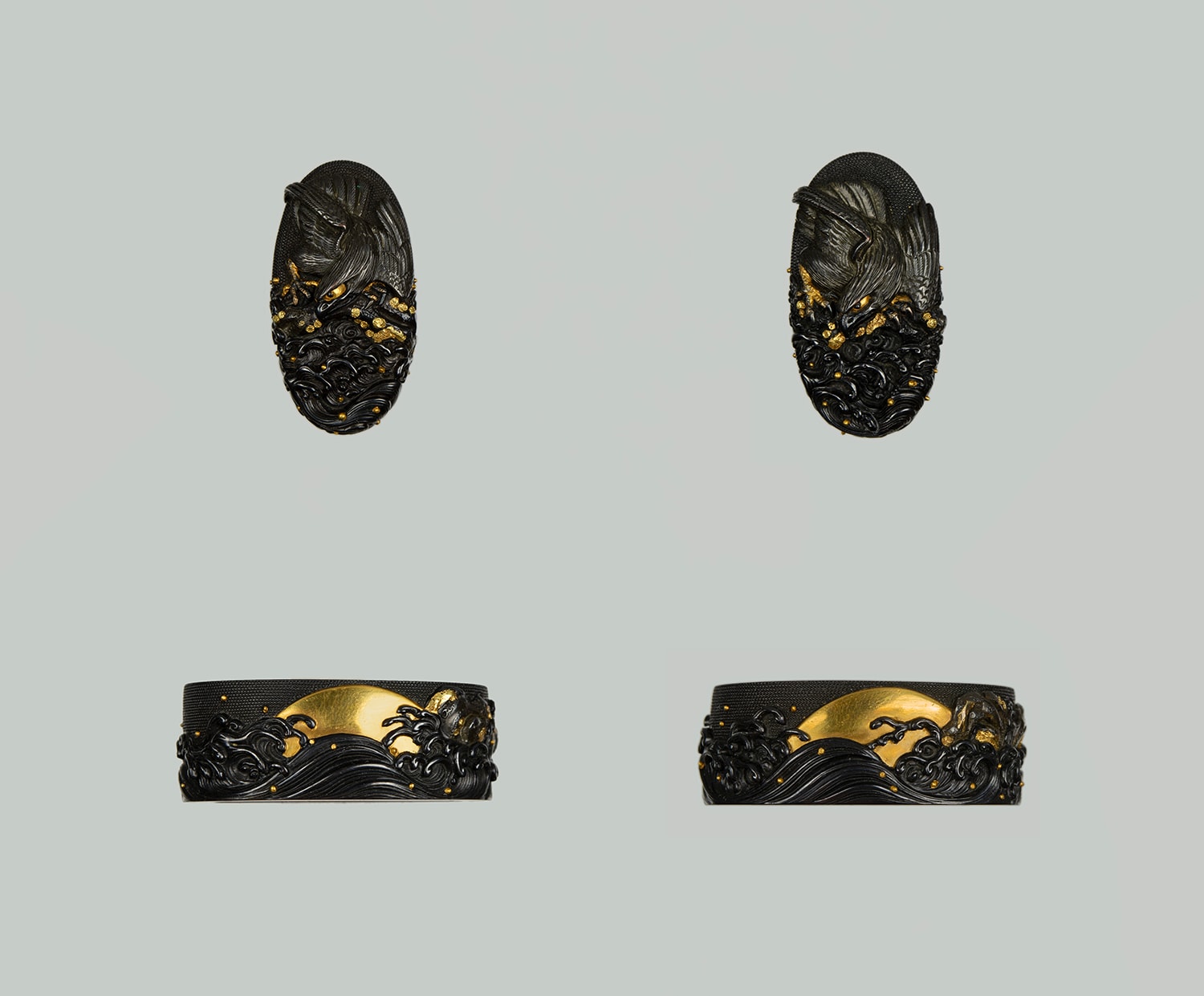
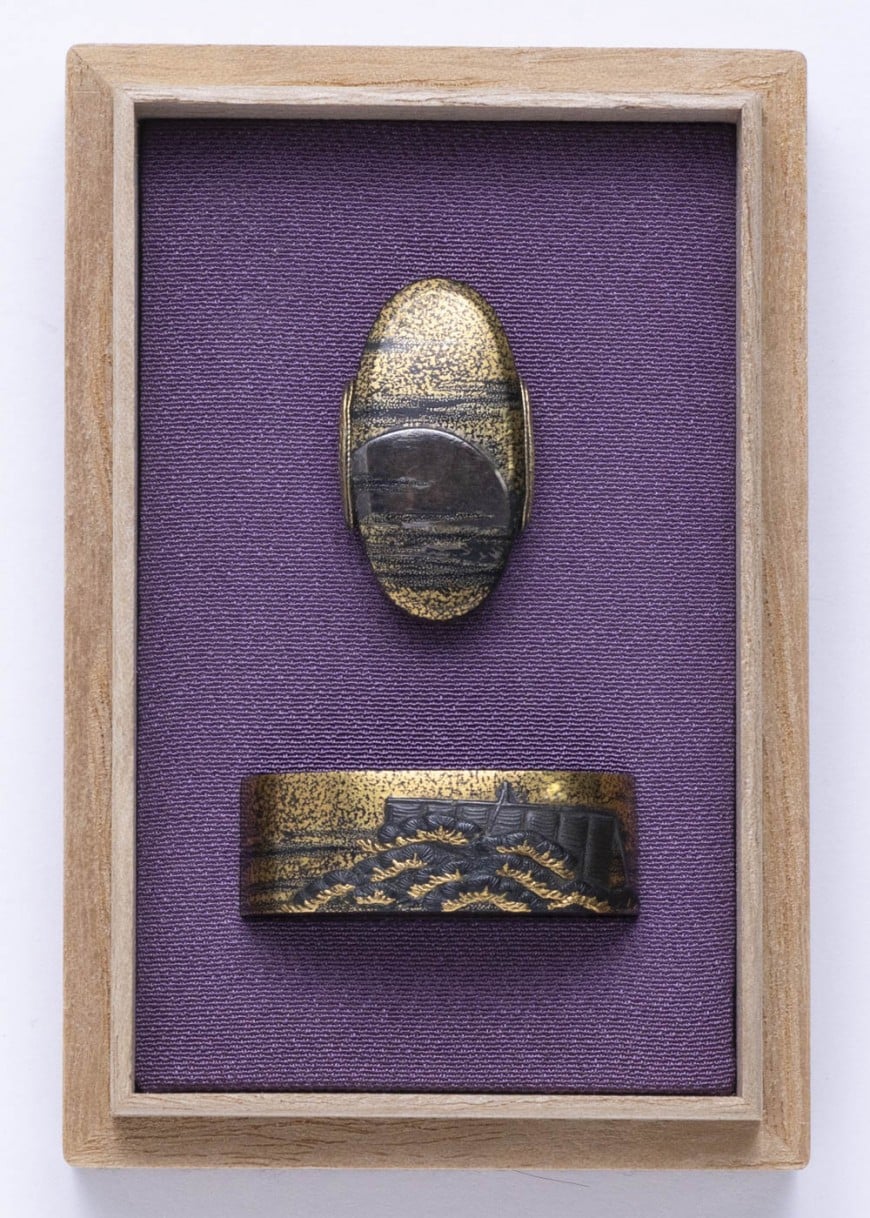
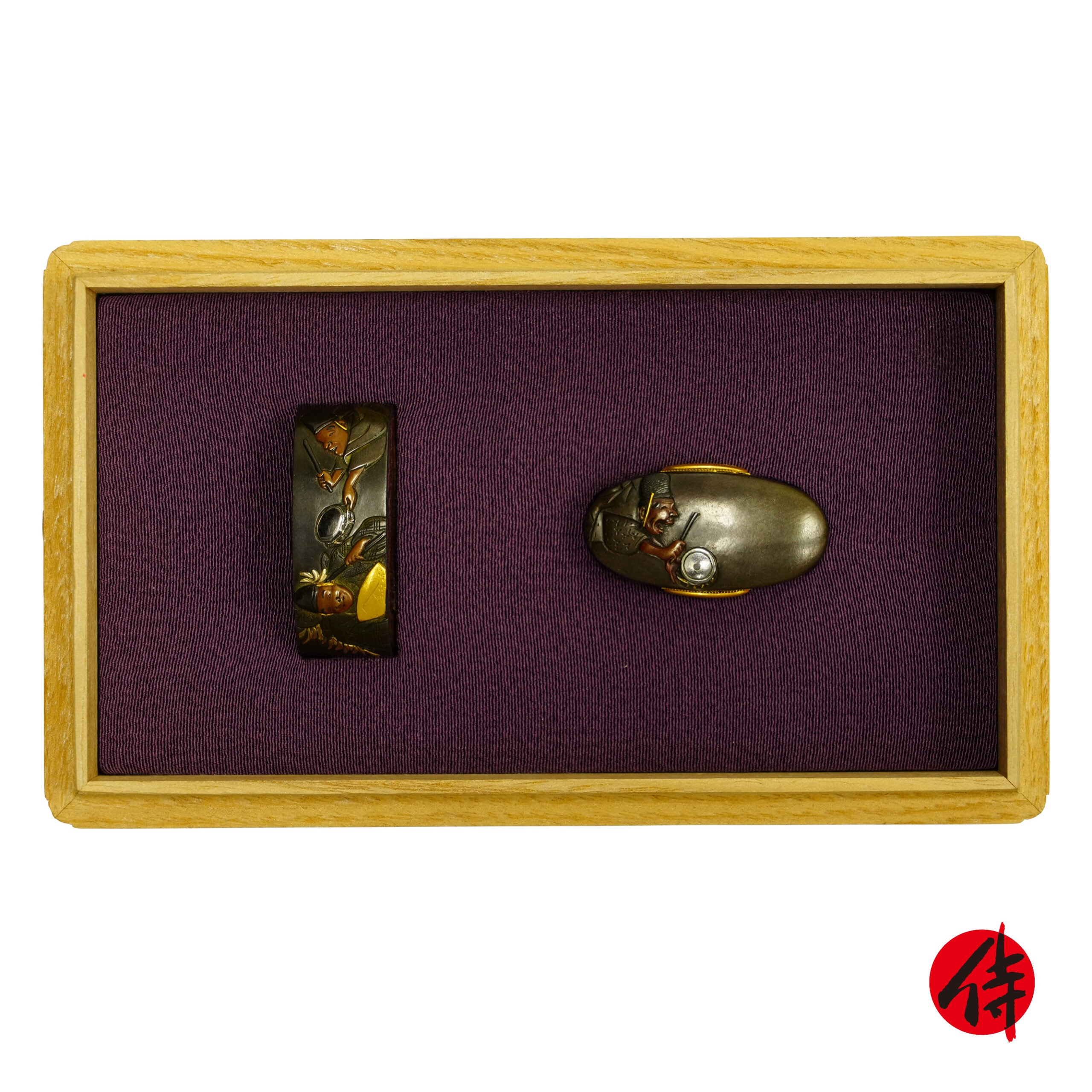
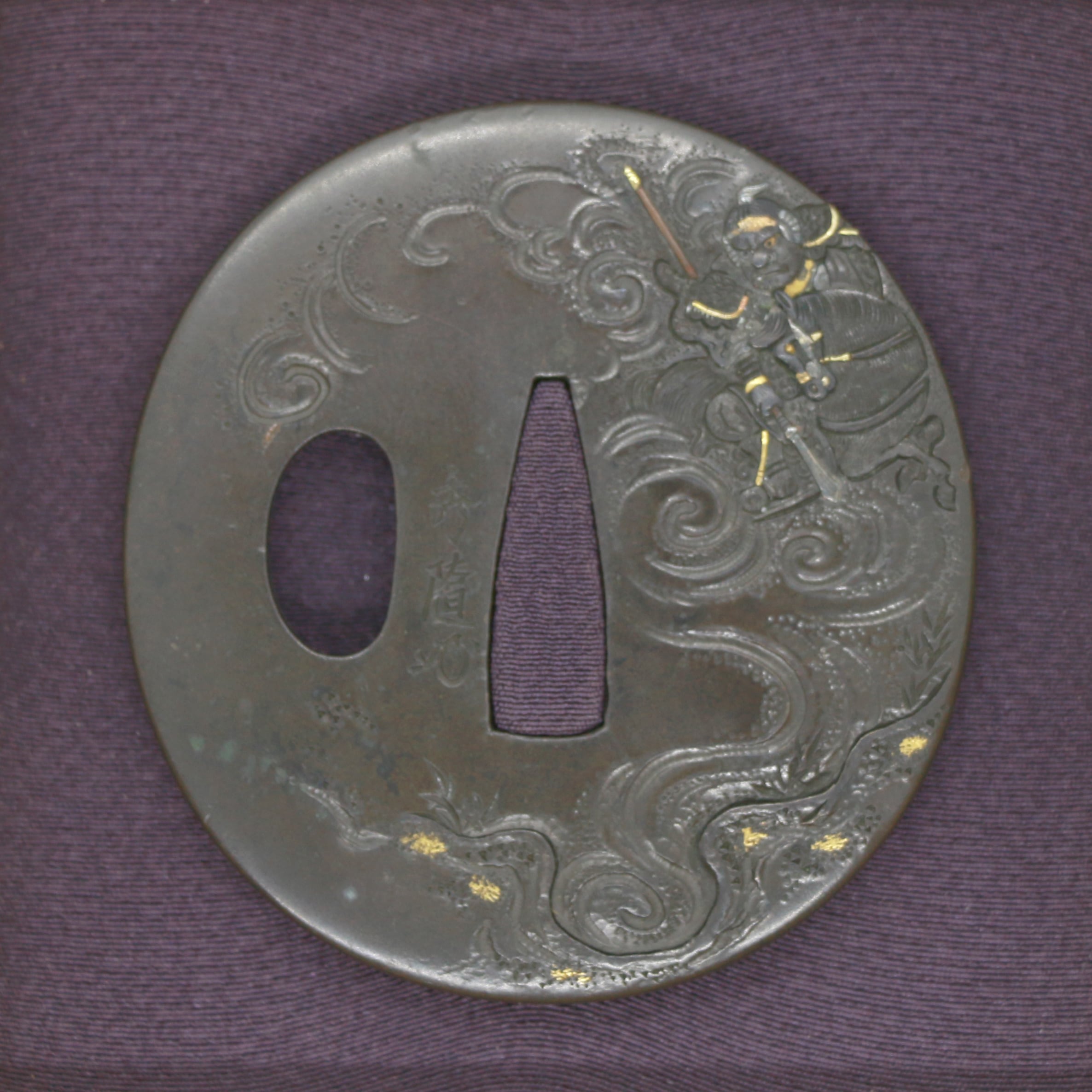
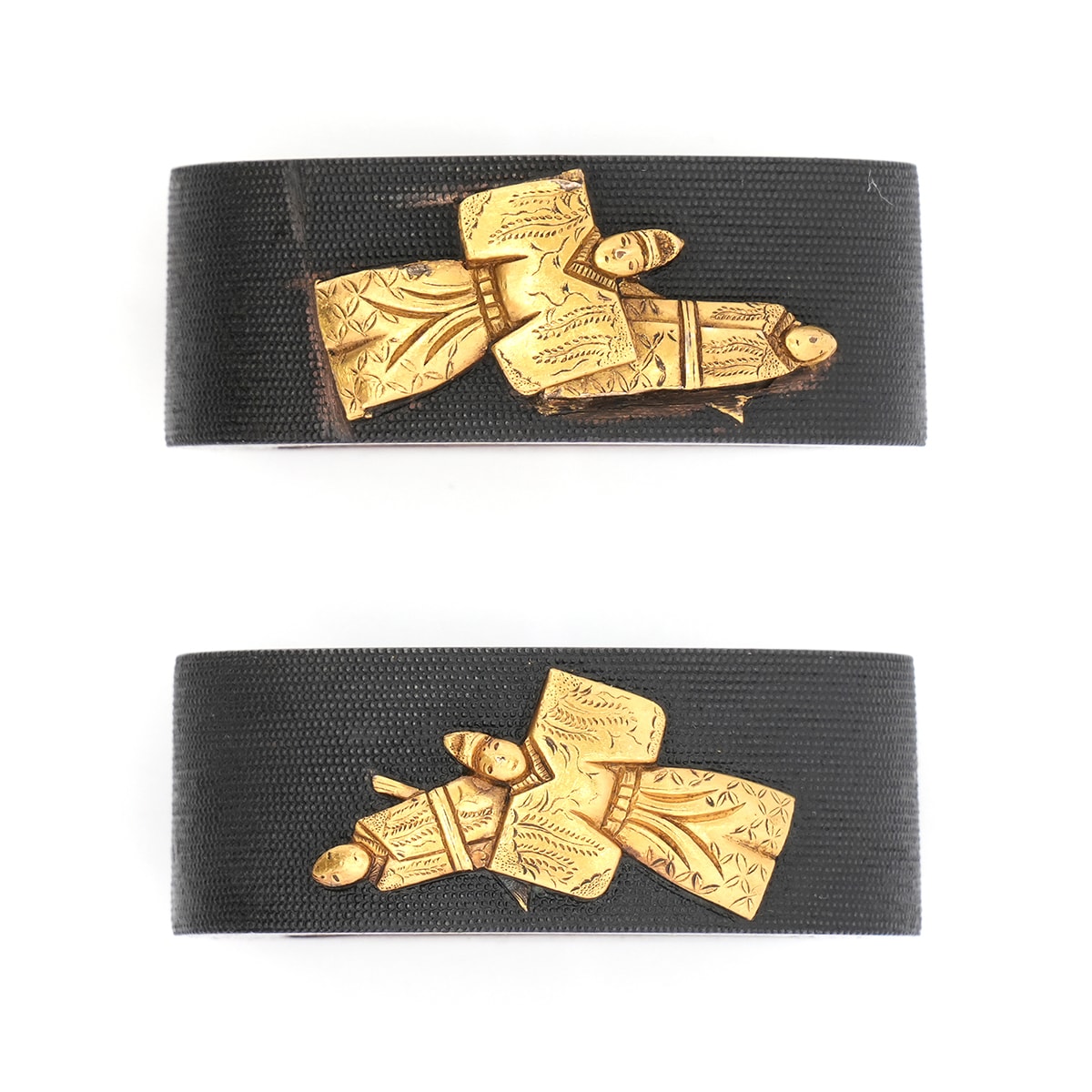
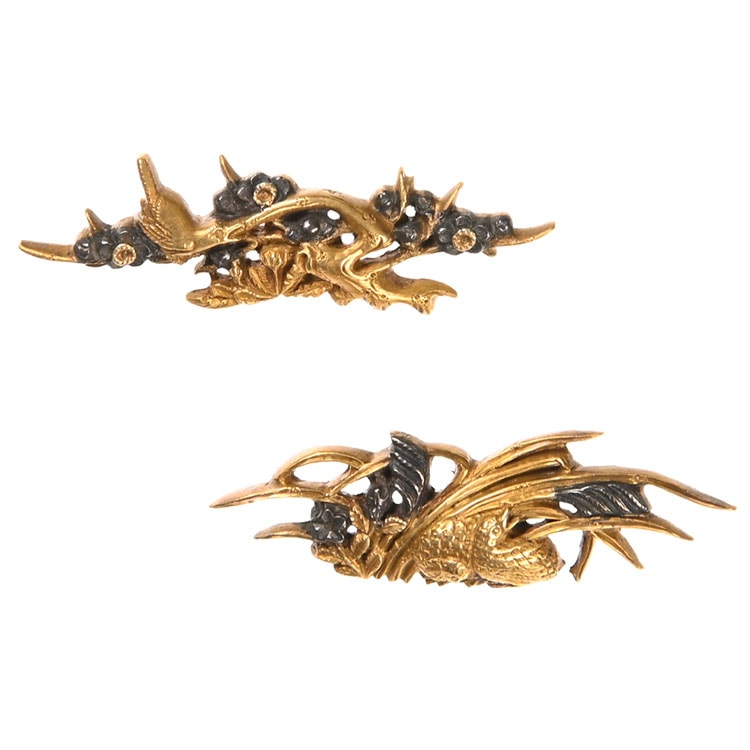
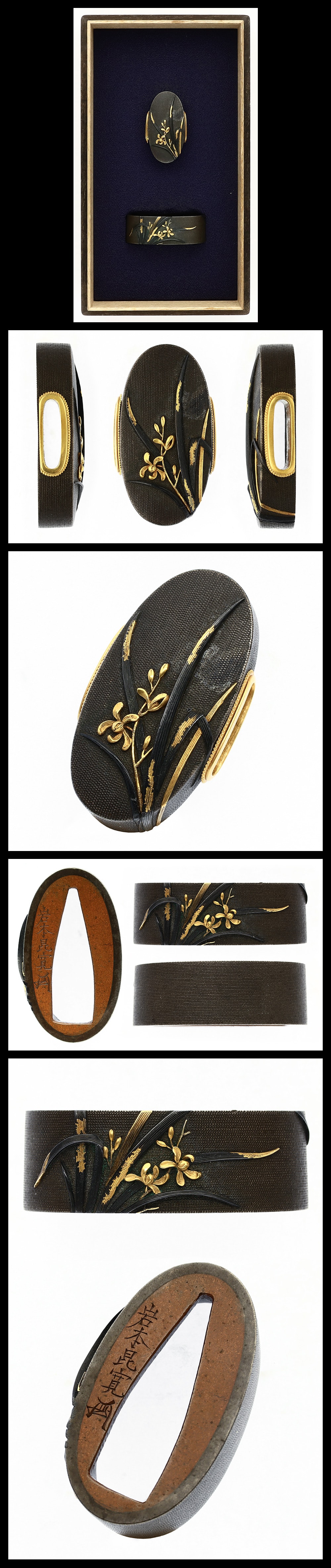
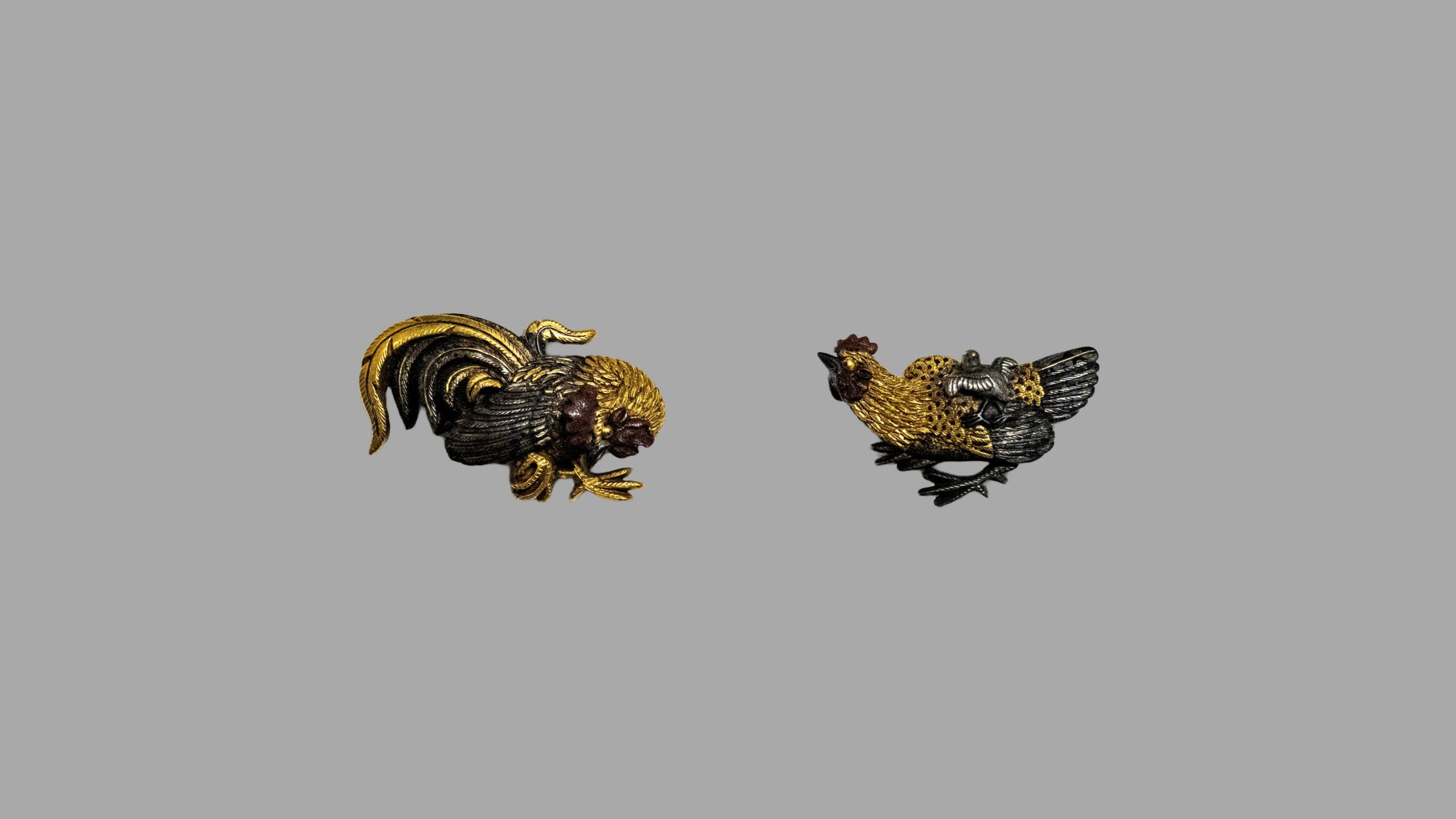
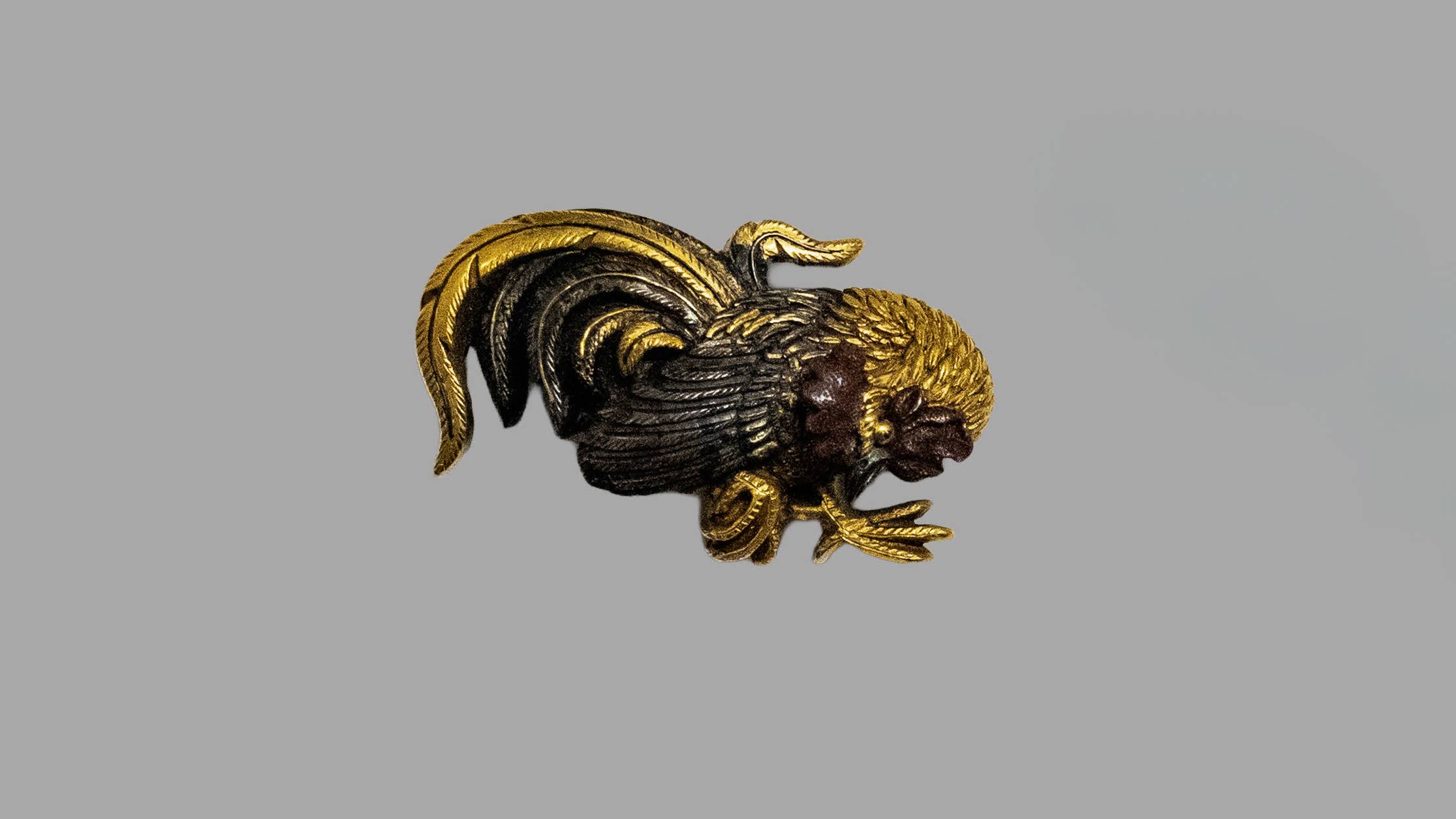
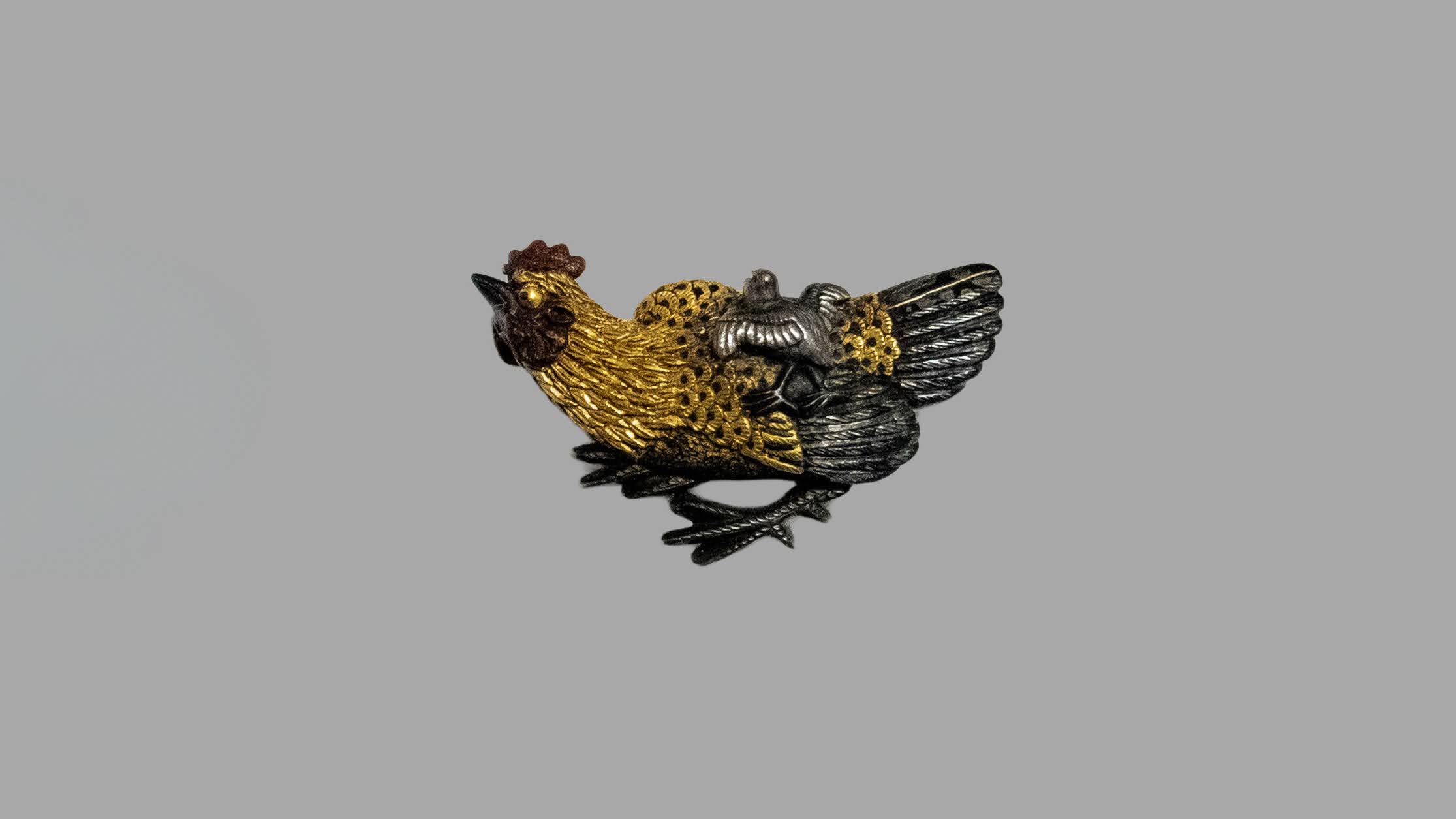
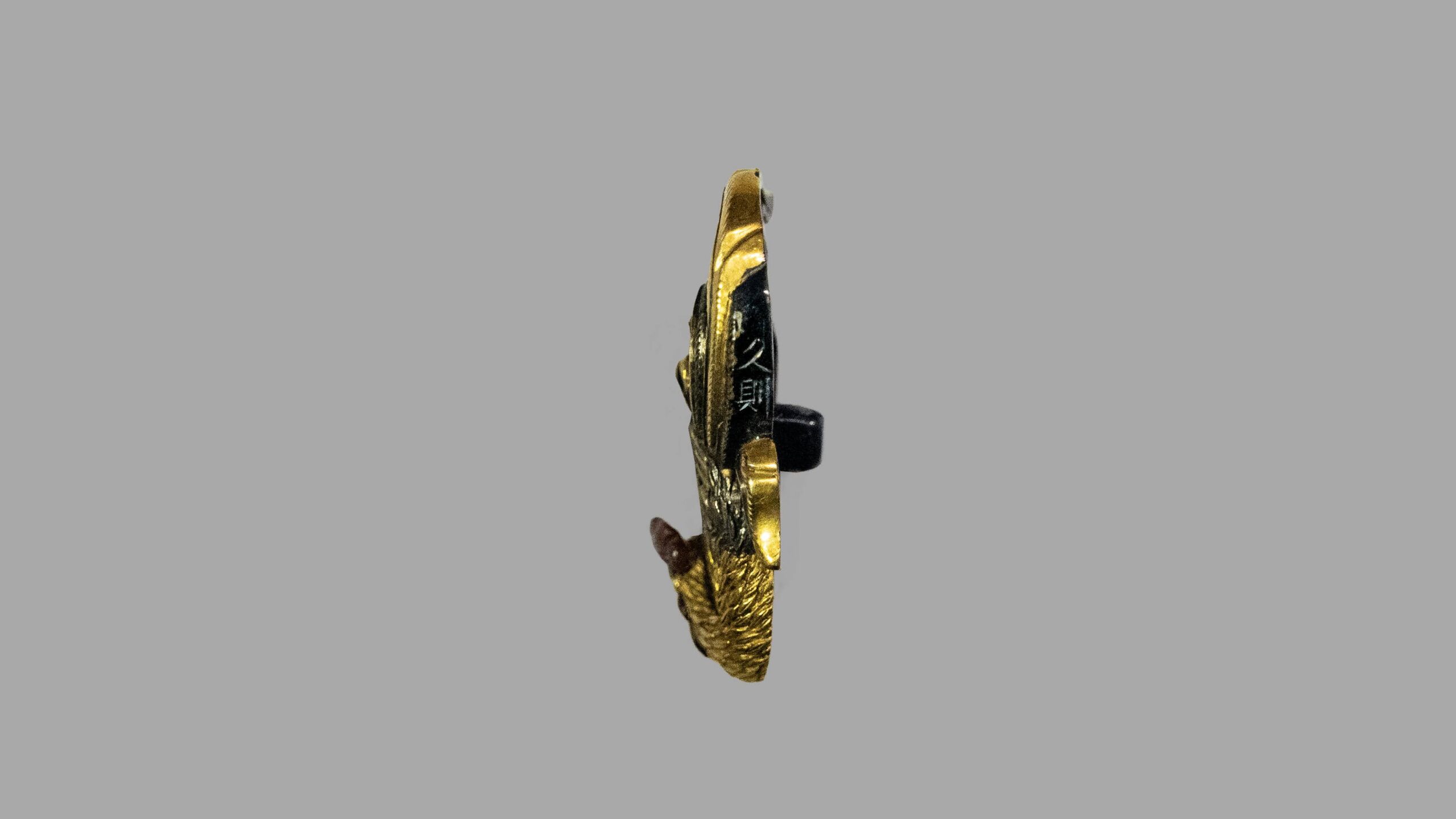
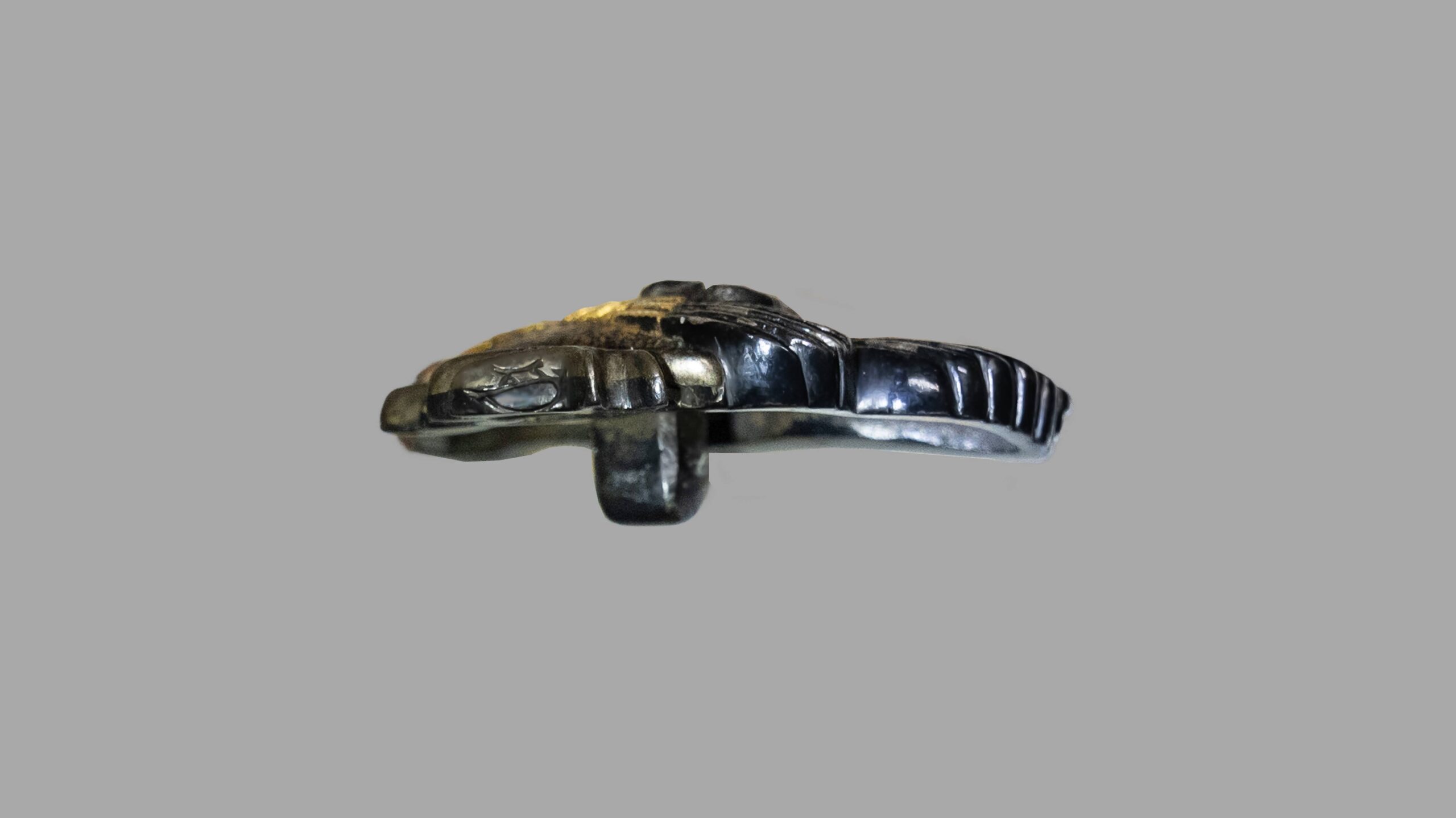
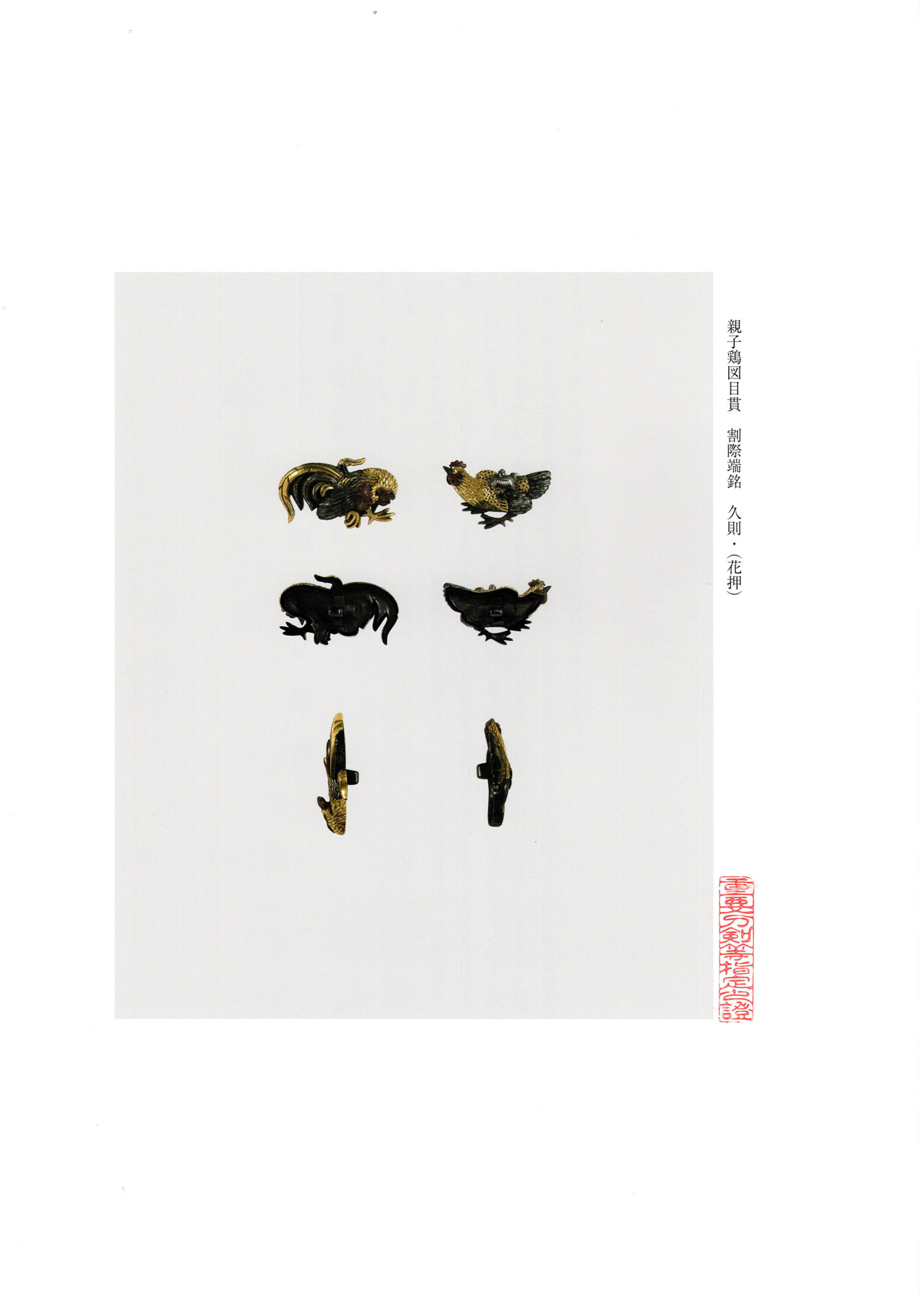
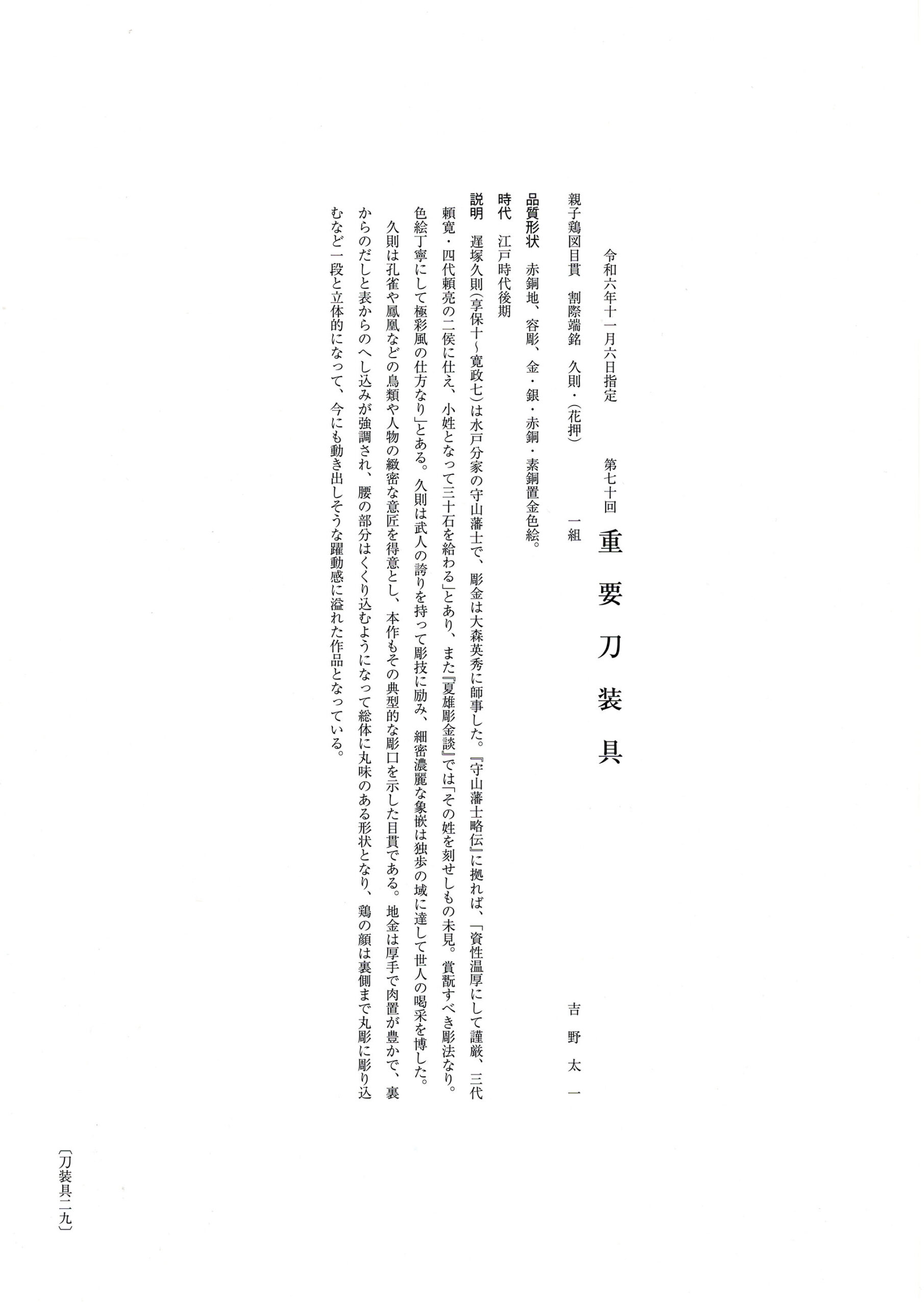
A pair of menuki by Hisanori (1725-1795), a samurai of the Moriyama Domain and student of Omori Teruhide. This piece features a hen and chicks motif, showcasing Hisanori's acclaimed detailed inlay work and exceptional three-dimensionality. It is accompanied by an NBTHK 70th Juyo Tosogu Certificate.
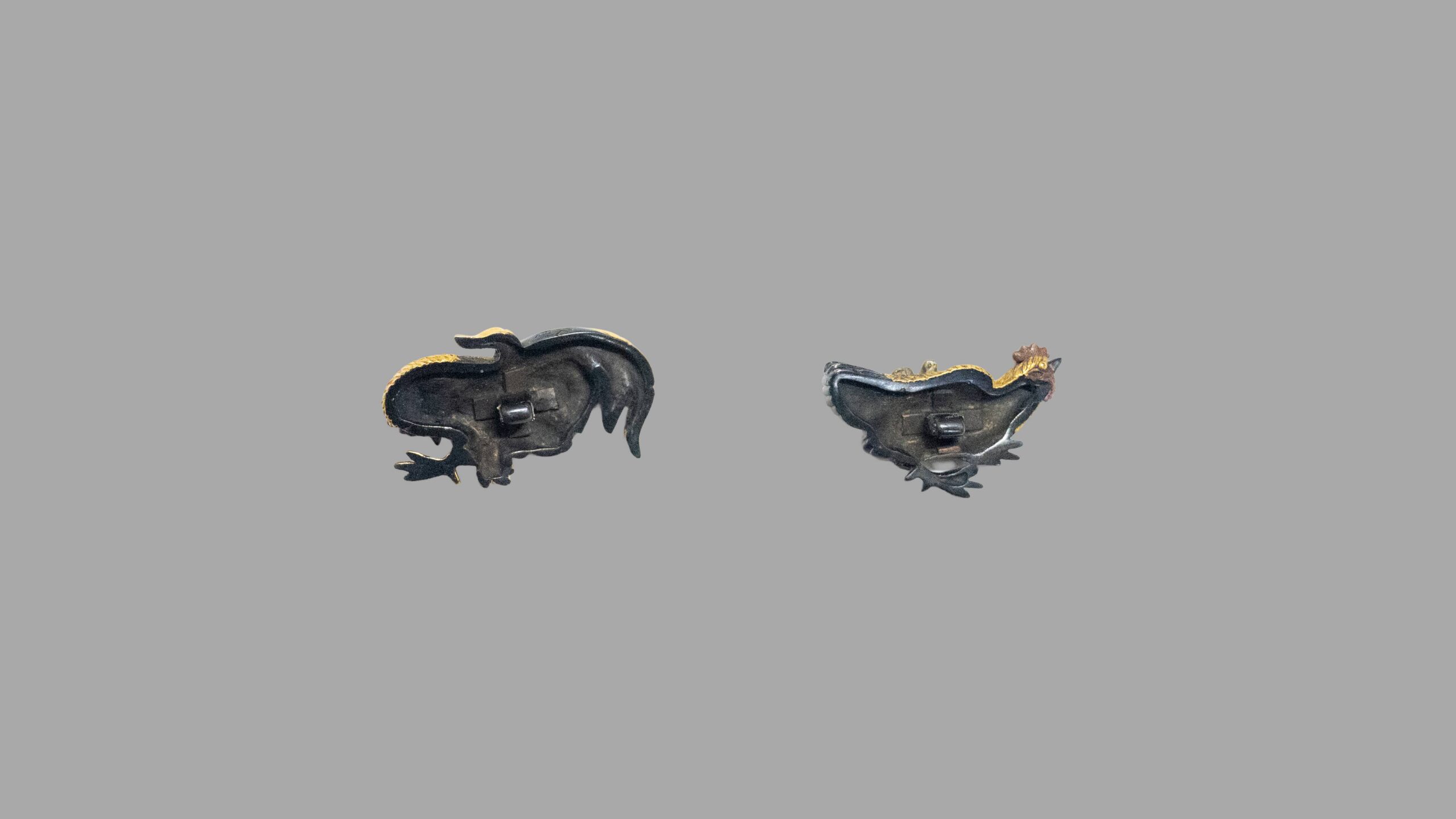
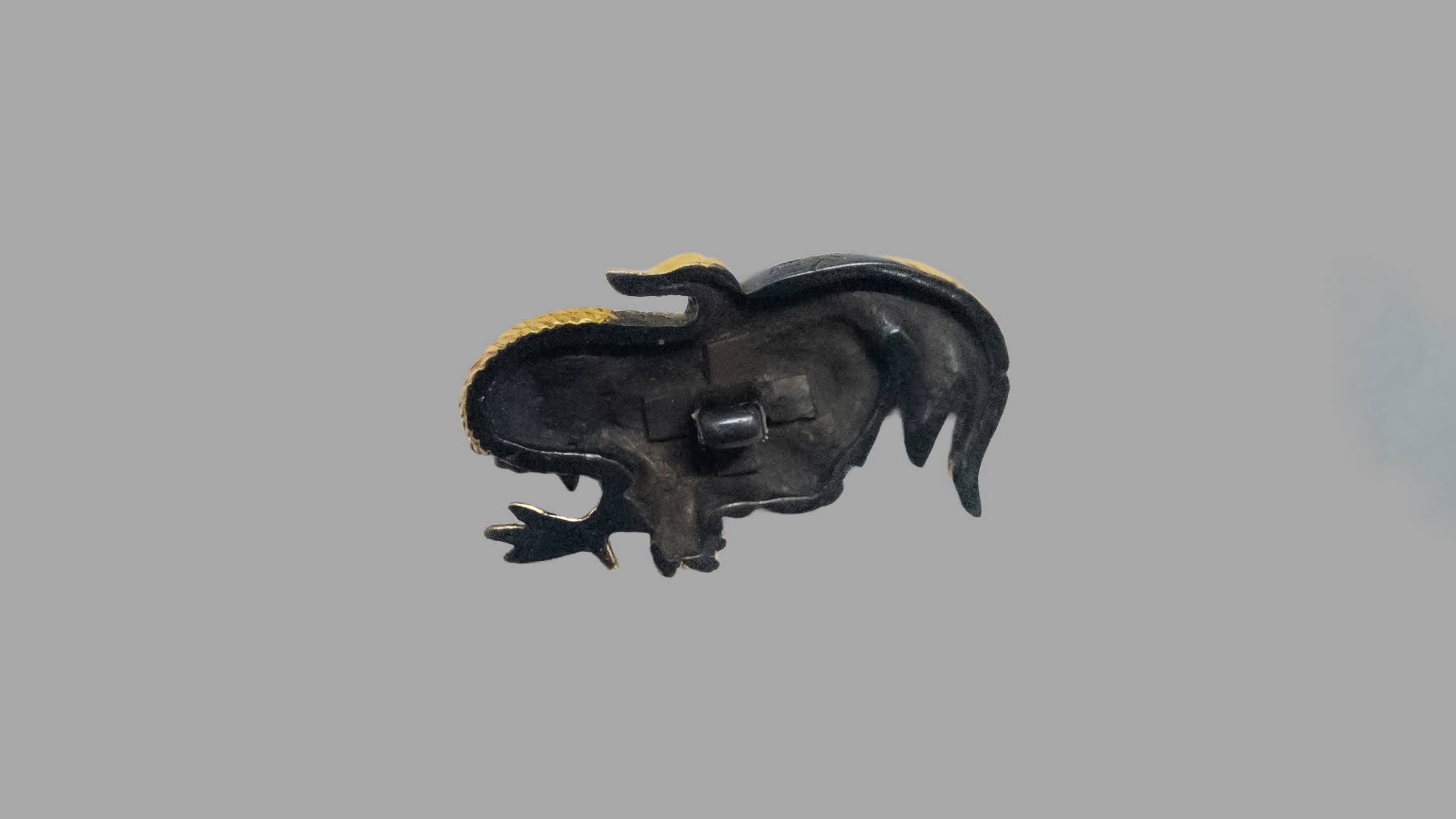
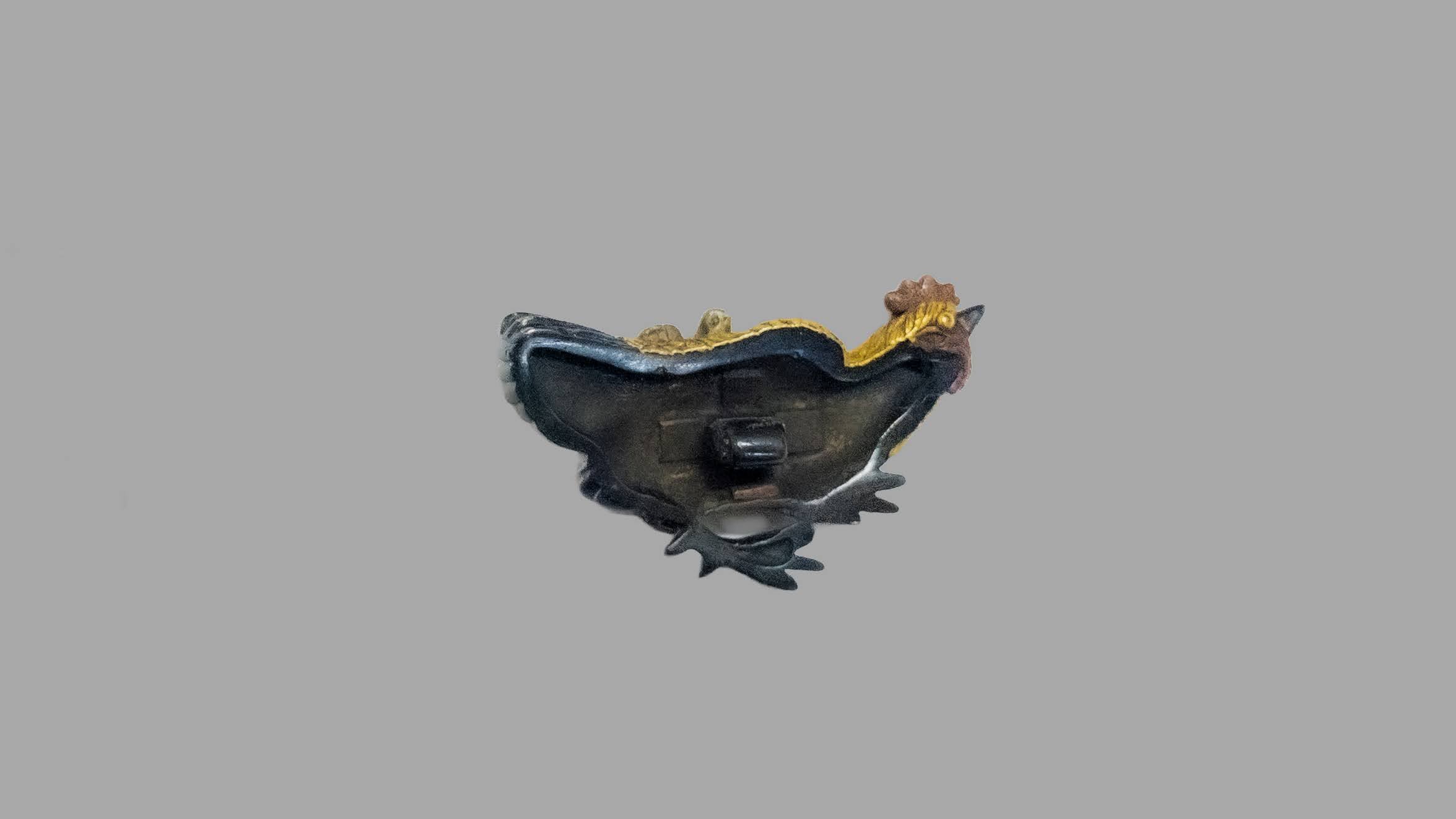
遅塚久則(享保十~寛政七)は水戸分家の守山藩士で、彫金は大森英秀に師事した。『守山藩士略伝』に拠れば、「資性温厚にして謹厳、三代 頼寛・四代頼亮の二侯に仕え、小姓となって三十石を給わる」とあり、また『夏雄彫金談』では「その姓を刻せしもの未見。賞翫すべき彫法なり。 色絵丁寧にして極彩風の仕方なり」とある。久則は武人の誇りを持って彫技に励み、細密濃麗な象嵌は独歩の域に達して世人の喝采を博した。 久則は孔雀や鳳凰などの鳥類や人物の緻密な意匠を得意とし、本作もその典型的な彫口を示した目貫である。地金は厚手で肉置が豊かで、 からのだしと表からのへし込みが強調され、腰の部分はくくり込むようになって総体に丸味のある形状となり、鶏の顔は裏側まで丸彫に彫り込 むなど一段と立体的になって、今にも動き出しそうな躍動感に溢れた作品となっている。
 NihontoWatch
mei · Omori · Kyōhō–Kansei (1725-1795)
Omori Chizuka Hisanori
Kyōhō–Kansei (1725-1795)
Signed
Jūyō #70 (NBTHK)
Machibori · around 1725-1795
1 piece on the market now
Otsuzuka Hisanori (active Kyōhō 10–Kansei 7; 1725–1795) was a samurai retainer of the Moriyama Domain, a cadet line of the Mito Tokugawa house, who studied the art of chōkin (metal carving) under Ōmori Teruhide. According to the Moriyama Hanshi Ryakuden, he was "gentle in disposition and earnest and strict in conduct," serving the third lord Yorihiro and the fourth lord Yoriaki as a page with a stipend of thirty koku[[c:1]]. The Natsuo Chōkin Dan further observes that "I have yet to see a work in which he engraved his family name," noting that his carving methods are "worthy of appreciation" and that his iroe is careful, tending toward "a brilliantly colored style."[[c:2]] Hisanori thus occupied a distinctive position among late Edo period metalworkers: a warrior-artist whose output was shaped by both martial discipline and refined aesthetic sensibility within the Ōmori lineage.
Hisanori devoted himself to metal carving with the pride of a warrior, and his dense, sumptuous iroe inlay reached a singular level that won widespread admiration. He particularly excelled in designs of birds — peacocks and phoenixes — as well as figural subjects such as the Chinese heroes Guan Yu and Zhou Cang. His treatment of menuki is immediately recognizable: the base metal is made thick, the nikuoki (placement of flesh) is full and rounded, the raising from the reverse and the pressing-in from the front are emphatically contrasted, and the "waist" portion tightens as though cinched, producing an overall rounded contour. He further enhanced three-dimensionality by carving avian faces in a manner suggestive of fully rounded sculpture, achieving what the NBTHK describes as "a truly sculptural effect." The iroe employs a wide palette — gold, silver, suaka, and hishoku-dō — applied with minute precision down to the smallest details.
Across his designated works, the NBTHK consistently praises Hisanori's "dense, minute, and lustrous inlay work" as having reached "an individual, unsurpassed level." His pieces are recognized as fully demonstrating "the artist's particular strengths" and his "true strengths," with a "strongly three-dimensional manner rich in mass and presence." His distinctive sculptural conception of the menuki form — thick ground, rounded modeling, cinched waist, and polychrome brilliance — constitutes a coherent personal idiom within the Ōmori school tradition. Hisanori's oeuvre stands as evidence that the samurai-artisan of the late Edo period could achieve technical and expressive heights of the first order in the service of chōkin.
Where Chizuka Hisanori stands among comparable artisans: across all of nihontō, and within tradition, era, and period. The tiers (Foremost · Leading · Major · Notable) weigh official designations from the NBTHK and Japan's Agency for Cultural Affairs, together with historical honors of lasting repute such as the Sansaku and Meibutsu-chō.
Select a lens to see how it's measured.
Machibori · Edo
15 pieces on the market now
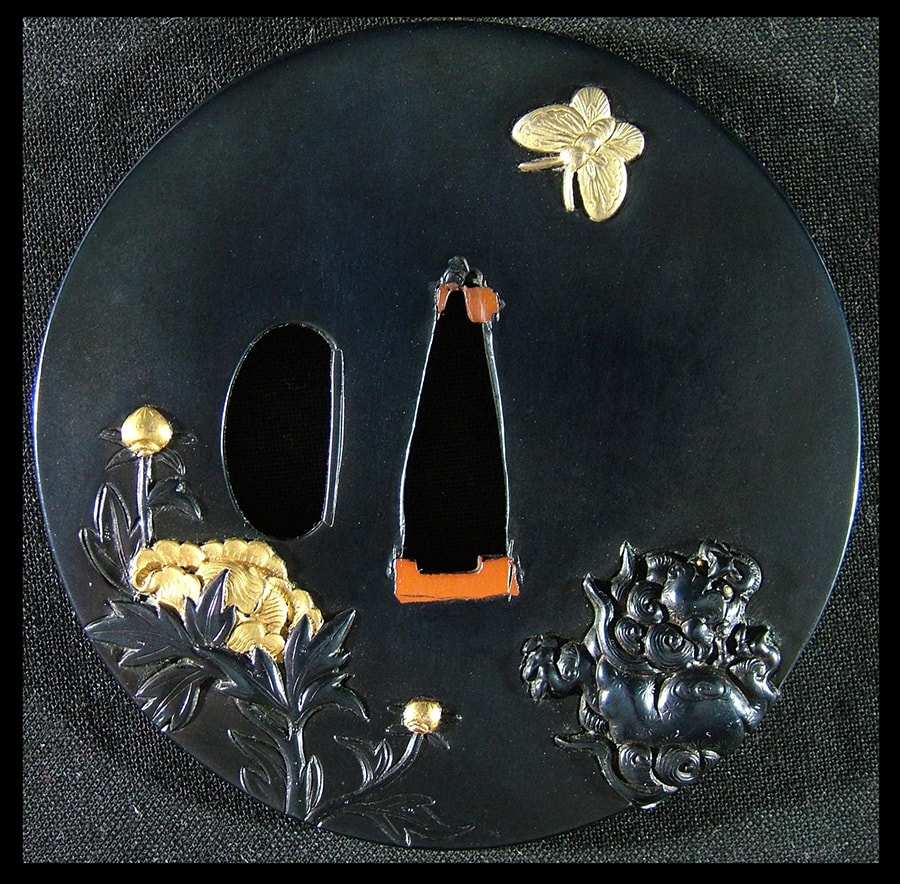
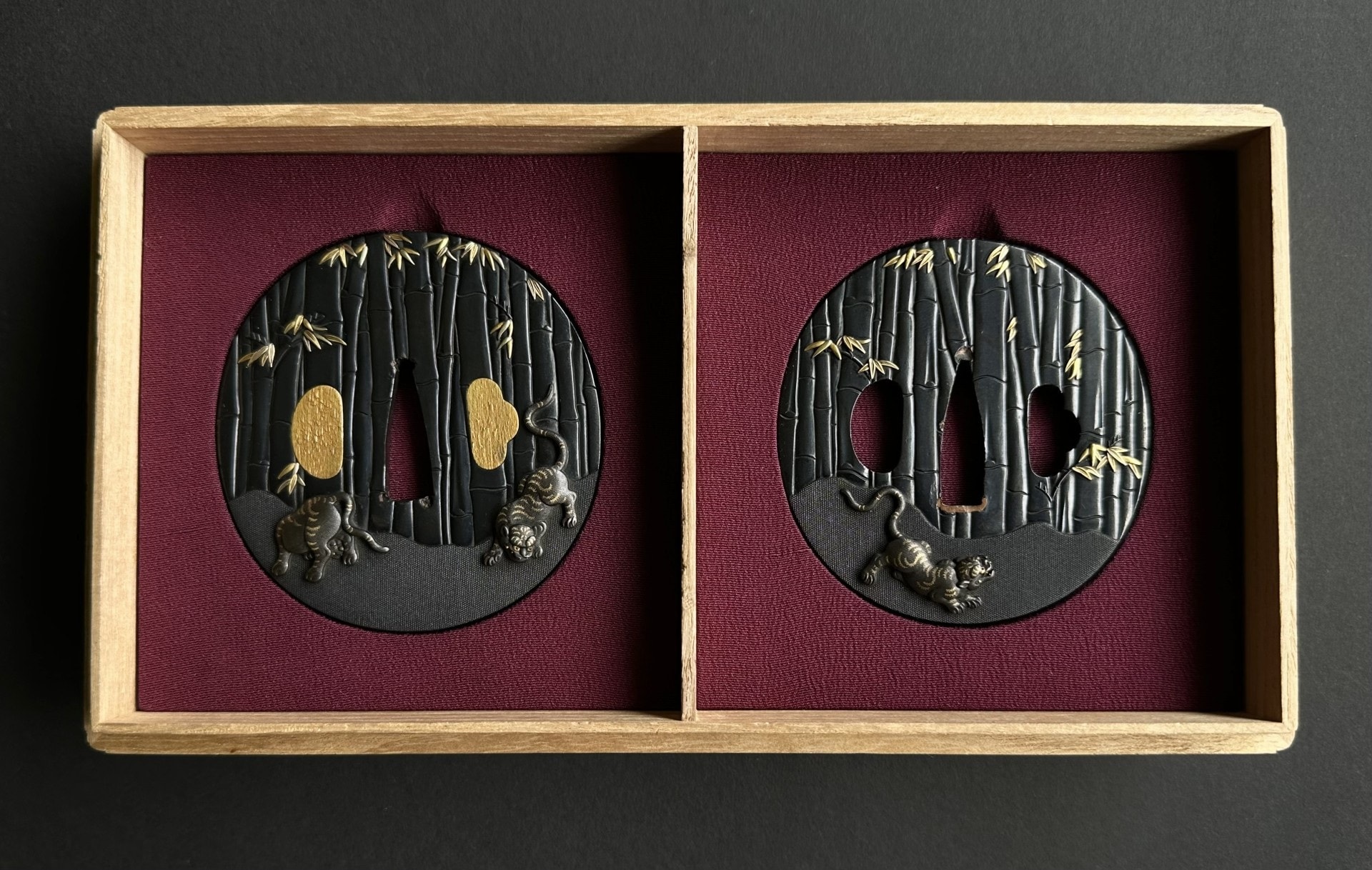
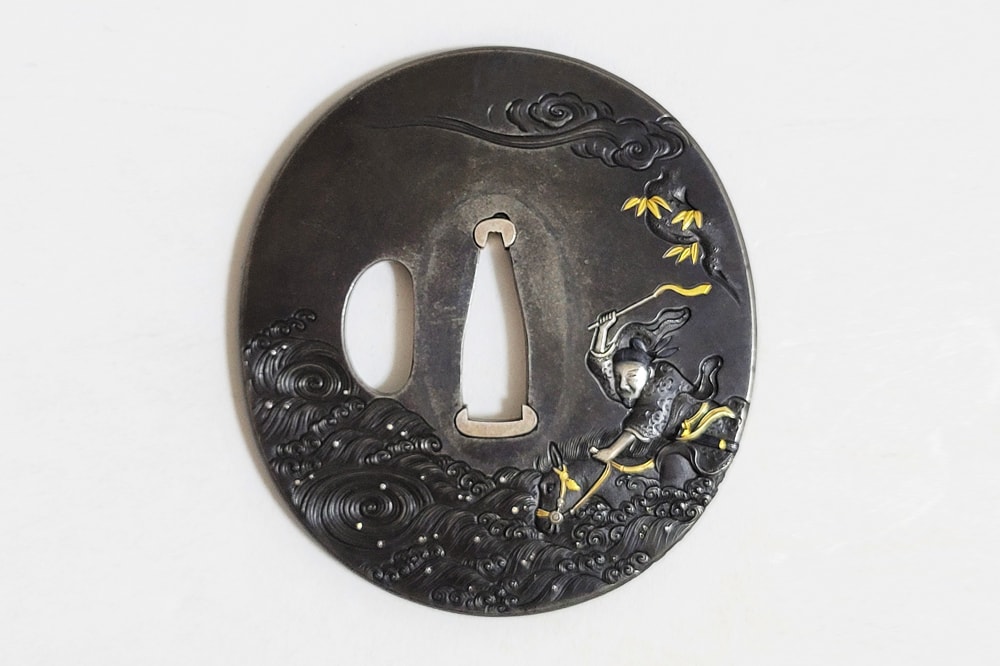
The Ōmori school was one of the great machibori (town-carving) lineages of Edo, founded in the first half of the eighteenth century by Ōmori Terumasa (大森英昌, also read Eishō), a direct disciple of Yokoya Sōmin. " A dated tsuba of Meiwa 7 (1770) anchors his mature activity, and the workshop remained rooted in the shogunal capital throughout its history — his pupil Hidetomo proudly signed works "Tōto, by the Sumida River"[[c:1]]. The headship then passed through Hidenaga to Hidemitsu (英満), Teruhide's fifth son, carrying the line deep into the late Edo period. " Its defining invention is the strikingly three-dimensional wave design known as Ōmori-nami (大森浪), the "Ōmori waves," together with sunago-zōgan gold-dust inlay executed in the kinkeshi manner and the flush gold inlay evocative of maki-e lacquer called nashiji-zōgan or chirigami-zōgan — techniques devised, the setsumei state, to heighten the elegant, courtly taste of the work. The judges single out "the weighty takabori carving characteristic of the Ōmori style," deployed across a repertoire spanning peony-and-shishi compositions, birds of prey amid rising sun and surging waves, tigers in bamboo, waves with myriad fish (uozukushi), the vanguard crossing of the Uji River, Fan Kuai at the Banquet at Hongmen, and the treasure ship of the Seven Lucky Gods.
Later generations show measured evolution: Hidemitsu "preserved the carving methods of his forebears while accepting changes in contemporary taste," turning also to iron ishime-ji grounds in sukidashi-bori and collaborating with the painter Kanō Dōhaku Aishin, whose preparatory drawings attest to exchange with the painting ateliers of the day; substitute works (daisaku) by his disciple Ōmori Mitsutoki under the master's signature reveal a flourishing workshop practice. The school's standing is confirmed at the highest levels of patronage: a ceremonial hosodachi mounting transmitted in the Ii family of Hikone, its entire suite of fittings by Teruhide with the clan's tachibana crest in takabori and gold iroe, documents the Ōmori masters as makers of daimyo ceremonial equipment. From the atelier radiated an exceptionally influential teaching lineage: Hidetomo (Ryūrinsai Ōmori Sadabei), recorded in the Kōto Kinkō Meifu as "a foremost disciple of Teruhide"; the Mito-branch Moriyama retainer Otsuzuka Hisanori, whose "dense, richly wrought inlay reached a uniquely individual realm" and drew praise in the Natsuo Chōkin-dan; Horie Kōsei, who entered the Ōmori school after Hamano Masayuki's death and later, as retained craftsman of the Hachisuka family of Awa, "trained many pupils of his own school"; and Izumi Hidetoshi, who studied under both Teruhide and Hidetomo. Through these channels the Ōmori manner — above all its sculptural waves and sumptuous relief — passed into the broader current of late-Edo machibori metalwork, securing the school's place as one of the most powerful branches of the Yokoya tradition in the tosogu canon. Learn more →
| Smith | Era | Designated |
|---|---|---|
| Teruhide英秀 | — | 15 |
| Chizuka Hisanori遅塚久則 | 1725-1795 | 9 |
| Horie Okinari堀江興成 | — | 7 |
| Terumitsu英満 | — | 4 |
| Horie Okiyoshi堀江興吉 | 1670 | 1 |
Exceptional craft of very high artistic value, judged to rank with a nationally recognized Important Art Object (Jūyō Bijutsuhin).
The NBTHK (Nihon Bijutsu Tōken Hozon Kyōkai, the Society for the Preservation of Japanese Art Swords) is a public-interest incorporated foundation founded in 1948 and supervised by Japan’s Agency for Cultural Affairs (Bunkachō); it is based at the Japanese Sword Museum in Tokyo. Its expert panels physically examine each submitted work (shinsa) and issue a certificate (kanteishō) ranking it by artistic and historical merit. NBTHK papers are the most widely recognized standard of authentication for Japanese swords and fittings.
NBTHK official siteReturns accepted within 7 days of receipt (JP terms; EN page states 3 days). Customer must contact within the window and return at own cost. Refund after items confirmed in original condition; repair fees charged if damage occurs.
Price on request
A pair of menuki by Hisanori (1725-1795), a samurai of the Moriyama Domain and student of Omori Teruhide. This piece features a hen and chicks motif, showcasing Hisanori's acclaimed detailed inlay work and exceptional three-dimensionality. It is accompanied by an NBTHK 70th Juyo Tosogu Certificate.
遅塚久則(享保十~寛政七)は水戸分家の守山藩士で、彫金は大森英秀に師事した。『守山藩士略伝』に拠れば、「資性温厚にして謹厳、三代 頼寛・四代頼亮の二侯に仕え、小姓となって三十石を給わる」とあり、また『夏雄彫金談』では「その姓を刻せしもの未見。賞翫すべき彫法なり。 色絵丁寧にして極彩風の仕方なり」とある。久則は武人の誇りを持って彫技に励み、細密濃麗な象嵌は独歩の域に達して世人の喝采を博した。 久則は孔雀や鳳凰などの鳥類や人物の緻密な意匠を得意とし、本作もその典型的な彫口を示した目貫である。地金は厚手で肉置が豊かで、 からのだしと表からのへし込みが強調され、腰の部分はくくり込むようになって総体に丸味のある形状となり、鶏の顔は裏側まで丸彫に彫り込 むなど一段と立体的になって、今にも動き出しそうな躍動感に溢れた作品となっている。
NihontoWatchmei · Omori · Kyōhō–Kansei (1725-1795)
Omori Chizuka Hisanori
Kyōhō–Kansei (1725-1795)
Signed
Jūyō #70 (NBTHK)
Machibori · around 1725-1795
1 piece on the market now
Otsuzuka Hisanori (active Kyōhō 10–Kansei 7; 1725–1795) was a samurai retainer of the Moriyama Domain, a cadet line of the Mito Tokugawa house, who studied the art of chōkin (metal carving) under Ōmori Teruhide. According to the Moriyama Hanshi Ryakuden, he was "gentle in disposition and earnest and strict in conduct," serving the third lord Yorihiro and the fourth lord Yoriaki as a page with a stipend of thirty koku[[c:1]]. The Natsuo Chōkin Dan further observes that "I have yet to see a work in which he engraved his family name," noting that his carving methods are "worthy of appreciation" and that his iroe is careful, tending toward "a brilliantly colored style."[[c:2]] Hisanori thus occupied a distinctive position among late Edo period metalworkers: a warrior-artist whose output was shaped by both martial discipline and refined aesthetic sensibility within the Ōmori lineage.
Hisanori devoted himself to metal carving with the pride of a warrior, and his dense, sumptuous iroe inlay reached a singular level that won widespread admiration. He particularly excelled in designs of birds — peacocks and phoenixes — as well as figural subjects such as the Chinese heroes Guan Yu and Zhou Cang. His treatment of menuki is immediately recognizable: the base metal is made thick, the nikuoki (placement of flesh) is full and rounded, the raising from the reverse and the pressing-in from the front are emphatically contrasted, and the "waist" portion tightens as though cinched, producing an overall rounded contour. He further enhanced three-dimensionality by carving avian faces in a manner suggestive of fully rounded sculpture, achieving what the NBTHK describes as "a truly sculptural effect." The iroe employs a wide palette — gold, silver, suaka, and hishoku-dō — applied with minute precision down to the smallest details.
Across his designated works, the NBTHK consistently praises Hisanori's "dense, minute, and lustrous inlay work" as having reached "an individual, unsurpassed level." His pieces are recognized as fully demonstrating "the artist's particular strengths" and his "true strengths," with a "strongly three-dimensional manner rich in mass and presence." His distinctive sculptural conception of the menuki form — thick ground, rounded modeling, cinched waist, and polychrome brilliance — constitutes a coherent personal idiom within the Ōmori school tradition. Hisanori's oeuvre stands as evidence that the samurai-artisan of the late Edo period could achieve technical and expressive heights of the first order in the service of chōkin.
Where Chizuka Hisanori stands among comparable artisans: across all of nihontō, and within tradition, era, and period. The tiers (Foremost · Leading · Major · Notable) weigh official designations from the NBTHK and Japan's Agency for Cultural Affairs, together with historical honors of lasting repute such as the Sansaku and Meibutsu-chō.
Select a lens to see how it's measured.
Machibori · Edo
15 pieces on the market now
The Ōmori school was one of the great machibori (town-carving) lineages of Edo, founded in the first half of the eighteenth century by Ōmori Terumasa (大森英昌, also read Eishō), a direct disciple of Yokoya Sōmin. " A dated tsuba of Meiwa 7 (1770) anchors his mature activity, and the workshop remained rooted in the shogunal capital throughout its history — his pupil Hidetomo proudly signed works "Tōto, by the Sumida River"[[c:1]]. The headship then passed through Hidenaga to Hidemitsu (英満), Teruhide's fifth son, carrying the line deep into the late Edo period. " Its defining invention is the strikingly three-dimensional wave design known as Ōmori-nami (大森浪), the "Ōmori waves," together with sunago-zōgan gold-dust inlay executed in the kinkeshi manner and the flush gold inlay evocative of maki-e lacquer called nashiji-zōgan or chirigami-zōgan — techniques devised, the setsumei state, to heighten the elegant, courtly taste of the work. The judges single out "the weighty takabori carving characteristic of the Ōmori style," deployed across a repertoire spanning peony-and-shishi compositions, birds of prey amid rising sun and surging waves, tigers in bamboo, waves with myriad fish (uozukushi), the vanguard crossing of the Uji River, Fan Kuai at the Banquet at Hongmen, and the treasure ship of the Seven Lucky Gods.
Later generations show measured evolution: Hidemitsu "preserved the carving methods of his forebears while accepting changes in contemporary taste," turning also to iron ishime-ji grounds in sukidashi-bori and collaborating with the painter Kanō Dōhaku Aishin, whose preparatory drawings attest to exchange with the painting ateliers of the day; substitute works (daisaku) by his disciple Ōmori Mitsutoki under the master's signature reveal a flourishing workshop practice. The school's standing is confirmed at the highest levels of patronage: a ceremonial hosodachi mounting transmitted in the Ii family of Hikone, its entire suite of fittings by Teruhide with the clan's tachibana crest in takabori and gold iroe, documents the Ōmori masters as makers of daimyo ceremonial equipment. From the atelier radiated an exceptionally influential teaching lineage: Hidetomo (Ryūrinsai Ōmori Sadabei), recorded in the Kōto Kinkō Meifu as "a foremost disciple of Teruhide"; the Mito-branch Moriyama retainer Otsuzuka Hisanori, whose "dense, richly wrought inlay reached a uniquely individual realm" and drew praise in the Natsuo Chōkin-dan; Horie Kōsei, who entered the Ōmori school after Hamano Masayuki's death and later, as retained craftsman of the Hachisuka family of Awa, "trained many pupils of his own school"; and Izumi Hidetoshi, who studied under both Teruhide and Hidetomo. Through these channels the Ōmori manner — above all its sculptural waves and sumptuous relief — passed into the broader current of late-Edo machibori metalwork, securing the school's place as one of the most powerful branches of the Yokoya tradition in the tosogu canon. Learn more →
| Smith | Era | Designated |
|---|---|---|
| Teruhide英秀 | — | 15 |
| Chizuka Hisanori遅塚久則 | 1725-1795 | 9 |
| Horie Okinari堀江興成 | — | 7 |
| Terumitsu英満 | — | 4 |
| Horie Okiyoshi堀江興吉 | 1670 | 1 |
Exceptional craft of very high artistic value, judged to rank with a nationally recognized Important Art Object (Jūyō Bijutsuhin).
The NBTHK (Nihon Bijutsu Tōken Hozon Kyōkai, the Society for the Preservation of Japanese Art Swords) is a public-interest incorporated foundation founded in 1948 and supervised by Japan’s Agency for Cultural Affairs (Bunkachō); it is based at the Japanese Sword Museum in Tokyo. Its expert panels physically examine each submitted work (shinsa) and issue a certificate (kanteishō) ranking it by artistic and historical merit. NBTHK papers are the most widely recognized standard of authentication for Japanese swords and fittings.
NBTHK official siteReturns accepted within 7 days of receipt (JP terms; EN page states 3 days). Customer must contact within the window and return at own cost. Refund after items confirmed in original condition; repair fees charged if damage occurs.
Price on request