NihontoWatch Mon

NihontoWatch

Market
Encyclopedia
Kantei
NihontoWatch Mon

NihontoWatch

Market
Encyclopedia
Kantei

Description

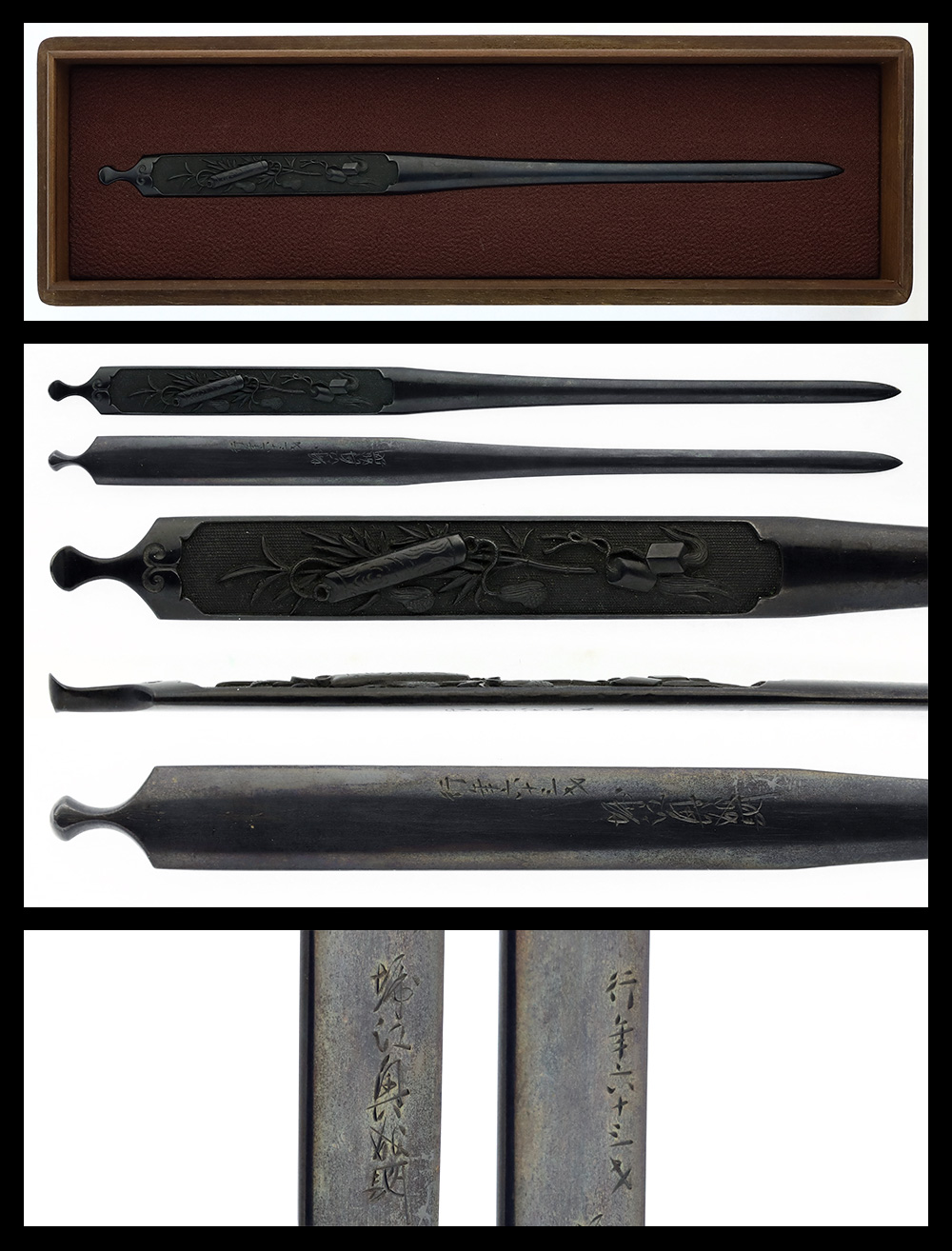
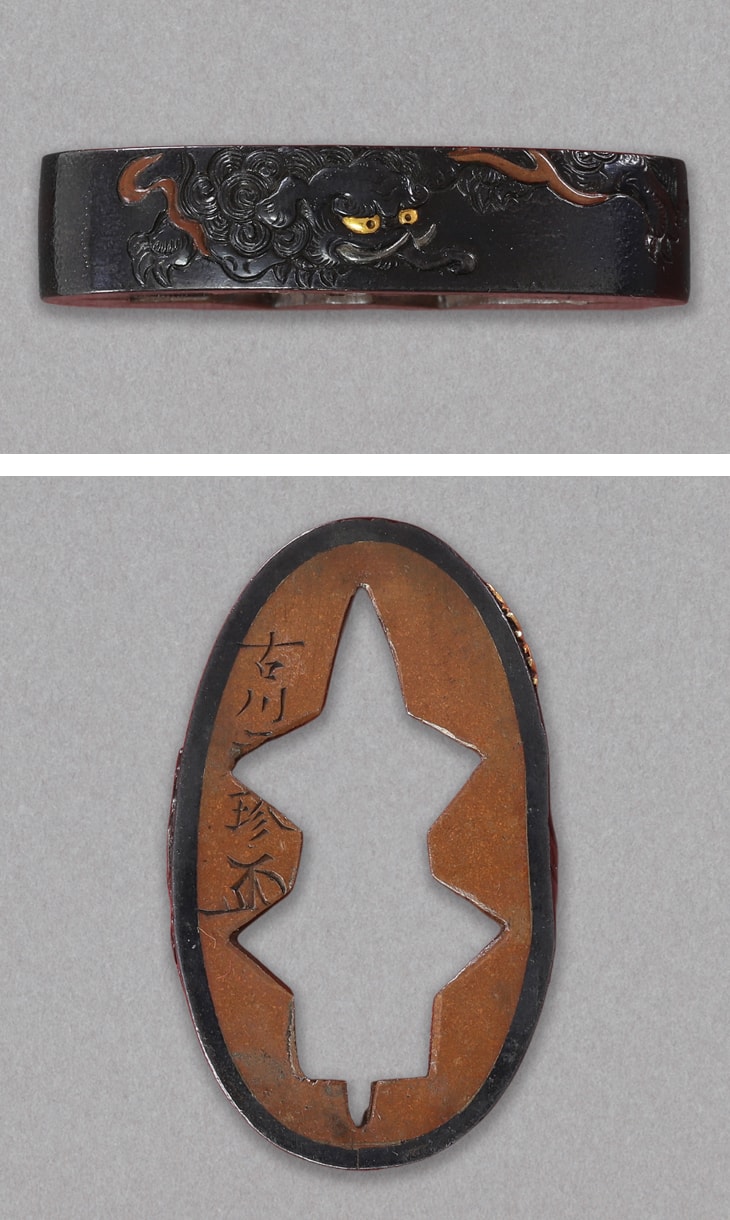
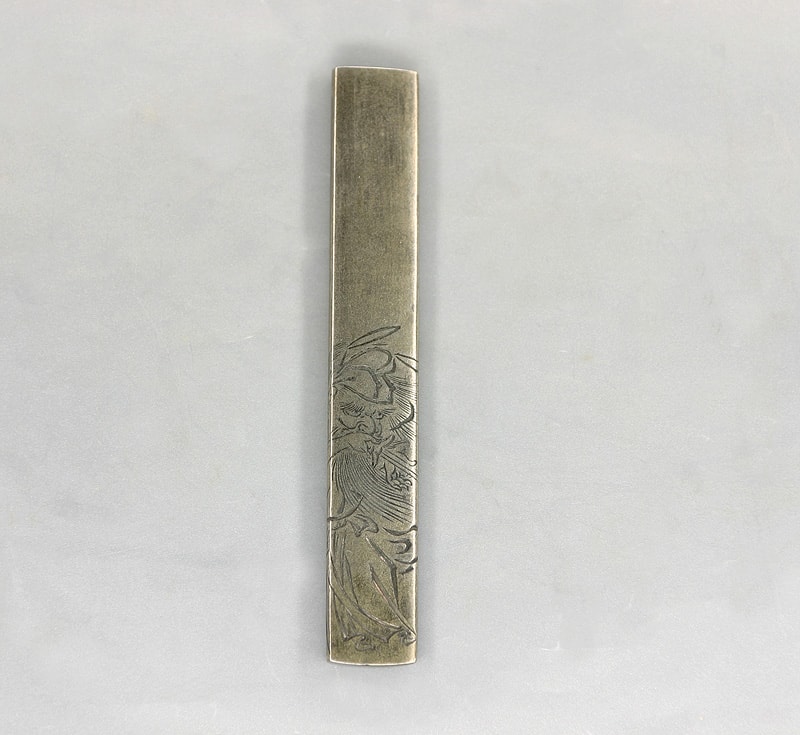
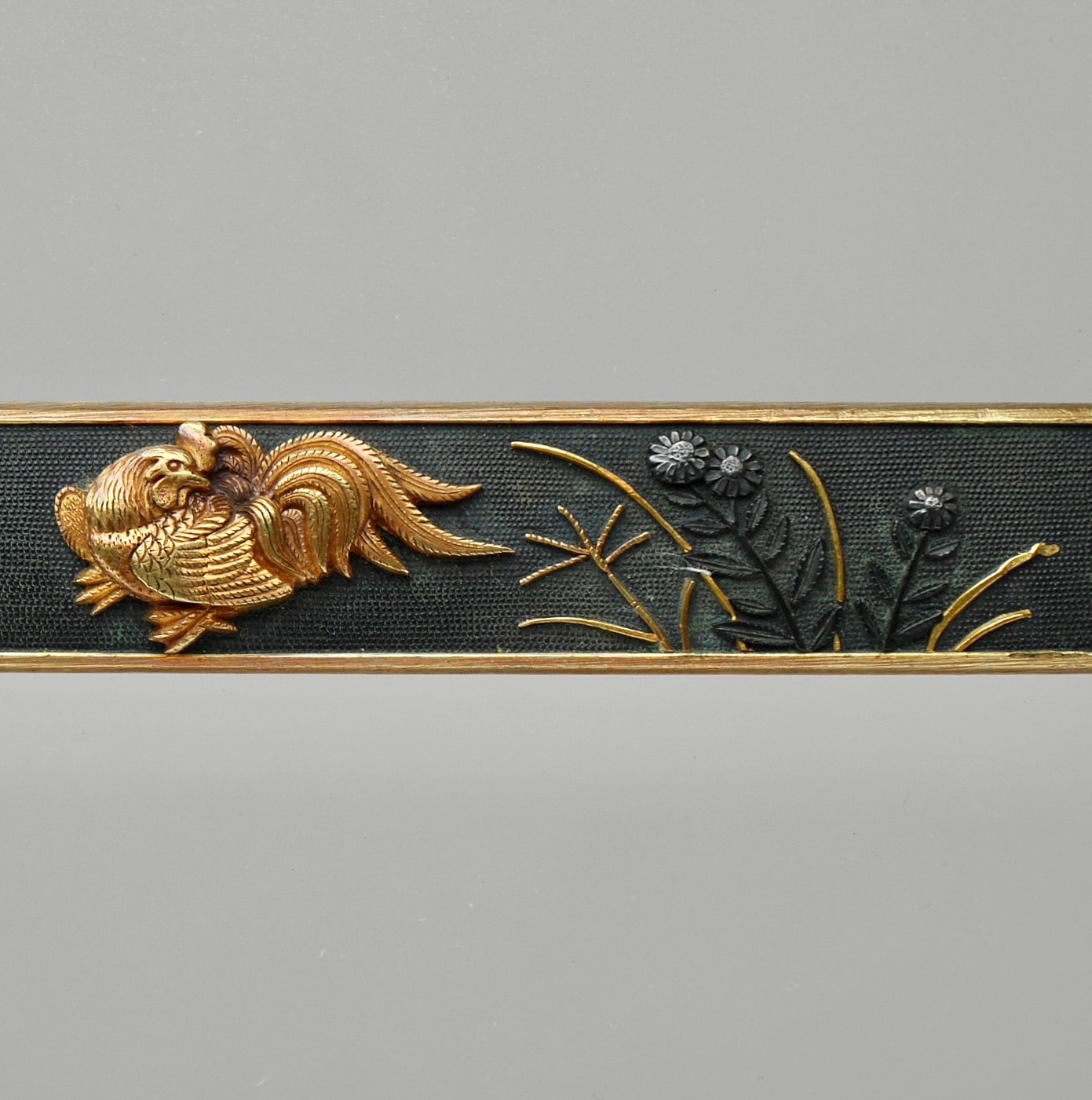
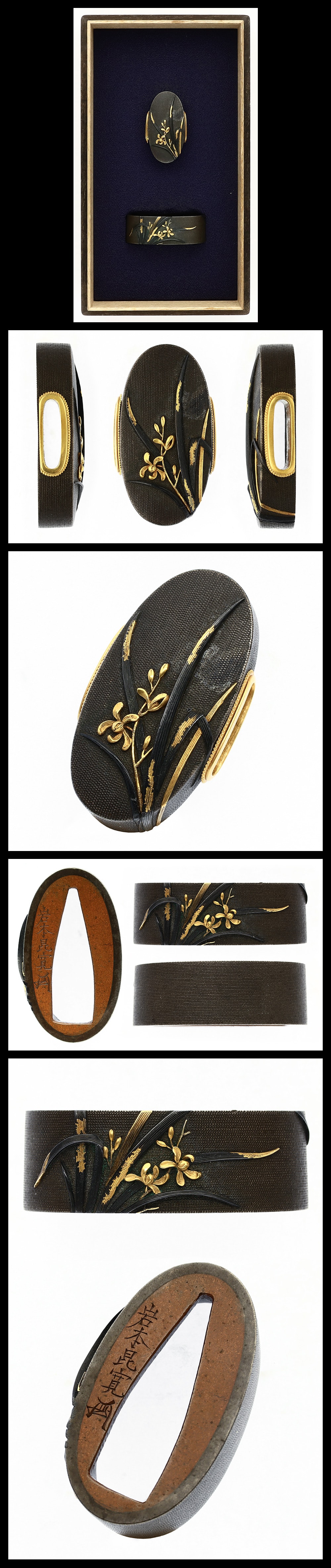
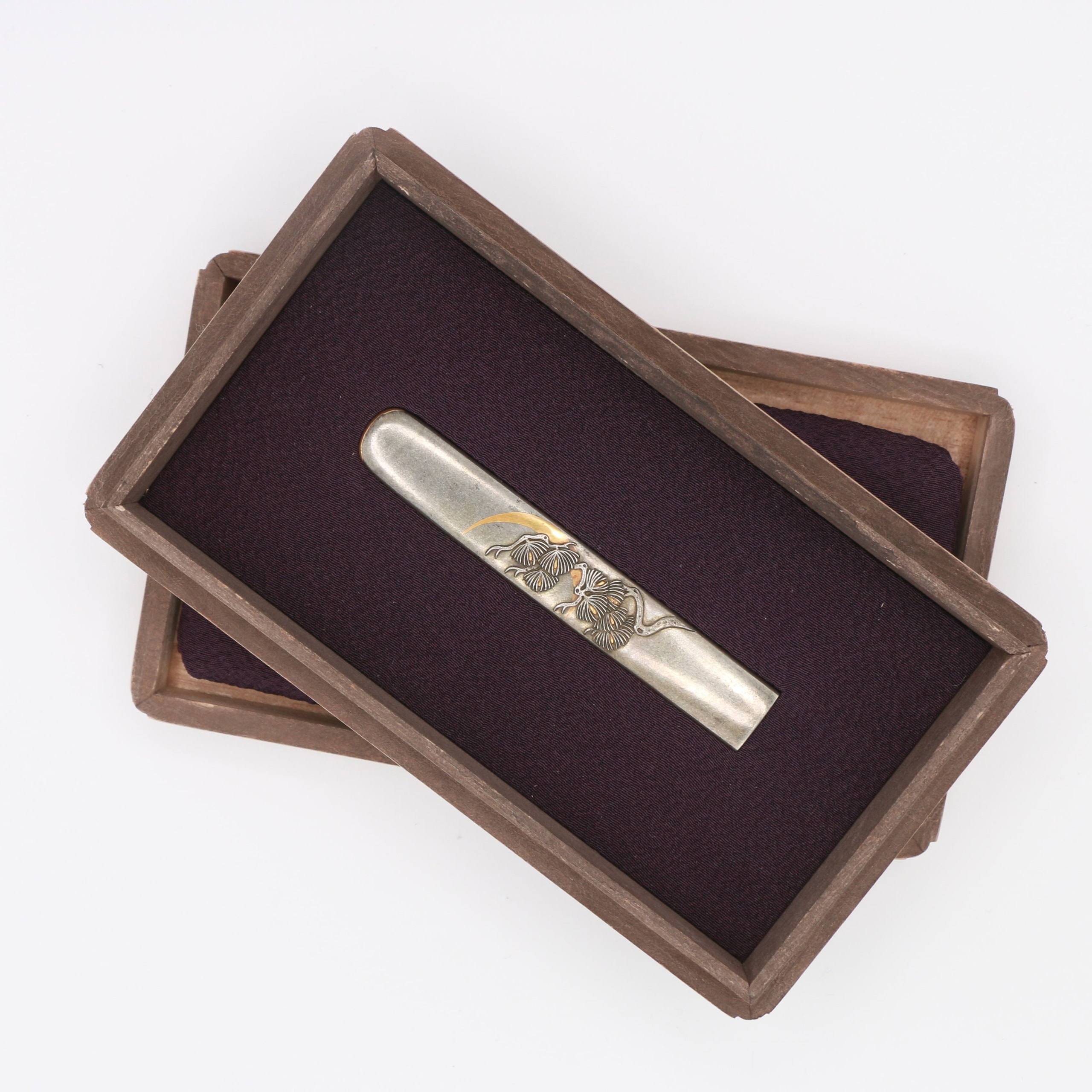
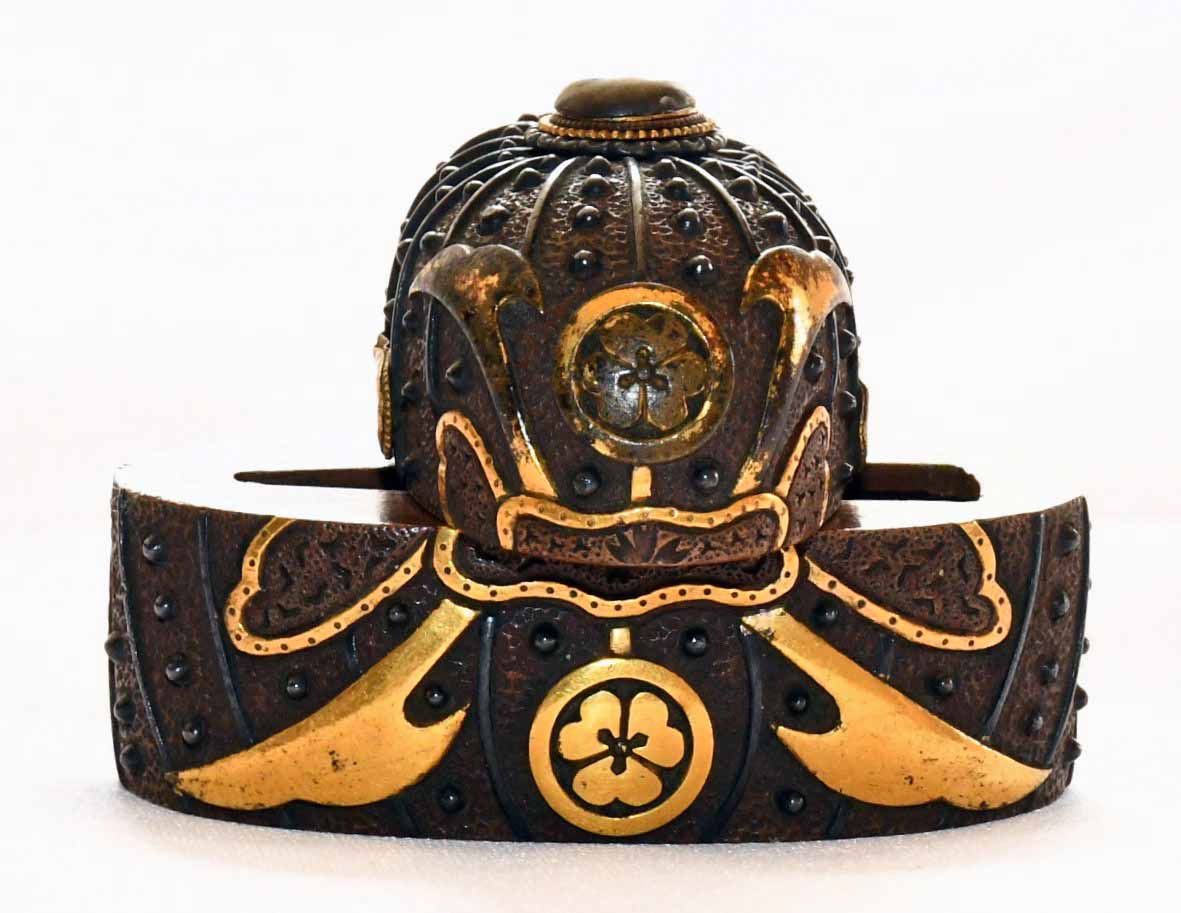
This kogai, made by Horie Okinari, features a kake-mamori design in high relief on a shakudō nanako ground. Horie Okinari was a late Edo-period metalsmith who studied under prominent masters and served the Hachisuka family. The piece is distinguished by its elegant design and superb, delicately executed carving, and comes with an NBTHK Hozon Tosogu certificate.

Certificate Reading

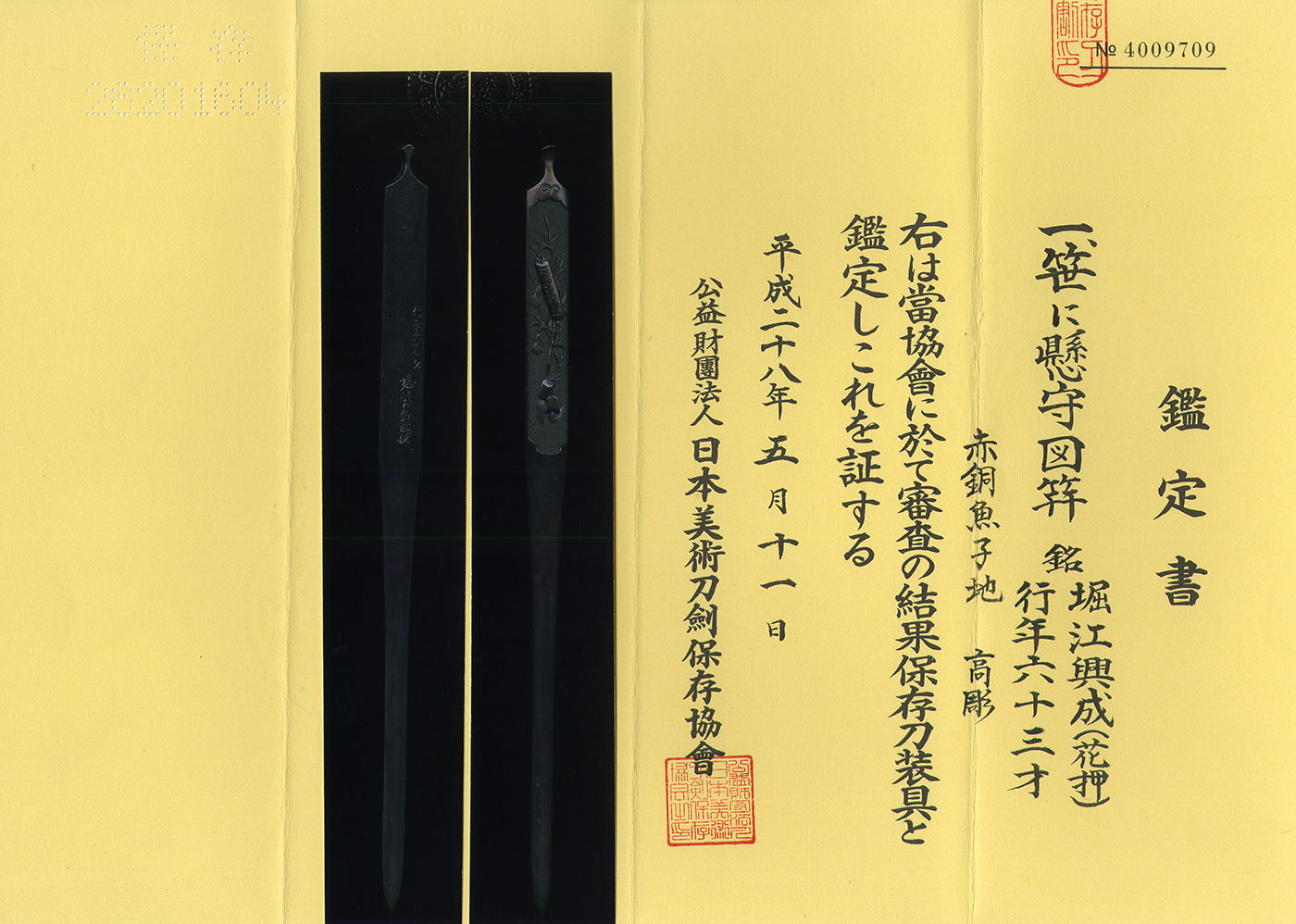
Certificate reading — 銘 堀江興成(花押) 行年六十三才

NihontoWatch MonNihontoWatch
MarketEncyclopediaKantei
Fittings›Machibori›Yokoya›Omori›Horie Okinari›Kogai: Horie Okinari (written seal mark, age of 63)
kogaiHozon
Omori Horie Okinari

Kogai: Horie Okinari (written seal mark, age of 63)

mei · act. Meiwa–Tenmei (c. 1770s-80s)
¥250,000
Visit seller website →
Omori Horie Okinari — 1 of 2
Omori Horie Okinari — 2 of 2
1 / 2
1 / 2
Omori Horie Okinari — 1 of 2Omori Horie Okinari — 2 of 2
Measurements & details
Maker

Omori Horie Okinari

Era

act. Meiwa–Tenmei (c. 1770s-80s)

Signature

Signed

Papers

Hozon (NBTHK)

Description

This kogai, made by Horie Okinari, features a kake-mamori design in high relief on a shakudō nanako ground. Horie Okinari was a late Edo-period metalsmith who studied under prominent masters and served the Hachisuka family. The piece is distinguished by its elegant design and superb, delicately executed carving, and comes with an NBTHK Hozon Tosogu certificate.

About the maker

Horie Okinari

堀江興成

Machibori

1 piece on the market now

›

Horie Kosei first studied under Hamano Masayuki, using the name Masusui. In Meiwa 6 (1769), while still in his twenties, he encountered the death of his teacher Masayuki, after which he newly entered the school of Omori Eishu. He was granted permission to use one character from his master's name and changed his art name to Eishun. He also became affiliated as a disciple of Ozaki Naomasa, a craftsman of Goto lineage, absorbing the methods of the mainline house-carving tradition. After establishing himself independently he adopted the name Kosei. Later he served as a kakae-ko -- an officially retained craftsman -- of the Hachisuka daimyo house of Awa Province, and trained many pupils and successors within his circle.

Kosei's technical command reflects the convergence of three lineages: the Hamano school's naturalism, the Omori school's structural discipline, and the Goto family's dignified takabori and iroe methods. His preferred materials are shakudo nanako-ji grounds enriched with polychrome inlay using gold, silver, and suaka, often finished with reverse gilding (kin'ura). Compositions range from matched sets of saddled horses rendered with gold crests in the Goto manner, to the Twelve Months of Birds and Flowers -- an hereditary treasure of the Hachisuka house -- based on poetic designs from Fujiwara no Teika's waka. In his later years, works such as sanshomono with shishi motifs employ kezuritsugi construction combining gold and shakudo to create visual variation. The menuki, frequently executed in solid gold (kinmuku), display richly modeled sculptural carving (yobori) of full, ample form.

The NBTHK consistently characterizes Kosei's production as embodying a dignified style modeled after Goto taste, yet enlivened by the innovative character associated with machibori. His works are described as possessing "high dignity" and "an elegant, courtly taste," with motifs treated in a "taut, crisp expression" that demonstrates "the full range of his abilities." Even in pieces that strongly emulate the Goto family style, the assessments note skill "well worth close attention" and a "chic, sophisticated design sense" with an "urbane, polished finish" -- qualities that distinguish Kosei as a consummate synthesizer of the major mid-Edo metalworking traditions.

Historical importance

Where Horie Okinari stands among comparable artisans: across all of nihontō, and within tradition, era, and period. The tiers (Foremost · Leading · Major · Notable) weigh official designations from the NBTHK and Japan's Agency for Cultural Affairs, together with historical honors of lasting repute such as the Sansaku and Meibutsu-chō.

随一
Foremost
屈指
Leading
有数
Major
著名
Notable

Select a lens to see how it's measured.

Designation record
7 designated works
Jūyō
7
1 work by Horie Okinari on the market→
Horie Okinari — full profileMachibori school
About the school

Omori

大森

Machibori · Edo

16 pieces on the market now

›

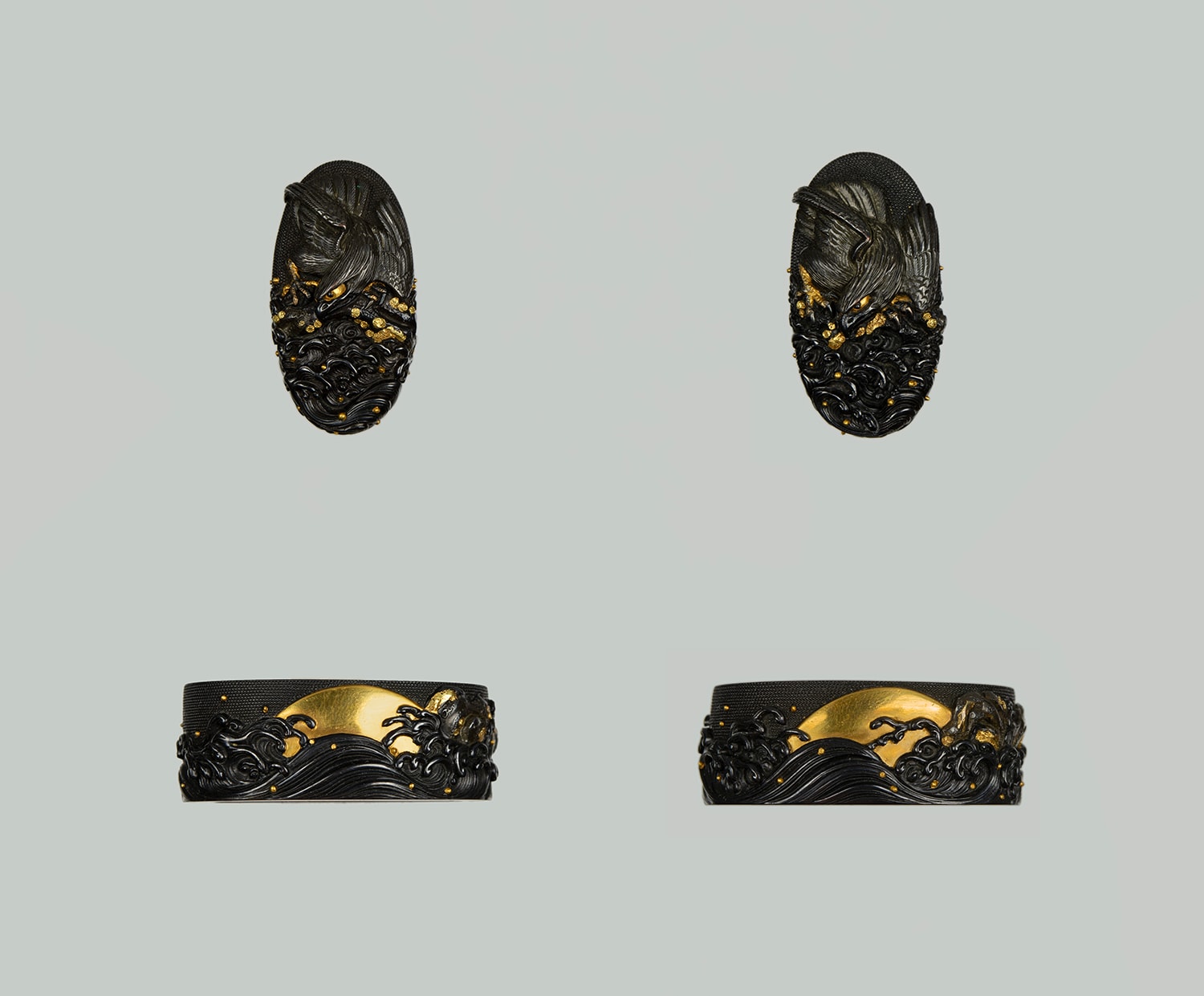
The Ōmori school was one of the great machibori (town-carving) lineages of Edo, founded in the first half of the eighteenth century by Ōmori Terumasa (大森英昌, also read Eishō), a direct disciple of Yokoya Sōmin. " A dated tsuba of Meiwa 7 (1770) anchors his mature activity, and the workshop remained rooted in the shogunal capital throughout its history — his pupil Hidetomo proudly signed works "Tōto, by the Sumida River"[[c:1]]. The headship then passed through Hidenaga to Hidemitsu (英満), Teruhide's fifth son, carrying the line deep into the late Edo period. " Its defining invention is the strikingly three-dimensional wave design known as Ōmori-nami (大森浪), the "Ōmori waves," together with sunago-zōgan gold-dust inlay executed in the kinkeshi manner and the flush gold inlay evocative of maki-e lacquer called nashiji-zōgan or chirigami-zōgan — techniques devised, the setsumei state, to heighten the elegant, courtly taste of the work. The judges single out "the weighty takabori carving characteristic of the Ōmori style," deployed across a repertoire spanning peony-and-shishi compositions, birds of prey amid rising sun and surging waves, tigers in bamboo, waves with myriad fish (uozukushi), the vanguard crossing of the Uji River, Fan Kuai at the Banquet at Hongmen, and the treasure ship of the Seven Lucky Gods.

Later generations show measured evolution: Hidemitsu "preserved the carving methods of his forebears while accepting changes in contemporary taste," turning also to iron ishime-ji grounds in sukidashi-bori and collaborating with the painter Kanō Dōhaku Aishin, whose preparatory drawings attest to exchange with the painting ateliers of the day; substitute works (daisaku) by his disciple Ōmori Mitsutoki under the master's signature reveal a flourishing workshop practice. The school's standing is confirmed at the highest levels of patronage: a ceremonial hosodachi mounting transmitted in the Ii family of Hikone, its entire suite of fittings by Teruhide with the clan's tachibana crest in takabori and gold iroe, documents the Ōmori masters as makers of daimyo ceremonial equipment. From the atelier radiated an exceptionally influential teaching lineage: Hidetomo (Ryūrinsai Ōmori Sadabei), recorded in the Kōto Kinkō Meifu as "a foremost disciple of Teruhide"; the Mito-branch Moriyama retainer Otsuzuka Hisanori, whose "dense, richly wrought inlay reached a uniquely individual realm" and drew praise in the Natsuo Chōkin-dan; Horie Kōsei, who entered the Ōmori school after Hamano Masayuki's death and later, as retained craftsman of the Hachisuka family of Awa, "trained many pupils of his own school"; and Izumi Hidetoshi, who studied under both Teruhide and Hidetomo. Through these channels the Ōmori manner — above all its sculptural waves and sumptuous relief — passed into the broader current of late-Edo machibori metalwork, securing the school's place as one of the most powerful branches of the Yokoya tradition in the tosogu canon. Learn more →

9 recorded smiths42 designated works
Leading smiths
SmithEraDesignated
Teruhide英秀—15
Chizuka Hisanori遅塚久則1725-17959
Horie Okinari堀江興成—7
Terumitsu英満—4
Okihisa興久—0
Explore the Omori school →
NBTHK Certificate
Hozon Tōsōgu保存刀装具
Fitting Worthy of Preservation
›

Certifies a genuine fitting worth preserving: a correct signature, or, if unsigned, an identifiable era and school, with recognized artistic and craft value.

Signed: 堀江興成(花押) 行年六十三才 (Omori Horie Okinari)
As written on the certificate
About the NBTHK›

The NBTHK (Nihon Bijutsu Tōken Hozon Kyōkai, the Society for the Preservation of Japanese Art Swords) is a public-interest incorporated foundation founded in 1948 and supervised by Japan’s Agency for Cultural Affairs (Bunkachō); it is based at the Japanese Sword Museum in Tokyo. Its expert panels physically examine each submitted work (shinsa) and issue a certificate (kanteishō) ranking it by artistic and historical merit. NBTHK papers are the most widely recognized standard of authentication for Japanese swords and fittings.

NBTHK official site→
Seller
A
Aoi Art
🇯🇵Ships from Japan
›
✓Verified dealeraoijapan.com
Settles in JPY
✓Ships worldwide✓English supportWire transferPayPalCredit card
Return policy

If you wish to return an item, please notify us within 3 days of receipt. After this period we cannot accept cancellations. Please ship the return to us within 5 business days. Cancellation is conditional on the item being kept in the same condition as at the time of sale, so please handle it with care.

View all of Aoi Art’s listings→View this item on the dealer’s site→

Previously sold by Omori Horie Okinari

Choshuya
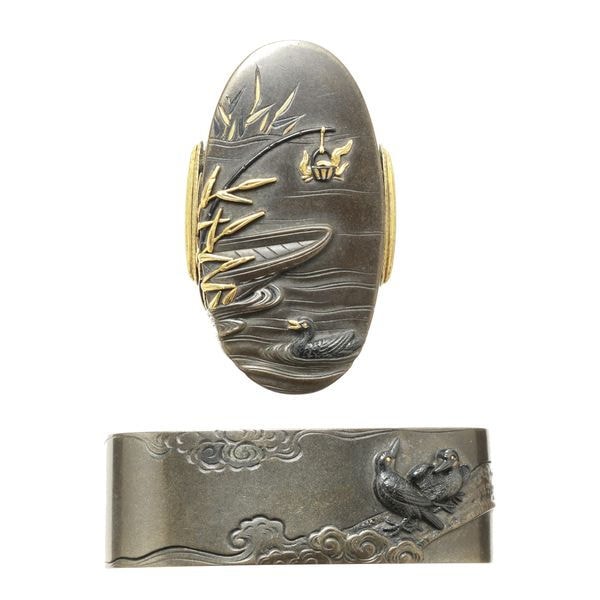
Fuchi-Kashira - by Omori Horie Okinari - Fuchi-Kashira with Tanabata (Cormorant Fishing, Egret Bridge) Design, Signed Horie Okishige with KaoFuchi-Kashira - by Omori Horie Okinari - Fuchi-Kashira with Tanabata (Cormorant Fishing, Egret Bridge) Design, Signed Horie Okishige with Kao
Sold

Fuchi-Kashira

ByOmori Horie Okinari
SOLD
Choshuya
Tokuho
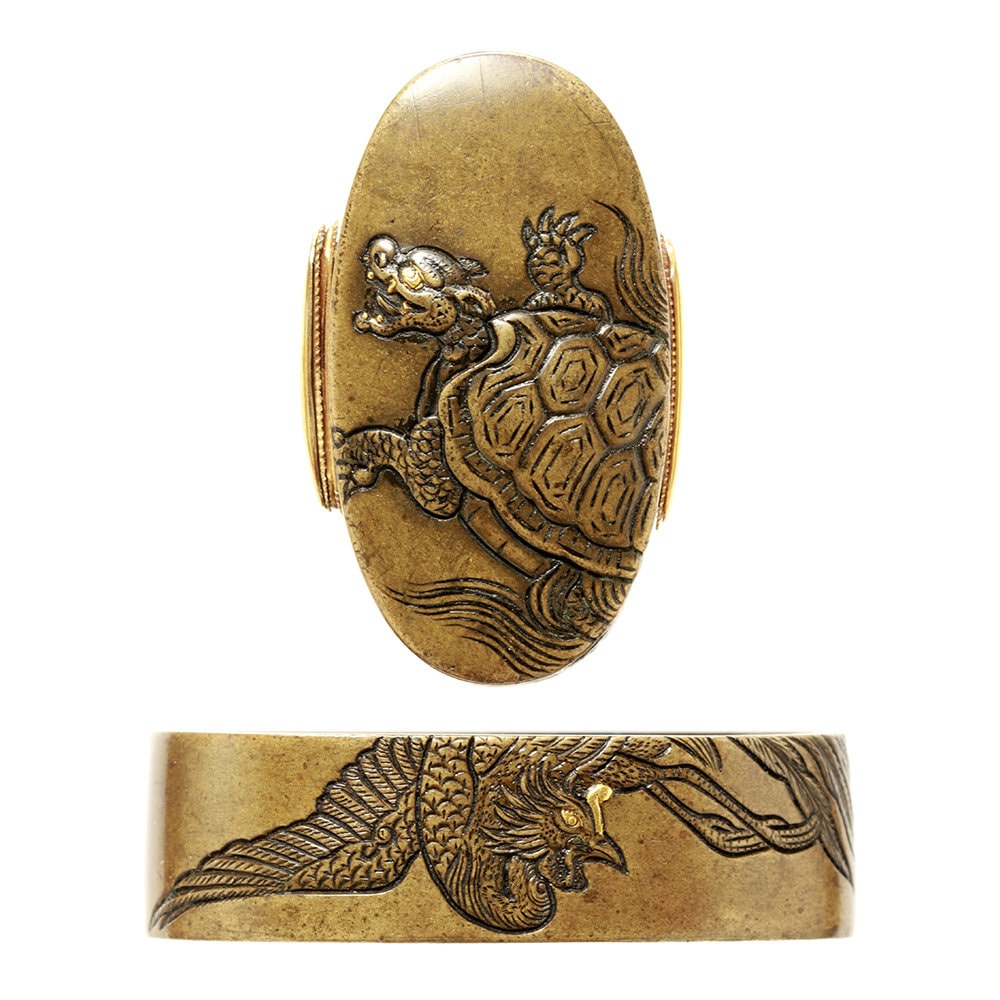
Fuchi-Kashira - Tokuho - by Omori Horie Okinari - Fuchi-Kashira: Minogame and Fenghuang Design, Signed Horie Okinari (Kao)Fuchi-Kashira - Tokuho - by Omori Horie Okinari - Fuchi-Kashira: Minogame and Fenghuang Design, Signed Horie Okinari (Kao)
Sold

Fuchi-Kashira

ByOmori Horie Okinari
SOLD

More from the Omori school

View all →
Nihontocraft
Jūyō
Fuchi-Kashira - Jūyō - by Omori Teruhide - Omori Eishu (Teruhide)Fuchi-Kashira - Jūyō - by Omori Teruhide - Omori Eishu (Teruhide)

Fuchi-Kashira

ByOmori Teruhide
¥55,000
Wakeidou
Hozon
Fuchi-Kashira - Hozon - by Omori Hidetoshi - Fuchi-Kashira: Hidetoshi (Kao) - Sunrise Sailboat DesignFuchi-Kashira - Hozon - by Omori Hidetoshi - Fuchi-Kashira: Hidetoshi (Kao) - Sunrise Sailboat Design

Fuchi-Kashira

ByOmori Hidetoshi
¥450,000
Ginza Seikodo
Jūyō
Menuki - Jūyō - by Omori Chizuka Hisanori - Split Tanzaku Signature Hisanori (kao) Hen and Chicks MotifMenuki - Jūyō - by Omori Chizuka Hisanori - Split Tanzaku Signature Hisanori (kao) Hen and Chicks Motif

Menuki

ByOmori Chizuka Hisanori
Ask
Samurai Museum
Tokuho
Fuchi-Kashira - Tokuho - by Omori School - Antique Fuchi Kashira for Samurai Sword with NBTHK Tokubetsu Hozon Certificate (F-41)Fuchi-Kashira - Tokuho - by Omori School - Antique Fuchi Kashira for Samurai Sword with NBTHK Tokubetsu Hozon Certificate (F-41)

Fuchi-Kashira

ByOmori School
¥1,867
Wakeidou
Hozon
Fuchi-Kashira - Hozon - by Omori Hidetomo - Fuchi-Kashira: Hidetoshi (Kao) - Peony and Lion DesignFuchi-Kashira - Hozon - by Omori Hidetomo - Fuchi-Kashira: Hidetoshi (Kao) - Peony and Lion Design

Fuchi-Kashira

ByOmori Hidetomo
¥400,000
Ayakashi
Hozon
Tsuba - Hozon - by Omori Hideyuki - Zhang Fei Design, Signed HideyukiTsuba - Hozon - by Omori Hideyuki - Zhang Fei Design, Signed Hideyuki

Tsuba

ByOmori Hideyuki
¥360,000
Nipponto
Hozon
Kozuka - Hozon - by Omori Teruhiko - Kozuka k-15 Omori Hidetomo (kao) Autumn Grass Design, Silver Migaki-ji, Ke-bori, Hira-zoganKozuka - Hozon - by Omori Teruhiko - Kozuka k-15 Omori Hidetomo (kao) Autumn Grass Design, Silver Migaki-ji, Ke-bori, Hira-zogan

Kozuka

ByOmori Teruhiko
¥98,000
Eirakudo
Hozon
Menuki - Hozon - by Omori School - EijuMenuki - Hozon - by Omori School - Eiju

Menuki

ByOmori School
¥450,000

More from the Yokoya school

View all →
Ginza Seikodo
Tokuho
Kozuka - Tokuho - by Yokoya Somin - Somin - Depiction of Shoki (Zhong Kui)Kozuka - Tokuho - by Yokoya Somin - Somin - Depiction of Shoki (Zhong Kui)

Kozuka

ByYokoya Somin
¥1,500,000
Yamasiroya
Hozon
Fuchi-Kashira - Hozon - by Kikuoka Mitsumasa - Fuchi-Kashira: Unryu Zu, Signed RinsendoFuchi-Kashira - Hozon - by Kikuoka Mitsumasa - Fuchi-Kashira: Unryu Zu, Signed Rinsendo

Fuchi-Kashira

ByKikuoka Mitsumasa
¥140,000
Aoi Art
Jūyō
Fuchi-Kashira - Jūyō - by Iwamoto Konkan - Fuchikashira: Iwamoto KonkanFuchi-Kashira - Jūyō - by Iwamoto Konkan - Fuchikashira: Iwamoto Konkan

Fuchi-Kashira

ByIwamoto Konkan
¥2,500,000
Nihontocraft
Jūyō
Mitokoromono - Jūyō - by Ishiguro Koretsune - Ishiguro Koretsune: The 28th Juyo TosoguMitokoromono - Jūyō - by Ishiguro Koretsune - Ishiguro Koretsune: The 28th Juyo Tosogu

Mitokoromono

ByIshiguro Koretsune
¥56,000
Choshuya
Tokuho
Kozuka - Tokuho - by Kikuoka Mitsumasa - Crawling Dragon Design, Signed Kikuoka Mitsumasa (with Kao)Kozuka - Tokuho - by Kikuoka Mitsumasa - Crawling Dragon Design, Signed Kikuoka Mitsumasa (with Kao)

Kozuka

ByKikuoka Mitsumasa
¥400,000
World Seiyudo
Hozon
Tsuba - Hozon - by Yanagawa Haruaki - Haruaki-hogan Kobumboku-zu-TsubaTsuba - Hozon - by Yanagawa Haruaki - Haruaki-hogan Kobumboku-zu-Tsuba

Tsuba

ByYanagawa Haruaki
¥2,500,000
Tetsugendo
Tokuho
Menuki - Tokuho - by Iwamoto Kanri - Signed Iwamoto Kanri - NBTHK Tokubetsu Hozon (1700s)Menuki - Tokuho - by Iwamoto Kanri - Signed Iwamoto Kanri - NBTHK Tokubetsu Hozon (1700s)

Menuki

ByIwamoto Kanri
¥2,500
Connoisseur Arms
Jūyō
Tsuba - Jūyō - by Iwamoto Konju - Iwamoto Konju Juyo Daisho Tsuba MasterpieceTsuba - Jūyō - by Iwamoto Konju - Iwamoto Konju Juyo Daisho Tsuba Masterpiece

Tsuba

ByIwamoto Konju
Ask

More from the Machibori tradition

View all →
Wakeidou
Tokuho
Tsuba - Tokuho - by Otsuki Tokuoki - TokuokiTsuba - Tokuho - by Otsuki Tokuoki - Tokuoki

Tsuba

ByOtsuki Tokuoki
¥700,000
Connoisseur Arms
Jūyō
Tsuba - Jūyō - by Hamano Sekibun - Masterpiece Tsuba by Yurakusai SekibunTsuba - Jūyō - by Hamano Sekibun - Masterpiece Tsuba by Yurakusai Sekibun

Tsuba

ByHamano Sekibun
Ask
Samurai Nippon
Tokuho
Tsuba - Tokuho - by Hamano School - Kashorin ZuTsuba - Tokuho - by Hamano School - Kashorin Zu

Tsuba

ByHamano School
¥820,000
Touken Matsumoto
Hozon
Fuchi-Kashira - Hozon - by Nara Munetoshi - Fuchi Kashira: Waterside Village SceneFuchi-Kashira - Hozon - by Nara Munetoshi - Fuchi Kashira: Waterside Village Scene

Fuchi-Kashira

ByNara Munetoshi
¥75,000
Aoi Art
Tokubetsu Kichō
Tsuba - Tokubetsu Kichō - by Nara School - Unsigned (Ko-Nara) - Kinko Sennin DesignTsuba - Tokubetsu Kichō - by Nara School - Unsigned (Ko-Nara) - Kinko Sennin Design

Tsuba

ByNara School
Starting Bid¥350,000
Nihonto Art
Tokuho
Tsuba - Tokuho - by Mito School - Edo Mito Unsigned Willow and Waterfowl - NBTHK Tokubetsu HozonTsuba - Tokuho - by Mito School - Edo Mito Unsigned Willow and Waterfowl - NBTHK Tokubetsu Hozon

Tsuba

ByMito School
¥2,250
Samurai Nippon
Tokubetsu Kichō
Kozuka - Tokubetsu Kichō - by Otsuki Mitsuhiro - Wave and Plover DesignKozuka - Tokubetsu Kichō - by Otsuki Mitsuhiro - Wave and Plover Design

Kozuka

ByOtsuki Mitsuhiro
¥85,000
Choshuya
Tokuho
Kozuka - Tokuho - by Hamano Sekibun - Kozuka with Hagoromo Design, Signed Yurakusai Sekibun (with Kao)Kozuka - Tokuho - by Hamano Sekibun - Kozuka with Hagoromo Design, Signed Yurakusai Sekibun (with Kao)

Kozuka

ByHamano Sekibun
Ask

Swords

  • Katana
  • Wakizashi
  • Tantō
  • Tachi
  • Naginata
  • Yari

Fittings

  • Tsuba
  • Fuchi-Kashira
  • Kozuka
  • Menuki

Armor

  • Kabuto
  • Samurai Armor

By Certification

  • Tokujū
  • Jūyō
  • Tokuho
  • Hozon

Resources

  • Dealer Directory
  • Artist Directory
  • The Daily Kantei
  • Glossary
  • Browse All
Nihontowatch© 2026
TermsPrivacyCookiesAbout

Description

This kogai, made by Horie Okinari, features a kake-mamori design in high relief on a shakudō nanako ground. Horie Okinari was a late Edo-period metalsmith who studied under prominent masters and served the Hachisuka family. The piece is distinguished by its elegant design and superb, delicately executed carving, and comes with an NBTHK Hozon Tosogu certificate.

Certificate Reading

Certificate reading — 銘 堀江興成(花押) 行年六十三才

NihontoWatch MonNihontoWatch
MarketEncyclopediaKantei
Fittings›Machibori›Yokoya›Omori›Horie Okinari›Kogai: Horie Okinari (written seal mark, age of 63)
kogaiHozon
Omori Horie Okinari

Kogai: Horie Okinari (written seal mark, age of 63)

mei · act. Meiwa–Tenmei (c. 1770s-80s)

¥250,000
Visit seller website →
Omori Horie Okinari — 1 of 2
Omori Horie Okinari — 2 of 2
1 / 2
1 / 2
Omori Horie Okinari — 1 of 2Omori Horie Okinari — 2 of 2
Measurements & details
Maker

Omori Horie Okinari

Era

act. Meiwa–Tenmei (c. 1770s-80s)

Signature

Signed

Papers

Hozon (NBTHK)

Description

This kogai, made by Horie Okinari, features a kake-mamori design in high relief on a shakudō nanako ground. Horie Okinari was a late Edo-period metalsmith who studied under prominent masters and served the Hachisuka family. The piece is distinguished by its elegant design and superb, delicately executed carving, and comes with an NBTHK Hozon Tosogu certificate.

About the maker

Horie Okinari

堀江興成

Machibori

1 piece on the market now

›

Horie Kosei first studied under Hamano Masayuki, using the name Masusui. In Meiwa 6 (1769), while still in his twenties, he encountered the death of his teacher Masayuki, after which he newly entered the school of Omori Eishu. He was granted permission to use one character from his master's name and changed his art name to Eishun. He also became affiliated as a disciple of Ozaki Naomasa, a craftsman of Goto lineage, absorbing the methods of the mainline house-carving tradition. After establishing himself independently he adopted the name Kosei. Later he served as a kakae-ko -- an officially retained craftsman -- of the Hachisuka daimyo house of Awa Province, and trained many pupils and successors within his circle.

Kosei's technical command reflects the convergence of three lineages: the Hamano school's naturalism, the Omori school's structural discipline, and the Goto family's dignified takabori and iroe methods. His preferred materials are shakudo nanako-ji grounds enriched with polychrome inlay using gold, silver, and suaka, often finished with reverse gilding (kin'ura). Compositions range from matched sets of saddled horses rendered with gold crests in the Goto manner, to the Twelve Months of Birds and Flowers -- an hereditary treasure of the Hachisuka house -- based on poetic designs from Fujiwara no Teika's waka. In his later years, works such as sanshomono with shishi motifs employ kezuritsugi construction combining gold and shakudo to create visual variation. The menuki, frequently executed in solid gold (kinmuku), display richly modeled sculptural carving (yobori) of full, ample form.

The NBTHK consistently characterizes Kosei's production as embodying a dignified style modeled after Goto taste, yet enlivened by the innovative character associated with machibori. His works are described as possessing "high dignity" and "an elegant, courtly taste," with motifs treated in a "taut, crisp expression" that demonstrates "the full range of his abilities." Even in pieces that strongly emulate the Goto family style, the assessments note skill "well worth close attention" and a "chic, sophisticated design sense" with an "urbane, polished finish" -- qualities that distinguish Kosei as a consummate synthesizer of the major mid-Edo metalworking traditions.

Historical importance

Where Horie Okinari stands among comparable artisans: across all of nihontō, and within tradition, era, and period. The tiers (Foremost · Leading · Major · Notable) weigh official designations from the NBTHK and Japan's Agency for Cultural Affairs, together with historical honors of lasting repute such as the Sansaku and Meibutsu-chō.

随一
Foremost
屈指
Leading
有数
Major
著名
Notable

Select a lens to see how it's measured.

Designation record
7 designated works
Jūyō
7
1 work by Horie Okinari on the market→
Horie Okinari — full profileMachibori school
About the school

Omori

大森

Machibori · Edo

16 pieces on the market now

›

The Ōmori school was one of the great machibori (town-carving) lineages of Edo, founded in the first half of the eighteenth century by Ōmori Terumasa (大森英昌, also read Eishō), a direct disciple of Yokoya Sōmin. " A dated tsuba of Meiwa 7 (1770) anchors his mature activity, and the workshop remained rooted in the shogunal capital throughout its history — his pupil Hidetomo proudly signed works "Tōto, by the Sumida River"[[c:1]]. The headship then passed through Hidenaga to Hidemitsu (英満), Teruhide's fifth son, carrying the line deep into the late Edo period. " Its defining invention is the strikingly three-dimensional wave design known as Ōmori-nami (大森浪), the "Ōmori waves," together with sunago-zōgan gold-dust inlay executed in the kinkeshi manner and the flush gold inlay evocative of maki-e lacquer called nashiji-zōgan or chirigami-zōgan — techniques devised, the setsumei state, to heighten the elegant, courtly taste of the work. The judges single out "the weighty takabori carving characteristic of the Ōmori style," deployed across a repertoire spanning peony-and-shishi compositions, birds of prey amid rising sun and surging waves, tigers in bamboo, waves with myriad fish (uozukushi), the vanguard crossing of the Uji River, Fan Kuai at the Banquet at Hongmen, and the treasure ship of the Seven Lucky Gods.

Later generations show measured evolution: Hidemitsu "preserved the carving methods of his forebears while accepting changes in contemporary taste," turning also to iron ishime-ji grounds in sukidashi-bori and collaborating with the painter Kanō Dōhaku Aishin, whose preparatory drawings attest to exchange with the painting ateliers of the day; substitute works (daisaku) by his disciple Ōmori Mitsutoki under the master's signature reveal a flourishing workshop practice. The school's standing is confirmed at the highest levels of patronage: a ceremonial hosodachi mounting transmitted in the Ii family of Hikone, its entire suite of fittings by Teruhide with the clan's tachibana crest in takabori and gold iroe, documents the Ōmori masters as makers of daimyo ceremonial equipment. From the atelier radiated an exceptionally influential teaching lineage: Hidetomo (Ryūrinsai Ōmori Sadabei), recorded in the Kōto Kinkō Meifu as "a foremost disciple of Teruhide"; the Mito-branch Moriyama retainer Otsuzuka Hisanori, whose "dense, richly wrought inlay reached a uniquely individual realm" and drew praise in the Natsuo Chōkin-dan; Horie Kōsei, who entered the Ōmori school after Hamano Masayuki's death and later, as retained craftsman of the Hachisuka family of Awa, "trained many pupils of his own school"; and Izumi Hidetoshi, who studied under both Teruhide and Hidetomo. Through these channels the Ōmori manner — above all its sculptural waves and sumptuous relief — passed into the broader current of late-Edo machibori metalwork, securing the school's place as one of the most powerful branches of the Yokoya tradition in the tosogu canon. Learn more →

9 recorded smiths42 designated works
Leading smiths
SmithEraDesignated
Teruhide英秀—15
Chizuka Hisanori遅塚久則1725-17959
Horie Okinari堀江興成—7
Terumitsu英満—4
Okihisa興久—0
Explore the Omori school →
NBTHK Certificate
Hozon Tōsōgu保存刀装具
Fitting Worthy of Preservation
›

Certifies a genuine fitting worth preserving: a correct signature, or, if unsigned, an identifiable era and school, with recognized artistic and craft value.

Signed: 堀江興成(花押) 行年六十三才 (Omori Horie Okinari)
As written on the certificate
About the NBTHK›

The NBTHK (Nihon Bijutsu Tōken Hozon Kyōkai, the Society for the Preservation of Japanese Art Swords) is a public-interest incorporated foundation founded in 1948 and supervised by Japan’s Agency for Cultural Affairs (Bunkachō); it is based at the Japanese Sword Museum in Tokyo. Its expert panels physically examine each submitted work (shinsa) and issue a certificate (kanteishō) ranking it by artistic and historical merit. NBTHK papers are the most widely recognized standard of authentication for Japanese swords and fittings.

NBTHK official site→
Seller
A
Aoi Art
🇯🇵Ships from Japan
›
✓Verified dealeraoijapan.com
Settles in JPY
✓Ships worldwide✓English supportWire transferPayPalCredit card
Return policy

If you wish to return an item, please notify us within 3 days of receipt. After this period we cannot accept cancellations. Please ship the return to us within 5 business days. Cancellation is conditional on the item being kept in the same condition as at the time of sale, so please handle it with care.

View all of Aoi Art’s listings→View this item on the dealer’s site→

Previously sold by Omori Horie Okinari

Choshuya
Fuchi-Kashira - by Omori Horie Okinari - Fuchi-Kashira with Tanabata (Cormorant Fishing, Egret Bridge) Design, Signed Horie Okishige with KaoFuchi-Kashira - by Omori Horie Okinari - Fuchi-Kashira with Tanabata (Cormorant Fishing, Egret Bridge) Design, Signed Horie Okishige with Kao
Sold

Fuchi-Kashira

ByOmori Horie Okinari
SOLD
Choshuya
Tokuho
Fuchi-Kashira - Tokuho - by Omori Horie Okinari - Fuchi-Kashira: Minogame and Fenghuang Design, Signed Horie Okinari (Kao)Fuchi-Kashira - Tokuho - by Omori Horie Okinari - Fuchi-Kashira: Minogame and Fenghuang Design, Signed Horie Okinari (Kao)
Sold

Fuchi-Kashira

ByOmori Horie Okinari
SOLD

More from the Omori school

View all →
Nihontocraft
Jūyō
Fuchi-Kashira - Jūyō - by Omori Teruhide - Omori Eishu (Teruhide)Fuchi-Kashira - Jūyō - by Omori Teruhide - Omori Eishu (Teruhide)

Fuchi-Kashira

ByOmori Teruhide
¥55,000
Wakeidou
Hozon
Fuchi-Kashira - Hozon - by Omori Hidetoshi - Fuchi-Kashira: Hidetoshi (Kao) - Sunrise Sailboat DesignFuchi-Kashira - Hozon - by Omori Hidetoshi - Fuchi-Kashira: Hidetoshi (Kao) - Sunrise Sailboat Design

Fuchi-Kashira

ByOmori Hidetoshi
¥450,000
Ginza Seikodo
Jūyō
Menuki - Jūyō - by Omori Chizuka Hisanori - Split Tanzaku Signature Hisanori (kao) Hen and Chicks MotifMenuki - Jūyō - by Omori Chizuka Hisanori - Split Tanzaku Signature Hisanori (kao) Hen and Chicks Motif

Menuki

ByOmori Chizuka Hisanori
Ask
Samurai Museum
Tokuho
Fuchi-Kashira - Tokuho - by Omori School - Antique Fuchi Kashira for Samurai Sword with NBTHK Tokubetsu Hozon Certificate (F-41)Fuchi-Kashira - Tokuho - by Omori School - Antique Fuchi Kashira for Samurai Sword with NBTHK Tokubetsu Hozon Certificate (F-41)

Fuchi-Kashira

ByOmori School
¥1,867
Wakeidou
Hozon
Fuchi-Kashira - Hozon - by Omori Hidetomo - Fuchi-Kashira: Hidetoshi (Kao) - Peony and Lion DesignFuchi-Kashira - Hozon - by Omori Hidetomo - Fuchi-Kashira: Hidetoshi (Kao) - Peony and Lion Design

Fuchi-Kashira

ByOmori Hidetomo
¥400,000
Ayakashi
Hozon
Tsuba - Hozon - by Omori Hideyuki - Zhang Fei Design, Signed HideyukiTsuba - Hozon - by Omori Hideyuki - Zhang Fei Design, Signed Hideyuki

Tsuba

ByOmori Hideyuki
¥360,000
Nipponto
Hozon
Kozuka - Hozon - by Omori Teruhiko - Kozuka k-15 Omori Hidetomo (kao) Autumn Grass Design, Silver Migaki-ji, Ke-bori, Hira-zoganKozuka - Hozon - by Omori Teruhiko - Kozuka k-15 Omori Hidetomo (kao) Autumn Grass Design, Silver Migaki-ji, Ke-bori, Hira-zogan

Kozuka

ByOmori Teruhiko
¥98,000
Eirakudo
Hozon
Menuki - Hozon - by Omori School - EijuMenuki - Hozon - by Omori School - Eiju

Menuki

ByOmori School
¥450,000

More from the Yokoya school

View all →
Ginza Seikodo
Tokuho
Kozuka - Tokuho - by Yokoya Somin - Somin - Depiction of Shoki (Zhong Kui)Kozuka - Tokuho - by Yokoya Somin - Somin - Depiction of Shoki (Zhong Kui)

Kozuka

ByYokoya Somin
¥1,500,000
Yamasiroya
Hozon
Fuchi-Kashira - Hozon - by Kikuoka Mitsumasa - Fuchi-Kashira: Unryu Zu, Signed RinsendoFuchi-Kashira - Hozon - by Kikuoka Mitsumasa - Fuchi-Kashira: Unryu Zu, Signed Rinsendo

Fuchi-Kashira

ByKikuoka Mitsumasa
¥140,000
Aoi Art
Jūyō
Fuchi-Kashira - Jūyō - by Iwamoto Konkan - Fuchikashira: Iwamoto KonkanFuchi-Kashira - Jūyō - by Iwamoto Konkan - Fuchikashira: Iwamoto Konkan

Fuchi-Kashira

ByIwamoto Konkan
¥2,500,000
Nihontocraft
Jūyō
Mitokoromono - Jūyō - by Ishiguro Koretsune - Ishiguro Koretsune: The 28th Juyo TosoguMitokoromono - Jūyō - by Ishiguro Koretsune - Ishiguro Koretsune: The 28th Juyo Tosogu

Mitokoromono

ByIshiguro Koretsune
¥56,000
Choshuya
Tokuho
Kozuka - Tokuho - by Kikuoka Mitsumasa - Crawling Dragon Design, Signed Kikuoka Mitsumasa (with Kao)Kozuka - Tokuho - by Kikuoka Mitsumasa - Crawling Dragon Design, Signed Kikuoka Mitsumasa (with Kao)

Kozuka

ByKikuoka Mitsumasa
¥400,000
World Seiyudo
Hozon
Tsuba - Hozon - by Yanagawa Haruaki - Haruaki-hogan Kobumboku-zu-TsubaTsuba - Hozon - by Yanagawa Haruaki - Haruaki-hogan Kobumboku-zu-Tsuba

Tsuba

ByYanagawa Haruaki
¥2,500,000
Tetsugendo
Tokuho
Menuki - Tokuho - by Iwamoto Kanri - Signed Iwamoto Kanri - NBTHK Tokubetsu Hozon (1700s)Menuki - Tokuho - by Iwamoto Kanri - Signed Iwamoto Kanri - NBTHK Tokubetsu Hozon (1700s)

Menuki

ByIwamoto Kanri
¥2,500
Connoisseur Arms
Jūyō
Tsuba - Jūyō - by Iwamoto Konju - Iwamoto Konju Juyo Daisho Tsuba MasterpieceTsuba - Jūyō - by Iwamoto Konju - Iwamoto Konju Juyo Daisho Tsuba Masterpiece

Tsuba

ByIwamoto Konju
Ask

More from the Machibori tradition

View all →
Wakeidou
Tokuho
Tsuba - Tokuho - by Otsuki Tokuoki - TokuokiTsuba - Tokuho - by Otsuki Tokuoki - Tokuoki

Tsuba

ByOtsuki Tokuoki
¥700,000
Connoisseur Arms
Jūyō
Tsuba - Jūyō - by Hamano Sekibun - Masterpiece Tsuba by Yurakusai SekibunTsuba - Jūyō - by Hamano Sekibun - Masterpiece Tsuba by Yurakusai Sekibun

Tsuba

ByHamano Sekibun
Ask
Samurai Nippon
Tokuho
Tsuba - Tokuho - by Hamano School - Kashorin ZuTsuba - Tokuho - by Hamano School - Kashorin Zu

Tsuba

ByHamano School
¥820,000
Touken Matsumoto
Hozon
Fuchi-Kashira - Hozon - by Nara Munetoshi - Fuchi Kashira: Waterside Village SceneFuchi-Kashira - Hozon - by Nara Munetoshi - Fuchi Kashira: Waterside Village Scene

Fuchi-Kashira

ByNara Munetoshi
¥75,000
Aoi Art
Tokubetsu Kichō
Tsuba - Tokubetsu Kichō - by Nara School - Unsigned (Ko-Nara) - Kinko Sennin DesignTsuba - Tokubetsu Kichō - by Nara School - Unsigned (Ko-Nara) - Kinko Sennin Design

Tsuba

ByNara School
Starting Bid¥350,000
Nihonto Art
Tokuho
Tsuba - Tokuho - by Mito School - Edo Mito Unsigned Willow and Waterfowl - NBTHK Tokubetsu HozonTsuba - Tokuho - by Mito School - Edo Mito Unsigned Willow and Waterfowl - NBTHK Tokubetsu Hozon

Tsuba

ByMito School
¥2,250
Samurai Nippon
Tokubetsu Kichō
Kozuka - Tokubetsu Kichō - by Otsuki Mitsuhiro - Wave and Plover DesignKozuka - Tokubetsu Kichō - by Otsuki Mitsuhiro - Wave and Plover Design

Kozuka

ByOtsuki Mitsuhiro
¥85,000
Choshuya
Tokuho
Kozuka - Tokuho - by Hamano Sekibun - Kozuka with Hagoromo Design, Signed Yurakusai Sekibun (with Kao)Kozuka - Tokuho - by Hamano Sekibun - Kozuka with Hagoromo Design, Signed Yurakusai Sekibun (with Kao)

Kozuka

ByHamano Sekibun
Ask

Swords

  • Katana
  • Wakizashi
  • Tantō
  • Tachi
  • Naginata
  • Yari

Fittings

  • Tsuba
  • Fuchi-Kashira
  • Kozuka
  • Menuki

Armor

  • Kabuto
  • Samurai Armor

By Certification

  • Tokujū
  • Jūyō
  • Tokuho
  • Hozon

Resources

  • Dealer Directory
  • Artist Directory
  • The Daily Kantei
  • Glossary
  • Browse All
Nihontowatch© 2026
TermsPrivacyCookiesAbout
NihontoWatch Mon

NihontoWatch

Market
Encyclopedia
Kantei
NihontoWatch Mon

NihontoWatch

Market
Encyclopedia
Kantei