 NihontoWatchNihontoWatch
An Important and Rare Joint Work of Goto Joshin and Goto Kojo Third and Fourth Mainline Goto Masters Among the many schools of fittings makers throughout Japanese history, the Goto school dominant in their longevity and success. Sixteen generations of mainline masters descended from the first generation, Goto Yujo, who worked for Ashikaga Yoshimasa about one hundred fifty years before the unification of Japan under the Tokugawa Shogunate. Successive generations of Goto makers sustained and improved the quality and workmanship and became the foundation for other great artists. Fittings made by Goto masters were especially precious and sets such as Mitokoromono (kogai, kozuka, and menuki, en suite) were used as exchanges of gifts to and between Daimyo and those of lofty social classes. Those with the means sought to build an entire set consisting of items from each Goto generation, a practice which continues to this day by enthusiastic collectors. Truly, this was an early example of the phrase “collect the whole set”. Because they were court artisans, the first four generations of mainline Goto makers did not sign their works. The importance of owning specific works brought many owners of items to bring pieces to later generation Goto masters for authentication, and on many works one can see the testimony of later generation’s attribution of a particular piece to a particular master. Of the seventeen generations of mainline Goto masters from 1440 to 1879, the first three generations are known as “Ko-Goto” or “Old Goto”, and consisted of Yujo, Sojo, and Joshin. Joshin’s work was born in the fury of the “age of battles” when the provinces of Japan were at continuous war. Although he excelled in the designs that all Goto traditionally made such as Dragons and Shishi, he favored powerful symbolic subjects such as Tigers as well. Joshin was a Samurai Henri Joly wrote of him “well known as a doughty soldier”. Naturally as can be imagined from his turbulent surroundings, man
NihontoWatchOffered by Legacy Swords
This piece has sold
Get an email when a new Goto Joshin piece hits the market.

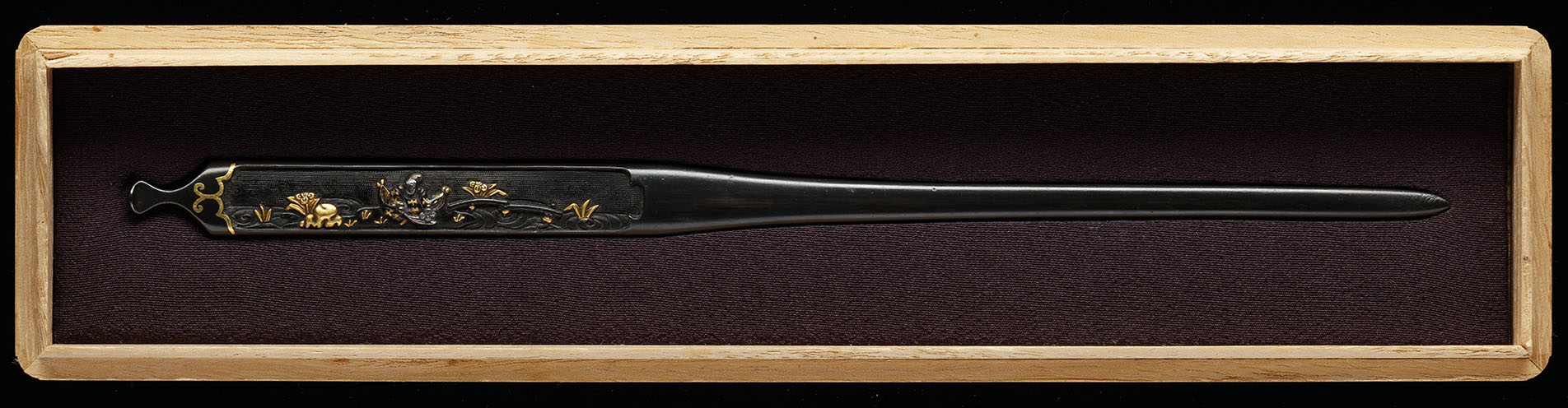
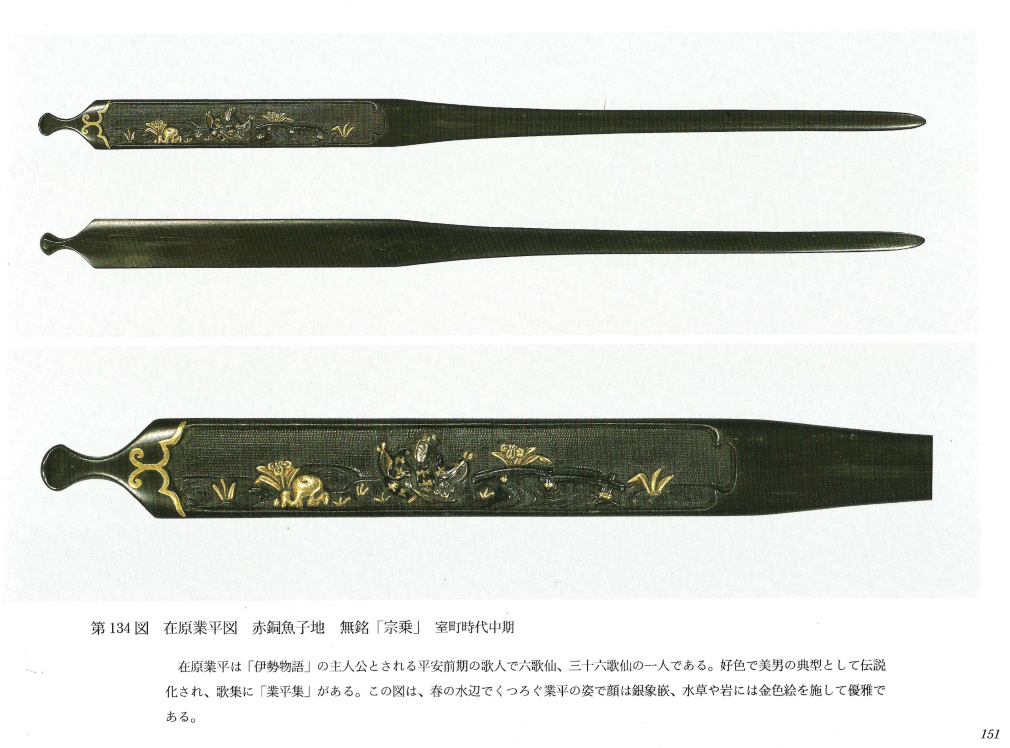
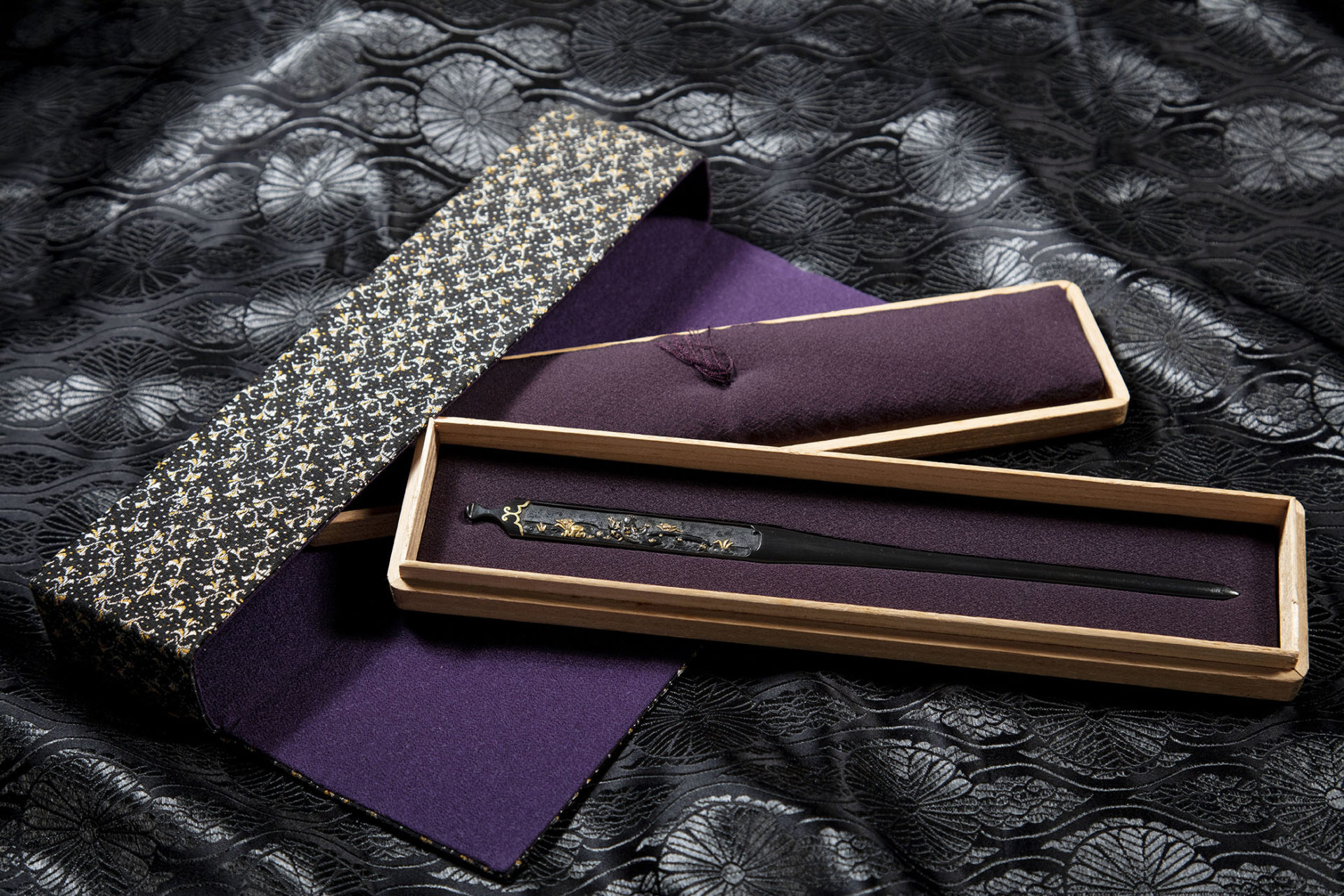
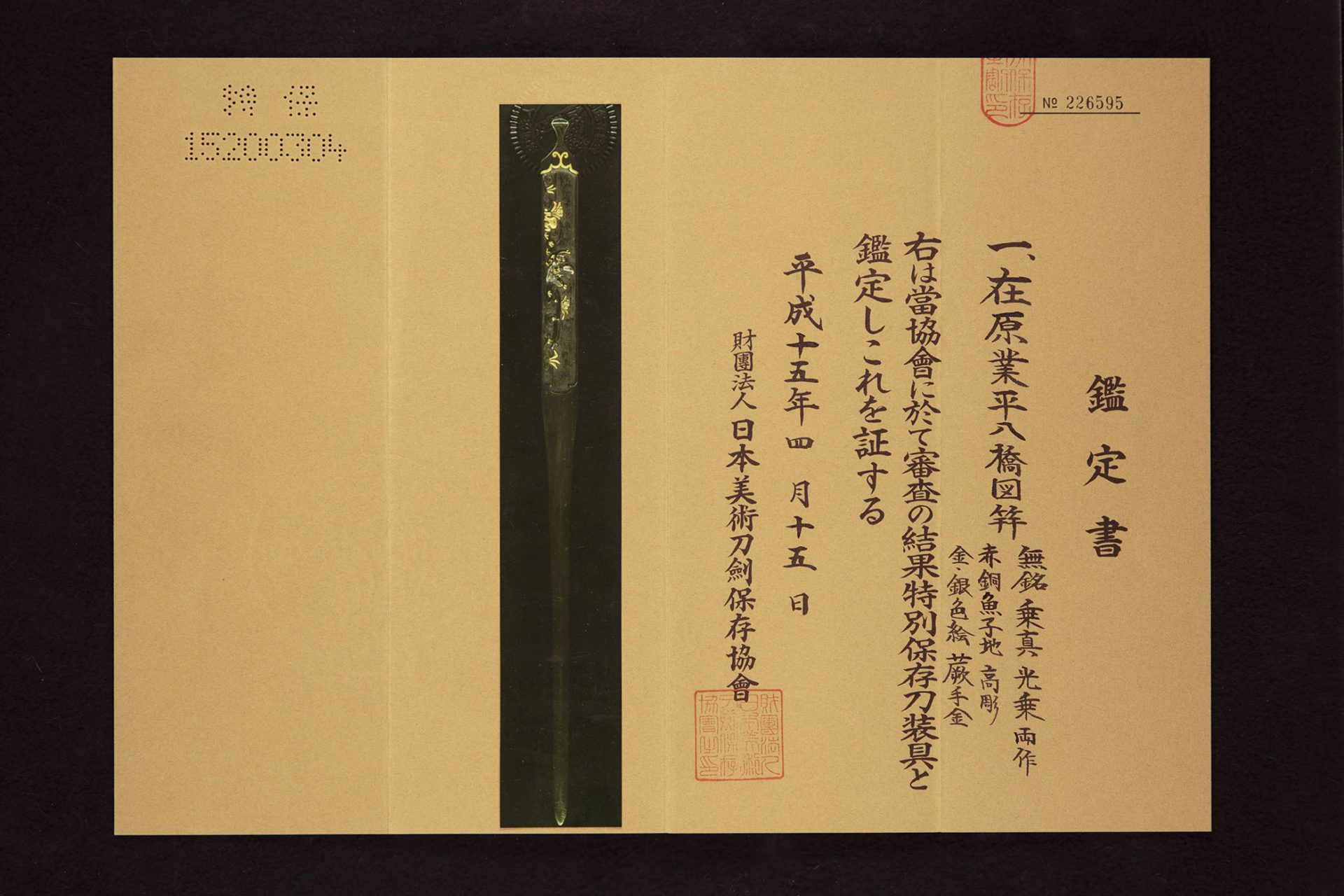

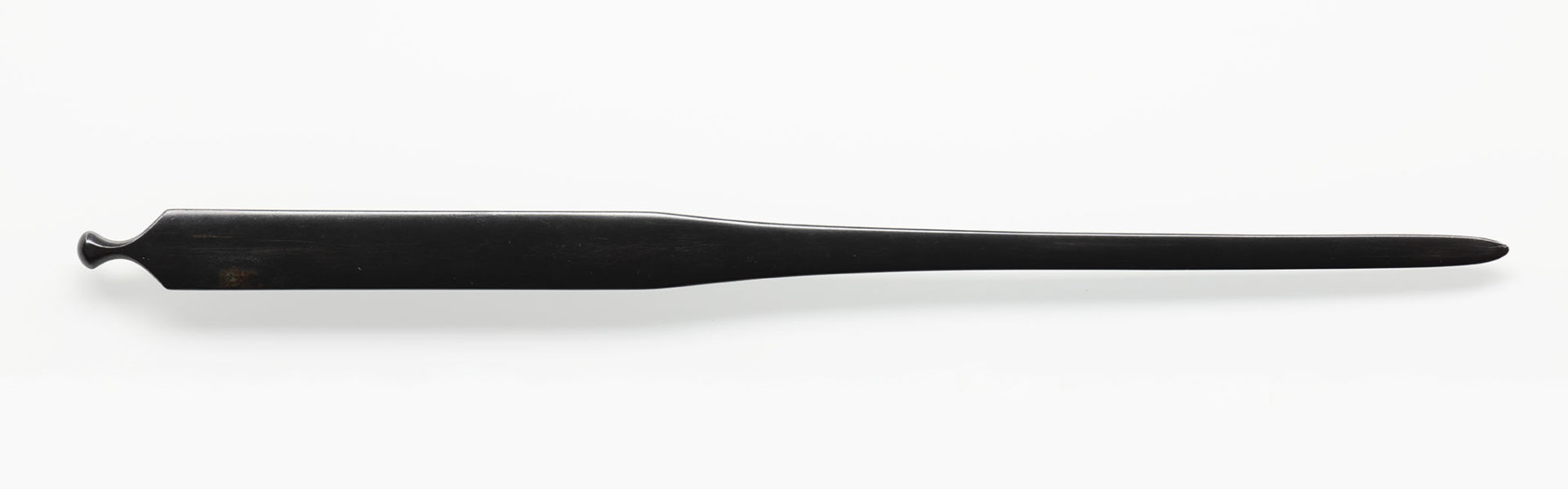
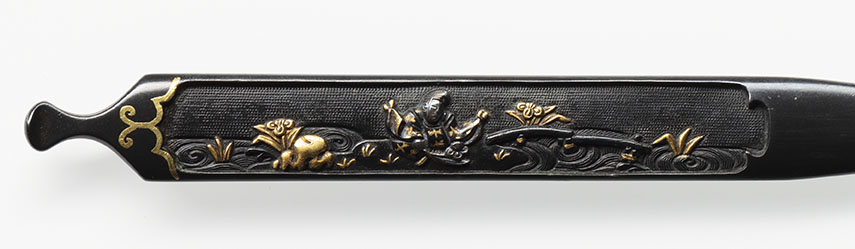
Goto Joshin
Muromachi
Unsigned
Tokuho (NBTHK)
Iebori · Yamashiro · around 1512-1562
5 pieces on the market now
Gotō Jōshin (乗真), the third head of the main Gotō line, was the eldest son of the second master Sōjō and the grandson of the founder Yūjō. The published sources record that he was born in Eishō 10, with the common name Jirō and the personal name Yoshihisa, later styling himself Genshirō Harumitsu. He served the Ashikaga shōguns Yoshiharu and Yoshiteru in both metalwork and financial affairs, held the house estate of three hundred chō at Sakamoto in Ōmi that had come down from Yūjō, and was later raised to the rank of Hōgen. Through a quarrel with the Azai of northern Ōmi he was attacked by Azai Ryōmasa and killed in battle in Eiroku 5 (1562), at fifty-one. The published sources join that life to his art: Jōshin was a warrior, of a most valiant temperament[[c:1]].
From that temperament they derive the trait they repeat on almost every designated piece. His work is large in scale and forceful, and it is carved to fill the whole field[[c:2]]. His plate is the house shakudō nanako, carved in takabori with gold uttori and colour, and his gold crests (kinmon) are full in volume and strong. On one composite set the published sources note that the triangular chisel marks of his crests stand out with particular clarity[[c:3]].
His modelling is described in the words of the Sōken Kishō: his chisel marks are sharp, with high mountains and deep valleys, a crisp and commanding hand[[c:4]]. The phrase returns across his record. On a pair of solid-gold lion menuki the modelling is "high mountain and low valley", and on a set of horse trappings the published sources call that relief his own unrivalled domain[[c:5]].
His subjects are first the Gotō house motifs, the kurikara dragon, paired lions and the crawling dragon, which each generation carved in its own way. The published sources compare his kurikara with the founder's: it is larger in build and charged with chisel power. Beside them stand the martial subjects of a warrior craftsman, horse trappings and a bow and arrows with ginger and ants, read as a pun on fortune in arms. A kōgai and a kozuka carry the matchlock with its powder flask, fuse and shot, a subject that entered Japan at Tanegashima in Tenmon 12 (1543) within his lifetime, carved to fill the field. There are also catfish among river weed, tigers and leopards in bamboo, waterfowl, cocks, and a six-piece set of a bridge, rocks and a waterfall.
Almost all of his work is unsigned and rests on the appraisal of later Gotō heads. Teijō, Kenjō, Renjō, Tsūjō and Mitsumori wrote origami or cut kiwame-mei such as "Mon Jōshin" on his pieces, and several sets were completed by them. On a kurikara kōgai the gold crest is his and the base plate was carved by Eijō, the sixth head. On a kurikara set Teijō carved the kozuka and menuki to match Jōshin's kōgai. The published sources add that kozuka of the upper three generations are very rare, most surviving being converted kōgai or reused crests[[c:6]]. On one kōgai, they write, the signature Gotō with a kaō is the oldest in the Gotō house and the only one of the upper three generations[[c:7]].
His designated record is five Tokubetsu Juyo and sixty-two Juyo pieces, with one Juyo Bijutsuhin and no National Treasures or Important Cultural Properties. The provenance the published sources give is daimyō and merchant. The six-piece Tokubetsu Juyo set descends from the Ōmaeda family of Kaga, and a cock mitokoromono from the Kōnoike, the great Ōsaka merchant house[[c:8]]. Other pieces passed through Matsudaira, Tsugaru and Maeda hands, and a Juyo Bijutsuhin mitokoromono of monkeys reaching for the moon, certified in 1949 from the collection of Hosokawa Moritatsu, is now held by the Eisei Bunko. Upper-three-generation Gotō work is rare at any level, and a Jōshin kōgai or menuki comes to market only from time to time, most often as a single piece rather than a set.
Where Goto Joshin stands among comparable artisans: across all of nihontō, and within tradition, era, and period. The tiers (Foremost · Leading · Major · Notable) weigh official designations from the NBTHK and Japan's Agency for Cultural Affairs, together with historical honors of lasting repute such as the Sansaku and Meibutsu-chō.
Select a lens to see how it's measured.
Iebori · Yamashiro
Phase: Ko-Goto古後藤· 1440–1573
309 pieces on the market now
| Smith | Era | Designated |
|---|---|---|
| Goto Joshin後藤乗真 | 1512-1562 | 68 |
| Goto Yujo後藤祐乗 | 1440-1512 | 41 |
| Goto Sojo後藤宗乗 | 1461-1538 | 56 |
| Goto Kenjo後藤顕乗 | 1586-1663 | 46 |
| Goto Teijo後藤程乗 | 1603-1673 | 42 |
A Hozon-certified fitting of notably superior craftsmanship and condition, often with signature or workmanship of high reference value.
The NBTHK (Nihon Bijutsu Tōken Hozon Kyōkai, the Society for the Preservation of Japanese Art Swords) is a public-interest incorporated foundation founded in 1948 and supervised by Japan’s Agency for Cultural Affairs (Bunkachō); it is based at the Japanese Sword Museum in Tokyo. Its expert panels physically examine each submitted work (shinsa) and issue a certificate (kanteishō) ranking it by artistic and historical merit. NBTHK papers are the most widely recognized standard of authentication for Japanese swords and fittings.
NBTHK official site