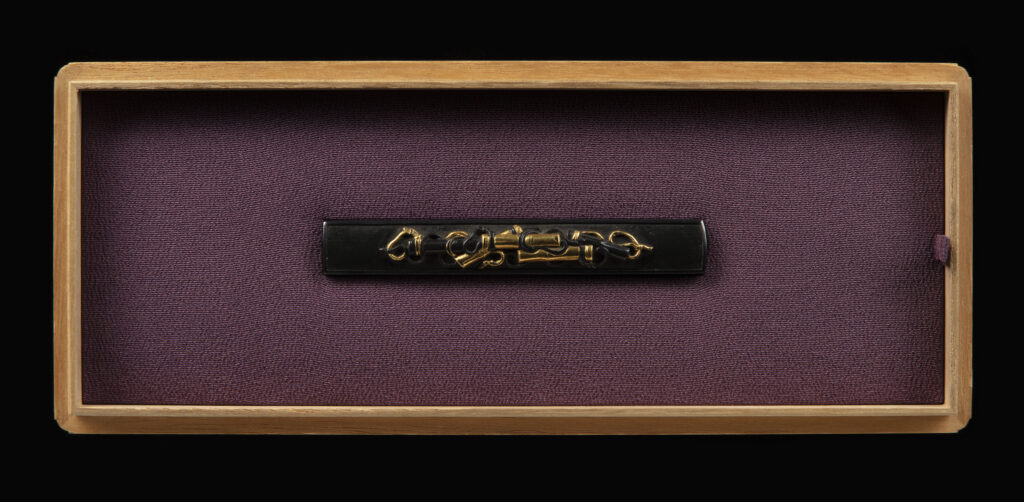
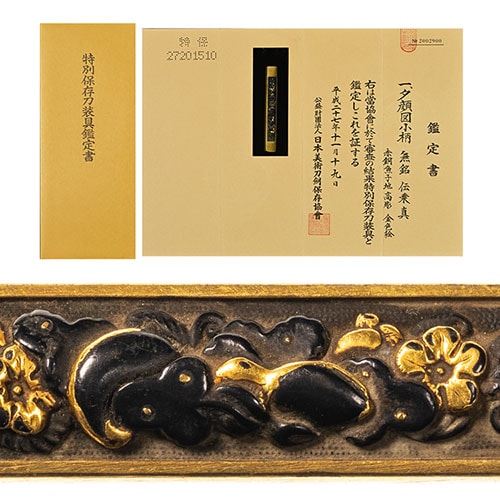
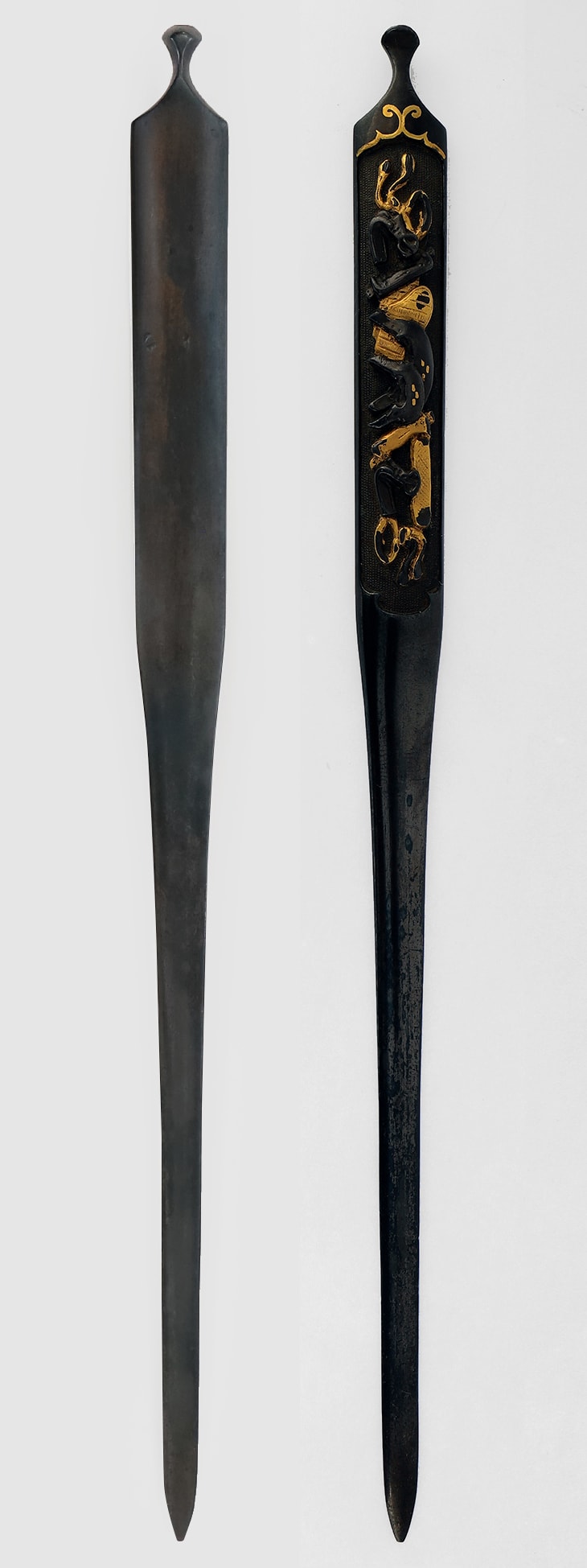
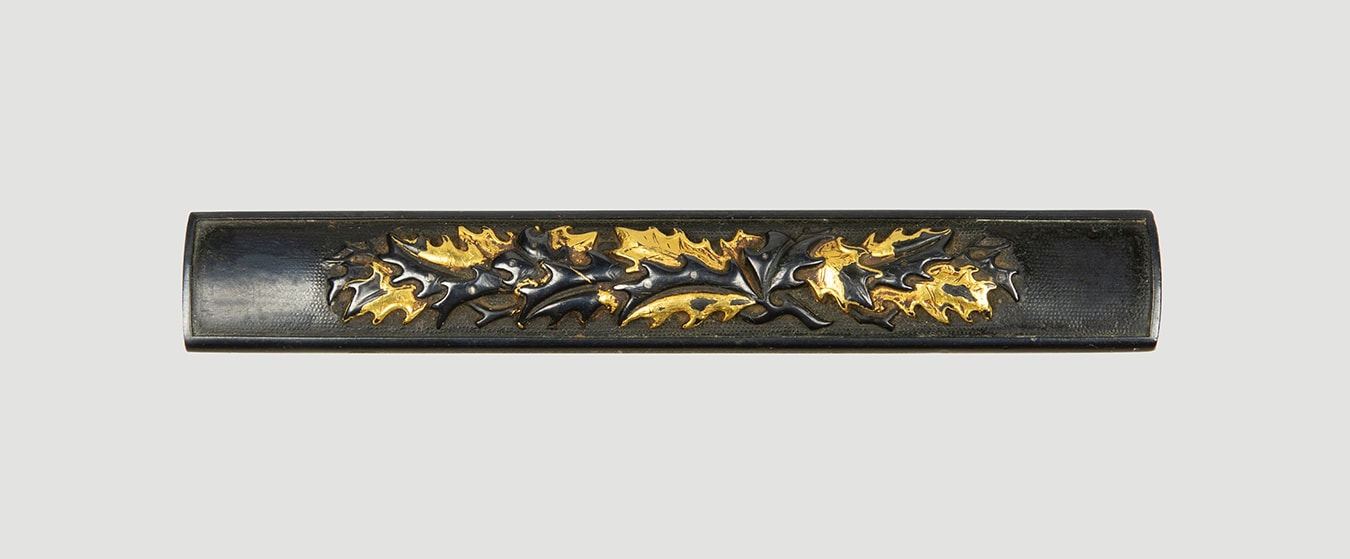
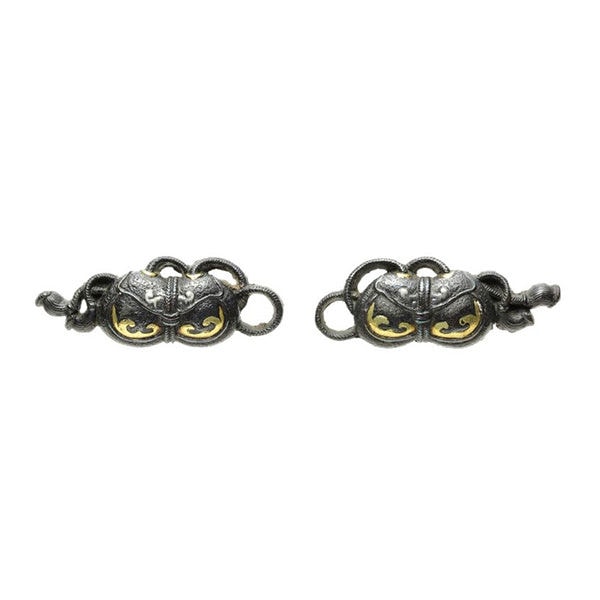
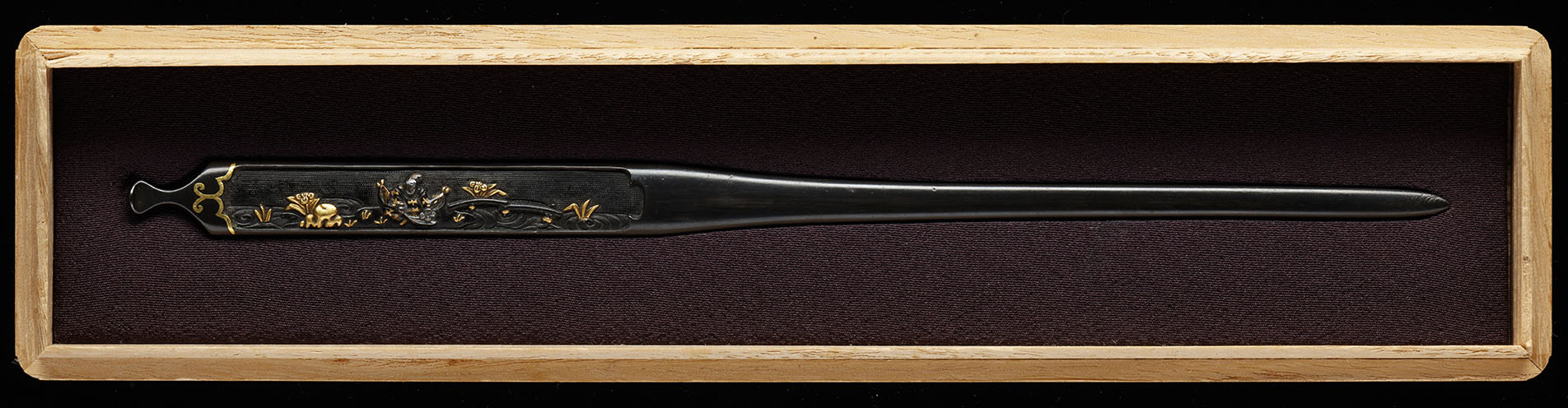
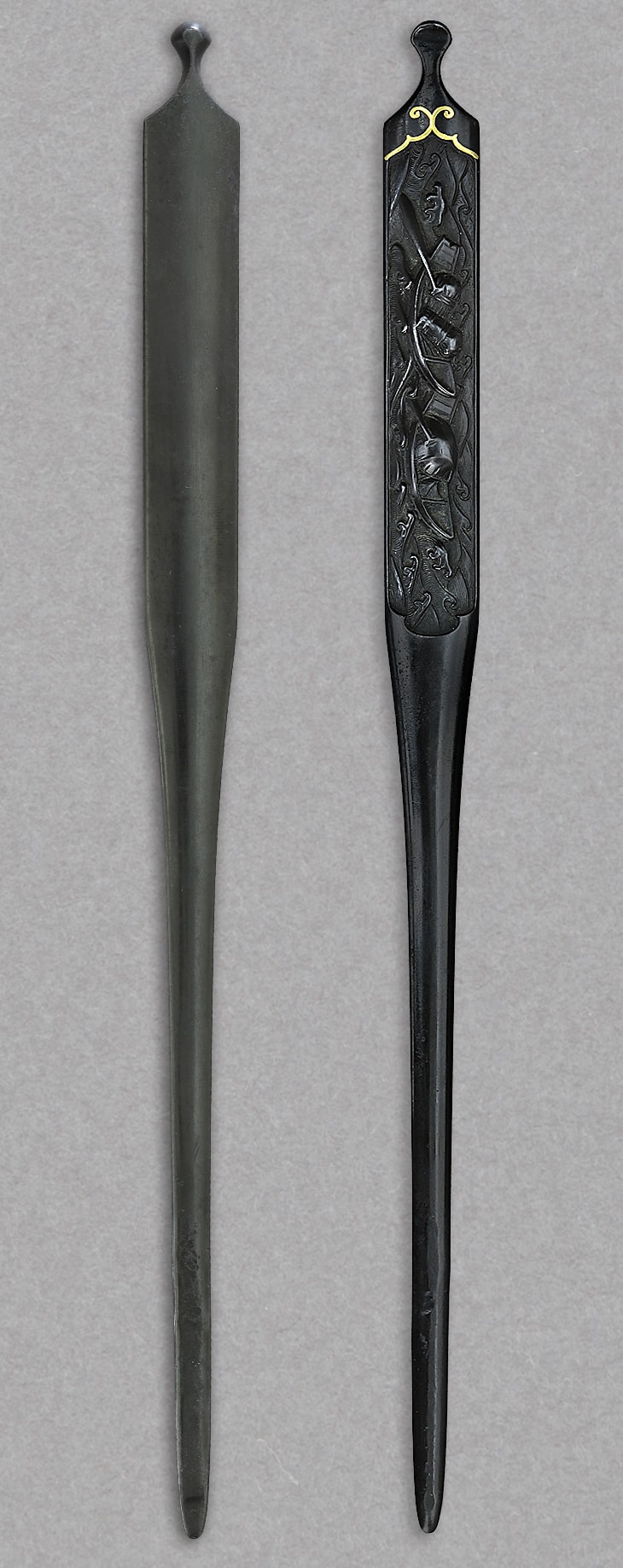
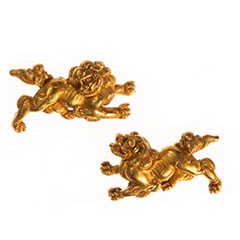
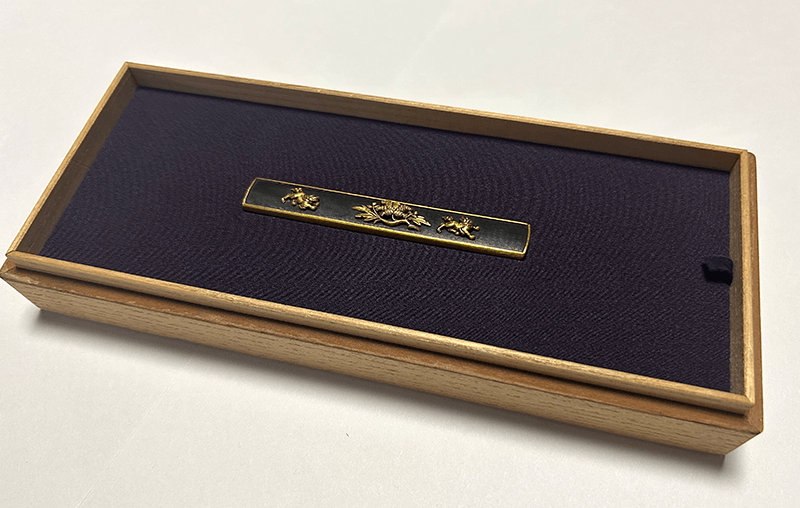
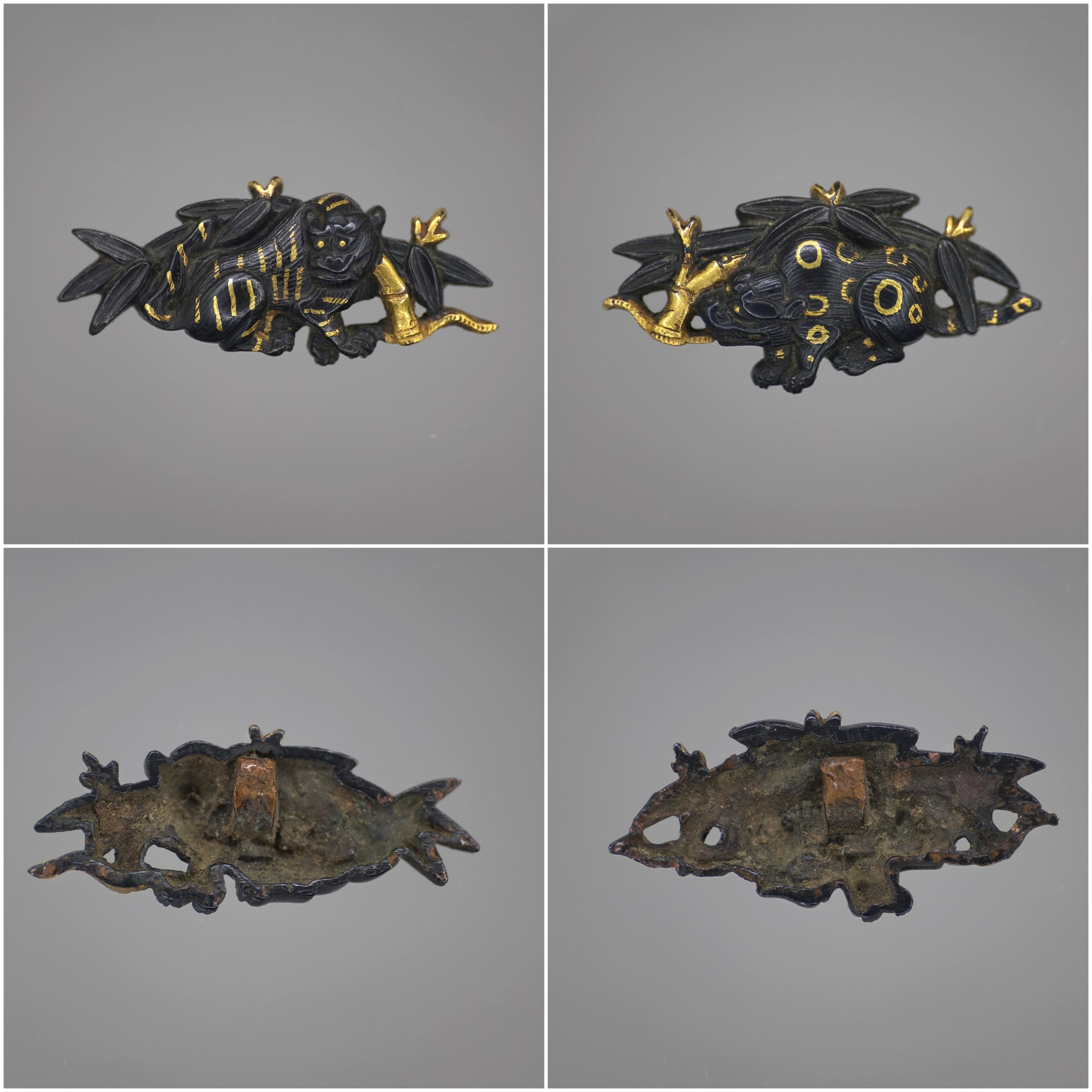
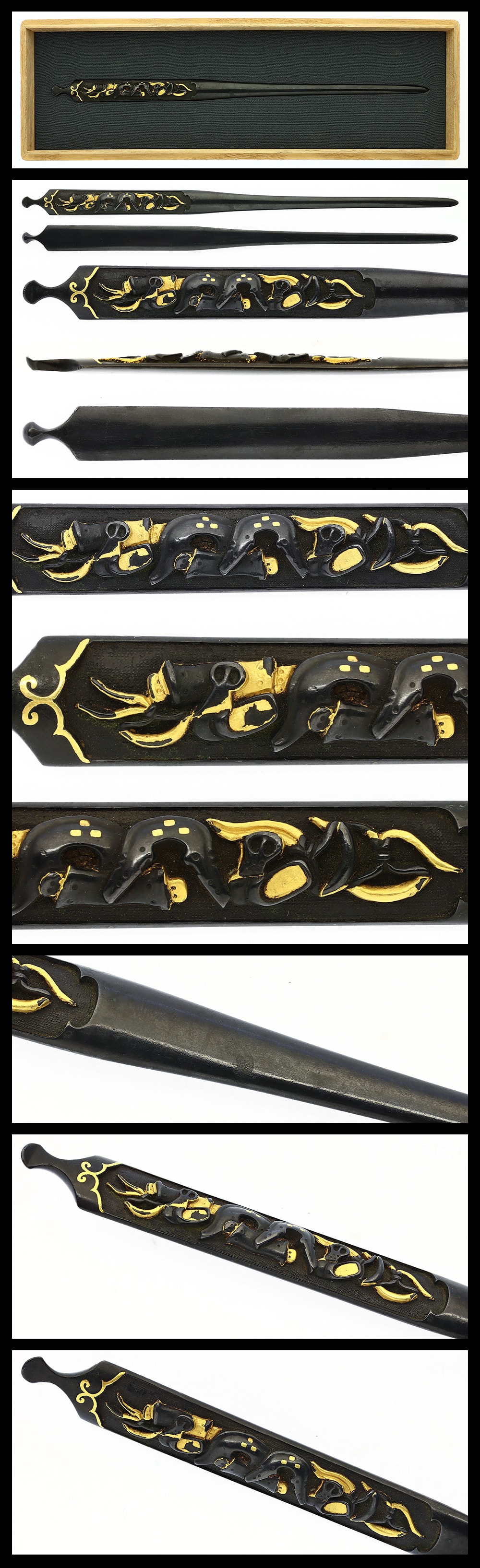
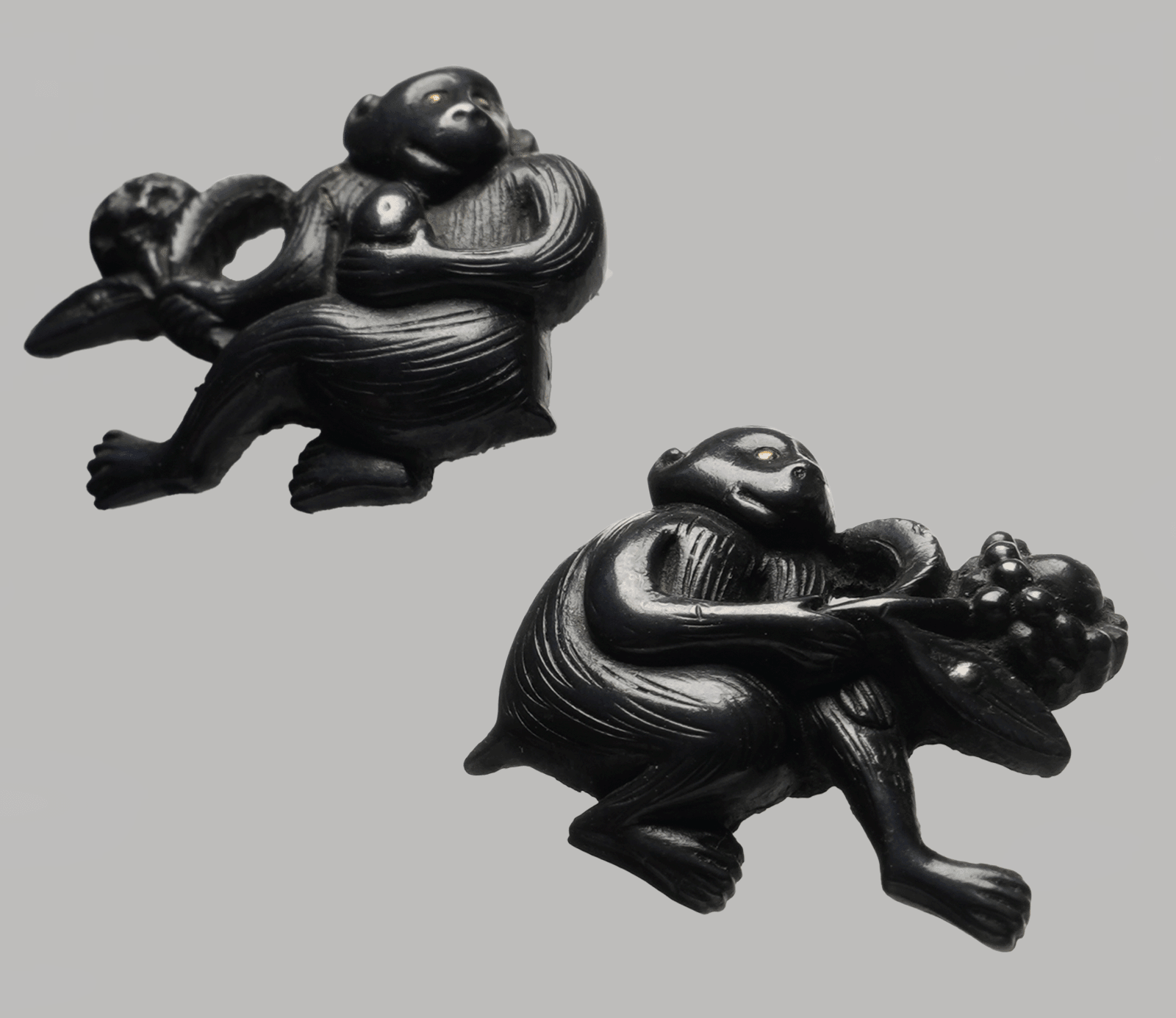
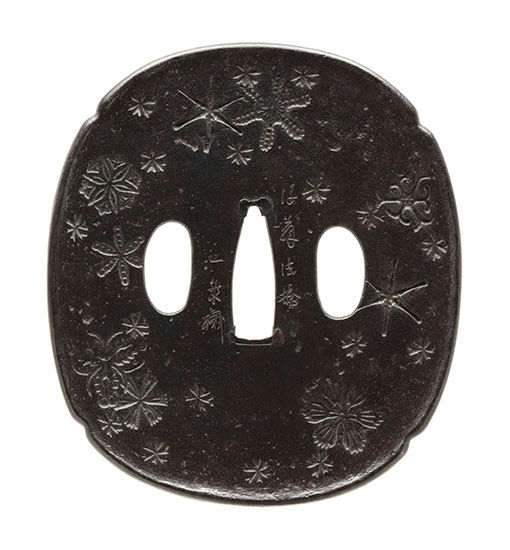
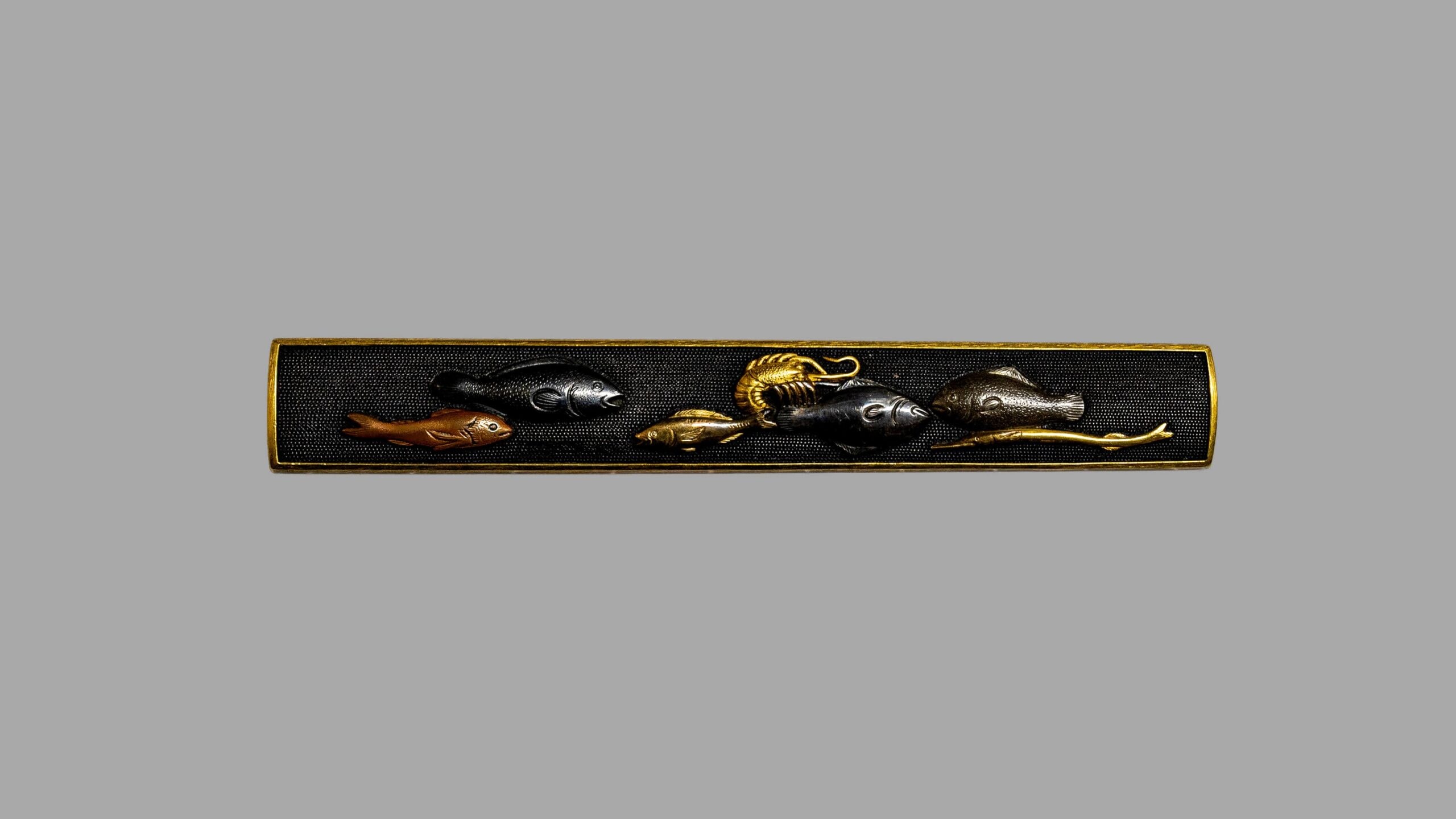
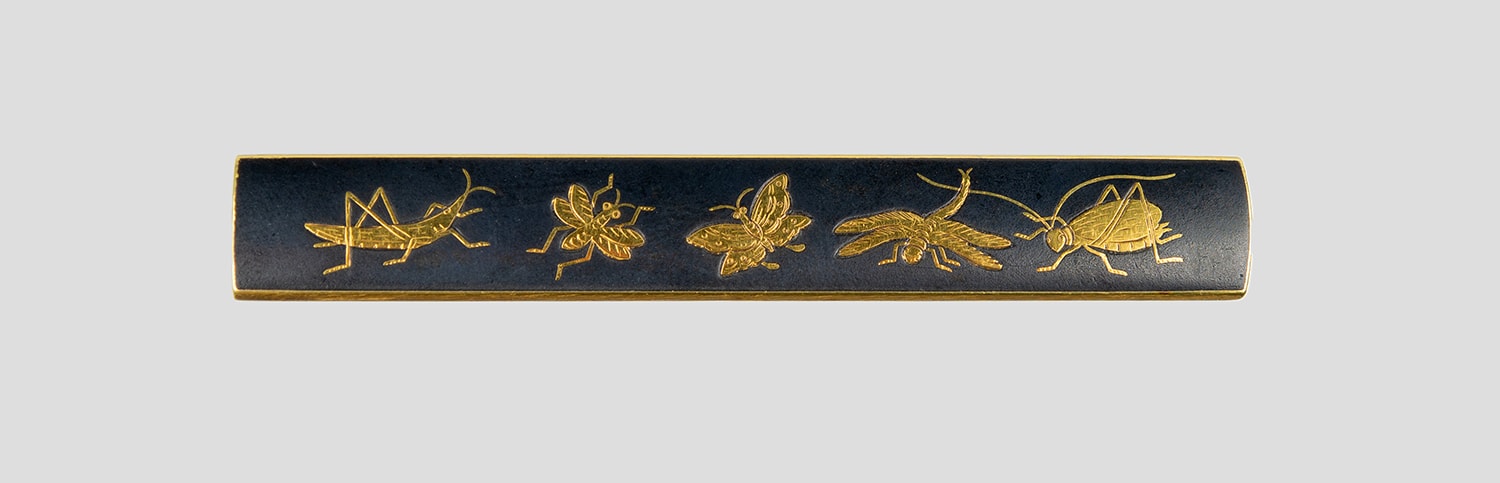
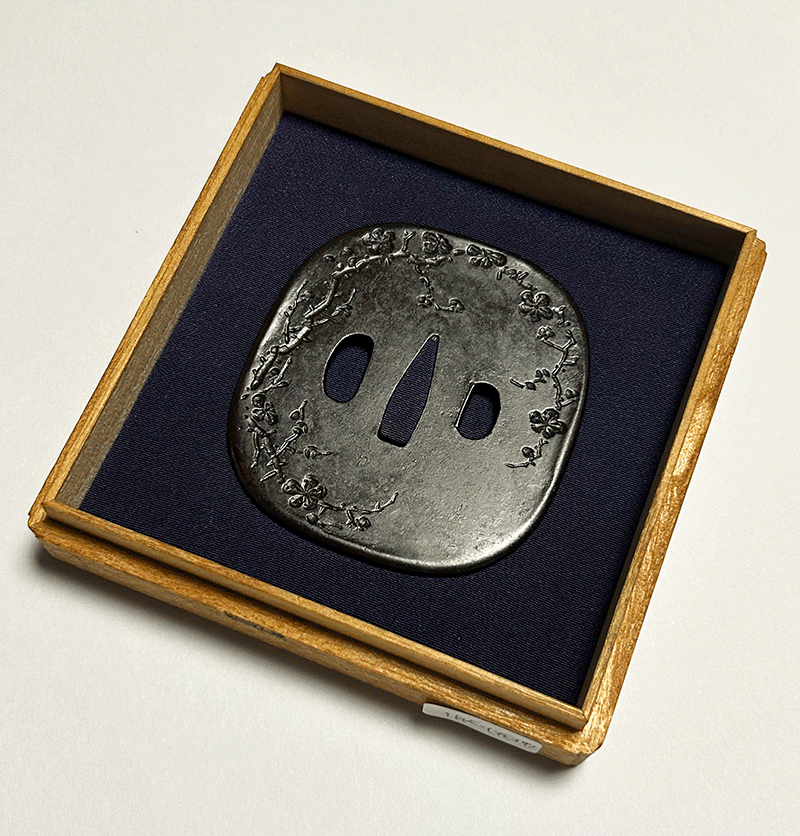
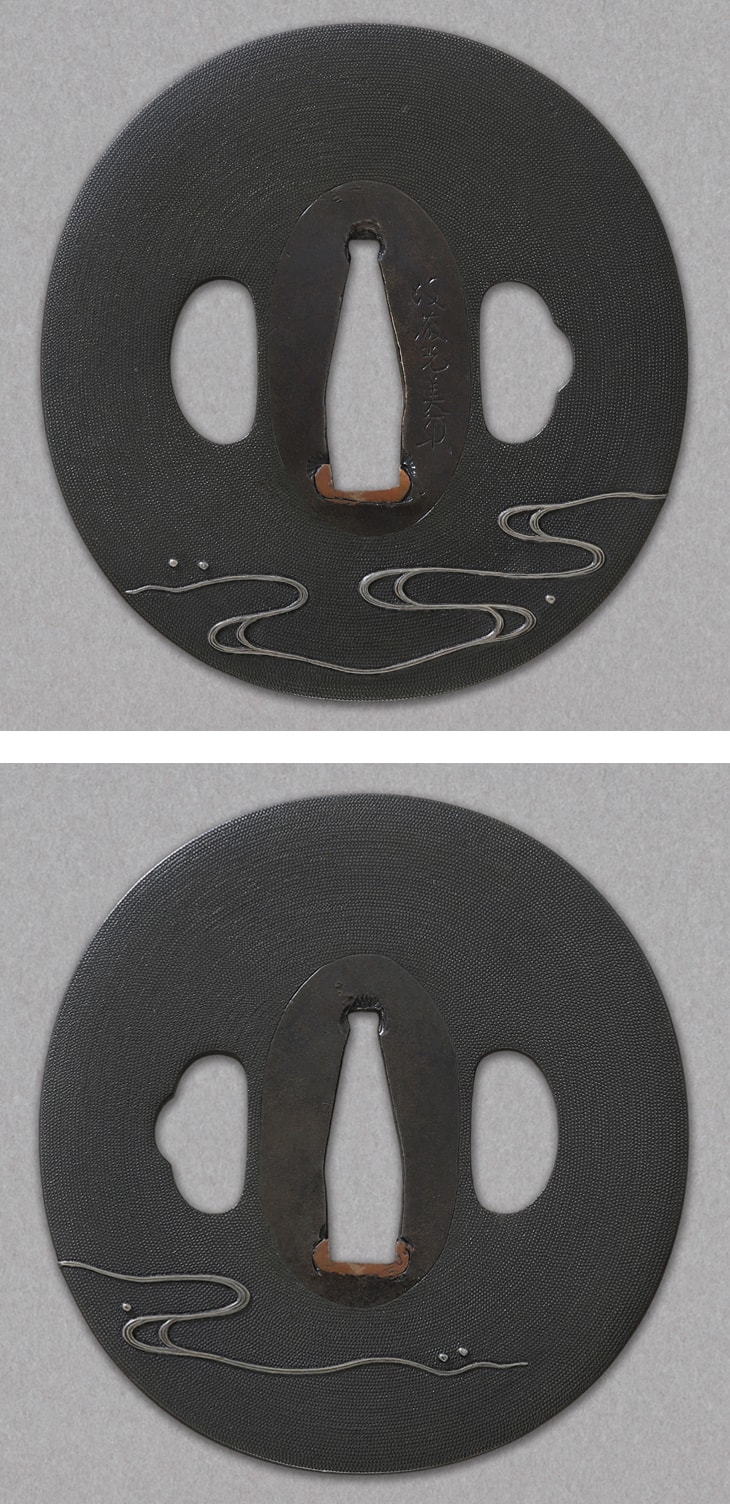
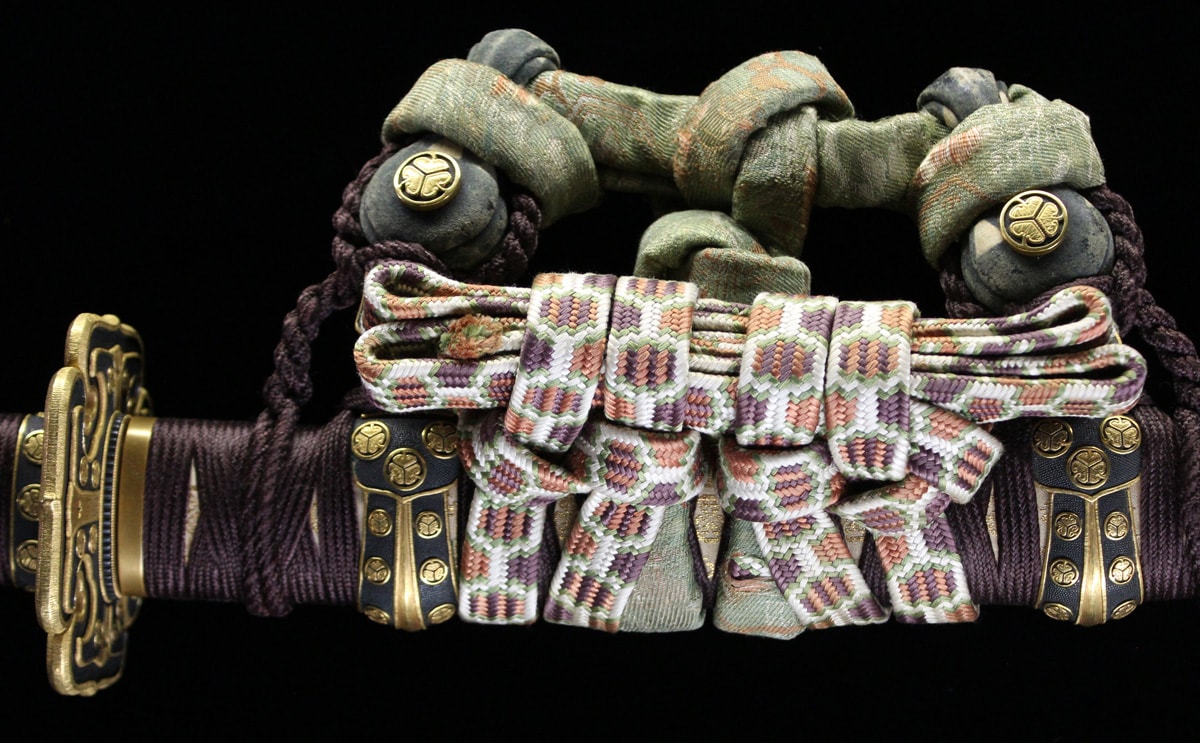
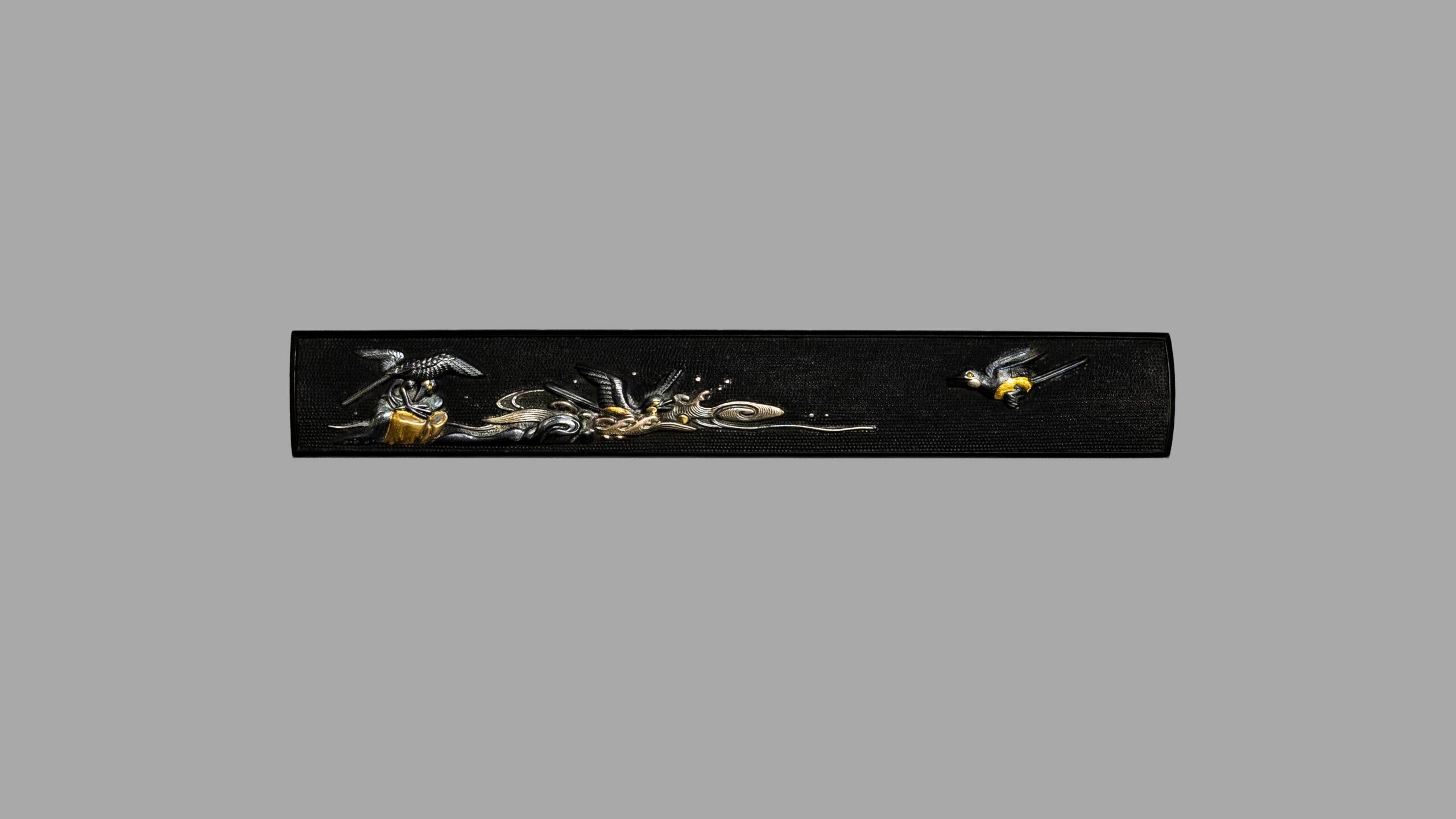
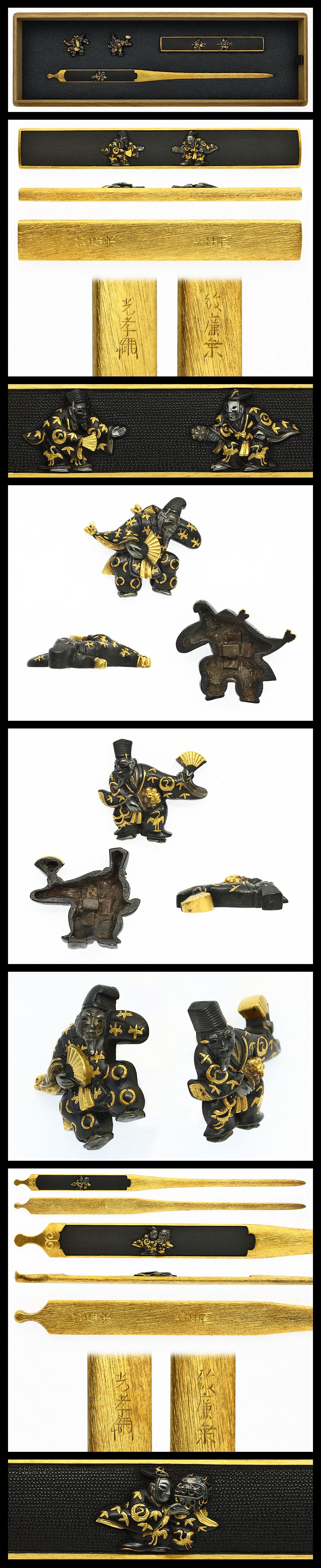
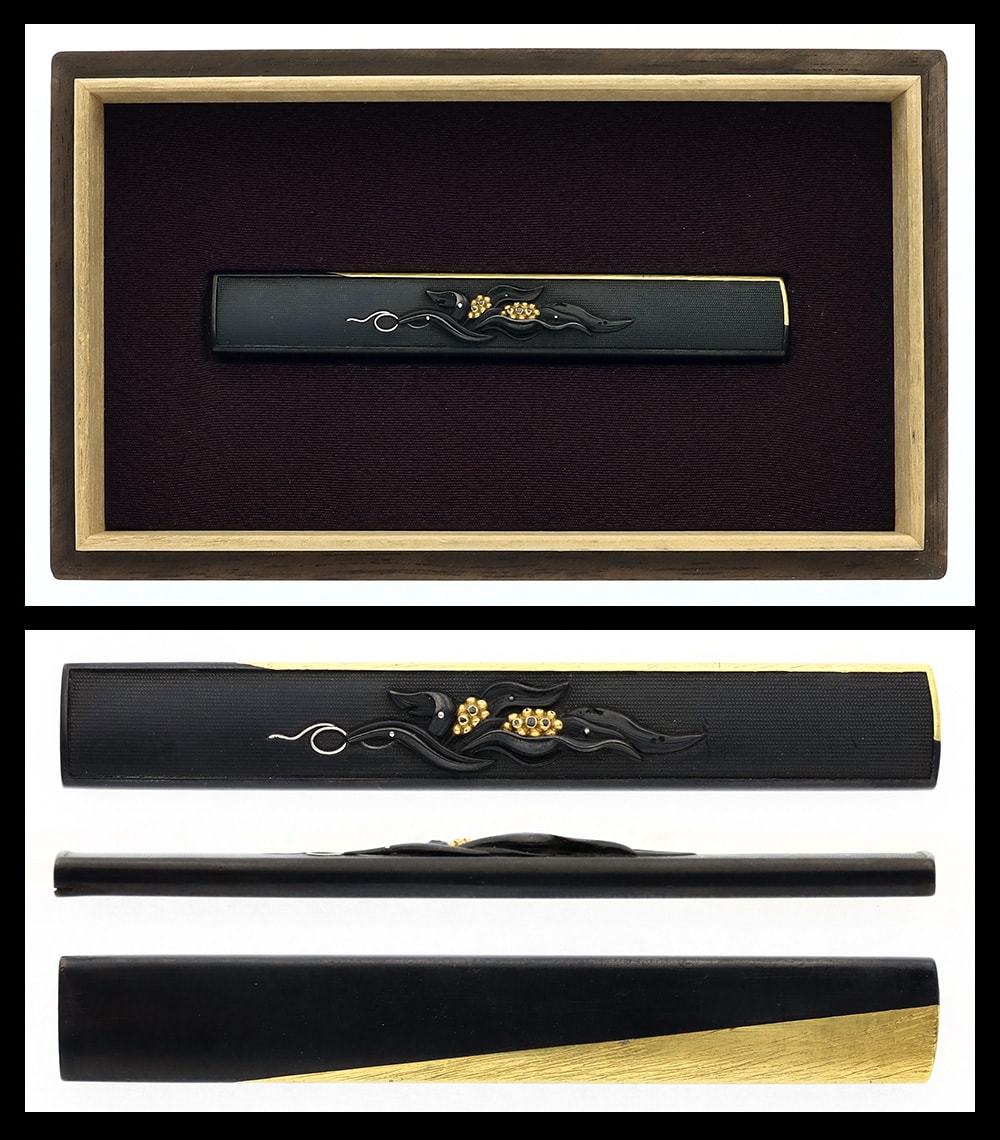
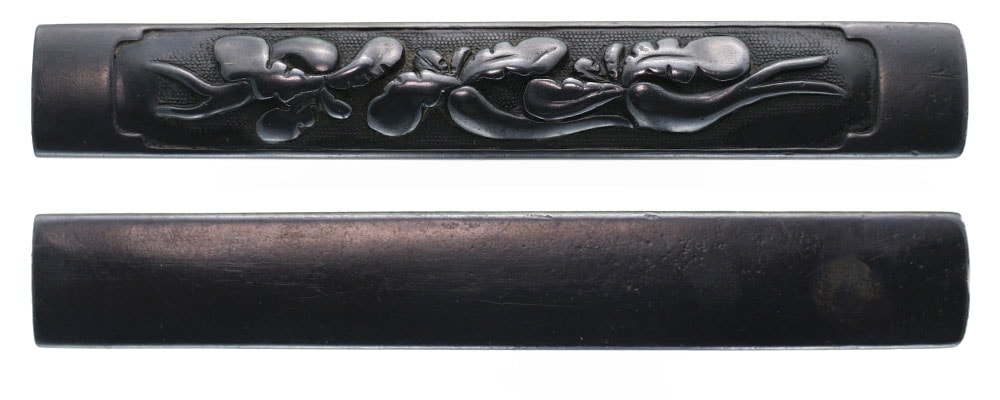
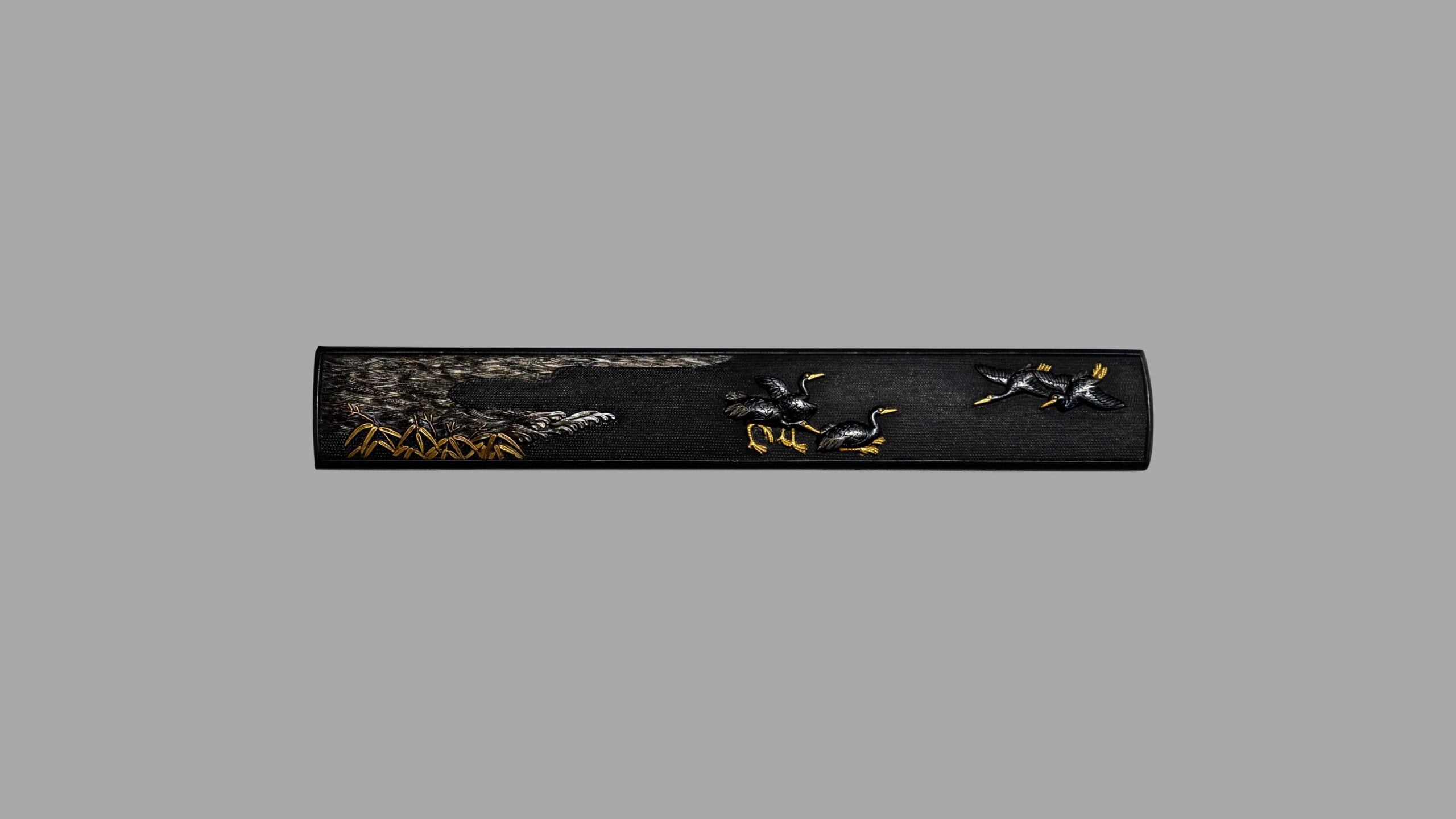
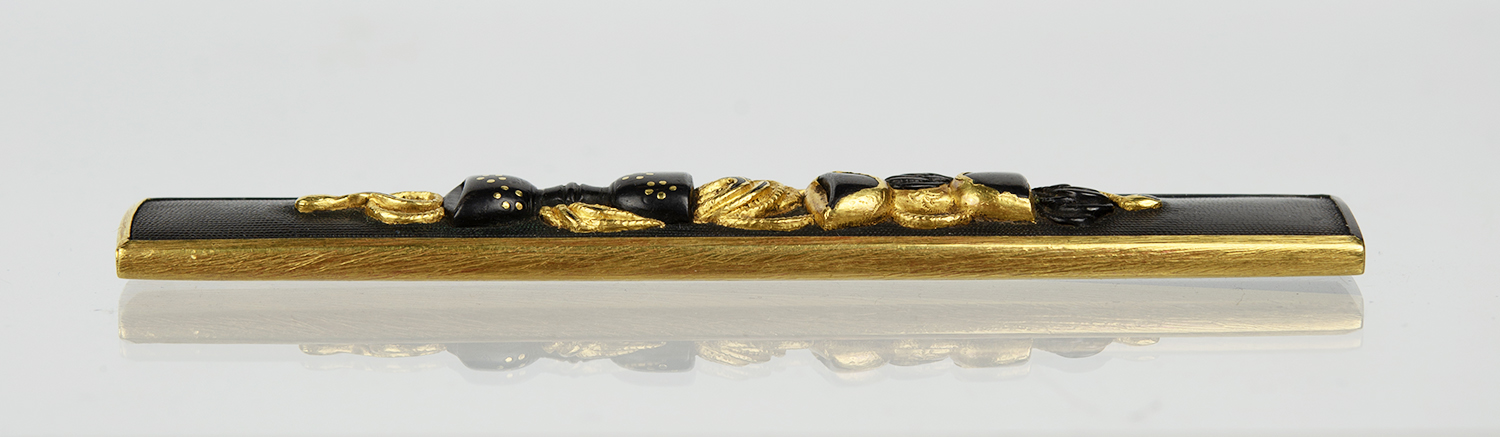
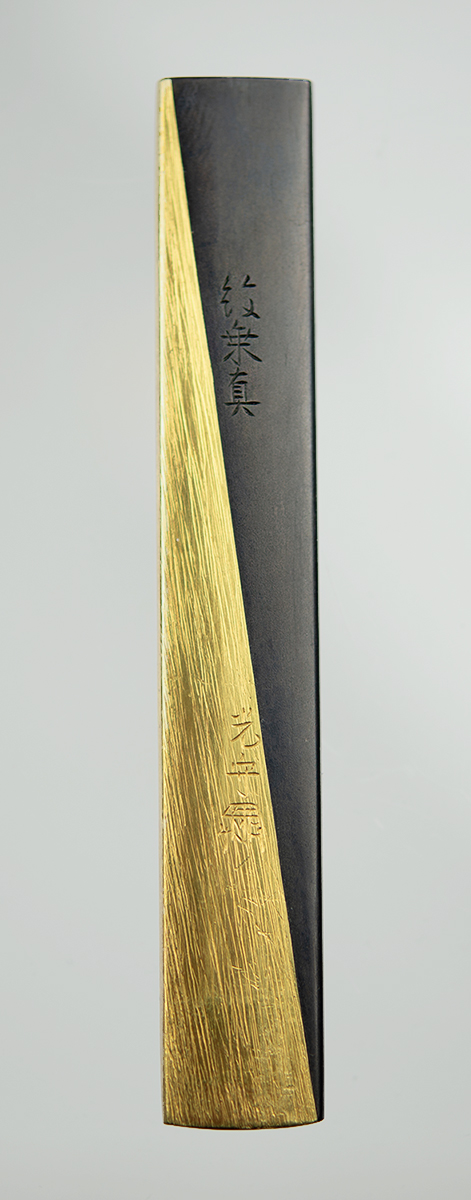
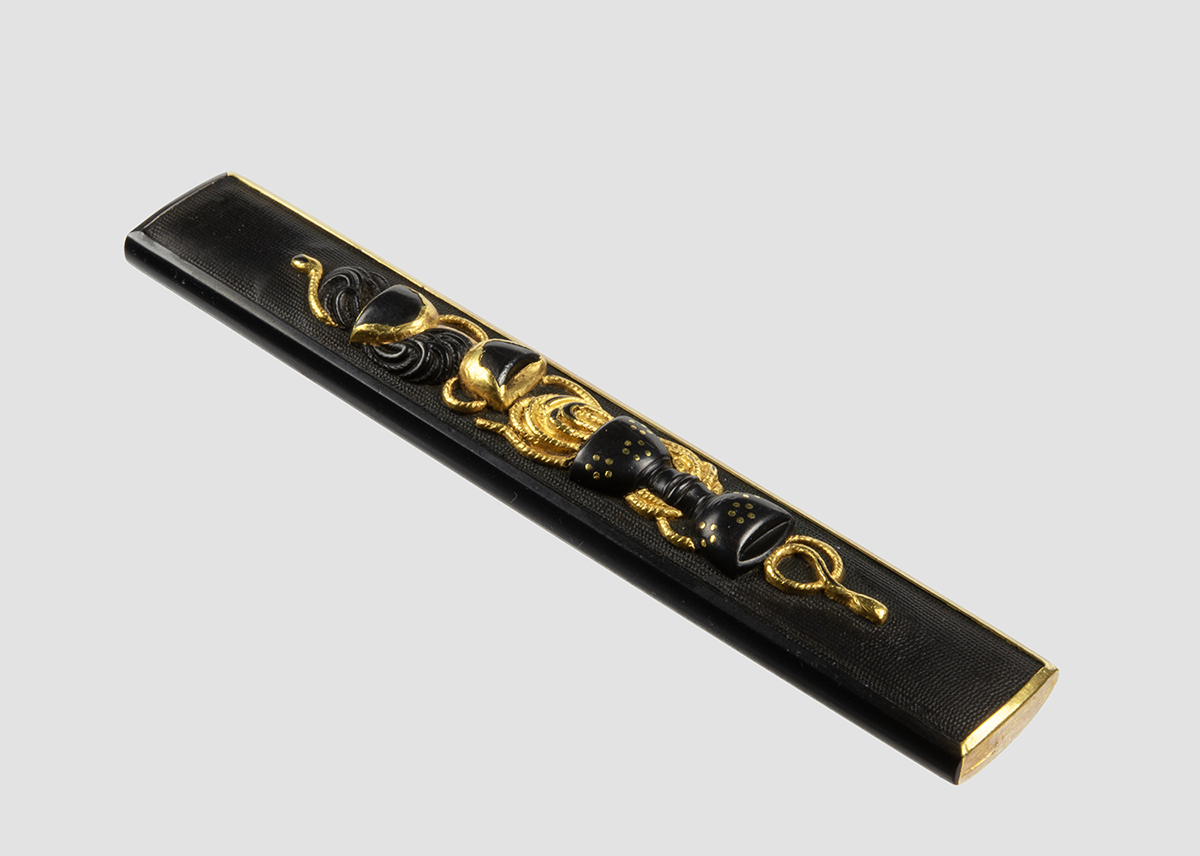
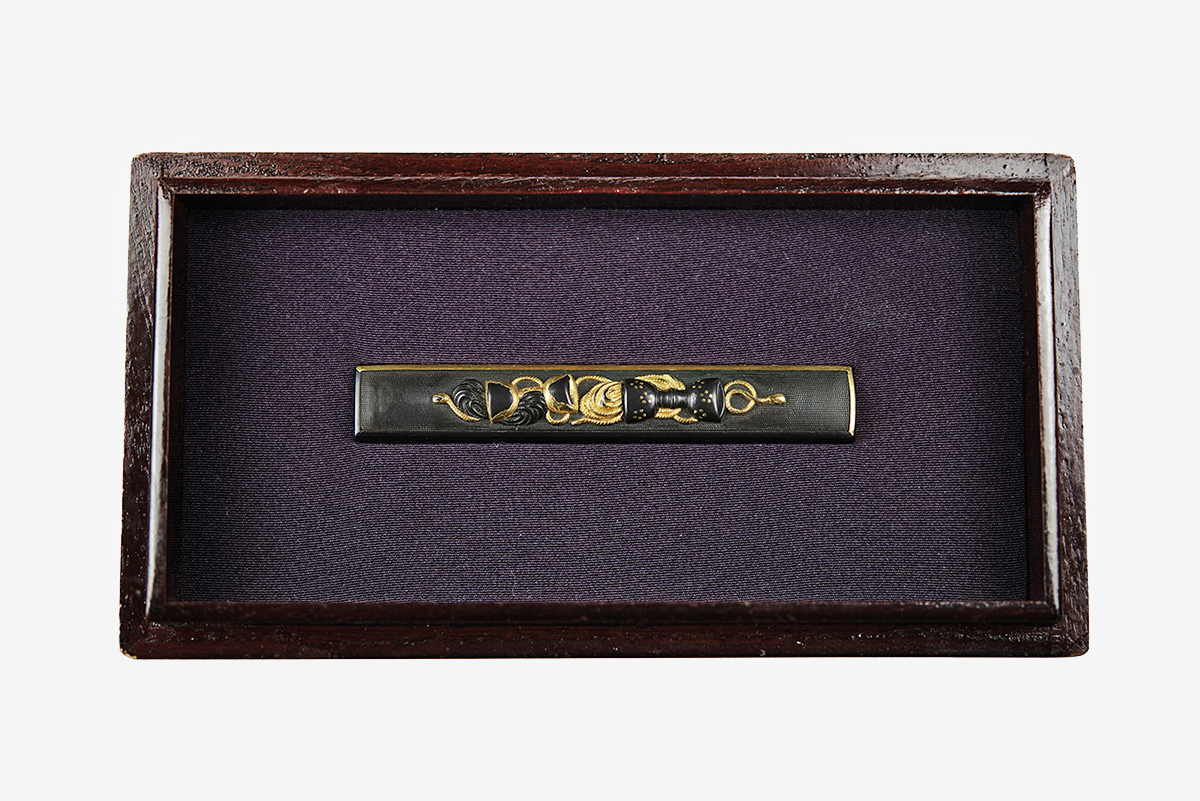
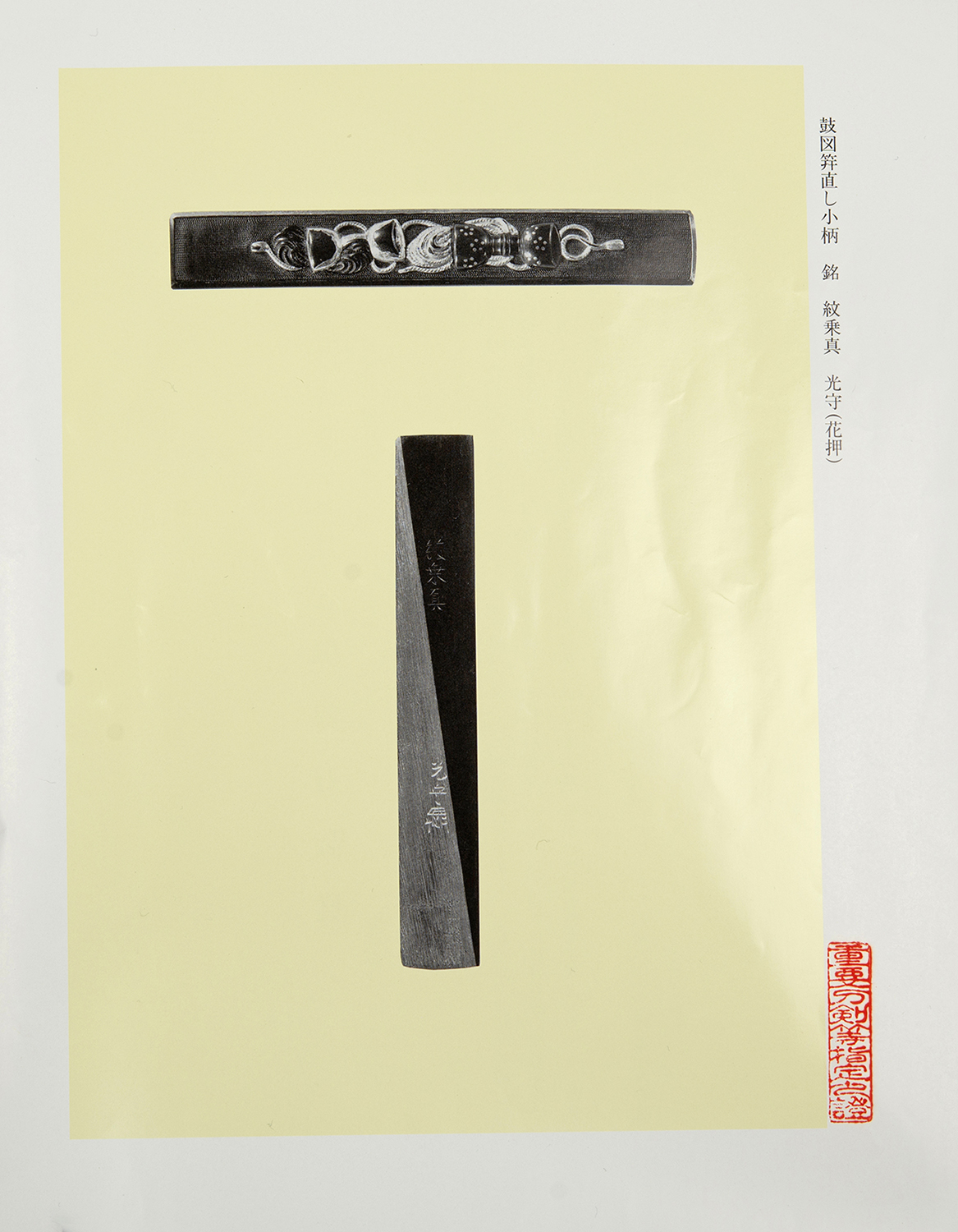
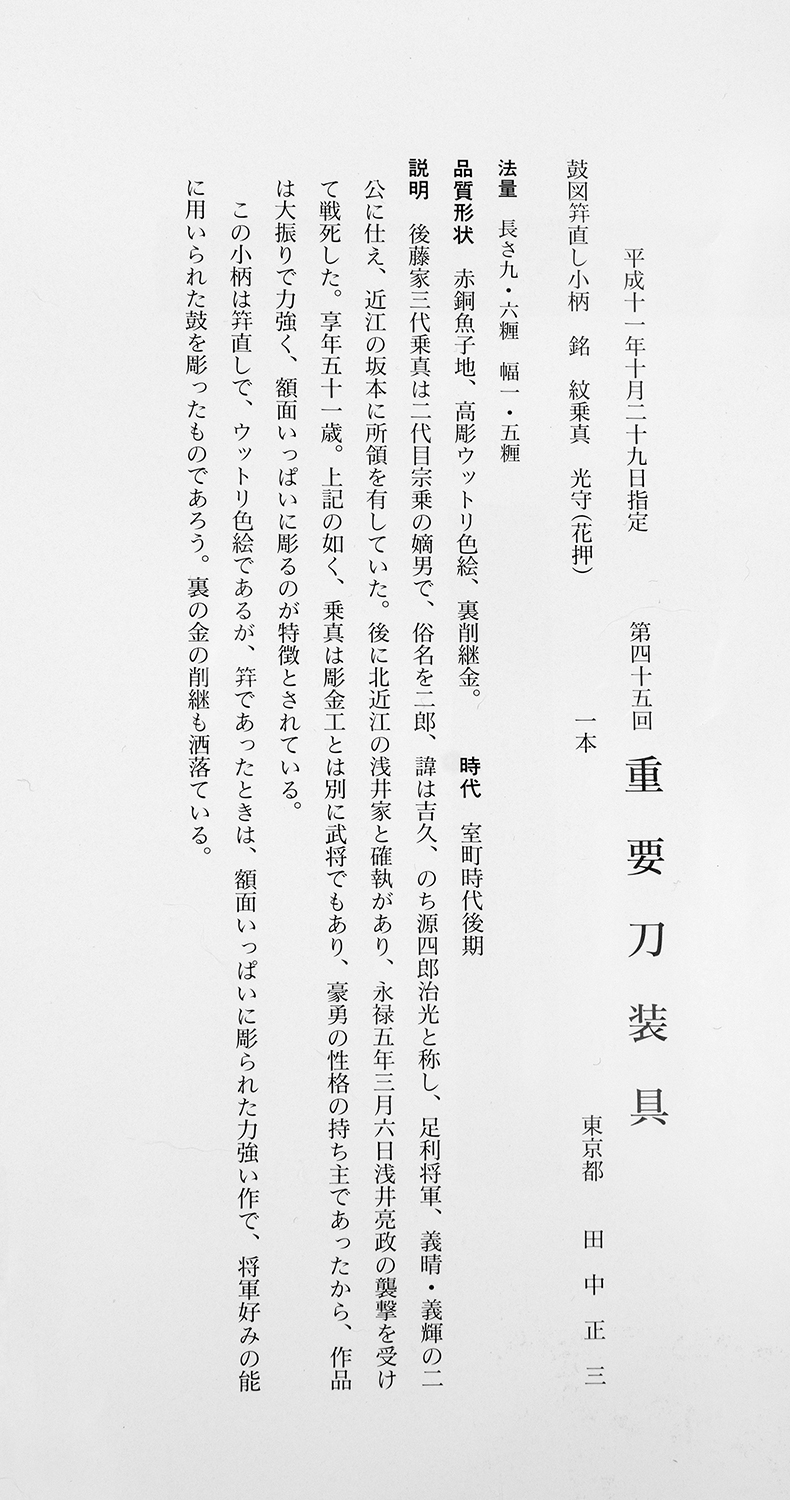
This is a Juyo kozuka made by Joshin, the third mainline Goto master. The kozuka is signed on the back “Mon Joshin Mitsmori (Kao)” indicating the motif was made by Joshin and attributed by Mitsumori. It features a drum theme kogai naoshi design with gold utori inlay.
 NihontoWatch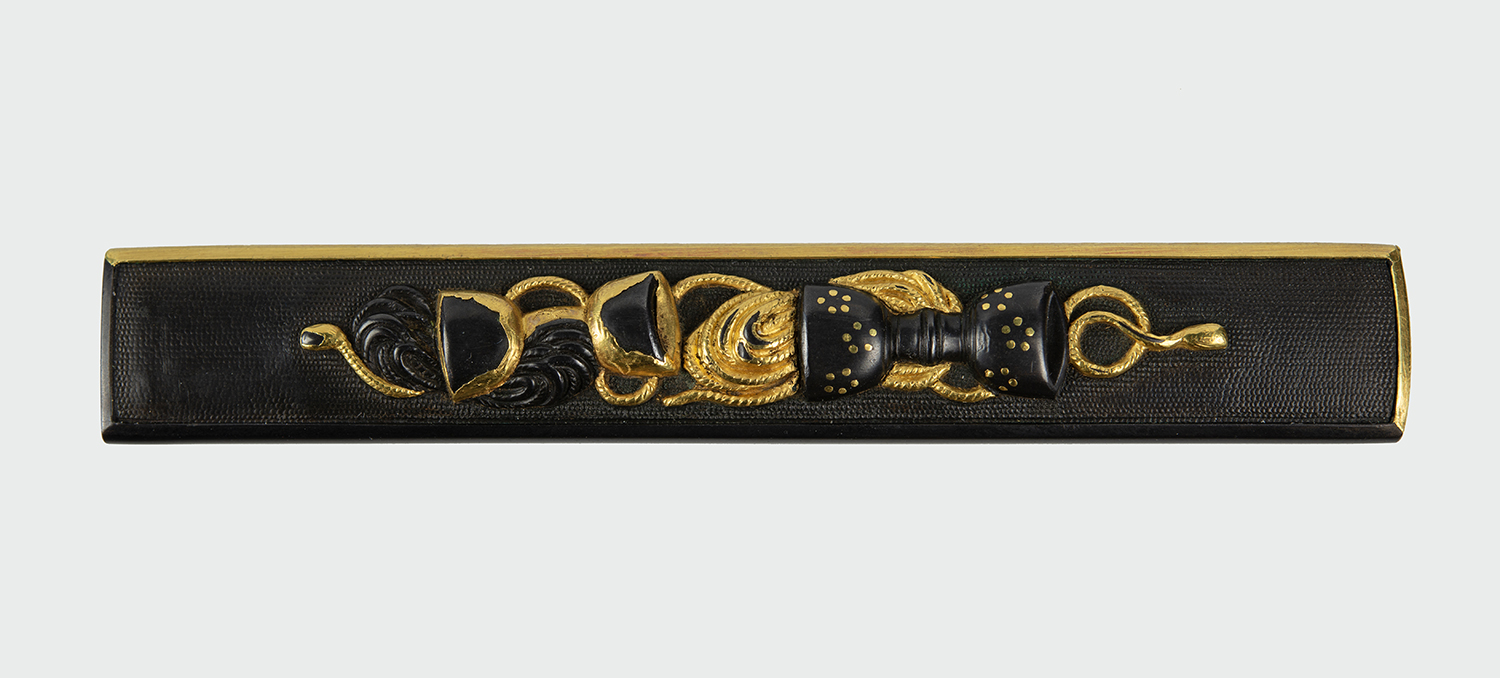
Goto Joshin
Muromachi
Signed
Jūyō #45 (NBTHK)
Iebori · Yamashiro · around 1512-1562
6 pieces on the market now
Goto Joshin, the third head of the mainline Goto house, was the legitimate son of the second master, Sojo. Born in Eisho 10 (1513), he bore the common name Jiro and the personal name (imina) Yoshihisa, later styling himself Genshiro Harumitsu. He served two successive Ashikaga shoguns, Yoshiharu and Yoshiteru, and held an estate of three hundred cho at Sakamoto in Omi Province. Joshin combined responsibilities in both metalwork and financial administration, and the NBTHK setsumei consistently note that he was "not only a metalworker but also a warrior," possessed of "a bold and valiant temperament." His dual vocation as craftsman and fighting man ended on the sixth day of the third month of Eiroku 5 (1562), when, owing to conflict with the Azai clan of northern Omi, he was attacked by Azai Ryomasa and killed in battle at the age of fifty-one. Within the Goto lineage he stands as a pivotal figure between the founding generation of Yujo and Sojo and the later masters who would enter Tokugawa service; several of his works survive as composite sets in which the sixth master Eijo or the ninth master Norinori supplied supplementary carvings to complete mitokoromono and mitsudogu ensembles begun by Joshin's hand.
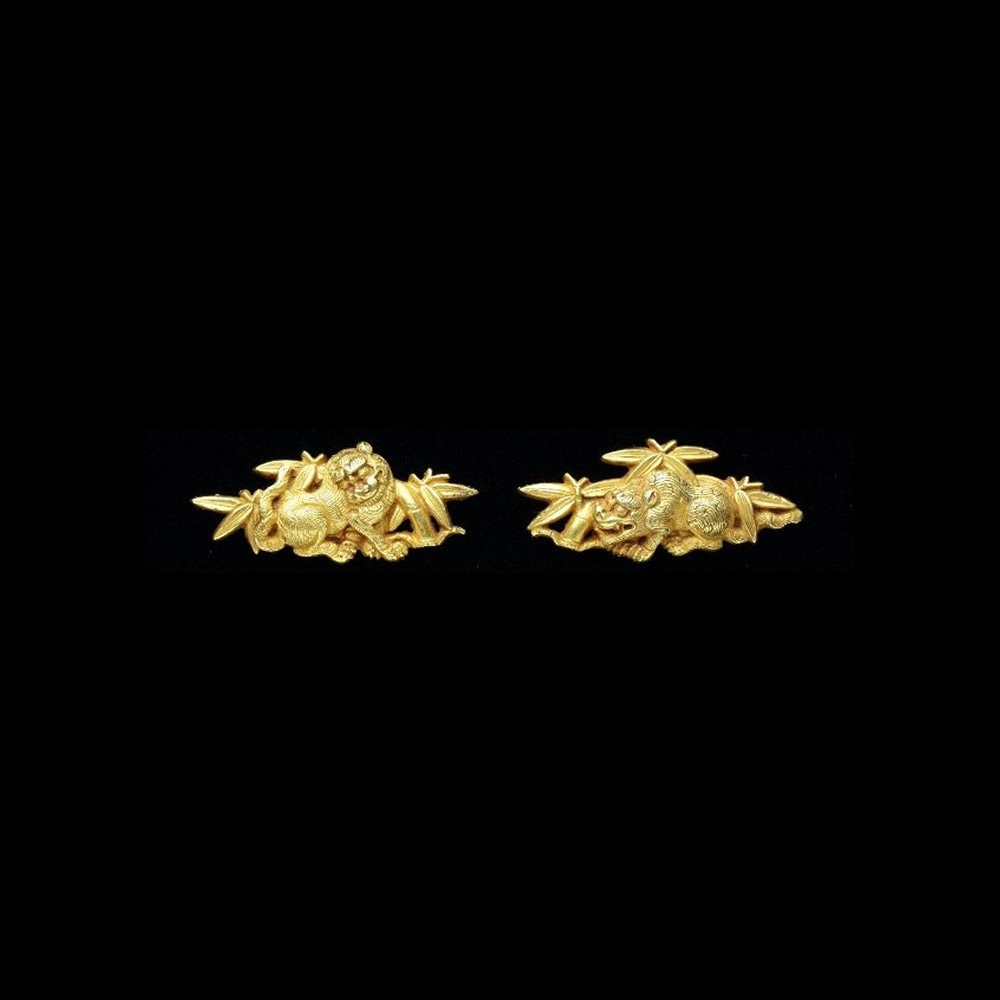
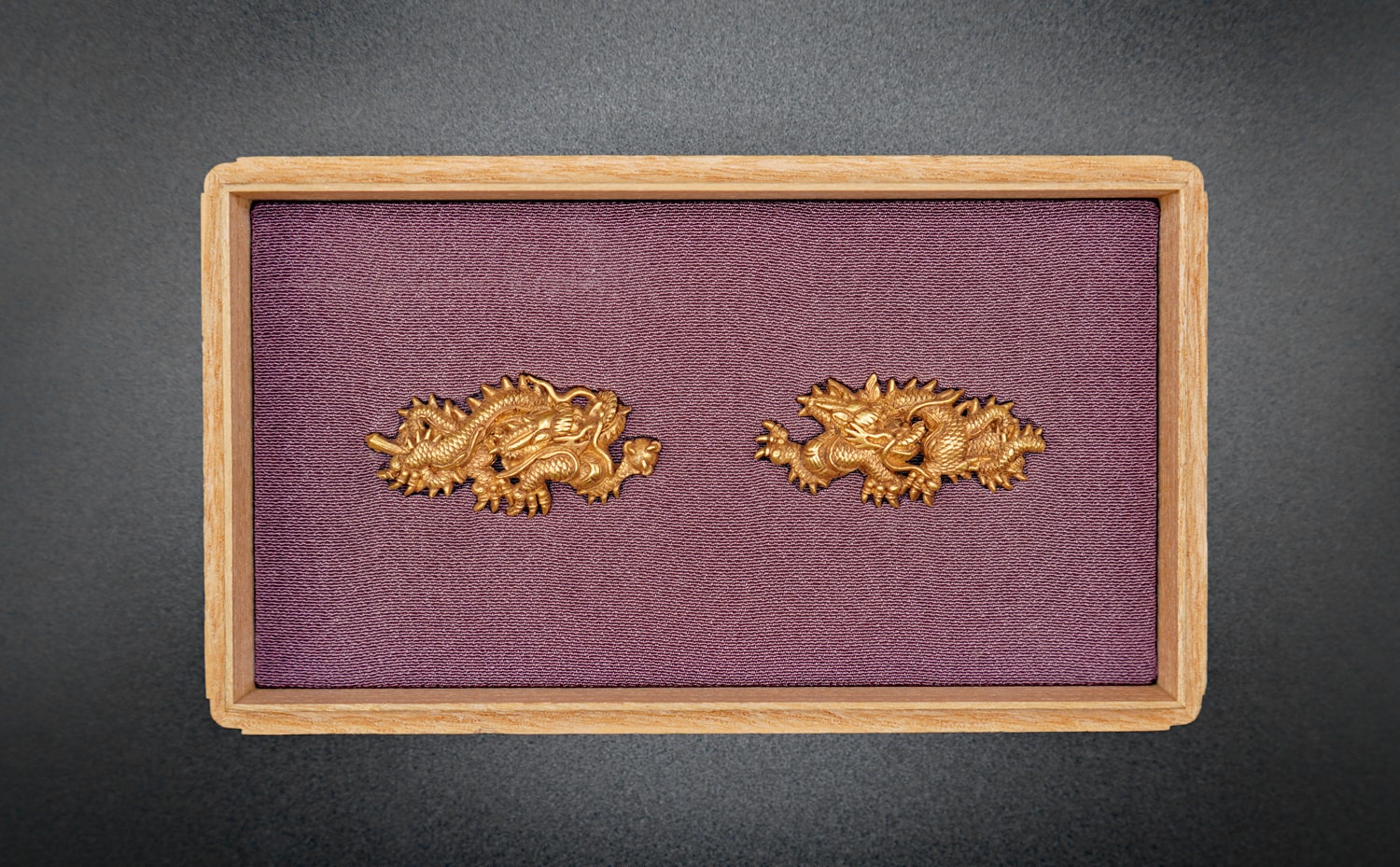
Joshin's works are executed overwhelmingly on shakudo nanako-ji grounds and are characterized, in the NBTHK's repeated formulation, by "large scale, forceful presence, and carving that fills the entire field[[c:1]]." The setsumei invoke a vivid spatial metaphor to describe his relief technique: "high mountains and deep valleys" — a modulation of volume in which the modeling rises emphatically from the ground while the recesses are cut deep and clean, producing what the assessors call "a pleasing sense of dynamism." His takabori is distinguished by "numerous triangular chisel marks" that "heighten the clarity and crispness of the workmanship," and by chisel lines that are consistently described as "tight" and "controlled." Among the Goto house's prescribed motifs (okitemono), Joshin treated the Kurikara-ryu dragon, paired lions (renjishi), and crawling dragon (hairyu) across successive generations, but his interpretations are set apart by their conspicuously larger scale and by claws that are "characteristically large and long, with the tips splayed open." His subjects range from auspicious themes — dragons that "raise clouds, call rain, and ascend to the heavens" — to martial motifs befitting a warrior-craftsman, including matchlock accoutrements, horse trappings, and bow-and-arrow compositions. Regardless of subject, his gold ornaments (kinmon) are described as "rich and brimming with strength," with the quality of the gold itself praised as "excellent" and "lustrous" against the deep tonality of jet-black shakudo. Works in solid gold (kinmuku) such as his renjishi menuki display "superb control of volume," while his iroe coloring in gold and silver achieves what the NBTHK calls "an especially pleasing chromatic effect."
The evaluative language applied to Joshin across his designated works is remarkably consistent: his carving is "abundant in volume and mass," his compositions "grand" and "dignified," and his finished pieces exhibit "an archaic dignity" and "elevated tone" that place them among the finest achievements of the early Goto house. The setsumei repeatedly conclude that individual works "fully manifest Joshin's true merit" or "display Jōshin's true merit to the fullest," a formulaic endorsement reserved for pieces judged to be wholly representative of a master's capability. His surviving oeuvre has been authenticated across centuries by successive Goto house heads — Kenjo (seventh generation), Teijo (ninth), Renjo (tenth), Mitsumori (fourteenth), and Mitsutaka (thirteenth) — whose origami appraisals, some dating to the early Edo period, are themselves regarded as documents "of great documentary value." Works bearing Joshin's attribution have been transmitted in such distinguished collections as the Konoike, Asano of Geishu, and Omaeda of Kaga families, underscoring that, even in his own era, fittings of this caliber could only have been commissioned by warriors of considerable rank.
Where Goto Joshin stands among comparable artisans: across all of nihontō, and within tradition, era, and period. The tiers (Foremost · Leading · Major · Notable) weigh official designations from the NBTHK and Japan's Agency for Cultural Affairs, together with historical honors of lasting repute such as the Sansaku and Meibutsu-chō.
Select a lens to see how it's measured.
Iebori · Yamashiro
Phase: Ko-Goto古後藤· 1440–1573
325 pieces on the market now
| Smith | Era | Designated |
|---|---|---|
| Goto Joshin後藤乗真 | 1512-1562 | 68 |
| Goto Yujo後藤祐乗 | 1440-1512 | 41 |
| Goto Kenjo後藤顕乗 | 1586-1663 | 46 |
| Goto Sojo後藤宗乗 | 1461-1538 | 55 |
| Goto Eijo後藤栄乗 | 1577-1617 | 35 |
Exceptional craft of very high artistic value, judged to rank with a nationally recognized Important Art Object (Jūyō Bijutsuhin).
The NBTHK (Nihon Bijutsu Tōken Hozon Kyōkai, the Society for the Preservation of Japanese Art Swords) is a public-interest incorporated foundation founded in 1948 and supervised by Japan’s Agency for Cultural Affairs (Bunkachō); it is based at the Japanese Sword Museum in Tokyo. Its expert panels physically examine each submitted work (shinsa) and issue a certificate (kanteishō) ranking it by artistic and historical merit. NBTHK papers are the most widely recognized standard of authentication for Japanese swords and fittings.
NBTHK official site3 day inspection period on all sales. Items can be returned for any reason for a full refund, less return shipping cost. Returned items must be in the same condition as when purchased.
This is a Juyo kozuka made by Joshin, the third mainline Goto master. The kozuka is signed on the back “Mon Joshin Mitsmori (Kao)” indicating the motif was made by Joshin and attributed by Mitsumori. It features a drum theme kogai naoshi design with gold utori inlay.
NihontoWatchGoto Joshin
Muromachi
Signed
Jūyō #45 (NBTHK)
Iebori · Yamashiro · around 1512-1562
6 pieces on the market now
Goto Joshin, the third head of the mainline Goto house, was the legitimate son of the second master, Sojo. Born in Eisho 10 (1513), he bore the common name Jiro and the personal name (imina) Yoshihisa, later styling himself Genshiro Harumitsu. He served two successive Ashikaga shoguns, Yoshiharu and Yoshiteru, and held an estate of three hundred cho at Sakamoto in Omi Province. Joshin combined responsibilities in both metalwork and financial administration, and the NBTHK setsumei consistently note that he was "not only a metalworker but also a warrior," possessed of "a bold and valiant temperament." His dual vocation as craftsman and fighting man ended on the sixth day of the third month of Eiroku 5 (1562), when, owing to conflict with the Azai clan of northern Omi, he was attacked by Azai Ryomasa and killed in battle at the age of fifty-one. Within the Goto lineage he stands as a pivotal figure between the founding generation of Yujo and Sojo and the later masters who would enter Tokugawa service; several of his works survive as composite sets in which the sixth master Eijo or the ninth master Norinori supplied supplementary carvings to complete mitokoromono and mitsudogu ensembles begun by Joshin's hand.
Joshin's works are executed overwhelmingly on shakudo nanako-ji grounds and are characterized, in the NBTHK's repeated formulation, by "large scale, forceful presence, and carving that fills the entire field[[c:1]]." The setsumei invoke a vivid spatial metaphor to describe his relief technique: "high mountains and deep valleys" — a modulation of volume in which the modeling rises emphatically from the ground while the recesses are cut deep and clean, producing what the assessors call "a pleasing sense of dynamism." His takabori is distinguished by "numerous triangular chisel marks" that "heighten the clarity and crispness of the workmanship," and by chisel lines that are consistently described as "tight" and "controlled." Among the Goto house's prescribed motifs (okitemono), Joshin treated the Kurikara-ryu dragon, paired lions (renjishi), and crawling dragon (hairyu) across successive generations, but his interpretations are set apart by their conspicuously larger scale and by claws that are "characteristically large and long, with the tips splayed open." His subjects range from auspicious themes — dragons that "raise clouds, call rain, and ascend to the heavens" — to martial motifs befitting a warrior-craftsman, including matchlock accoutrements, horse trappings, and bow-and-arrow compositions. Regardless of subject, his gold ornaments (kinmon) are described as "rich and brimming with strength," with the quality of the gold itself praised as "excellent" and "lustrous" against the deep tonality of jet-black shakudo. Works in solid gold (kinmuku) such as his renjishi menuki display "superb control of volume," while his iroe coloring in gold and silver achieves what the NBTHK calls "an especially pleasing chromatic effect."
The evaluative language applied to Joshin across his designated works is remarkably consistent: his carving is "abundant in volume and mass," his compositions "grand" and "dignified," and his finished pieces exhibit "an archaic dignity" and "elevated tone" that place them among the finest achievements of the early Goto house. The setsumei repeatedly conclude that individual works "fully manifest Joshin's true merit" or "display Jōshin's true merit to the fullest," a formulaic endorsement reserved for pieces judged to be wholly representative of a master's capability. His surviving oeuvre has been authenticated across centuries by successive Goto house heads — Kenjo (seventh generation), Teijo (ninth), Renjo (tenth), Mitsumori (fourteenth), and Mitsutaka (thirteenth) — whose origami appraisals, some dating to the early Edo period, are themselves regarded as documents "of great documentary value." Works bearing Joshin's attribution have been transmitted in such distinguished collections as the Konoike, Asano of Geishu, and Omaeda of Kaga families, underscoring that, even in his own era, fittings of this caliber could only have been commissioned by warriors of considerable rank.
Where Goto Joshin stands among comparable artisans: across all of nihontō, and within tradition, era, and period. The tiers (Foremost · Leading · Major · Notable) weigh official designations from the NBTHK and Japan's Agency for Cultural Affairs, together with historical honors of lasting repute such as the Sansaku and Meibutsu-chō.
Select a lens to see how it's measured.
Iebori · Yamashiro
Phase: Ko-Goto古後藤· 1440–1573
325 pieces on the market now
| Smith | Era | Designated |
|---|---|---|
| Goto Joshin後藤乗真 | 1512-1562 | 68 |
| Goto Yujo後藤祐乗 | 1440-1512 | 41 |
| Goto Kenjo後藤顕乗 | 1586-1663 | 46 |
| Goto Sojo後藤宗乗 | 1461-1538 | 55 |
| Goto Eijo後藤栄乗 | 1577-1617 | 35 |
Exceptional craft of very high artistic value, judged to rank with a nationally recognized Important Art Object (Jūyō Bijutsuhin).
The NBTHK (Nihon Bijutsu Tōken Hozon Kyōkai, the Society for the Preservation of Japanese Art Swords) is a public-interest incorporated foundation founded in 1948 and supervised by Japan’s Agency for Cultural Affairs (Bunkachō); it is based at the Japanese Sword Museum in Tokyo. Its expert panels physically examine each submitted work (shinsa) and issue a certificate (kanteishō) ranking it by artistic and historical merit. NBTHK papers are the most widely recognized standard of authentication for Japanese swords and fittings.
NBTHK official site3 day inspection period on all sales. Items can be returned for any reason for a full refund, less return shipping cost. Returned items must be in the same condition as when purchased.