 NihontoWatchNihontoWatch
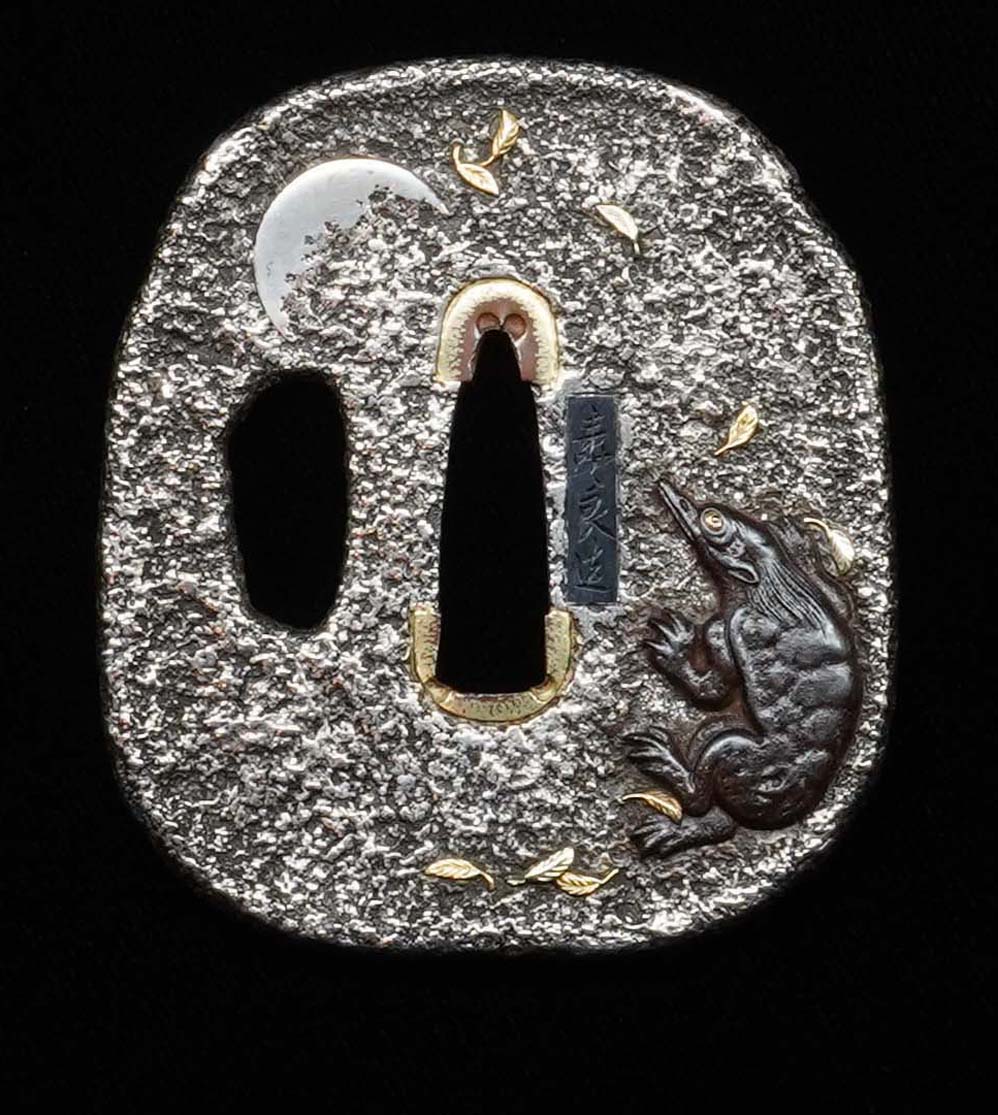
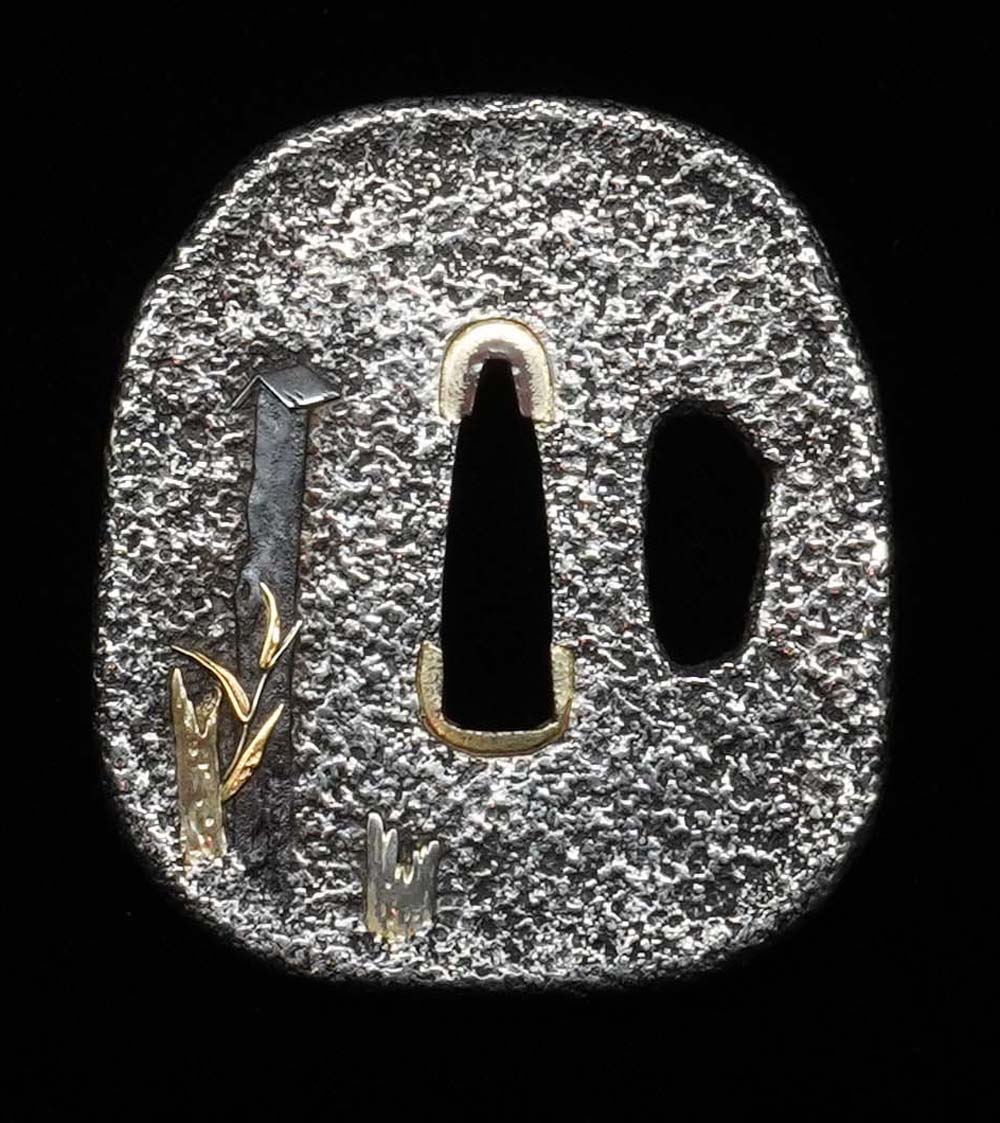
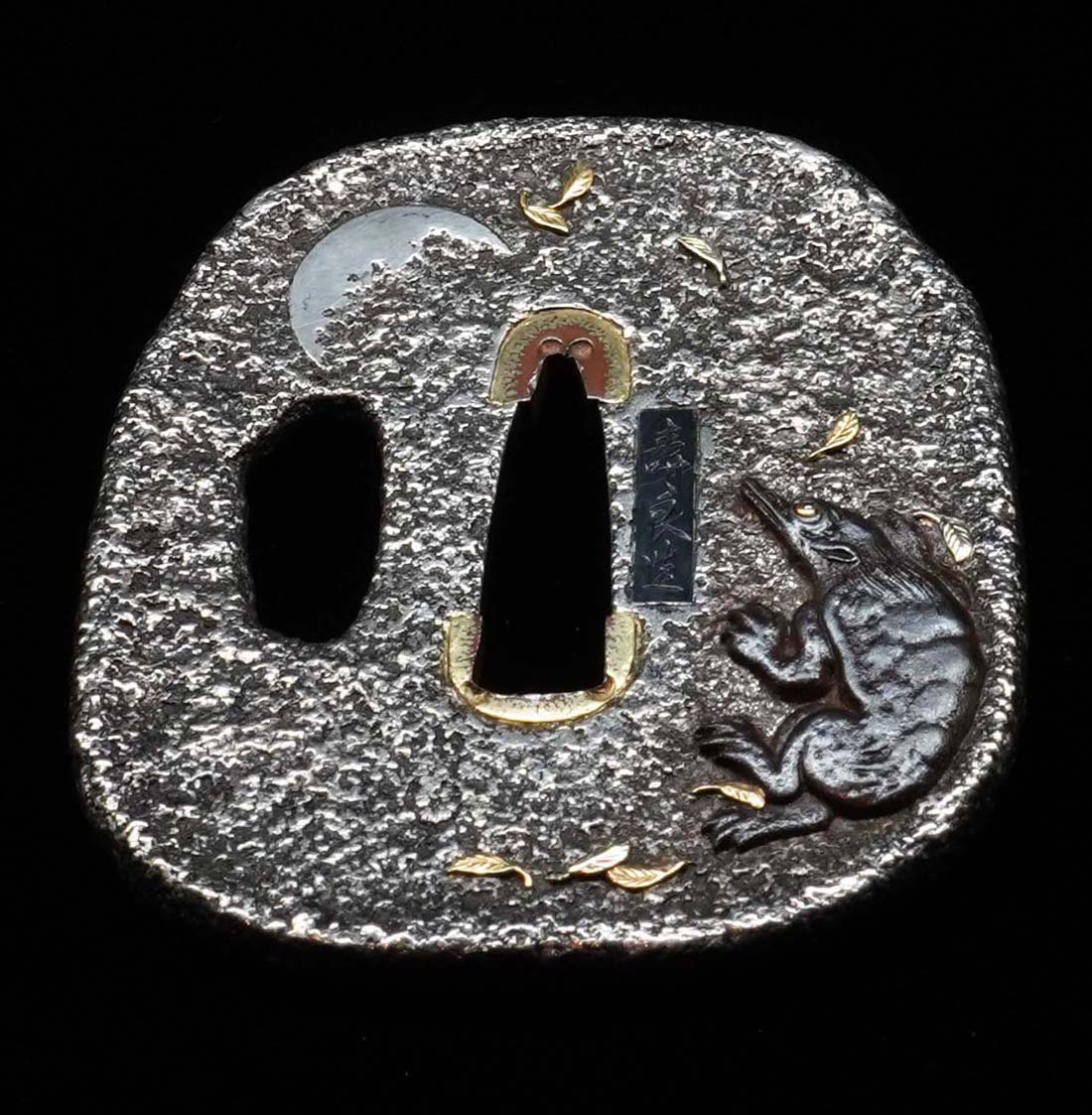
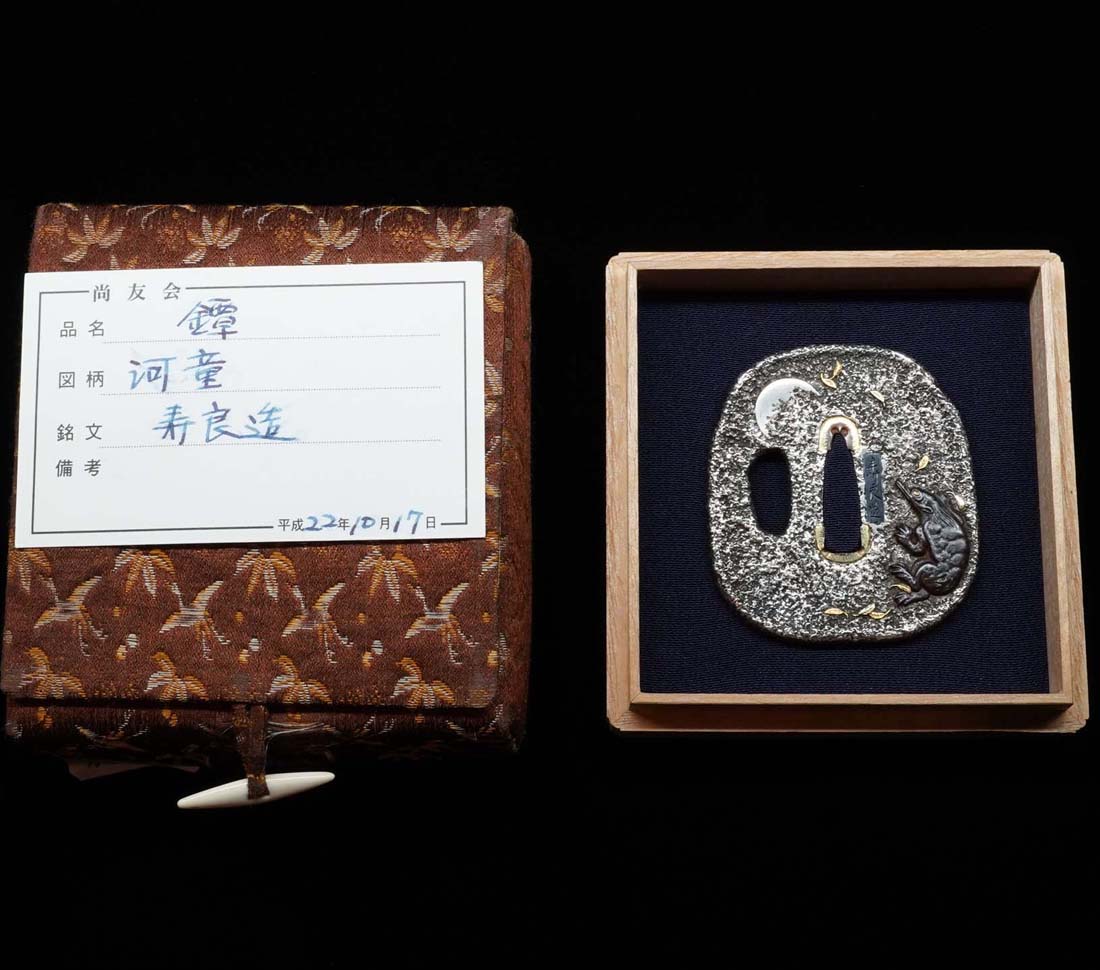
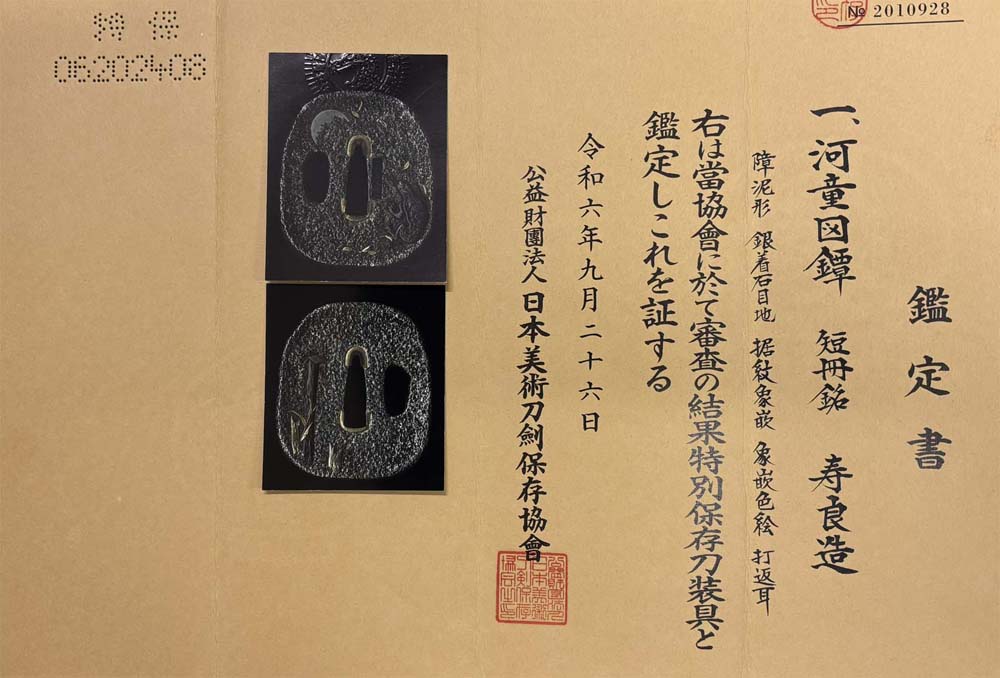
柴原(藤原)寿良は、東龍斎清寿門下の逸材で、師に次ぐ名工と賞され、江戸趣味豊かな技法を師より継承した、東龍斎一門の第一者です。 河の中から、月明かりに呼び寄せられ現れた川岸の河童は、月夜に僅かに照らされて、濡れた姿が艶やかに表現されており、裏の象嵌色絵も実に見事で、船着き場の木杭にも、江戸情緒があふれる景観となっています。 月夜の明かりを銀地に石目地の手法で巧みに表現し、また河童図は大変、珍重されているところから、名工の名に相応し名鐔です。
NihontoWatchOffered by Yamasiroya
This piece has sold
15 on the market
Get an email when a new Murasakibara Toshiyoshi piece hits the market.

Machibori · Musashi
A wakizashi koshirae fitted entirely with his work takes its subjects from the Twenty-Four Filial Exemplars of China, and its iron tsuba is dated in the cyclical year 戊辰, which the published sources identify as Meiji 1 (1868). Its maker, Shibahara (Fujiwara) Toshiyoshi, was born in Bunsei 12 (1829) and went by the common name Kyutaro. The NBTHK's commentary calls him an outstanding talent among the pupils of Toryusai Kiyotoshi[[c:1]], an artist who carried on the stylish, true Edo technique of the Toryusai school and who is praised as a master second only to his teacher[[c:2]]. He used the art names Seijo, Koso (孔叟), Koso (耕叟) and Ryugansai, and his work runs from the closing years of the Edo period into the early Meiji era.
The piece the published sources single out as his strongest is a kozuka of a tiger in the rain. They note that the tiger was a subject favoured by Tsuchiya Yasuchika of the Nara school, and later attempted by Iwamoto Konkan, Taizan Motoyoshi and Murakami Jochiku. Toshiyoshi carved his tiger in shibuichi in high relief, coloured it and set it as an applied inlay on a polished iron plate. The commentary finds it extremely rich in volume, the eyes keen, the fierce animal carried by its thick, heavy forelegs. It calls the kozuka 「寿良の技量がいかんなく示された屈指の作」, a leading work in which his skill is shown to the full, charged with force, with the rain also well rendered.
His preferred plate is polished shibuichi, which the commentary calls his specialty[[c:3]], and he worked shakudo, iron, oborogin, solid gold and solid silver beside it. On a kozuka of Saigyo standing alone beneath a willow by a quiet river, the published sources praise the modest but assured chisel and 「柔軟性に富む円やかな彫り口」, the supple, rounded carving that is his own quality. They add that the cat-scratch file marks on the reverse are often seen in this school. On a three-piece set of the poets Yamabe no Akahito and Saigyo, the empty shibuichi field is given light and shade 「特殊な技法で濃淡をつける」, by a special technique, so that the kozuka carries the loneliness of an autumn evening and the kogai the breadth of Suruga Bay beneath Fuji. On a tsuba of the Setsubun demon-expelling rite he hammered oborogin into a tsuchime texture, and the commentary finds the essence of the piece in the oni's sharp yet somehow bewildered expression.
His subjects are figural above all, and Chinese sages and immortals are handled with a gentle air. A tsuba of three immortals shows Gama and Tekkai on the front and Choka-ro on the back, and in the sukidashi carving of its pine and bamboo the commentary sees the manner of Kiyotoshi[[c:4]]. A kozuka and fuchi-kashira set pairs Rin Wasei with crane and plum against the giant Kyoreijin with his tiger, worked on shakudo with a roughened texture, fine high relief, varied colour inlay, flat inlay and keshi gilding. A tsuba of Okuninushi, shown in the guise of Daikokuten with his mallet and great sack, carries the maxim 「徳者本也 財者末也」, virtue as the root and wealth as the branch, and the commentary reads the whole as 「沈着とした雰囲気に満ちている」, filled with a composed, settled atmosphere. A Jurojin tsuba sets the god beneath a great pine trunk on the front and a deer in open space on the back, and a pair of menuki renders the guardian Kongo Misshaku, the vajra-bearer who drives off the enemies of the Buddha, in hiirodo copper with shakudo and gold.
Within the Toryusai school the published sources treat him as the closest continuator of his teacher. They call him the most capable hand among Kiyotoshi's pupils[[c:5]], and of a pair of menuki of a fisherman and an Ohara woman at rest they write that the work convinces one that he was 「清寿門下随一の金工」, the foremost metalworker among Kiyotoshi's pupils. His fittings also appear on complete koshirae, among them an aikuchi mounting fitted throughout in solid gold with landscape fittings, and another in solid silver whose fittings follow the four seasons. On one wakizashi mounting the fuchi-kashira and tsuba are his, while the kozuka is by Koryusai Fukawa Kazunori, a separate artist trained under Higashi Masutsune, and that piece is not his hand.
His designated record is fourteen works, all at the Juyo rank for sword fittings and mountings, among them tsuba, kozuka, menuki, a three-piece set and complete koshirae. There are no Tokubetsu Juyo pieces, and no current holder or daimyo provenance is recorded against them. One tsuba is kept in a box of the Ryushido inscribed by Ito Katsumi in remembrance of him, and a pair of menuki comes with its original box. His work appears on the market from time to time rather than often, and a signed piece on polished shibuichi, carved with the supple, rounded relief the published sources name as his own, shows the side of his art they praise most.
Where Toshiyoshi stands among comparable artisans: across all of nihontō, and within tradition, era, and period. The tiers (Foremost · Leading · Major · Notable) weigh official designations from the NBTHK and Japan's Agency for Cultural Affairs, together with historical honors of lasting repute such as the Sansaku and Meibutsu-chō.
Select a lens to see how it's measured.
Machibori · Edo
15 pieces on the market now
The Toryusai school was established in Edo by Tanaka Seiju (1804--1876), born the son of the Musashi Province tsuba maker Tanaka Fusajiro. Seiju trained formally under Goto Sojiro Masanori but pursued the broader field of kinko largely through self-directed study, ultimately perfecting a stylish, distinctive personal manner that became known as the Toryusai style. Counted among the "three great masters of Bakumatsu metalwork," he rivaled the fame of Goto Ichijo in Kyoto and, like Ichijo, was granted the rank of Hogen. " Kono Shunmei (Haruaki), a master of the Yanagawa lineage who shared Seiju's milieu in Edo, represented a parallel current of late-Edo kinko artistry whose weighty chisel manner and illustrative e-fu carving influenced the broader circle in which the Toryusai school operated. Together, these artists constituted the vital core of Edo-based decorative metalwork during the final decades of the Tokugawa shogunate. The Toryusai school's collective identity rests upon an encyclopedic command of metalworking techniques unified by a distinctly Edo sensibility -- urbane, witty, and decoratively assured. Across the lineage, from Seiju through Kiyoshige and Toshiyoshi, one encounters a shared mastery of takabori with iroe polychrome, sukidashi-bori, suemon-zogan, hira-zogan, and nunome-zogan, deployed across grounds of shakudo, shibuichi, iron, and silver with fluent authority. " Kiyoshige inherited this vocabulary and distinguished himself through exceptional volumetric modeling -- his yobori approaching fully sculptural marubori with what the NBTHK terms outstanding "placement of flesh" (nikuoki).
Toshiyoshi, working primarily on polished shibuichi grounds, synthesized multiple inlay techniques within single compositions, combining suemon-zogan, okigane, and keshi-tokin to achieve chromatic depth and tonal complexity. A hallmark of the school's later production is the neko-kaki yasurime ("cat-scratch" file marks) found on the reverse of kozuka -- a workshop convention that links Toshiyoshi's output to the broader Toryusai lineage. Throughout, the school's pictorial range is vast: figure compositions, birds and animals, literary themes from the Taketori Monogatari and Tsurezuregusa, folk tales, and witty conceits including anthropomorphized frogs and the "Daruma-in-absence" design, all handled with the okashimi (humorous charm) that conveys the school's fashionable Edo flair. The NBTHK's appraisals consistently characterize the Toryusai school's productions as works of notably high dignity and completion, possessing a solemn yet unpretentious taste even when gold inlay is used abundantly. Seiju's mature works display technique and conception operating "in full concert," while Kiyoshige's finest pieces are judged as attaining a level comparable to the founder himself. " The school's significance extends beyond individual virtuosity: the Toryusai lineage represents the most coherent articulation of an independent Edo kinko aesthetic -- one that assimilated the carving methods of the Goto and Yanagawa families yet forged from these an unmistakably personal idiom marked by fresh designs and ingenious, taste-driven sensibility. That the lineage sustained its identity from Seiju's founding through Kiyoshige's succession and into Toshiyoshi's Meiji-era continuation testifies to the robustness of its artistic vision, preserving the refined character of late-Edo metalwork at the moment of its historical transition. Learn more →
| Smith | Era | Designated |
|---|---|---|
| Kiyotoshi清寿 | — | 39 |
| Toshiyoshi寿良 | — | 14 |
| Kiyoshige清重 | — | 5 |
| Yoshitsugu良次 | 1670 | 4 |
| Toshimasa寿政 | — | 0 |
A Hozon-certified fitting of notably superior craftsmanship and condition, often with signature or workmanship of high reference value.
The NBTHK (Nihon Bijutsu Tōken Hozon Kyōkai, the Society for the Preservation of Japanese Art Swords) is a public-interest incorporated foundation founded in 1948 and supervised by Japan’s Agency for Cultural Affairs (Bunkachō); it is based at the Japanese Sword Museum in Tokyo. Its expert panels physically examine each submitted work (shinsa) and issue a certificate (kanteishō) ranking it by artistic and historical merit. NBTHK papers are the most widely recognized standard of authentication for Japanese swords and fittings.
NBTHK official siteIf the item's contents differ significantly from our description, we accept returns within 3 days counted from receipt. Because mail-order sales have no cooling-off provision under the Act on Specified Commercial Transactions, cooling-off is not available.