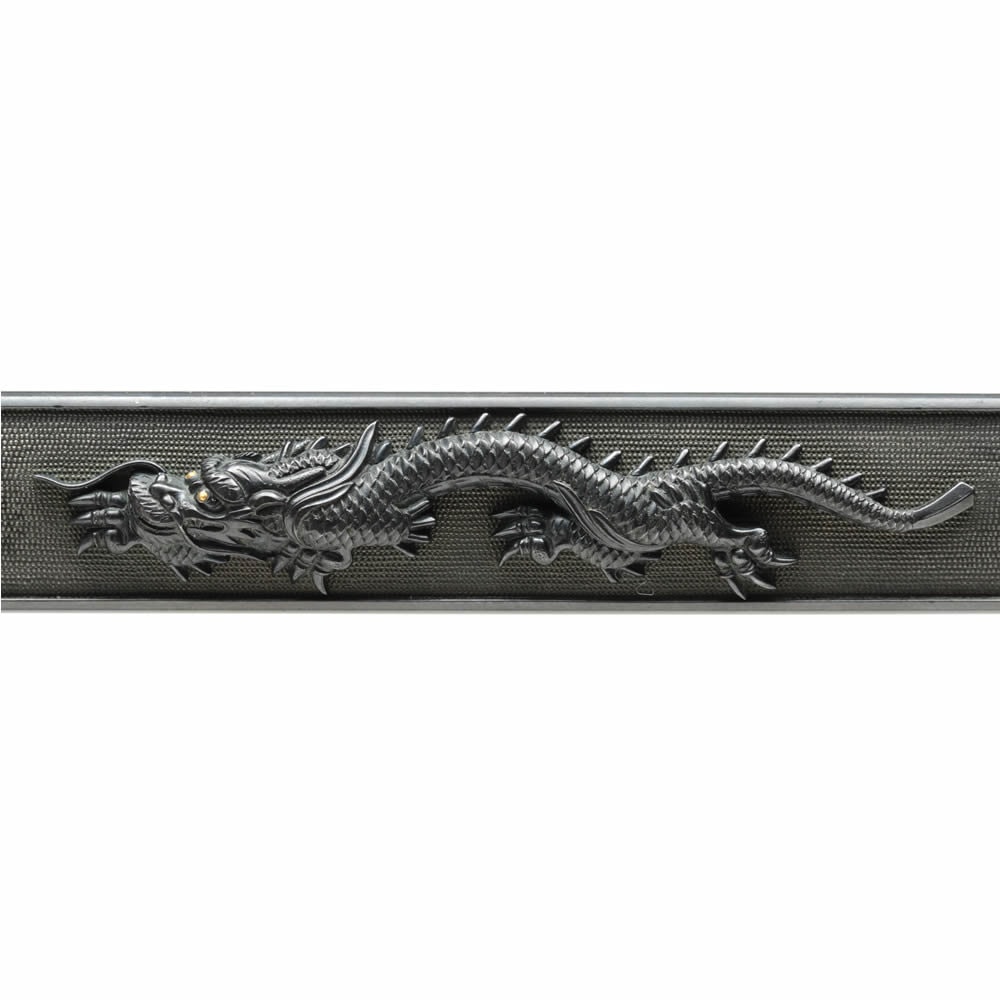
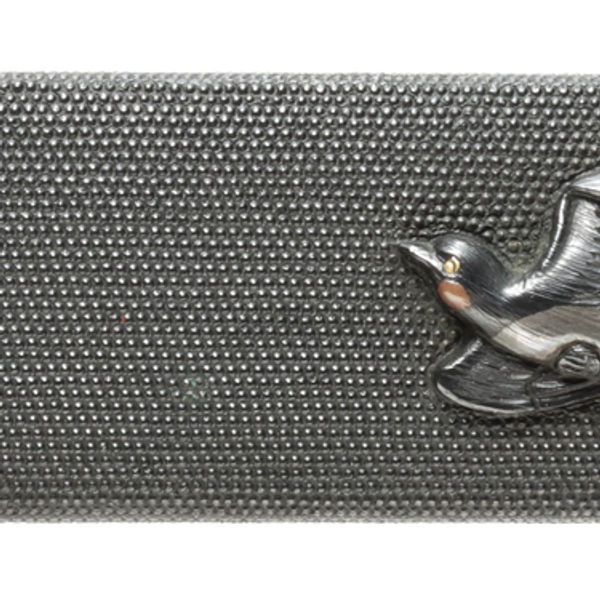
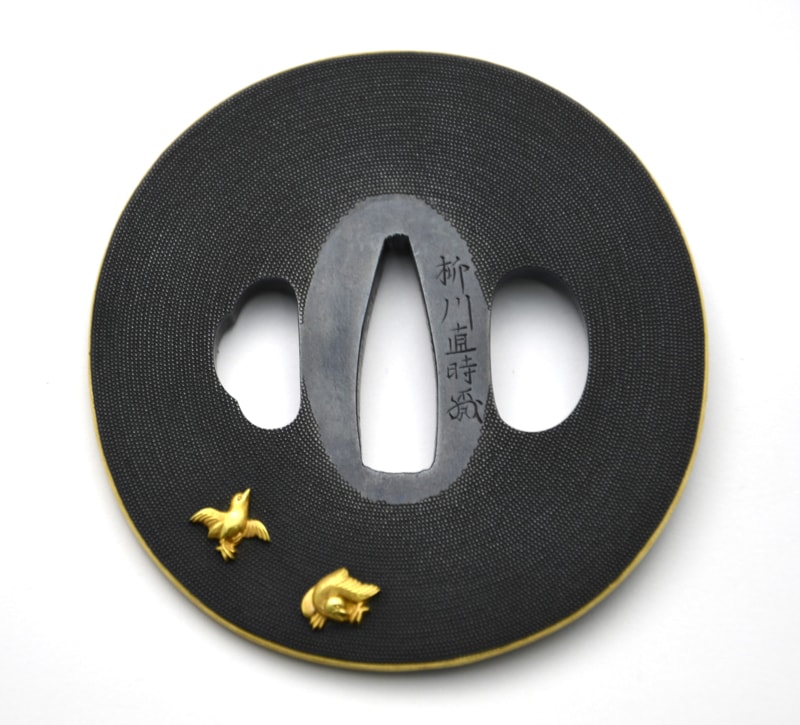
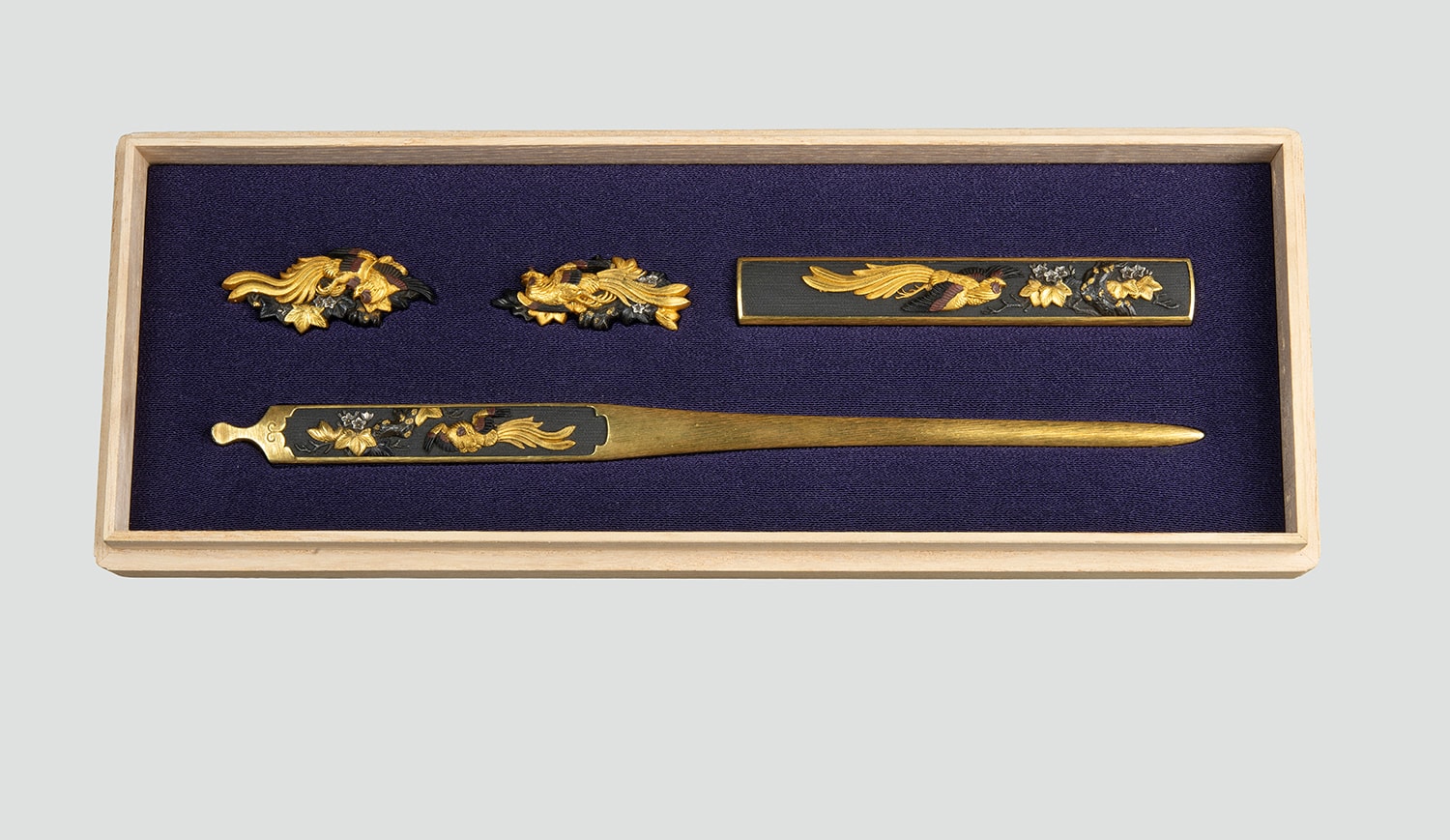
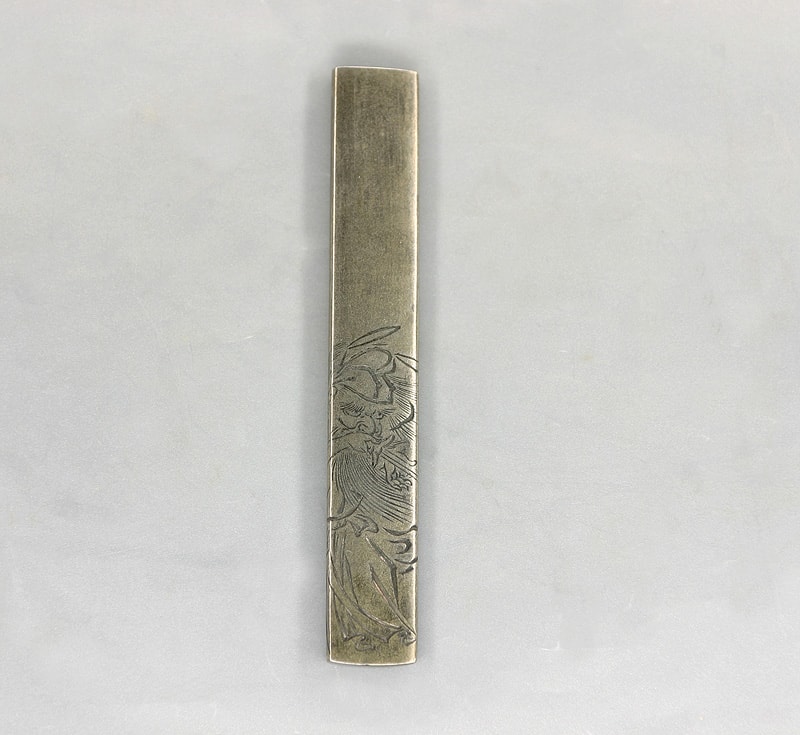
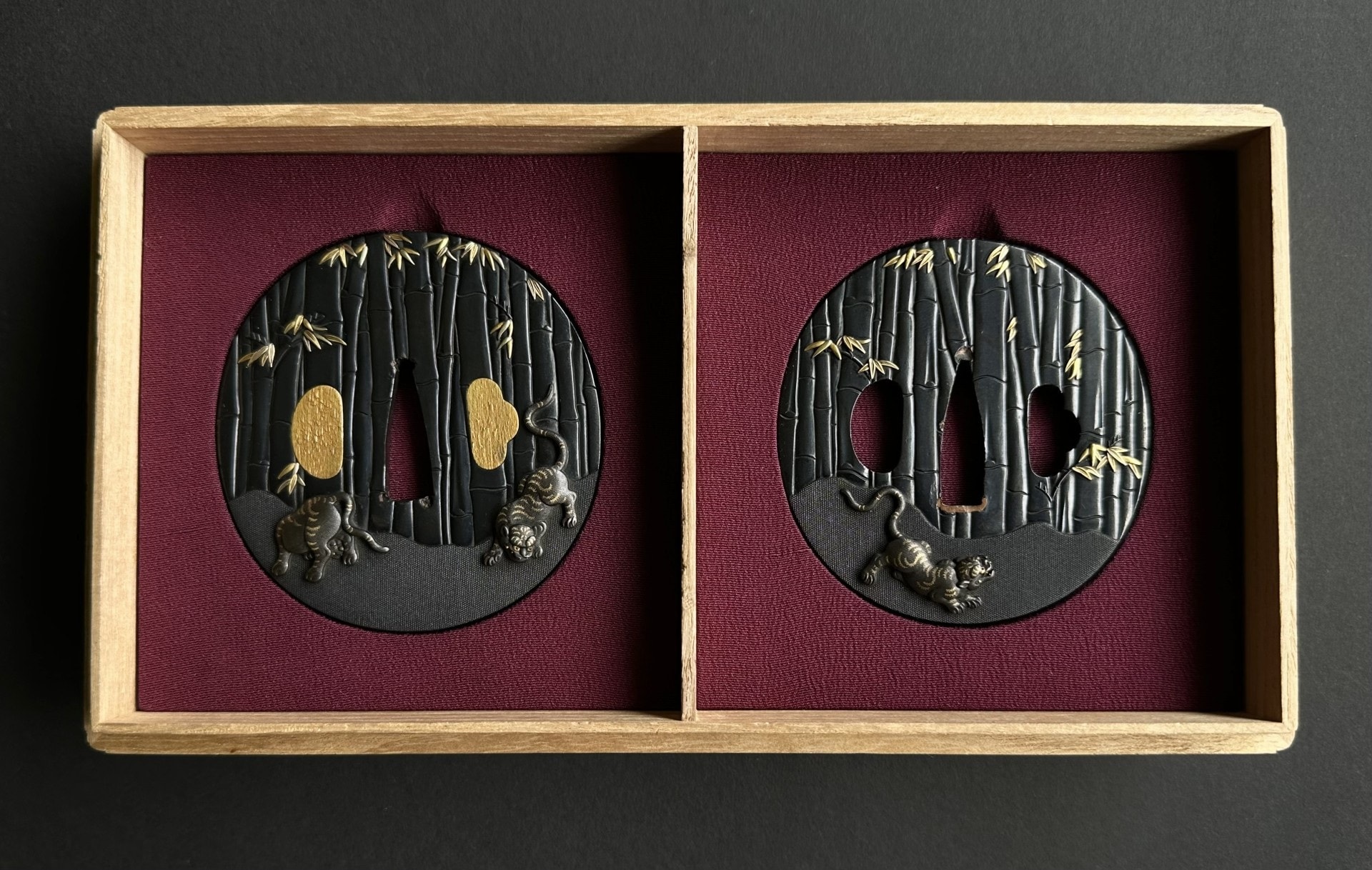
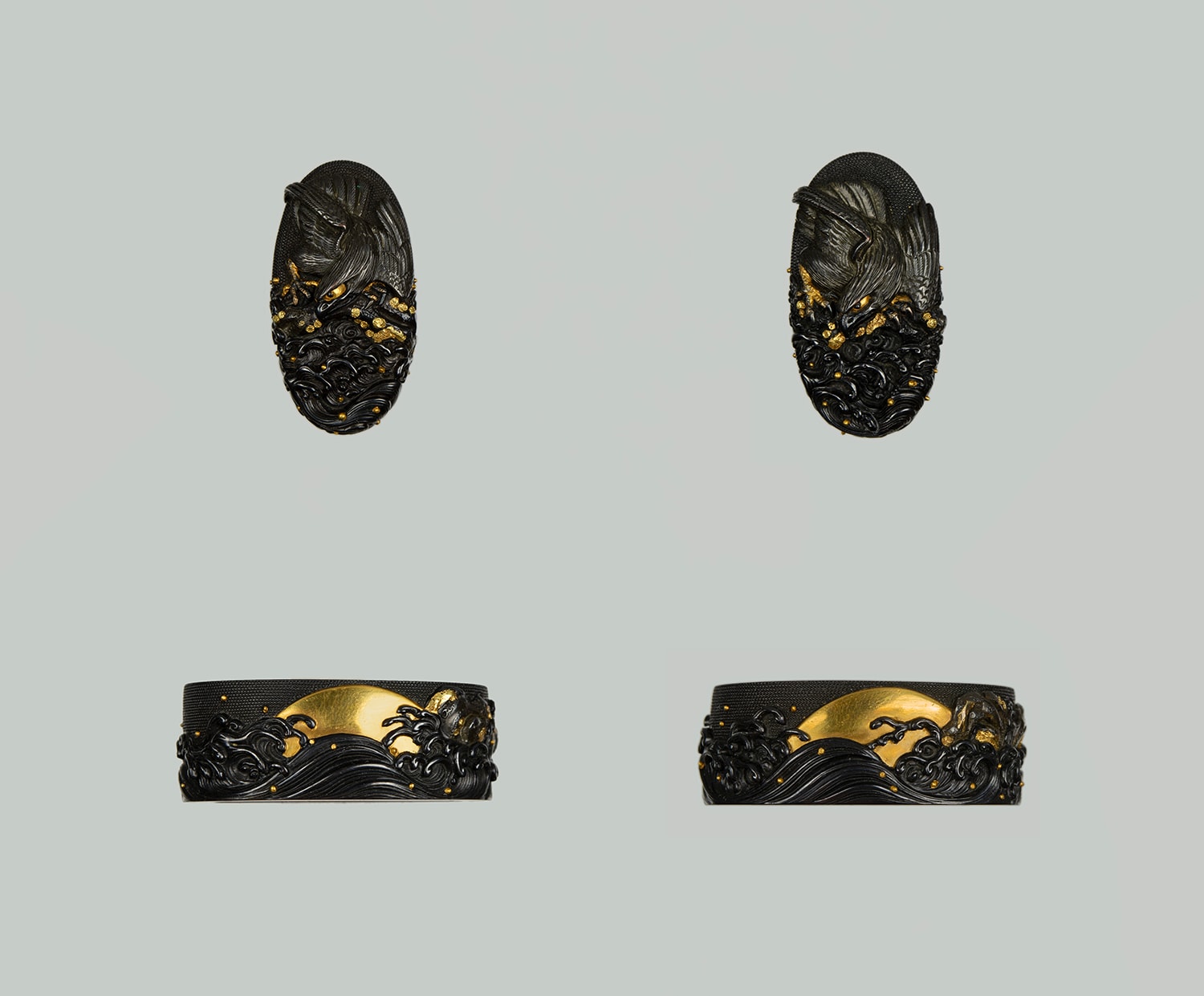
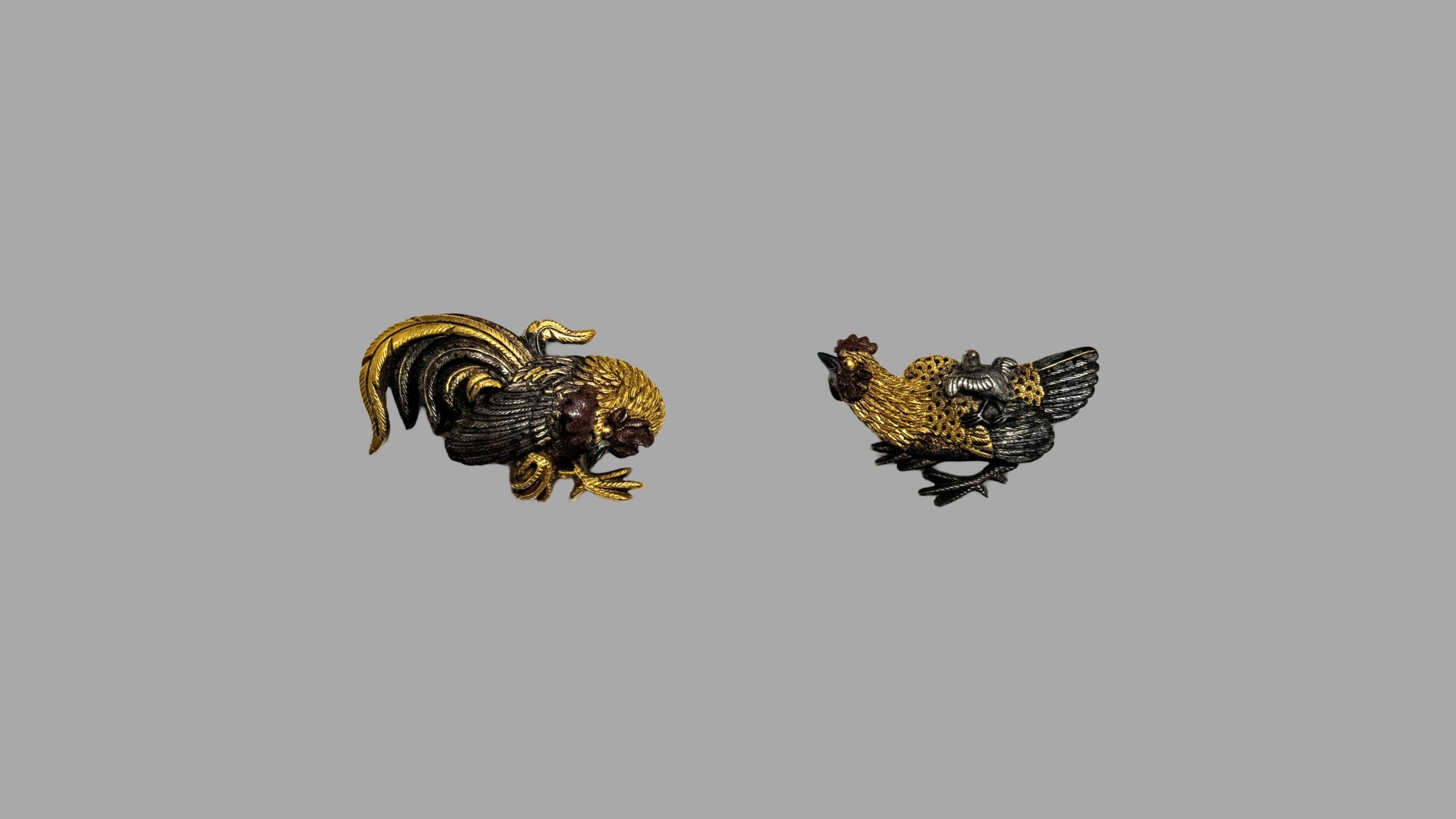
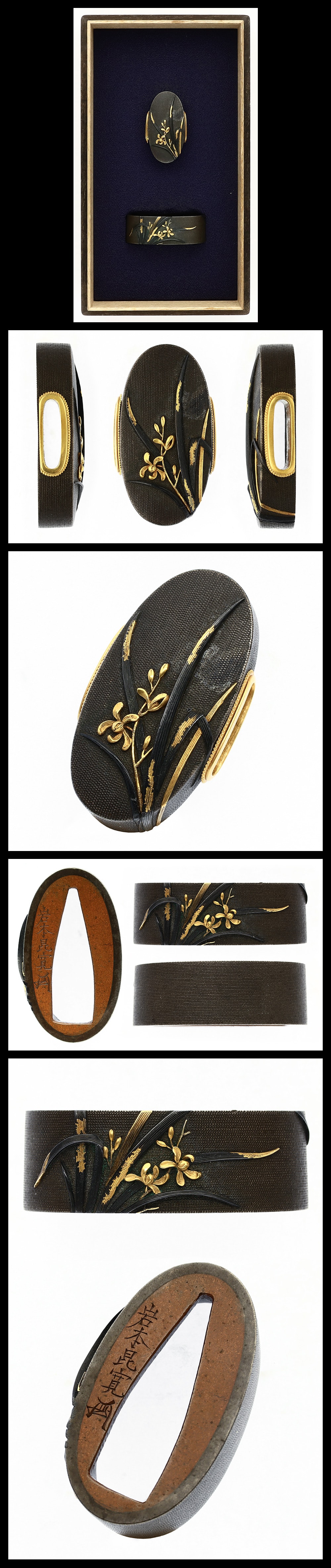
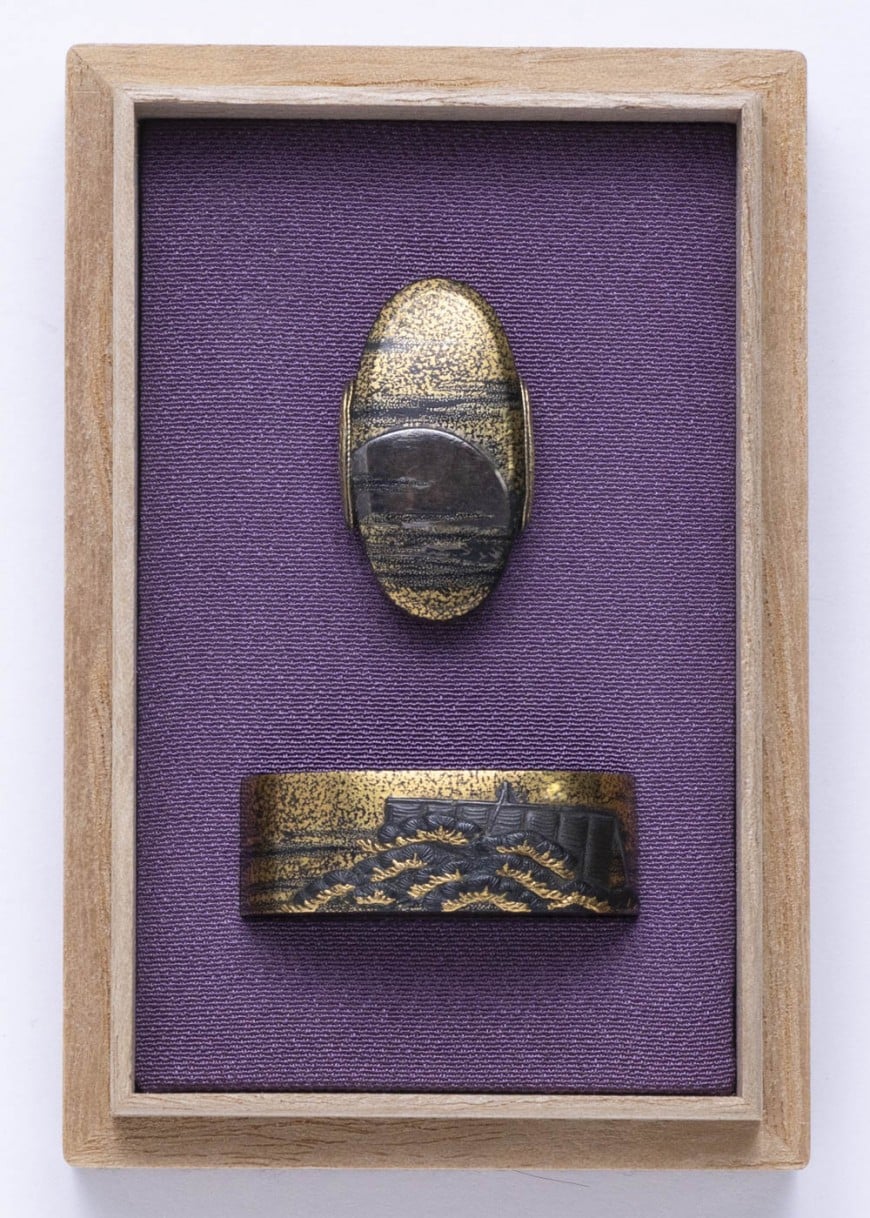
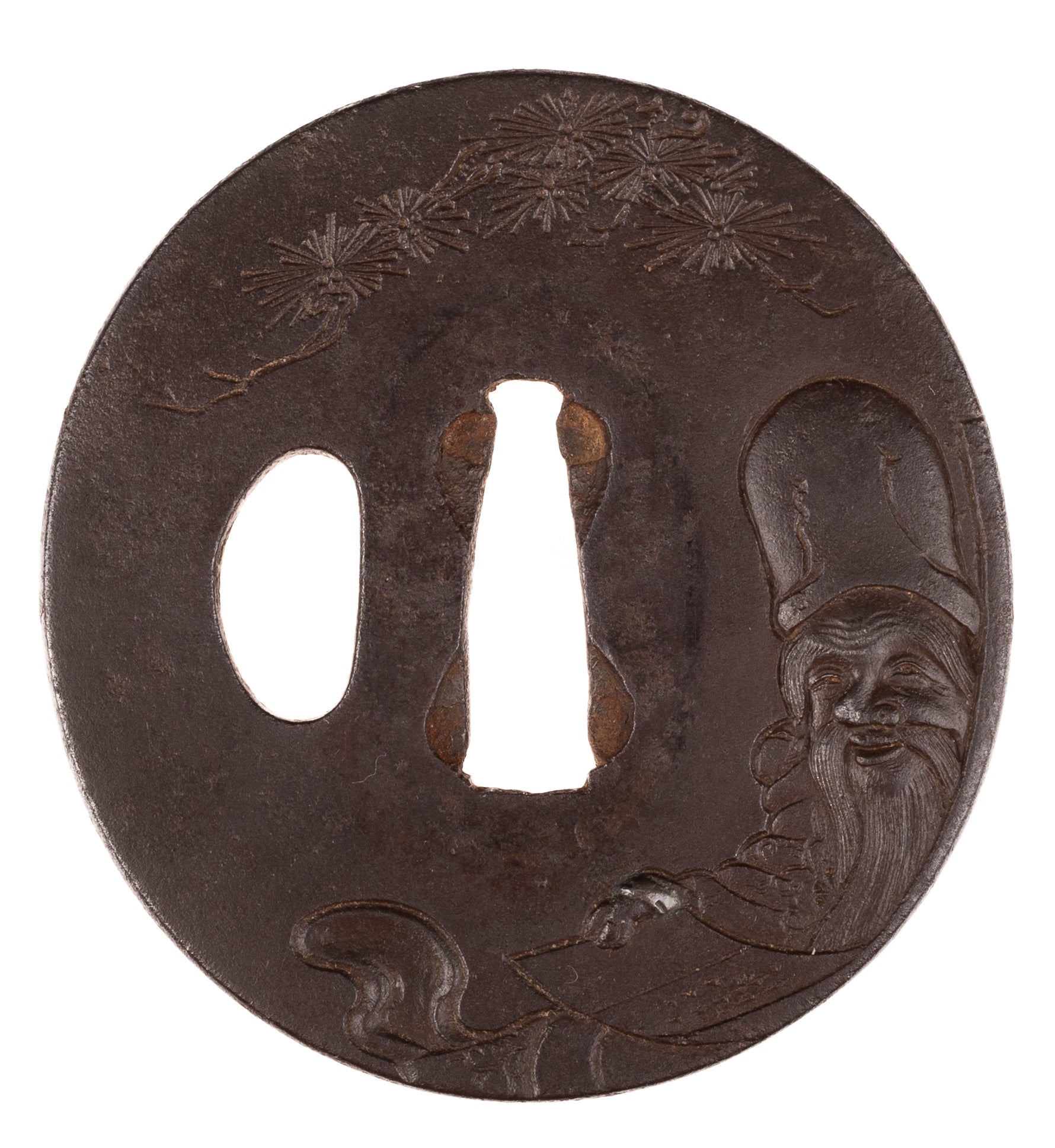
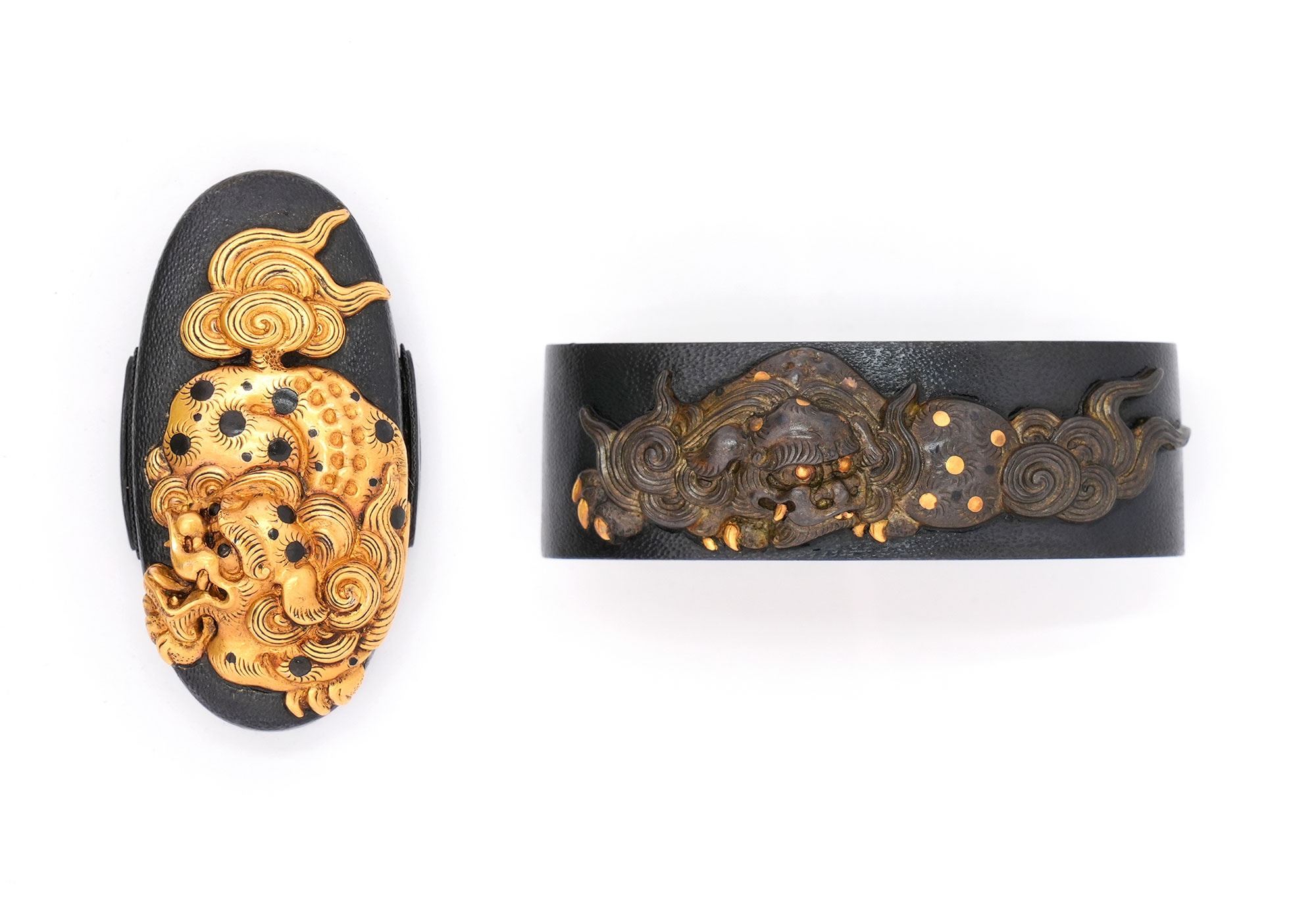
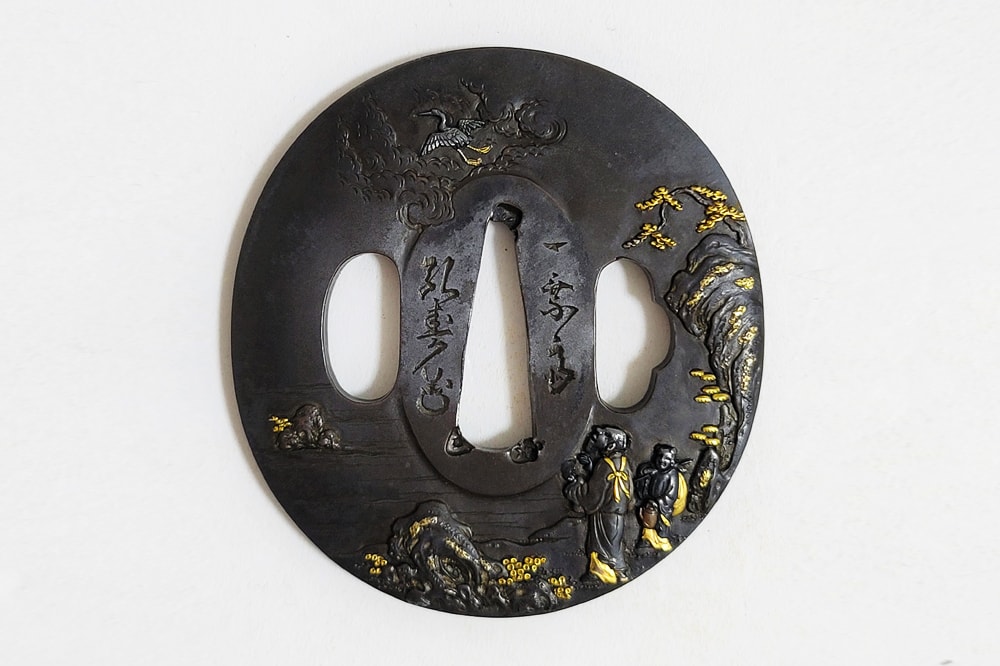
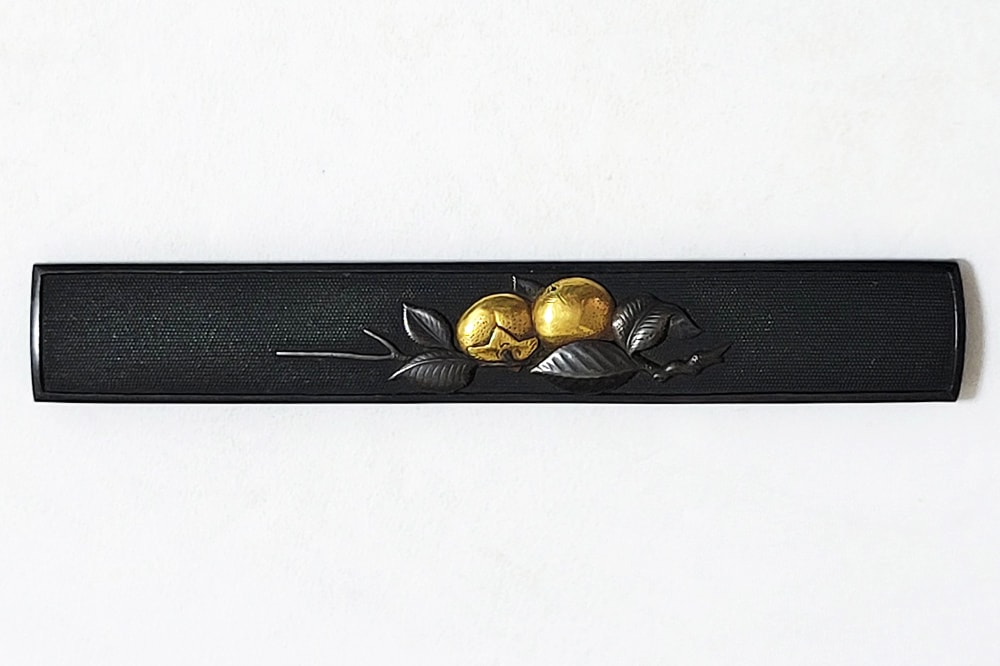
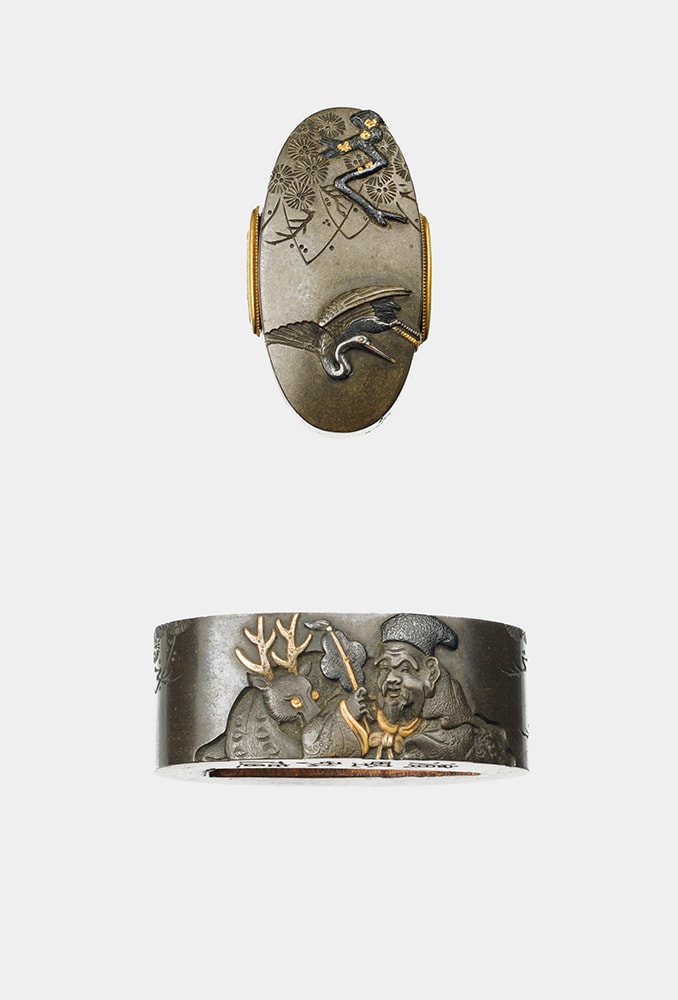
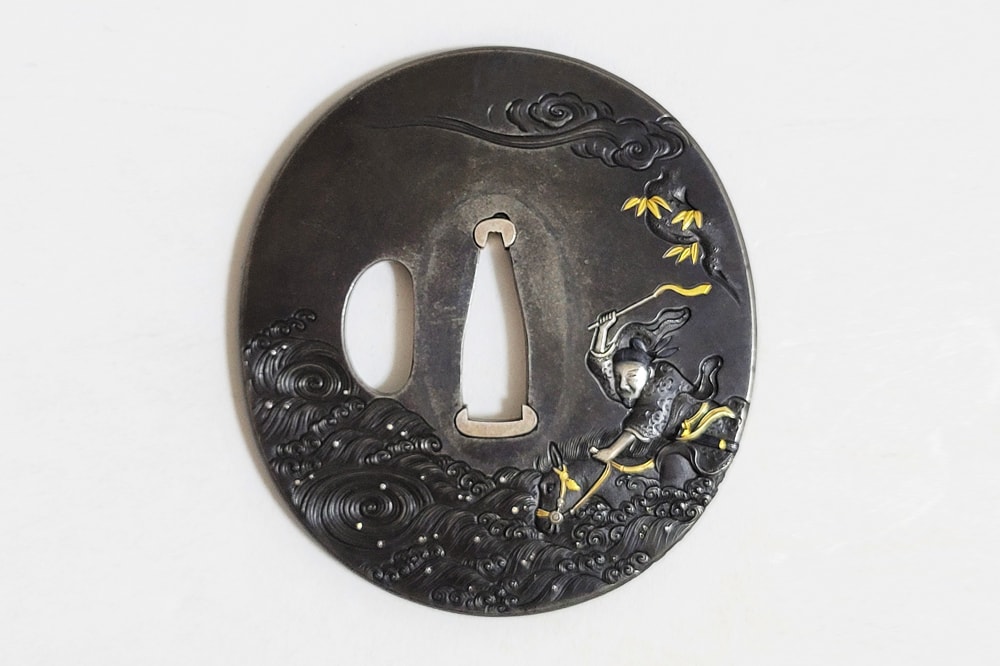
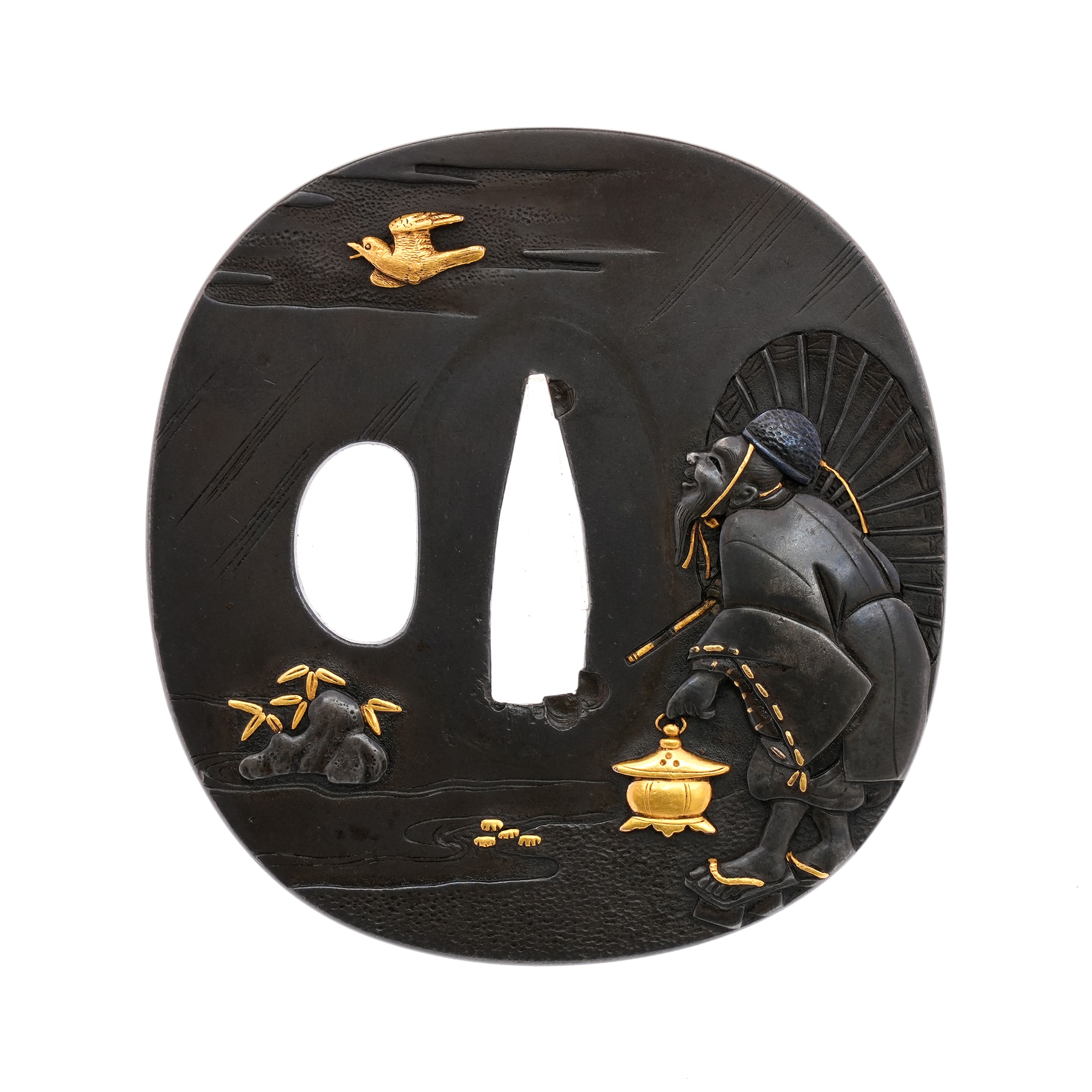
Takahashi Ryoji was born into the family of the metalworker '-sai Toshitsugu, inheriting a lineage already established in the craft of sword-fitting production. He first studied metalworking under his father and under Shibahara Juro before becoming a disciple of the celebrated Bakumatsu master Toryusai Seiju (Tanaka Seiju), one of the foremost figures of the late period. Among Ryoji's own pupils was Okada Setsuga, ensuring the continuation of the lineage into the Meiji era. A distinct figure within the family line was Takahashi Yoshitsugu, born in Tempo 13 (1842), who likewise studied under Toshiyoshi and Tanaka Seiju but died in Meiji 6 (1873) at the young age of thirty-two, leaving behind a small but remarkably accomplished body of work.
Ryoji is recognized by the above all for his mastery of fully unified fittings suites -- kanagu -- executed entirely in solid gold (kin-muku). His decorative programs deploy an elevated iconographic vocabulary: the "Four Gentlemen" (shikunshi), the "Three Friends of Winter" (saikan sanyu), and chrysanthemum-spray (eda-giku) compositions recur across his oeuvre. His technique encompasses takabori with iroe, nanako-ji groundwork, suemon applique, katakiribori, kebori, and hira-zogan in gold, silver, shakudo, and shibuichi. The NBTHK consistently notes how his gold fittings achieve effects that are at once "weighty and luxurious" (omoomoshiku kago) and "refined and tasteful" (johin na aji), with the brilliance of solid gold harmonized against restrained lacquer grounds to produce mountings of cohesive elegance.
Within the tradition of Bakumatsu metalwork, Takahashi Ryoji occupies a position of particular distinction as a maker capable of conceiving and executing entire mounting programs as unified artistic statements. The NBTHK characterizes his productions as "opulent and luxurious" and "thoroughly in keeping with refined Edo taste1," singling out the coherence of his issaku suites as their defining quality. His daishi koshirae, uchigatana koshirae, and tsukubei mountings represent the culmination of late-Edo metalworking ambition, in which the splendid radiance of gold and the cultivated elegance of the design are, in the words of the designation committee, "fused to striking effect."
Kantei
3 descriptive axes: material (a full kinko palette, but solid gold the celebrated ground of every piece here) x technique (katabori and high relief with iro-e, flat inlay, katakiri and engraved detail) x themes (auspicious and literati, in his teacher Kiyotoshi's Edo-taste manner). With only four matched koshirae, all solid-gold fitting-sets, this corpus offers few personal stylistic separators from the broader Toryusai school; the defensible ones are his sumptuous solid-gold complete fitting-sets and his own real-name signature Yoshitsugu, distinct from the school go.
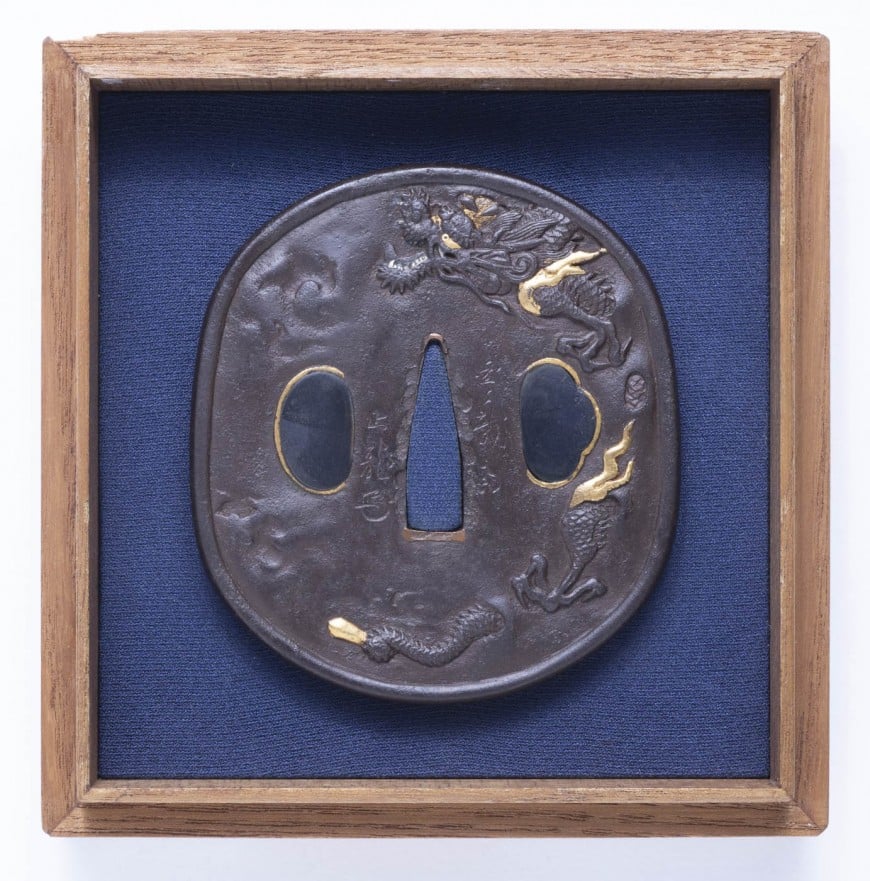
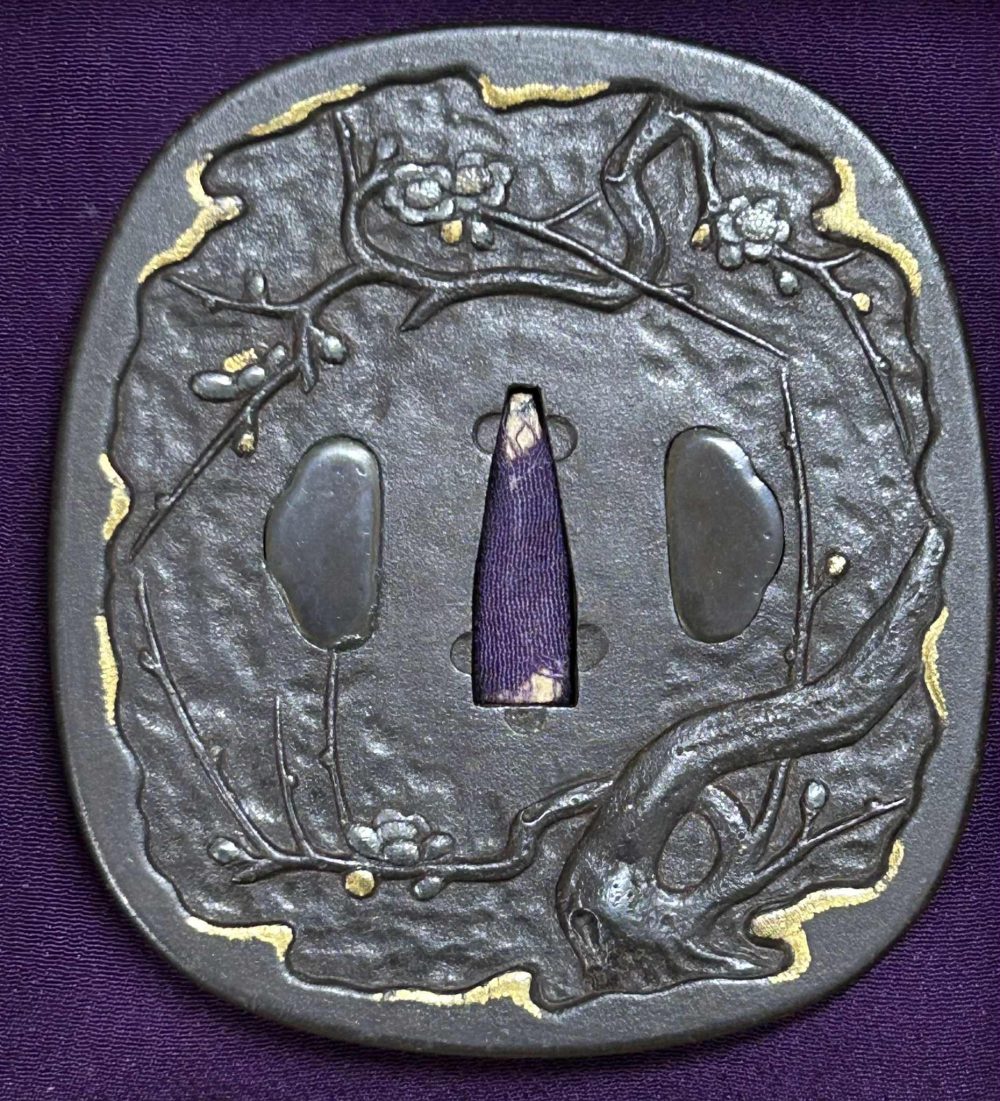
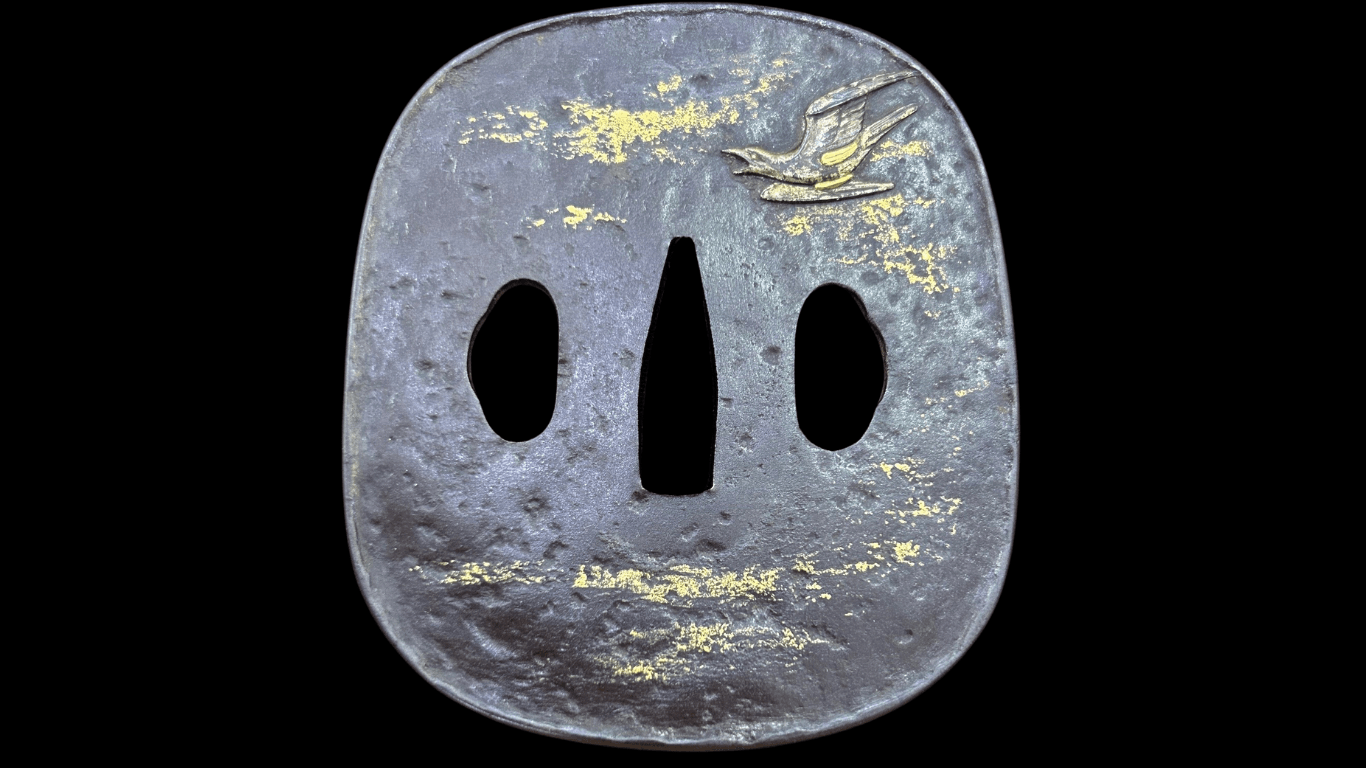
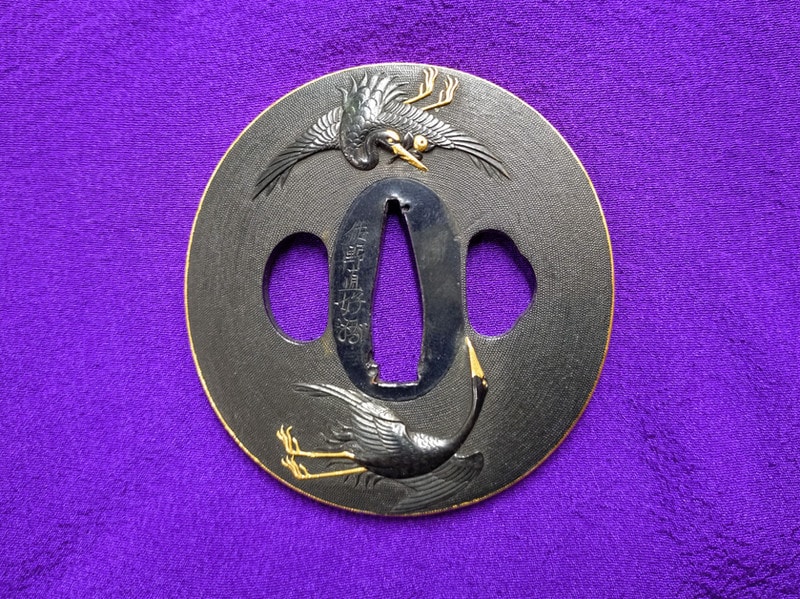
Takahashi Yoshitsugu, born Tenpo 13 (1842) into the family of the Edo metalwork artist Tounsai Hisatsugu, first learned engraving from his father and from Shibahara Toshiyoshi, then became a pupil of Tanaka Kiyotoshi, the founder of the Toryusai school of bakumatsu Edo metalwork; his own pupil was Okada Sekiga. He is met in this corpus only through four sumptuous matched koshirae, all of them complete fitting-sets of solid gold (kinmukuichi-saku), and the records single him out as one of the skilled hands of the Kiyotoshi school, his work full of Edo-taste chic. His subjects are auspicious and literati, chrysanthemum, the Four Gentlemen and autumn grasses, scattered fans, with longevity figures, handled in his teacher's manner. He died young, in Meiji 6 (1873) at the age of thirty-two.
Diagnostic discriminators
金無垢一作金具kinmuku ichi-saku kanagu4
all four koshirae in this corpus are complete fitting-sets worked in solid gold, and the setsumei twice name him a skilled hand of the Kiyotoshi school for these lavish solid-gold ichi-saku commissions; where his teacher Kiyotoshi was celebrated above all for iron, Yoshitsugu is met here through solid-gold matched sets, so the ground separates his surviving work from the school field, though the thinness of the corpus (n=4, all koshirae) should temper the comparison
本名「良次」の銘real-name mei Yoshitsugu4
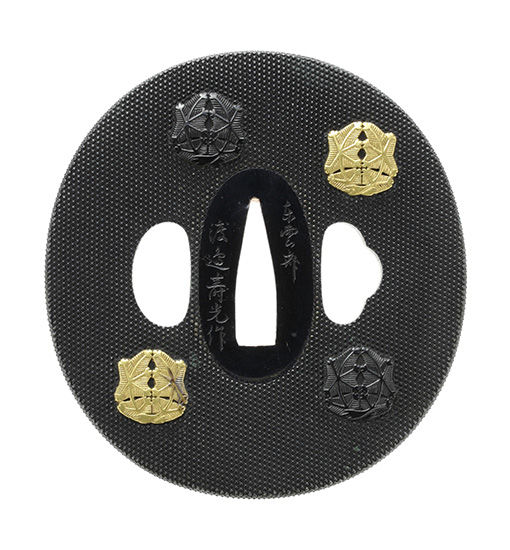
he signs his real name Yoshitsugu, as 良次造之 / 良次造, often with the surname 高橋良次造 or its abbreviation 高良次造, and the split 良・次 wari-mei on menuki; one Meiji piece is dated kanoe-uma (1870); he does not take a school go, so the real-name signature itself separates his hand from the go-signing members of the line
Material (grounds)
Across these matched koshirae his ground is solid gold above all, the whole fitting-set carved in pure gold for a lavish golden effect; shakudo, both nanako and polished migaki, suaka and four-one shibuichi appear on the tsuba and small fittings, sometimes ishime-textured.
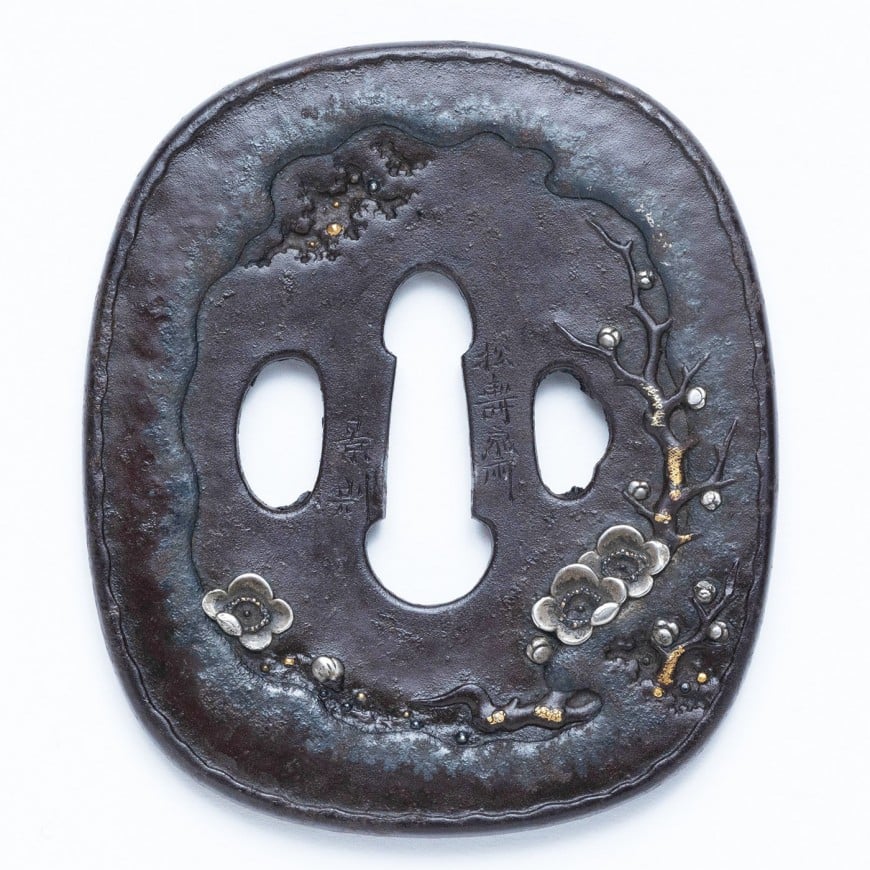
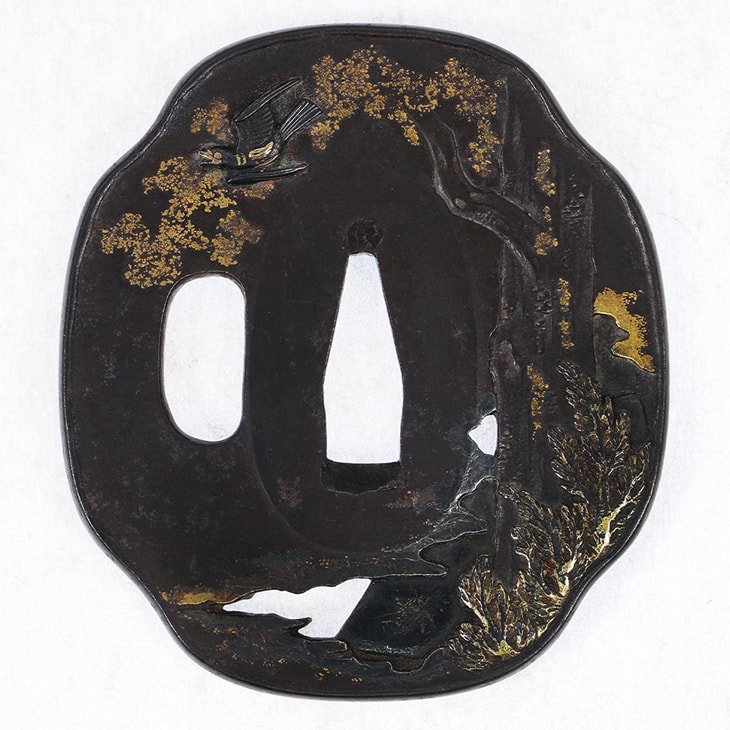
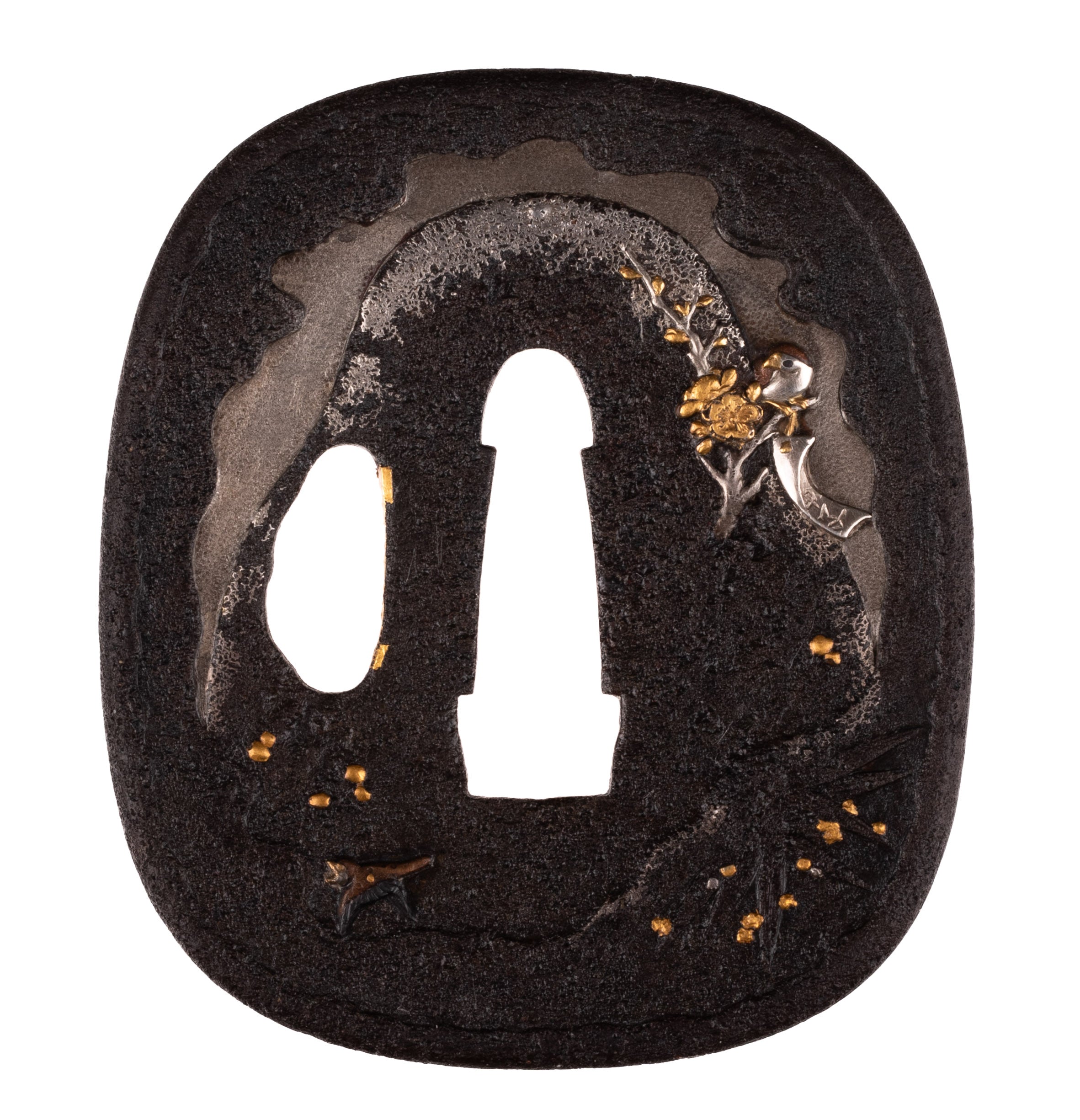
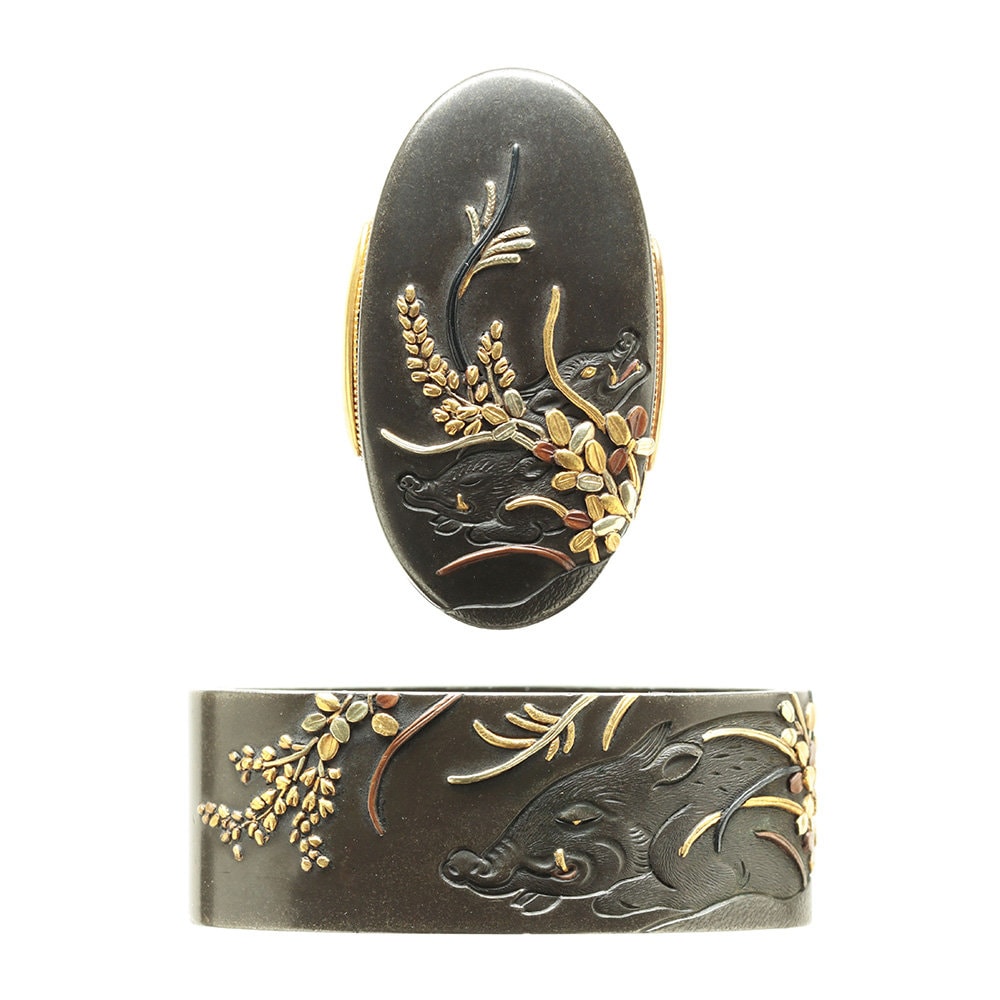
His hand is katabori and high relief enriched with gold, silver, suaka and shibuichi iro-e, applied suemon and flat inlay; he commands sukidashi-takabori and niku-bori, and works katakiri-bori and fine hairline kebori for the detail.
His subjects are auspicious and literati, treated in his teacher's Edo-taste manner: chrysanthemum above all, with peony, orchid and the Four Gentlemen and Four Friends sets; autumn grasses with bell-cricket; scattered fans bearing plum, pine, bamboo and orchid; and longevity figures such as Rin Wasei with his crane and the reishi fungus, set on the solid-gold fittings of his matched koshirae.
Chrysanthemum, the Four Gentlemen and longevity
Chrysanthemum above all, with peony and orchid, gathered into the literati Four Gentlemen and Four Friends sets, and longevity emblems such as the reishi fungus.
菊kiku2牡丹botan1四君子shikunshi1霊芝reishi1
Autumn grasses and seasonal plantsless firmly established
Autumn grasses with bell-cricket, pine and orchid on scattered fans, the quiet seasonal matter of his ko-dogu and matched fittings.
Yoshitsugu (良次), base two-character name / wari-meihis core name, with the split 良・次 wari-mei on menuki; suppressed when a fuller surname/dated form is present1 pieces1
Yoshitsugu tsukuru (良次造之)his core real-name signature with the made-mark, on the fuchi and small fittings1 pieces1
Takahashi Yoshitsugu tsukuru (高橋良次造)the full surname-and-name signature with the made-mark, on the fuchi-gashira of the matched sets1 pieces1
Taka Yoshitsugu tsukuru (高良次造之)the abbreviated-surname form (高 for 高橋) with the made-mark1 pieces1
dated kanoe-uma-year, Taka(hashi) Yoshitsugu (庚午冬日高良次造)the year-marked signature on the Meiji short-sword koshirae, the kanoe-uma year (1870) winter day1 pieces1
Placement
split signature (wari-mei) divided across the pair of menuki1 pieces1
Recorded signatures
良次Yoshitsugu4 pieces4
高良次Taka Yoshitsugu1 pieces1
高橋良次Takahashi Yoshitsugu1 pieces1
Documentary note
Yoshitsugu signs the two characters Yoshitsugu (良次), most often with the made-mark as Yoshitsugu tsukuru (良次造之 / 良次造), frequently prefixed with the surname as Takahashi Yoshitsugu tsukuru (高橋良次造) or its abbreviation Taka Yoshitsugu tsukuru (高良次造之 / 高良次造); menuki carry the split Yoshi-Tsugu (良・次) wari-mei, and one Meiji short-sword koshirae bears the year-marked kanoe-uma-day Taka Yoshitsugu tsukuru (庚午冬日高良次造). His pieces are matched solid-gold ichi-saku fitting-sets, so distinguish his hand from the saya-lacquerers and co-makers who appear with him and are not his work: the maki-esaya-lacquerer Rikuyusai on the breakthrough-pike koshirae, and the separate metalwork artist whose name is run together with an order-patron's name in the garbled transcription of that record. The biography recites his teachers, his father, Shibahara Toshiyoshi and Tanaka Kiyotoshi, and his pupil Okada Sekiga, which are names in the record, not signatures here.
Scholarship
He is traditionally said to have studied under Tanaka Kiyotoshi, the founder of the Toryusai school, and his work is taken to continue that line.2
Before entering Kiyotoshi he is said to have learned engraving from his father and from Shibahara Toshiyoshi.2
Historical importance
Where Yoshitsugu stands among comparable artisans: across all of nihontō, and within tradition, era, and period. The tiers (Foremost · Leading · Major · Notable) weigh official designations from the NBTHK and Japan's Agency for Cultural Affairs, together with historical honors of lasting repute such as the Sansaku and Meibutsu-chō.