Power sat in Kamakura, but taste was still made in Kyōto. The Awataguchi school’s pear-skin steel became a byword for perfection, and the Rai line supplied dignified tachi to the court, senior warriors, and the great temples alike.
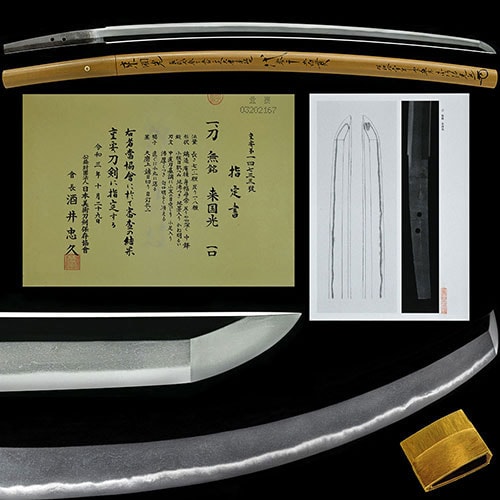
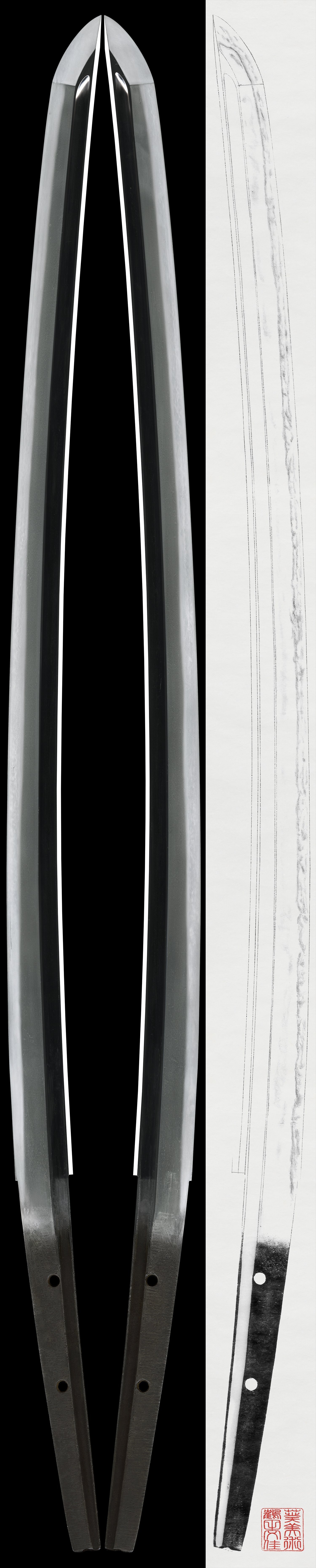
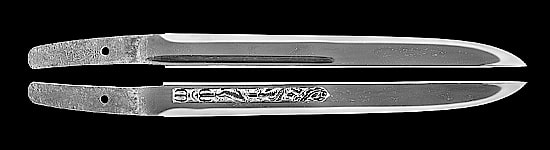
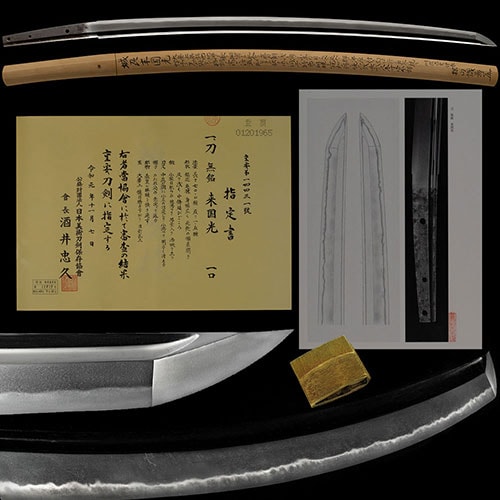
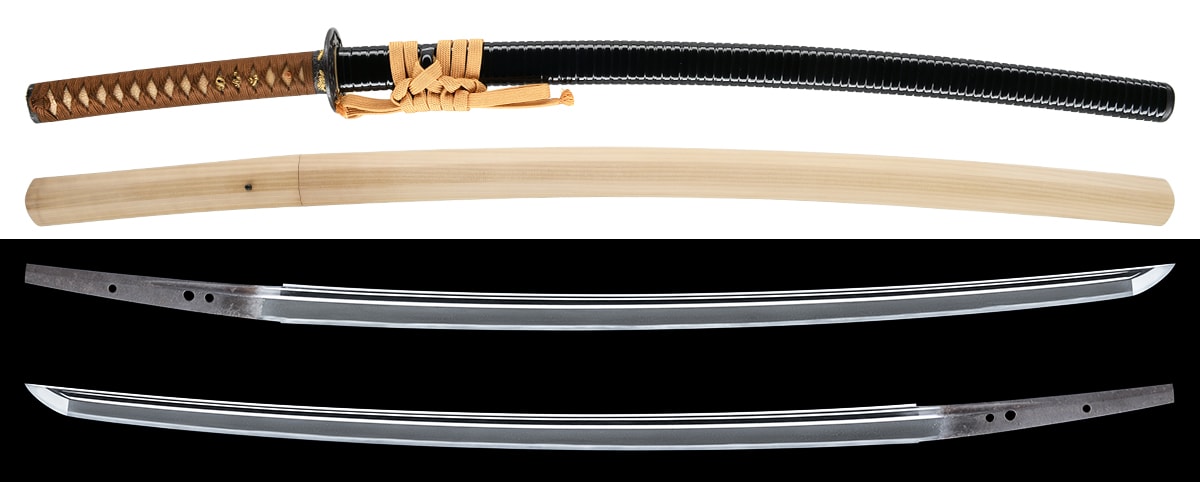
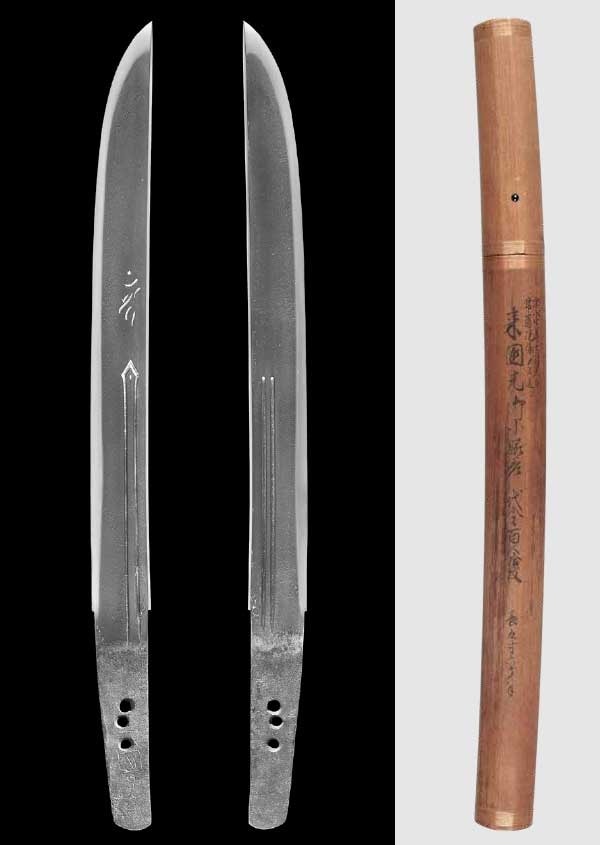
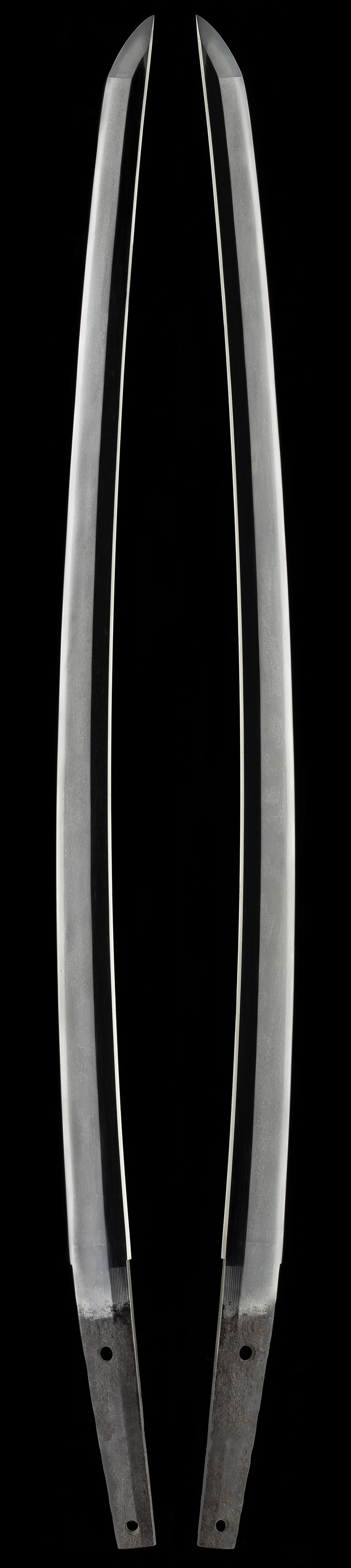
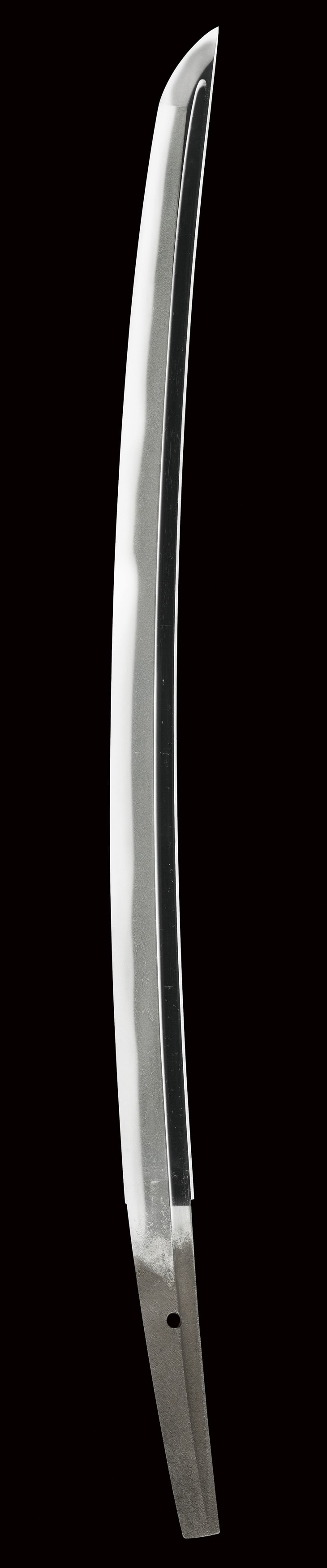
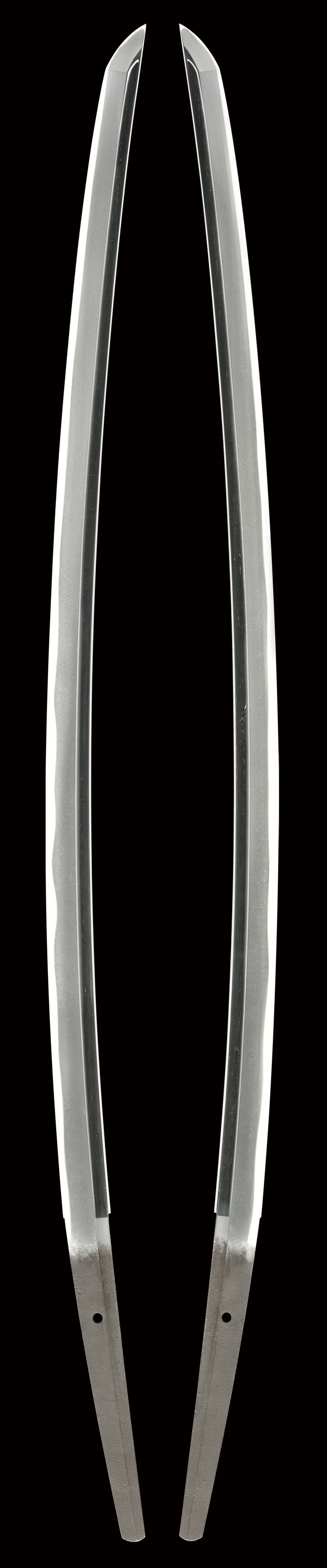
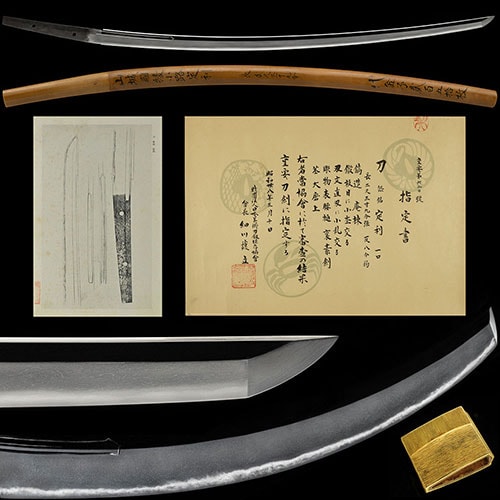
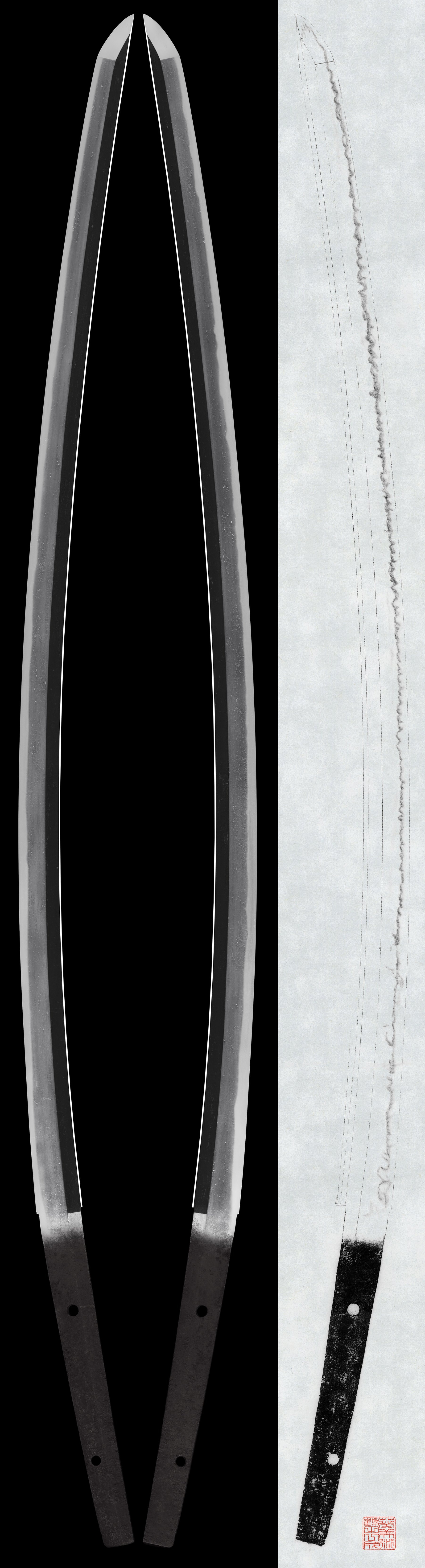
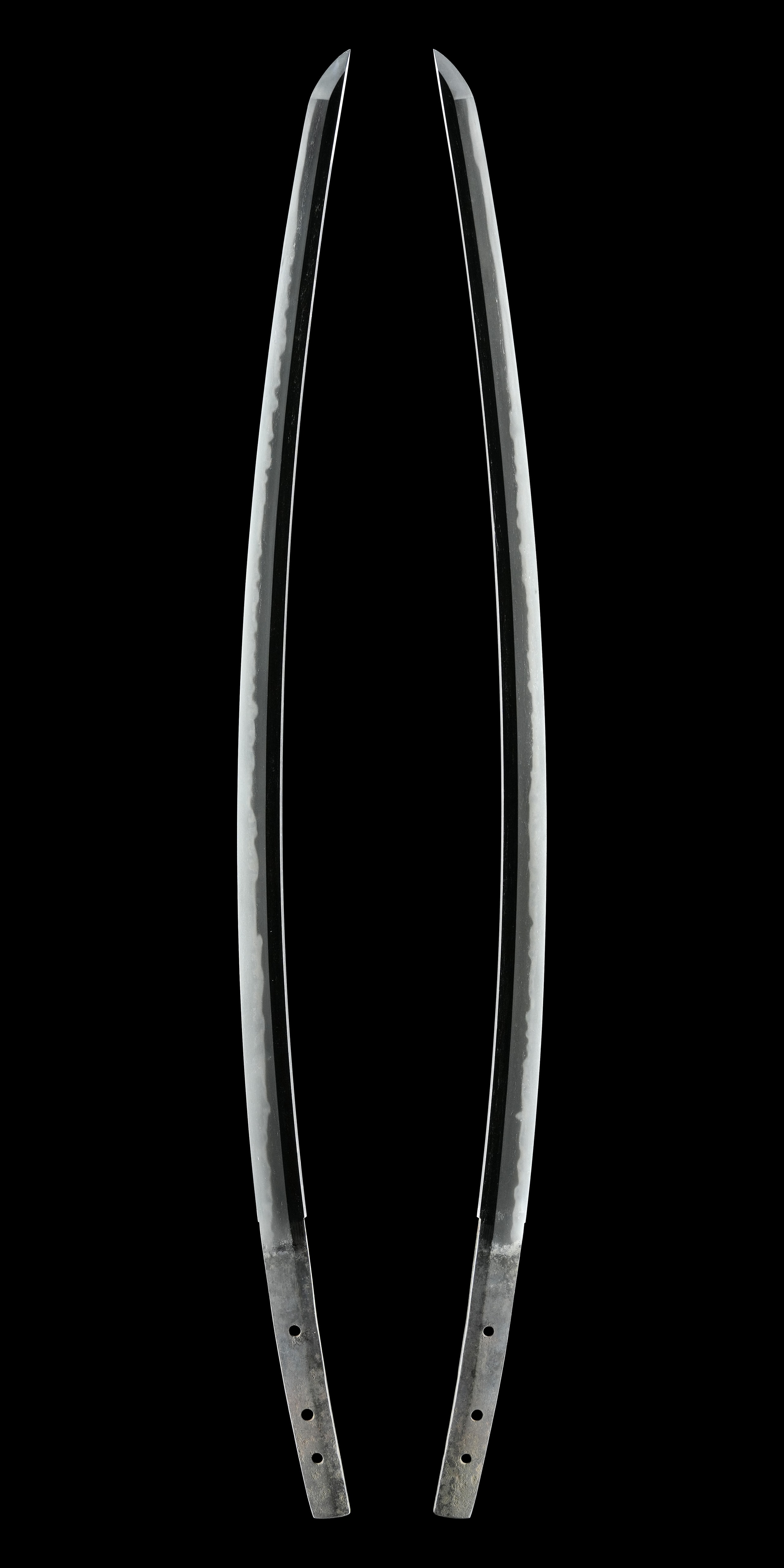
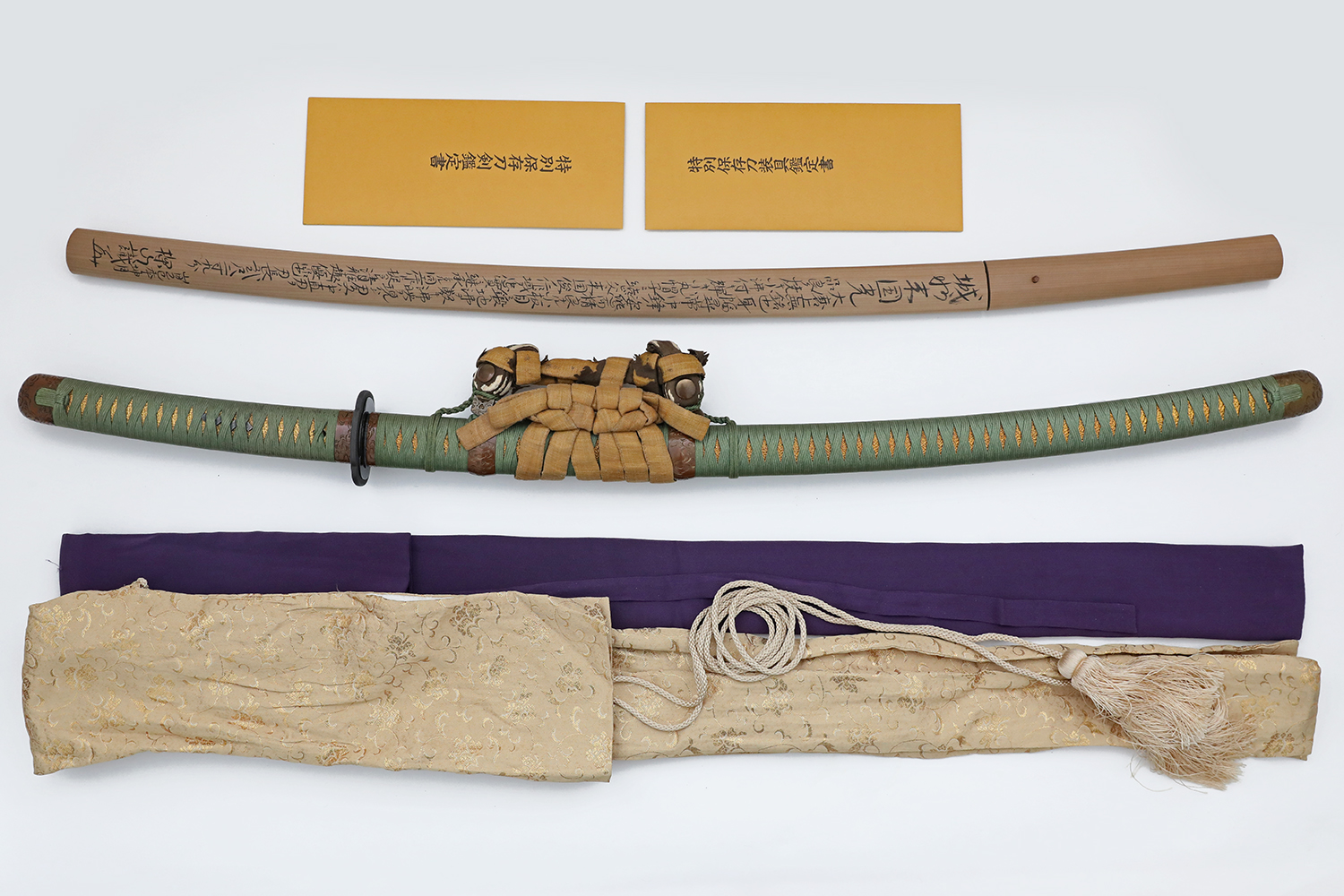
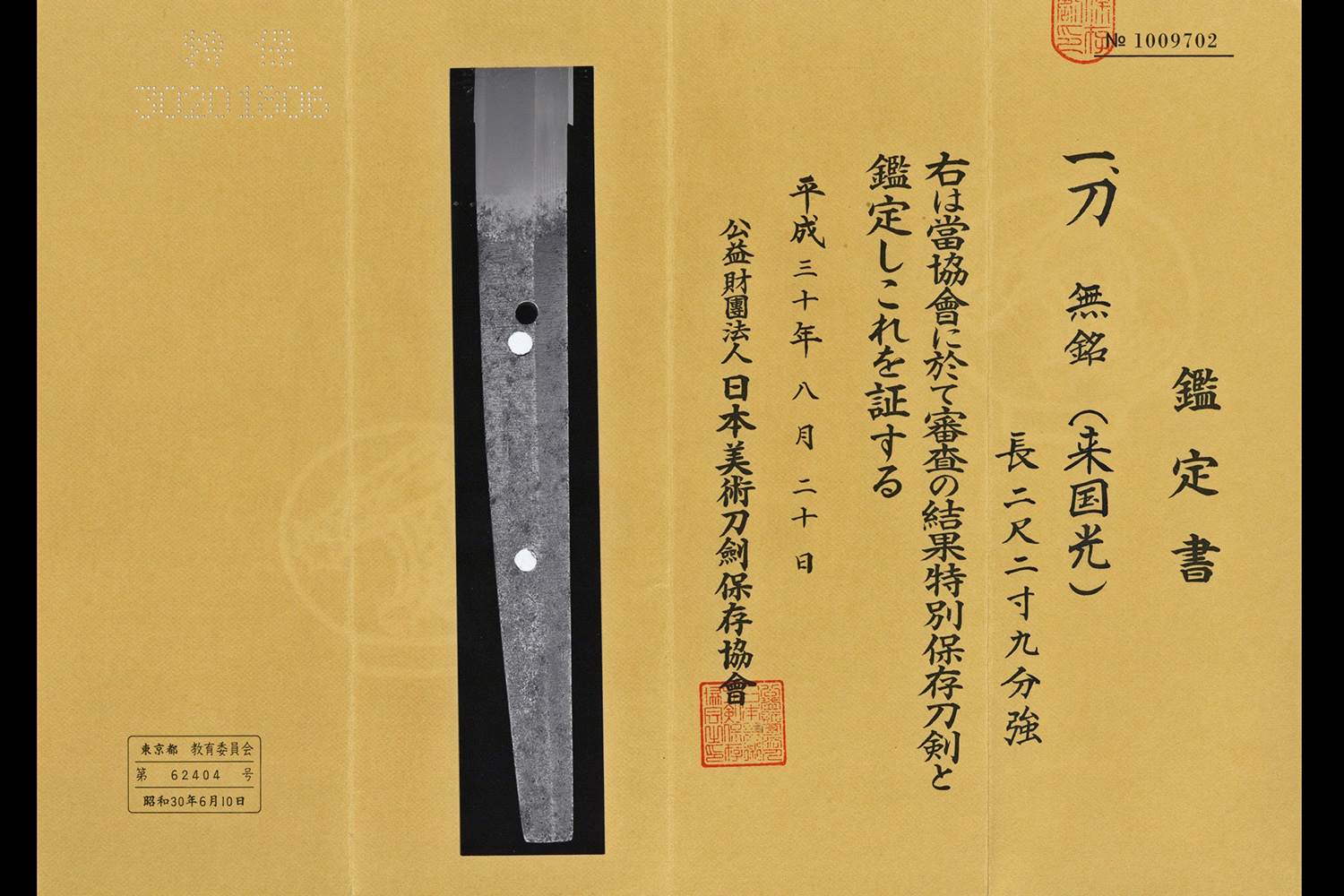
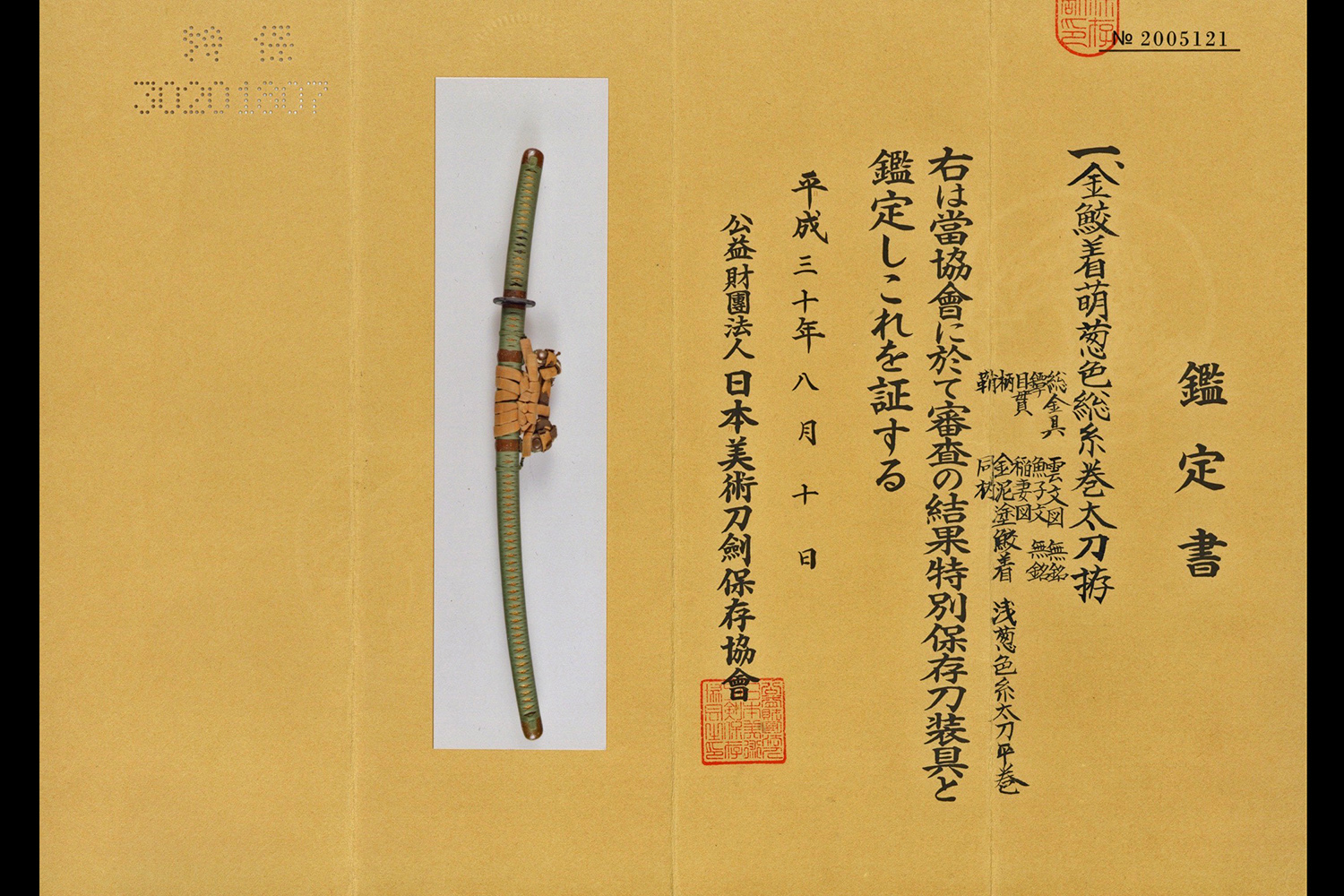
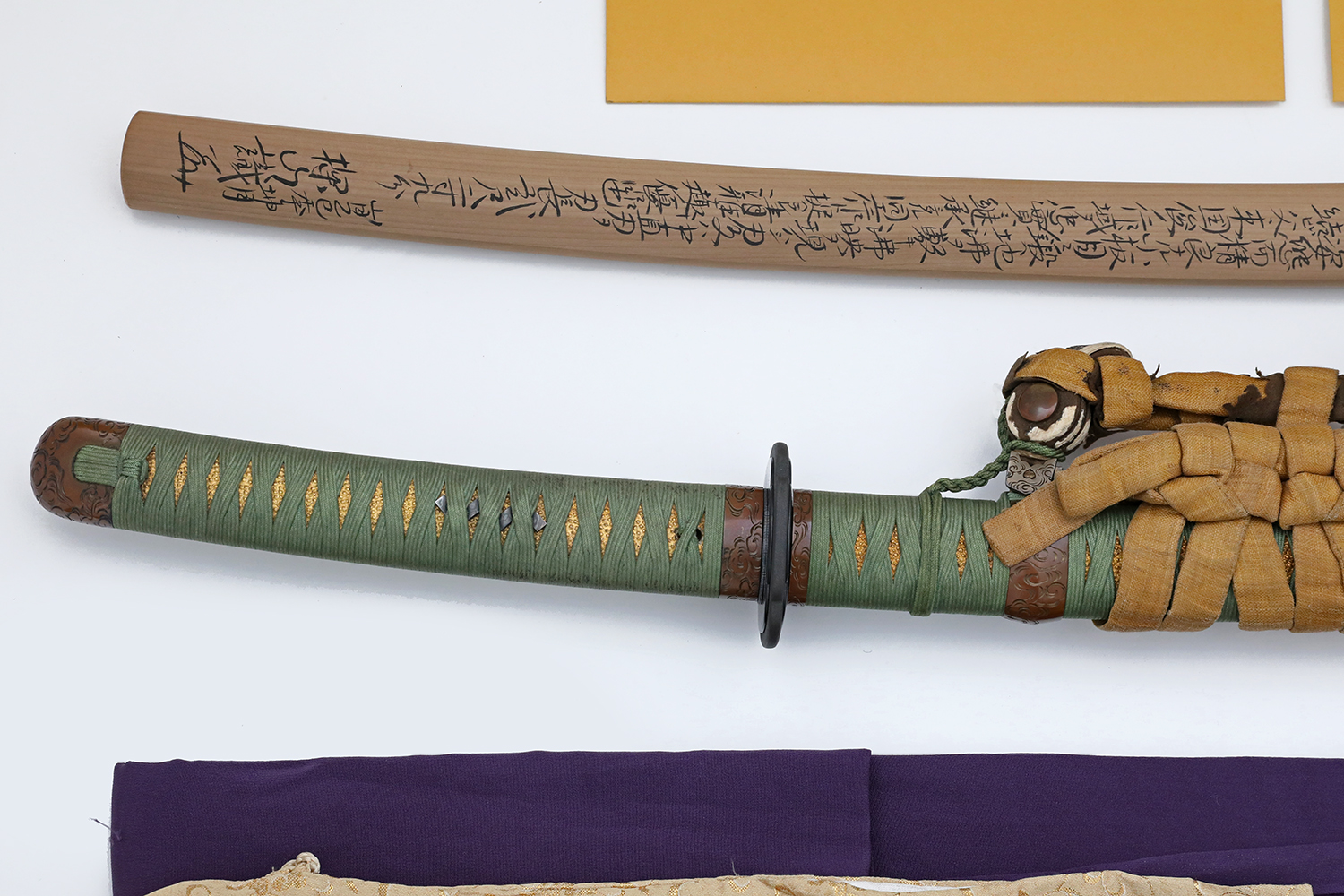
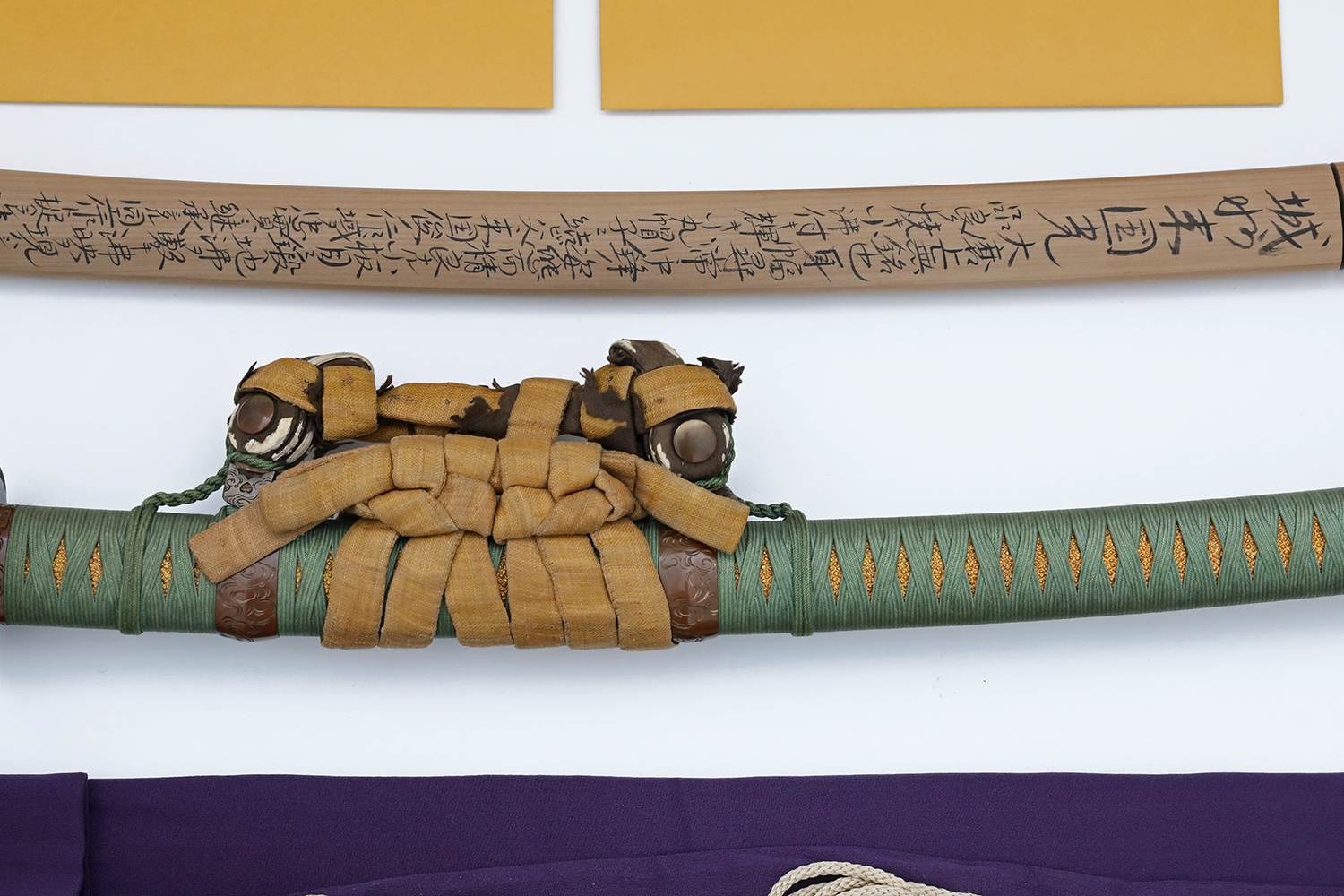
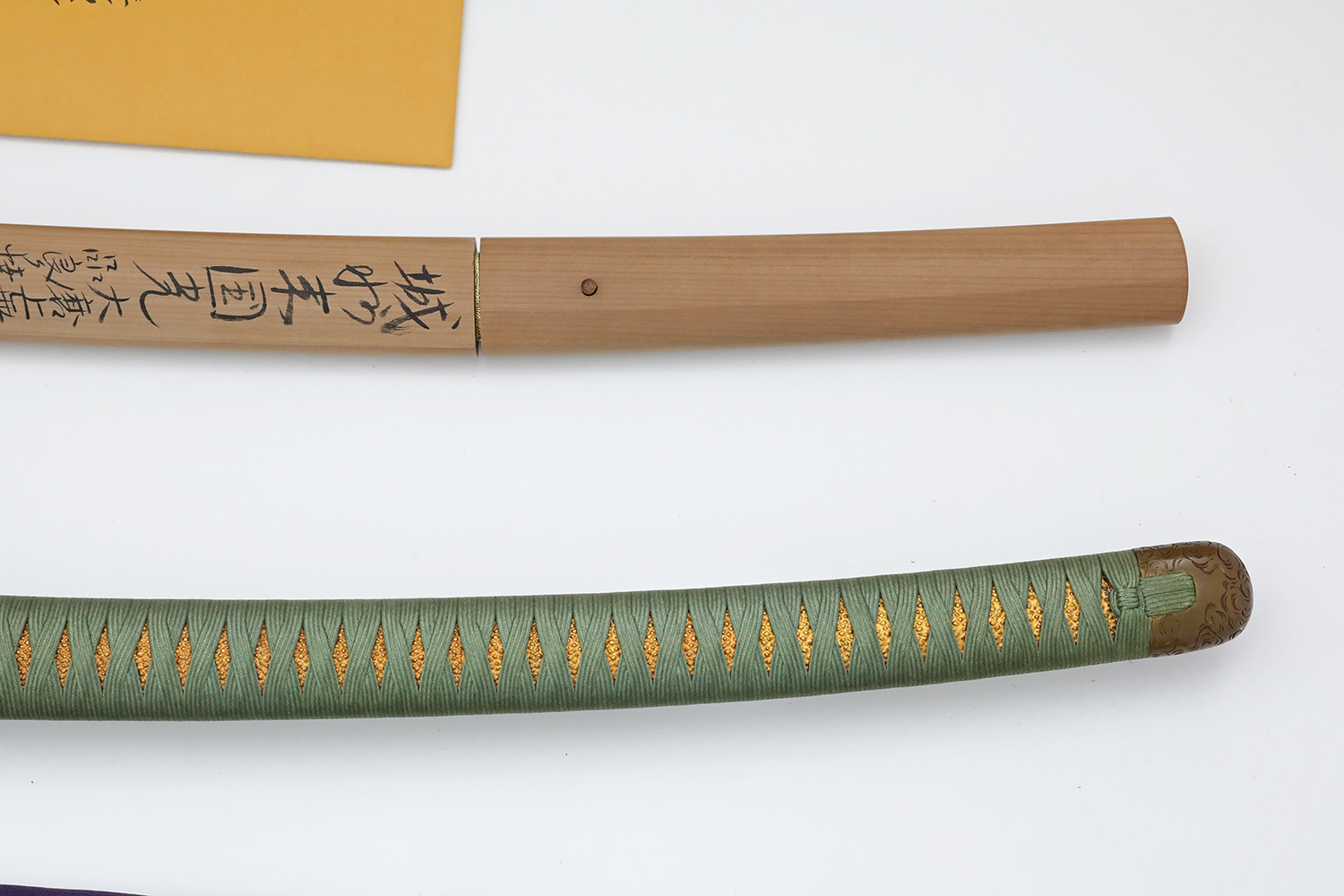
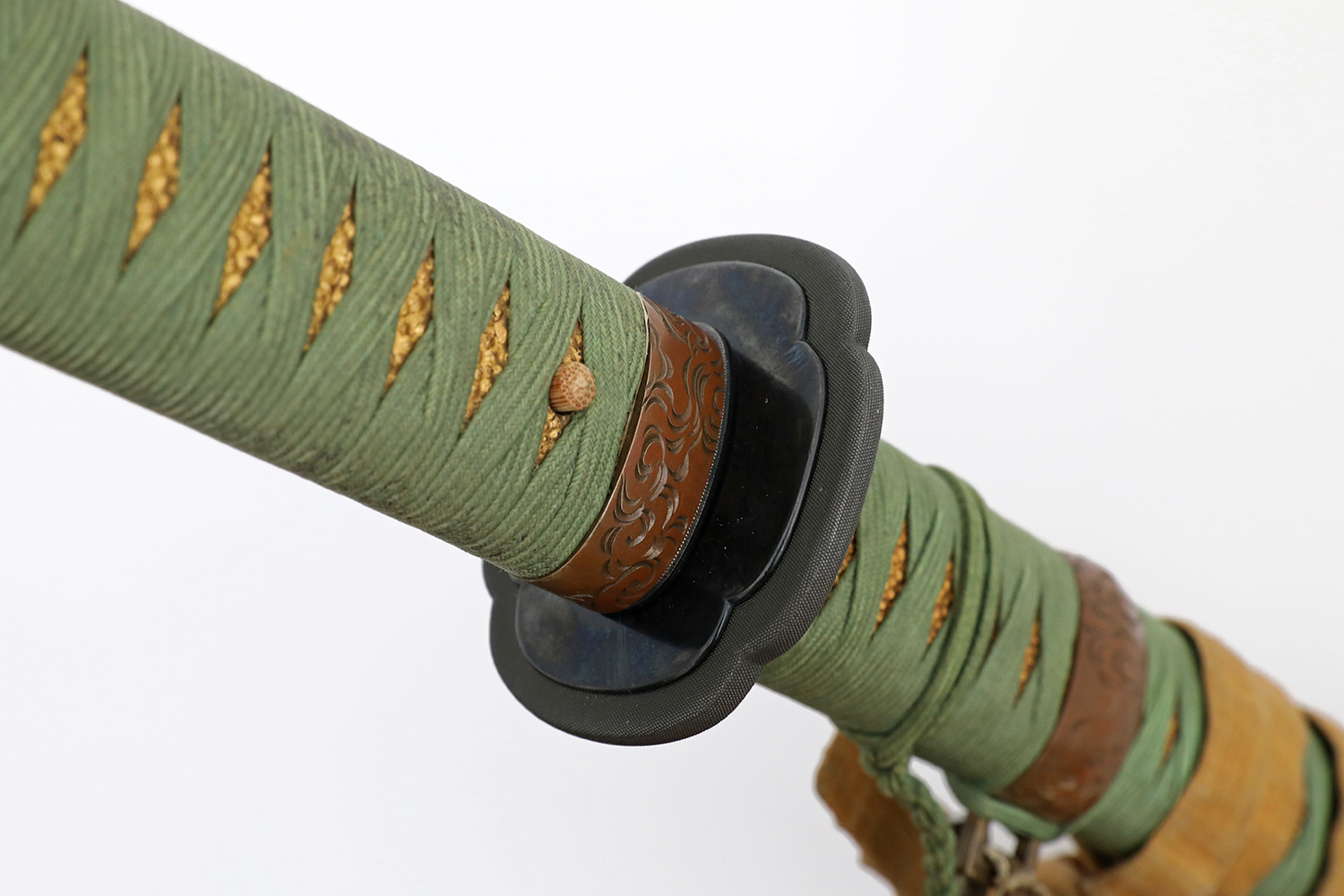
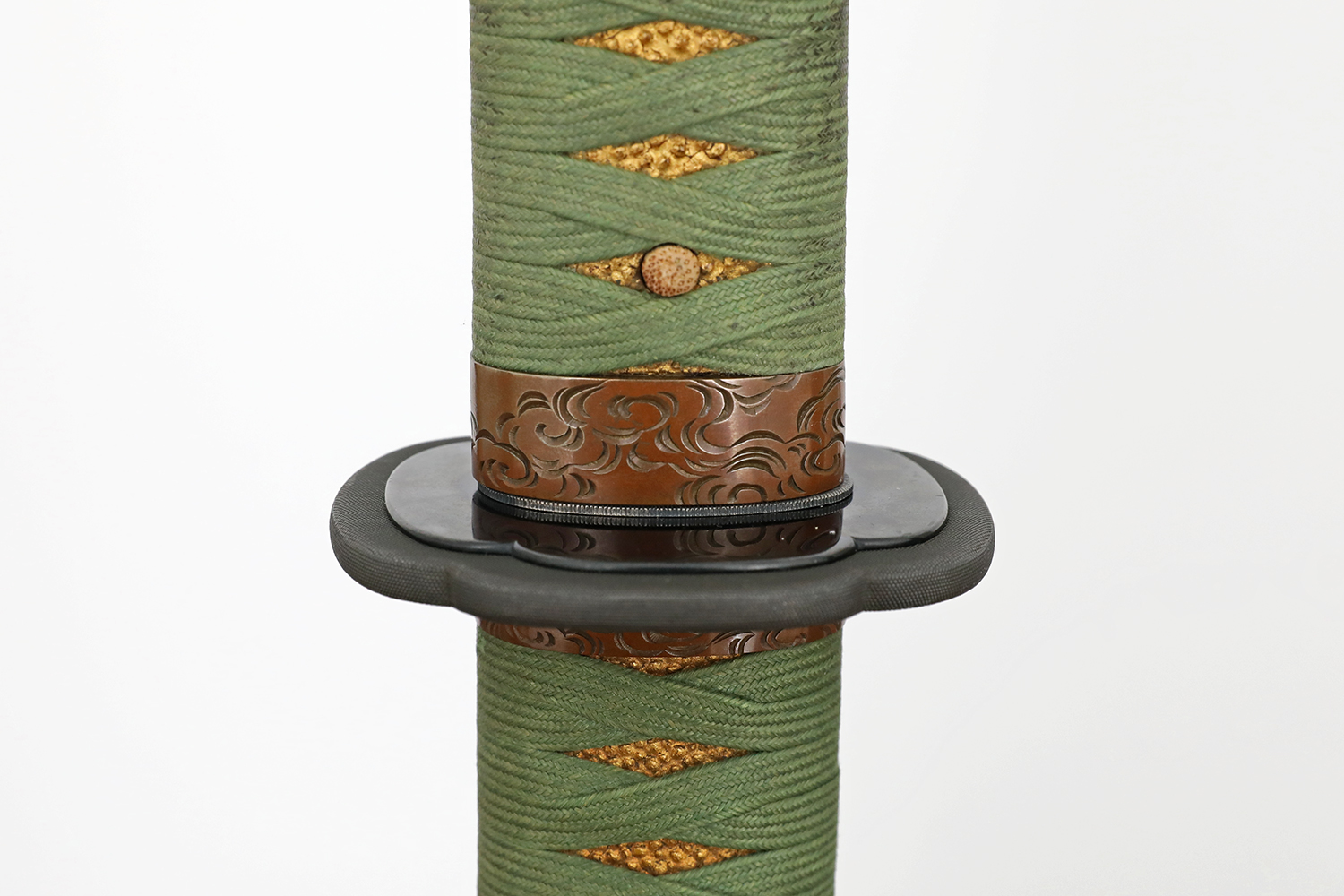
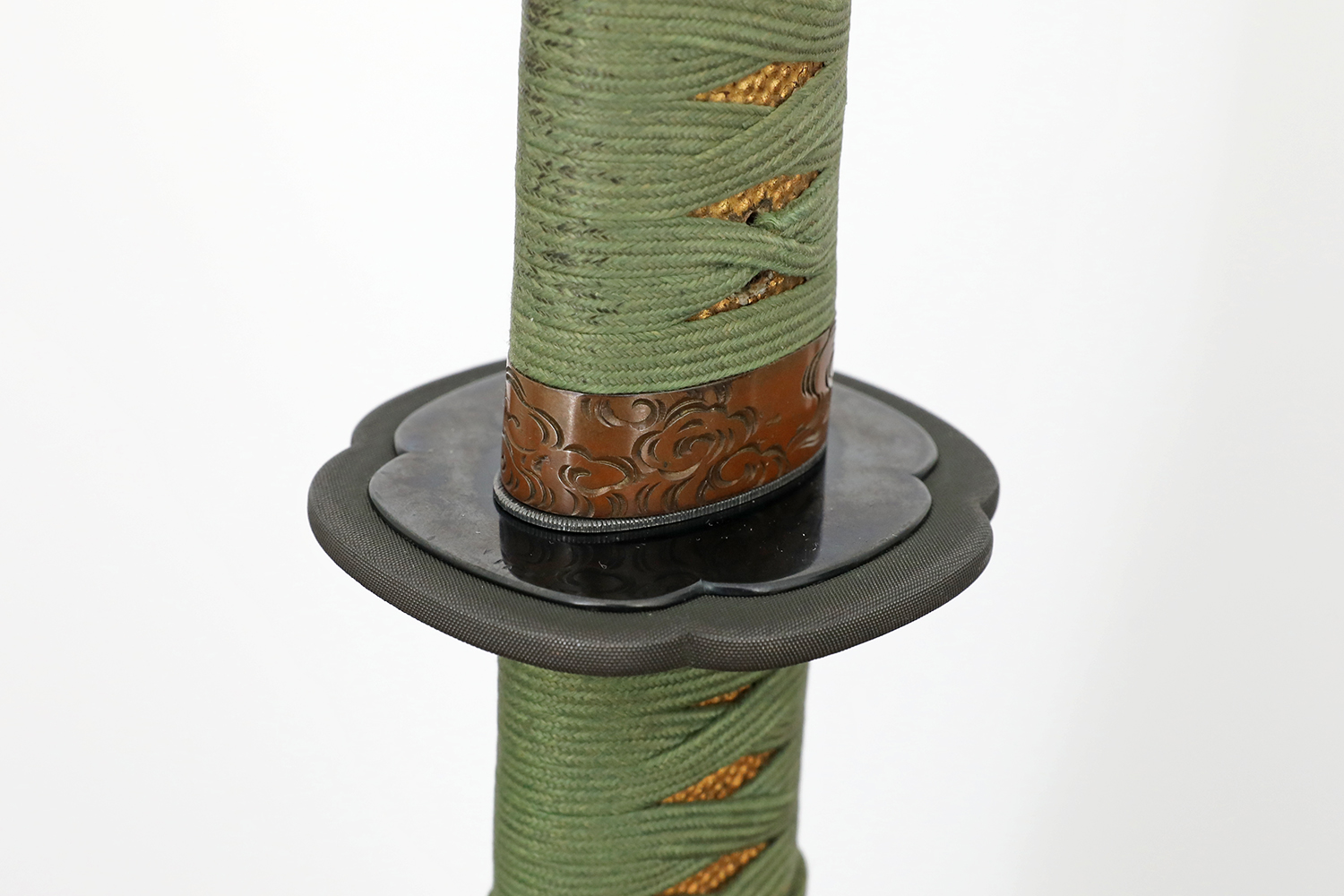
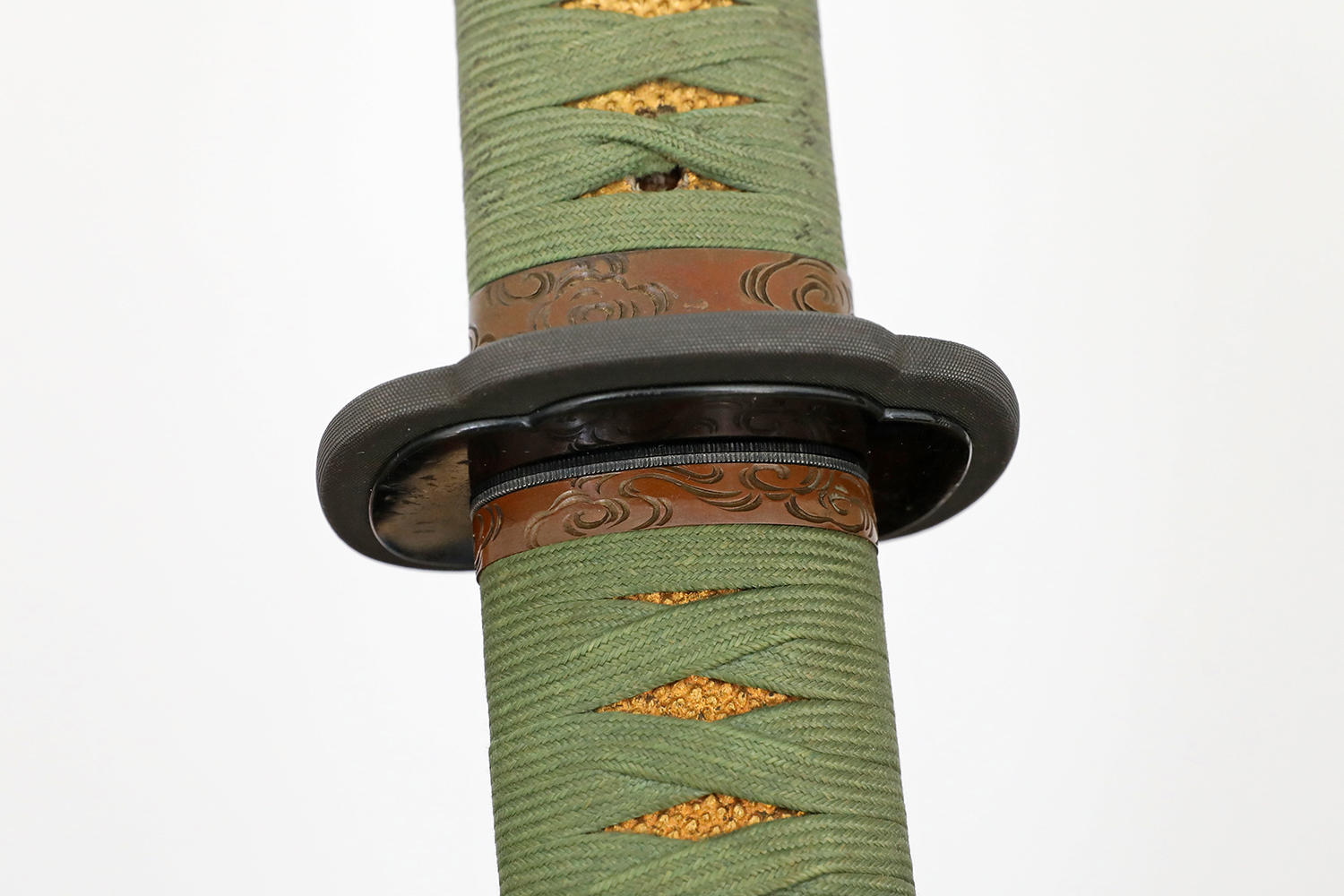
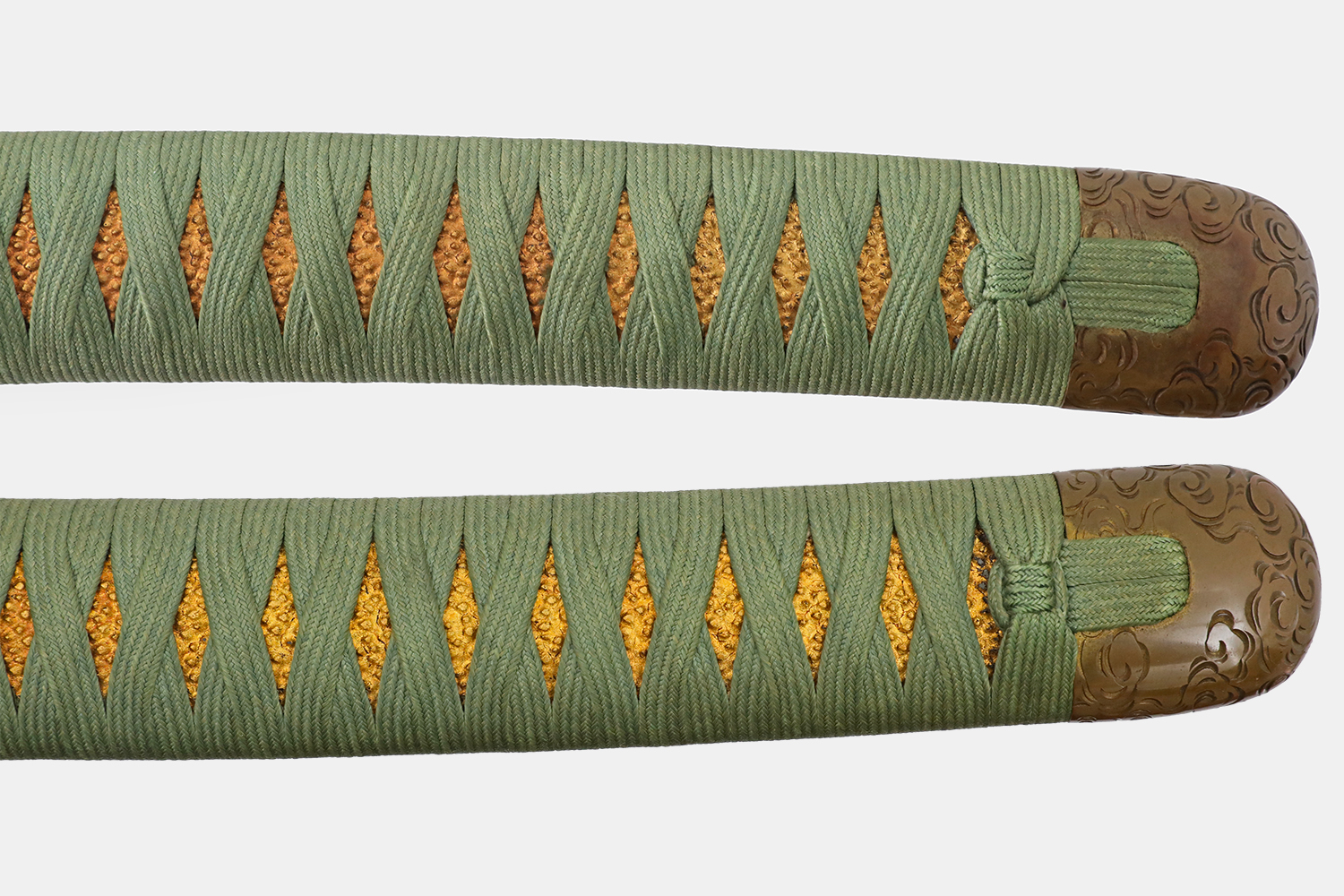
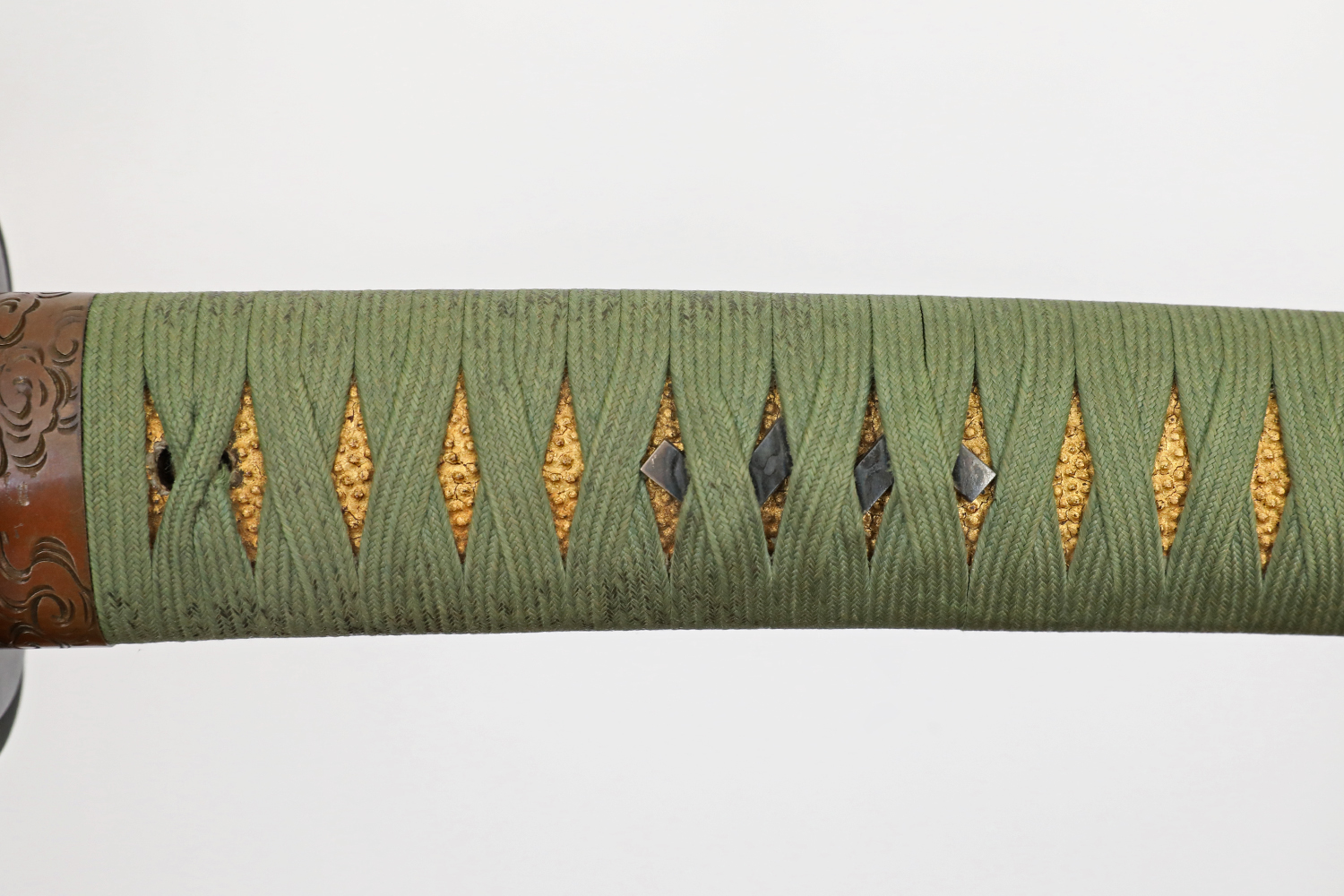
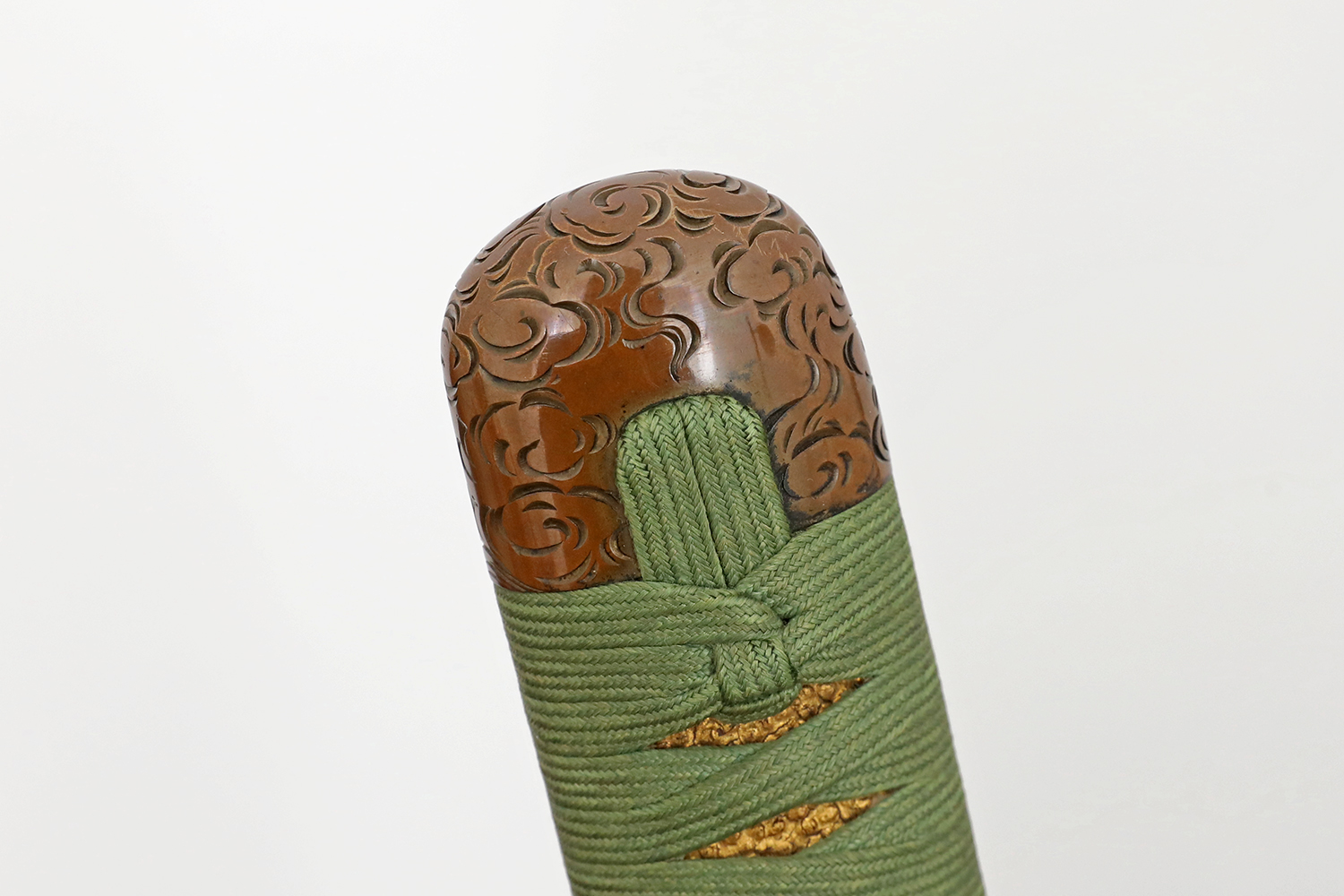
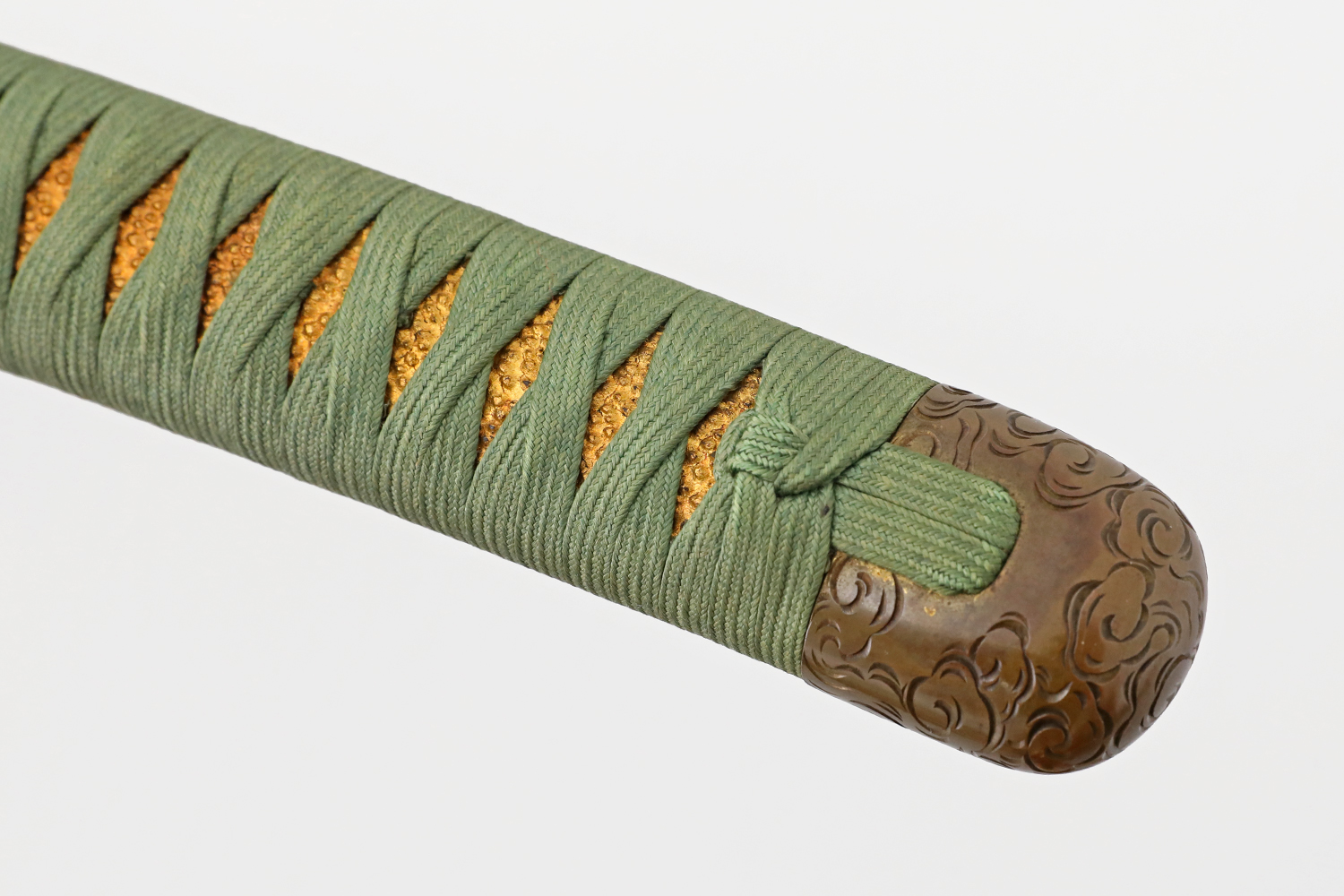
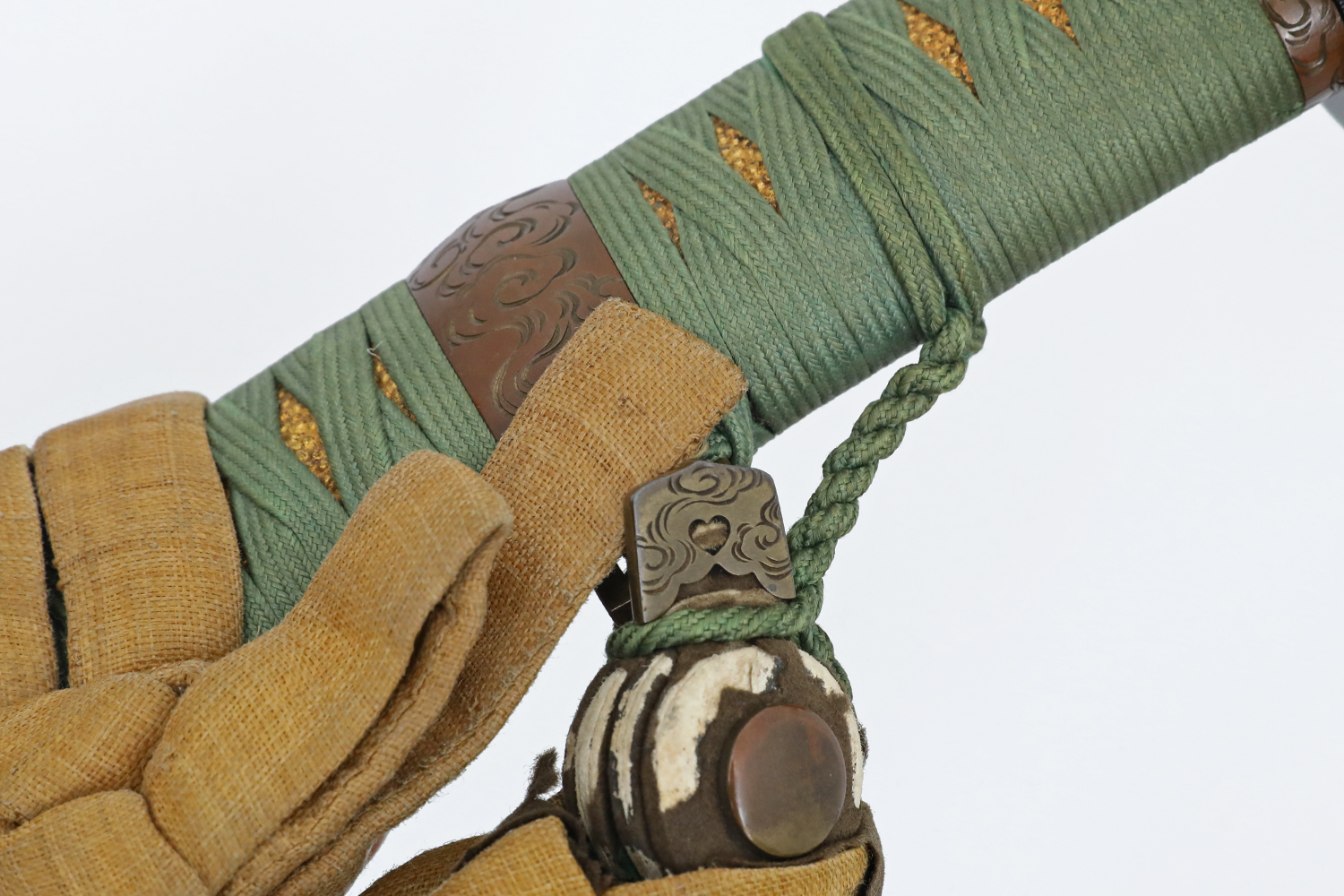
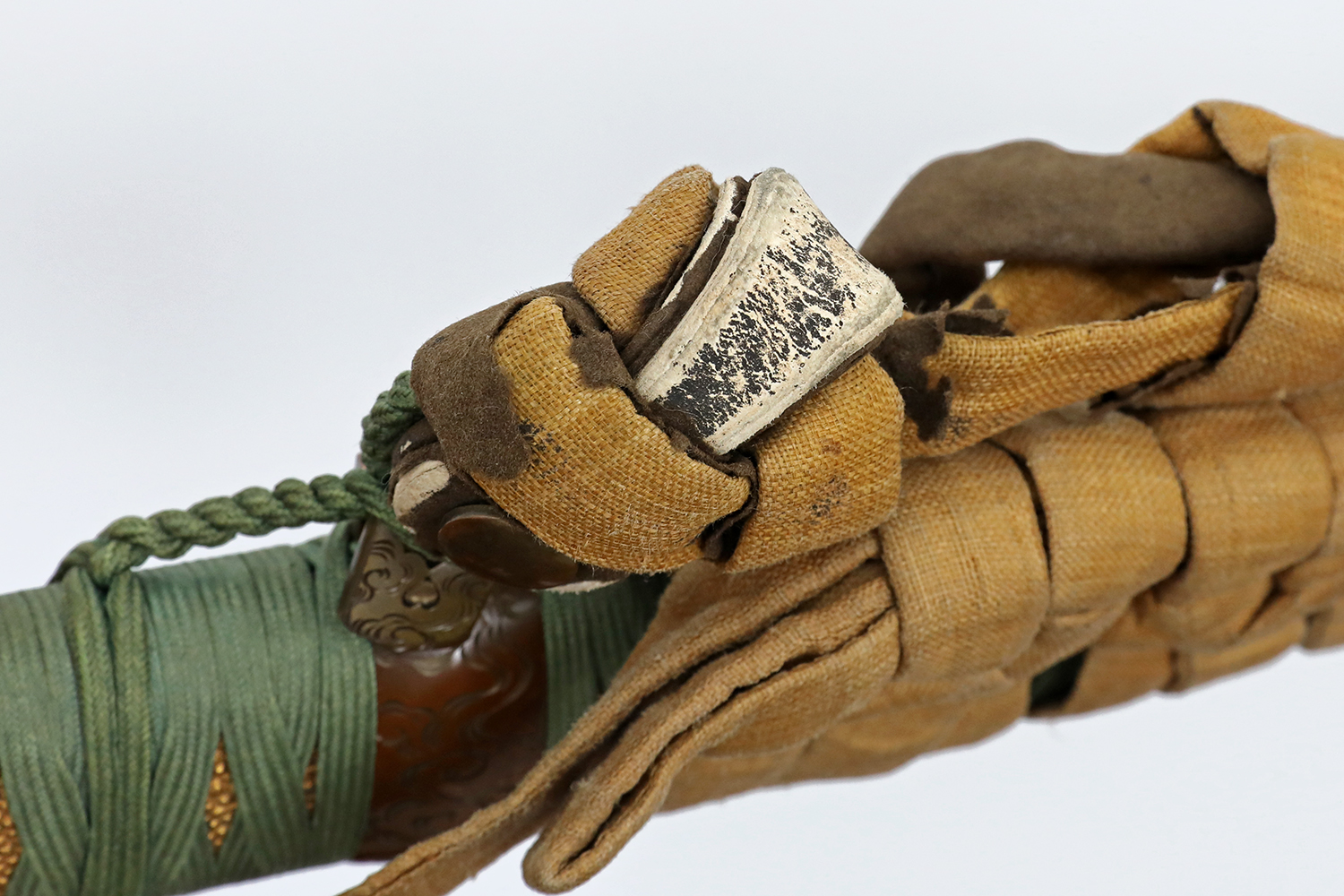
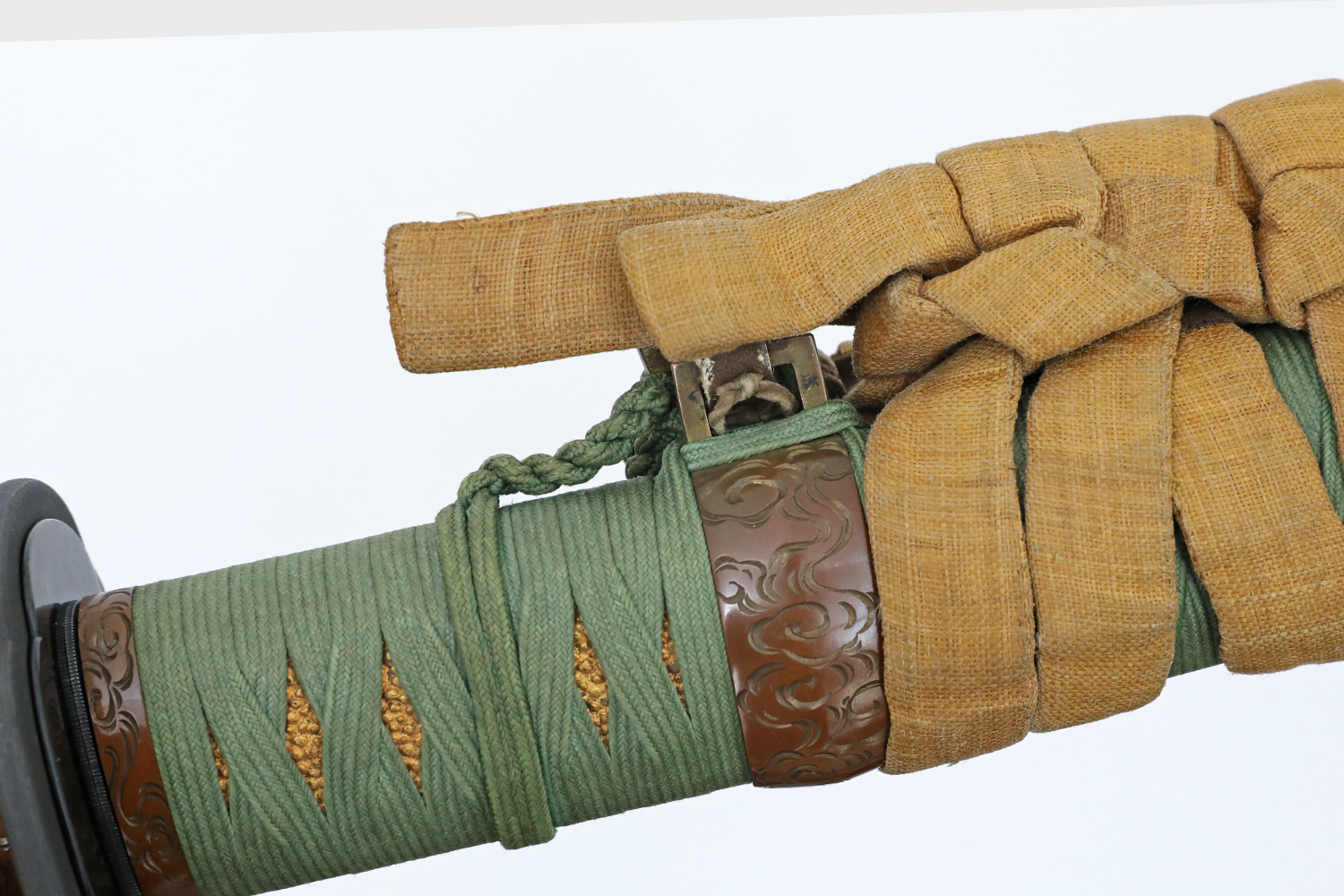
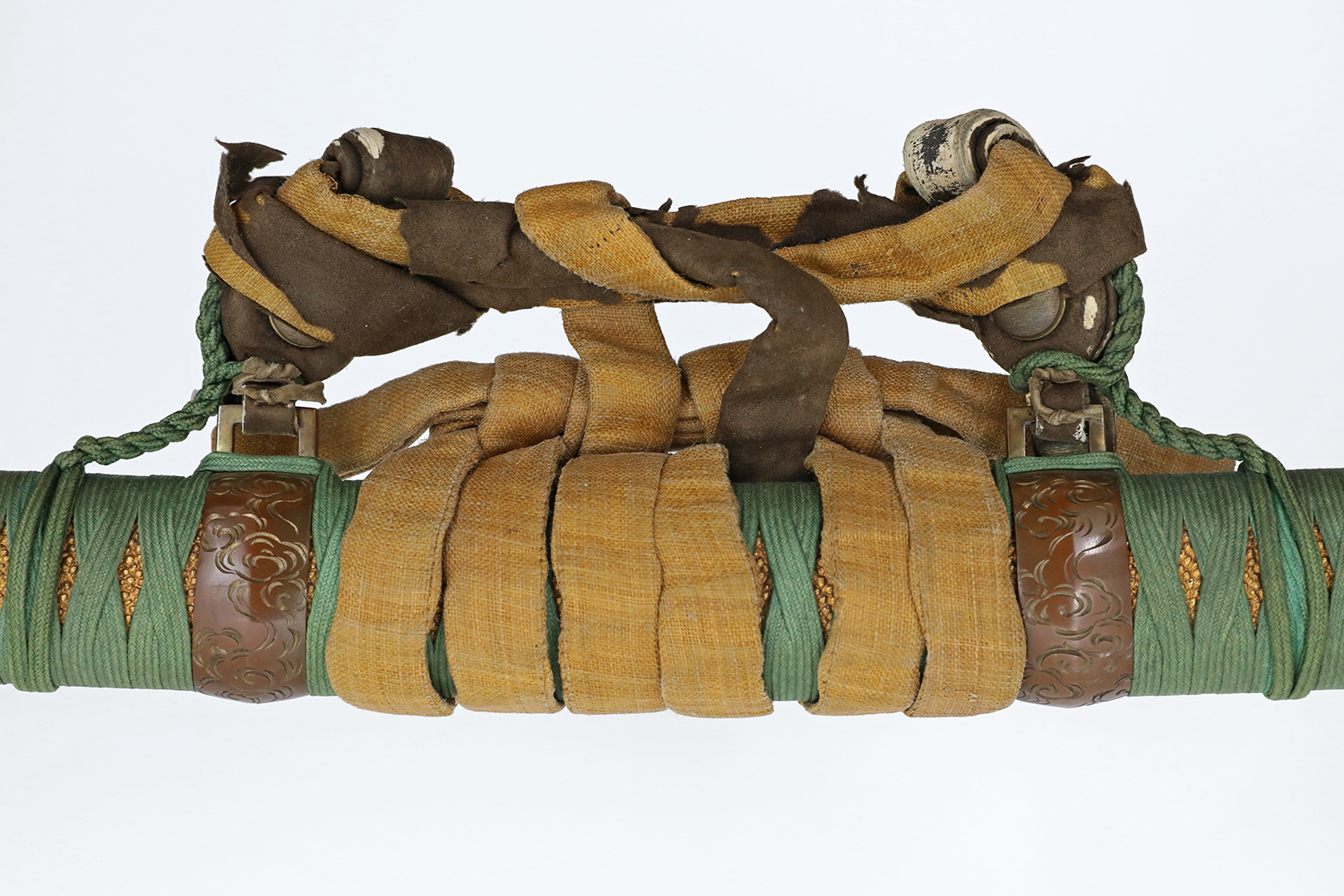
This is an exceptional Tachi by the famed Rai Kunimitsu, who was ranked Saijo-Saku (Supreme made). It is mounted in an incredible Tachi Koshirae with gold lacquered manta ray skin. The blade comes with NBTHK Tokubetsu Hozon certification and a Sayagaki by Tanobe Sensei.
 NihontoWatch
Rai · Showa (1312-1317) · nagasa 69.4cm
Rai (Yamashiro) · Yamashiro · around 1326-1351
Fujishiro Sai-jo saku · Tōken Taikan top 3%
4 pieces on the market now
The dated works of Rai Kunimitsu (来国光) run from Karyaku 1 (1326) to Kan'o 2 (1351), carrying the Rai school of Yamashiro from the close of the Kamakura period into the early Nanbokucho period. By the prevailing tradition he is transmitted as a son of Rai Kunitoshi, by some accounts a pupil, and the published sources observe that the smith with the most surviving works in the school is Kunimitsu himself. Their constant judgment reaches further: he is "the most versatile smith of the Rai school, the one with the widest working range"[[c:1]]. The notes enumerate that range: beyond the traditional true suguha of the Kyoto line, there are works on a suguha base mixing ko-gunome and ko-choji, works in suguha with a slight ko-midare tendency, works in a notare tone mixed with gunome, and works whose midare is dominated by gunome, spread across tachi, tanto and ko-wakizashi of equally varied form.
His most numerous work is the wide, robust osuriage katana, unsigned yet keeping the deep, evenly arched curvature the published record calls wazori, the chu-kissaki often a little extended. On these blades the temper is a chu-suguha or hiro-suguha within which ko-gunome and ko-choji stand apart; ashi and yo enter thickly, and the nioiguchi runs deep, bright and clear. Ko-nie adheres richly, kinsuji and fine sunagashi pass through the ha, and the boshi is sugu with a komaru turnback. The conspicuous presence of gunome within the suguha is the recognition point the sources state outright, the feature that separates his hand from Kunitoshi and Kuniyuki; of one such katana the NBTHK writes that these features "clearly manifest the characteristic traits of Rai Kunimitsu."
The jigane is constant beneath all of his manners: a tightly packed ko-itame under thick, dust-fine ji-nie, with fine chikei woven in and a nie-utsuri standing in the ji, the steel bright and clear. Here and there a softer patch of hada appears, the so-called Rai-hada, which the record treats as a tell of the school rather than a fault. On the Karyaku 2 dated tanto the notes describe the nie-utsuri near the fukura taking on a yubashiri-like appearance, entering as though drooping down toward the tempered edge, an aspect frequently encountered not only in his work but throughout the Rai group.
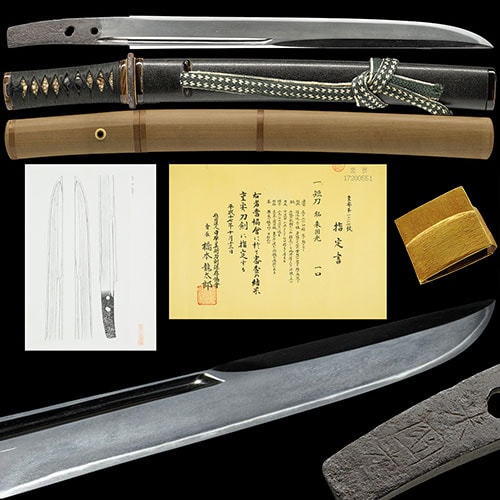
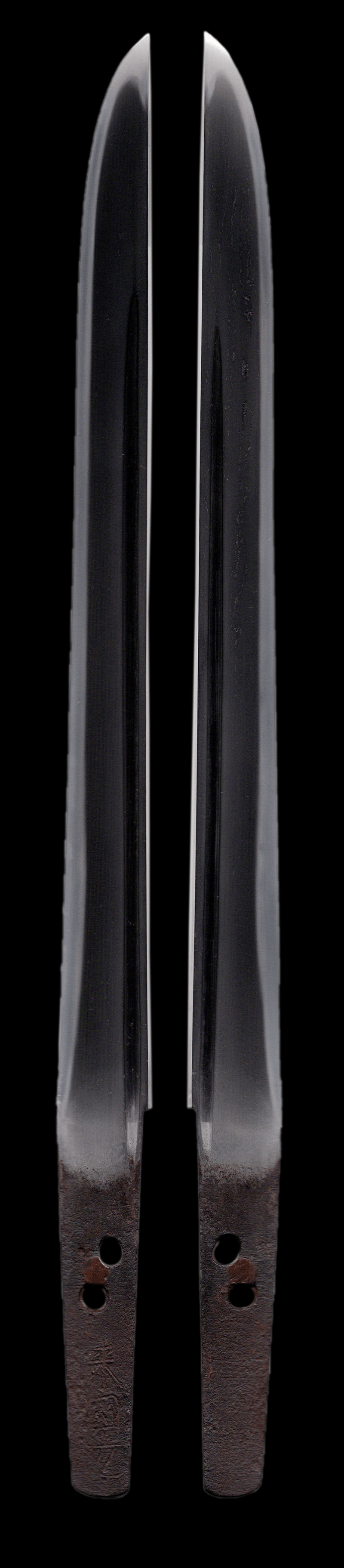
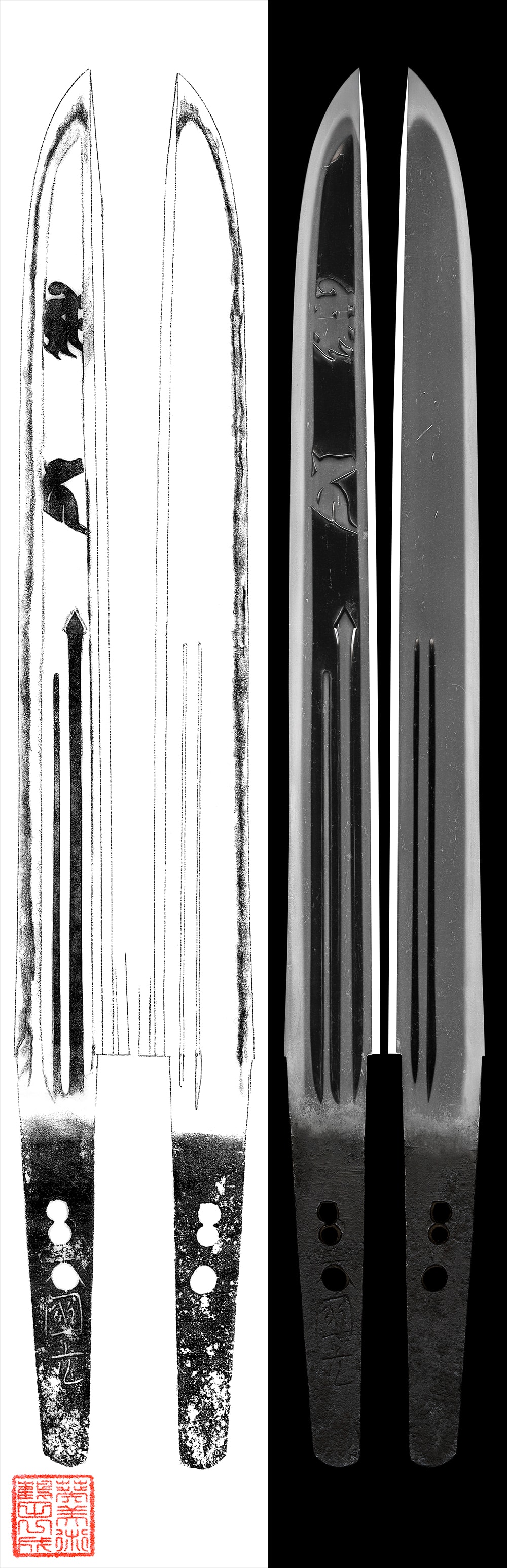
His tanto carry the two poles of the range most plainly. The small ones with uchizori, often bearing the simple, skillful suken and gomabashi carvings the record calls most frequent in his work, follow the father so closely, down to the hardening over the machi, that they pass at first sight for Kunitoshi; a slender suguha blade of this class is read as early work. The large ones run wide, sunnobi and nearly without sori, and on them he tempers his midare, notare mixed with gunome or gunome-dominant patterns, in nie a step stronger than on his tachi; these, the sources write, resemble the work of his junior fellow pupil Rai Kunitsugu, being "tinged with the color of the Soshu tradition and filled with bold spirit"[[c:2]]. The tanto dated Karyaku 2 (1327) shows the manner already formed, and the largest of the class is the meibutsu Aratami Rai (新身来). The signatures follow the forms: "on tachi the mei is comparatively small"[[c:3]], cut low on the tang toward the mune, while on tanto a bold three-character mei is placed below the mekugi-ana; his character for Rai, the record adds, is cut in a form differing from that used by Kunitoshi. A chronology of the mei is established: those of the Karyaku and Gentoku years have a softness, the enclosing kuni component characteristically rounded, while those of Jowa and Kan'o harden and the enclosure turns angular. The long working span and these changes of style and signature sustain an argument for a first and a second generation, which the Kokon Kaji Meizukushi divides around Gentoku to Kenmu and around Koei; yet the single-generation view remains strong, and the published sources leave the question as one that should await further study.
Set beside his father, the judges' formula is exact: compared with Kunitoshi he yields a little in the point of dignity, but gives the impression of surpassing him in force[[c:4]]. His nie runs somewhat stronger, and the chikei in the ji together with the kinsuji and sunagashi in the ha lend the work its vigor. Beside Rai Kuniyuki he lacks the elder smith's expansiveness: the yakiba sits a shade tighter, ashi crowd in, and the boshi tends toward a point. The wide midare tanto can pass at a glance for Rai Kunitsugu, and there the record draws the line in a single sentence: against Kunitsugu his hardening sits a touch lower, and in the sharp boshi with its thrusting tendency[[c:5]] the individuality of this smith can be discerned. Even his standard suguha can momentarily suggest the Enju offshoot; of one such blade the notes say it can at first glance be confused with Enju, but on careful examination proves a step superior. With Kunitsugu he carries the Soshu-tinged manner that closes the Rai mainline into the Nanbokucho period.
Fujishiro grades him Sai-jo saku, and 249 designated works stand on record: three National Treasures and twenty Important Cultural Properties, preserved as patrimony in museums, shrines and long-held collections, with twenty-three Juyo Bijutsuhin and 197 blades in the Tokubetsu Juyo and Juyo tiers beneath them. Signed and unsigned works survive in nearly equal numbers, the tachi mostly osuriage and mumei, the tanto largely ubu and signed. Fifty-seven blades carry recorded provenance, and the roll is of the first rank: a tachi the record calls "a tachi worn by Ieyasu, treasured in the Tokugawa house together with the Honjo Masamune"[[c:6]]; heirlooms of the Kishu, Owari and Mito Tokugawa, the Date of Sendai, the Maeda of Kaga, and the Kuroda, Shimazu, Asano, Hosokawa, Ikeda and Satake houses, with pieces from the Imperial Family; among the Hon'ami appraisals that follow them is an origami of Genroku 3 (1690) by Hon'ami Kotsune valuing one Owari Tokugawa blade at 500 kan. Holders recorded against his blades today include the Tokyo National Museum, the Kyoto National Museum, the Tokugawa Art Museum, the Sano Art Museum and the Seikado Bunko Art Museum. For the private collector he is not wholly beyond reach: blades in the Tokubetsu Juyo and Juyo tiers remain in private hands and one appears on the market from time to time, though for a name of this rank such an appearance is infrequent, and an event when it comes.
Where Kunimitsu stands among comparable artisans: across all of nihontō, and within tradition, era, and period. The tiers (Foremost · Leading · Major · Notable) weigh official designations from the NBTHK and Japan's Agency for Cultural Affairs, together with historical honors of lasting repute such as the Sansaku and Meibutsu-chō.
Select a lens to see how it's measured.
Years he was demonstrably active, proven by signed-and-dated blades
Yamashiro-den · Yamashiro
46 pieces on the market now
A calm, lustrous steel is the first thing the connoisseur's eye is meant to settle on with the Rai school: a finely forged ko-itame (小板目) worked until it is dense and refined, over which the ji-nie lies thickly in minute particles, fine chikei (地景) enter, and a nie-utsuri rises in the ji. This bright, refined jihada, the surface the trade reads as Rai-hada when its softer, looser patches intrude, is the constant beneath every manner the house produced. The school took shape in Kyoto in the mid-Kamakura period around the workshop of Rai Kuniyuki (來國行), the de facto founder of the line, whose chronology is reckoned from the Koan 1 (1278) tachi of his transmitted son. From Kuniyuki the Yamashiro-den tradition of late Kamakura was built, carried by Niji Kunitoshi, the two-character 國俊, traditionally his son and the nearest of the house to his hand; by the three-character Rai Kunitoshi, the first to crown his name with the character Rai, a practice all who followed took from him; and onward through Rai Kunimitsu (來國光), Rai Kunitsugu (來國次) and the lesser names Kunizane, Tomokuni, Kunihide and Mitsukane into the early Nanbokucho period. Whether the two Kunitoshi are one smith or two remains the classic open question of the school, argued from a span of dated work running about forty years from Koan 1 to Genko 1 (1321). What unites the house is a temper of restraint and activity at once, its life carried in the nie rather than in the height of the pattern. Against Kuniyuki's wide, suguha-toned ha and against the refined chu- or hoso-suguha of the three-character line, the smiths mix ko-choji, ko-gunome and small midare; ashi and yo enter densely, often as the Kyoto-style kyo-sakaashi (京逆足) that slants back toward the nakago, the opposite of the Bizen direction; the nioiguchi runs deep and bright, ko-nie attaches thickly, and kinsuji and sunagashi move through the body of the ha. The boshi is the school's most misjudged trait: a ko-maru drawn out by hakikake, the brushed nie of the point continuing the work of the ji below, often falling into midare-komi with a pointing tip. Muneyaki along the back recurs often enough that the records name it a habit of the Rai hand, and carving in the groove, suken or gomabashi with an added side hi, is a practice the texts call peculiar to Rai work. The strength of the nie within the ha, the utsuri rising as a nie-utsuri, and the kyo-sakaashi are precisely the marks that part Niji Kunitoshi's choji-dominant midare, which the old books said resembles the Bizen Ichimonji, from the Ichimonji itself.
Where the early masters keep this calm Kyoto register, the late line bends toward Soshu-den: Kunitsugu, counted among the Ten Brilliant Pupils of Masamune and named Kamakura-Rai, shows the strongest nie of ji and ha in the whole school, a notare mixed with gunome the earlier Rai never had. For a collector the house style is the recognition tool. An unsigned, o-suriage katana settles to Rai when the packed ko-itame, the fine nie over it, the standing utsuri and the kyo-sakaashi read together; the named smith is then fixed by degree. Niji Kunitoshi and the three-character Kunitoshi, both graded Sai-jo saku by Fujishiro, anchor the canon, the latter unusually approachable because his signed work is abundant and roughly half of it tanto, late Yamashiro work in its purest form. Kunimitsu, the most prolific and most versatile of the house, gives the impression of surpassing his father in force; Kunitsugu, graded Jo-jo saku, is the Soshu-facing edge whose signed tachi are scarce. Mitsukane, the Chudo Rai who withdrew to forge on Mt. Hiei, stands apart as the strong pole, his ji-nie laid thicker than Kunitoshi's or Kunimitsu's and likened upward to Awataguchi Yoshimitsu; the smaller Kunizane, Tomokuni and Kunihide carry the jigane a step into the Nanbokucho. The provenance roll is of the first rank, with blades worn by Ieyasu and held beside the Honjo Masamune, meibutsu such as the Aizen Kunitoshi, the Torikai Kunitsugu and the Midare-Mitsukane, and descent through the Owari and Kishu Tokugawa, the Maeda, Uesugi and Shimazu houses. Much sits locked as National Treasure and patrimony, yet the Juyo tier of the major names, and the whole record of the minor hands, remains a goal a serious collector can actually reach. Learn more →
| Smith | Era | Designated |
|---|---|---|
| Kuniyuki國行 | 1259-1260 | 125 |
| Kunitoshi國俊 | 1278-1288 | 79 |
| Kunitsugu國次 | 1311-1327 | 65 |
| Kunimitsu國光 | 1326-1351 | 259 |
| Kunitoshi國俊 | 1288-1319 | 196 |
Yamashiro in the Kamakura period
Power sat in Kamakura, but taste was still made in Kyōto. The Awataguchi school’s pear-skin steel became a byword for perfection, and the Rai line supplied dignified tachi to the court, senior warriors, and the great temples alike.
We could not find an authenticity certificate on the seller’s listing. Japanese swords and fittings are normally papered by the NBTHK (or the NTHK). Without one, the attribution is the seller’s own assessment and has not been independently verified — treat it with caution and ask the dealer about certification before buying.
If the item fails to meet the description, it may be eligible for a return (at the seller's discretion). Item(s) must be shipped back only via FedEx or UPS within 48 hours of receipt, in original undamaged state. Costs are the purchaser's responsibility.
This is an exceptional Tachi by the famed Rai Kunimitsu, who was ranked Saijo-Saku (Supreme made). It is mounted in an incredible Tachi Koshirae with gold lacquered manta ray skin. The blade comes with NBTHK Tokubetsu Hozon certification and a Sayagaki by Tanobe Sensei.
NihontoWatchRai · Showa (1312-1317) · nagasa 69.4cm
Rai (Yamashiro) · Yamashiro · around 1326-1351
Fujishiro Sai-jo saku · Tōken Taikan top 3%
4 pieces on the market now
The dated works of Rai Kunimitsu (来国光) run from Karyaku 1 (1326) to Kan'o 2 (1351), carrying the Rai school of Yamashiro from the close of the Kamakura period into the early Nanbokucho period. By the prevailing tradition he is transmitted as a son of Rai Kunitoshi, by some accounts a pupil, and the published sources observe that the smith with the most surviving works in the school is Kunimitsu himself. Their constant judgment reaches further: he is "the most versatile smith of the Rai school, the one with the widest working range"[[c:1]]. The notes enumerate that range: beyond the traditional true suguha of the Kyoto line, there are works on a suguha base mixing ko-gunome and ko-choji, works in suguha with a slight ko-midare tendency, works in a notare tone mixed with gunome, and works whose midare is dominated by gunome, spread across tachi, tanto and ko-wakizashi of equally varied form.
His most numerous work is the wide, robust osuriage katana, unsigned yet keeping the deep, evenly arched curvature the published record calls wazori, the chu-kissaki often a little extended. On these blades the temper is a chu-suguha or hiro-suguha within which ko-gunome and ko-choji stand apart; ashi and yo enter thickly, and the nioiguchi runs deep, bright and clear. Ko-nie adheres richly, kinsuji and fine sunagashi pass through the ha, and the boshi is sugu with a komaru turnback. The conspicuous presence of gunome within the suguha is the recognition point the sources state outright, the feature that separates his hand from Kunitoshi and Kuniyuki; of one such katana the NBTHK writes that these features "clearly manifest the characteristic traits of Rai Kunimitsu."
The jigane is constant beneath all of his manners: a tightly packed ko-itame under thick, dust-fine ji-nie, with fine chikei woven in and a nie-utsuri standing in the ji, the steel bright and clear. Here and there a softer patch of hada appears, the so-called Rai-hada, which the record treats as a tell of the school rather than a fault. On the Karyaku 2 dated tanto the notes describe the nie-utsuri near the fukura taking on a yubashiri-like appearance, entering as though drooping down toward the tempered edge, an aspect frequently encountered not only in his work but throughout the Rai group.
His tanto carry the two poles of the range most plainly. The small ones with uchizori, often bearing the simple, skillful suken and gomabashi carvings the record calls most frequent in his work, follow the father so closely, down to the hardening over the machi, that they pass at first sight for Kunitoshi; a slender suguha blade of this class is read as early work. The large ones run wide, sunnobi and nearly without sori, and on them he tempers his midare, notare mixed with gunome or gunome-dominant patterns, in nie a step stronger than on his tachi; these, the sources write, resemble the work of his junior fellow pupil Rai Kunitsugu, being "tinged with the color of the Soshu tradition and filled with bold spirit"[[c:2]]. The tanto dated Karyaku 2 (1327) shows the manner already formed, and the largest of the class is the meibutsu Aratami Rai (新身来). The signatures follow the forms: "on tachi the mei is comparatively small"[[c:3]], cut low on the tang toward the mune, while on tanto a bold three-character mei is placed below the mekugi-ana; his character for Rai, the record adds, is cut in a form differing from that used by Kunitoshi. A chronology of the mei is established: those of the Karyaku and Gentoku years have a softness, the enclosing kuni component characteristically rounded, while those of Jowa and Kan'o harden and the enclosure turns angular. The long working span and these changes of style and signature sustain an argument for a first and a second generation, which the Kokon Kaji Meizukushi divides around Gentoku to Kenmu and around Koei; yet the single-generation view remains strong, and the published sources leave the question as one that should await further study.
Set beside his father, the judges' formula is exact: compared with Kunitoshi he yields a little in the point of dignity, but gives the impression of surpassing him in force[[c:4]]. His nie runs somewhat stronger, and the chikei in the ji together with the kinsuji and sunagashi in the ha lend the work its vigor. Beside Rai Kuniyuki he lacks the elder smith's expansiveness: the yakiba sits a shade tighter, ashi crowd in, and the boshi tends toward a point. The wide midare tanto can pass at a glance for Rai Kunitsugu, and there the record draws the line in a single sentence: against Kunitsugu his hardening sits a touch lower, and in the sharp boshi with its thrusting tendency[[c:5]] the individuality of this smith can be discerned. Even his standard suguha can momentarily suggest the Enju offshoot; of one such blade the notes say it can at first glance be confused with Enju, but on careful examination proves a step superior. With Kunitsugu he carries the Soshu-tinged manner that closes the Rai mainline into the Nanbokucho period.
Fujishiro grades him Sai-jo saku, and 249 designated works stand on record: three National Treasures and twenty Important Cultural Properties, preserved as patrimony in museums, shrines and long-held collections, with twenty-three Juyo Bijutsuhin and 197 blades in the Tokubetsu Juyo and Juyo tiers beneath them. Signed and unsigned works survive in nearly equal numbers, the tachi mostly osuriage and mumei, the tanto largely ubu and signed. Fifty-seven blades carry recorded provenance, and the roll is of the first rank: a tachi the record calls "a tachi worn by Ieyasu, treasured in the Tokugawa house together with the Honjo Masamune"[[c:6]]; heirlooms of the Kishu, Owari and Mito Tokugawa, the Date of Sendai, the Maeda of Kaga, and the Kuroda, Shimazu, Asano, Hosokawa, Ikeda and Satake houses, with pieces from the Imperial Family; among the Hon'ami appraisals that follow them is an origami of Genroku 3 (1690) by Hon'ami Kotsune valuing one Owari Tokugawa blade at 500 kan. Holders recorded against his blades today include the Tokyo National Museum, the Kyoto National Museum, the Tokugawa Art Museum, the Sano Art Museum and the Seikado Bunko Art Museum. For the private collector he is not wholly beyond reach: blades in the Tokubetsu Juyo and Juyo tiers remain in private hands and one appears on the market from time to time, though for a name of this rank such an appearance is infrequent, and an event when it comes.
Where Kunimitsu stands among comparable artisans: across all of nihontō, and within tradition, era, and period. The tiers (Foremost · Leading · Major · Notable) weigh official designations from the NBTHK and Japan's Agency for Cultural Affairs, together with historical honors of lasting repute such as the Sansaku and Meibutsu-chō.
Select a lens to see how it's measured.
Years he was demonstrably active, proven by signed-and-dated blades
Yamashiro-den · Yamashiro
46 pieces on the market now
A calm, lustrous steel is the first thing the connoisseur's eye is meant to settle on with the Rai school: a finely forged ko-itame (小板目) worked until it is dense and refined, over which the ji-nie lies thickly in minute particles, fine chikei (地景) enter, and a nie-utsuri rises in the ji. This bright, refined jihada, the surface the trade reads as Rai-hada when its softer, looser patches intrude, is the constant beneath every manner the house produced. The school took shape in Kyoto in the mid-Kamakura period around the workshop of Rai Kuniyuki (來國行), the de facto founder of the line, whose chronology is reckoned from the Koan 1 (1278) tachi of his transmitted son. From Kuniyuki the Yamashiro-den tradition of late Kamakura was built, carried by Niji Kunitoshi, the two-character 國俊, traditionally his son and the nearest of the house to his hand; by the three-character Rai Kunitoshi, the first to crown his name with the character Rai, a practice all who followed took from him; and onward through Rai Kunimitsu (來國光), Rai Kunitsugu (來國次) and the lesser names Kunizane, Tomokuni, Kunihide and Mitsukane into the early Nanbokucho period. Whether the two Kunitoshi are one smith or two remains the classic open question of the school, argued from a span of dated work running about forty years from Koan 1 to Genko 1 (1321). What unites the house is a temper of restraint and activity at once, its life carried in the nie rather than in the height of the pattern. Against Kuniyuki's wide, suguha-toned ha and against the refined chu- or hoso-suguha of the three-character line, the smiths mix ko-choji, ko-gunome and small midare; ashi and yo enter densely, often as the Kyoto-style kyo-sakaashi (京逆足) that slants back toward the nakago, the opposite of the Bizen direction; the nioiguchi runs deep and bright, ko-nie attaches thickly, and kinsuji and sunagashi move through the body of the ha. The boshi is the school's most misjudged trait: a ko-maru drawn out by hakikake, the brushed nie of the point continuing the work of the ji below, often falling into midare-komi with a pointing tip. Muneyaki along the back recurs often enough that the records name it a habit of the Rai hand, and carving in the groove, suken or gomabashi with an added side hi, is a practice the texts call peculiar to Rai work. The strength of the nie within the ha, the utsuri rising as a nie-utsuri, and the kyo-sakaashi are precisely the marks that part Niji Kunitoshi's choji-dominant midare, which the old books said resembles the Bizen Ichimonji, from the Ichimonji itself.
Where the early masters keep this calm Kyoto register, the late line bends toward Soshu-den: Kunitsugu, counted among the Ten Brilliant Pupils of Masamune and named Kamakura-Rai, shows the strongest nie of ji and ha in the whole school, a notare mixed with gunome the earlier Rai never had. For a collector the house style is the recognition tool. An unsigned, o-suriage katana settles to Rai when the packed ko-itame, the fine nie over it, the standing utsuri and the kyo-sakaashi read together; the named smith is then fixed by degree. Niji Kunitoshi and the three-character Kunitoshi, both graded Sai-jo saku by Fujishiro, anchor the canon, the latter unusually approachable because his signed work is abundant and roughly half of it tanto, late Yamashiro work in its purest form. Kunimitsu, the most prolific and most versatile of the house, gives the impression of surpassing his father in force; Kunitsugu, graded Jo-jo saku, is the Soshu-facing edge whose signed tachi are scarce. Mitsukane, the Chudo Rai who withdrew to forge on Mt. Hiei, stands apart as the strong pole, his ji-nie laid thicker than Kunitoshi's or Kunimitsu's and likened upward to Awataguchi Yoshimitsu; the smaller Kunizane, Tomokuni and Kunihide carry the jigane a step into the Nanbokucho. The provenance roll is of the first rank, with blades worn by Ieyasu and held beside the Honjo Masamune, meibutsu such as the Aizen Kunitoshi, the Torikai Kunitsugu and the Midare-Mitsukane, and descent through the Owari and Kishu Tokugawa, the Maeda, Uesugi and Shimazu houses. Much sits locked as National Treasure and patrimony, yet the Juyo tier of the major names, and the whole record of the minor hands, remains a goal a serious collector can actually reach. Learn more →
| Smith | Era | Designated |
|---|---|---|
| Kuniyuki國行 | 1259-1260 | 125 |
| Kunitoshi國俊 | 1278-1288 | 79 |
| Kunitsugu國次 | 1311-1327 | 65 |
| Kunimitsu國光 | 1326-1351 | 259 |
| Kunitoshi國俊 | 1288-1319 | 196 |
Yamashiro in the Kamakura period
Power sat in Kamakura, but taste was still made in Kyōto. The Awataguchi school’s pear-skin steel became a byword for perfection, and the Rai line supplied dignified tachi to the court, senior warriors, and the great temples alike.
We could not find an authenticity certificate on the seller’s listing. Japanese swords and fittings are normally papered by the NBTHK (or the NTHK). Without one, the attribution is the seller’s own assessment and has not been independently verified — treat it with caution and ask the dealer about certification before buying.
If the item fails to meet the description, it may be eligible for a return (at the seller's discretion). Item(s) must be shipped back only via FedEx or UPS within 48 hours of receipt, in original undamaged state. Costs are the purchaser's responsibility.