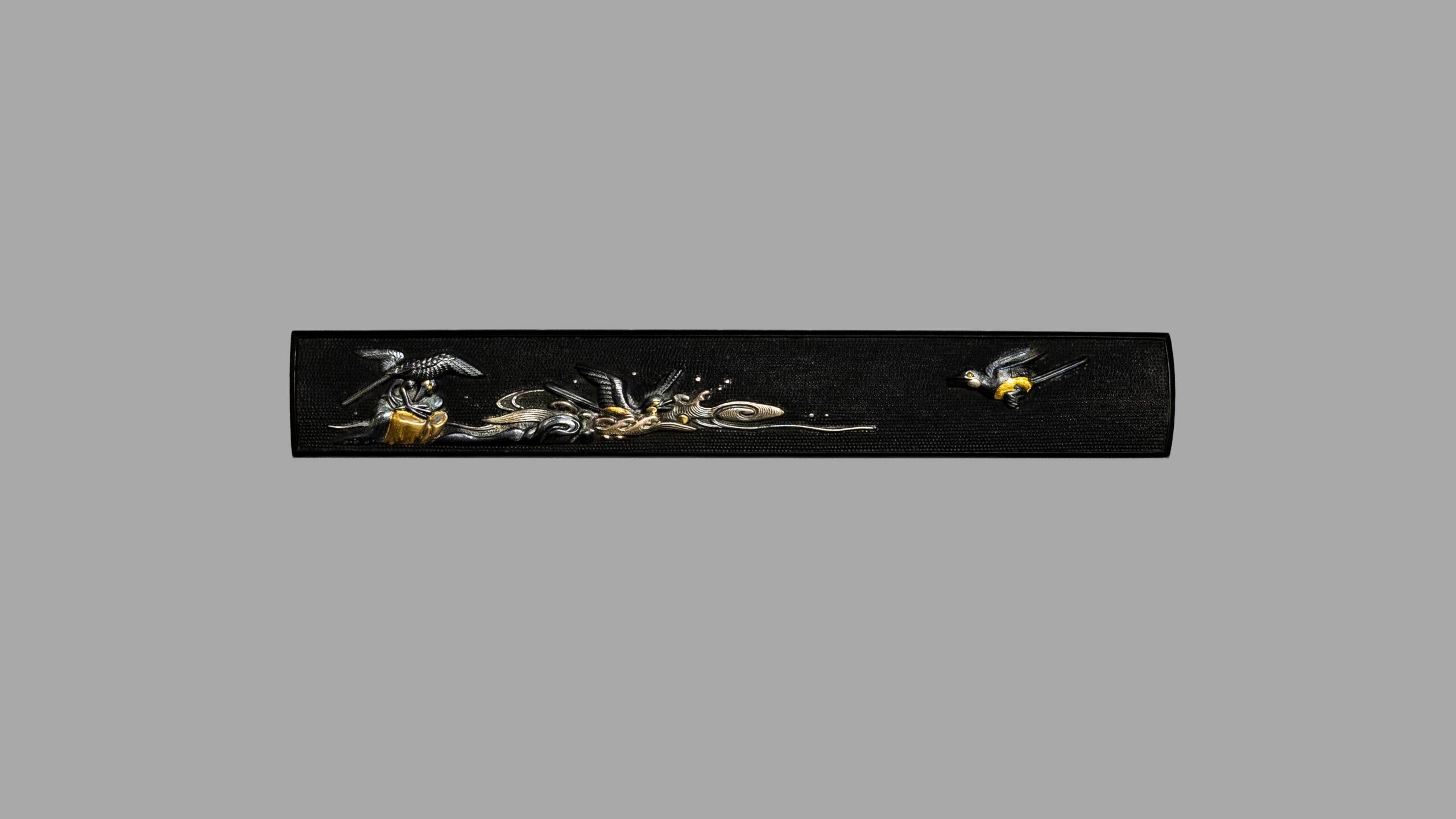
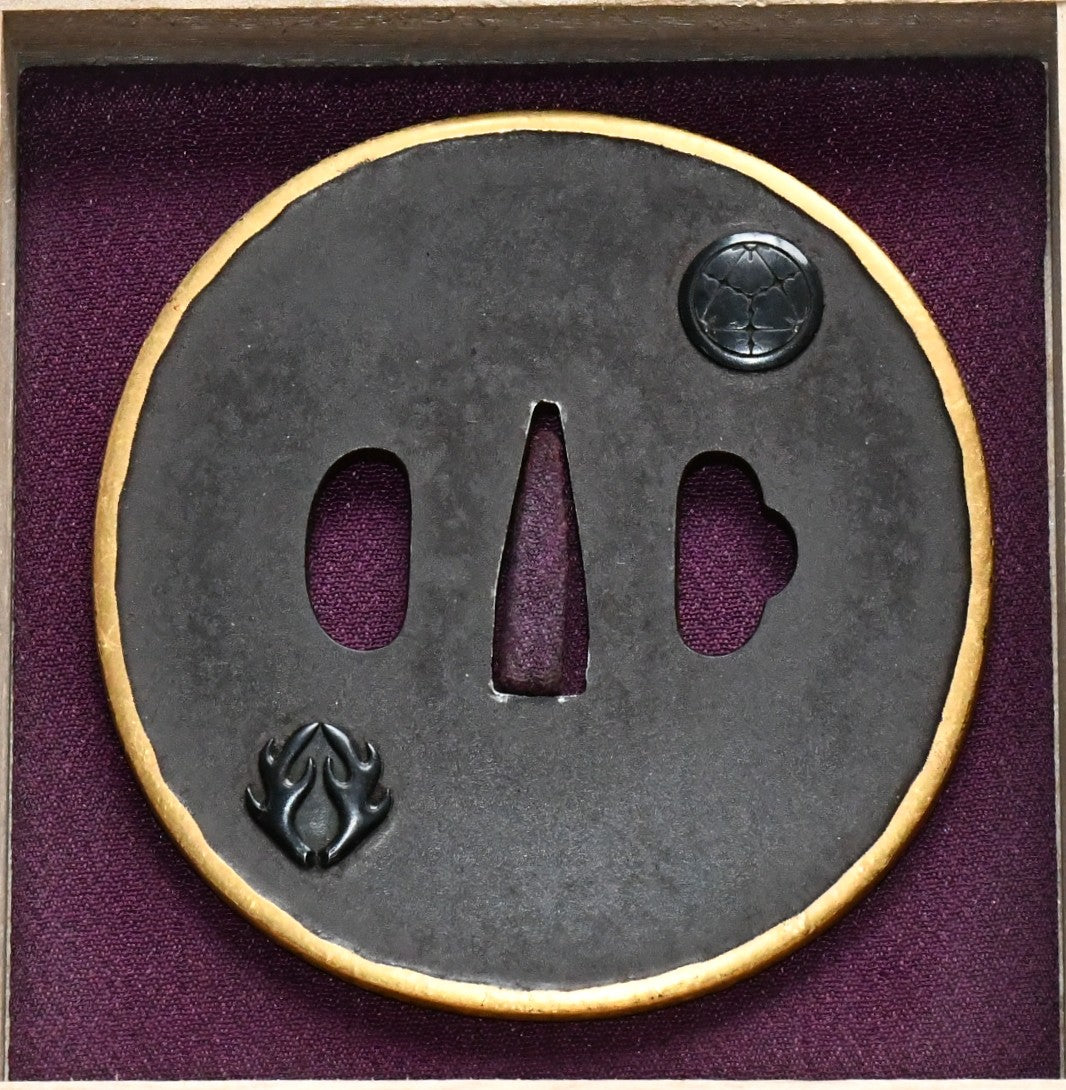
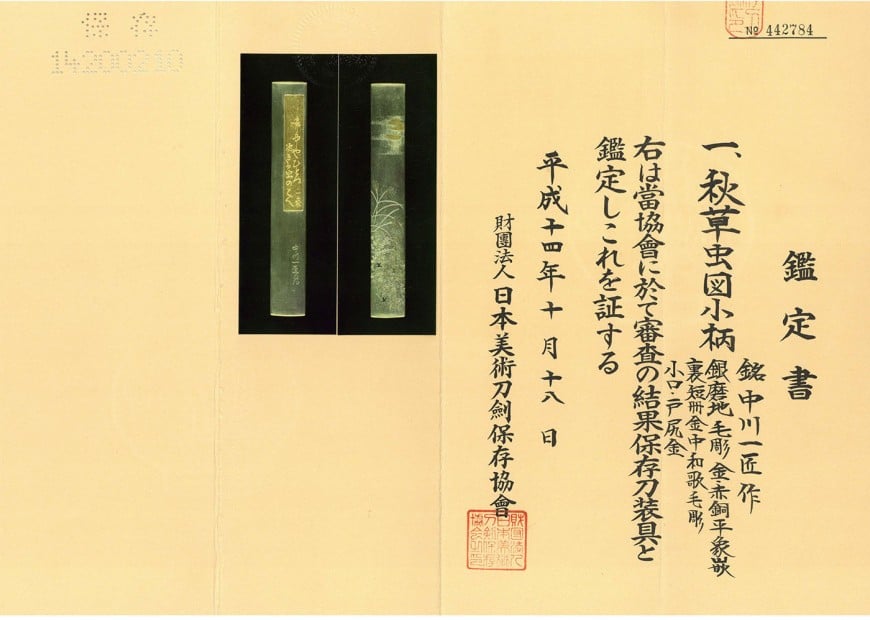
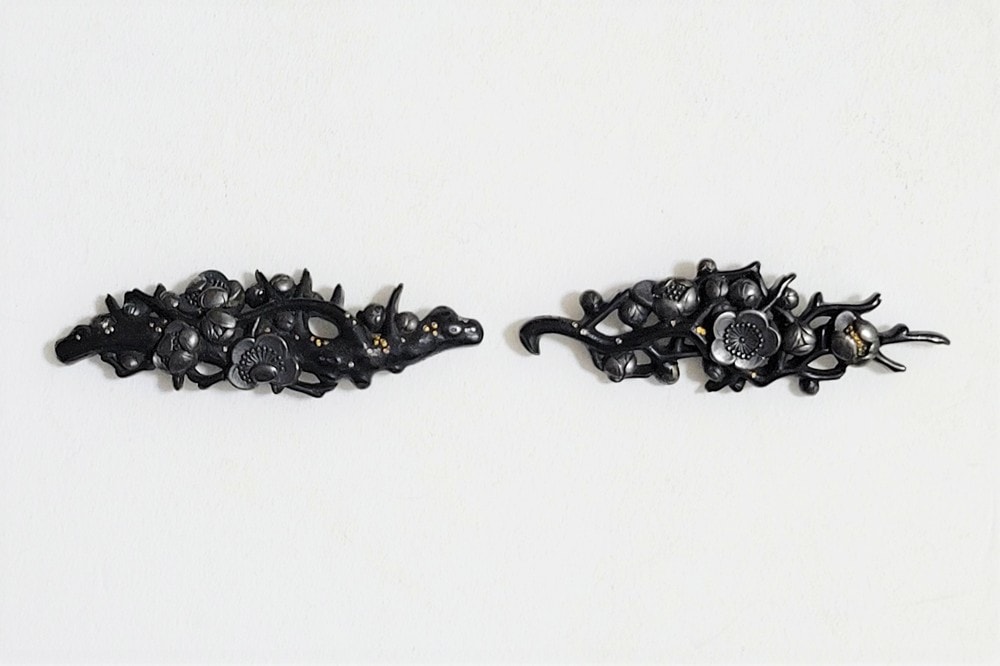
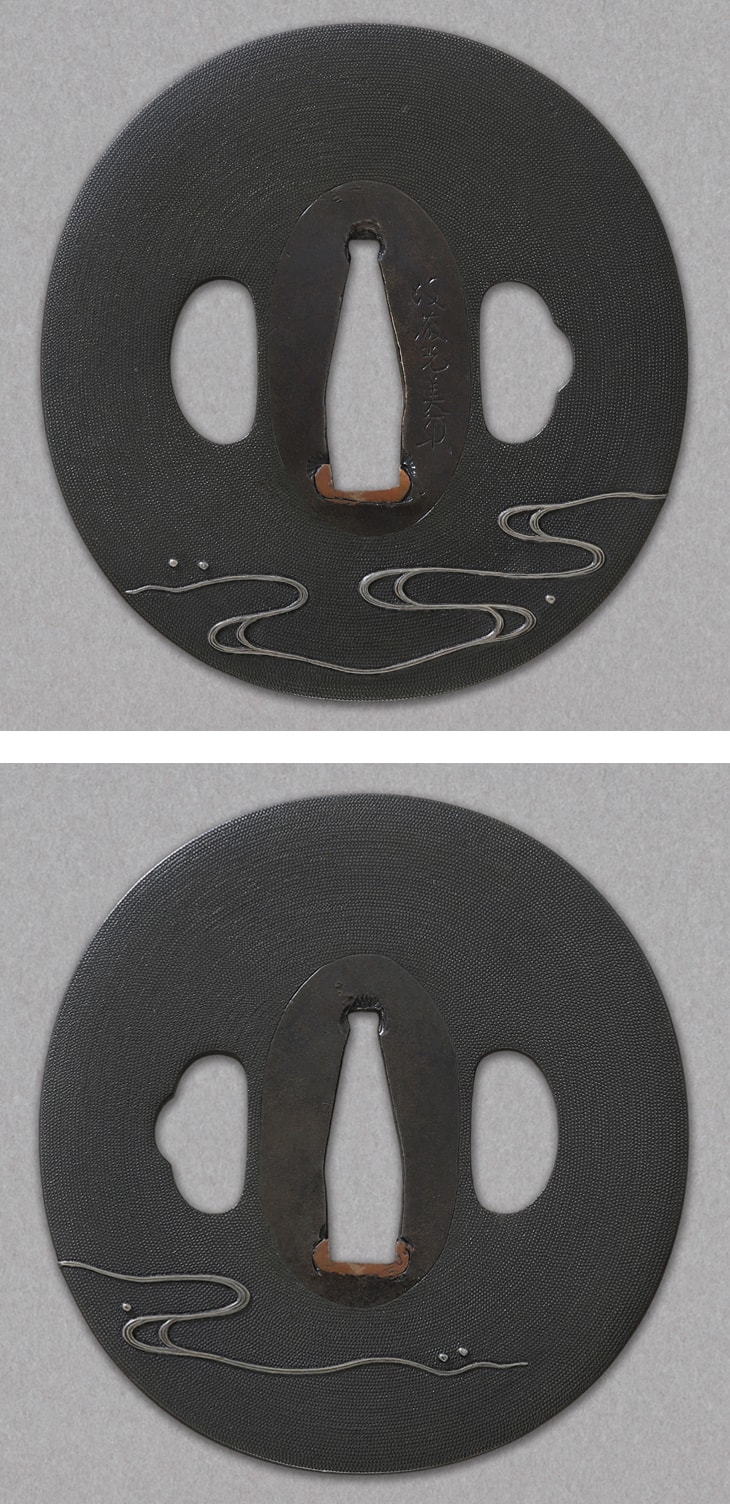
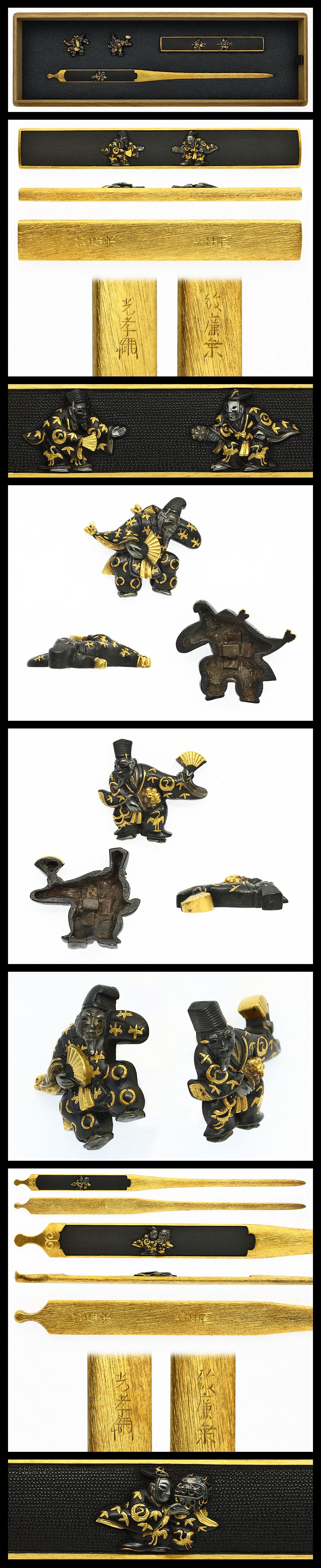
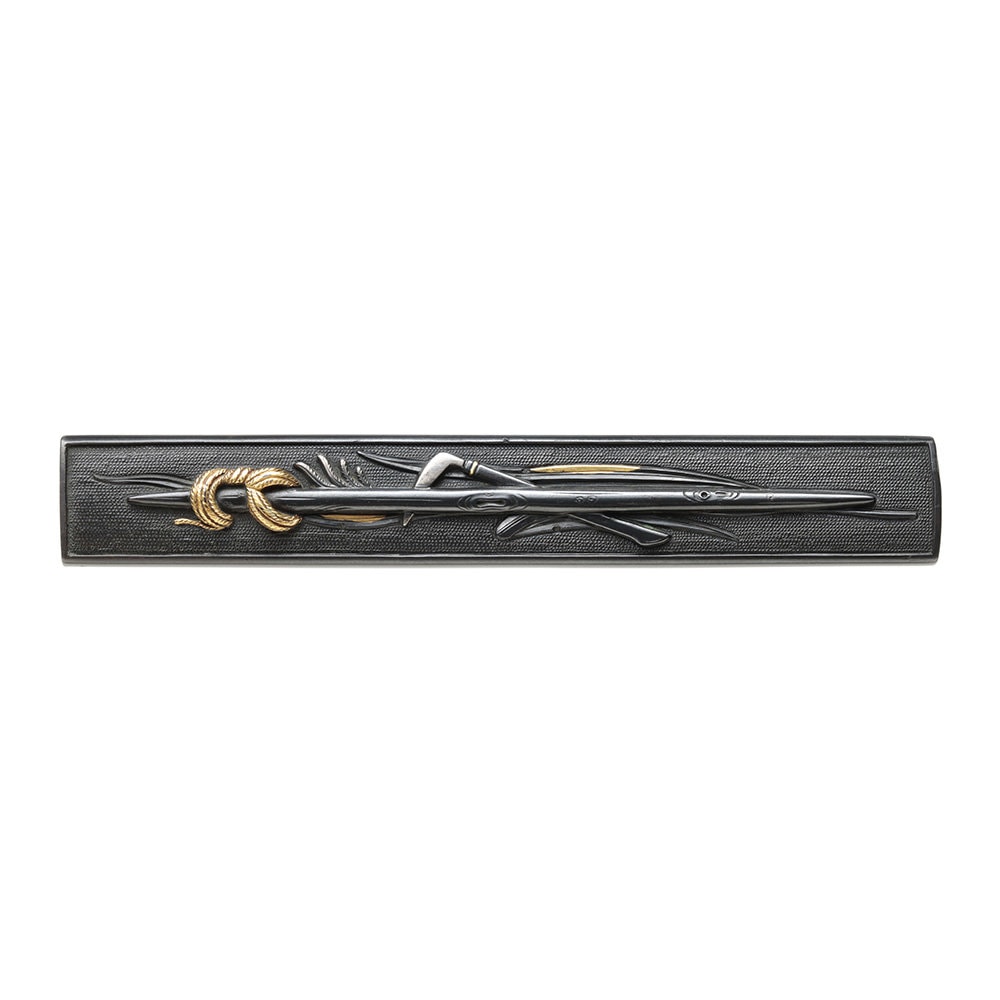
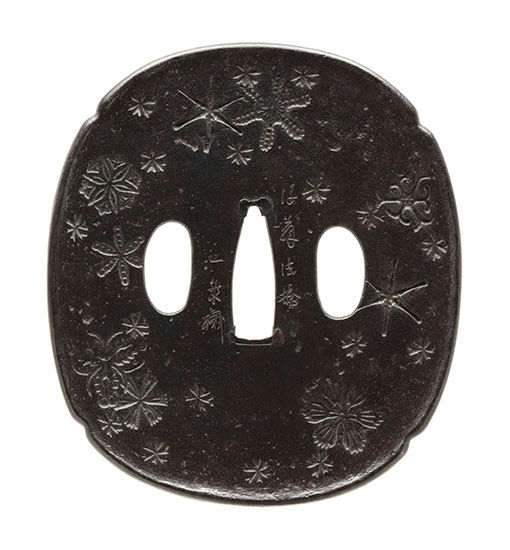
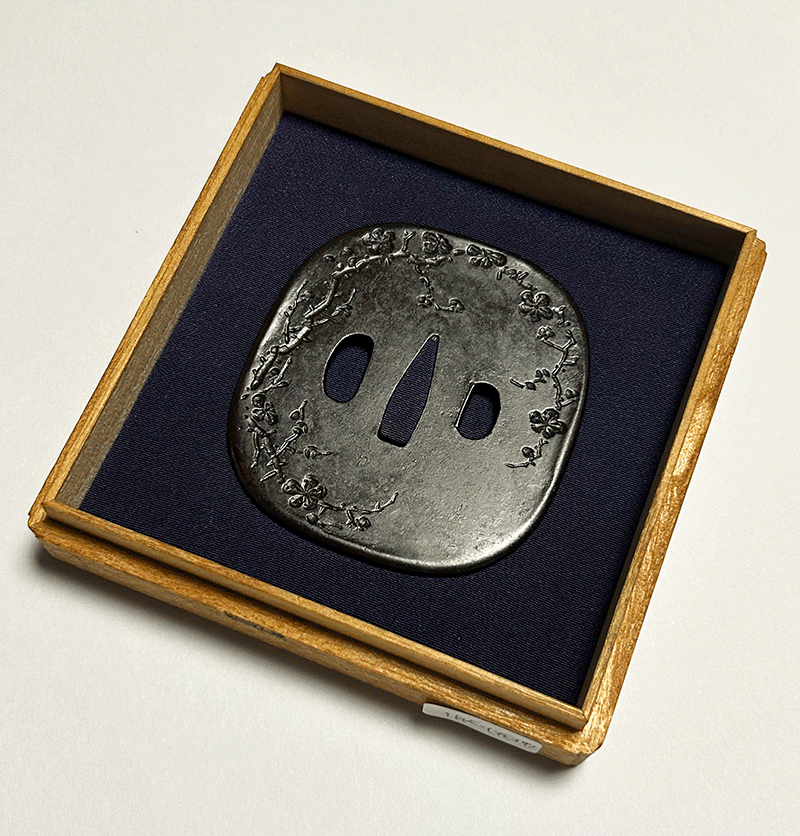
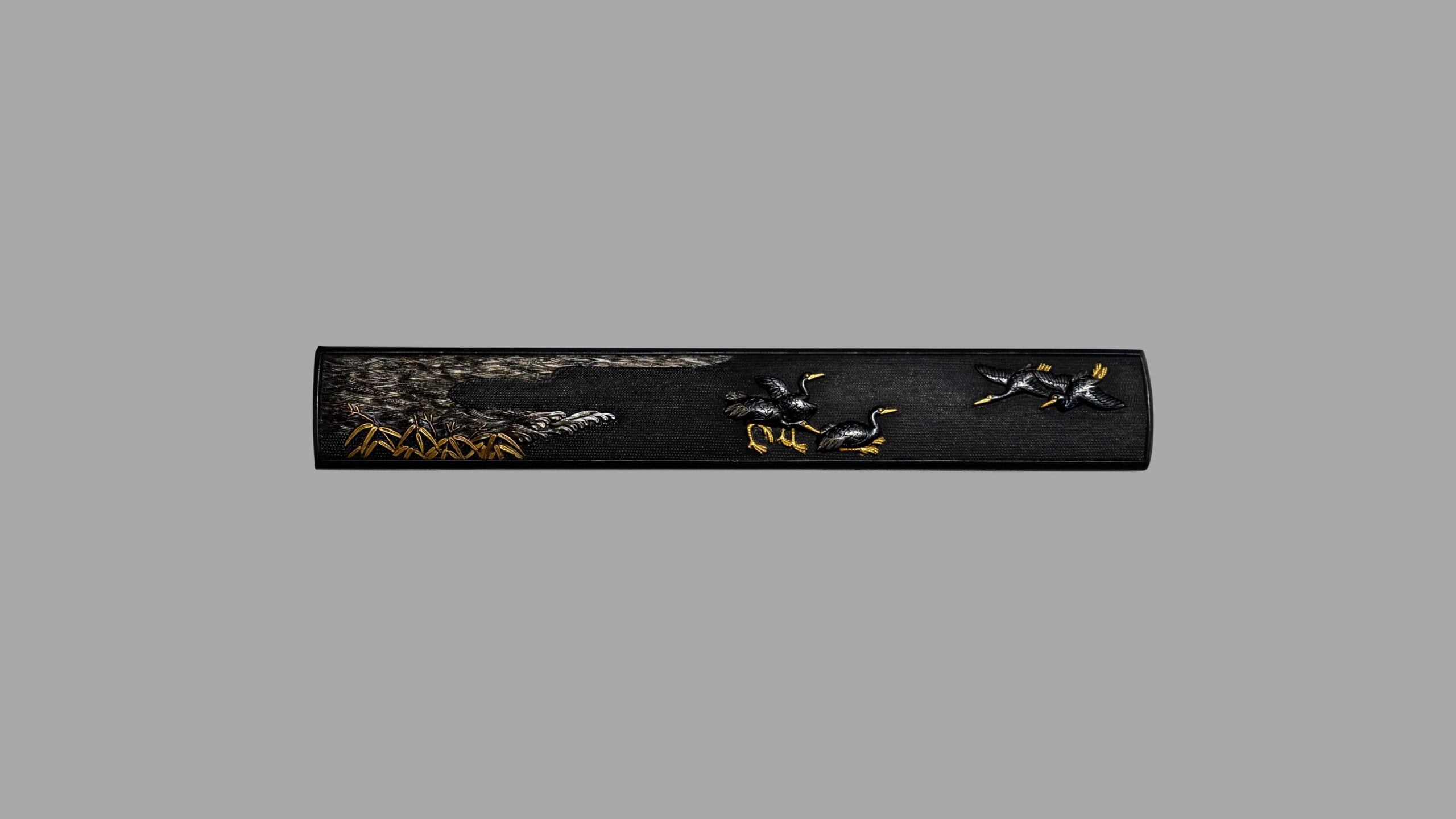
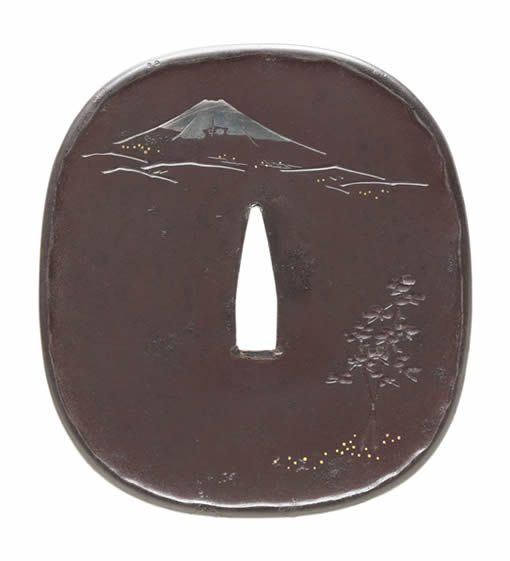
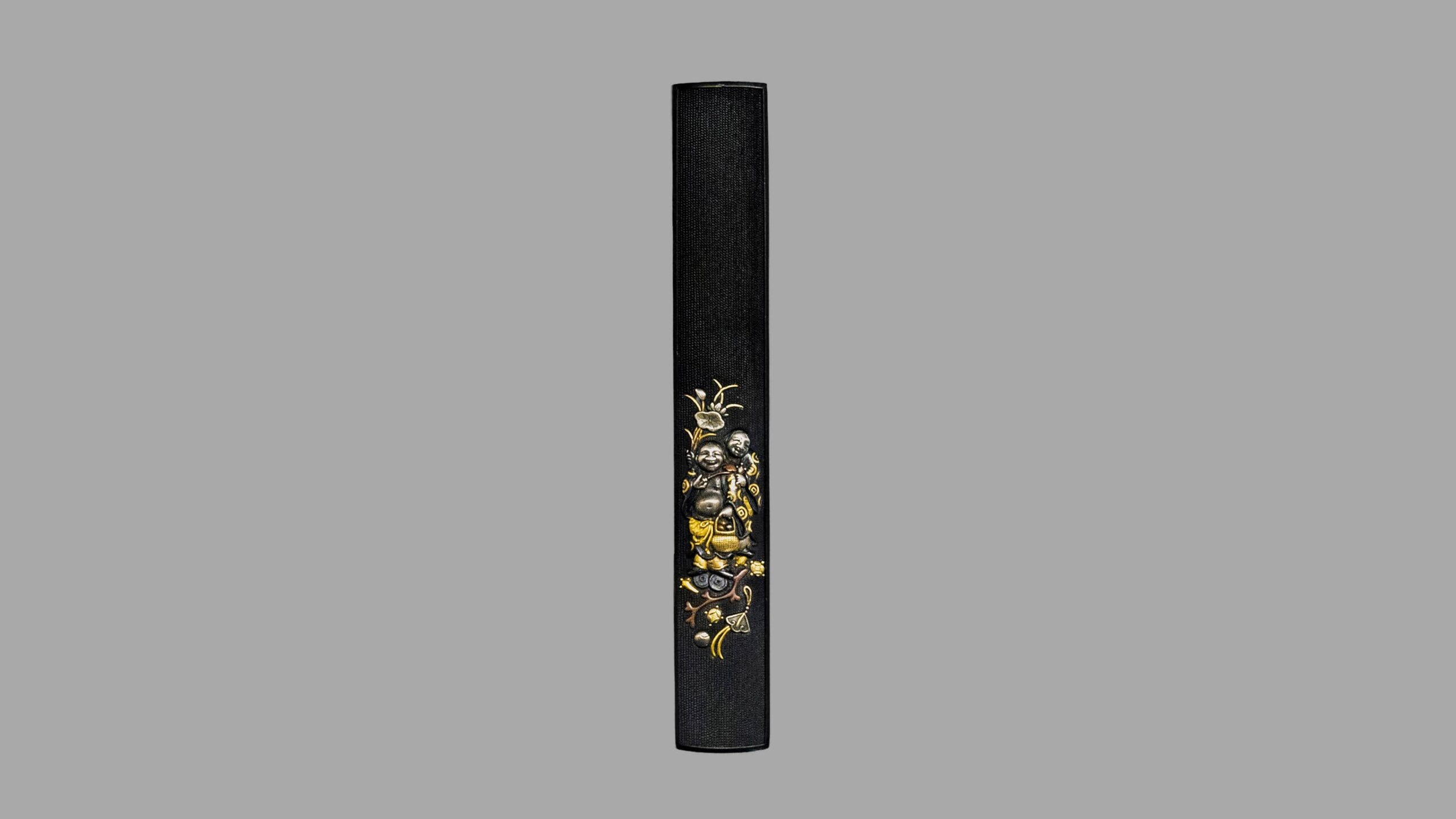
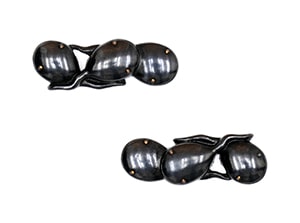
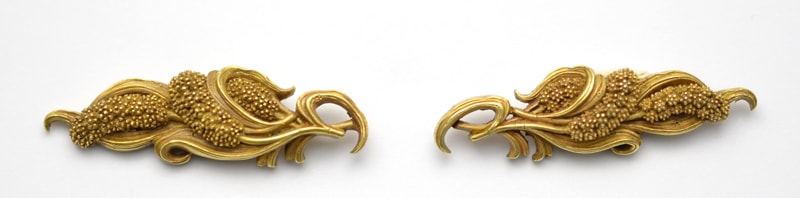
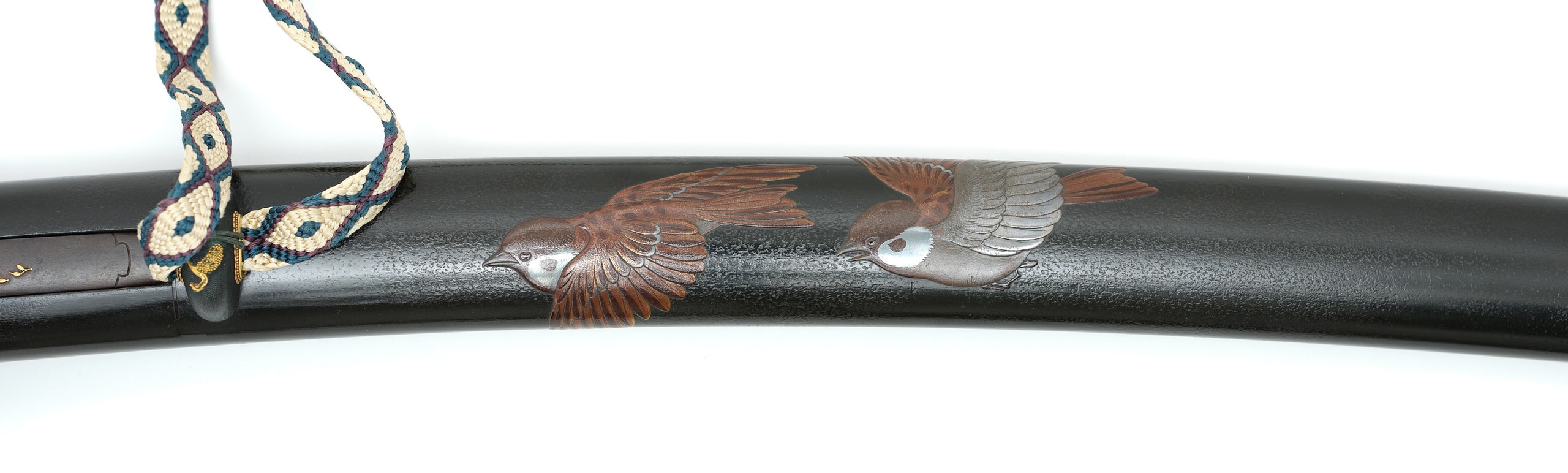
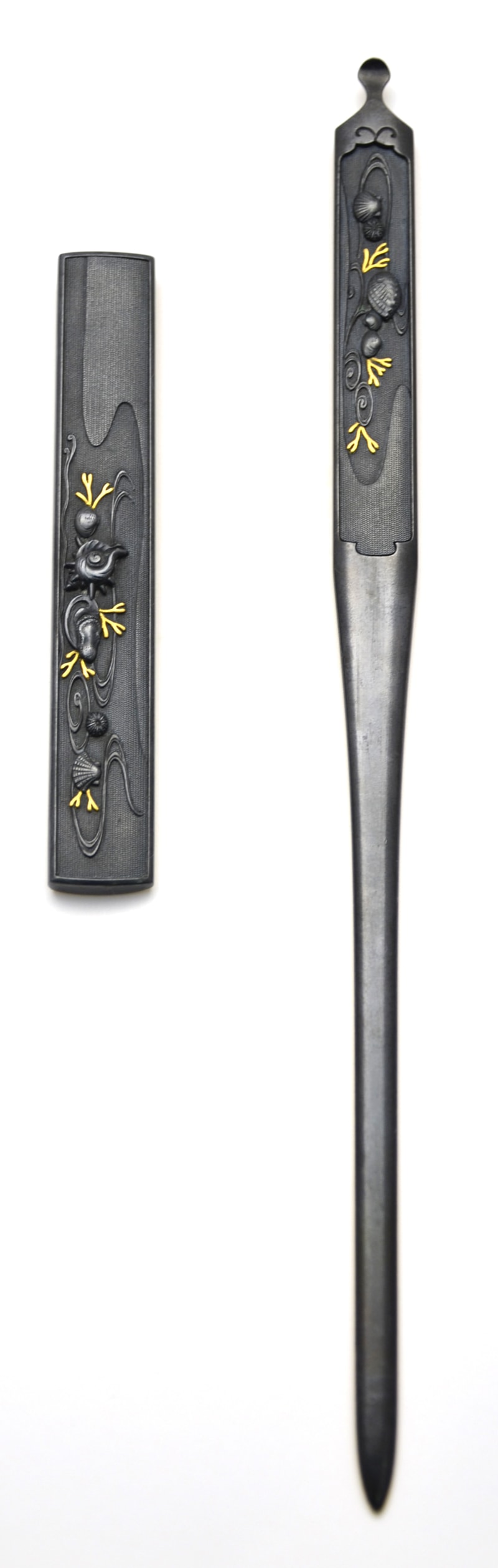
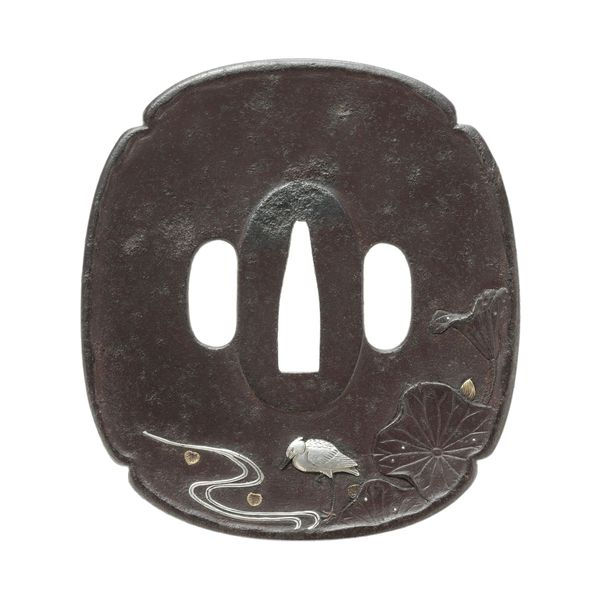
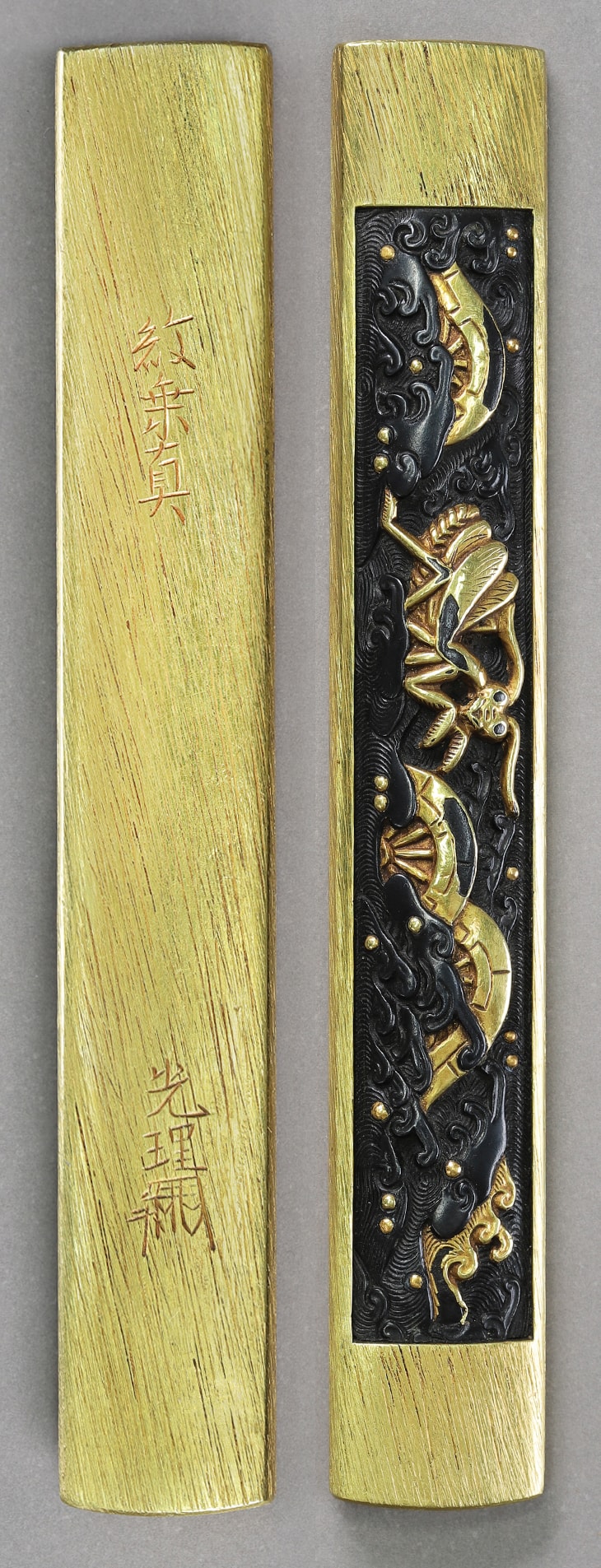
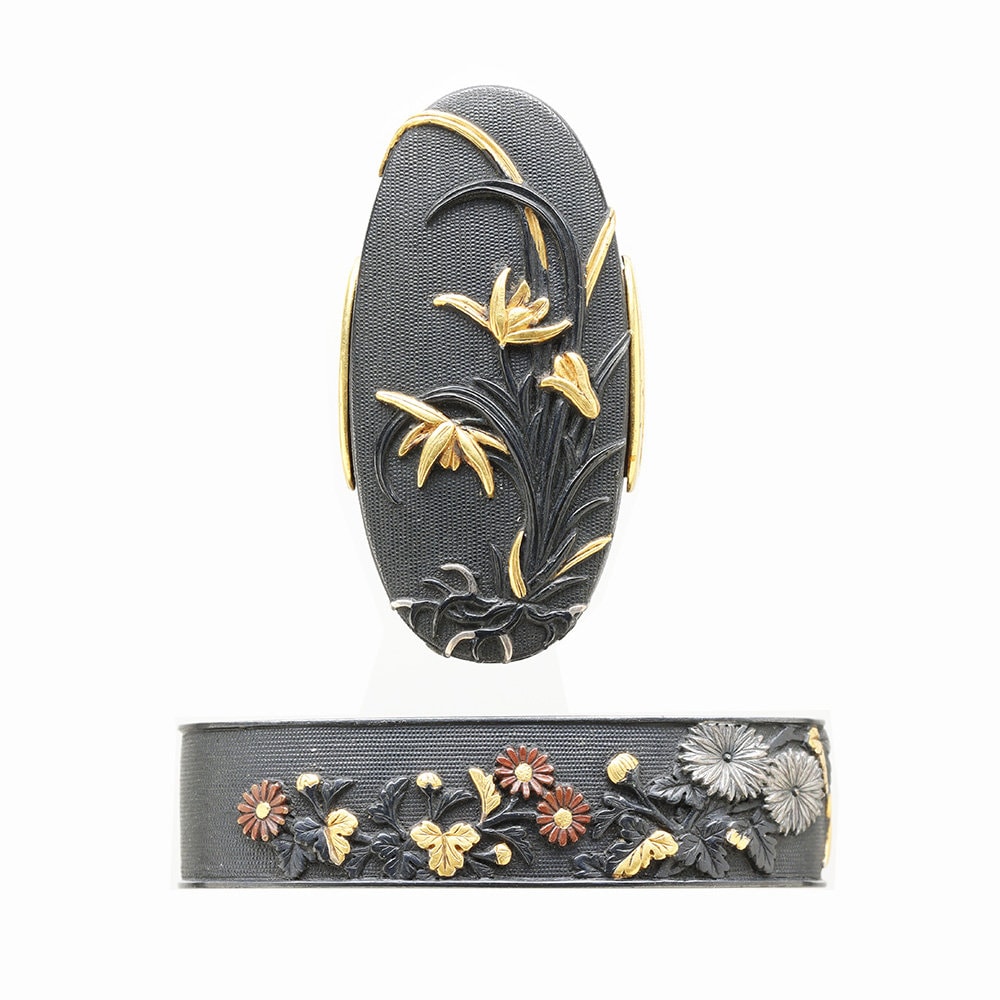
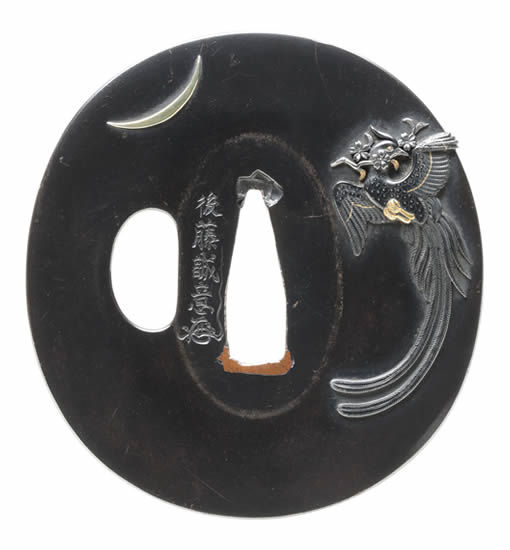
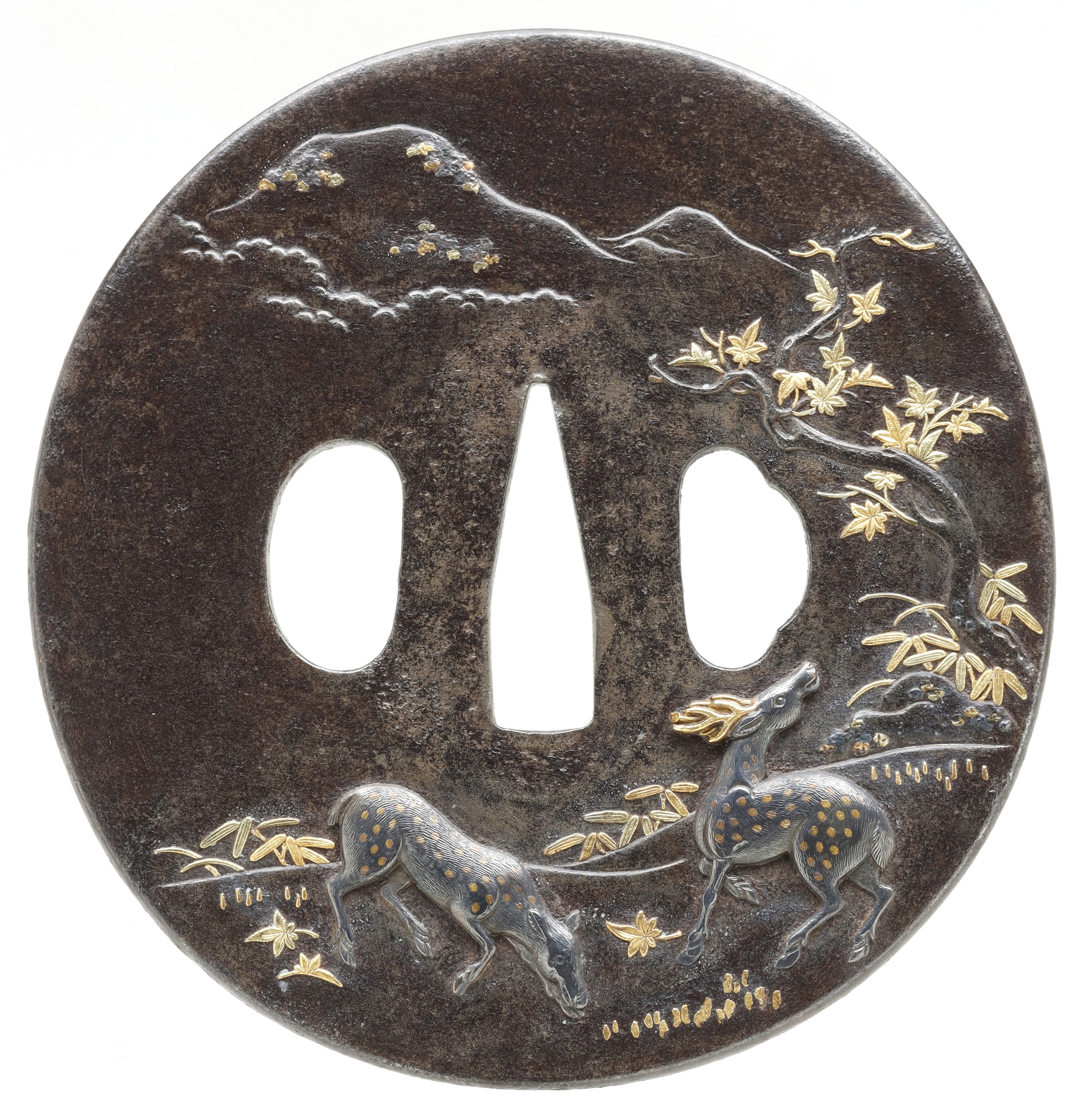
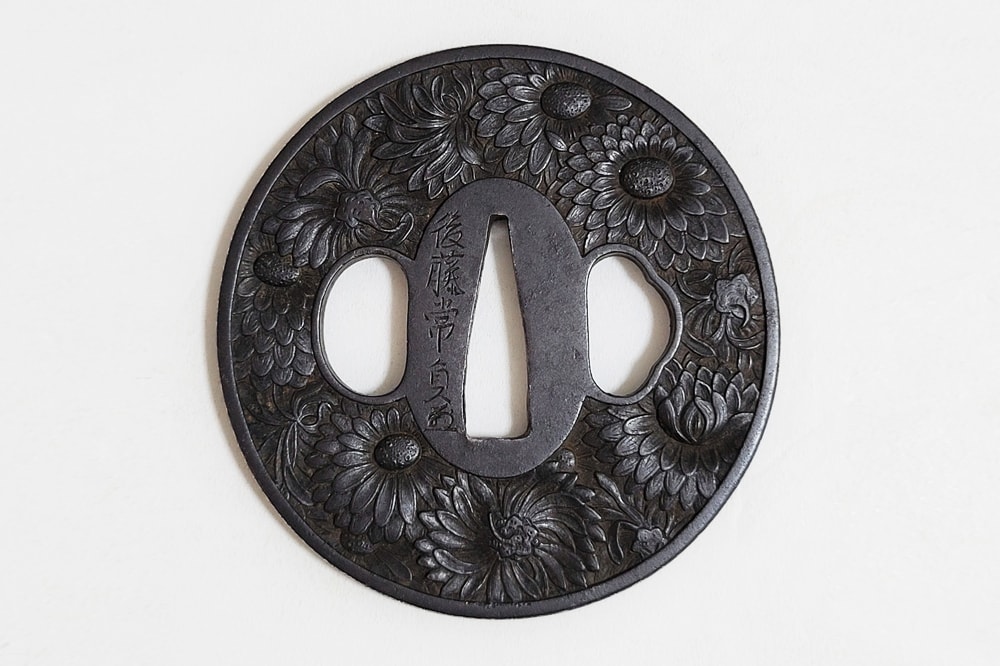
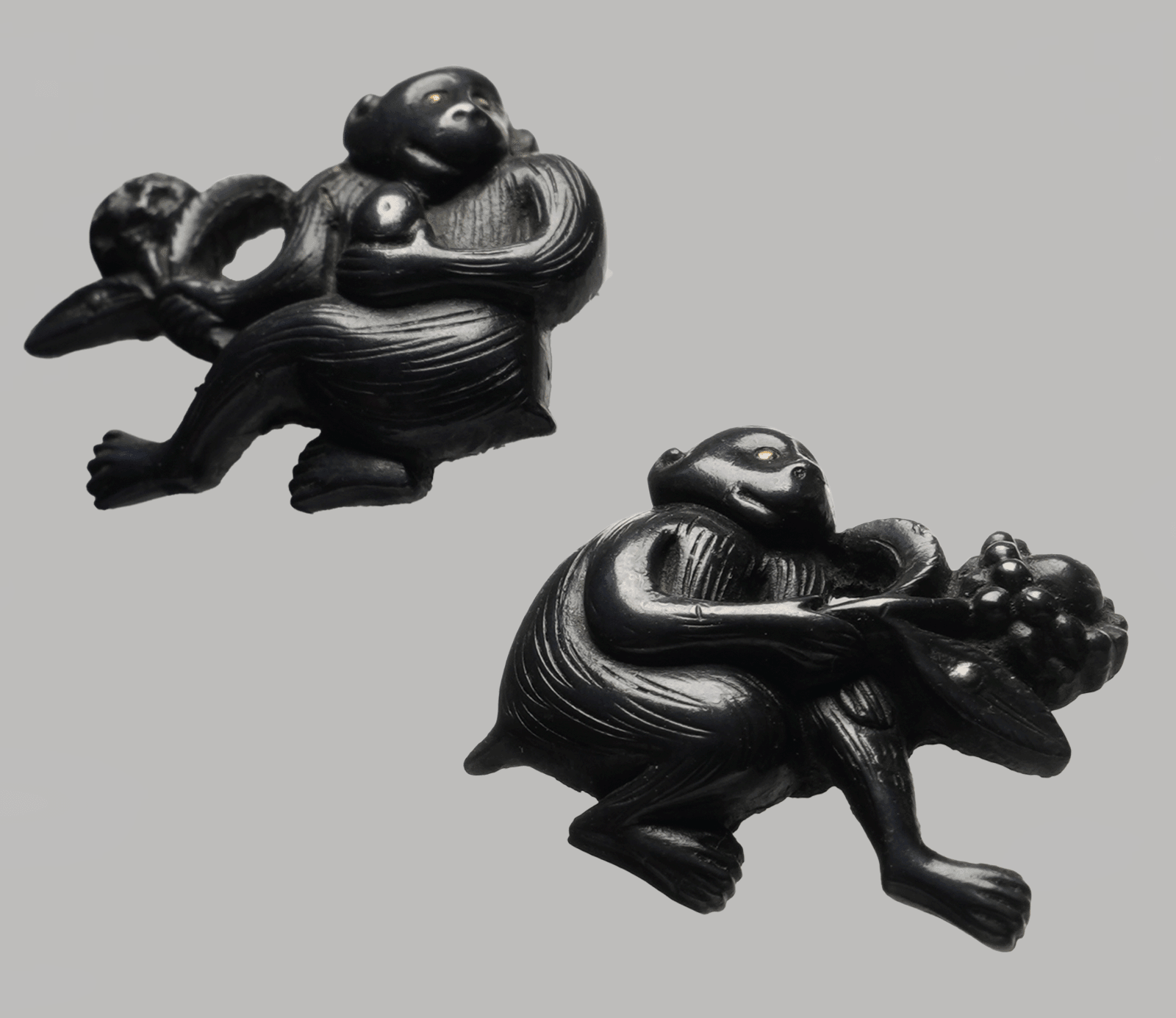
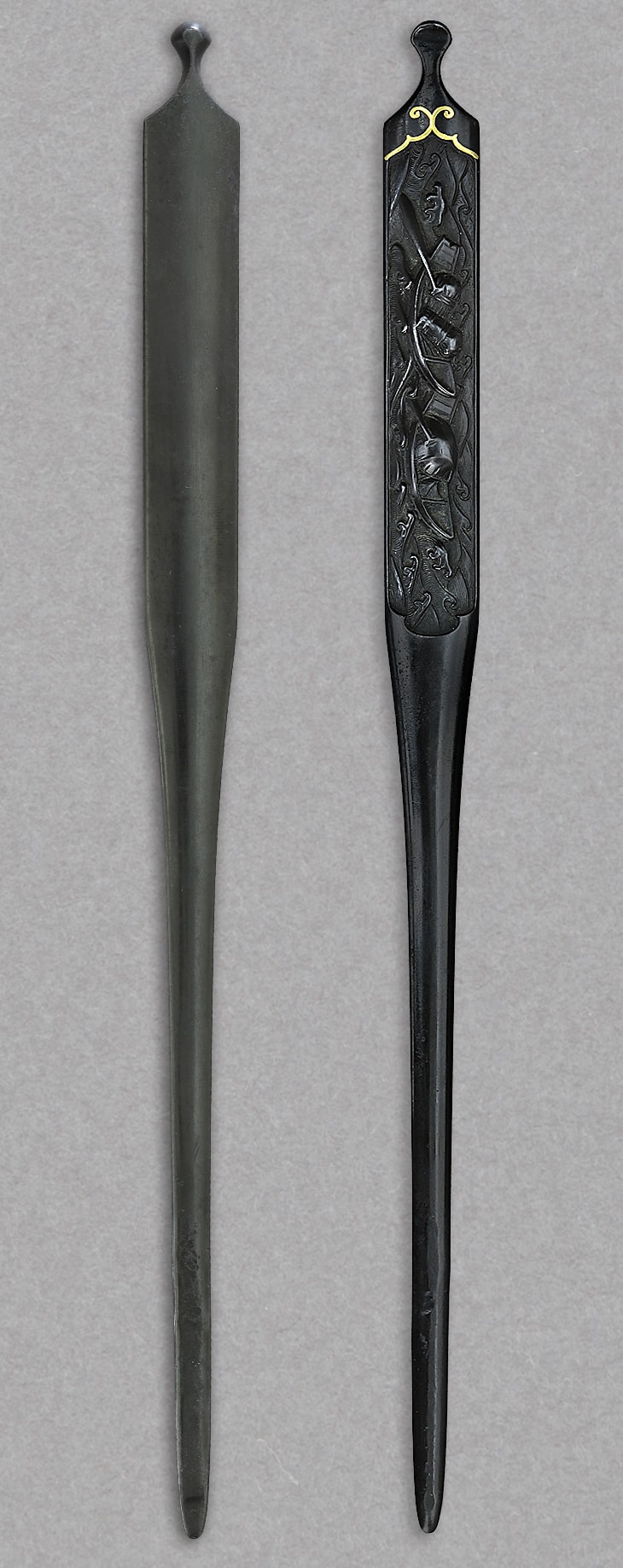
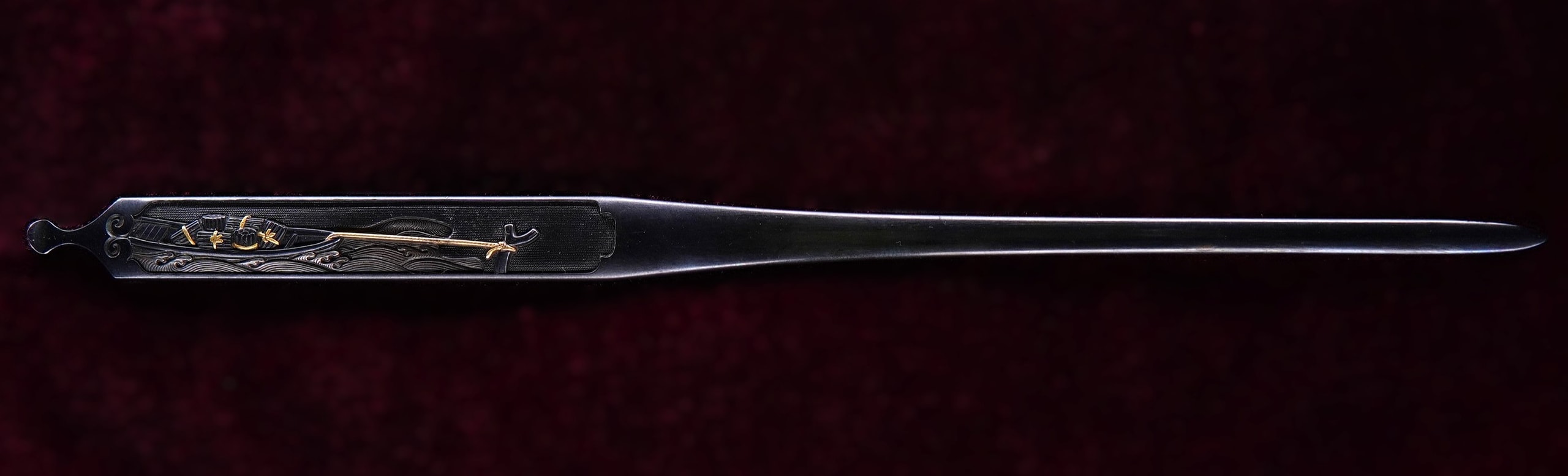
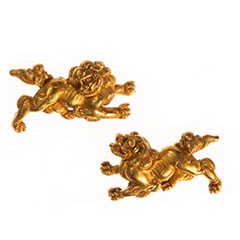
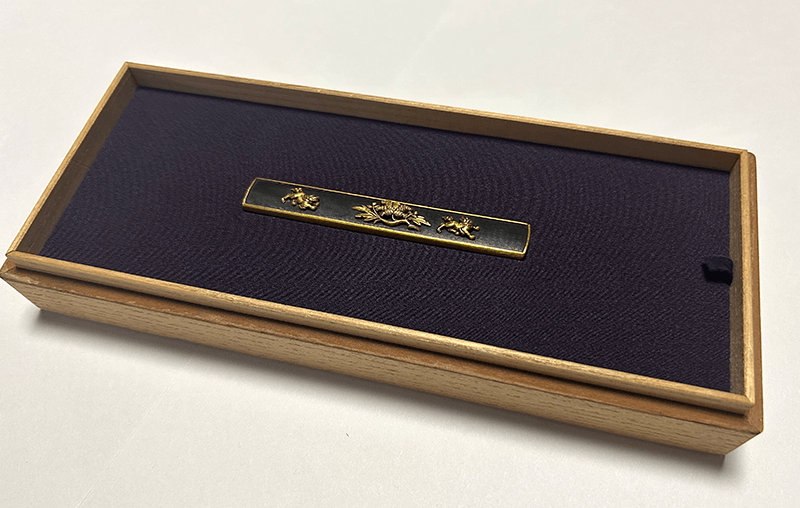
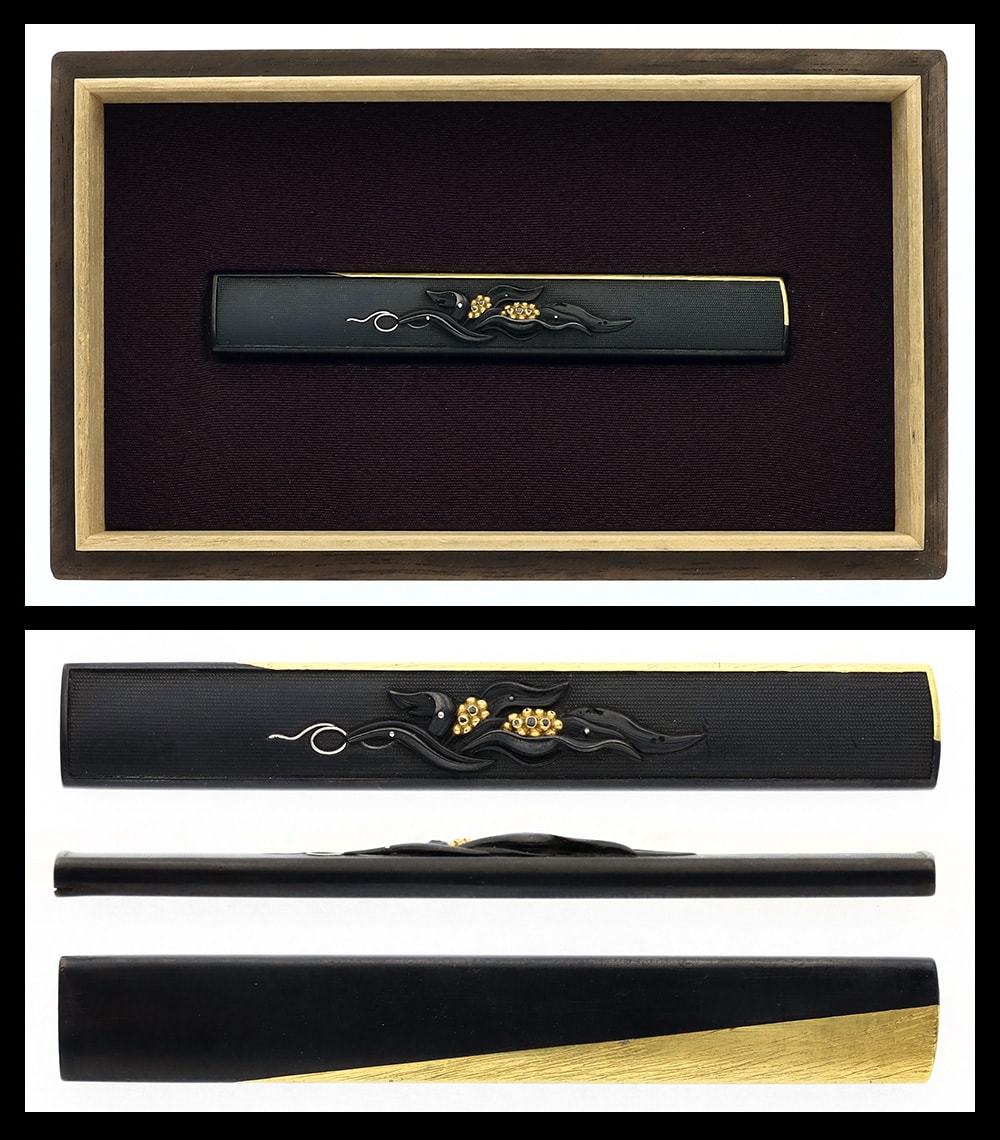
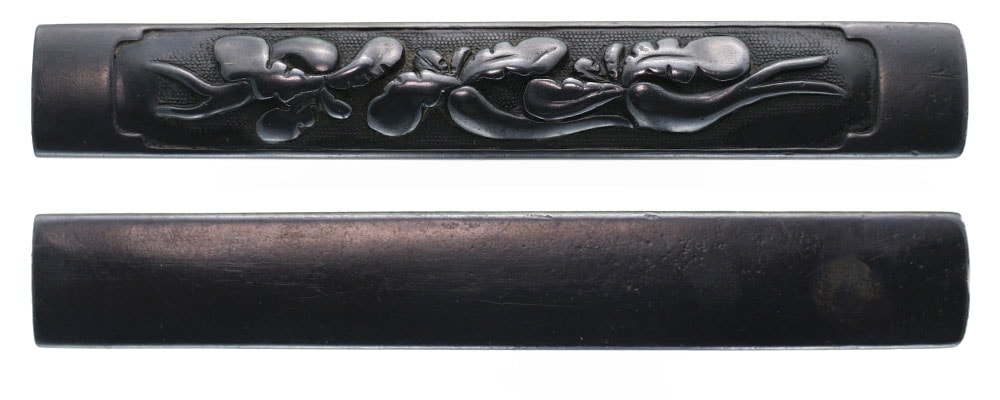
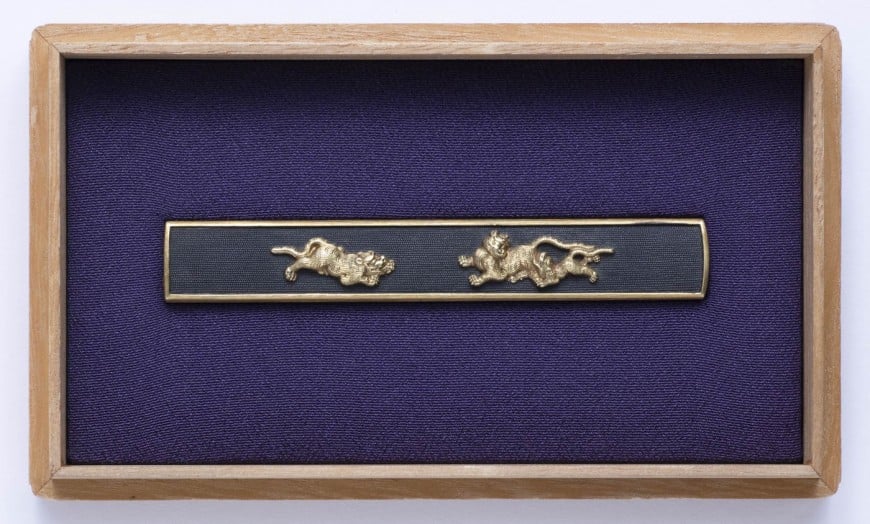
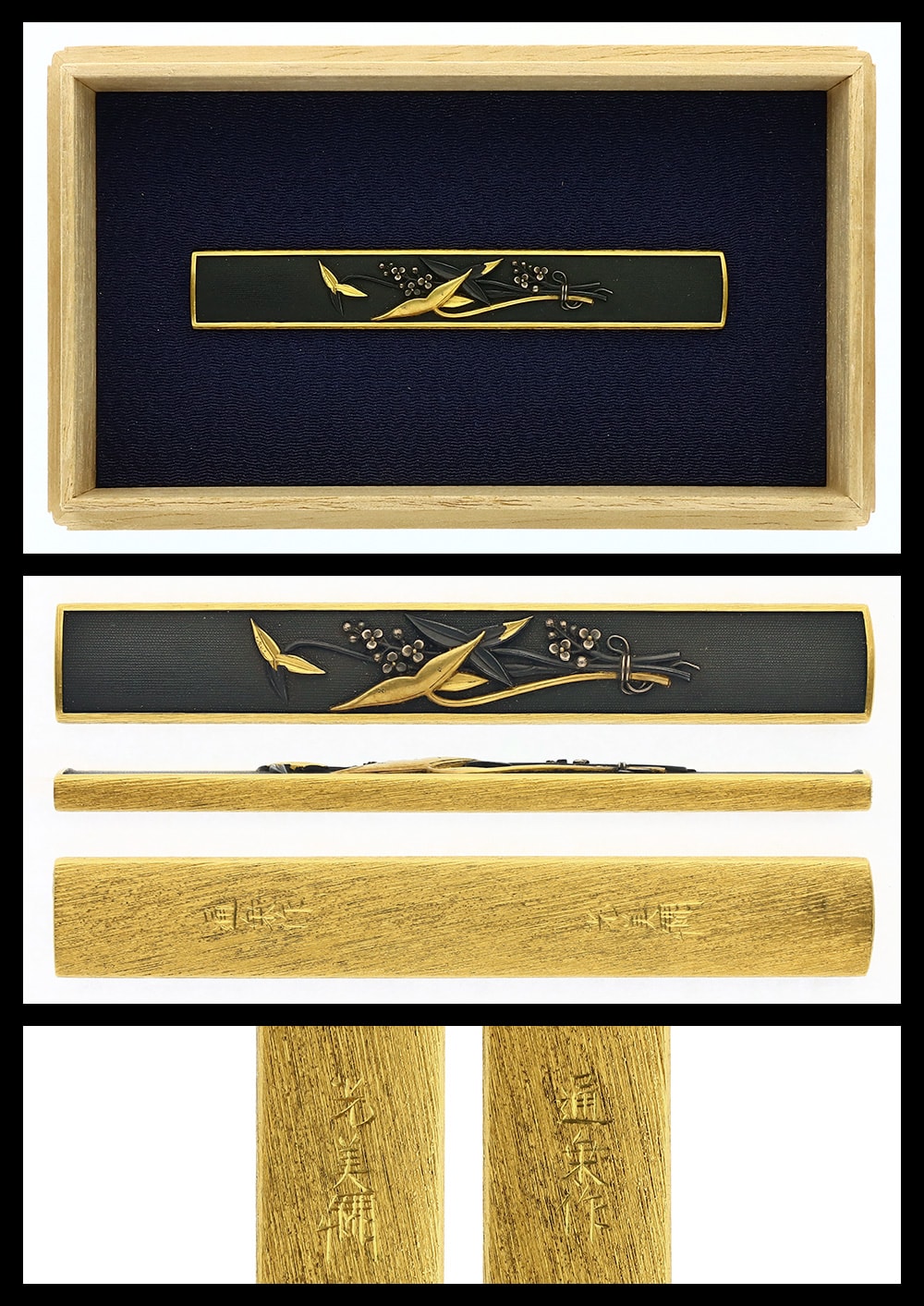
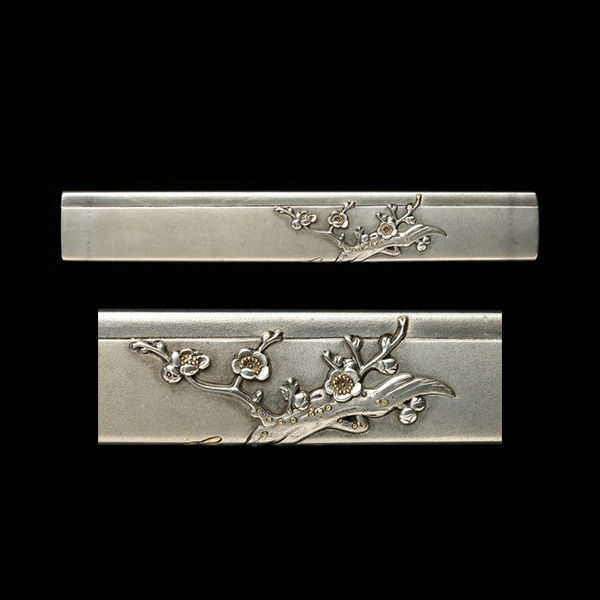
This is a kozuka featuring a plum tree in the morning sun, signed by Nakagawa Issho Toun. Made in the late Edo period in Edo city, Musashi province, it is crafted from shibuichi with high-relief carving and iroe inlay. The reverse side features a gold strip inlaid with a haiku by Basho. It comes with an NBTHK Tokubetsu Hozon certificate.
 NihontoWatch
mei · Nakagawa · Edo
Ichijo Issho
Edo
Musashi
Signed
Tokuho (NBTHK)
Iebori · Mimasaka / Yamashiro · around 1828-1876
2 pieces on the market now
Nakagawa Issho was the second son of Nakagawa Katsutsugu, a retained artisan (kakae-ko) of the Matsudaira family, lords of the Tsuyama domain in Mimasaka Province. His real name was Nakagawa Katsuzane, and his common name (tsusho) was Naojiro. At the age of twenty-one he entered the workshop of Goto Ichijo in Kyoto, and by twenty-five -- as evidenced by extant dated works -- he had already been granted the character "Ichi" by Ichijo and styled himself "Ikkatsu." During the Ansei era (1854-1860) he returned to Tsuyama; however, the Nakagawa house was ultimately succeeded by his youngest brother Katsutaka, and Issho returned to Edo in Man'en 1 (1860). Two years later, in Bunkyu 2 (1862), he changed "Ikkatsu" to "Issho." Traditionally counted among Ichijo's celebrated "Five Tigers" (Goko), he died in Meiji 9 (1876) at the age of forty-eight.
Issho's technical vocabulary encompasses the full range of the Ichijo school's metalworking tradition, deployed with what the NBTHK consistently characterizes as "assured technical skill." His mitokoromono demonstrate extremely fine nanako -- the refined "silk nanako" (kinu-nanako)[[c:1]] -- over shakudo grounds, embellished with graceful, minute takabori enriched by vivid iroe in gold and hi-irodo (scarlet copper). In his oborogin ground pieces, he renders dense, sumptuous motifs through takabori with iroe and kin-sunago zogan, "achieving a rich pictorial effect while maintaining crisp definition in the carving." His command of kosuki-bori and kebori is described as wielding chisels "with complete freedom," further employing among hira-zogan such refined techniques as pale, subdued keshi-zogan and sunago-zogan to convey what the NBTHK terms "a courtly and elegant taste." His rounded-relief menuki -- "a refinement characteristic of the Ichijo line" -- are carved with exceptionally fine technique.
The NBTHK positions Issho as one of the foremost pupils in the lineage of Goto Ichijo, a craftsman whose unified, fully matching sets of fittings represent the highest standard of coordinated metalwork in the late Edo and early Meiji periods. His productions consistently demonstrate the capacity to unify entire mounting programs -- from scabbard lacquer to hilt furnishings -- into works where "every aspect is imbued with a luxurious and splendid taste." The workmanship across his complete koshirae is repeatedly praised as executed "with exceptional care and meticulousness throughout," reflecting a mastery that places him securely among the principal inheritors of the Ichijo tradition.
Where Issho stands among comparable artisans: across all of nihontō, and within tradition, era, and period. The tiers (Foremost · Leading · Major · Notable) weigh official designations from the NBTHK and Japan's Agency for Cultural Affairs, together with historical honors of lasting repute such as the Sansaku and Meibutsu-chō.
Select a lens to see how it's measured.
Iebori · Kyoto
Phase: Goto Main Line後藤宗家· 1573–1900
32 pieces on the market now
| Smith | Era | Designated |
|---|---|---|
| Goto Ichijo後藤一乗 | — | 91 |
| Tomei東明 | — | 31 |
| Nagatake永武 | — | 14 |
| Ikkin一琴 | — | 11 |
| Issho一匠 | 1828-1876 | 10 |
A Hozon-certified fitting of notably superior craftsmanship and condition, often with signature or workmanship of high reference value.
The NBTHK (Nihon Bijutsu Tōken Hozon Kyōkai, the Society for the Preservation of Japanese Art Swords) is a public-interest incorporated foundation founded in 1948 and supervised by Japan’s Agency for Cultural Affairs (Bunkachō); it is based at the Japanese Sword Museum in Tokyo. Its expert panels physically examine each submitted work (shinsa) and issue a certificate (kanteishō) ranking it by artistic and historical merit. NBTHK papers are the most widely recognized standard of authentication for Japanese swords and fittings.
NBTHK official siteIf, due to our fault, the item differs significantly from its proper condition, the item may be returned. Cooling-off is within one week of the item's arrival.
This is a kozuka featuring a plum tree in the morning sun, signed by Nakagawa Issho Toun. Made in the late Edo period in Edo city, Musashi province, it is crafted from shibuichi with high-relief carving and iroe inlay. The reverse side features a gold strip inlaid with a haiku by Basho. It comes with an NBTHK Tokubetsu Hozon certificate.
NihontoWatchmei · Nakagawa · Edo
Ichijo Issho
Edo
Musashi
Signed
Tokuho (NBTHK)
Iebori · Mimasaka / Yamashiro · around 1828-1876
2 pieces on the market now
Nakagawa Issho was the second son of Nakagawa Katsutsugu, a retained artisan (kakae-ko) of the Matsudaira family, lords of the Tsuyama domain in Mimasaka Province. His real name was Nakagawa Katsuzane, and his common name (tsusho) was Naojiro. At the age of twenty-one he entered the workshop of Goto Ichijo in Kyoto, and by twenty-five -- as evidenced by extant dated works -- he had already been granted the character "Ichi" by Ichijo and styled himself "Ikkatsu." During the Ansei era (1854-1860) he returned to Tsuyama; however, the Nakagawa house was ultimately succeeded by his youngest brother Katsutaka, and Issho returned to Edo in Man'en 1 (1860). Two years later, in Bunkyu 2 (1862), he changed "Ikkatsu" to "Issho." Traditionally counted among Ichijo's celebrated "Five Tigers" (Goko), he died in Meiji 9 (1876) at the age of forty-eight.
Issho's technical vocabulary encompasses the full range of the Ichijo school's metalworking tradition, deployed with what the NBTHK consistently characterizes as "assured technical skill." His mitokoromono demonstrate extremely fine nanako -- the refined "silk nanako" (kinu-nanako)[[c:1]] -- over shakudo grounds, embellished with graceful, minute takabori enriched by vivid iroe in gold and hi-irodo (scarlet copper). In his oborogin ground pieces, he renders dense, sumptuous motifs through takabori with iroe and kin-sunago zogan, "achieving a rich pictorial effect while maintaining crisp definition in the carving." His command of kosuki-bori and kebori is described as wielding chisels "with complete freedom," further employing among hira-zogan such refined techniques as pale, subdued keshi-zogan and sunago-zogan to convey what the NBTHK terms "a courtly and elegant taste." His rounded-relief menuki -- "a refinement characteristic of the Ichijo line" -- are carved with exceptionally fine technique.
The NBTHK positions Issho as one of the foremost pupils in the lineage of Goto Ichijo, a craftsman whose unified, fully matching sets of fittings represent the highest standard of coordinated metalwork in the late Edo and early Meiji periods. His productions consistently demonstrate the capacity to unify entire mounting programs -- from scabbard lacquer to hilt furnishings -- into works where "every aspect is imbued with a luxurious and splendid taste." The workmanship across his complete koshirae is repeatedly praised as executed "with exceptional care and meticulousness throughout," reflecting a mastery that places him securely among the principal inheritors of the Ichijo tradition.
Where Issho stands among comparable artisans: across all of nihontō, and within tradition, era, and period. The tiers (Foremost · Leading · Major · Notable) weigh official designations from the NBTHK and Japan's Agency for Cultural Affairs, together with historical honors of lasting repute such as the Sansaku and Meibutsu-chō.
Select a lens to see how it's measured.
Iebori · Kyoto
Phase: Goto Main Line後藤宗家· 1573–1900
32 pieces on the market now
| Smith | Era | Designated |
|---|---|---|
| Goto Ichijo後藤一乗 | — | 91 |
| Tomei東明 | — | 31 |
| Nagatake永武 | — | 14 |
| Ikkin一琴 | — | 11 |
| Issho一匠 | 1828-1876 | 10 |
A Hozon-certified fitting of notably superior craftsmanship and condition, often with signature or workmanship of high reference value.
The NBTHK (Nihon Bijutsu Tōken Hozon Kyōkai, the Society for the Preservation of Japanese Art Swords) is a public-interest incorporated foundation founded in 1948 and supervised by Japan’s Agency for Cultural Affairs (Bunkachō); it is based at the Japanese Sword Museum in Tokyo. Its expert panels physically examine each submitted work (shinsa) and issue a certificate (kanteishō) ranking it by artistic and historical merit. NBTHK papers are the most widely recognized standard of authentication for Japanese swords and fittings.
NBTHK official siteIf, due to our fault, the item differs significantly from its proper condition, the item may be returned. Cooling-off is within one week of the item's arrival.