 NihontoWatchNihontoWatch
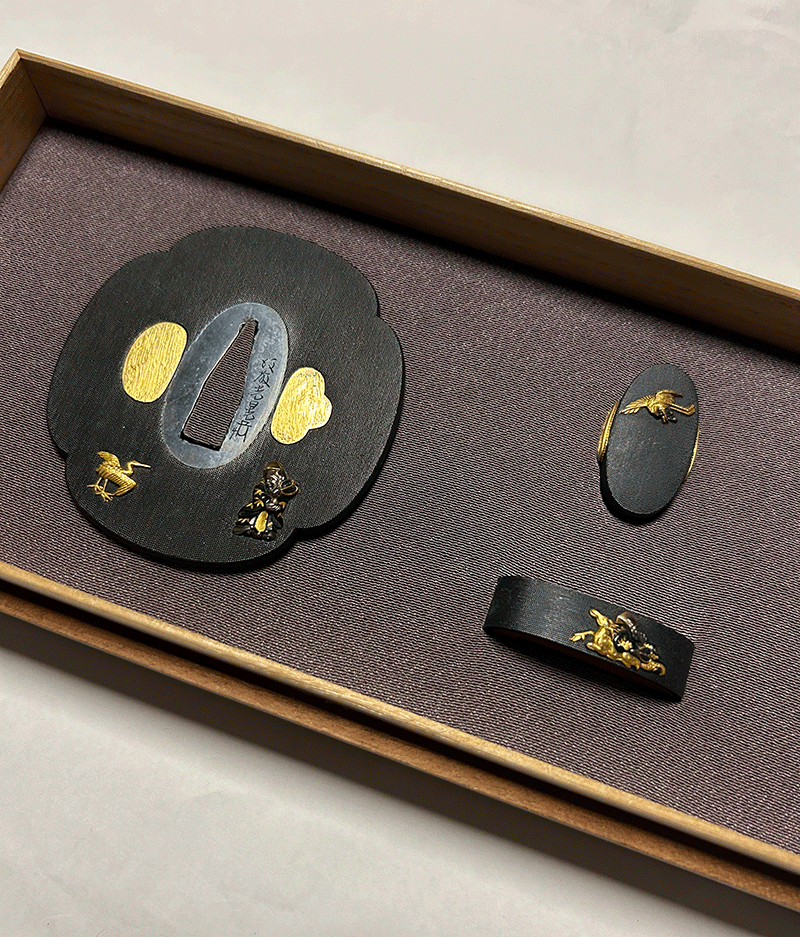
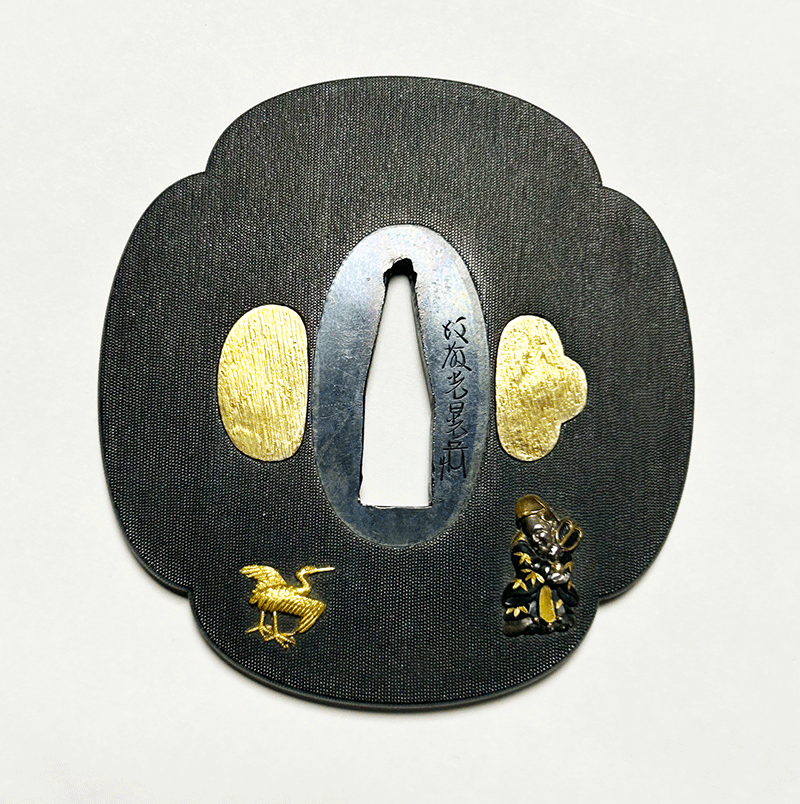
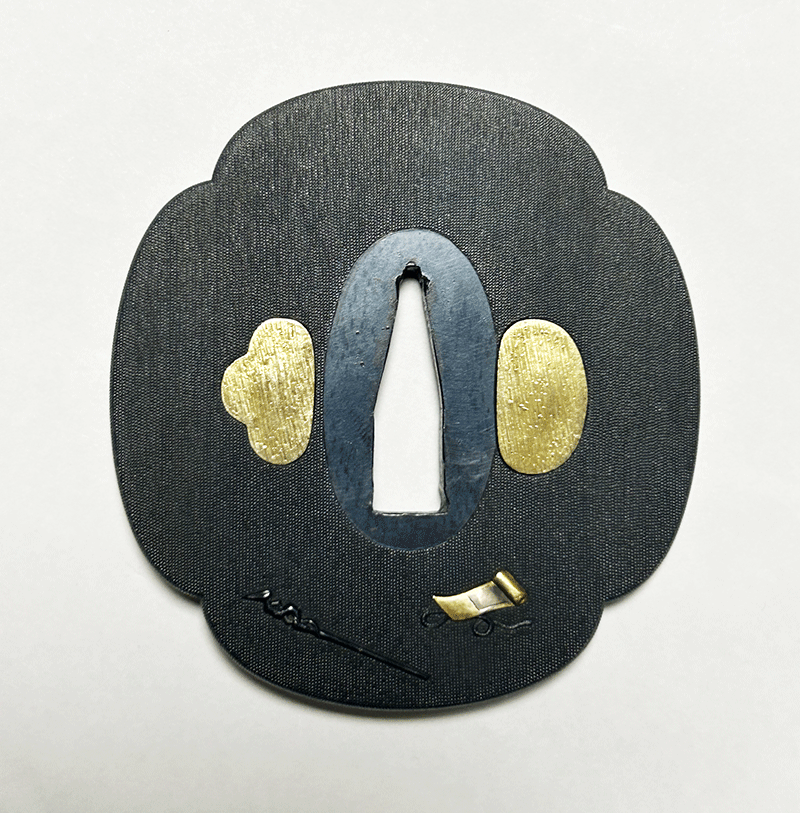
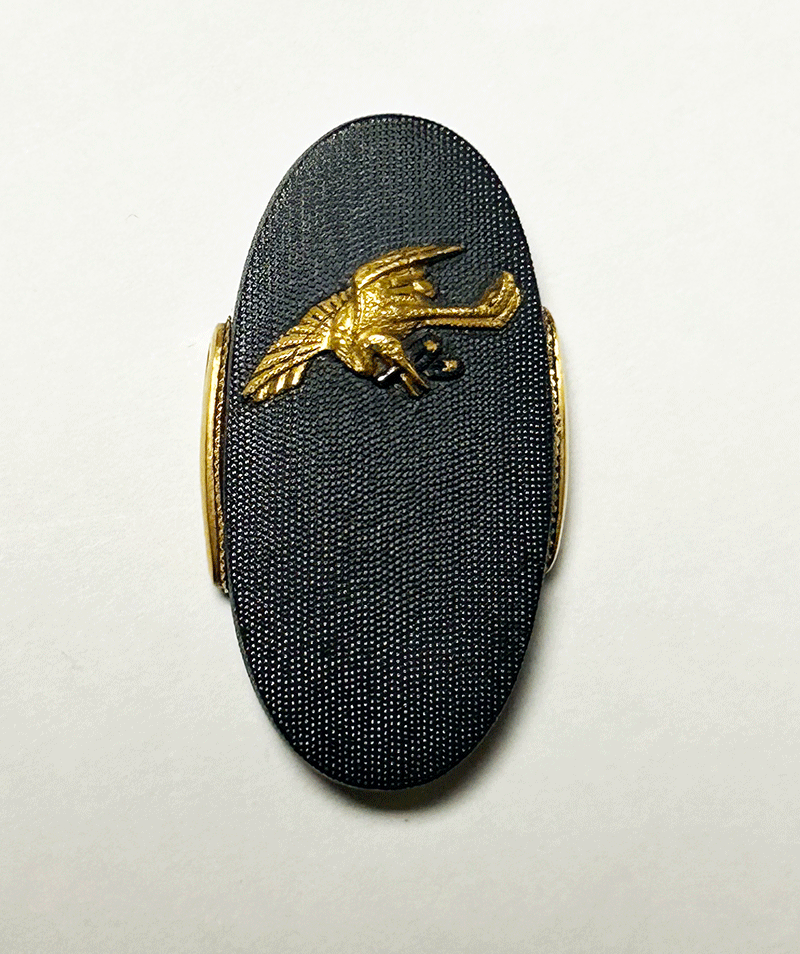
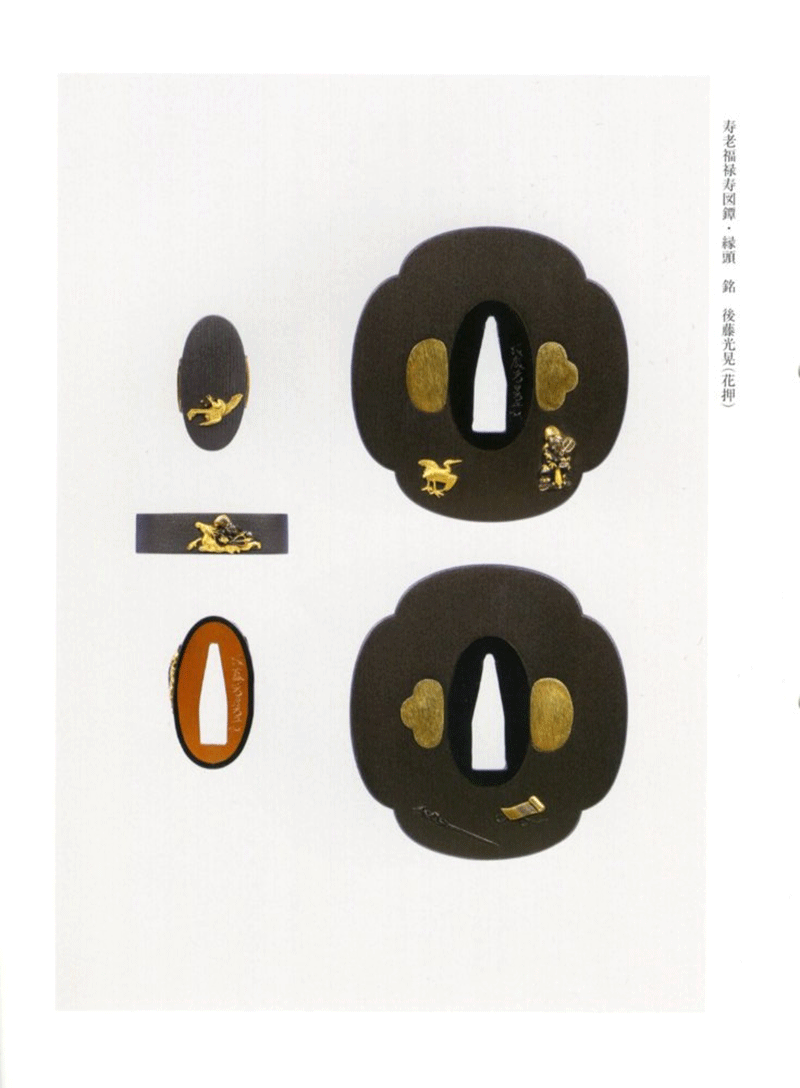
The 16th generation Goto Mitsuaki (Hojo) was born in Bunka 13 as the fifth son of the previous generation Mitsumi, and used the young mei of Mitsunari. Due to the early deaths of his older brothers, he inherited the family headship at age 19, changed his name to Mitsuaki, and took the ho-go Hojo. The works of Mitsuaki possess a sword technique that combines elaborateness and elegance with steadiness, maintaining the dignity of the Soke. One can see iebori style works of takabori iroe on shakudo nanako-ji, as well as e-fu style kebori and katakiribori. In this work, the elder Fukurokuju, a crane, and an ox are expressed with true delicacy in takabori iroe amidst minute shakudo nanako. The elder Fukurokuju is one of the Shichifukujin, a deity symbolizing the three virtues of happiness (fuku), fortune (roku), and longevity (ju). His appearance is depicted as an old man with a long head and a white beard, often with a scroll tied to a staff and accompanied by a crane. The figure of the crane with spread wings expressed on the kashira is truly elegant and beautiful as a composition. The elder Fukurokuju depicted on the fuchi, shown resting his body against an ox, is interesting. On the back of the tsuba, the staff and scroll held by the elder Fukurokuju are firmly carved; it is a superior work whose well-ordered design characteristic of the Bakumatsu period, along with certain skill, captures the heart.
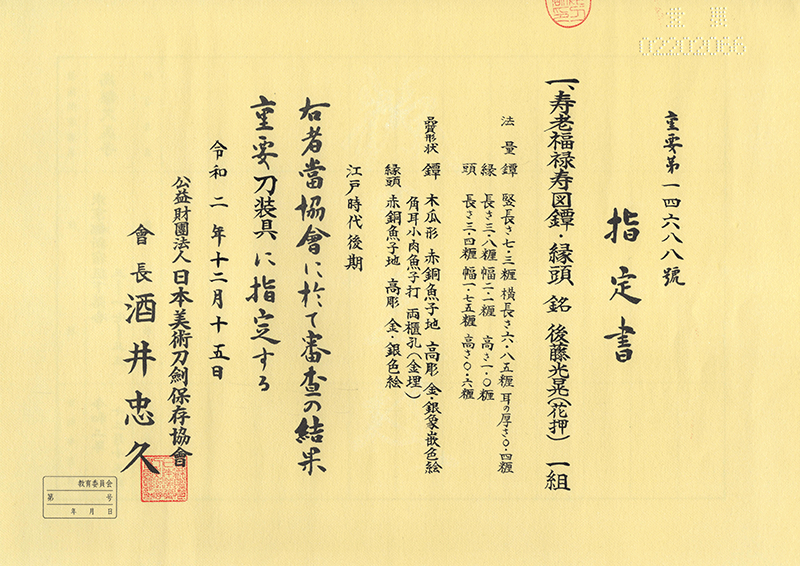
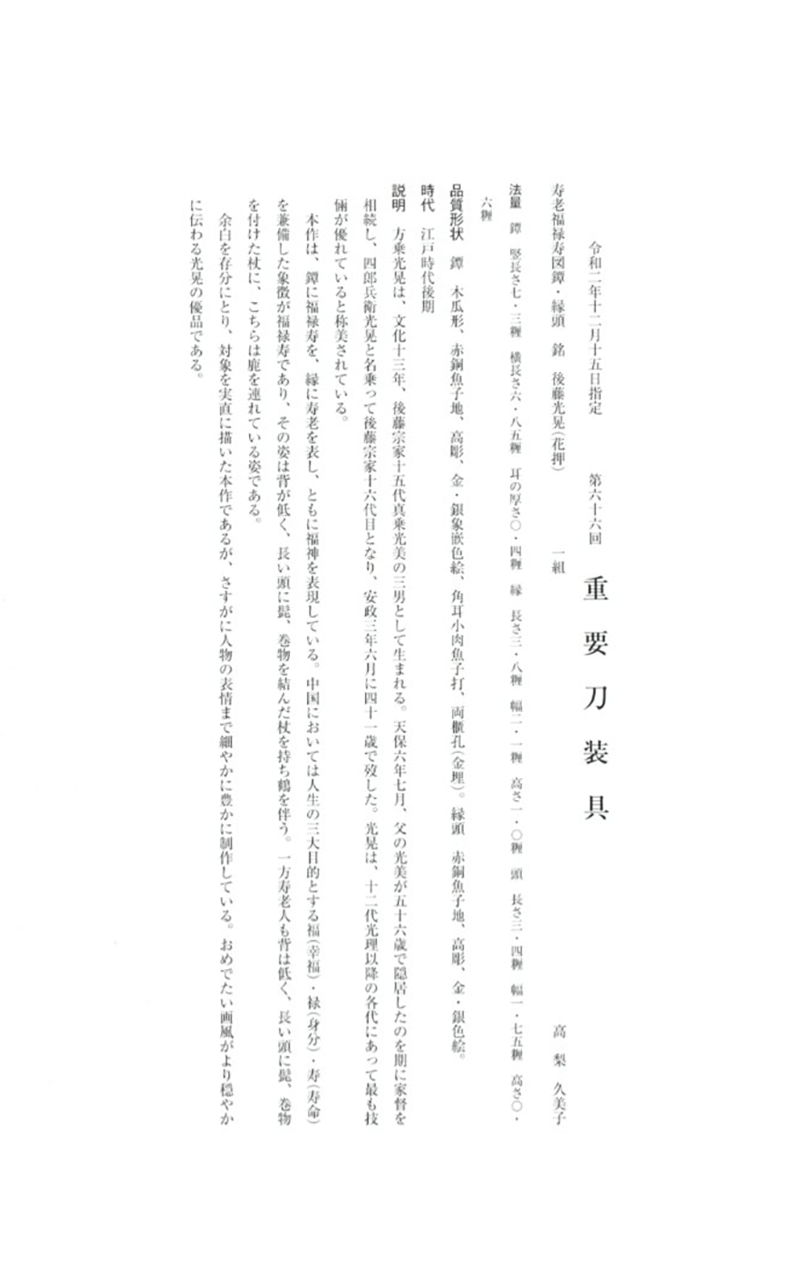
方乗光晃は、文化十三年、後藤宗家十五代真乗光美の三男として生まれる。 天保六年七月、父の光美が五十六歳で隠居したのを期に家督を 相続し、四郎兵衛光晃と名乗って後藤宗家十六代目となり、安政三年六月に四十一歳で歿した。光晃は、十二代光理以降の各代にあって最も技 倆が優れていると称されている。 本作は、鐔に福禄寿を、縁に寿老を表し、ともに福神を表現している。中国においては人生の三大目的とする福(幸福)・禄(身分)・寿(寿命) を兼備した象徴が福禄寿であり、その姿は背が低く、長い頭に髭、巻物を結んだ杖を持ち鶴を伴う。一方寿老人も背は低く、長い頭に髭、巻物 を付けた杖に、こちらは鹿を連れている姿である。 余白を存分にとり、対象を実直に描いた本作であるが、さすがに人物の表情まで細やかに豊かに制作している。 おめでたい画風がより穏やか に伝わる光晃の優品である。
NihontoWatchOffered by Iida Koendo

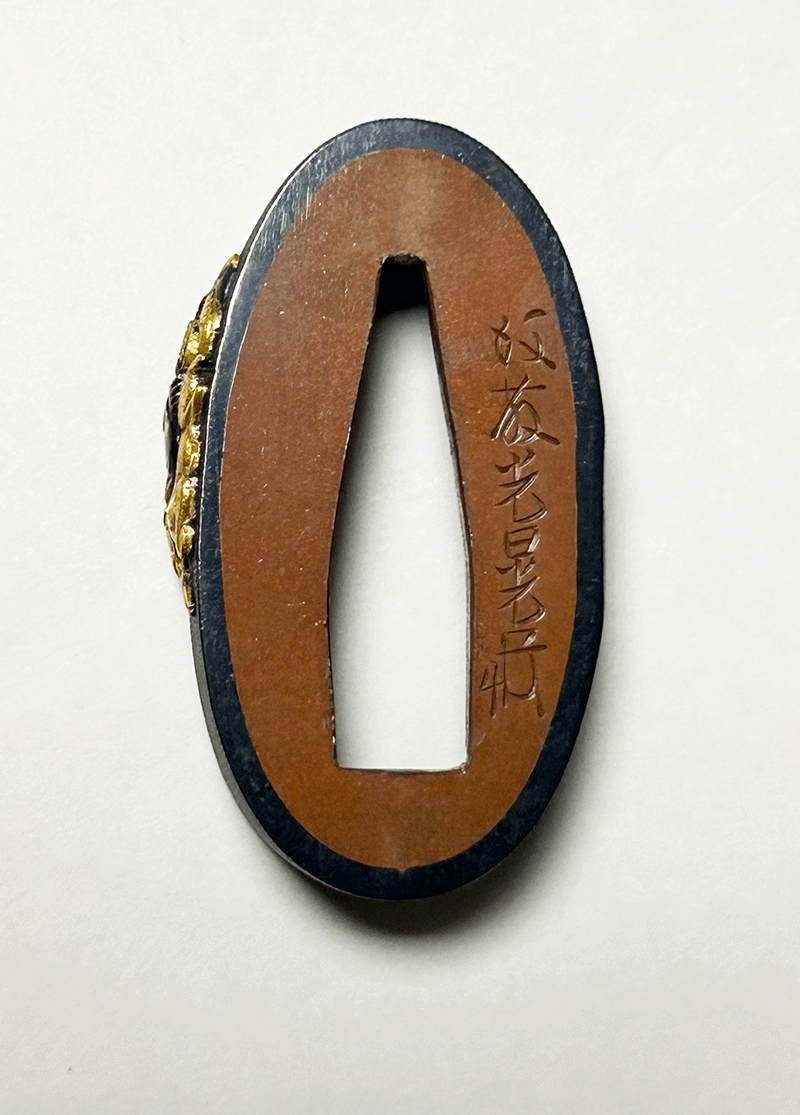
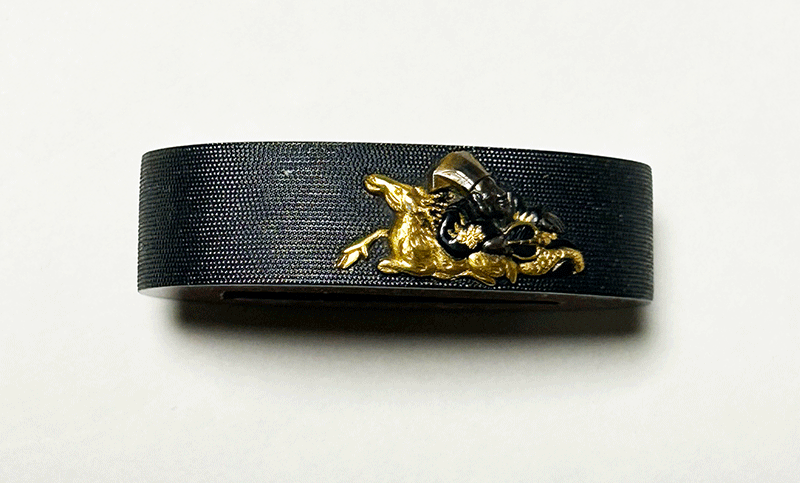
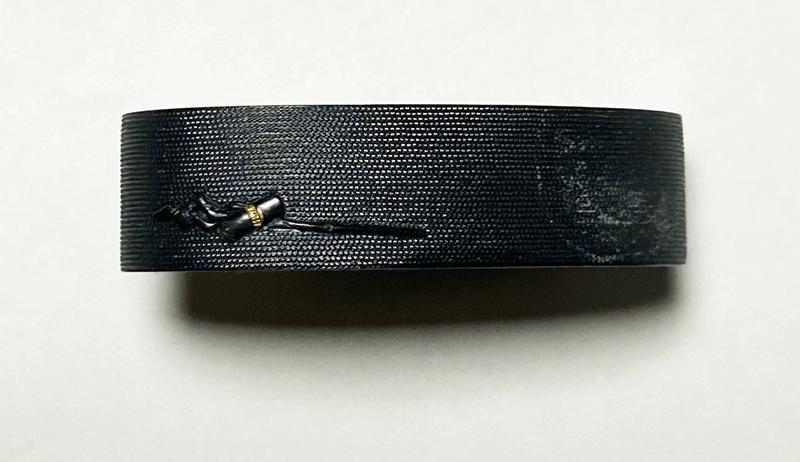
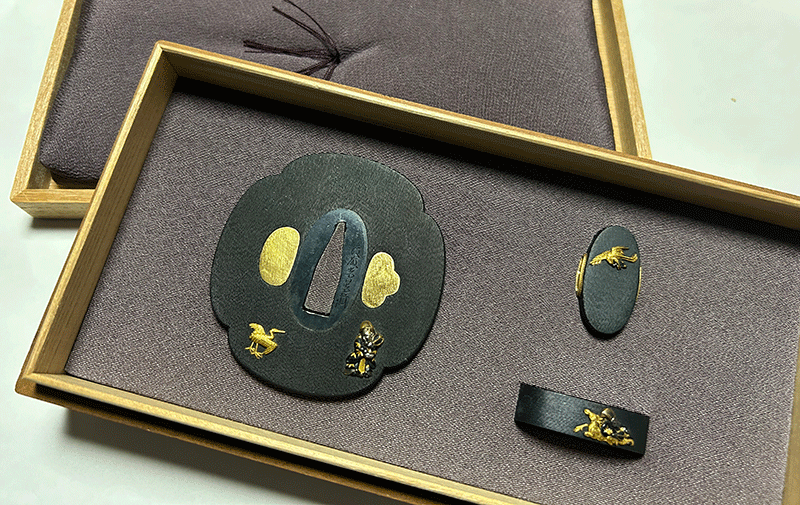
As written by the shop
Machine translation from the shop's Japanese · may contain errors ·
Iebori · Yamashiro
2 pieces on the market now
Iebori · Yamashiro
305 pieces on the market now
The Goto house stands as the preeminent dynasty of sword-fitting makers in the history of Japanese metalwork, an unbroken lineage of seventeen generations spanning from the founding master Yujo (1440--1512), who served Ashikaga Yoshimasa amid the refined culture of Higashiyama, through the final head Hojo (1816--1856) in the closing years of the Tokugawa shogunate. From its inception the house served successive rulers -- Ashikaga shoguns, Oda Nobunaga, Toyotomi Hideyoshi, and the Tokugawa -- and its productions became known as iebori, the "house carving" distinguished from machibori made for ordinary public demand. The fourth master Kojo first introduced warrior subjects and employed preparatory drawings by Kano Motonobu and Eitoku; the fifth master Tokujo struck the celebrated "Tokujo kiri" hallmark upon oban gold coinage for Hideyoshi; the third master Joshin -- "not only a metalworker but also a warrior" -- was killed in battle against the Azai clan in 1562. The seventh master Kenjo, praised since ancient times as a restorer of the house's fortunes (the finest exponents being termed Yuko-ken), traveled to Kaga and laid the foundations for the later flourishing of the Kaga-Goto tradition, while the tenth master Renjo carried the mainline from Kyoto to Edo, where it would remain through the seventeenth generation. The eleventh master Tsujo bridged the formal tradition with the expressive spirit of the Genroku era, and the thirteenth master Enjo served as an authoritative appraiser, authenticating works by earlier masters across the entire succession. The collective technical vocabulary of the Goto house is built upon shakudo nanako-ji grounds of extraordinarily minute and dense stippling, upon which motifs are rendered in takabori with kin-iroe and gin-iroe, frequently supplemented by solid gold (kinmuku) construction and kin'ura gilt backing. The sculptural manner is characterized by what the NBTHK repeatedly describes as "high mountains and deep valleys" -- a modulation of volume in which modeling rises emphatically while recesses are cut deep and clean, producing forceful and crisply articulated relief.
" Sojo inherited and tightened these forms with controlled elegance; Joshin amplified them to conspicuously larger scale with claws that are "characteristically large and long, with the tips splayed open"; Eijo brought a finer, more delicate precision to compositions of equally grand ambition; and Kenjo introduced a distinctive shosha quality -- austere and urbane -- that distinguished his work from the first six generations. The later masters sustained this discipline: Teijo's calm restraint and distinctive coloristic effects, Renjo's forty-five years of deeply worked takabori capturing instantaneous warrior movements, Tsujo's innovative left-right spreading compositions, and Hojo's reintroduction of machibori aesthetics into the official house style all demonstrate the lineage's capacity for renewal within tradition. The Goto house's enduring significance resides not merely in the technical excellence of individual masters but in the institutional continuity of a critical tradition sustained across four centuries. Works from the "upper six generations" (kami roku-dai) through Eijo established the canonical repertoire of prescribed okitemono motifs -- dragons, lions, paulownia crests, Kurikara, and auspicious figures -- while successive heads served simultaneously as makers and authenticators, issuing origami certificates and kiwame-mei inscriptions that themselves constitute important documents of connoisseurship. Valuations reaching one thousand kan and transmission through such distinguished collections as the Konoike, Shimazu, Tokugawa, and Maeda houses attest to the unrivaled esteem in which Goto metalwork has been held. Even Sokujo, whose tenure lasted barely four years before his death at thirty-two, left a small but distinguished body of work authenticated across eight subsequent generations of headmasters. From Yujo's founding vision through Hojo's final flowering -- whose technical command the NBTHK judges the finest from the twelfth master onward, betraying "not the slightest hint of the approaching conclusion" of the unbroken line -- the Goto house represents the defining standard against which all Japanese metalwork is measured, the wellspring from which the entire sokeN kinkO tradition flows. Learn more →
| Smith | Era | Designated |
|---|---|---|
| Goto Joshin後藤乗真 | 1512-1562 | 68 |
| Goto Yujo後藤祐乗 | 1440-1512 | 41 |
| Goto Sojo後藤宗乗 | 1461-1538 | 56 |
| Goto Kenjo後藤顕乗 | 1586-1663 | 46 |
| Goto Teijo後藤程乗 | 1603-1673 | 42 |
Exceptional craft of very high artistic value, judged to rank with a nationally recognized Important Art Object (Jūyō Bijutsuhin).
The NBTHK (Nihon Bijutsu Tōken Hozon Kyōkai, the Society for the Preservation of Japanese Art Swords) is a public-interest incorporated foundation founded in 1948 and supervised by Japan’s Agency for Cultural Affairs (Bunkachō); it is based at the Japanese Sword Museum in Tokyo. Its expert panels physically examine each submitted work (shinsa) and issue a certificate (kanteishō) ranking it by artistic and historical merit. NBTHK papers are the most widely recognized standard of authentication for Japanese swords and fittings.
NBTHK official siteFor returns at the customer's convenience, please notify us within two days of the item's arrival. Items that have been altered cannot be accepted. Return shipping is at the customer's expense. Costs other than the item price (bank transfer fees, cash-on-delivery fees, etc.) cannot be refunded. Items delivered overseas cannot be returned or refunded.
¥5,500,000