 NihontoWatchNihontoWatch
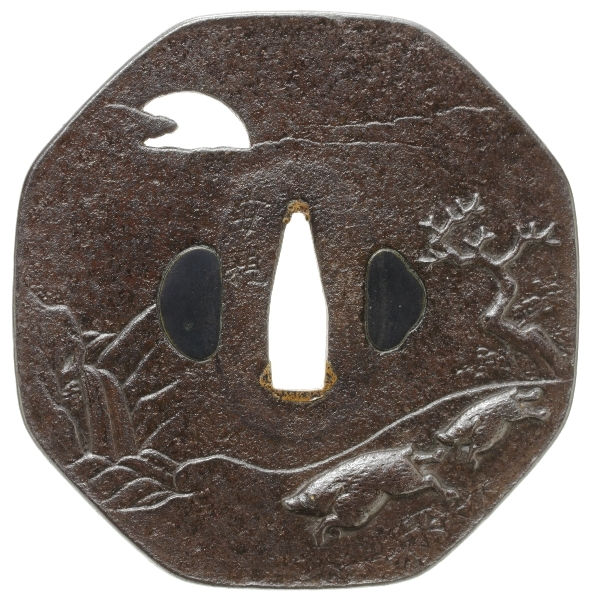
安親は寛文十年出羽国鶴岡の生まれ。父は庄内藩士土屋忠左衛門。長じて家老松平内膳に仕える傍ら、正阿弥珍久に師事して金工技術の研鑽に勤しむ。金工芸術に創意工夫を凝らすに連れて、更なる高みを目指すべく江戸に修行にでたのが齢三十四歳。妻子を郷里に残して、江戸で修行の日々を過ごした安親は、誰よりも親子の情を理解していたのであろう。本作には表に母子の猪を、裏には父猪を彫り上げて自らの境遇を表したものであろう。八角鐔の遺例の希少さと心に染みるような温かい人間味がそこはかとなく漂う安親作中の傑作である。
NihontoWatchOffered by Choshuya
This piece has sold
14 on the market
Get an email when new Tsuchiya School work hits the market.

As written by the shop
Machibori · Musashi (Edo)
14 pieces on the market now
The Tsuchiya school is a branch of the Nara kinkō tradition, established in Edo (Musashi Province) by Tsuchiya Yasuchika, counted among the Nara Sansaku (Three Great Masters of Nara). Six generations of main-line heads carried the name Yasuchika (安親), perpetuating a continuous workshop lineage from the Genroku era through the late Edo period. The Shōnai Kinkō Meifu records Yasutsugu (安族) as a pupil of the first-generation Yasuchika who served as a cooperative assistant craftsman in Edo before returning to Shōnai[[c:2]], where his descendants continued in metalwork. The sixth-generation head, Tsuchiya Masachika — also known as Hōgen Yasuchika — was the eldest son of Kunichika (the fifth-generation head), born in Shimotsuke Province at Shimodate. He "traveled widely to study and refine his skills[[c:3]]," establishing himself at Shiba-Shinbashi in Edo and serving as domain craftsman to the Satake family of Akita. He was granted the court title Hōgen, used the art names Sekienji and Tōsen, and died in Man'en 2 (1861).
A further branch member, Tsuchiya Morichika I, signed under the extended form Tōensha Tsuchiya Kōsen Morichika. The school's collective style is rooted in the Nara tradition's carving vocabulary, with sukidashi-takabori (relief carving raised from the ground) as its foundational technique. Iron and shakudō are the primary ground metals, frequently worked in ishime-ji or tsuchime-ji (hammered ground), with rich iroe in gold, silver, shibuichi, and suaka. " The pictorial sensibility favors literary and allusive compositions; Morichika's Five Seasonal Festivals suite expresses each observance "through evocative images of associated objects and settings that allude to the observances[[c:5]]" rather than depicting ceremonial scenes literally. " The setsumei consistently position the Tsuchiya school as a vehicle for the continuation of Nara-school principles across the mid- and late Edo periods. " Commissioned works for daimyō patrons — the Satake family of Akita and the Matsui family of Maebashi — attest to the enduring esteem in which the Tsuchiya line was held by the upper warrior class. Learn more →
| Smith | Era | Designated |
|---|---|---|
| Yasuchika安親 | 1804-1830 | 0 |
| Yasuchika安親 | 1718-1778 | 0 |
| Yasunari安成 | — | 0 |
| Yasunori安則 | — | 0 |
| Kunichika国親 | — | 0 |
If, due to our fault, the item differs significantly from its proper condition, the item may be returned. Cooling-off is within one week of the item's arrival.