 NihontoWatchNihontoWatch
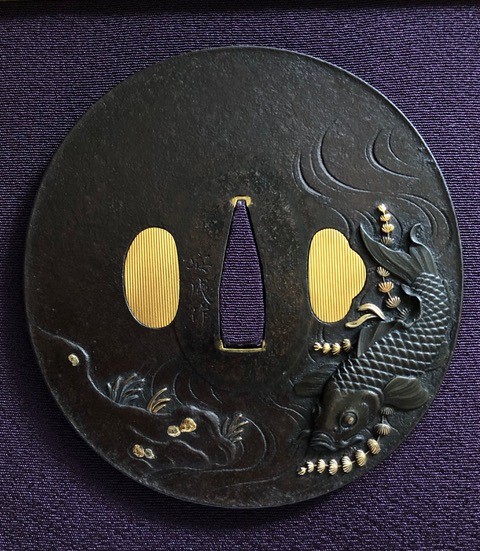
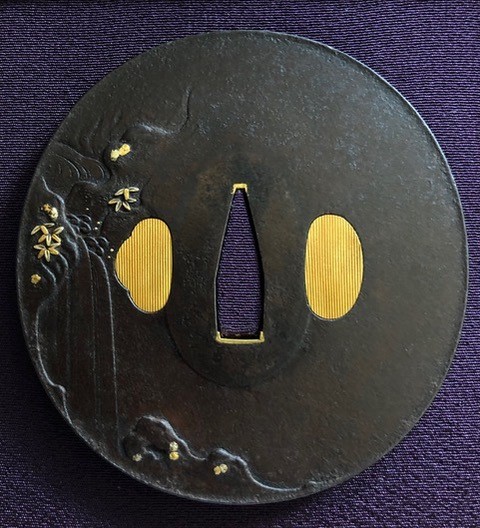
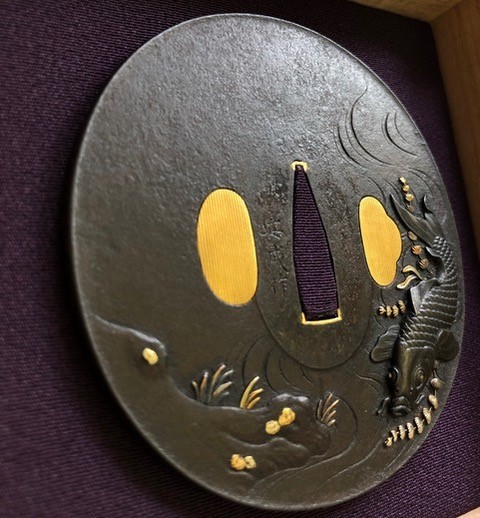
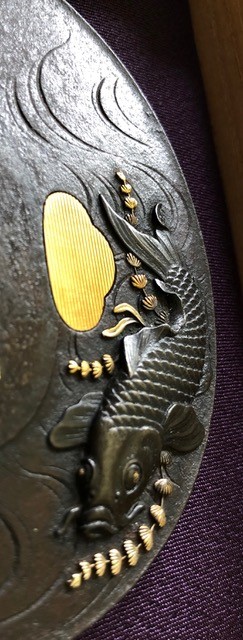
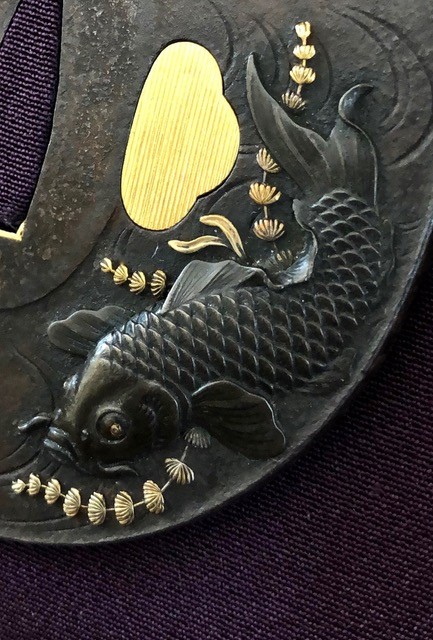
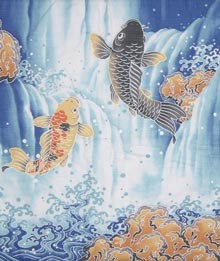
Explanation: MASTERPIECE TSUBA by YASUNARI Comes with it's box and outer box cover. Certification: NBTHK Tokubetsu Hozon Certificate ( Extraordinarily Worthy of Preservation) Setsmei : ( Explanation) Condition: The condition of this Tsuba is wonderful and has a very fine beautiful brown Iron patina. The Koi ( Carp) is intricately made with fine detail in Shibuichi giving it a beautiful contrast with the Iron, with waves, and water plants executed in high relief Gold on both sides. Both Hitsu Ana are filled with Gold with intricate and symmetrical vertical lines. In the hand and observed and appreciated with human eyes the Tsuba is overwhelming and yet has calm aesthetic harmony with the Koi balanced perfectly in 3D. YASUNARI was recognised as a best student of the Famous YASUCHIKA ( Nara Sansaku) One of the three great Masters of Nara. Yasunari’s work in this particular design of a KOI clearly attains the level of his Master’s work of a very similar design and is a Testament of his dedication and level of artistry on this particular Tsuba. YASUNARI ca 1700. ( YASUNARI worked in Shonai Dewa Province) This Tsuba is a Masterpiece of the highest level by YASUNARI and has potential for Juyo although it hasn’t been submitted as yet. I present and recommend this extremely rare Tsuba for connoisseurs who appreciate the very best in Japanese Tsuba Artwork. Koi as a Samurai Warrior Koi Symbolism is also very prevalent in Japanese culture. It is said that a Koi swims up rivers and climbs waterfalls with bravery not unlike a Samurai warrior. As well, it is said that if a Koi is caught, it will lie still beneath the knife, facing its death bravely like a Samurai facing a sword. Koi fish symbolism has gained strength over the centuries to encompass numerous positive qualities related to courage, overcoming adversity, the ability to attain the highest goals, and strong character. Dragon's Gate on Yellow River According to Chinese legend, there was a place called Dragon's Gate at the top of a large waterfall on Yellow River. Koi (Carp) would swim up the river, against the current to reach the base of the waterfall. Although many would try, only a few were brave and able enough to attempt the final leap up the waterfall. It was said that if a carp was able to complete the journey through Dragon's Gate at the top of the falls, then it would be transformed into a powerful dragon. In Chinese culture, the dragon is a symbol of great power. The story symbolises that anybody who is able to persevere through great trials can accomplish their highest goals to become great.
NihontoWatchOffered by Connoisseur Arms
15 on the market
Machibori · Musashi (Edo)
1 piece on the market now
Machibori · Musashi (Edo)
15 pieces on the market now
The Tsuchiya school is a branch of the Nara kinkō tradition, established in Edo (Musashi Province) by Tsuchiya Yasuchika, counted among the Nara Sansaku (Three Great Masters of Nara). Six generations of main-line heads carried the name Yasuchika (安親), perpetuating a continuous workshop lineage from the Genroku era through the late Edo period. The Shōnai Kinkō Meifu records Yasutsugu (安族) as a pupil of the first-generation Yasuchika who served as a cooperative assistant craftsman in Edo before returning to Shōnai[[c:2]], where his descendants continued in metalwork. The sixth-generation head, Tsuchiya Masachika — also known as Hōgen Yasuchika — was the eldest son of Kunichika (the fifth-generation head), born in Shimotsuke Province at Shimodate. He "traveled widely to study and refine his skills[[c:3]]," establishing himself at Shiba-Shinbashi in Edo and serving as domain craftsman to the Satake family of Akita. He was granted the court title Hōgen, used the art names Sekienji and Tōsen, and died in Man'en 2 (1861).
A further branch member, Tsuchiya Morichika I, signed under the extended form Tōensha Tsuchiya Kōsen Morichika. The school's collective style is rooted in the Nara tradition's carving vocabulary, with sukidashi-takabori (relief carving raised from the ground) as its foundational technique. Iron and shakudō are the primary ground metals, frequently worked in ishime-ji or tsuchime-ji (hammered ground), with rich iroe in gold, silver, shibuichi, and suaka. " The pictorial sensibility favors literary and allusive compositions; Morichika's Five Seasonal Festivals suite expresses each observance "through evocative images of associated objects and settings that allude to the observances[[c:5]]" rather than depicting ceremonial scenes literally. " The setsumei consistently position the Tsuchiya school as a vehicle for the continuation of Nara-school principles across the mid- and late Edo periods. " Commissioned works for daimyō patrons — the Satake family of Akita and the Matsui family of Maebashi — attest to the enduring esteem in which the Tsuchiya line was held by the upper warrior class. Learn more →
| Smith | Era | Designated |
|---|---|---|
| Yasuchika安親 | 1804-1830 | 0 |
| Yasuchika安親 | 1718-1778 | 0 |
| Yasunari安成 | — | 0 |
| Yasunori安則 | — | 0 |
| Kunichika国親 | — | 0 |
A Hozon-certified fitting of notably superior craftsmanship and condition, often with signature or workmanship of high reference value.
The NBTHK (Nihon Bijutsu Tōken Hozon Kyōkai, the Society for the Preservation of Japanese Art Swords) is a public-interest incorporated foundation founded in 1948 and supervised by Japan’s Agency for Cultural Affairs (Bunkachō); it is based at the Japanese Sword Museum in Tokyo. Its expert panels physically examine each submitted work (shinsa) and issue a certificate (kanteishō) ranking it by artistic and historical merit. NBTHK papers are the most widely recognized standard of authentication for Japanese swords and fittings.
NBTHK official sitePurchases are final and items cannot be returned unless otherwise stated.
Price on request