

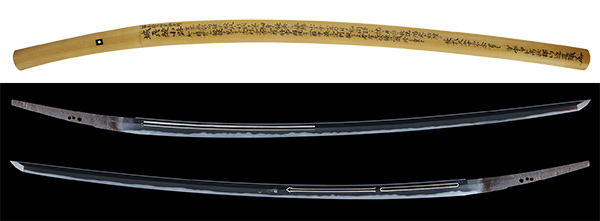

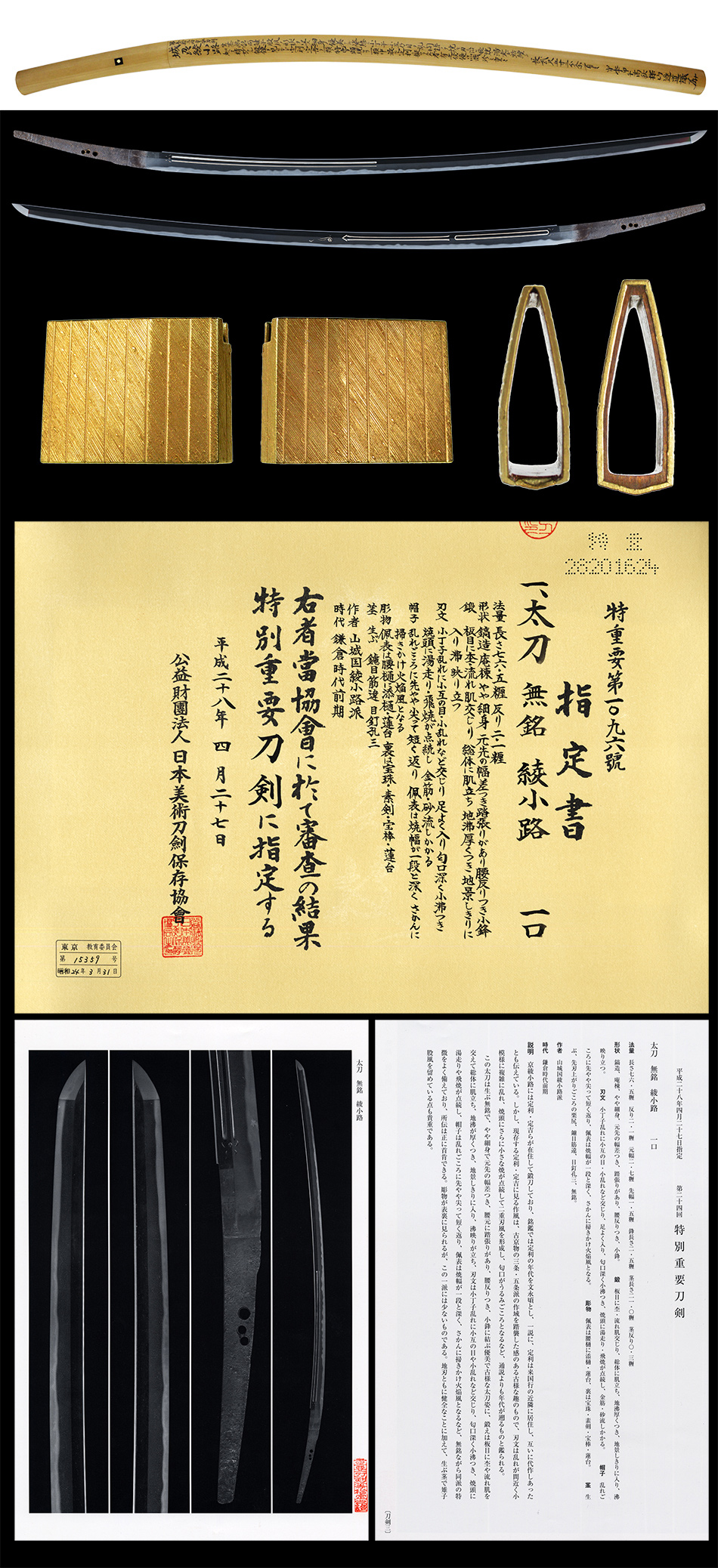
-, 24th Session — Designated April 27, 2016
, : Ayakoji school (綾小路)
Measurements 76.5 cm, 2.1 cm, 2.5 cm, 1.5 cm, 2.0 cm, 18.3 cm
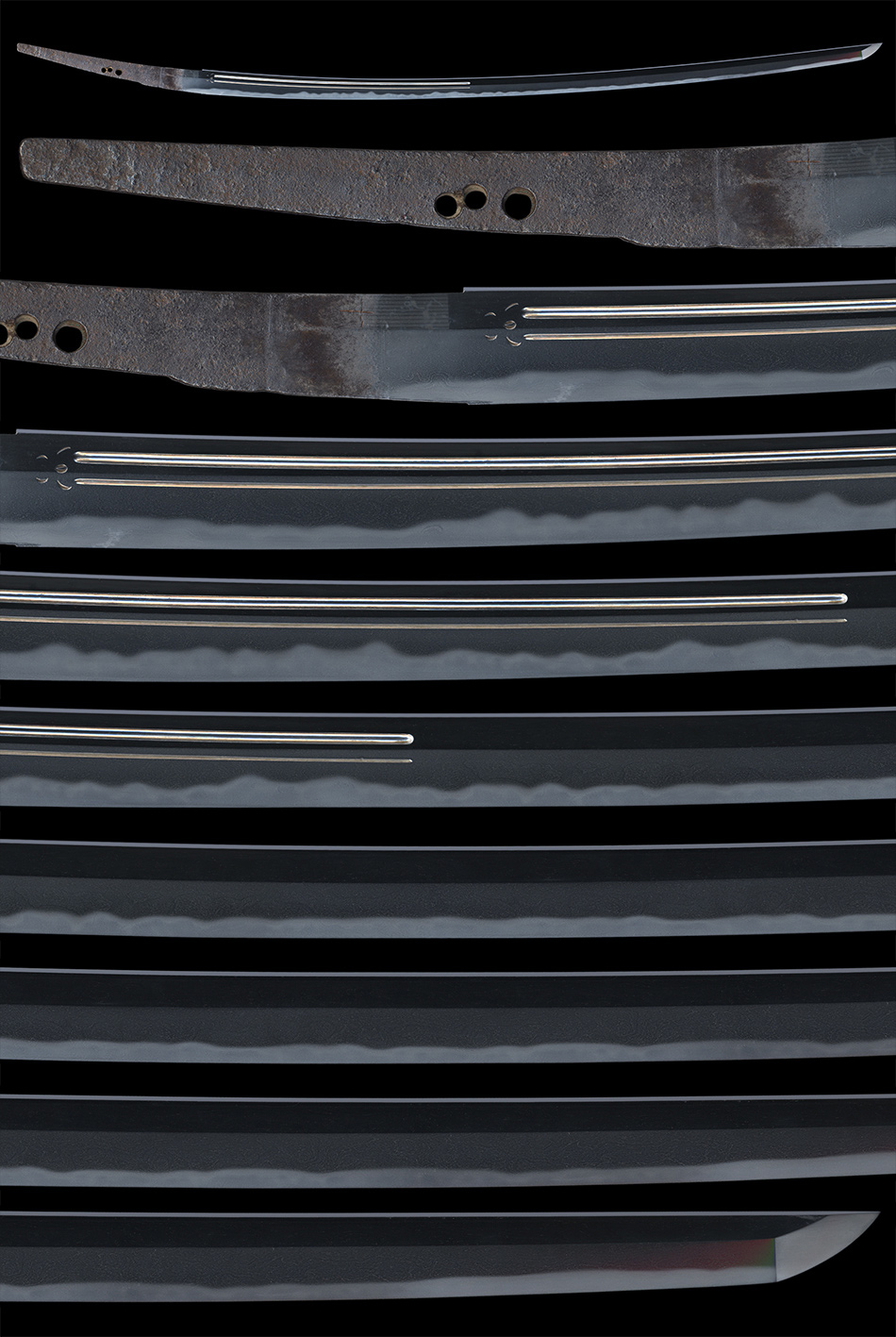
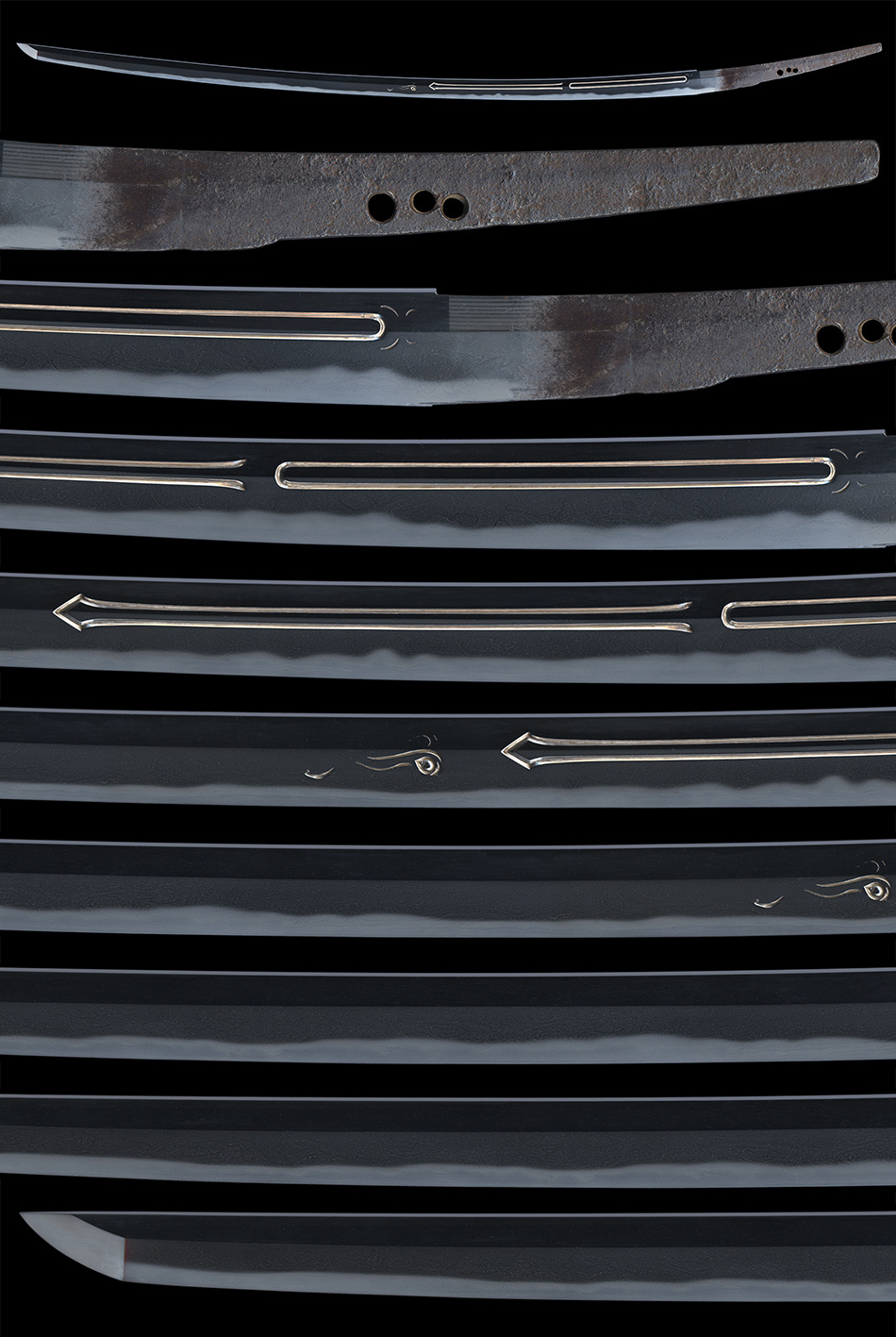
Description : , ; somewhat slender, with a pronounced difference between and width; with a slight swelling at the base (koshihari); . : mixed with ; overall the grain stands out (), with thickly formed , frequent , and a strongly -laden texture. : mixed with and ; enter well; deep with ; and appear intermittently along the ; and are seen. : with a tendency; the point is slightly pointed and turns back briefly; on the the tempered width is notably deeper, and vigorous produces a flame-like (-style) effect. : : a with a motif near the waist; : , , hōbō, and . : ; tendency at the tip; file marks; three ; unsigned.
Artisan Ayakoji school of Yamashiro Province
Era Early period
Explanation In Kyoto’s Ayakōji district there were swordsmiths such as Sadatoshi and Sadayoshi who resided there and forged blades. According to the prevailing view, Sadatoshi is placed around the Kenkyū era (1190–1199). One theory further relates that Sadatoshi lived near Kuniyuki and that the two are even said to have produced substitute works for one another. However, the styles seen in extant works by Sadatoshi and Sadayoshi are archaic in flavor, recalling the old manner of the and Gojō groups. Their temper patterns are based on and become intricately complex in small-scale motifs; in addition, still smaller irregularities are scattered within the tempered area, forming (a double temper line), and the takes on an (moist/soft) tendency. For these reasons, such works are considered to date earlier than the commonly accepted chronology.
This is and . Its elegant and archaic form—somewhat slender, with a marked taper from base to tip, swelling at the base, , and a —is especially graceful. The forging shows mixed with , with overall ; thick adheres, enter frequently, and the texture is conspicuously -laden. The is mixed with and small irregularities; the is deep with ; and and are observed along the . The tends toward , with a slightly pointed tip and a short turn-back; on the the tempered width is notably deeper, and vigorous yields a flame-like effect. Although unsigned, the blade fully embodies the distinctive features of this group, and the traditional attribution is entirely persuasive.
Carvings are present on both sides; such are rare within this school. In addition to the fact that both and are (sound and well-preserved), it is also precious that the blade remains with its original tang intact. Finally, the piece was previously designated an “Important Sword” ( ) by the Tokyo Metropolitan Board of Education (No. 15359) on March 31, 1949.