NihontoWatch MonNihontoWatch
Market
Encyclopedia
Kantei
NihontoWatch MonNihontoWatch
Market
Encyclopedia
Kantei

Description

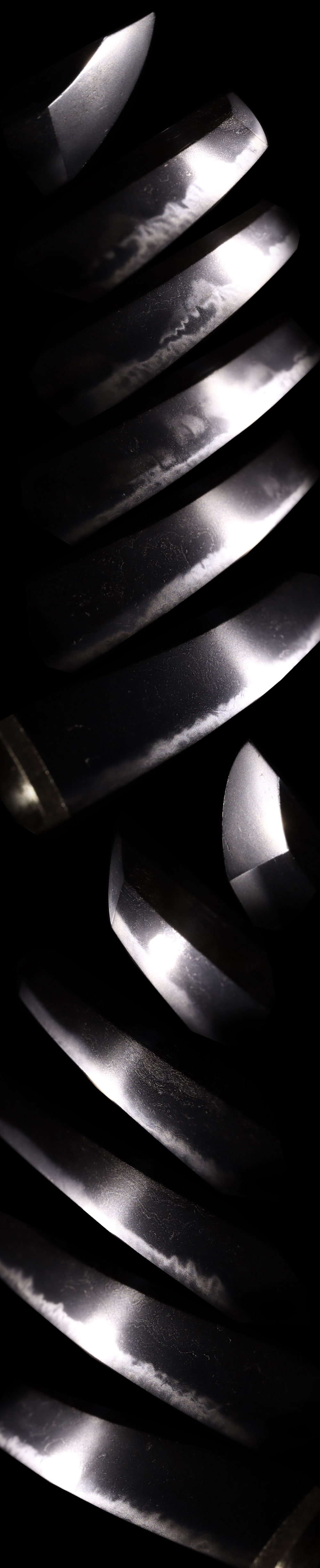
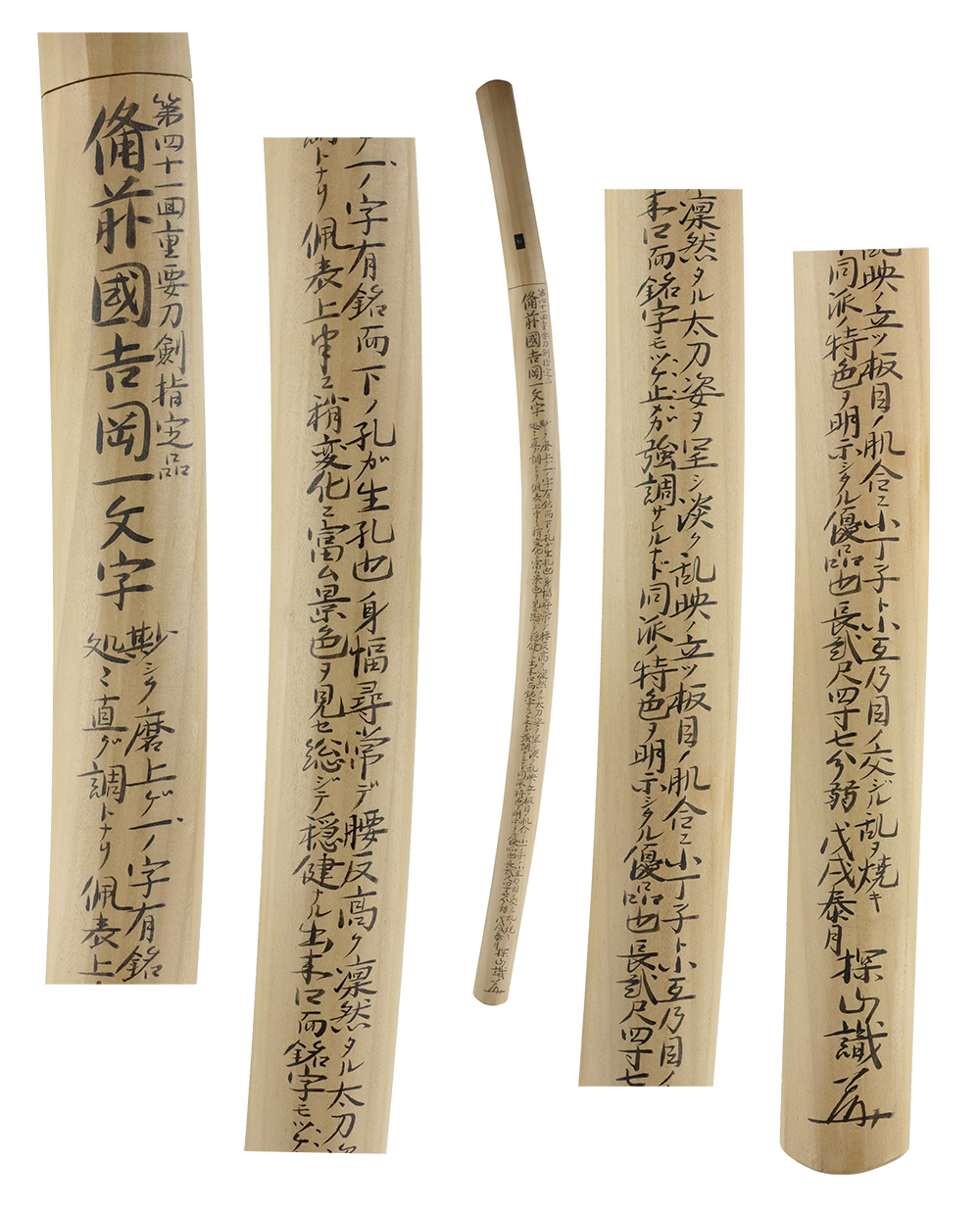
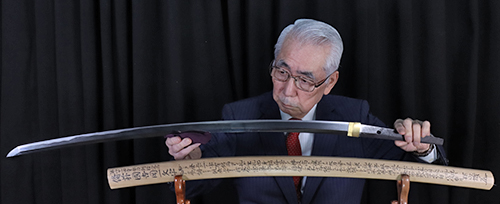
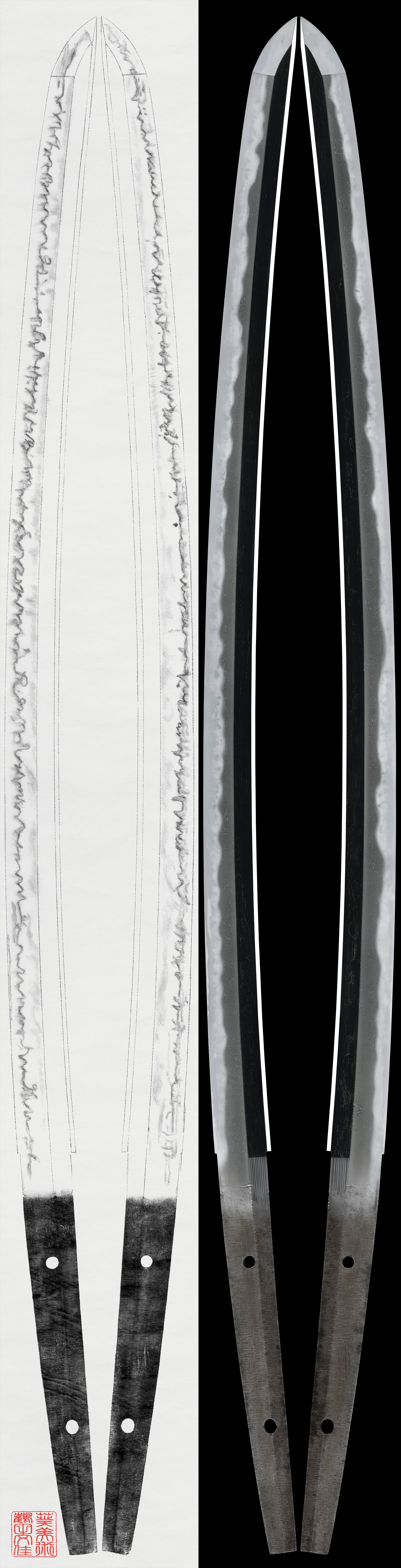
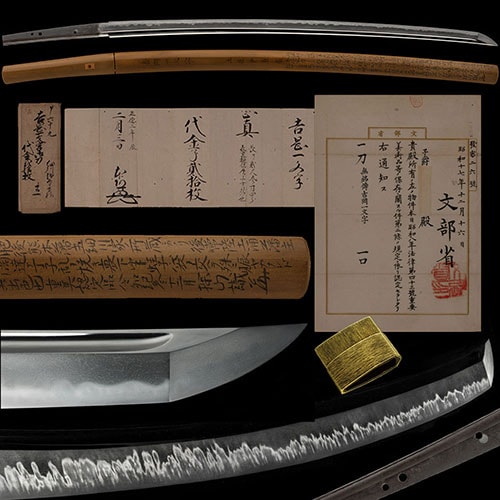
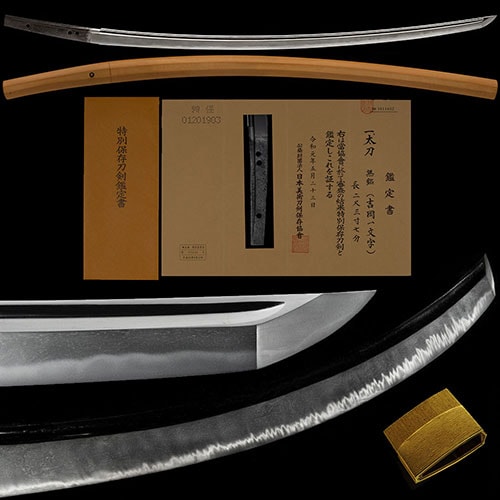
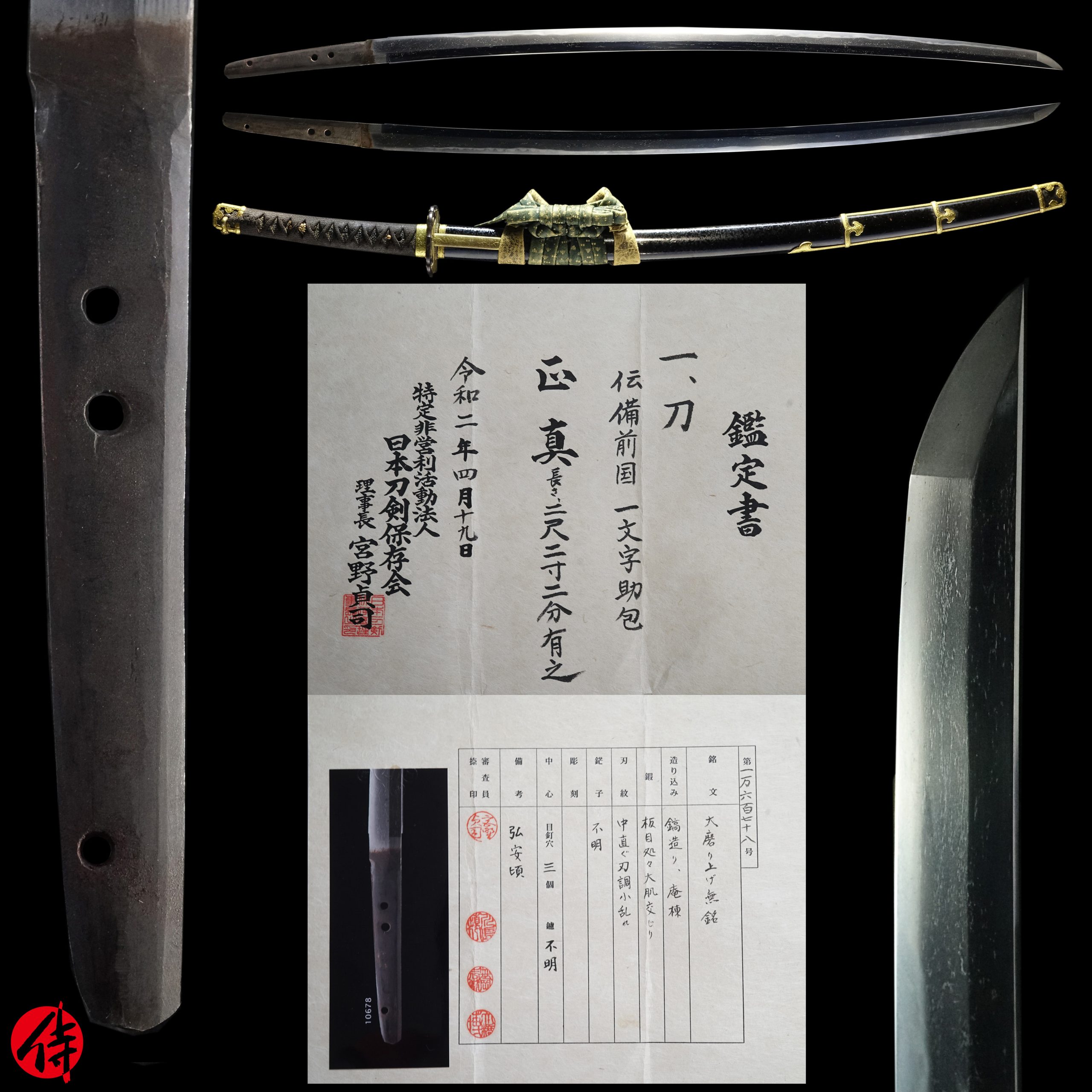
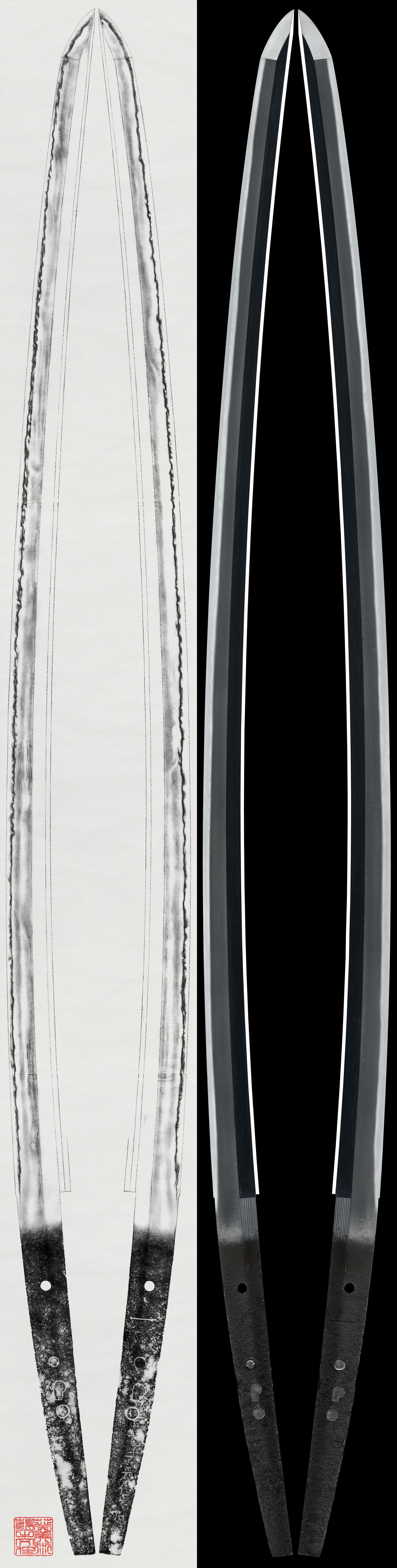
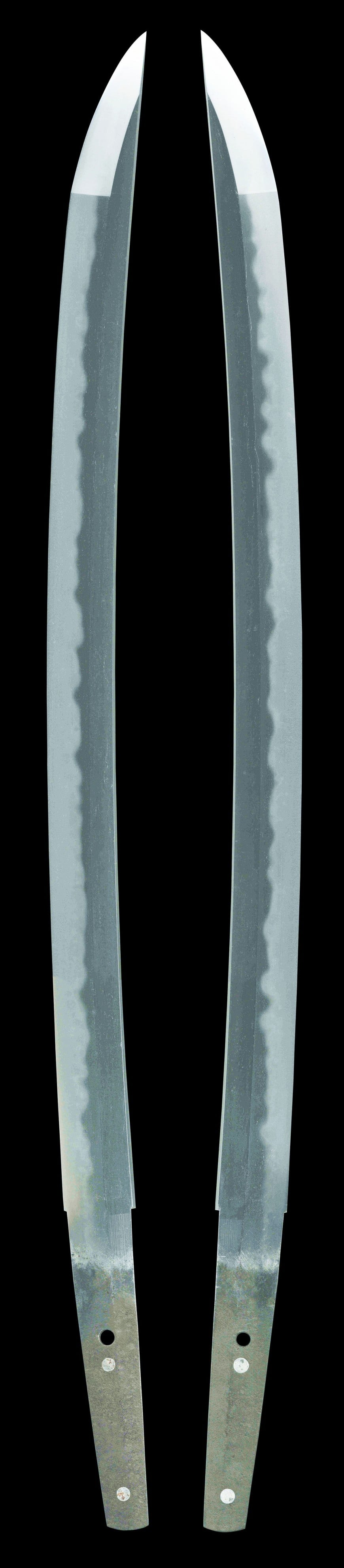
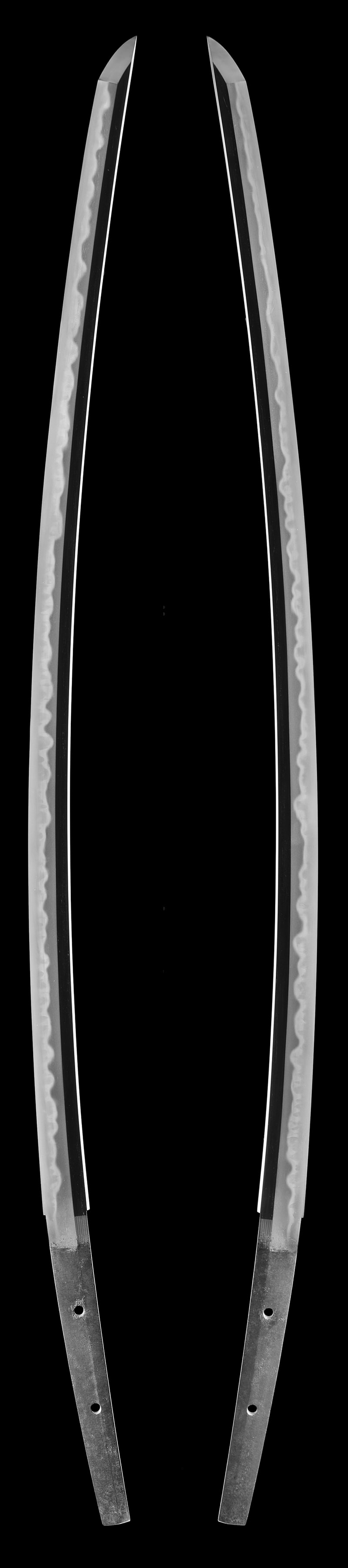
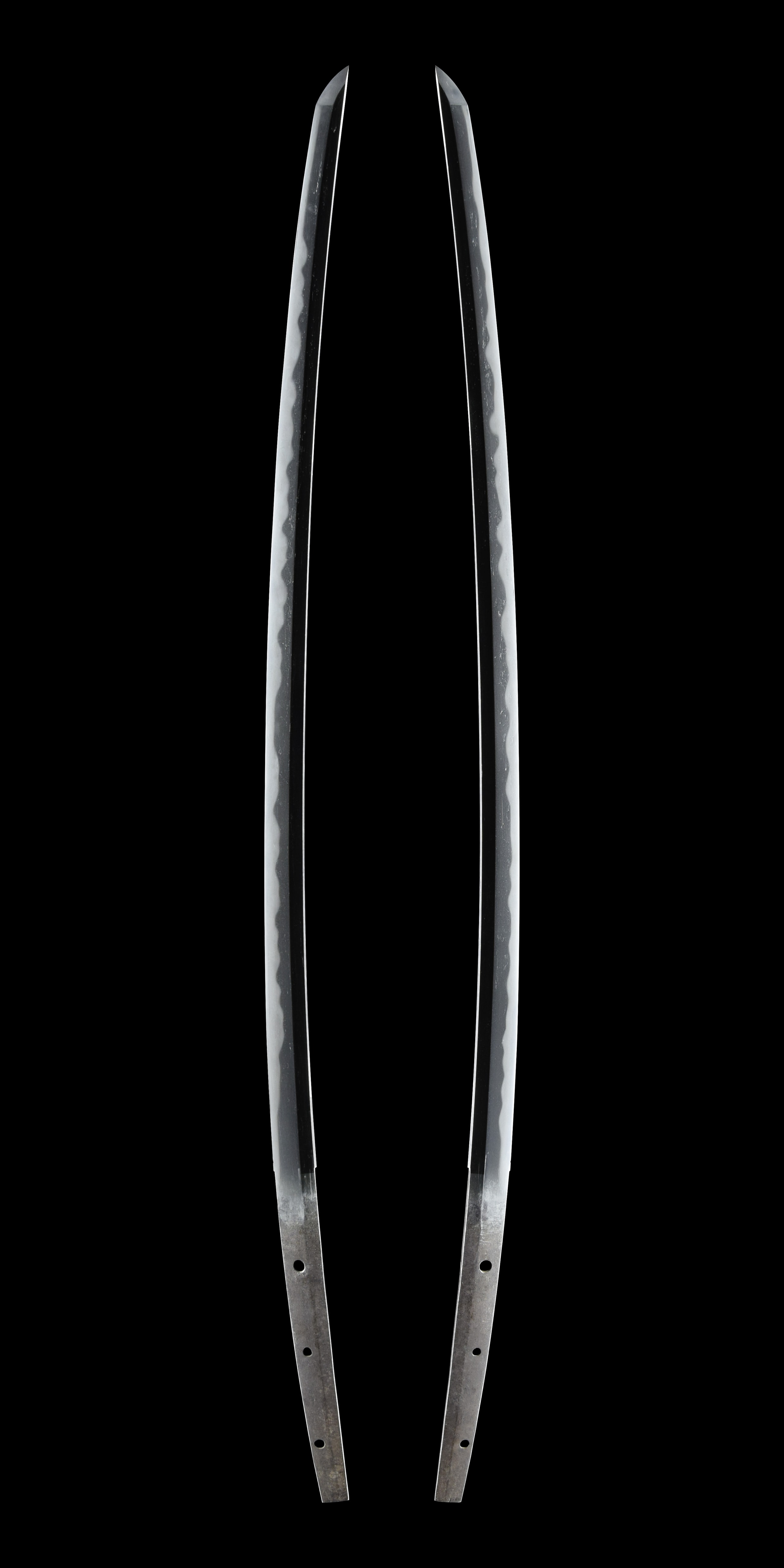
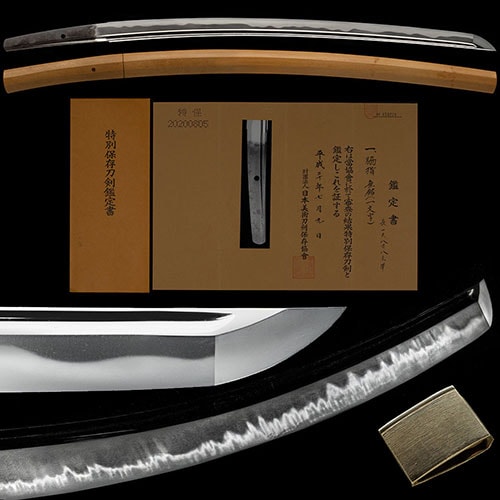
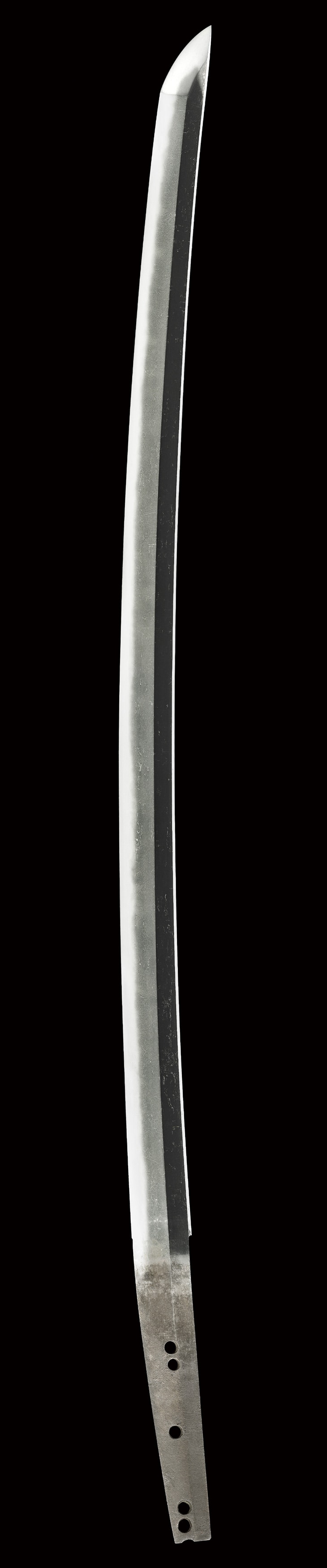
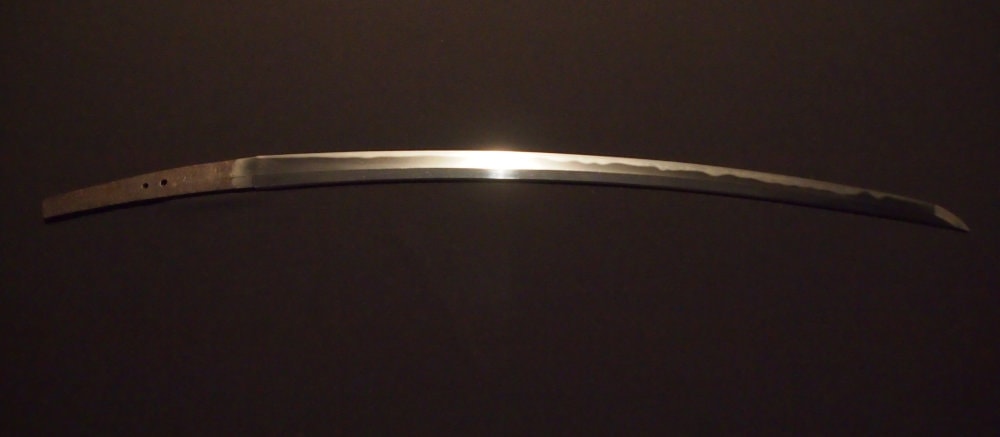
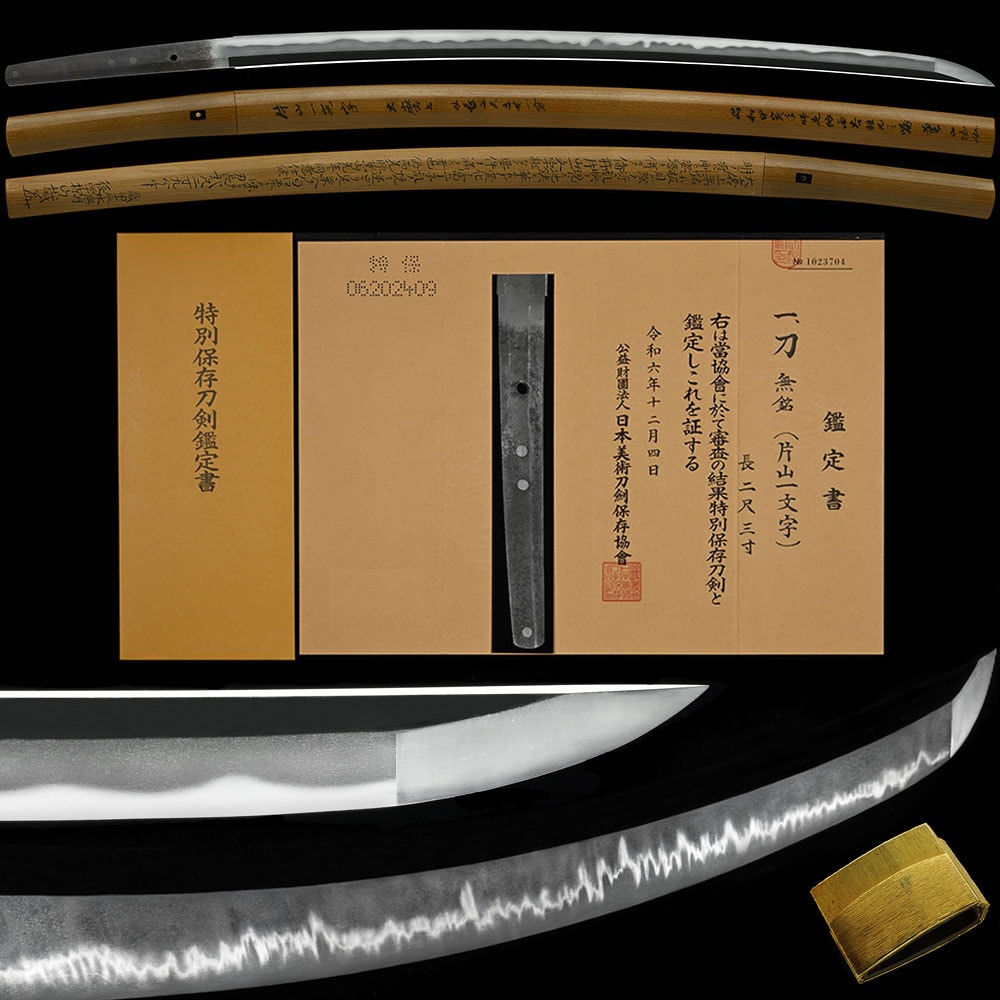
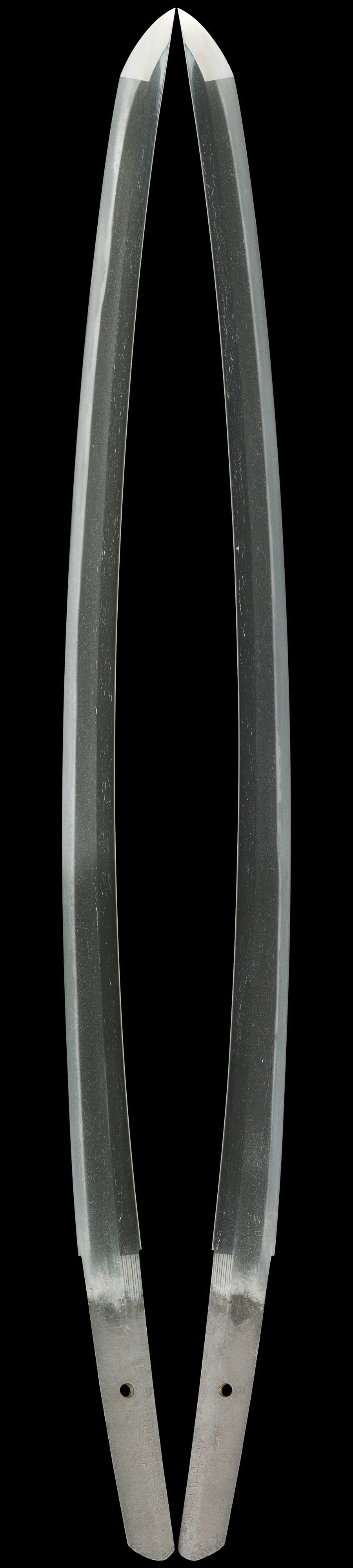
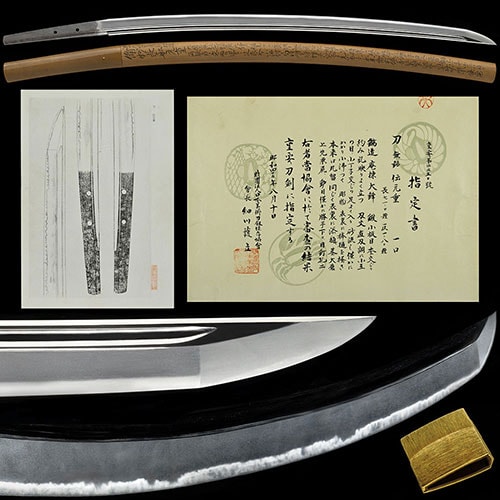
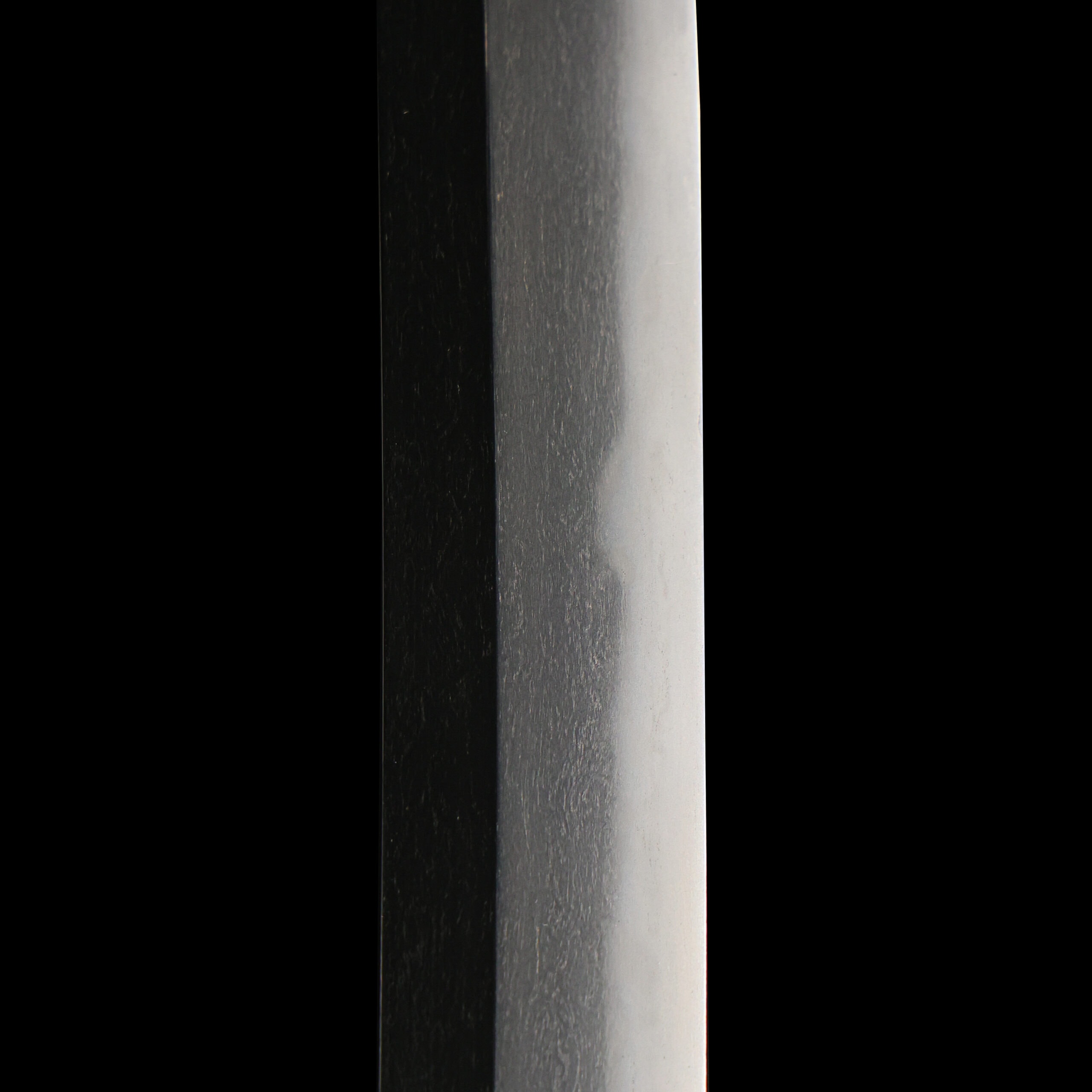
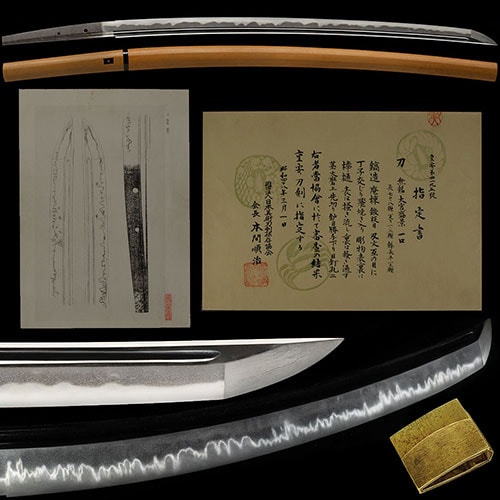
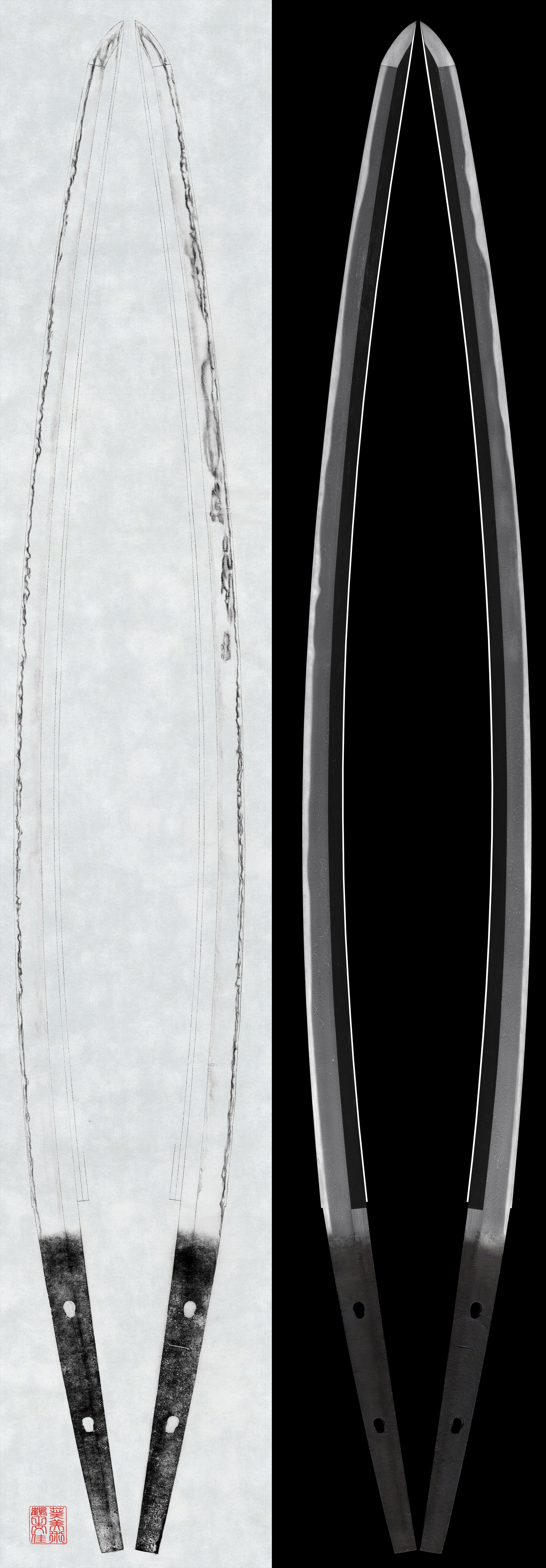
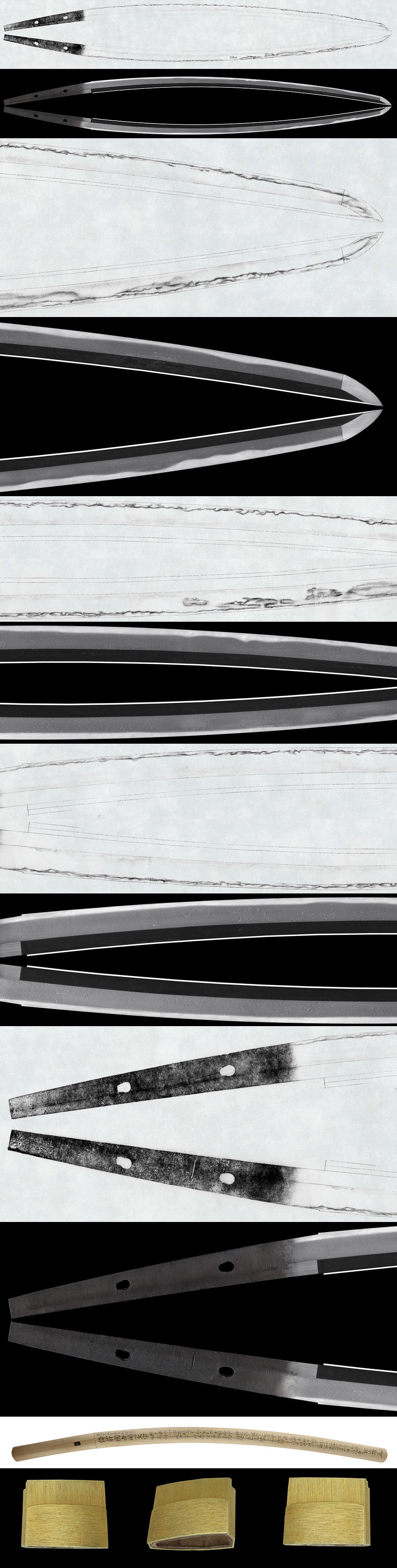
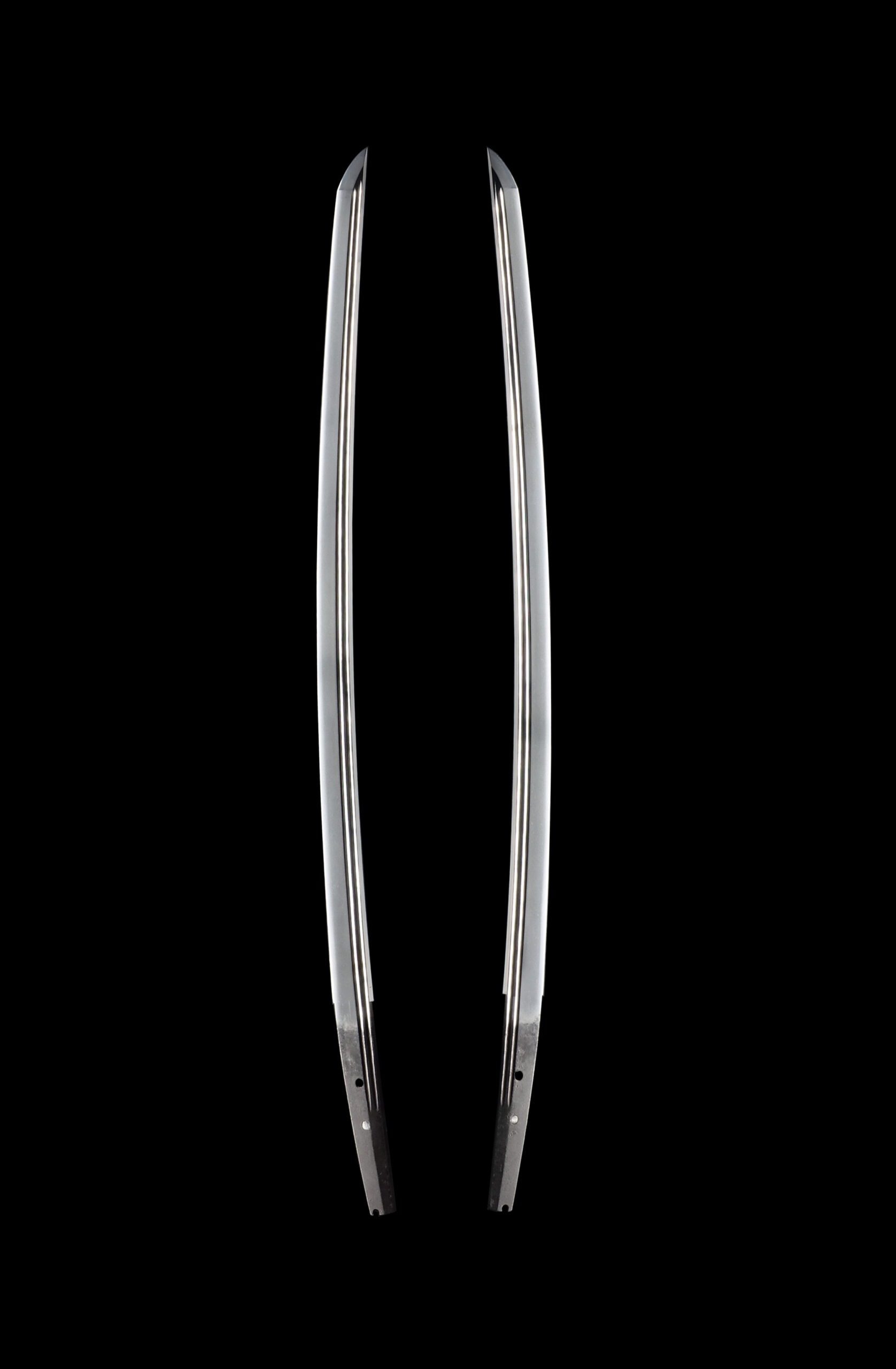
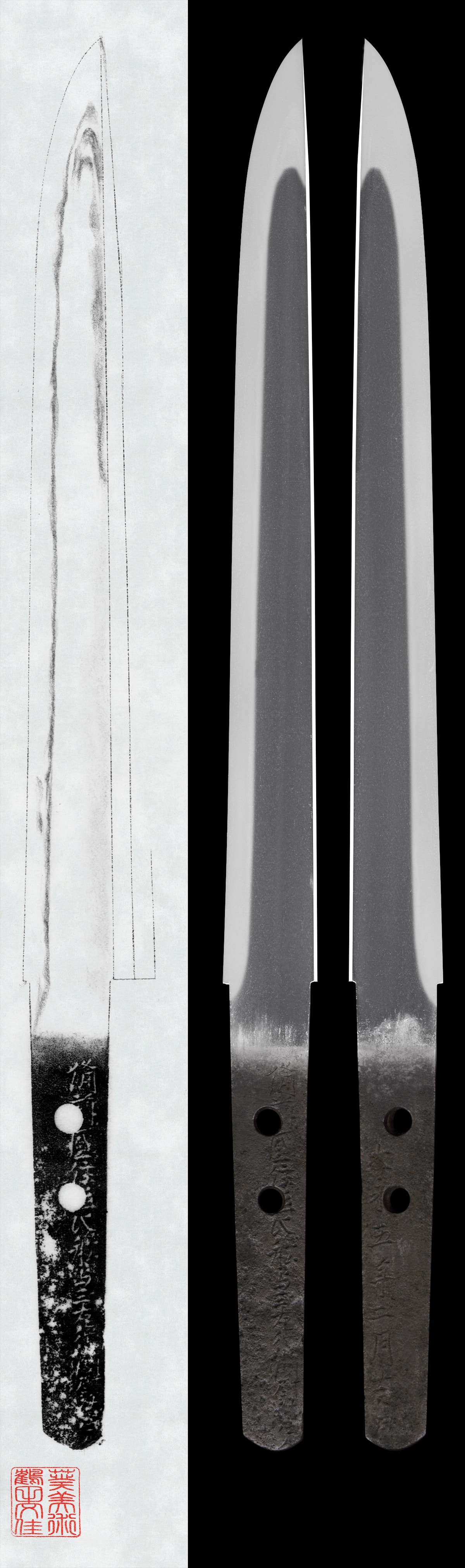
This is a tachi attributed to Yoshioka Ichimonji school of Bizen province, dating back to the Kamakura period. The blade features a bright Choji Midare hamon and a well-grained Ko Itame Hada jigane with defined Utsuri. It is a designated Juyo Token by the NBTHK (41st session) and comes in shirasaya.

NBTHK Setsumei

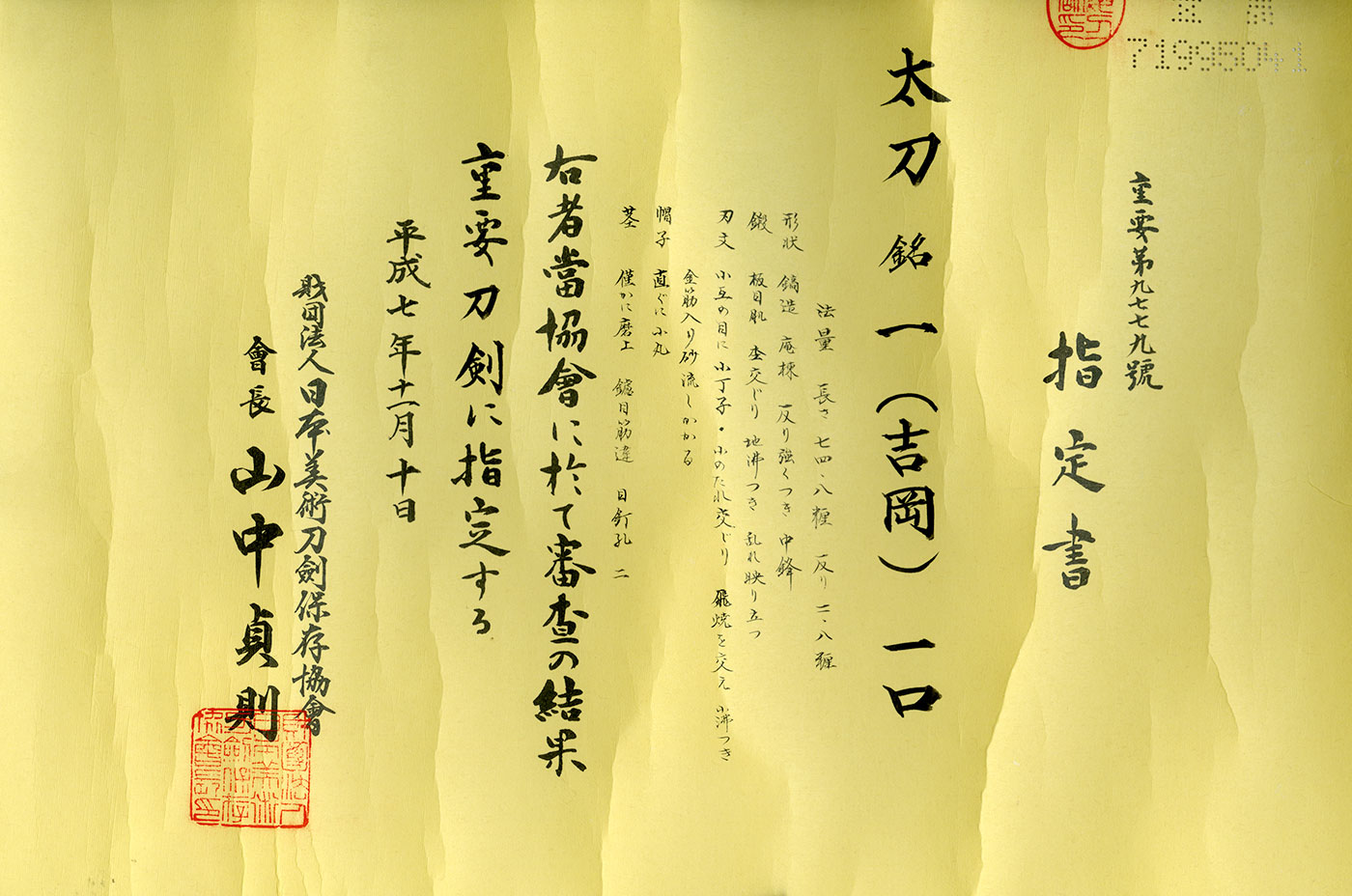
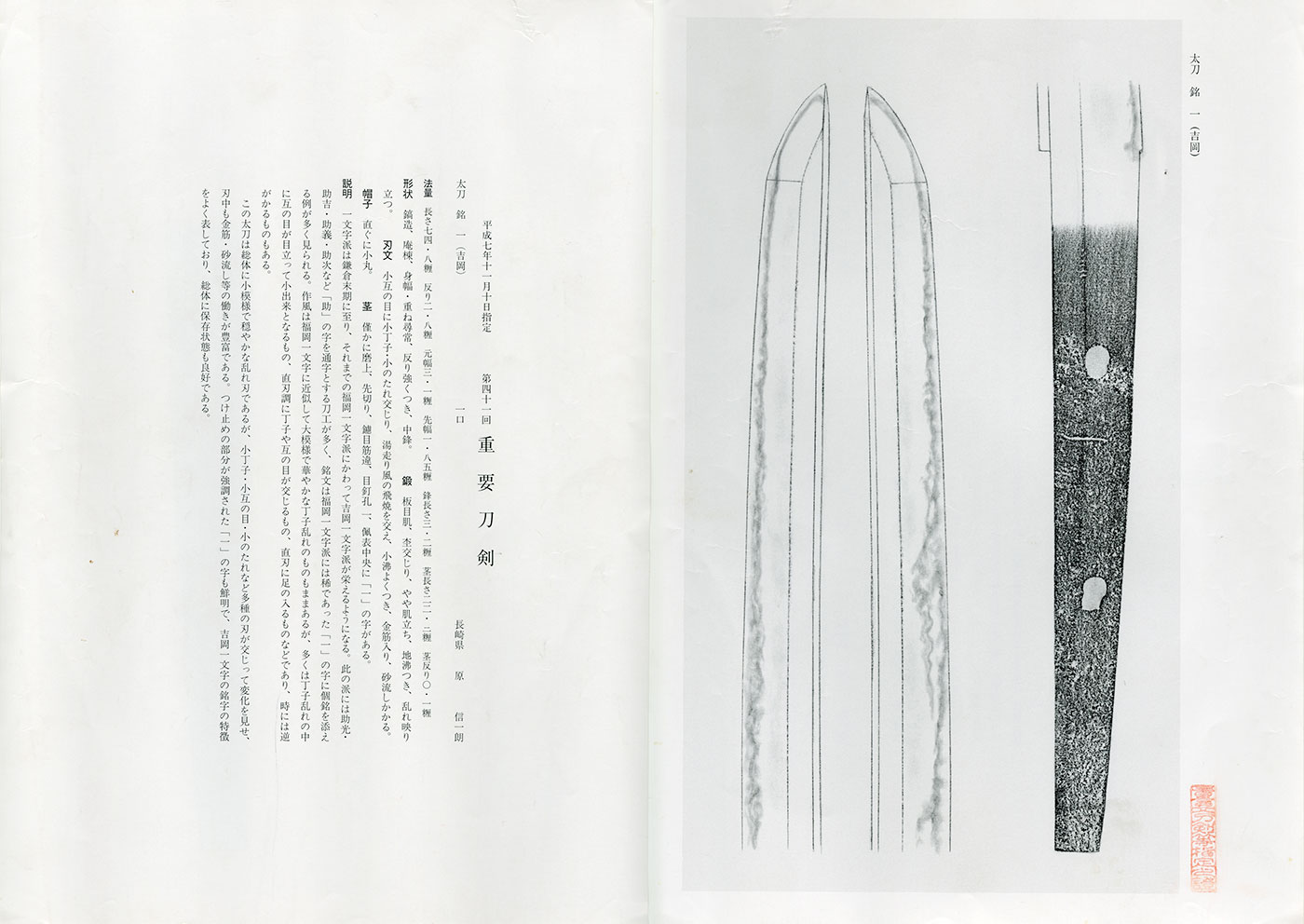
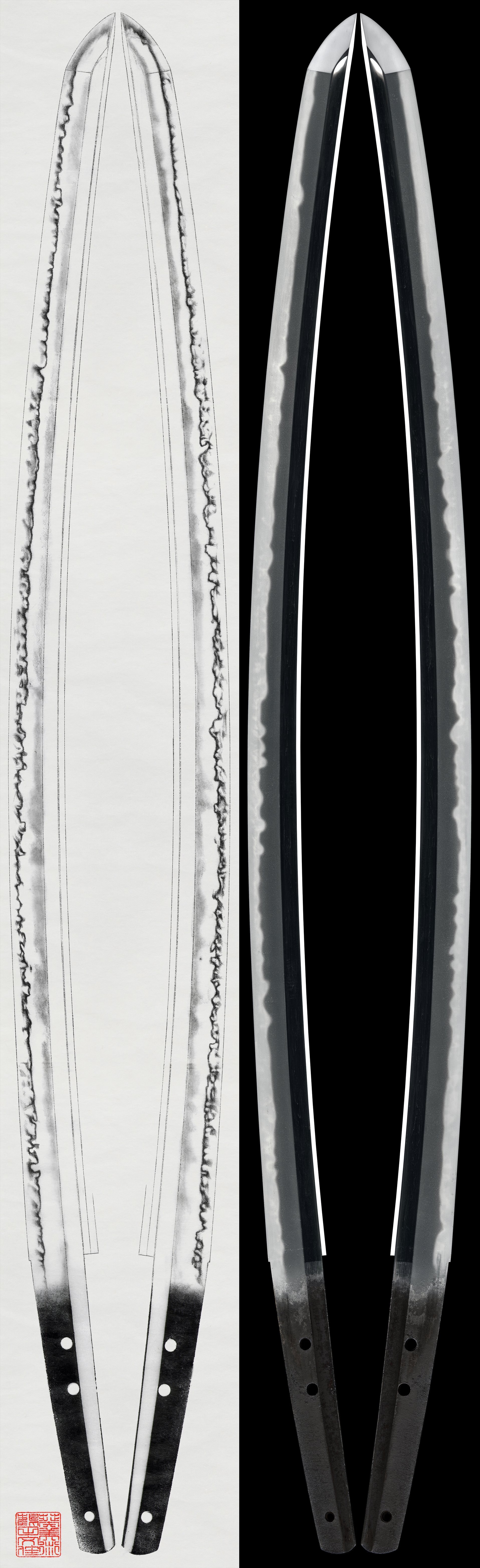
Jūyō-Tōken, 41st Session — Designated November 10, 1995 Tachi, mei: Yoshioka Ichimonji (吉岡一文字) Measurements Nagasa 74.8 cm, sori 2.8 cm, motohaba 3.1 cm, sakihaba 1.85 cm, kissaki-nagasa 3.2 cm, nakago-nagasa 22.3 cm, nakago-sori 0.1 cm Description Keijō: Shinogi-zukuri, iori-mune; mihaba and kasane are standard; the sori is strongly pronounced; chū-kissaki. Kitae: Itame-hada mixed with mokume; somewhat hada-dachi; ji-nie appears; midare-utsuri stands out. Hamon: Ko-gunome mixed with ko-chōji and ko-notare; incorporates tobiyaki suggestive of yubashiri; ko-nie adheres well; kinsuji enters and sunagashi runs through. Bōshi: Straight, forming ko-maru. Horimono: None. Nakago: Slightly shortened (suriage); tip kiri; file marks sujikai; two mekugi-ana; on the tachi omote, at the center, is the character “一”. Artisan Yoshioka Ichimonji (吉岡一文字) Era Late Kamakura period Explanation By the late Kamakura period, the Yoshioka Ichimonji line came to flourish, replacing the earlier Fukuoka Ichimonji line. Within this group there were many smiths who shared the character suke (助) as a common element in their names, such as Sukemitsu, Sukeyoshi, Sukeyoshi (助義), and Suketsugu. In their inscriptions, one often finds examples in which the character “一”—a practice rare among the Fukuoka Ichimonji—is combined with an individual name. In workmanship, they are close to the Fukuoka Ichimonji: there are not infrequently pieces with large-patterned, flamboyant chōji-midare. However, many works are of smaller formation, in which gunome stands out within chōji-midare; or they show a suguha-based flavor with chōji and gunome intermixed; or a straight temper with ashi entering; and at times there are even examples that run into a reverse tendency. This tachi is, in overall impression, a calm midare-ba of small pattern. Yet it displays variety through the mingling of multiple forms—ko-chōji, ko-gunome, ko-notare, and others—and within the temper there is abundant activity such as kinsuji and sunagashi. The character “一” is also sharply cut, with emphasis in the terminating strokes, and it clearly expresses the characteristic manner of the Yoshioka Ichimonji inscription. Overall, the state of preservation is good.

NihontoWatch MonNihontoWatch
MarketEncyclopediaKantei
Swords›Bizen-den›Ichimonji›Yoshioka Ichimonji›Tachi: Ichi (judged as Yoshioka Ichimonji) (NBTHK the 41st Juyo Token)
tachiJūyō
Yoshioka Ichimonji School

Tachi: Ichi (judged as Yoshioka Ichimonji) (NBTHK the 41st Juyo Token)

mei · Yoshioka Ichimonji · Kamakura · nagasa 74.8cm · sori 3.1cm

SOLD
TachiJūyō
Could you name the smith from the blade alone? Today’s kantei →
Yoshioka Ichimonji School — 1 of 7
Yoshioka Ichimonji School — 2 of 7
Yoshioka Ichimonji School — 3 of 7
Yoshioka Ichimonji School — 4 of 7
Yoshioka Ichimonji School — 5 of 7
Yoshioka Ichimonji School — 6 of 7
Yoshioka Ichimonji School — 7 of 7
1 / 7
1 / 7
Yoshioka Ichimonji School — 1 of 7Yoshioka Ichimonji School — 2 of 7Yoshioka Ichimonji School — 3 of 7Yoshioka Ichimonji School — 4 of 7Yoshioka Ichimonji School — 5 of 7Yoshioka Ichimonji School — 6 of 7Yoshioka Ichimonji School — 7 of 7
TachiJūyō
Could you name the smith from the blade alone? Today’s kantei →
Measurements & details
Smith
Yoshioka Ichimonji School
Type
Tachi
School
Yoshioka Ichimonji
Period
Kamakura(Late Kamakura)
Province
Bizen
Signature
Signed(22% of this smith's designated works are signed)
Measurements
Nagasa 74.8cmSori 3.1cmMotohaba 3.04cmSakihaba 1.88cmKasane 0.7cmWeight 785g
Description

This is a tachi attributed to Yoshioka Ichimonji school of Bizen province, dating back to the Kamakura period. The blade features a bright Choji Midare hamon and a well-grained Ko Itame Hada jigane with defined Utsuri. It is a designated Juyo Token by the NBTHK (41st session) and comes in shirasaya.

NBTHK Zufu Commentary

Juyo #41

AI translation — may contain errors

-, 41st Session — Designated November 10, 1995

, : Yoshioka (吉岡一文字)

Measurements 74.8 cm, 2.8 cm, 3.1 cm, 1.85 cm, 3.2 cm, 22.3 cm, 0.1 cm

Description Keijō: , ; and are standard; the is strongly pronounced; . : mixed with ; somewhat ; appears; stands out. : mixed with and ; incorporates suggestive of ; adheres well; enters and runs through. : Straight, forming . : None. : Slightly shortened (); tip ; file marks ; two ; on the , at the center, is the character “一”.

Artisan Yoshioka (吉岡一文字)

Era Late period

Explanation By the late period, the Yoshioka line came to flourish, replacing the earlier Fukuoka line. Within this group there were many smiths who shared the character (助) as a common element in their names, such as Sukemitsu, Sukeyoshi, Sukeyoshi (助義), and Suketsugu. In their inscriptions, one often finds examples in which the character “一”—a practice rare among the Fukuoka —is combined with an individual name.

In workmanship, they are close to the Fukuoka : there are not infrequently pieces with large-patterned, flamboyant . However, many works are of smaller formation, in which stands out within ; or they show a -based flavor with and intermixed; or a straight temper with entering; and at times there are even examples that run into a reverse tendency.

This is, in overall impression, a calm -ba of small pattern. Yet it displays variety through the mingling of multiple forms—, , , and others—and within the temper there is abundant activity such as and . The character “一” is also sharply cut, with emphasis in the terminating strokes, and it clearly expresses the characteristic manner of the Yoshioka inscription. Overall, the state of preservation is good.

About the school

Yoshioka Ichimonji

吉岡一文字

Bizen-den · Bizen

8 pieces on the market now

›

Working at Yoshioka in Bizen Province, this branch of the Ichimonji lineage arose toward the close of the Kamakura period (its dated works begin in the late thirteenth century) and carried the tradition forward into the Nanbokuchō era. It took shape as the successor to the Fukuoka Ichimonji once that earlier group had passed its apex, and the published sources rank it directly behind Fukuoka among the Ichimonji branches in both prosperity and quality. Its representative hands share the suke element in their names, the line led by Sukemitsu, who held the court title Sakon-no-shōgen and signed in full beneath the school's single character ichi (Bizen no Kuni Yoshioka-jū Sakon-no-shōgen Ki-no-Sukemitsu), together with Sukeyoshi, Sukeshige and Suketsugu. Several of these smiths left long signatures incorporating the Yoshioka residence, such as Bishū Yoshioka-jū Saemon-no-jō, and their dated blades run through the Einin, Genkō, Ryakuō, Jōwa (Sadawa) and Shōhei eras, a span reaching to the 1360s. Where Fukuoka built its name on towering, large-pattern chōji-midare, the Yoshioka hand turns to a calmer and more closely worked line, and the Bizen-den it practices is distinctly the more regular of the two. The fundamental Yoshioka manner sets a suguha-toned edge into which ko-chōji and ko-gunome intermingle, the chōji smaller and more subdued, and a marked tendency for gunome to stand out within the midare, at times inclining in reverse (saka-gakari) or compacting (kozumu) toward the monouchi, a leaning toward the Osafune manner of the period.

The ground is a well-forged itame, often tightening into ko-itame and mixed with mokume or nagare, carrying ji-nie and chikei under a clear midare-utsuri that stands across signed and attributed blades alike; the nioiguchi is bright and nioi-dominant with ko-nie, the temper carried in ashi and yō with fine kinsuji and sunagashi, and a bō-hi is commonly carved through. A rarer and more flamboyant face survives in certain works, a high chōji-midare mixing gunome and togariba with fine tobiyaki, which at a glance can be mistaken for Fukuoka; the published commentary holds the school apart from its parent by scale rather than by kind, the typical Yoshioka work being the more modest, gunome-marked line over the bright Yoshioka jigane. To kantei a Yoshioka Ichimonji blade is to read this division: the bright midare-utsuri and the small, gunome-inflected chōji over a refined ko-itame are the school's signature, the temper subdued and regular against Fukuoka's grander clove-flower, with the reverse-slanting and compacted passages serving as recognition points. Among the members Sukemitsu sets the standard, his dated and signed tachi the fixed reference against which the mumei attributions are measured, the published sources appraising his finest den mumei katana a superior work of the school[[c:1]]; Sukeyoshi, Sukeshige and the others fill out the recognized roster, several documented through long signatures and dated inscriptions, with a rare kanmuri-otoshi-zukuri tantō dated Gentoku 3 (1331) attesting to a breadth of form unusual for Bizen of the era. Signed Yoshioka works with reliable inscriptions are few, and dated ubu examples are valued as documentary anchors for the school's chronology; provenance runs through the great houses, with works transmitted via the Maeda of Kaga, the Honami appraisers and institutions such as the Tokugawa Art Museum. A signed Yoshioka Ichimonji blade coming to light remains a landmark, a record of how the Yoshioka kept the Ichimonji manner alive into the close of the Kamakura age and across the Nanbokuchō divide. Learn more →

11 recorded smiths175 designated works
Leading smiths
SmithEraDesignated
Sukemitsu助光1299-13027
Ichi一1288-12933
Sukeyoshi助吉1303-13063
Kageyasu景泰1326-13290
Kagehide景秀1329-13310
Explore the Yoshioka Ichimonji school →

Historical context

Bizen in the Kamakura period

›

Kamakura was Bizen’s summit. Tradition places Ichimonji smiths among Go-Toba’s goban kaji, Mitsutada founded the Osafune line at mid-century, and orders flowed from the court and the warrior government alike. No province holds more National Treasure blades.

Bizen in the Kamakura period →

NBTHK Certificate
Jūyō Tōken重要刀剣
Important Sword
›

A blade of top-grade workmanship and condition, formally judged to rank with a nationally recognized Important Art Object (Jūyō Bijutsuhin). Awarded only at the NBTHK’s competitive annual examination.

Of Japan’s roughly 2.5 million registered swords, only 12,307 (about 1 in 203) have ever attained Jūyō.

About the NBTHK›

The NBTHK (Nihon Bijutsu Tōken Hozon Kyōkai, the Society for the Preservation of Japanese Art Swords) is a public-interest incorporated foundation founded in 1948 and supervised by Japan’s Agency for Cultural Affairs (Bunkachō); it is based at the Japanese Sword Museum in Tokyo. Its expert panels physically examine each submitted work (shinsa) and issue a certificate (kanteishō) ranking it by artistic and historical merit. NBTHK papers are the most widely recognized standard of authentication for Japanese swords and fittings.

NBTHK official site→
Seller
A
Aoi Art
🇯🇵Ships from Japan
›
✓Verified dealeraoijapan.com
✓Ships worldwide✓English supportWire transferPayPalCredit card
Return policy

If you wish to return an item, please notify us within 3 days of receipt. After this period we cannot accept cancellations. Please ship the return to us within 5 business days. Cancellation is conditional on the item being kept in the same condition as at the time of sale, so please handle it with care.

View all of Aoi Art’s listings→View this item on the dealer’s site→

Previously sold — Yoshioka Ichimonji School

View all →
Aoi Art
Tokuho
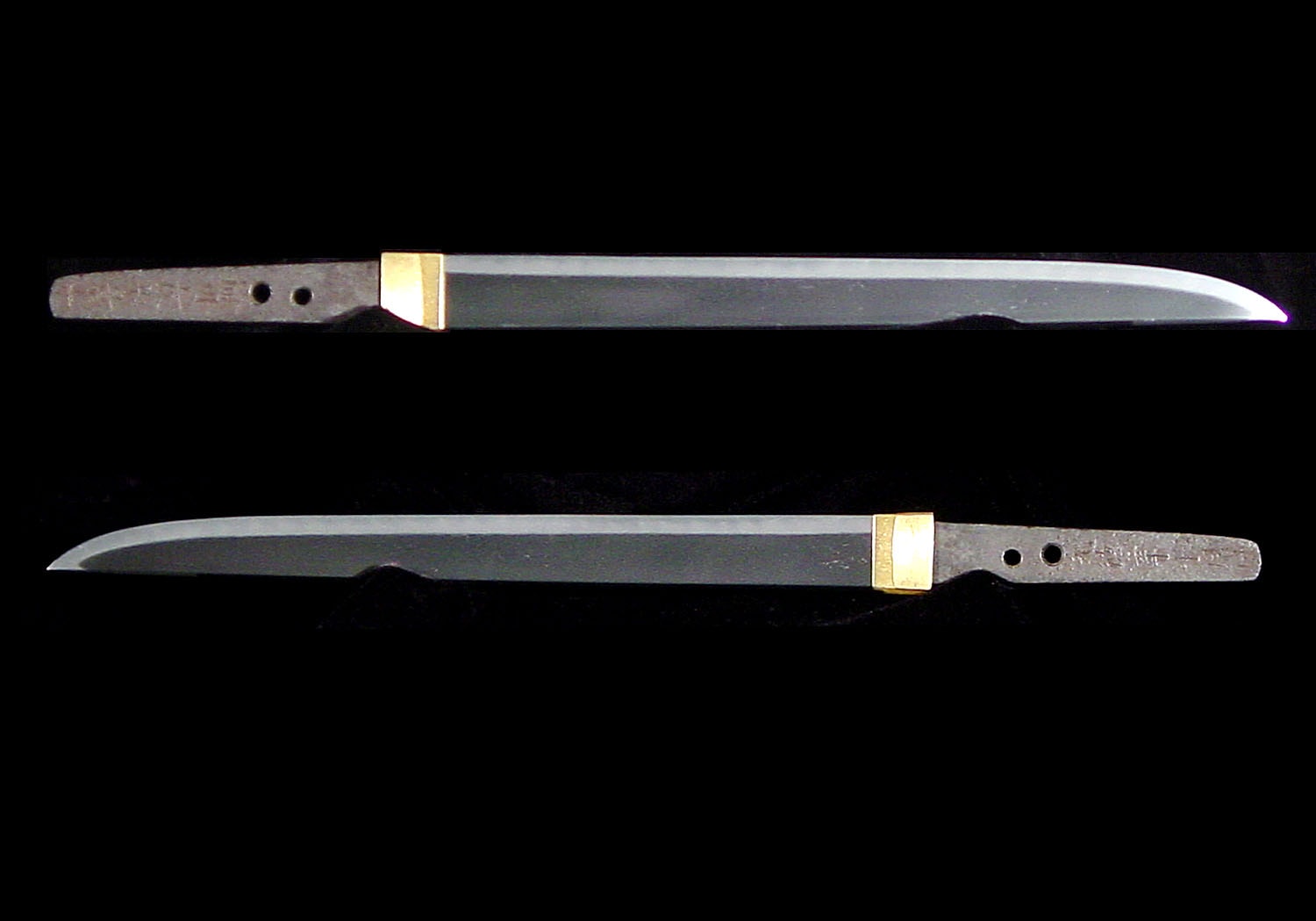
Wakizashi - Tokuho - by Yoshioka Ichimonji School - Mumei (Yoshioka Ichimonji) - NBTHK Tokubetsu Hozon TokenWakizashi - Tokuho - by Yoshioka Ichimonji School - Mumei (Yoshioka Ichimonji) - NBTHK Tokubetsu Hozon Token
Sold

Wakizashi

ByYoshioka Ichimonji School
SOLD
Eirakudo
Jūyō Bijutsuhin
Katana - Jubi - by Yoshioka Ichimonji School - Yoshioka Ichimonji Katana Juyo BijutsuhinKatana - Jubi - by Yoshioka Ichimonji School - Yoshioka Ichimonji Katana Juyo Bijutsuhin
Sold

Katana

ByYoshioka Ichimonji School
SOLD
Eirakudo
Tokuho
Tachi - Tokuho - by Yoshioka Ichimonji School - Yoshioka Ichimonji Tachi - Tokubetsu Hozon TokenTachi - Tokuho - by Yoshioka Ichimonji School - Yoshioka Ichimonji Tachi - Tokubetsu Hozon Token
Sold

Tachi

ByYoshioka Ichimonji School
SOLD
Nihonto US
Jūyō
Katana - Jūyō - by Yoshioka Ichimonji School - Yoshioka Ichimonji - JuyoKatana - Jūyō - by Yoshioka Ichimonji School - Yoshioka Ichimonji - Juyo
Sold

Katana

ByYoshioka Ichimonji School
SOLD
Nihonto US
Jūyō
Katana - Jūyō - by Yoshioka Ichimonji School - Yoshioka Ichimonji - Juyo #49Katana - Jūyō - by Yoshioka Ichimonji School - Yoshioka Ichimonji - Juyo #49
Sold

Katana

ByYoshioka Ichimonji School
SOLD
Samurai Museum
NTHK
Tachi - NTHK - by Yoshioka Ichimonji School - Antique Japanese Sword Tachi: Unsigned Ichimonji Sukekane with NTHK Kanteisho CertificateTachi - NTHK - by Yoshioka Ichimonji School - Antique Japanese Sword Tachi: Unsigned Ichimonji Sukekane with NTHK Kanteisho Certificate
Sold

Tachi

ByYoshioka Ichimonji School
SOLD
Shoubudou
Jūyō
Katana - Jūyō - by Yoshioka Ichimonji School - Mumei Yoshioka IchimonjiKatana - Jūyō - by Yoshioka Ichimonji School - Mumei Yoshioka Ichimonji
Sold

Katana

ByYoshioka Ichimonji School
SOLD
Eirakudo
Tokuho
Katana - Tokuho - by Yoshioka Ichimonji School - Yoshioka Ichimonji Katana Tokubetsu Hozon TokenKatana - Tokuho - by Yoshioka Ichimonji School - Yoshioka Ichimonji Katana Tokubetsu Hozon Token
Sold

Katana

ByYoshioka Ichimonji School
SOLD

More from the Yoshioka Ichimonji school

View all →
Eirakudo
Jūyō
Tachi - Jūyō - by Yoshioka Ichimonji School - Yoshioka Ichimonji Tachi Juyo TokenTachi - Jūyō - by Yoshioka Ichimonji School - Yoshioka Ichimonji Tachi Juyo Token

Tachi

ByYoshioka Ichimonji School
Ask
Eirakudo
Tokuho
Tachi - Tokuho - by Yoshioka Ichimonji Sukemitsu - Ko-Bizen Sukemitsu Signed Tachi - Tokubetsu Hozon TokenTachi - Tokuho - by Yoshioka Ichimonji Sukemitsu - Ko-Bizen Sukemitsu Signed Tachi - Tokubetsu Hozon Token

Tachi

ByYoshioka Ichimonji Sukemitsu
¥3,900,000
Aoi Art
Jūyō
Katana - Jūyō - by Yoshioka Ichimonji Sukemitsu - Ichi Bizen-koku Yoshioka Sakon Sho SukemitsuKatana - Jūyō - by Yoshioka Ichimonji Sukemitsu - Ichi Bizen-koku Yoshioka Sakon Sho Sukemitsu

Katana

ByYoshioka Ichimonji Sukemitsu
¥9,500,000
Yazawa Shokai
Hozon
Tanto - Hozon - by Yoshioka Ichimonji Suketsugu - Mitsumune (Shin no Mune) - Bottom Mei Suketsugu - Hozon - In Shirasaya - Nagasa 25.6cm - Sori 0cmTanto - Hozon - by Yoshioka Ichimonji Suketsugu - Mitsumune (Shin no Mune) - Bottom Mei Suketsugu - Hozon - In Shirasaya - Nagasa 25.6cm - Sori 0cm

Tantō

ByYoshioka Ichimonji Suketsugu
¥135,000
Wakeidou
Jūyō
Wakizashi - Jūyō - by Yoshioka Ichimonji School - Mumei Yoshioka IchimonjiWakizashi - Jūyō - by Yoshioka Ichimonji School - Mumei Yoshioka Ichimonji

Wakizashi

ByYoshioka Ichimonji School
¥4,500,000
Nakano Kosen
Katana - by Yoshioka Ichimonji Suketsugu - SuketsuguKatana - by Yoshioka Ichimonji Suketsugu - Suketsugu

Katana

ByYoshioka Ichimonji Suketsugu
¥920,000
Nihonto Australia
Tokuho
Tachi - Tokuho - by Yoshioka Ichimonji Ietsugu - Bizen IetsuguTachi - Tokuho - by Yoshioka Ichimonji Ietsugu - Bizen Ietsugu

Tachi

ByYoshioka Ichimonji Ietsugu
Ask
Katana Ando
短刀Photos not published
Tanto - by Yoshioka Ichimonji School - Tanto Bishu Yoshioka Sukemitsu

Tantō

ByYoshioka Ichimonji School
Ask

More from the Ichimonji school

View all →
Tsuruginoya
Jūyō
Katana - Jūyō - by Fukuoka Ichimonji School - Mumei Fukuoka IchimonjiKatana - Jūyō - by Fukuoka Ichimonji School - Mumei Fukuoka Ichimonji

Katana

ByFukuoka Ichimonji School
Ask
Hyozaemon
Tokuho
Tokuho - by Fukuoka Ichimonji Yoshifusa - Naginata Naoshi Wakizashi by Fukuoka Ichimonji Yoshifusa, a Master of IchimonjiTokuho - by Fukuoka Ichimonji Yoshifusa - Naginata Naoshi Wakizashi by Fukuoka Ichimonji Yoshifusa, a Master of Ichimonji

Naginata Naoshi Wakizashi by Fukuoka Ichimonji Yoshifusa, a Master of Ichimonji

ByFukuoka Ichimonji Yoshifusa
Ask
Eirakudo
Tokuho
Katana - Tokuho - by Katayama Ichimonji School - Katayama Ichimonji - Tokubetsu Hozon TokenKatana - Tokuho - by Katayama Ichimonji School - Katayama Ichimonji - Tokubetsu Hozon Token

Katana

ByKatayama Ichimonji School
¥4,500,000
Toushin
Katana - by Ichimonji School - Mumei (Hatakeda Mitsumori) (Bizen no kuni Yoshioka Ichimonji Sukemitsu)Katana - by Ichimonji School - Mumei (Hatakeda Mitsumori) (Bizen no kuni Yoshioka Ichimonji Sukemitsu)

Katana

ByIchimonji School
¥1,210,000
Eirakudo
Tokuho
Wakizashi - Tokuho - by Ichimonji School - Fukuoka Ichimonji Wakizashi Tokubetsu Hozon TokenWakizashi - Tokuho - by Ichimonji School - Fukuoka Ichimonji Wakizashi Tokubetsu Hozon Token

Wakizashi

ByIchimonji School
¥3,500,000
Samurai Nippon
Tokuho
Wakizashi - Tokuho - by Iwato Ichimonji School - Iwato Ichimonji (Unsigned)Wakizashi - Tokuho - by Iwato Ichimonji School - Iwato Ichimonji (Unsigned)

Wakizashi

ByIwato Ichimonji School
¥1,200,000
Kanda Toukodo
Jūyō
Katana - Jūyō - by Ichimonji School - Juyo Token (25th Session)Katana - Jūyō - by Ichimonji School - Juyo Token (25th Session)

Katana

ByIchimonji School
Ask
Eirakudo
Tokuho
Katana - Tokuho - by Katayama Ichimonji School - Katayama Ichimonji - Tokubetsu Hozon TokenKatana - Tokuho - by Katayama Ichimonji School - Katayama Ichimonji - Tokubetsu Hozon Token

Katana

ByKatayama Ichimonji School
¥4,000,000

More from the Bizen tradition

View all →
Aoi Art
Jūyō Bijutsuhin
Daisho - Jubi - by Osafune Nagamitsu - Dai Sho: Katana (Important Art Object): Mumei (Attributed to Nagamitsu) / Wakizashi: Mumei (Attributed to Sekishu Naotsuna)Daisho - Jubi - by Osafune Nagamitsu - Dai Sho: Katana (Important Art Object): Mumei (Attributed to Nagamitsu) / Wakizashi: Mumei (Attributed to Sekishu Naotsuna)

Daishō

ByOsafune Nagamitsu
Ask
Nihonto.com
Jūyō
Tanto - Jūyō - by Osafune Kagemitsu - Juyo Tanto by Bizen KagemitsuTanto - Jūyō - by Osafune Kagemitsu - Juyo Tanto by Bizen Kagemitsu

Tantō

ByOsafune Kagemitsu
¥89,500
Touken Matsumoto
Hozon
Wakizashi - Hozon - by Sukesada School - Bishu Osafune Sukesada, Eisho Juninen NigatsujitsuWakizashi - Hozon - by Sukesada School - Bishu Osafune Sukesada, Eisho Juninen Nigatsujitsu

Wakizashi

BySukesada School
¥650,000
Eirakudo
Jūyō
Katana - Jūyō - by Motoshige - Motoshige - Juyo TokenKatana - Jūyō - by Motoshige - Motoshige - Juyo Token

Katana

ByMotoshige
¥6,000,000
Samurai Museum
Katana - by Osafune Kanemitsu - Antique Japanese Sword Katana Attributed to Den Osafune Kanemitsu NTHK Yushu Saku Kanteisho CertificateKatana - by Osafune Kanemitsu - Antique Japanese Sword Katana Attributed to Den Osafune Kanemitsu NTHK Yushu Saku Kanteisho Certificate

Katana

ByOsafune Kanemitsu
¥27,856
Eirakudo
Jūyō
Katana - Jūyō - by Omiya Morikage - Ohmiya Morikage - Juyo TokenKatana - Jūyō - by Omiya Morikage - Ohmiya Morikage - Juyo Token

Katana

ByOmiya Morikage
¥4,000,000
Samurai Museum
Tokuho
Wakizashi - Tokuho - by Osafune Kagemitsu - Antique Japanese Sword Wakizashi Attributed to Den Osafune Kagemitsu NBTHK Tokubetsu Hozon CertificateWakizashi - Tokuho - by Osafune Kagemitsu - Antique Japanese Sword Wakizashi Attributed to Den Osafune Kagemitsu NBTHK Tokubetsu Hozon Certificate

Wakizashi

ByOsafune Kagemitsu
¥20,730
Aoi Art
Tokuho
Tanto - Tokuho - by Sukesada - Bizen Kuni Ju Osafune Yozaemon-no-jo Sukesada Dated: A lucky day in the second month of Daiei 5 (1525)Tanto - Tokuho - by Sukesada - Bizen Kuni Ju Osafune Yozaemon-no-jo Sukesada Dated: A lucky day in the second month of Daiei 5 (1525)

Tantō

BySukesada
Starting Bid¥1,850,000

Swords

  • Katana
  • Wakizashi
  • Tantō
  • Tachi
  • Naginata
  • Yari
  • Japanese Swords
  • Samurai Swords

Fittings

  • Tsuba
  • Fuchi-Kashira
  • Kozuka
  • Menuki
  • Sword Guards (Tsuba)

Armor

  • Kabuto
  • Samurai Armor
  • All Samurai Armor

By Certification

  • Tokujū
  • Jūyō
  • Tokuho
  • Hozon

Resources

  • Dealer Directory
  • Artist Directory
  • The Daily Kantei
  • Glossary
  • Browse All
Nihontowatch© 2026
TermsPrivacyCookiesAbout
Sold

Description

This is a tachi attributed to Yoshioka Ichimonji school of Bizen province, dating back to the Kamakura period. The blade features a bright Choji Midare hamon and a well-grained Ko Itame Hada jigane with defined Utsuri. It is a designated Juyo Token by the NBTHK (41st session) and comes in shirasaya.

NBTHK Setsumei

Jūyō-Tōken, 41st Session — Designated November 10, 1995 Tachi, mei: Yoshioka Ichimonji (吉岡一文字) Measurements Nagasa 74.8 cm, sori 2.8 cm, motohaba 3.1 cm, sakihaba 1.85 cm, kissaki-nagasa 3.2 cm, nakago-nagasa 22.3 cm, nakago-sori 0.1 cm Description Keijō: Shinogi-zukuri, iori-mune; mihaba and kasane are standard; the sori is strongly pronounced; chū-kissaki. Kitae: Itame-hada mixed with mokume; somewhat hada-dachi; ji-nie appears; midare-utsuri stands out. Hamon: Ko-gunome mixed with ko-chōji and ko-notare; incorporates tobiyaki suggestive of yubashiri; ko-nie adheres well; kinsuji enters and sunagashi runs through. Bōshi: Straight, forming ko-maru. Horimono: None. Nakago: Slightly shortened (suriage); tip kiri; file marks sujikai; two mekugi-ana; on the tachi omote, at the center, is the character “一”. Artisan Yoshioka Ichimonji (吉岡一文字) Era Late Kamakura period Explanation By the late Kamakura period, the Yoshioka Ichimonji line came to flourish, replacing the earlier Fukuoka Ichimonji line. Within this group there were many smiths who shared the character suke (助) as a common element in their names, such as Sukemitsu, Sukeyoshi, Sukeyoshi (助義), and Suketsugu. In their inscriptions, one often finds examples in which the character “一”—a practice rare among the Fukuoka Ichimonji—is combined with an individual name. In workmanship, they are close to the Fukuoka Ichimonji: there are not infrequently pieces with large-patterned, flamboyant chōji-midare. However, many works are of smaller formation, in which gunome stands out within chōji-midare; or they show a suguha-based flavor with chōji and gunome intermixed; or a straight temper with ashi entering; and at times there are even examples that run into a reverse tendency. This tachi is, in overall impression, a calm midare-ba of small pattern. Yet it displays variety through the mingling of multiple forms—ko-chōji, ko-gunome, ko-notare, and others—and within the temper there is abundant activity such as kinsuji and sunagashi. The character “一” is also sharply cut, with emphasis in the terminating strokes, and it clearly expresses the characteristic manner of the Yoshioka Ichimonji inscription. Overall, the state of preservation is good.

NihontoWatch MonNihontoWatch
MarketEncyclopediaKantei
Swords›Bizen-den›Ichimonji›Yoshioka Ichimonji›Tachi: Ichi (judged as Yoshioka Ichimonji) (NBTHK the 41st Juyo Token)
tachiJūyō
Yoshioka Ichimonji School

Tachi: Ichi (judged as Yoshioka Ichimonji) (NBTHK the 41st Juyo Token)

mei · Yoshioka Ichimonji · Kamakura · nagasa 74.8cm · sori 3.1cm

SOLD
TachiJūyō
Could you name the smith from the blade alone? Today’s kantei →
Yoshioka Ichimonji School — 1 of 7
Yoshioka Ichimonji School — 2 of 7
Yoshioka Ichimonji School — 3 of 7
Yoshioka Ichimonji School — 4 of 7
Yoshioka Ichimonji School — 5 of 7
Yoshioka Ichimonji School — 6 of 7
Yoshioka Ichimonji School — 7 of 7
1 / 7
1 / 7
Yoshioka Ichimonji School — 1 of 7Yoshioka Ichimonji School — 2 of 7Yoshioka Ichimonji School — 3 of 7Yoshioka Ichimonji School — 4 of 7Yoshioka Ichimonji School — 5 of 7Yoshioka Ichimonji School — 6 of 7Yoshioka Ichimonji School — 7 of 7
TachiJūyō
Could you name the smith from the blade alone? Today’s kantei →
Measurements & details
Smith
Yoshioka Ichimonji School
Type
Tachi
School
Yoshioka Ichimonji
Period
Kamakura(Late Kamakura)
Province
Bizen
Signature
Signed(22% of this smith's designated works are signed)
Measurements
Nagasa 74.8cmSori 3.1cmMotohaba 3.04cmSakihaba 1.88cmKasane 0.7cmWeight 785g
Description

This is a tachi attributed to Yoshioka Ichimonji school of Bizen province, dating back to the Kamakura period. The blade features a bright Choji Midare hamon and a well-grained Ko Itame Hada jigane with defined Utsuri. It is a designated Juyo Token by the NBTHK (41st session) and comes in shirasaya.

NBTHK Zufu Commentary

Juyo #41

AI translation — may contain errors

-, 41st Session — Designated November 10, 1995

, : Yoshioka (吉岡一文字)

Measurements 74.8 cm, 2.8 cm, 3.1 cm, 1.85 cm, 3.2 cm, 22.3 cm, 0.1 cm

Description Keijō: , ; and are standard; the is strongly pronounced; . : mixed with ; somewhat ; appears; stands out. : mixed with and ; incorporates suggestive of ; adheres well; enters and runs through. : Straight, forming . : None. : Slightly shortened (); tip ; file marks ; two ; on the , at the center, is the character “一”.

Artisan Yoshioka (吉岡一文字)

Era Late period

Explanation By the late period, the Yoshioka line came to flourish, replacing the earlier Fukuoka line. Within this group there were many smiths who shared the character (助) as a common element in their names, such as Sukemitsu, Sukeyoshi, Sukeyoshi (助義), and Suketsugu. In their inscriptions, one often finds examples in which the character “一”—a practice rare among the Fukuoka —is combined with an individual name.

In workmanship, they are close to the Fukuoka : there are not infrequently pieces with large-patterned, flamboyant . However, many works are of smaller formation, in which stands out within ; or they show a -based flavor with and intermixed; or a straight temper with entering; and at times there are even examples that run into a reverse tendency.

This is, in overall impression, a calm -ba of small pattern. Yet it displays variety through the mingling of multiple forms—, , , and others—and within the temper there is abundant activity such as and . The character “一” is also sharply cut, with emphasis in the terminating strokes, and it clearly expresses the characteristic manner of the Yoshioka inscription. Overall, the state of preservation is good.

About the school

Yoshioka Ichimonji

吉岡一文字

Bizen-den · Bizen

8 pieces on the market now

›

Working at Yoshioka in Bizen Province, this branch of the Ichimonji lineage arose toward the close of the Kamakura period (its dated works begin in the late thirteenth century) and carried the tradition forward into the Nanbokuchō era. It took shape as the successor to the Fukuoka Ichimonji once that earlier group had passed its apex, and the published sources rank it directly behind Fukuoka among the Ichimonji branches in both prosperity and quality. Its representative hands share the suke element in their names, the line led by Sukemitsu, who held the court title Sakon-no-shōgen and signed in full beneath the school's single character ichi (Bizen no Kuni Yoshioka-jū Sakon-no-shōgen Ki-no-Sukemitsu), together with Sukeyoshi, Sukeshige and Suketsugu. Several of these smiths left long signatures incorporating the Yoshioka residence, such as Bishū Yoshioka-jū Saemon-no-jō, and their dated blades run through the Einin, Genkō, Ryakuō, Jōwa (Sadawa) and Shōhei eras, a span reaching to the 1360s. Where Fukuoka built its name on towering, large-pattern chōji-midare, the Yoshioka hand turns to a calmer and more closely worked line, and the Bizen-den it practices is distinctly the more regular of the two. The fundamental Yoshioka manner sets a suguha-toned edge into which ko-chōji and ko-gunome intermingle, the chōji smaller and more subdued, and a marked tendency for gunome to stand out within the midare, at times inclining in reverse (saka-gakari) or compacting (kozumu) toward the monouchi, a leaning toward the Osafune manner of the period.

The ground is a well-forged itame, often tightening into ko-itame and mixed with mokume or nagare, carrying ji-nie and chikei under a clear midare-utsuri that stands across signed and attributed blades alike; the nioiguchi is bright and nioi-dominant with ko-nie, the temper carried in ashi and yō with fine kinsuji and sunagashi, and a bō-hi is commonly carved through. A rarer and more flamboyant face survives in certain works, a high chōji-midare mixing gunome and togariba with fine tobiyaki, which at a glance can be mistaken for Fukuoka; the published commentary holds the school apart from its parent by scale rather than by kind, the typical Yoshioka work being the more modest, gunome-marked line over the bright Yoshioka jigane. To kantei a Yoshioka Ichimonji blade is to read this division: the bright midare-utsuri and the small, gunome-inflected chōji over a refined ko-itame are the school's signature, the temper subdued and regular against Fukuoka's grander clove-flower, with the reverse-slanting and compacted passages serving as recognition points. Among the members Sukemitsu sets the standard, his dated and signed tachi the fixed reference against which the mumei attributions are measured, the published sources appraising his finest den mumei katana a superior work of the school[[c:1]]; Sukeyoshi, Sukeshige and the others fill out the recognized roster, several documented through long signatures and dated inscriptions, with a rare kanmuri-otoshi-zukuri tantō dated Gentoku 3 (1331) attesting to a breadth of form unusual for Bizen of the era. Signed Yoshioka works with reliable inscriptions are few, and dated ubu examples are valued as documentary anchors for the school's chronology; provenance runs through the great houses, with works transmitted via the Maeda of Kaga, the Honami appraisers and institutions such as the Tokugawa Art Museum. A signed Yoshioka Ichimonji blade coming to light remains a landmark, a record of how the Yoshioka kept the Ichimonji manner alive into the close of the Kamakura age and across the Nanbokuchō divide. Learn more →
11 recorded smiths175 designated works
Leading smiths
SmithEraDesignated
Sukemitsu助光1299-13027
Ichi一1288-12933
Sukeyoshi助吉1303-13063
Kageyasu景泰1326-13290
Kagehide景秀1329-13310
Explore the Yoshioka Ichimonji school →
Historical context

Bizen in the Kamakura period

›

Kamakura was Bizen’s summit. Tradition places Ichimonji smiths among Go-Toba’s goban kaji, Mitsutada founded the Osafune line at mid-century, and orders flowed from the court and the warrior government alike. No province holds more National Treasure blades.

Bizen in the Kamakura period →
NBTHK Certificate
Jūyō Tōken重要刀剣
Important Sword
›

A blade of top-grade workmanship and condition, formally judged to rank with a nationally recognized Important Art Object (Jūyō Bijutsuhin). Awarded only at the NBTHK’s competitive annual examination.

Of Japan’s roughly 2.5 million registered swords, only 12,307 (about 1 in 203) have ever attained Jūyō.

About the NBTHK›

The NBTHK (Nihon Bijutsu Tōken Hozon Kyōkai, the Society for the Preservation of Japanese Art Swords) is a public-interest incorporated foundation founded in 1948 and supervised by Japan’s Agency for Cultural Affairs (Bunkachō); it is based at the Japanese Sword Museum in Tokyo. Its expert panels physically examine each submitted work (shinsa) and issue a certificate (kanteishō) ranking it by artistic and historical merit. NBTHK papers are the most widely recognized standard of authentication for Japanese swords and fittings.

NBTHK official site→
Seller
A
Aoi Art
🇯🇵Ships from Japan
›
✓Verified dealeraoijapan.com
✓Ships worldwide✓English supportWire transferPayPalCredit card
Return policy

If you wish to return an item, please notify us within 3 days of receipt. After this period we cannot accept cancellations. Please ship the return to us within 5 business days. Cancellation is conditional on the item being kept in the same condition as at the time of sale, so please handle it with care.

View all of Aoi Art’s listings→View this item on the dealer’s site→

Previously sold — Yoshioka Ichimonji School

View all →
Aoi Art
Tokuho
Wakizashi - Tokuho - by Yoshioka Ichimonji School - Mumei (Yoshioka Ichimonji) - NBTHK Tokubetsu Hozon TokenWakizashi - Tokuho - by Yoshioka Ichimonji School - Mumei (Yoshioka Ichimonji) - NBTHK Tokubetsu Hozon Token
Sold

Wakizashi

ByYoshioka Ichimonji School
SOLD
Eirakudo
Jūyō Bijutsuhin
Katana - Jubi - by Yoshioka Ichimonji School - Yoshioka Ichimonji Katana Juyo BijutsuhinKatana - Jubi - by Yoshioka Ichimonji School - Yoshioka Ichimonji Katana Juyo Bijutsuhin
Sold

Katana

ByYoshioka Ichimonji School
SOLD
Eirakudo
Tokuho
Tachi - Tokuho - by Yoshioka Ichimonji School - Yoshioka Ichimonji Tachi - Tokubetsu Hozon TokenTachi - Tokuho - by Yoshioka Ichimonji School - Yoshioka Ichimonji Tachi - Tokubetsu Hozon Token
Sold

Tachi

ByYoshioka Ichimonji School
SOLD
Nihonto US
Jūyō
Katana - Jūyō - by Yoshioka Ichimonji School - Yoshioka Ichimonji - JuyoKatana - Jūyō - by Yoshioka Ichimonji School - Yoshioka Ichimonji - Juyo
Sold

Katana

ByYoshioka Ichimonji School
SOLD
Nihonto US
Jūyō
Katana - Jūyō - by Yoshioka Ichimonji School - Yoshioka Ichimonji - Juyo #49Katana - Jūyō - by Yoshioka Ichimonji School - Yoshioka Ichimonji - Juyo #49
Sold

Katana

ByYoshioka Ichimonji School
SOLD
Samurai Museum
NTHK
Tachi - NTHK - by Yoshioka Ichimonji School - Antique Japanese Sword Tachi: Unsigned Ichimonji Sukekane with NTHK Kanteisho CertificateTachi - NTHK - by Yoshioka Ichimonji School - Antique Japanese Sword Tachi: Unsigned Ichimonji Sukekane with NTHK Kanteisho Certificate
Sold

Tachi

ByYoshioka Ichimonji School
SOLD
Shoubudou
Jūyō
Katana - Jūyō - by Yoshioka Ichimonji School - Mumei Yoshioka IchimonjiKatana - Jūyō - by Yoshioka Ichimonji School - Mumei Yoshioka Ichimonji
Sold

Katana

ByYoshioka Ichimonji School
SOLD
Eirakudo
Tokuho
Katana - Tokuho - by Yoshioka Ichimonji School - Yoshioka Ichimonji Katana Tokubetsu Hozon TokenKatana - Tokuho - by Yoshioka Ichimonji School - Yoshioka Ichimonji Katana Tokubetsu Hozon Token
Sold

Katana

ByYoshioka Ichimonji School
SOLD

More from the Yoshioka Ichimonji school

View all →
Eirakudo
Jūyō
Tachi - Jūyō - by Yoshioka Ichimonji School - Yoshioka Ichimonji Tachi Juyo TokenTachi - Jūyō - by Yoshioka Ichimonji School - Yoshioka Ichimonji Tachi Juyo Token

Tachi

ByYoshioka Ichimonji School
Ask
Eirakudo
Tokuho
Tachi - Tokuho - by Yoshioka Ichimonji Sukemitsu - Ko-Bizen Sukemitsu Signed Tachi - Tokubetsu Hozon TokenTachi - Tokuho - by Yoshioka Ichimonji Sukemitsu - Ko-Bizen Sukemitsu Signed Tachi - Tokubetsu Hozon Token

Tachi

ByYoshioka Ichimonji Sukemitsu
¥3,900,000
Aoi Art
Jūyō
Katana - Jūyō - by Yoshioka Ichimonji Sukemitsu - Ichi Bizen-koku Yoshioka Sakon Sho SukemitsuKatana - Jūyō - by Yoshioka Ichimonji Sukemitsu - Ichi Bizen-koku Yoshioka Sakon Sho Sukemitsu

Katana

ByYoshioka Ichimonji Sukemitsu
¥9,500,000
Yazawa Shokai
Hozon
Tanto - Hozon - by Yoshioka Ichimonji Suketsugu - Mitsumune (Shin no Mune) - Bottom Mei Suketsugu - Hozon - In Shirasaya - Nagasa 25.6cm - Sori 0cmTanto - Hozon - by Yoshioka Ichimonji Suketsugu - Mitsumune (Shin no Mune) - Bottom Mei Suketsugu - Hozon - In Shirasaya - Nagasa 25.6cm - Sori 0cm

Tantō

ByYoshioka Ichimonji Suketsugu
¥135,000
Wakeidou
Jūyō
Wakizashi - Jūyō - by Yoshioka Ichimonji School - Mumei Yoshioka IchimonjiWakizashi - Jūyō - by Yoshioka Ichimonji School - Mumei Yoshioka Ichimonji

Wakizashi

ByYoshioka Ichimonji School
¥4,500,000
Nakano Kosen
Katana - by Yoshioka Ichimonji Suketsugu - SuketsuguKatana - by Yoshioka Ichimonji Suketsugu - Suketsugu

Katana

ByYoshioka Ichimonji Suketsugu
¥920,000
Nihonto Australia
Tokuho
Tachi - Tokuho - by Yoshioka Ichimonji Ietsugu - Bizen IetsuguTachi - Tokuho - by Yoshioka Ichimonji Ietsugu - Bizen Ietsugu

Tachi

ByYoshioka Ichimonji Ietsugu
Ask
Katana Ando
短刀Photos not published
Tanto - by Yoshioka Ichimonji School - Tanto Bishu Yoshioka Sukemitsu

Tantō

ByYoshioka Ichimonji School
Ask

More from the Ichimonji school

View all →
Tsuruginoya
Jūyō
Katana - Jūyō - by Fukuoka Ichimonji School - Mumei Fukuoka IchimonjiKatana - Jūyō - by Fukuoka Ichimonji School - Mumei Fukuoka Ichimonji

Katana

ByFukuoka Ichimonji School
Ask
Hyozaemon
Tokuho
Tokuho - by Fukuoka Ichimonji Yoshifusa - Naginata Naoshi Wakizashi by Fukuoka Ichimonji Yoshifusa, a Master of IchimonjiTokuho - by Fukuoka Ichimonji Yoshifusa - Naginata Naoshi Wakizashi by Fukuoka Ichimonji Yoshifusa, a Master of Ichimonji

Naginata Naoshi Wakizashi by Fukuoka Ichimonji Yoshifusa, a Master of Ichimonji

ByFukuoka Ichimonji Yoshifusa
Ask
Eirakudo
Tokuho
Katana - Tokuho - by Katayama Ichimonji School - Katayama Ichimonji - Tokubetsu Hozon TokenKatana - Tokuho - by Katayama Ichimonji School - Katayama Ichimonji - Tokubetsu Hozon Token

Katana

ByKatayama Ichimonji School
¥4,500,000
Toushin
Katana - by Ichimonji School - Mumei (Hatakeda Mitsumori) (Bizen no kuni Yoshioka Ichimonji Sukemitsu)Katana - by Ichimonji School - Mumei (Hatakeda Mitsumori) (Bizen no kuni Yoshioka Ichimonji Sukemitsu)

Katana

ByIchimonji School
¥1,210,000
Eirakudo
Tokuho
Wakizashi - Tokuho - by Ichimonji School - Fukuoka Ichimonji Wakizashi Tokubetsu Hozon TokenWakizashi - Tokuho - by Ichimonji School - Fukuoka Ichimonji Wakizashi Tokubetsu Hozon Token

Wakizashi

ByIchimonji School
¥3,500,000
Samurai Nippon
Tokuho
Wakizashi - Tokuho - by Iwato Ichimonji School - Iwato Ichimonji (Unsigned)Wakizashi - Tokuho - by Iwato Ichimonji School - Iwato Ichimonji (Unsigned)

Wakizashi

ByIwato Ichimonji School
¥1,200,000
Kanda Toukodo
Jūyō
Katana - Jūyō - by Ichimonji School - Juyo Token (25th Session)Katana - Jūyō - by Ichimonji School - Juyo Token (25th Session)

Katana

ByIchimonji School
Ask
Eirakudo
Tokuho
Katana - Tokuho - by Katayama Ichimonji School - Katayama Ichimonji - Tokubetsu Hozon TokenKatana - Tokuho - by Katayama Ichimonji School - Katayama Ichimonji - Tokubetsu Hozon Token

Katana

ByKatayama Ichimonji School
¥4,000,000

More from the Bizen tradition

View all →
Aoi Art
Jūyō Bijutsuhin
Daisho - Jubi - by Osafune Nagamitsu - Dai Sho: Katana (Important Art Object): Mumei (Attributed to Nagamitsu) / Wakizashi: Mumei (Attributed to Sekishu Naotsuna)Daisho - Jubi - by Osafune Nagamitsu - Dai Sho: Katana (Important Art Object): Mumei (Attributed to Nagamitsu) / Wakizashi: Mumei (Attributed to Sekishu Naotsuna)

Daishō

ByOsafune Nagamitsu
Ask
Nihonto.com
Jūyō
Tanto - Jūyō - by Osafune Kagemitsu - Juyo Tanto by Bizen KagemitsuTanto - Jūyō - by Osafune Kagemitsu - Juyo Tanto by Bizen Kagemitsu

Tantō

ByOsafune Kagemitsu
¥89,500
Touken Matsumoto
Hozon
Wakizashi - Hozon - by Sukesada School - Bishu Osafune Sukesada, Eisho Juninen NigatsujitsuWakizashi - Hozon - by Sukesada School - Bishu Osafune Sukesada, Eisho Juninen Nigatsujitsu

Wakizashi

BySukesada School
¥650,000
Eirakudo
Jūyō
Katana - Jūyō - by Motoshige - Motoshige - Juyo TokenKatana - Jūyō - by Motoshige - Motoshige - Juyo Token

Katana

ByMotoshige
¥6,000,000
Samurai Museum
Katana - by Osafune Kanemitsu - Antique Japanese Sword Katana Attributed to Den Osafune Kanemitsu NTHK Yushu Saku Kanteisho CertificateKatana - by Osafune Kanemitsu - Antique Japanese Sword Katana Attributed to Den Osafune Kanemitsu NTHK Yushu Saku Kanteisho Certificate

Katana

ByOsafune Kanemitsu
¥27,856
Eirakudo
Jūyō
Katana - Jūyō - by Omiya Morikage - Ohmiya Morikage - Juyo TokenKatana - Jūyō - by Omiya Morikage - Ohmiya Morikage - Juyo Token

Katana

ByOmiya Morikage
¥4,000,000
Samurai Museum
Tokuho
Wakizashi - Tokuho - by Osafune Kagemitsu - Antique Japanese Sword Wakizashi Attributed to Den Osafune Kagemitsu NBTHK Tokubetsu Hozon CertificateWakizashi - Tokuho - by Osafune Kagemitsu - Antique Japanese Sword Wakizashi Attributed to Den Osafune Kagemitsu NBTHK Tokubetsu Hozon Certificate

Wakizashi

ByOsafune Kagemitsu
¥20,730
Aoi Art
Tokuho
Tanto - Tokuho - by Sukesada - Bizen Kuni Ju Osafune Yozaemon-no-jo Sukesada Dated: A lucky day in the second month of Daiei 5 (1525)Tanto - Tokuho - by Sukesada - Bizen Kuni Ju Osafune Yozaemon-no-jo Sukesada Dated: A lucky day in the second month of Daiei 5 (1525)

Tantō

BySukesada
Starting Bid¥1,850,000

Swords

  • Katana
  • Wakizashi
  • Tantō
  • Tachi
  • Naginata
  • Yari
  • Japanese Swords
  • Samurai Swords

Fittings

  • Tsuba
  • Fuchi-Kashira
  • Kozuka
  • Menuki
  • Sword Guards (Tsuba)

Armor

  • Kabuto
  • Samurai Armor
  • All Samurai Armor

By Certification

  • Tokujū
  • Jūyō
  • Tokuho
  • Hozon

Resources

  • Dealer Directory
  • Artist Directory
  • The Daily Kantei
  • Glossary
  • Browse All
Nihontowatch© 2026
TermsPrivacyCookiesAbout
Sold
NihontoWatch MonNihontoWatch
Market
Encyclopedia
Kantei
NihontoWatch MonNihontoWatch
Market
Encyclopedia
Kantei