 NihontoWatchNihontoWatch
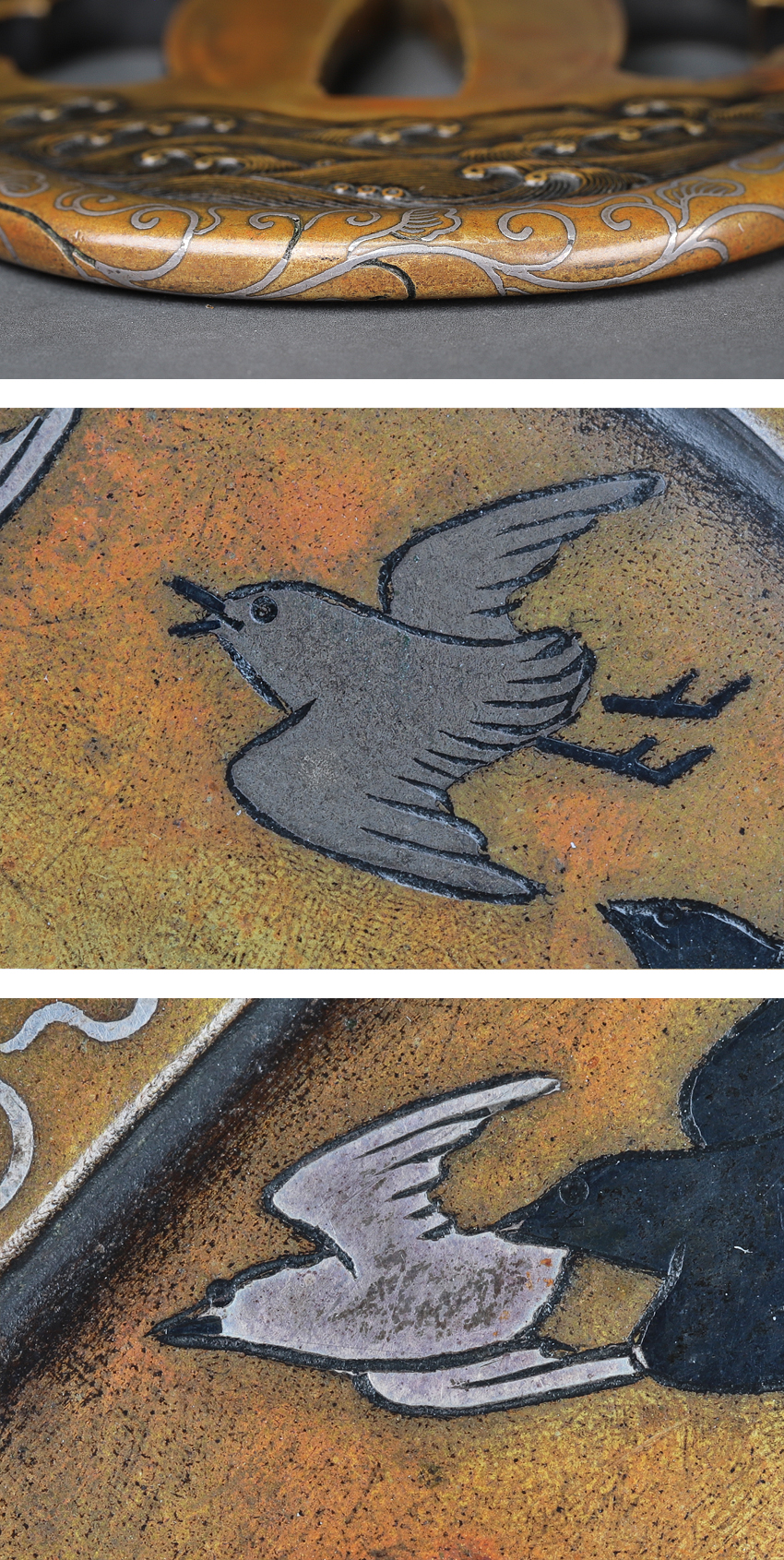
Shinchu kenma-ji nade-mokko-gata, sukidashi-bori, kin, gin, suaka, shakudo, hira-zogan, sukinokoshi karakusa gin-zogan mimi, ryohitsukitsu. The second generation Kanshiro was born in Kan'ei 16 and, following in his father's footsteps, also served the Hosokawa family. It is said that the skill of the second generation was so great that it surpassed the first generation, and he is superior to the first generation in terms of elaborateness and the skill of hira-zogan. This tsuba is truly a work that demonstrates the true essence of the Nishigaki family; the shinchu kenma-ji is slightly sukisage towards the mimi, depicting a flock of chidori rendered with kebori and hira-zogan using kin, gin, shakudo, suaka, and so on, while waves are carved in sukidashi-nikubori at the bottom. Furthermore, karakusa patterns are applied to the mimi in gin hira-zogan, enhancing its unique atmosphere. In the Showa 38 book "Tsuba Kansho" by Noda Kiyoshige, it is recorded as the first generation, but the NBTHK has given a kiwame to the second generation. I believe this appraisal is due to the magnificence of the hira-zogan. The movement of the chidori, the magnificence of the wave carving, the silver karakusa patterns, and the atmosphere of the shinchu-ji created by the era are all moving and make this a precious work. Comes in a dedicated paulownia box.
NihontoWatchOffered by Samurai Nippon
2 on the market

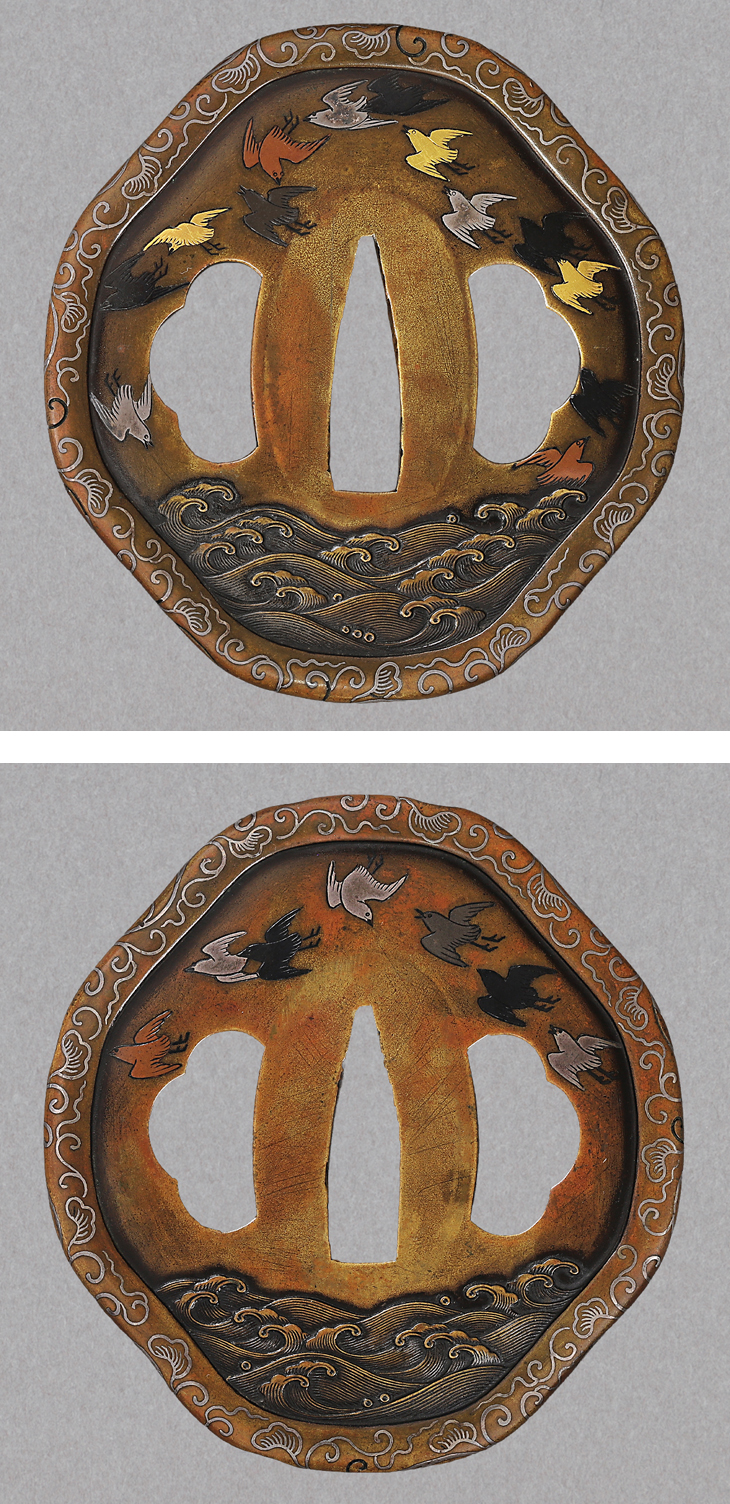
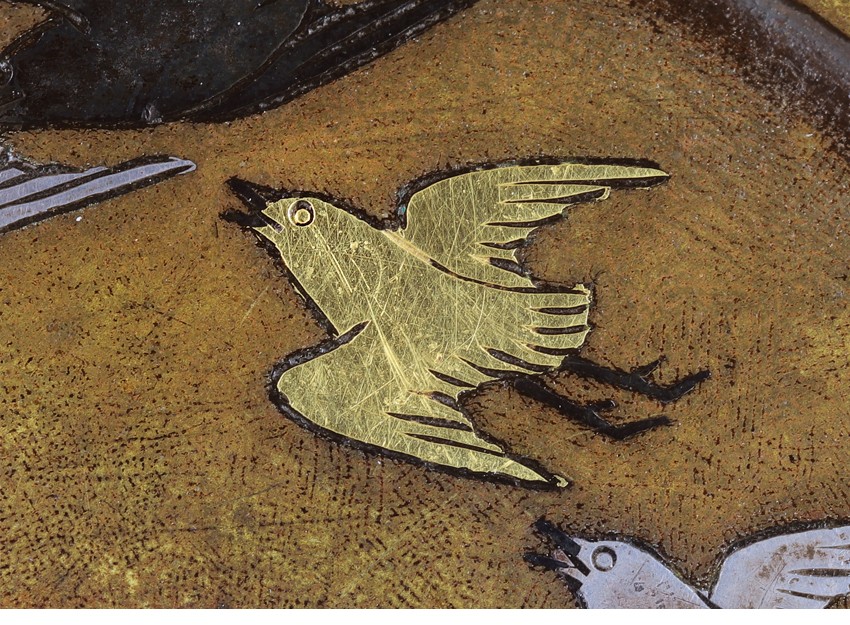
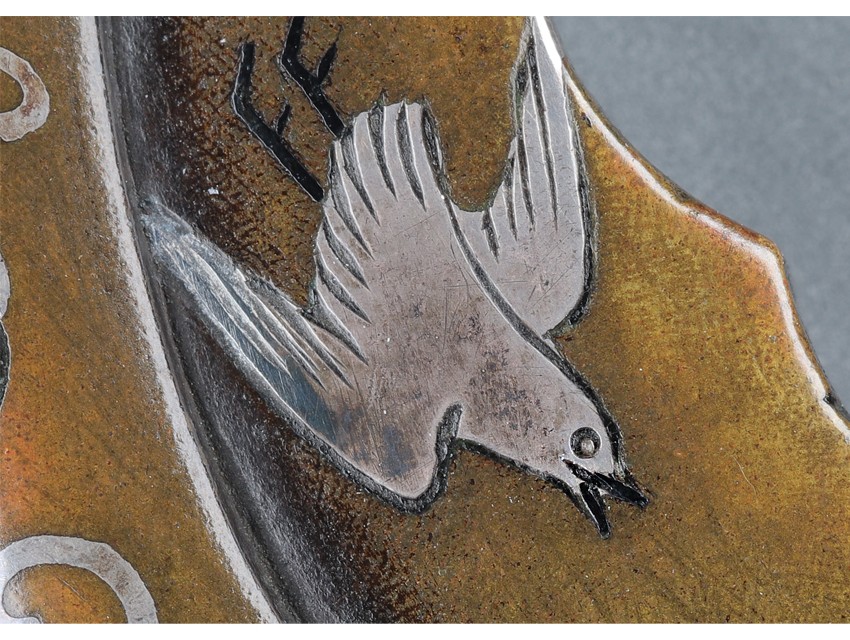
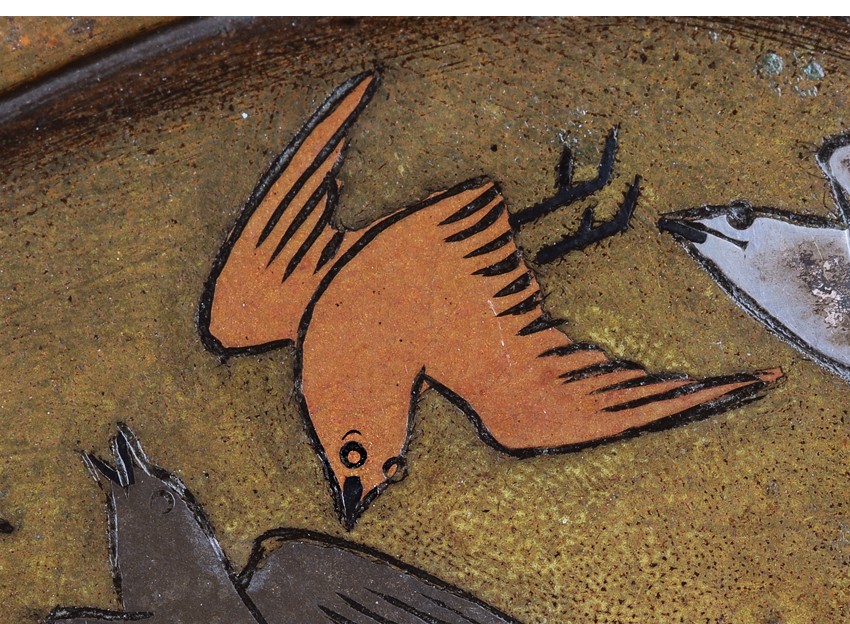
As written by the shop
Machine translation from the shop's Japanese · may contain errors ·
Higo · Higo
2 pieces on the market now
The second-generation Nishigaki Kanshiro, whose go is Nagahisa, is the eldest son of the founder of the Higo Nishigaki line, one of the four great schools of Higo metalwork. The records make him a master second only to his father, give his common name as Mosaku and his go as Yoshimasa or Nagahisa, and say he was born in Kan'ei 16 (1639) and died in Kyoho 2 (1717) aged seventy-nine, with a younger brother Kanpei. Where the founder is wholly unsigned and excelled at the iron openwork guard (the tossed-paulownia and distant-pine devices), the second generation is the first of the house to sign and turned to skilful inlay on brass and refined-copper grounds, in which the records find his true strength; his celebrated masterpiece is the Tagoto-no-tsuki (moon-in-each-paddy) guard. He is also said to have studied under the seventh Goto head Kenjo. His accepted work runs to both signed brass-and-copper inlay guards and a few iron openwork tsuba in the founder's manner.
Where Nagahisa stands among comparable artisans: across all of nihontō, and within tradition, era, and period. The tiers (Foremost · Leading · Major · Notable) weigh official designations from the NBTHK and Japan's Agency for Cultural Affairs, together with historical honors of lasting repute such as the Sansaku and Meibutsu-chō.
Select a lens to see how it's measured.
Higo · Higo
39 pieces on the market now
The Nishigaki school is one of the four great lineages of Higo metalworkers, ranked alongside the Hayashi, Hirata, and Shimizu families. Its founder, Nishigaki Kanshiro I (also known as Yoshihiro), was born in Keicho 18 (1613) at Nakatsu in Buzen Province, the son of a Shinto priest. He entered the workshop of Hirata Hikozo, received full transmission licensing (soden menkyo), and upon establishing himself independently was taken into service by the Hosokawa clan as a retained craftsman, receiving a stipend of twenty men's rations from Hosokawa Sansai Tadaoki. In Kan'ei 9 (1632) he accompanied his lord upon the domain transfer and relocated to Yatsushiro in Higo Province, later settling in the artisans' quarter of Kumamoto. As a contemporary of Hayashi Matashichi, the two are frequently contrasted: whereas Matashichi is said to possess the dignified bearing of a kunshi (gentleman)[[c:1]], Kanshiro is characterized as having the elegant refinement of a koshi[[c:2]] -- a lofty, cultivated recluse. Through the guidance of Sansai -- one of the Seven Sages of Rikyu and deeply versed in chanoyu -- the school came to express on the tsuba a fuin (aesthetic resonance) grounded in the sensibility of tea. Kanshiro died in Genroku 6 (1693) at eighty-one. The first Kanshiro's oeuvre centres on iron ji-sukashi (ground openwork) tsuba, with the nagekiri-kiri (thrown paulownia) as his most characteristic motif -- also called odori-kiri (dancing paulownia) or nimai-kiri, a stylization of the cursive hana-kiri mon. Other hallmark subjects include aged pines (oimatsu), chrysanthemums, and sea cucumbers (namako).
The setsumei identify several diagnostic traits: carving contours slightly gentler than those of the Hayashi school; finer, more animated kebori (hairline engraving) in leaf-vein detailing; a distinctive treatment whereby the inner rim edge assumes a chrysanthemum-like character; and an intentionally irregular outline with subtle distortion, often incorporating the shitabari (flared-lower) shodei-gata that is a major hallmark. A compositional technique of in'yo-sukashi -- "positive-and-negative" openwork pairing contrasting motifs in outer and inner contours -- is noted as a particular strength. The iron is repeatedly praised for its soft, pliant character and beautiful yokan-iro (dark reddish-brown bean-jelly hue). Beyond iron, the school also worked in suaka (plain copper) and brass (shinchu) grounds, sometimes with lacquer finishing. The second-generation Kanshiro (Nagahisa, also Yoshito or Eikyu; 1639--1717), eldest son of the founder, studied additionally under the Goto mainline master Kenjo and excelled in zogan (inlay) -- including nunome-zogan and suemon-zogan on brass and suaka grounds, extending his range to fuchi-kashira, kozuka, and menuki. "[[c:3]] The Nishigaki school occupies a distinctive place in the Higo canon as the embodiment of cultivated restraint -- refined elegance (gashu, fuga) achieved through studied imperfection. The first Kanshiro's iron openwork tsuba, with their deliberately asymmetric contours, subdued yet resonant surfaces, and evocative negative space, are repeatedly appraised as expressing precisely the wabi beauty of the Hosokawa school of tea. Among the school's most celebrated works, Nagahisa's Tagoto no tsuki ("Moon over the Rice Paddies") tsuba -- a Juyo-Bijutsuhin now held by Eisei Bunko -- demonstrates the family's mastery of polychrome inlay, employing shakudo, shibuichi, copper, shudo, and fine gold zogan on a brass ground to render moonlight variously reflected across partitioned paddies. "[[c:4]] The school's works embody a sustained dialogue between daimyo patronage and the refined aesthetics of chanoyu, achieving quiet beauty through the suggestive resonance of open spaces and the distinctive savour (aji) of Higo iron. Learn more →
| Smith | Era | Designated |
|---|---|---|
| Kanshiro勘四郎 | — | 31 |
| Nagahisa永久 | — | 5 |
| Kanzaemon勘左衛門 | — | 0 |
| Kanzaemon勘左衛門 | — | 0 |
| Kanpei勘平 | — | 0 |
Certifies a genuine fitting worth preserving: a correct signature, or, if unsigned, an identifiable era and school, with recognized artistic and craft value.
The NBTHK (Nihon Bijutsu Tōken Hozon Kyōkai, the Society for the Preservation of Japanese Art Swords) is a public-interest incorporated foundation founded in 1948 and supervised by Japan’s Agency for Cultural Affairs (Bunkachō); it is based at the Japanese Sword Museum in Tokyo. Its expert panels physically examine each submitted work (shinsa) and issue a certificate (kanteishō) ranking it by artistic and historical merit. NBTHK papers are the most widely recognized standard of authentication for Japanese swords and fittings.
NBTHK official siteFor one-of-a-kind items such as swords, sword fittings and antiques, other customers may be waiting for the item, so please contact us about a return within 3 days of its arrival and ship it back within 8 days. Refunds are made on the day the returned item arrives.
Price on request