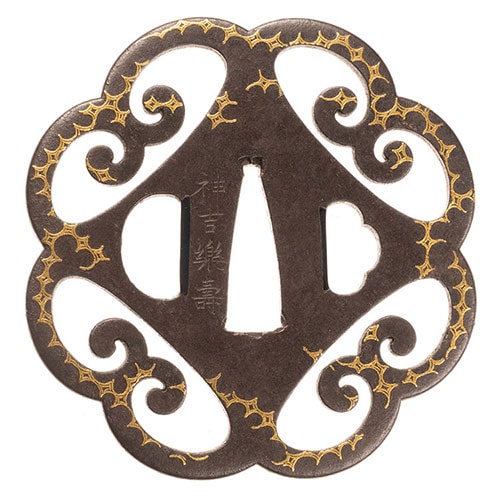
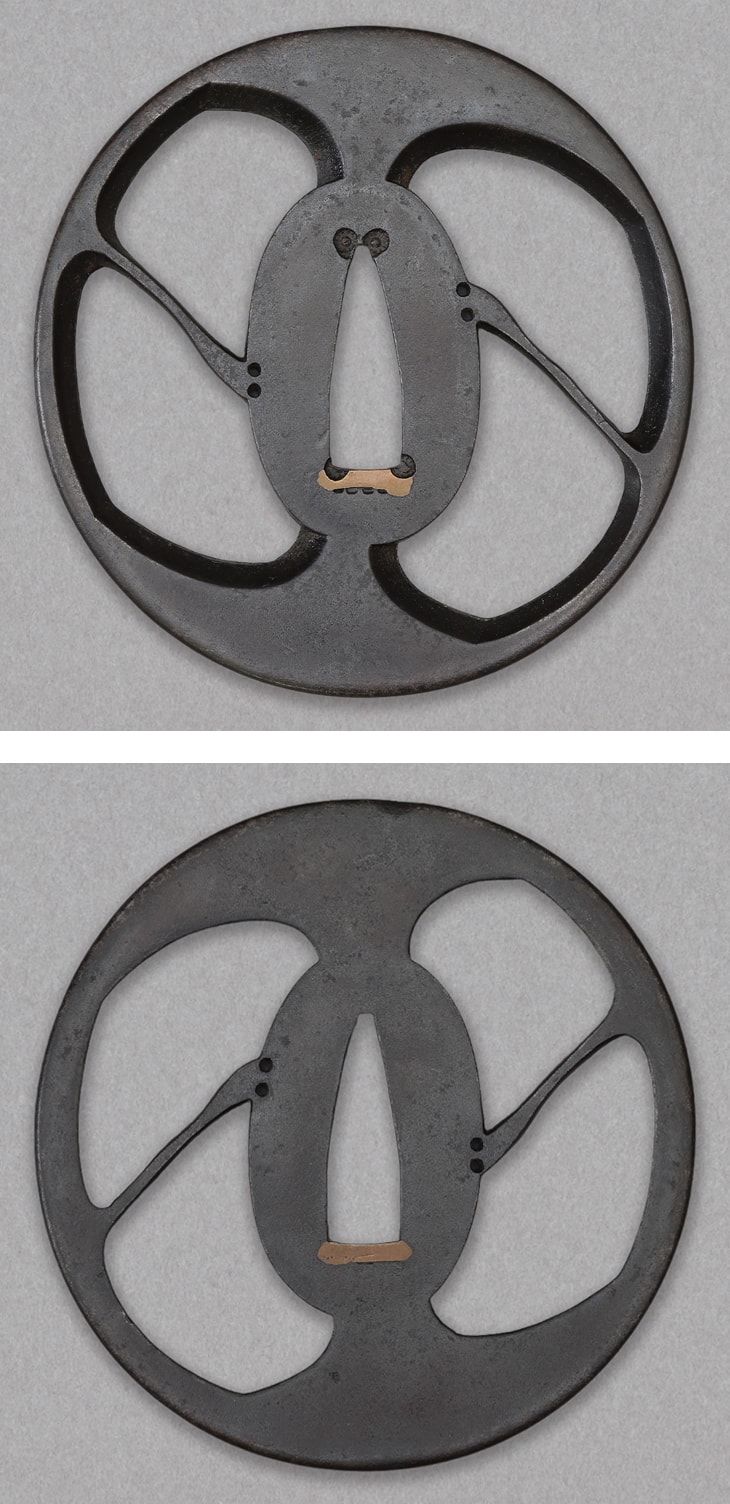
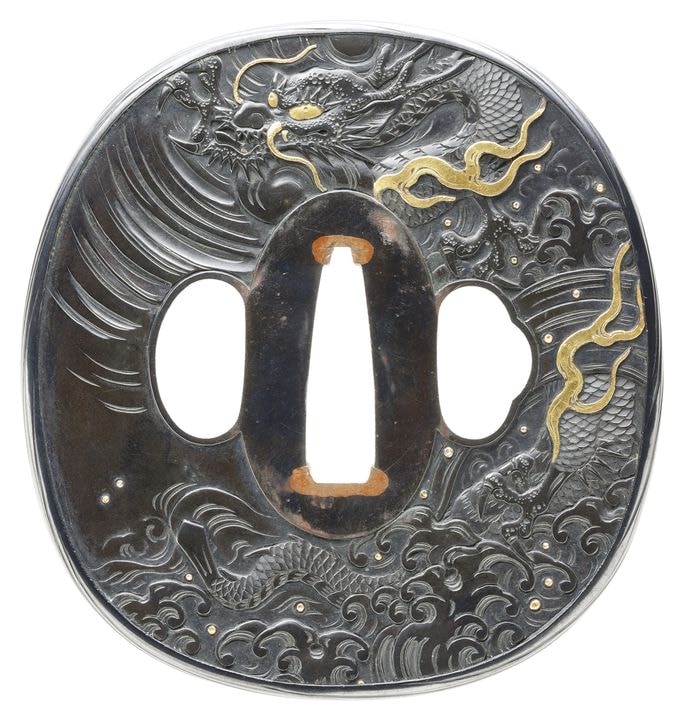
ProvinceHigoEraEarly Edo (1613–1699)SchoolHigo Kinko>HayashiTraditionHigoTeacherSelf-taught. Father Seibei Katsumitsu (清兵衛勝光) was a gun-maker (teppōkaji) from Owari who served Katō Kiyomasa. Matashichi transitioned from gunsmithing to tsuba-making after the Katō clan fell (1632).Specialtiestsuba, inlayTypeTosogu MakerCodeHAY_MAT1
Hayashi Matashichi (林又七), also known as Seizaburō Shigeharu, was born in Kumamoto in Keichō 18 (1613) and is regarded as the founder of the Hayashi lineage among metalworkers ( kinkō Hayashi-ha). His forebears were gunsmiths (teppō kaji) of Owari Province who, it is said, also occasionally made tsuba. In his father Seibei's generation the family served Katō Kiyomasa as gunsmiths and relocated to Higo Kumamoto; after the Katō house was dispossessed, they entered the service of the Hosokawa, who were transferred to that domain. Matashichi died in Genroku 12 (1699) at the age of eighty-seven. As head of the Hayashi school, he is a master craftsman who "occupies the highest rank among Higo artisans." The Higo Kinkōroku records that Higo metalwork flourished under the guidance of Hosokawa Sansai Tadaoki, and the four principal lineages — Hayashi (Kasuga), Hirata, Nishigaki, and Shimizu — trace their origins to that patronage. Incorporating the strengths of Owari tsuba and early Shōami work (ko-Shōami), Matashichi devised distinctive approaches to nunome-zōgan and inlaid carving (horikomi-zōgan), thereby establishing himself as the progenitor of a distinct school.
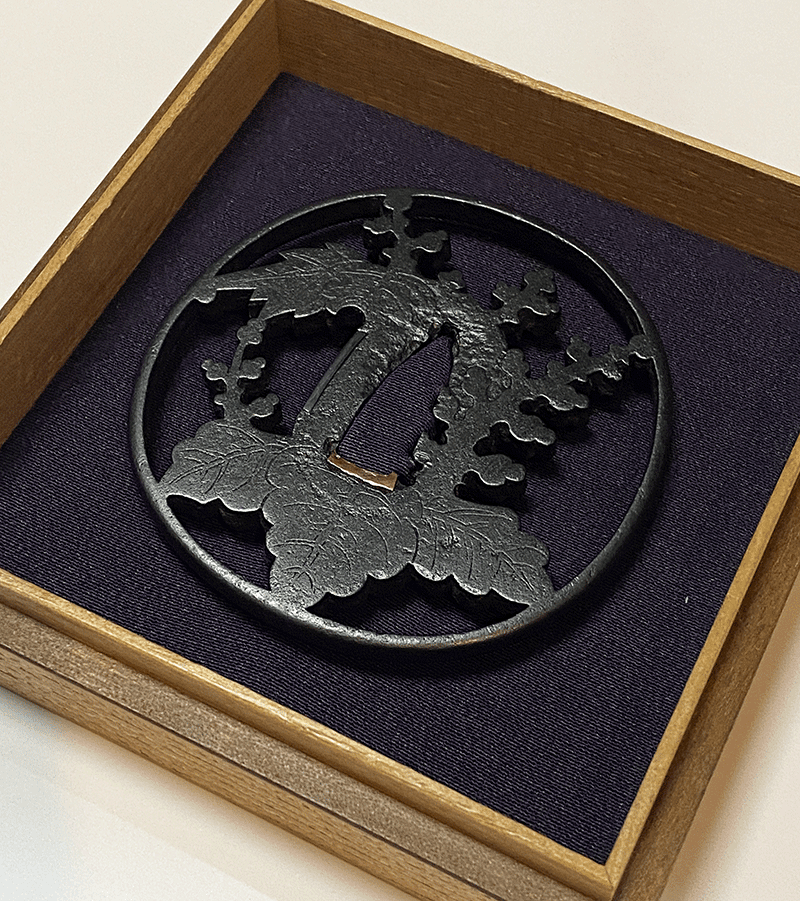
Matashichi's hallmark is his exceptionally well-forged iron plate, whose lustrous, viscous surface is likened to the color of yōkan1 — a deep, richly glossy tone that the Higo Kinkōroku praises in memorable terms: "the color of the iron is without equal; the forging is tightly knit, and its beauty is beyond comparison." The NBTHKsetsumei repeatedly return to the dense, clinging sheen of this iron2 as the principal point of appreciation. Beyond the iron itself, Matashichi commands a wide repertoire of technique3. His gold nunome-zōgan is applied with deliberate passages rendered "as though broken or torn," conveying what the setsumei call "the exceptional refinement of Matashichi's aesthetic sensibility." His kareki-zōgan (withered-tree inlay) is especially the artist's forte, "reaching a level that other craftsmen found difficult to match." His ji-sukashi (ground openwork) — whether rendering bamboo, paulownia, distant pine, or cherry blossoms at Yoshinogawa — demonstrates an outstanding sense of design; later generations actively copied these compositions across multiple schools, yet "in terms of the quality of the iron, the excellence of the overall bearing, and the refined elegance," none surpass Matashichi. He also produced fuchi-kashira in which the fuchi and kashira employ differing base metals, a practice noted as distinctive to his hand.
The evaluative language across decades of NBTHKsetsumei is remarkably consistent: Matashichi's works possess a "dignified, firmly-set presence" and a "tenacious quality" in the iron; they are "high in tone and elegance," recalling the saying that his work made even other craftsmen "keep their distance by three sha," so elevated was its authority5. His openwork is praised for its bold, unhurried spaciousness4, its economical niku-oki (placement of relief), and its capacity to convey poetic feeling — "the springy resilience of bamboo," "a fresh breeze stirring through each leaf," or the crystallization of the bushidō ethos in the form of a tsuba6. Among his oeuvre, the setsumei distinguish two constructional manners — pieces of keen, sensitive construction with little flat niku, and others of broad, generous construction with fuller niku — both developing "splendidly distinctive manners of workmanship." Whether signed with the precious kinzōgan-mei "又七" or appraised as mumei, Matashichi's tsuba are recognized as expressing "the appeal of Higotsuba to the fullest extent."
Kantei
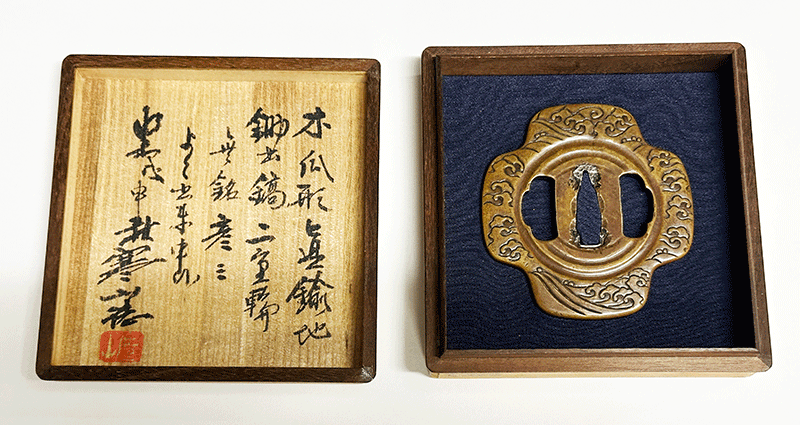
3 descriptive axes for an iron master: material (the forged iron ground with its yokan-colour patina) x technique (sukashi openwork + nunome and sunk-in inlay) x themes, which divide into two openwork modes the setsumei keep apart: the device-and-crest register (pine, crests, bamboo, paulownia) and a pictorial-landscape register with a real sense of perspective (the Yatsuhashi bridges, river-waves). The load-bearing discriminator is the quality of the iron itself.
Hayashi Matashichi is the founder of the Higo Hayashi (Kasuga) school of iron tsuba and the highest-ranked Higo metalworker, born in Kumamoto in 1613. Descended from Owari gunsmiths who served Kato Kiyomasa and then the Hosokawa, he was guided by Hosokawa Sansai. His load-bearing tell is the iron itself: a superbly forged ground whose moist, glossy patina the setsumei liken to yokan (sweet-bean jelly). Working sukashi openwork, including the silhouette (kage) kind, with nunome cloth-inlay and his own sunk-in (horikomi) and withered-tree (kareki) inlay, he originated the distant-view pine and the cross-kuyo crest openwork, motifs his successors and rivals copied but never matched.
Diagnostic discriminators
羊羹色yokan-iro12
unique vs ordinary iron tsuba and later imitators
遠見松tomi-matsu4
unique vs other Higo and later iron schools
彫込象嵌horikomi-zogan5
sunk-in (horikomi) inlay, his own invention, with the withered-tree (kareki) inlay the setsumei call his most celebrated speciality
Material (iron ground)
The ground is iron, worked as hammered (tsuchime), forging-grain (kitame) or polished surface, with a refined purple-tinged patina. Its moist, glossy quality, likened to yokan, is the school's load-bearing tell, set above all imitators.
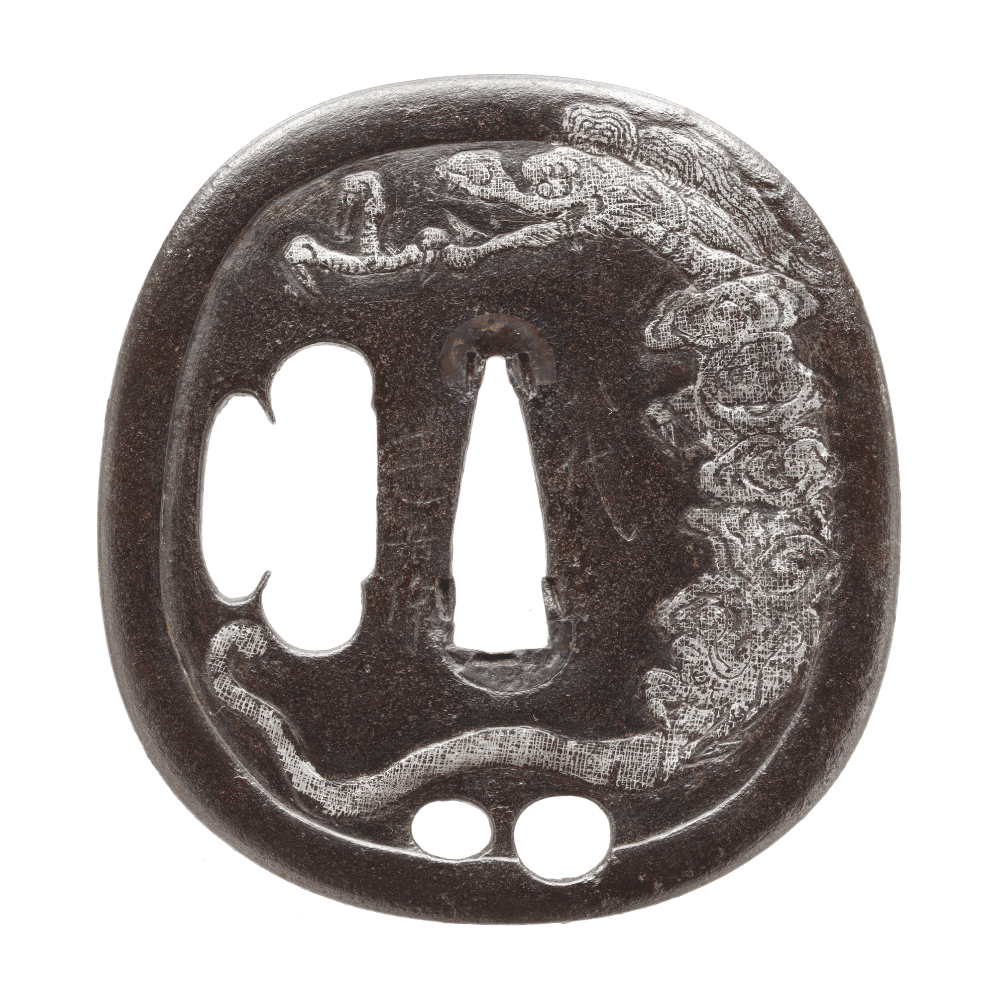
His core register is sukashi openwork cut through the plate, including the silhouette (kage) kind and relief-and-pierced ground. Over and within it he sets nunome cloth-inlay and his own sunk-in (horikomi) and withered-tree (kareki) inlay, with rope-pattern inlay and kebori, finished at a round rim.
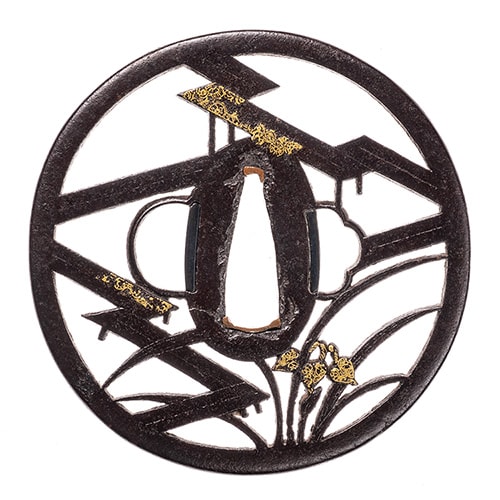
His subjects fall into two openwork modes the setsumei keep apart. The first is the device-and-crest register: the distant-view pine he originated, the Hosokawa nine-luminaries crest paired with cherry, the cross-kuyo crest, snapped-branch bamboo, plum, fern-frond scroll and the tossed-paulownia. The second is a pictorial-landscape mode, where the setsumei single out a real sense of perspective (enkin) within the narrow plate: the Yatsuhashi eight-bridges among iris, river-waves with cherry, all pierced in iron.
Openwork devices and crests
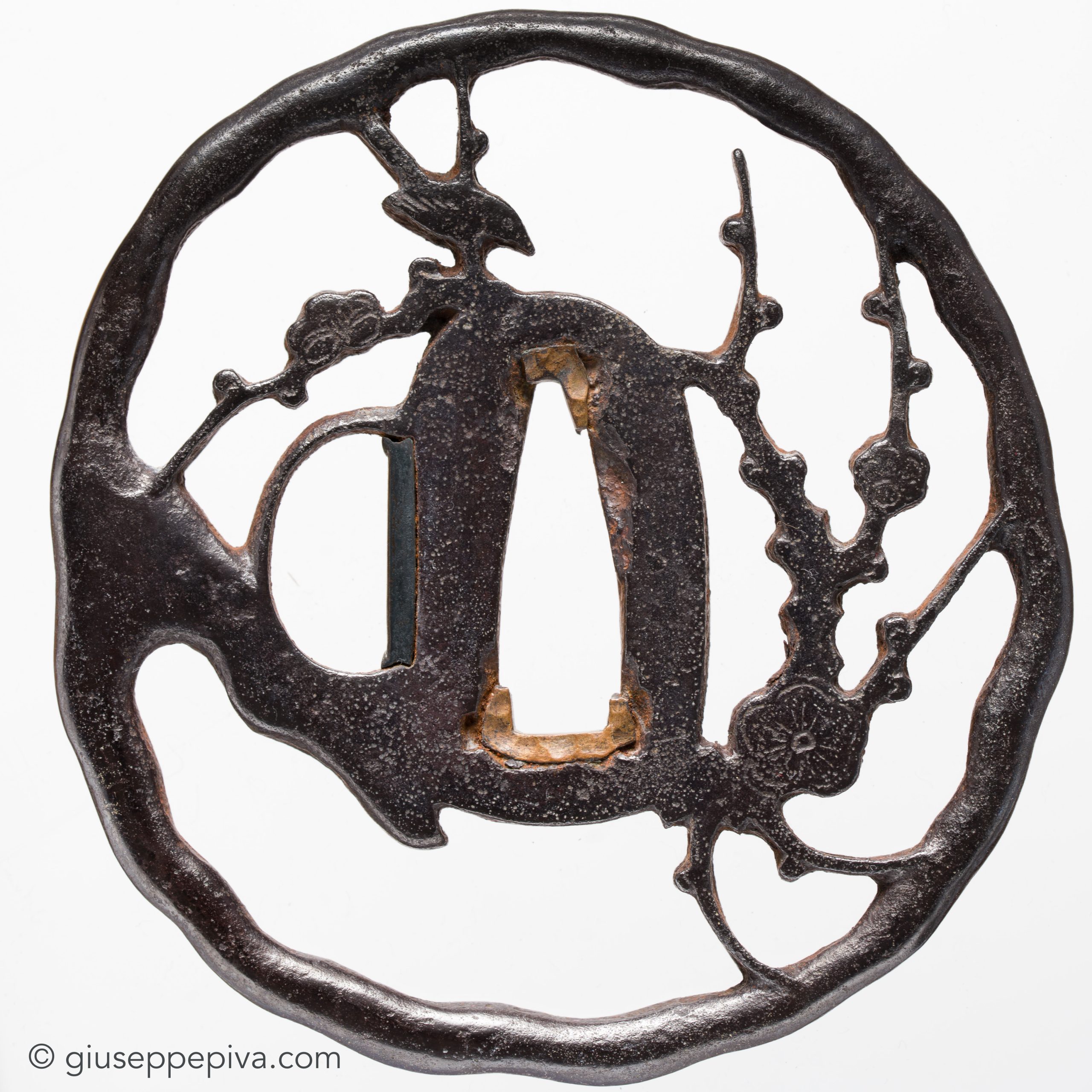
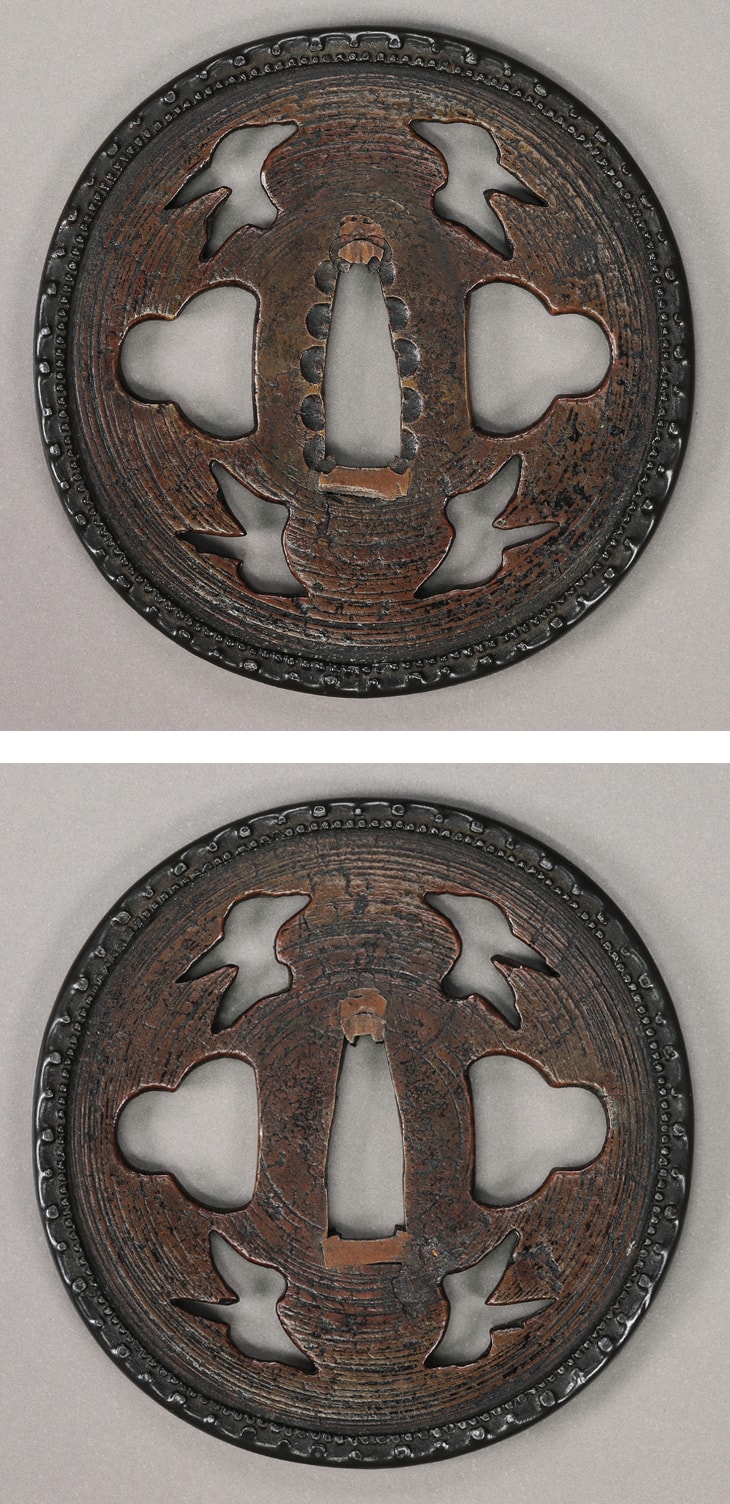
His primary register: the distant-view pine he originated, the nine-luminaries and cross-kuyo crests, cherry, snapped bamboo, fern-frond scroll, plum and the tossed-paulownia, all pierced in iron and finished with sparing hairline engraving.
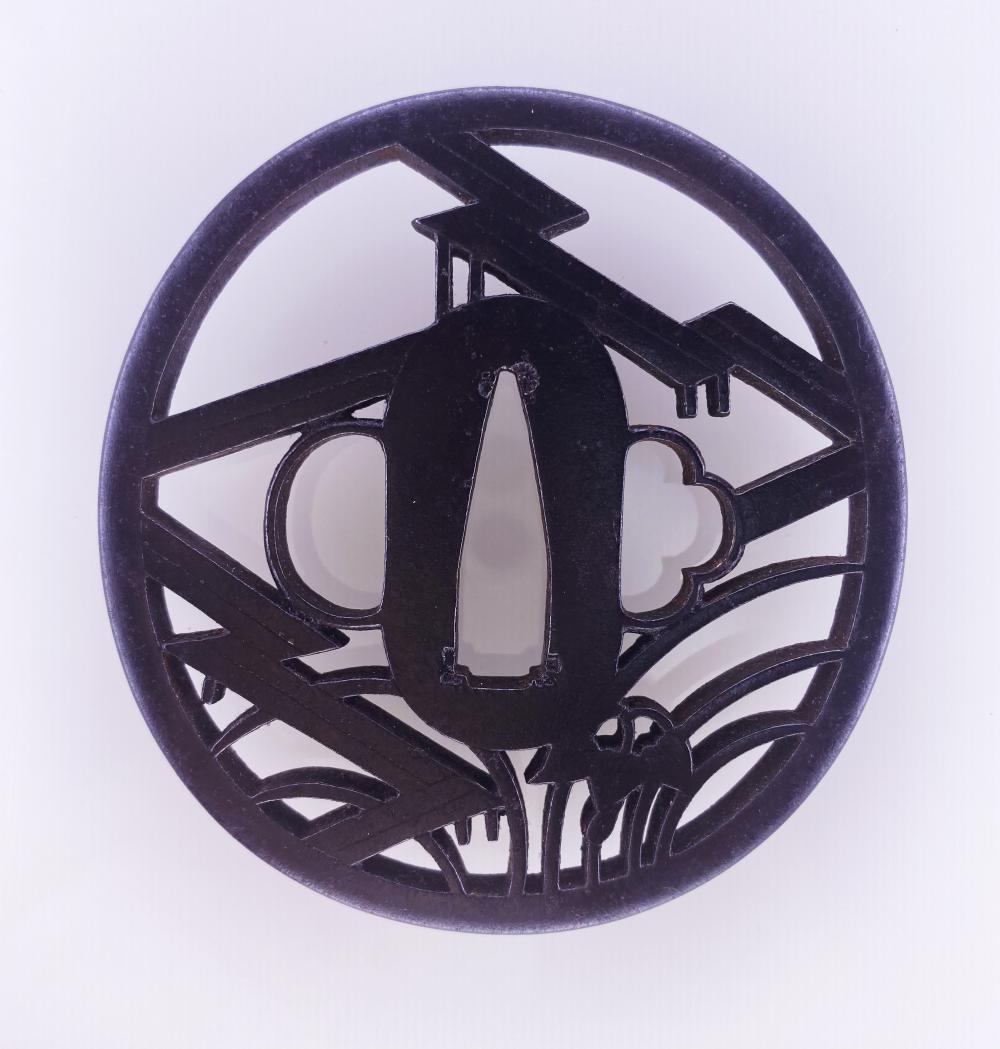
A distinct pictorial mode the setsumei keep separate from the crest devices: the Yatsuhashi eight-bridges set among iris, and river-waves with cherry. The NBTHK single out a genuine sense of distance (enkin) achieved within the narrow guard, a depth they call rare in iron openwork.
八橋the Yatsuhashi eight-bridges among iris2菖蒲iris beside the bridges1川波river-waves with cherry1
Matashichi (又七, gold-inlay)early Edo; most works are unsigned attributions1 pieces1
Recorded signatures
又七Matashichi1 pieces1
Documentary note
Most of his work is unsigned and attributed; signed pieces are rare and gold-inlaid, in two forms, the three-character Hayashi Matashichi and the two-character Matashichi. The corpus genuinely contests his death (Genroku 12 aged 87 dominant, also aged 88, also Genroku 4 aged 84) and one entry states the dates are simply unknown, so a single death date must not be asserted. The extract's attribution labels on unsigned pieces are not physical inscriptions.
Scholarship
The Higo-kinko record praises his iron as without compare: 'the colour of the iron is peerless, its forging tight, lovely beyond likeness.'1
Where the rival Nishigaki Kanshiro treats the same subjects, the setsumei judge none so bold in the openwork as Matashichi.1
Historical importance
Where Matashichi stands among comparable artisans: across all of nihontō, and within tradition, era, and period. The tiers (Foremost · Leading · Major · Notable) weigh official designations from the NBTHK and Japan's Agency for Cultural Affairs, together with historical honors of lasting repute such as the Sansaku and Meibutsu-chō.
随一
Foremost
屈指
Leading
All tōsōguShintō
有数
Major
Higo
著名
Notable
Select a lens to see how it's measured.
Designations
Kokuhō—
Jūyō Bunkazai2
Jūyō Bijutsuhin4
Gyobutsu—
Tokubetsu Jūyō1
Jūyō Tōken45
Elite Standing
0.31 across 52 designated works
Top 3% among makers
Provenance
6 documented provenances across certified works by Matashichi
Imperial—
Shogunal—
▸Premier Daimyō4
Major Daimyō—
Other Daimyō—
Zaibatsu—
Institutions—
▸Named Collectors2
Provenance Standing
4 works held in elite collections across 6 documented provenances