Sengoku Seki was an industry: smiths organized under their tutelary Kasuga shrine, arming the war bands of central Japan. Magoroku Kanemoto’s sanbonsugi and the finest Kanesada work prove quality survived inside mass production.
 NihontoWatchNihontoWatch
Wakizashi in Shirasaya (NBTHK Tokubetsu Hozon Token) (We divide 4 sections for each sword as Saijyo Saku, Jyojyo Saku, Jyo Saku and Regular Saku). This blade is ranked as Jyojyo Saku among the works of Kanesada. Shape: wide and thin blade with thin Shinogi. Jigane: Itame and Mokume. The jigane displays prominent chikei. Hamon: Gunome and pointed gunome midare with much sunagashi. Special Feature: Among the swordsmiths who signed their works Kanesada, the second-generation Izumi no Kami Kanesada (Nosada) is particularly well known. However, several swordsmiths used the signature Kanesada during the late Muromachi period. This wakizashi features well-forged jigane with prominent chikei, as well as a hamon with abundant nie and sunagashi. It is an attractive piece with many interesting features worthy of appreciation. Historical Background: In 1543 (Tenbun 12), a Chinese (Ming Dynasty) ship carrying Portuguese passengers drifted ashore on Tanegashima Island in present-day Kagoshima Prefecture. This event marked the first introduction of European matchlock firearms (teppo) to Japan. Within a relatively short period, matchlock guns were mass-produced by swordsmiths and other craftsmen and introduced into warfare. NBTHK Tokubetsu Hozon Certificate
NihontoWatchOffered by Aoi Art
21 on the market

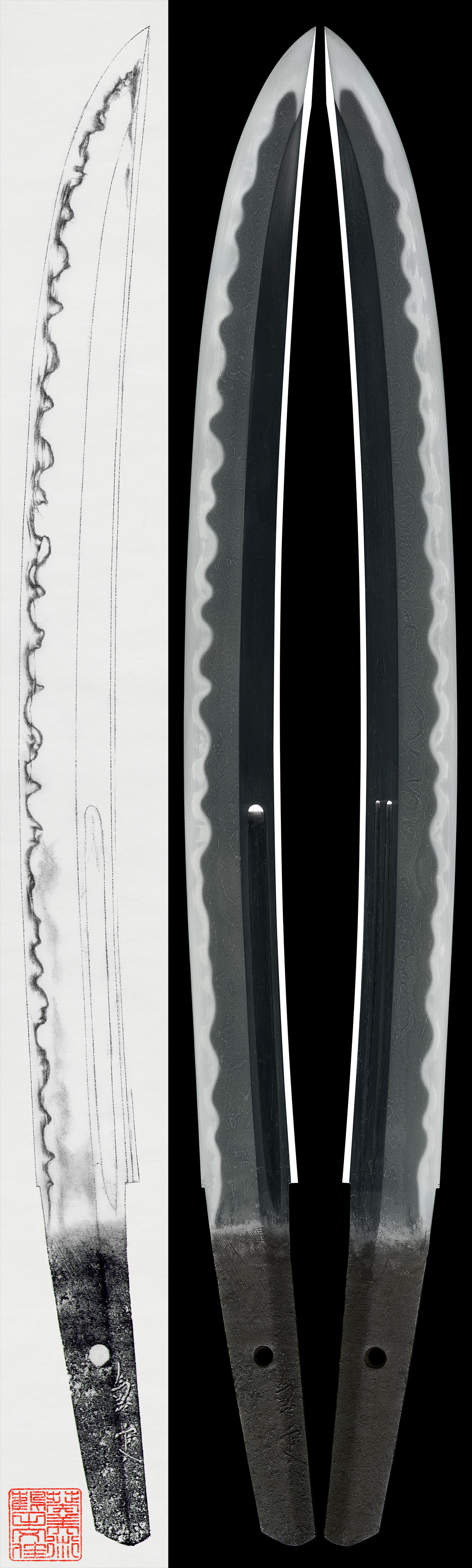


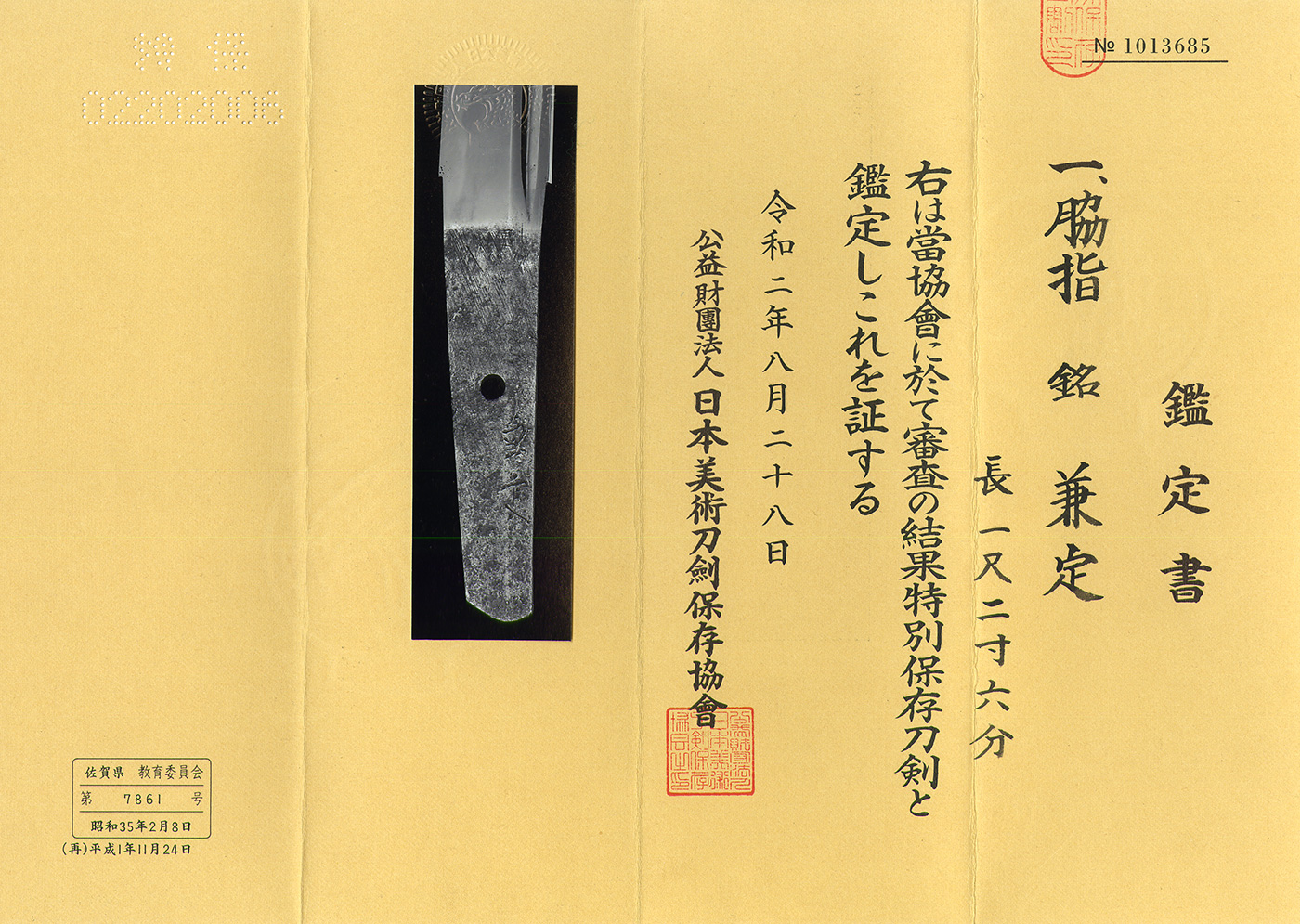
As written by the shop
Mino-den · Mino
21 pieces on the market now
Seki in Mino province supplied the base for the Kanesada line, whose blades the NBTHK places among the representative work of the Mino-den in the closing phase of the Muromachi period. The setsumei consistently pair Kanesada with Kanemoto as the two leading masters of Sue-Seki, the late Seki group active with Seki as its center, where (as one 31st-session katana notes) the Mino smiths flourished second only to Bizen. Within the line the signatures sort by how the character sada (定) is cut: when the element under the u-kanmuri (う冠) appears as 之, the smith is called Nosada (之定), and when it appears as 疋, Hikisada (疋定). Several generations and individuals carried each name, which the entries for the tantō in Honma's inventory of the Imperial collection (Kotō #85 to #87) state makes precise identification difficult; a kanwaku of ordinary workmanship is mentioned alongside them, and one entry records that a Kanesada was called Hachiya Seki, residing at Hachiya in the same province. The standout is the second-generation Izumi no Kami Kanesada, the Nosada the records single out for high technical ability and for receiving, rare in the kotō era, the court title Izumi no Kami. Per the Kotō Mei Shūroku cited in the 14th Tokuju setsumei, he first cut sada in kaisho (standard script) and shifted to the 之 form, the change placed by extant works between the eleventh month of Meiō 8 and before the eighth month of Meiō 9, with Nosada signatures running on to about Daiei 6 (1526). Several blades carry domain provenance: Nosada works pass through the Tosa Yamanouchi, Akita Satake, Shimazu, and Tatebayashi Akimoto families, and one was made for Takeda Nobutora, father of Shingen. The shared vocabulary the setsumei draw is a refined itame-hada, frequently mixed with nagare (flowing grain) or mokume and tending to stand up as hada-dachi, carrying ji-nie, chikei, and very often a whitish shirake-utsuri. Against Kanemoto's pointed, togariba-dominant sanbon-sugi, Kanesada is defined by variety: rounded gunome, ko-notare, and gunome-chōji, with togariba and yahazu-like elements mixed in, ashi and yō entering, sunagashi and kinsuji running, and a nioiguchi the records repeatedly call bright and clear (saeru). A second register is the elegant suguha the setsumei name Rai-utsushi, an evocation of Rai work that the 30th-session tantō likens directly to Rai Kuniyoshi; the 45th-session tantō ties the same Kyō-modeled chū-suguha to a Nosada early signature.
The hand is read most clearly in Nosada: a gunome-chōji base broken into modest rises and falls, a jigane that is brighter and more thoroughly nerareta (well-kneaded) than ordinary Sue-Seki, and, on katana, a slender to standard mihaba with pronounced taper and slightly elevated sakizori. When Nosada turns to notare the silhouette broadens with a larger kissaki. The bōshi runs midare-komi to ko-maru, at times Jizō-flavored, and a mizukage-like stand-up at the machi recurs. Lesser Kanesada and the Hikisada works read as plainer and, where togari-heavy gunome dominates a tantō, the inventory entries judge the manner unusual and late. For kantei the registers converge on Seki signatures: taka-no-ha (and on tantō often higaki) yasurime, ubu kurijiri or, in later years, iriyama-gata tangs with sujikai file, and the diagnostic 之-versus-疋 reading of sada. Tang-form drift, higaki kurijiri giving way to sujikai iriyama-gata, lets the 50th-session tantō be dated to late Daiei. The cutting reputation is carried in metal: kinzōgan cutting-test inscriptions appear on the 14th-session Tokuju katana, owned as a personal sash-sword by Miura Shōgen, karō of the Kii Tokugawa, and on a 58th-session katana, while another names Kosuga Tatewaki of the Tsuyama Matsudaira and another the Nawa cutting record. The Jūyō-Bijutsuhin Nosada for Takeda Nobutora is recorded in the Kokon Kaji Bikō and Mino-tō Taikan; the 62nd-session katana survives in the oshigata of Kōzu Haku. On this evidence the line holds standing as the Mino tradition's most accomplished late voice, Nosada its peak hand for a brightness and refinement uncommon for Seki. Learn more →
| Smith | Era | Designated |
|---|---|---|
| Kanesada兼定 | 1492-1515 | 35 |
| Kanesada兼定 | 1532-1555 | 0 |
| Kanesada兼定 | 1558-1570 | 0 |
| Kanesada兼定 | 1573-1592 | 0 |
| Kanesada兼定 | 1469-1487 | 0 |
Mino in the Muromachi period
Sengoku Seki was an industry: smiths organized under their tutelary Kasuga shrine, arming the war bands of central Japan. Magoroku Kanemoto’s sanbonsugi and the finest Kanesada work prove quality survived inside mass production.
A Hozon-certified blade judged to show notably superior workmanship and a better state of preservation. The bar is higher: re-tempered blades and most unsigned Muromachi/Edo works are excluded.
The NBTHK (Nihon Bijutsu Tōken Hozon Kyōkai, the Society for the Preservation of Japanese Art Swords) is a public-interest incorporated foundation founded in 1948 and supervised by Japan’s Agency for Cultural Affairs (Bunkachō); it is based at the Japanese Sword Museum in Tokyo. Its expert panels physically examine each submitted work (shinsa) and issue a certificate (kanteishō) ranking it by artistic and historical merit. NBTHK papers are the most widely recognized standard of authentication for Japanese swords and fittings.
NBTHK official siteIf you wish to return an item, please notify us within 3 days of receipt. After this period we cannot accept cancellations. Please ship the return to us within 5 business days. Cancellation is conditional on the item being kept in the same condition as at the time of sale, so please handle it with care.
Starting price
¥530,000