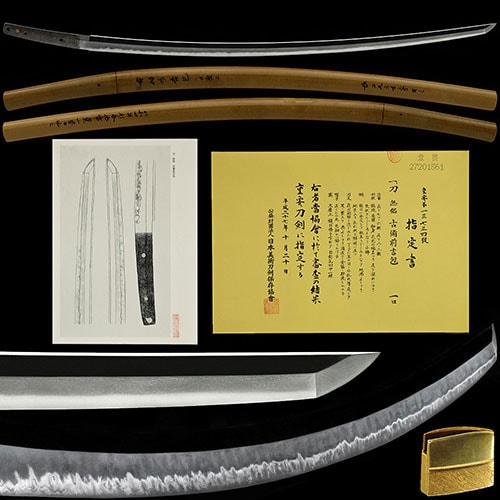
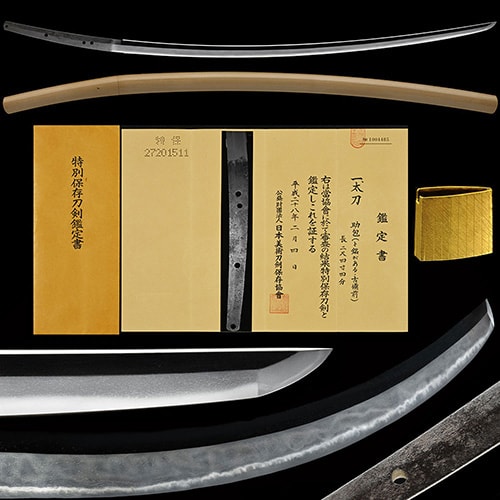
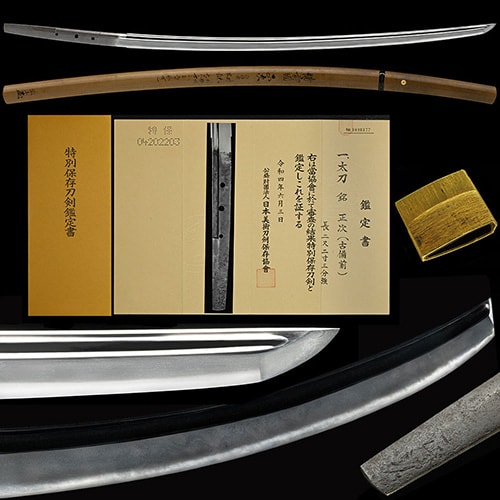
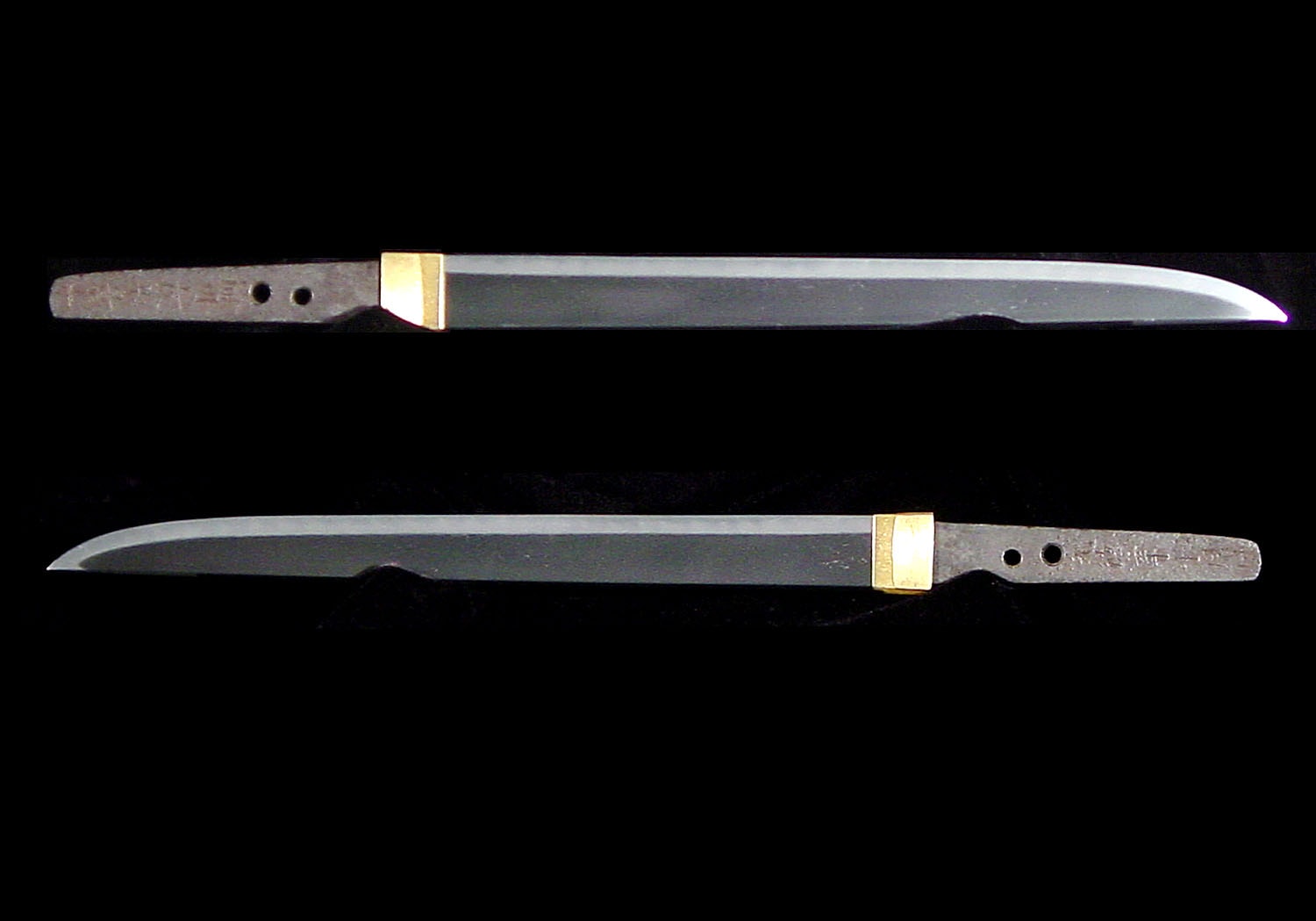
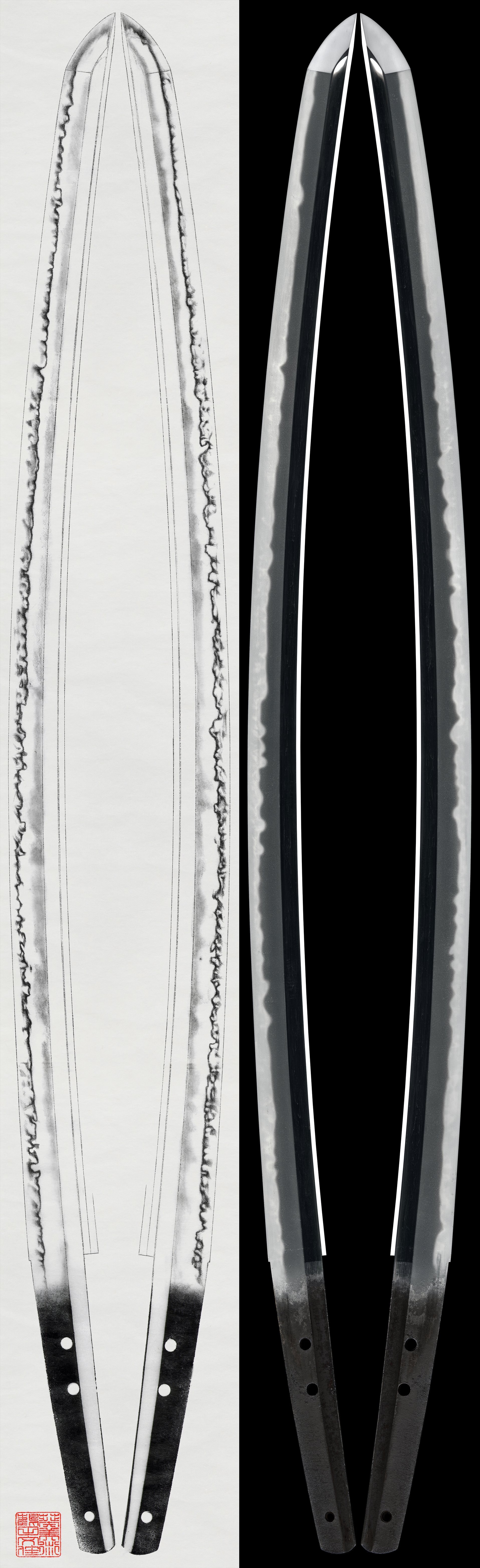
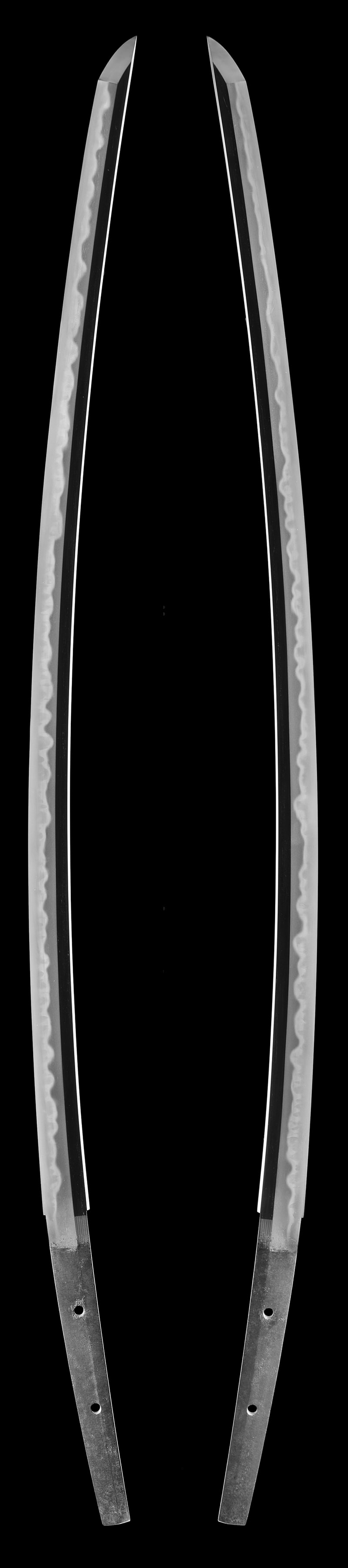
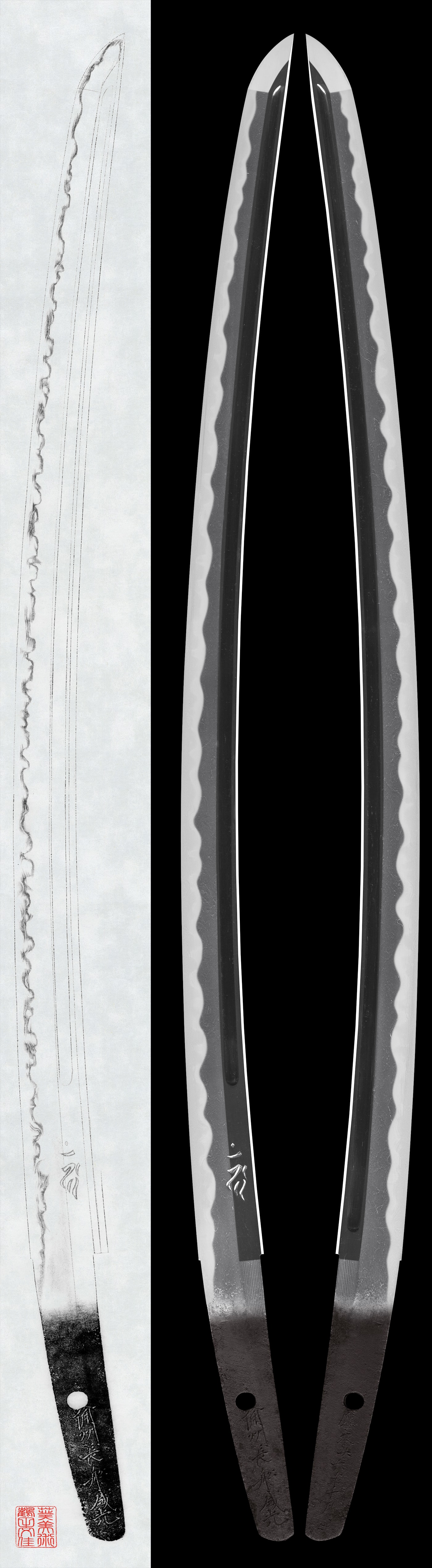
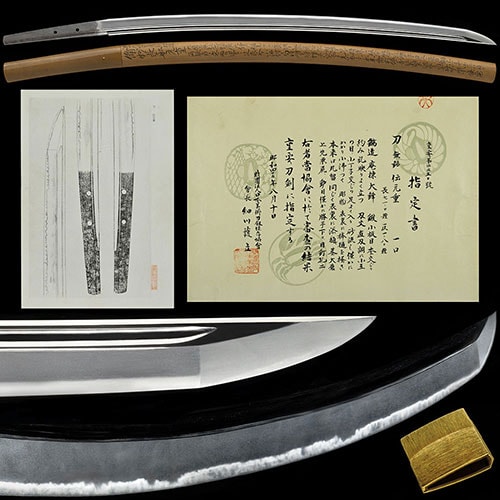
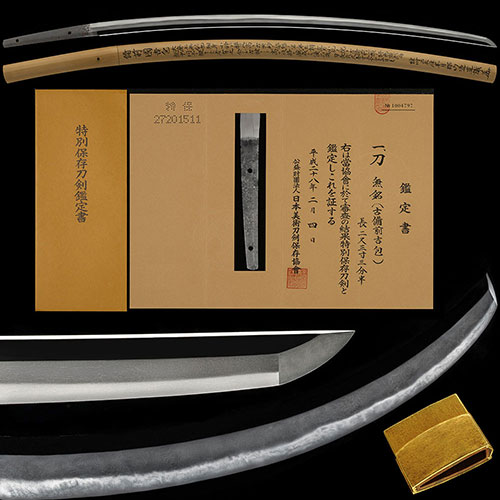
This is a katana by Kobizen Yoshikane from the late Heian period. It features a slender blade with deep sori, a small kissaki, and a hamon in suguha style with small midare and chouji. The blade is described as a masterpiece that exudes elegance and dignity, and is in sound condition.
mei · Kobizen · Heian · nagasa 70.2cm · sori 2.4cm


Ko-Bizen (Bizen) · Bizen · around 1150-1220
Fujishiro Jo-jo saku · Tōken Taikan top 5%
When a signed tachi of Yoshikane was designated at the seventh Tokubetsu Juyo session in 1980, the commentary called it "a typical work of Ko-Bizen Yoshikane in the quality of the ji and ha and in the manner of the signature alike"[[c:1]]. Yoshikane (吉包) was a smith, or more probably several smiths, of the Ko-Bizen school of Bizen province, active from the end of the Heian period into the early Kamakura period. For so early a hand his works survive in comparative number and in a nearly uniform style. From the mei and the workmanship the published sources read several smiths of the name across slightly different dates, all of them judged Ko-Bizen, and they leave the question of generations open. The same name recurs a little later in the early Fukuoka Ichimonji school of the same province, so that the appraisal of any Yoshikane begins by deciding between the two. Fujishiro rates him Jo-jo saku.
His tachi are slender, with high koshizori and marked funbari, closing in a small kissaki that often inclines gently forward; the published sources call the figure classical and graceful, and one entry adds that pieces in which blade and nakago alike seem to carry rather little hiraniku "are frequent in Yoshikane"[[c:2]]. The forging is the first of his marks: an itame that stands out, mixing o-hada in places and patches of jifu, with ji-nie attaching well. The NBTHK states the point outright, writing that "within Ko-Bizen it is the comparatively standing hada that is the characteristic of this smith"[[c:3]]. The second lies in the temper, whose nioiguchi sinks rather than brightens; describing a Tokubetsu Juyo tachi, the published sources name the pair together, finding that "Yoshikane's character appears in points such as the sinking tendency of the nioiguchi and the standing hada of the jigane"[[c:4]].
The yakiba itself is a suguha-toned line that undulates shallowly into ko-midare, mixing ko-choji and traces of gunome. Ashi and yo enter busily, ko-nie attaches, and sunagashi and kinsuji run through the ha. At times the temper is dropped above the machi, and here the published record is careful with its own evidence, noting that yakiotoshi "is not confined to this smith but is met with from time to time in Ko-Bizen work"[[c:5]]. A midare-utsuri does appear, but it is held in check rather than bright: on the refined ko-itame blades the published sources find only a faint jifu-utsuri, while a wider o-suriage katana shows a more conspicuous midare-utsuri, so that the reflection runs from quiet to plain but never reaches the standing brilliance of the Ichimonji namesake. The boshi runs sugu to ko-maru, frequently with hakikake at the point.
The published record divides his work and his mei into two manners, a small signature on a slender blade with a suguha-toned ha against a somewhat larger signature on a wider blade quenched in ko-midare, and it states that "the former is regarded as the earlier in date"[[c:6]]. The earlier register is known above all through an o-suriage katana bearing a gold-inlay attribution by Hon'ami Kochu, designated Tokubetsu Juyo at the twenty-fifth session with an itomaki-tachi koshirae of gold nashiji bearing chrysanthemum and paulownia crests. There the standing itame gives way to a tight ko-itame with ji-nie and a faint jifu-utsuri, the ha widening into a broad suguha tone with ko-choji and ko-midare; of its jigane the commentary writes that "the excellent forging built mainly on ko-itame is praised"[[c:7]], and it finds the broad, softly inflected nioiguchi deeply appealing. The scholarship has also moved within the record itself: a Juyo tachi formerly carried a vermilion attribution to Nagamitsu, but on repolishing the jigane and the ha proved distinctly older than Nagamitsu, and the blade was re-designated with the attribution changed to Yoshikane.
Inside Ko-Bizen the published sources separate him by exactly the traits above: the hada that stands more than in his fellow smiths, the nioiguchi that sinks, the quieter utsuri, the occasional yakiotoshi. Against the Ichimonji namesake the line is drawn from his own side as well. The Ko-Bizen Yoshikane signs with a small two-character mei cut with a fine chisel, the character 包 differing in particular from the Ichimonji form, and the habit of adding saku is met with more often in the Ko-Bizen works; his temper keeps ko-midare as its keynote with a restrained utsuri, where the namesake favors flamboyant choji under a standing midare-utsuri. The published sources add the matter of supply: "in general more works of the Ichimonji survive, and Ko-Bizen Yoshikane is scarce"[[c:8]].
The designated record now runs deep for so early a name: seven blades at the Tokubetsu Juyo level and twenty-eight at Juyo, with a further group of Important Cultural Property and prewar Juyo Bijutsuhin tachi, and two blades that descend in the Imperial Household. There is no National Treasure among them, and the early Imperial and Important Cultural Property blades are patrimony held in court and museum hands rather than pieces that trade. The provenance recorded behind the rest reaches court and daimyo houses alike: the Imperial Family through the Katsura-no-miya line, the Tokugawa and Kuroda houses, the Hisamatsu-Matsudaira and Matsudaira Yasuharu, the Yamauchi, and the Kikkawa family of Iwakuni, whose mumei tachi the commentary judged the piece "that can most fittingly be likened to Yoshikane among the many smiths of Ko-Bizen"[[c:9]]; a signed Juyo tachi descends from the Walter A. Compton collection. What a private collector may realistically encounter is the thirty-five blades of the Tokubetsu Juyo and Juyo tiers, of which only some have a recorded whereabouts, and the published record itself remarks on how seldom the name comes to hand. A Ko-Bizen Yoshikane, above all a signed one, comes to market rarely and is among the rarer encounters that old Bizen affords.
Where Yoshikane stands among comparable artisans: across all of nihontō, and within tradition, era, and period. The tiers (Foremost · Leading · Major · Notable) weigh official designations from the NBTHK and Japan's Agency for Cultural Affairs, together with historical honors of lasting repute such as the Sansaku and Meibutsu-chō.
Select a lens to see how it's measured.
Bizen-den · Bizen
5 pieces on the market now
Ko-Bizen (古備前) is the oldest stratum of the Bizen tradition, the work of the smiths who forged in Bizen province from the late Heian period, around the Eien era, into the early and middle Kamakura. Learn more →
| Smith | Era | Designated |
|---|---|---|
| Tomonari友成 | 987-989 | 33 |
| Masatsune正恒 | 987-989 | 66 |
| Kanehira包平 | 1151-1200 | 28 |
| Kageyasu景安 | 1222-1224 | 27 |
| Yoshikane吉包 | 1150-1220 | 46 |
A Hozon-certified blade judged to show notably superior workmanship and a better state of preservation. The bar is higher: re-tempered blades and most unsigned Muromachi/Edo works are excluded.
The NBTHK (Nihon Bijutsu Tōken Hozon Kyōkai, the Society for the Preservation of Japanese Art Swords) is a public-interest incorporated foundation founded in 1948 and supervised by Japan’s Agency for Cultural Affairs (Bunkachō); it is based at the Japanese Sword Museum in Tokyo. Its expert panels physically examine each submitted work (shinsa) and issue a certificate (kanteishō) ranking it by artistic and historical merit. NBTHK papers are the most widely recognized standard of authentication for Japanese swords and fittings.
NBTHK official siteReturns/exchanges/cancellations not accepted after shipment except for significant defects; if defective, return/exchange possible within 3 days of arrival (return shipping paid by customer).
This is a katana by Kobizen Yoshikane from the late Heian period. It features a slender blade with deep sori, a small kissaki, and a hamon in suguha style with small midare and chouji. The blade is described as a masterpiece that exudes elegance and dignity, and is in sound condition.
mei · Kobizen · Heian · nagasa 70.2cm · sori 2.4cm


Ko-Bizen (Bizen) · Bizen · around 1150-1220
Fujishiro Jo-jo saku · Tōken Taikan top 5%
When a signed tachi of Yoshikane was designated at the seventh Tokubetsu Juyo session in 1980, the commentary called it "a typical work of Ko-Bizen Yoshikane in the quality of the ji and ha and in the manner of the signature alike"[[c:1]]. Yoshikane (吉包) was a smith, or more probably several smiths, of the Ko-Bizen school of Bizen province, active from the end of the Heian period into the early Kamakura period. For so early a hand his works survive in comparative number and in a nearly uniform style. From the mei and the workmanship the published sources read several smiths of the name across slightly different dates, all of them judged Ko-Bizen, and they leave the question of generations open. The same name recurs a little later in the early Fukuoka Ichimonji school of the same province, so that the appraisal of any Yoshikane begins by deciding between the two. Fujishiro rates him Jo-jo saku.
His tachi are slender, with high koshizori and marked funbari, closing in a small kissaki that often inclines gently forward; the published sources call the figure classical and graceful, and one entry adds that pieces in which blade and nakago alike seem to carry rather little hiraniku "are frequent in Yoshikane"[[c:2]]. The forging is the first of his marks: an itame that stands out, mixing o-hada in places and patches of jifu, with ji-nie attaching well. The NBTHK states the point outright, writing that "within Ko-Bizen it is the comparatively standing hada that is the characteristic of this smith"[[c:3]]. The second lies in the temper, whose nioiguchi sinks rather than brightens; describing a Tokubetsu Juyo tachi, the published sources name the pair together, finding that "Yoshikane's character appears in points such as the sinking tendency of the nioiguchi and the standing hada of the jigane"[[c:4]].
The yakiba itself is a suguha-toned line that undulates shallowly into ko-midare, mixing ko-choji and traces of gunome. Ashi and yo enter busily, ko-nie attaches, and sunagashi and kinsuji run through the ha. At times the temper is dropped above the machi, and here the published record is careful with its own evidence, noting that yakiotoshi "is not confined to this smith but is met with from time to time in Ko-Bizen work"[[c:5]]. A midare-utsuri does appear, but it is held in check rather than bright: on the refined ko-itame blades the published sources find only a faint jifu-utsuri, while a wider o-suriage katana shows a more conspicuous midare-utsuri, so that the reflection runs from quiet to plain but never reaches the standing brilliance of the Ichimonji namesake. The boshi runs sugu to ko-maru, frequently with hakikake at the point.
The published record divides his work and his mei into two manners, a small signature on a slender blade with a suguha-toned ha against a somewhat larger signature on a wider blade quenched in ko-midare, and it states that "the former is regarded as the earlier in date"[[c:6]]. The earlier register is known above all through an o-suriage katana bearing a gold-inlay attribution by Hon'ami Kochu, designated Tokubetsu Juyo at the twenty-fifth session with an itomaki-tachi koshirae of gold nashiji bearing chrysanthemum and paulownia crests. There the standing itame gives way to a tight ko-itame with ji-nie and a faint jifu-utsuri, the ha widening into a broad suguha tone with ko-choji and ko-midare; of its jigane the commentary writes that "the excellent forging built mainly on ko-itame is praised"[[c:7]], and it finds the broad, softly inflected nioiguchi deeply appealing. The scholarship has also moved within the record itself: a Juyo tachi formerly carried a vermilion attribution to Nagamitsu, but on repolishing the jigane and the ha proved distinctly older than Nagamitsu, and the blade was re-designated with the attribution changed to Yoshikane.
Inside Ko-Bizen the published sources separate him by exactly the traits above: the hada that stands more than in his fellow smiths, the nioiguchi that sinks, the quieter utsuri, the occasional yakiotoshi. Against the Ichimonji namesake the line is drawn from his own side as well. The Ko-Bizen Yoshikane signs with a small two-character mei cut with a fine chisel, the character 包 differing in particular from the Ichimonji form, and the habit of adding saku is met with more often in the Ko-Bizen works; his temper keeps ko-midare as its keynote with a restrained utsuri, where the namesake favors flamboyant choji under a standing midare-utsuri. The published sources add the matter of supply: "in general more works of the Ichimonji survive, and Ko-Bizen Yoshikane is scarce"[[c:8]].
The designated record now runs deep for so early a name: seven blades at the Tokubetsu Juyo level and twenty-eight at Juyo, with a further group of Important Cultural Property and prewar Juyo Bijutsuhin tachi, and two blades that descend in the Imperial Household. There is no National Treasure among them, and the early Imperial and Important Cultural Property blades are patrimony held in court and museum hands rather than pieces that trade. The provenance recorded behind the rest reaches court and daimyo houses alike: the Imperial Family through the Katsura-no-miya line, the Tokugawa and Kuroda houses, the Hisamatsu-Matsudaira and Matsudaira Yasuharu, the Yamauchi, and the Kikkawa family of Iwakuni, whose mumei tachi the commentary judged the piece "that can most fittingly be likened to Yoshikane among the many smiths of Ko-Bizen"[[c:9]]; a signed Juyo tachi descends from the Walter A. Compton collection. What a private collector may realistically encounter is the thirty-five blades of the Tokubetsu Juyo and Juyo tiers, of which only some have a recorded whereabouts, and the published record itself remarks on how seldom the name comes to hand. A Ko-Bizen Yoshikane, above all a signed one, comes to market rarely and is among the rarer encounters that old Bizen affords.
Where Yoshikane stands among comparable artisans: across all of nihontō, and within tradition, era, and period. The tiers (Foremost · Leading · Major · Notable) weigh official designations from the NBTHK and Japan's Agency for Cultural Affairs, together with historical honors of lasting repute such as the Sansaku and Meibutsu-chō.
Select a lens to see how it's measured.
Bizen-den · Bizen
5 pieces on the market now
Ko-Bizen (古備前) is the oldest stratum of the Bizen tradition, the work of the smiths who forged in Bizen province from the late Heian period, around the Eien era, into the early and middle Kamakura. Learn more →
| Smith | Era | Designated |
|---|---|---|
| Tomonari友成 | 987-989 | 33 |
| Masatsune正恒 | 987-989 | 66 |
| Kanehira包平 | 1151-1200 | 28 |
| Kageyasu景安 | 1222-1224 | 27 |
| Yoshikane吉包 | 1150-1220 | 46 |
A Hozon-certified blade judged to show notably superior workmanship and a better state of preservation. The bar is higher: re-tempered blades and most unsigned Muromachi/Edo works are excluded.
The NBTHK (Nihon Bijutsu Tōken Hozon Kyōkai, the Society for the Preservation of Japanese Art Swords) is a public-interest incorporated foundation founded in 1948 and supervised by Japan’s Agency for Cultural Affairs (Bunkachō); it is based at the Japanese Sword Museum in Tokyo. Its expert panels physically examine each submitted work (shinsa) and issue a certificate (kanteishō) ranking it by artistic and historical merit. NBTHK papers are the most widely recognized standard of authentication for Japanese swords and fittings.
NBTHK official siteReturns/exchanges/cancellations not accepted after shipment except for significant defects; if defective, return/exchange possible within 3 days of arrival (return shipping paid by customer).