NihontoWatch MonNihontoWatchBETA
MarketEncyclopedia
NihontoWatch Mon

NihontoWatchBETA

Market
Encyclopedia
Overview·Kantei·Designations·Provenance·Blade Forms·Signatures·School
OverviewKanteiDesignationsProvenanceBlade FormsSignaturesSchool
  1. Schools
  2. Ko-Bizen
  3. Sukemori

Ko-Bizen Sukemori

助守

Tokujū
Vol. 7, No. 26 · Tachi

Ko-Bizen Sukemori

助守

4 ranked works

ProvinceBizenEraHeian (late) - Ko-BizenPeriodKamakuraSchoolKo-BizenTraditionBizen-denTypeSwordsmithCodeSUK1080
1Jūyō Bunkazai
1Jūyō Bijutsuhin
1Tokubetsu Jūyō1Jūyō Tōken

Overview

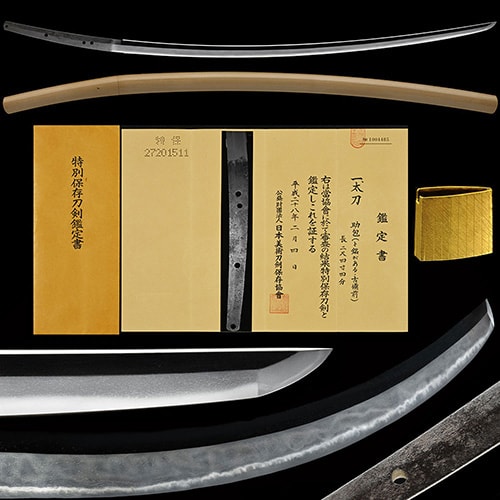
Sukemori is a swordsmith of the late into the early period, known today only by a small body of signed , each bearing a bold, large two-character cut with a thick chisel. His name is one of the standing attribution problems. The reference works enter a smith called Sukemori among the Fukuoka group, but the published sources hold that a clearly distinct, older Sukemori works in a manner, and that it is to this archaic hand that his recognized signed blades belong. The point is made plainly on his Jūyō Bijutsuhin : although the list an Sukemori, "there exists a Sukemori clearly different from that one, and this blade is likely his" (それとは明らかに異った古備前の助守があり、本作がそれであろう). His signature style, the source adds, is more old-fashioned than that of the Sukemori, so even the name on the tang reads as the older hand.

The temper is the tell of his work. Over a of he sets a broad -tone that undulates gently and becomes "wet" in feeling, mixing and into the line, with entering abundantly. What separates him from his namesakes is the strength of the : it adheres heavily through both and , runs frequently along the temper, and the tends to , a subdued depth rather than a bright clove-flower. The published sources, weighing the several Sukemori smiths they have examined, judge this one "the strongest in and the most archaic in tone" (経眼した限りではこの助守が沸強く、最も古調である). The flaring and high clove heads of the mature Fukuoka school are absent; in their place is the quieter, -laden of an older generation.

The carries that archaic character. The is dense, thickly covered with and entered by fine , standing a little in places and admixed on one blade with a touch of along the . The shape agrees with the dating: slender in build, the set at the waist and retained even after shortening, running to a , the dignified bearing of the early . The runs in a and turns back with a tendency. Taken together, the published sources read the whole "as more archaic than Fukuoka , a work of around the early " (総じて福岡一文字よりも古調で鎌倉初期頃の古備前物と鑑せられる).

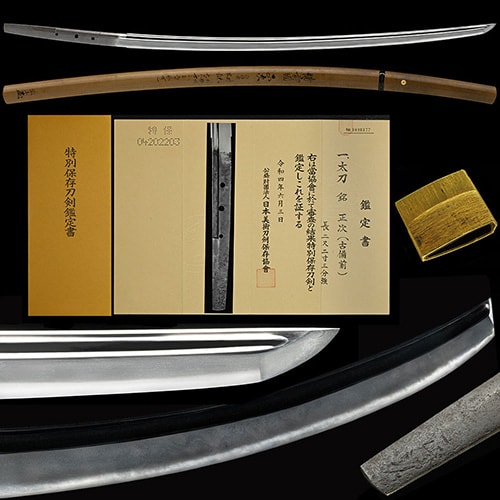
Within his small surviving group the degree of flamboyance varies, and the variation is itself instructive. His more decorative , an blade keeping its three-character though the inscription is corroded, widens the body and raises the line into a mixed with and small , the deep with and running through. Yet even there the judges place him by style and signature in the group rather than the . The name recurs, the published sources note, in both the and the lineages with differing workmanship and differing manners of signing, so several smiths used it across both schools, from the very end of into the period; this Sukemori is held the most archaic of them.

What sets his hand apart from both its neighbours is exactly what the judges name. He is held apart from the flamboyant of the mid- by the calm of his -toned line and the depth of its , his "signature style older than the Sukemori" (銘振りも一文字助守より古調である); and he is distinguished from the plainer old- hands by the strength of that and the that enlivens it. He stands before the school's great flowering at Fukuoka, one of the quiet archaic roots from which the brightest of the traditions would grow.

For the collector he is a rare early name carried by a slight but high record. He has no National Treasures; his designations run instead through an Important Cultural Property held at Kitano Tenmangū Shrine in Kyoto, a prewar Jūyō Bijutsuhin published in the Kōzan , the Kantō Zuiroku and the Nihontō Taikan, a , and two , the Jūyō Bijutsuhin piece having descended through Shigetaka Kinkyō of Toyama. The published commentary calls his finest signed "sound in both and , a well-made example" (地刃健全で出来のよい一口である), and holds the signed blade valuable as reference material for the school. These are designated cultural property and long-held heritage, not blades that pass through the market; the few in the and tiers come to light only seldom. A signed Sukemori in private hands is among the rarer things a collector of early could hope to encounter, and a document, when one appears, of how the line stood before .
Kantei

one archaic Ko-Bizen hand read through a quality spread: the typical broad suguha-toned ko-midare, strong in nie with frequent sunagashi, the calm core of his signed tachi, opening on his more decorative piece into a choji-midare with gunome and small notare over an itame with chikei

Sukemori is a smith of the late into the early period, and his name is one of the problems: the enters Sukemori among several smiths of the Fukuoka group, but the published sources hold that there exists a clearly distinct, older Sukemori in a manner, and it is to this archaic hand that his recognized signed belong. His readable record is a small body of signed , all bearing a bold two-character . Over a slender, he forges an , in places standing or with a touch of , thickly covered with and fine . The temper is the tell: a broad -tone undulating gently and mixing and , entering well, adhering strongly, with running frequently and the tending to . The published sources judge this more archaic than Fukuoka and, among the several Sukemori namesakes they have examined, the strongest in and the most archaic in tone. His one more decorative raises the line into a with and small , the deep with and running, while the keeps a turning to a small round. Signed Sukemori survive in only a handful, so an - example is prized as reference material.

Diagnostic discriminators

Observation by phase

The broad suguha-toned ko-midare (his typical hand, the most archaic Sukemori)

His core record is the signed tempered in a broad -tone. The shape is the old bearing: slender in build, with retained even after shortening, running to a . Over a dense , on one piece with a slight admixture of on the and on another standing a little, he sets a thick and fine entering. The temper is a broad undulating gently, becoming wet in feeling and mixing and , abundant entering, adhering strongly, running frequently, the tending to . The runs in a turning back with a tendency. The published sources judge this overall more archaic than Fukuoka , a work of around the early , and among the several Sukemori namesakes they have examined the strongest in and the most archaic in tone, both and sound and well-made.

Sugata 姿
Jigane 地鉄
Hamon 刃文
Bōshi 帽子

The more decorative choji-midare (his showier piece)

His one more decorative surviving is wider in body with a somewhat deep and a , an blade retaining its three-character signature though the inscription is corroded. Over an with a little entering, the temper is a mixed with and small , the deep with adhering, and and running through. The is straight into a small round. The published sources, noting that the Sukemori name occurs in both the and the groups with differing workmanship and signature manners, judge this one by its style and its to belong, like his calmer , to the group.

Sugata 姿
Jigane 地鉄
Hamon 刃文
Bōshi 帽子
Scholarship

The published sources record that the Sukemori name is entered in the Meikan among the Fukuoka Ichimonji group, but that there exists a clearly distinct, older Sukemori in a Ko-Bizen manner, to which his signed tachi belong, more archaic than Fukuoka Ichimonji and old in its signature style. They further note that the name recurs in both the Ko-Bizen and Ichimonji groups with differing workmanship and signatures, so multiple smiths of the name worked in both lineages, from the very end of Ko-Bizen into the Nanbokucho period.

On the Juyo Bijutsuhin tachi the published sources give two appraisals: that the hamon is ko-midare with strong nie in the ji and ha, displaying an archaic manner whose signature style is older than the Ichimonji Sukemori, and that among the examples examined this Sukemori is the strongest in nie and the most archaic in tone.

Designations

Kokuhō—
Jūyō Bunkazai1
Jūyō Bijutsuhin1
Gyobutsu—
Tokubetsu Jūyō1
Jūyō Tōken1

Elite Standing

0.11 across 4 designated works

Top 18% among smiths

Provenance

1 documented provenance across certified works by Sukemori

Provenance Standing

0 works held in elite collections across 1 documented provenances

Top 48% among smiths

Raw score: 2.00 / 10

Blade Forms

Distribution across 4 ranked works

Signatures

Signature types across 4 ranked works

Currently Available

Ko-Bizen School

Other artisans of the Ko-Bizen school

  1. 1.Tomonari友成34designated
  2. 2.Masatsune正恒66designated
  3. 3.Kanehira包平32designated
  4. 4.Kageyasu景安1 for sale27designated
  5. 5.Yoshikane吉包46designated
  6. 6.Nobufusa信房13designated
  7. 7.Naritaka成高9designated
  8. 8.Yukihide行秀16designated
  9. 9.Sukekane助包1 for sale28designated
  10. 10.Motochika基近4designated
  11. 11.Junkei順慶7designated
  12. 12.Tsunemitsu恒光8designated

Sukemori

Sukemori(助守) was a Japanese swordsmith of the Ko-Bizen school in Bizen province, active during the Heian (late) - Ko-Bizen period.

The work follows the Bizen-den tradition.

Designated works by Sukemori include 1 Jūyō Bunkazai (Important Cultural Property), 1 Tokubetsu Jūyō, 1 Jūyō.







