NihontoWatch MonNihontoWatchBETA
MarketEncyclopedia
NihontoWatch Mon

NihontoWatchBETA

Market
Encyclopedia
Overview·Kantei·Designations·Provenance·Blade Forms·Signatures·Lineage·School
OverviewKanteiDesignationsProvenanceBlade FormsSignaturesLineageSchool
  1. Schools
  2. Ko-Bizen
  3. Tsunemitsu

Ko-Bizen Tsunemitsu

恒光

Tokujū
Vol. 4, No. 16 · Tachi

Ko-Bizen Tsunemitsu

恒光

8 ranked works

ProvinceBizenEraHogen (1156–1159)PeriodHeianSchoolKo-BizenTraditionBizen-denTeacherMasatsuneTypeSwordsmithCodeTSU363
1Jūyō Bunkazai
2Jūyō Bijutsuhin
1Tokubetsu Jūyō4Jūyō Tōken

Overview

Tsunemitsu is a swordsmith of the Masatsune line, working at the close of the and the opening of the period. The published sources transmit him as the son, or else a disciple, of Masatsune, and read his work as belonging unmistakably to that house: of the formerly in the Daishōji Maeda family they write that it 'displays workmanship in both and shared with Masatsune' (地刃共に正恒に共通する作風を示しており), enough to accept the maker as one of that line. His surviving record is small, a handful of signed and a single shortened drawn to him on workmanship alone, and the commentary returns each time to the point, that signed works by his hand are 'comparatively few, in contrast to Masatsune' (この工の在銘作は、正恒と相反して少なく). He is one of the quiet old- hands standing at the threshold before the Fukuoka would flower in the mid-.

His hand is a single manner read through a spread of quality rather than two separate registers. The temper that recurs across his signed blades is a -based into which and are mixed, with and entering, the tending slightly toward tightness, adhering well, and and running frequently through it. It is a shallow, small irregular line, calm by the standard of later , and it is by this temper above all that the school knows him: on the Daishōji Maeda the published sources note that 'in both and the blade calls Masatsune to mind' (この太刀は刃文も帽子も正恒をおもわせるものがあって), the signature clear and the nearly shape valuable in itself. The runs straight into a small round, the piece finishing instead in a larger , and on three of the a is carved through, terminating in .

Beneath that temper the is a well-packed , standing a little in places, with and a faint rising in the calmer pieces. On his best blades the reflection clears into a true over a slightly standing mixed with a little , entering, the old- the judges name among the principal points of his work. The shape is the bearing of his period throughout, slender, with a clear taper from base to point, a high with and a small , the settling toward the tip.

His most decorative surviving pieces open the manner toward flamboyance without leaving it. On the of the sixty-second session the temper rises high at the in a -like fashion, then proceeds in a mixing and , the showing , fine and intermixing, and running, while a clear stands in the ; the published sources call it a blade in which 'the points of interest of old work are well displayed' (古備前物の見どころがよく表示されている). On the of the thirty-eighth session the mixes with and becomes a shallow toward the , the tightening and the predominating, named by the judges as one characteristic style of this smith. The signed work is the body of his record, and cut with a bold two-character ; the one shortened , wide-bodied and in the , was placed within the line on its and despite the loss of its signature.

What separates Tsunemitsu within old is exactly what the judges name in placing him. His calm -based , his bright on the finest pieces, and his and held in common with Masatsune mark him as that smith's nearest follower, while his quiet line and his comparatively few signatures set him apart from the more prolific master and, looking forward, from the flamboyant of the Fukuoka that the mid- would bring. One commentary, examining the most representative of his surviving , calls its signature 'the most typical example' of his hand, the touchstone by which the rest are read.

For the collector he is a rare early name with a small but high designated record. Fujishiro assigns him no grade, and he has no National Treasures; his survival runs instead through one signed designated an Important Cultural Property, one raised to , four at , and two prewar Jūyō Bijutsuhin, almost all of them signed. His blades are heritage carried down in named houses and a public collection rather than swords that circulate: the and one descended through the Daishōji Maeda family of , the latter accompanied by a Kōjō appraising it at fifteen gold coins; the two Jūyō Bijutsuhin passed through Tachibana Kantoku of Fukuoka; and one of his blades is now held at the Seikadō Bunko. The Important Cultural Property is patrimony that does not come to market, and the handful in the and tiers reach it only rarely, since the published sources call an , signed example 'few in number, of high value as reference material' (数少ない同工の生ぶの有銘作として資料的に貴重であり). A signed Tsunemitsu in private hands is among the rarer things a collector of early could hope to encounter, and one appears, when it does, only with patience.
Kantei

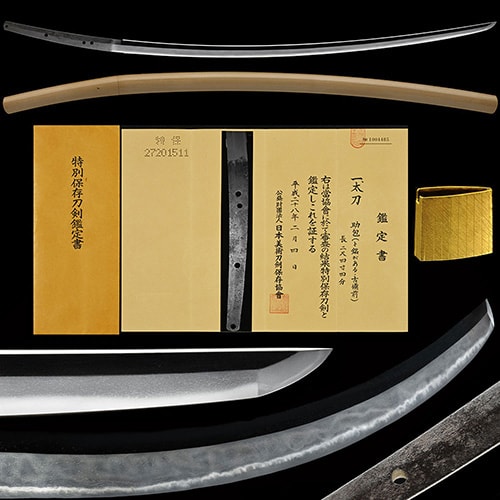
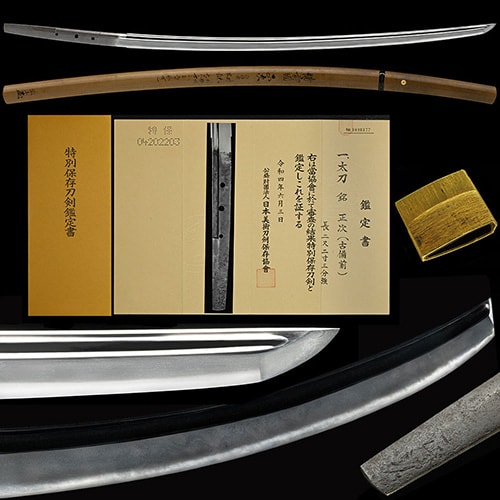
one Ko-Bizen hand read through a quality spread: the typical suguha-based ko-midare that recalls Masatsune, the calm core of his signed and mumei work, opening on his best pieces into a more decorative koshiba-raised choji-midare over a clear midare-utsuri

Tsunemitsu is a smith of the Masatsune line, working at the close of the and the opening of the period, transmitted as the son or a disciple of Masatsune. His readable record is a small body of signed , and bearing a bold two-character , with one attributed to him on workmanship. The hand is one manner read through a quality spread, not two registers. Over a slender, high with and a small he forges a , in places standing a little, with and a faint that clears into a on his best pieces. The temper is a -based mixed with and , and entering, adhering well, with frequent and , the straight into a small round. The published sources read it as a and that call Masatsune to mind, the principal points of old well displayed. His most decorative pieces raise the temper high at the in a -like manner, mixing and over a clear . Signed works by him are, the published sources stress, comparatively few beside Masatsune's, so an signed Tsunemitsu is prized as reference material.

Diagnostic discriminators

Observation by phase

The suguha-based ko-midare (his typical hand, recalling Masatsune)

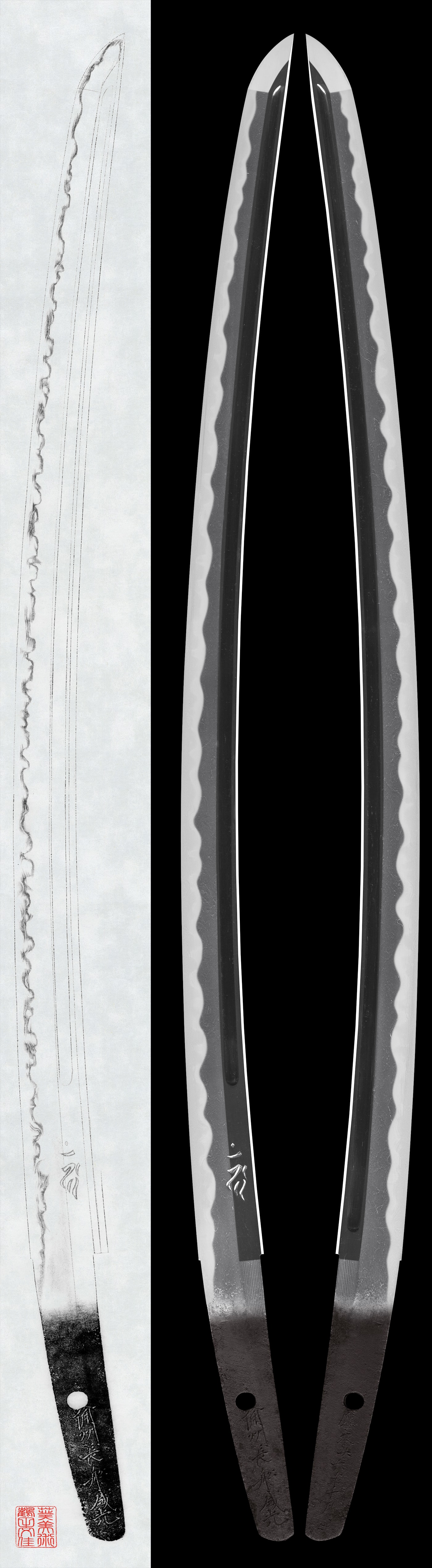
His core record is the signed in a -based . The shape is the old bearing of the late and early : slender, with a clear difference between base and tip width, a high with , the tending to settle toward a small . Over a well-packed , in places standing a little, he sets and a faint . The temper is shallow and small, a -toned mixed with and , and entering, the tending slightly toward tightness, adhering, with and running through. The is straight into a small round, the finishing in a larger . He carves a on both sides, terminating in . The published sources hold this to be a and that call Masatsune to mind, and judge the signature, on the most typical of the surviving pieces, the most representative of his hand. The attributed to him extends the manner in a wider body, the , with intermittent and along the temper.

Sugata 姿
Jigane 地鉄
Hamon 刃文
Bōshi 帽子

The decorative choji-midare with raised koshimoto temper (his best pieces)

His most decorative surviving work raises the temper high at the in a -like manner, then proceeds in a mixed with , becoming a shallow toward the . Beneath it the is an , in places standing a little and with a slight admixture of , carrying , , and a clear rather than the faint reflection of the calmer pieces. On the 62 the temper above the further mixes and within a , the shows , fine and intermix, and and run, the published sources singling out the and entwining the at the base as splendid. The 38 keeps the tight with predominating and adhering, named by the judges as one characteristic style of this smith. The remains straight into a small round.

Sugata 姿
Jigane 地鉄
Hamon 刃文
Bōshi 帽子
Scholarship

The published sources transmit Tsunemitsu as the son or a disciple of Masatsune of Ko-Bizen, note that his extant signed works are comparatively few, and judge that his ji and ha share the workmanship of Masatsune, so that even an o-suriage mumei katana can be conclusively placed within the line as his work. One commentary calls the signature on the most typical surviving tachi the most representative example of his hand.

On one Jubi tachi the published sources record a tampered signature: the tang now reads Masatsune (正恒), but the character 正 was added later and the original 光 beneath 恒 was struck out, so that the blade is in fact a Tsunemitsu (恒光) whose mei was altered toward the more famous Masatsune.

Designations

Kokuhō—
Jūyō Bunkazai1
Jūyō Bijutsuhin2
Gyobutsu—
Tokubetsu Jūyō1
Jūyō Tōken4

Elite Standing

0.23 across 8 designated works

Top 10% among smiths

Provenance

2 documented provenances across certified works by Tsunemitsu

Provenance Standing

1 works held in elite collections across 2 documented provenances

Top 69% among smiths

Raw score: 1.91 / 10

Blade Forms

Distribution across 8 ranked works

Signatures

Signature types across 8 ranked works

Currently Available

Lineage

TeacherMasatsune
Tsunemitsu
Student
  1. 1.Norinobu則延

Ko-Bizen School

Other artisans of the Ko-Bizen school

  1. 1.Tomonari友成34designated
  2. 2.Masatsune正恒66designated
  3. 3.Kanehira包平32designated
  4. 4.Kageyasu景安1 for sale27designated
  5. 5.Yoshikane吉包46designated
  6. 6.Nobufusa信房13designated
  7. 7.Naritaka成高9designated
  8. 8.Yukihide行秀16designated
  9. 9.Sukekane助包1 for sale28designated
  10. 10.Motochika基近4designated
  11. 11.Junkei順慶7designated
  12. 12.Toshitsune利恒21designated