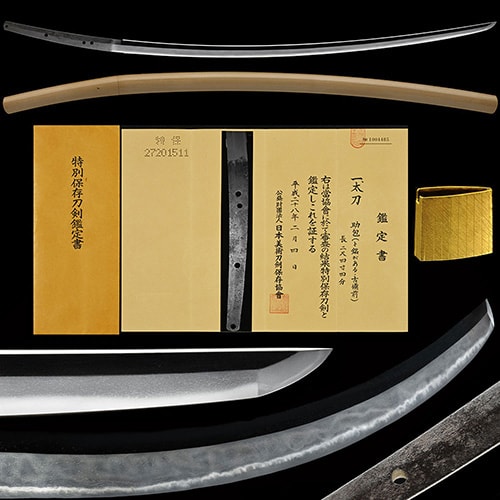
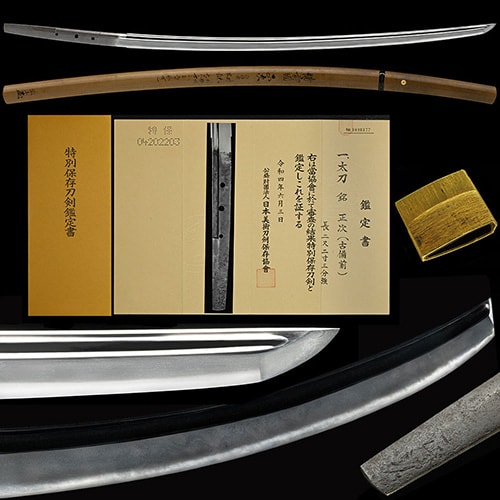
Sukehira is a smith of the close of the and the opening of the period, and since antiquity he has been named one of the Sanbira, the three '-' smiths, alongside Takahira and Kanehira. The published sources put the rarity of his name plainly: of the three, Kanehira is met from time to time, Sukehira is extremely rare, and Takahira has no work that can be regarded with confidence as authentic. The , an blade signed no Sukehira in five characters, is the anchor of the small surviving group, and on it the commentary calls the workmanship one that evokes "the antique fragrance and deep flavor characteristic of old ". His record is one consistent hand, read not as two manners but as a single old- style seen across a spread of condition.
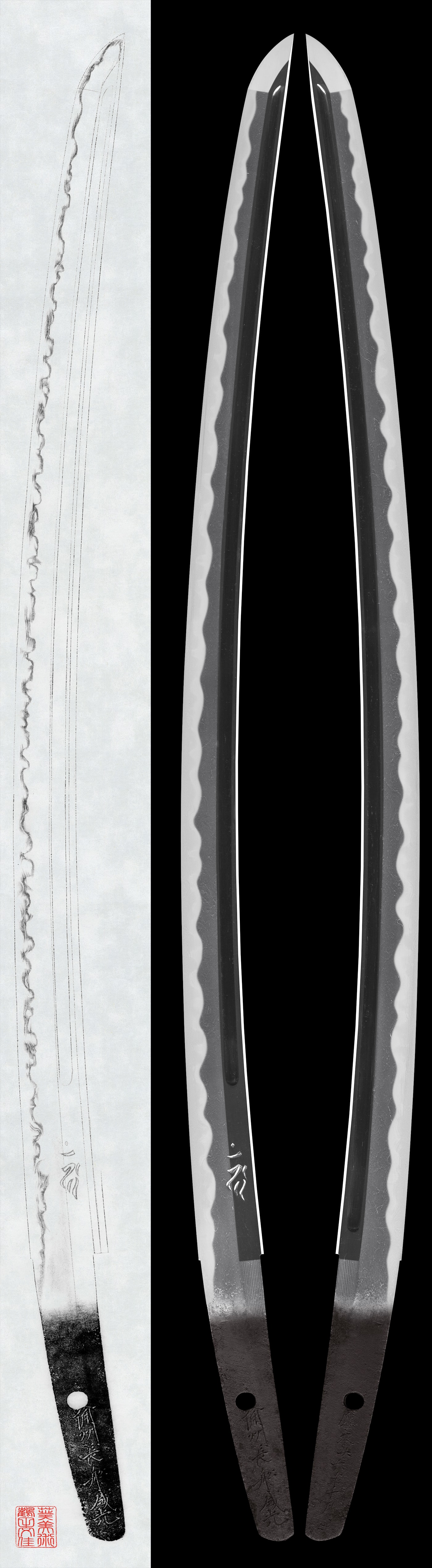
His characteristic hand is a low, quiet temper rather than a flamboyant one. Over the slender body he sets a -toned , the deliberately low, into which enter , and , with and and thickly adhering . Fine and run throughout, and along the hardened edge intermittent and are interwoven. On the slighter survivors the line draws in to a mixed with , and , the tending to , with appearing. This is the calm root manner of old , set apart from the high, decorative of the Fukuoka that would flower a generation later, and the published sources read on the signed the points by which "the individual traits of this smith can be discerned".
The is the constant beneath that quiet temper. It is an mixed with , the grain well packed, with well adhering and fine entering frequently, and over it a stands distinctly on his best pieces, while the more worn keep only a faint reflection. The runs straight into a , on the blade with and a slight turnback, in one piece showing . On the 29 a is carved kaki-nagashi through both faces. On the finest examples both and are rich in throughout, the activity carried in the and of the temper and the of the .
The surviving body divides by condition rather than by style. The signed , the and 49 among them, keep the original high , the and the , and present what the commentary calls a form "dignified yet graceful"; the on these is clear. The shortened survivors carry the hand more subdued: one blade, slightly shortened but almost , shows the and tending overall to fatigue and the small irregularities of the temper a little unsettled, while another is read as a low-tempered -based of "subdued flavor". A constant tell binds them: every confirmed survivor is cut with the long five-character signature no Sukehira, none with the two-character , the reverse of Kanehira, whose long signature is the exception.
What sets him apart within old is read off his own work rather than by contrast. His is the bright old- with , frequent and a standing , carrying a low -based enlivened by and , the calm manner that precedes the school's great flowering at Fukuoka. The published sources draw the comparison directly on the 29 : extant signed Sukehira survive in the Imperial collection, in the former Imperial holding now in the Tokyo National Museum and in the fire-damaged Nikkō Tōshōgū blade, and the long signatures on these pieces are cut in a strikingly similar manner, so that they at once display the flavor of and allow this smith's own traits to be discerned. He stands at the threshold of the tradition, the quiet root from which its most brilliant hands grew.
For the collector he is among the rarest of early names. Fujishiro grades him Jō-jō . He has no National Treasures and no Important Cultural Properties; his record runs instead through a single and a small number of , with related pieces in the Imperial collection, the Tokyo National Museum, the Nikkō Tōshōgū and the Hikone Castle Museum. Provenance is distinguished where it survives: one descended through the Fushimi-no-miya household with a Hōreki 13 and a gold chrysanthemum-crest cord-wrapped mounting, and his blades passed also through the Imperial Family, the Iwasaki and the Tōdō houses. The published sources hold an signed Sukehira to be "exceptionally valuable as documentary material". With only a handful of authenticated works in existence and most held in institutions and long-held collections, a signed Sukehira reaches private hands only very rarely. A documented example is among the rarest things a collector of old could encounter, a witness to how the tradition began.