NihontoWatch MonNihontoWatchBETA
MarketEncyclopedia
NihontoWatch Mon

NihontoWatchBETA

Market
Encyclopedia
Overview·Kantei·Designations·Provenance·Blade Forms·Signatures·Lineage·School
OverviewKanteiDesignationsProvenanceBlade FormsSignaturesLineageSchool
  1. Schools
  2. Horikawa
  3. Kunisuke

Horikawa Kunisuke

國助

Jūyō
Vol. 48, No. 154 · Naginata

Horikawa Kunisuke

國助

50 ranked works

ProvinceSettsuEraGenna-Shoho (1615–1647)PeriodEdoSchoolHorikawaTraditionShintoGeneration1stTeacherKunihiroFujishiroJo-jo sakuToko Taikan700(top 17%)TypeSwordsmithCodeKUN1197
1Jūyō Bijutsuhin
1Gyobutsu
48Jūyō Tōken

Overview

Kawachi no Kami Kunisuke is an Osaka name carried by two hands, and the published sources keep the two carefully apart. The first generation went up to Kyoto and entered the school of Kunihiro as a late disciple; when Kunihiro died in Keichō 19 he moved to Ōsaka together with Izumi no Kami Kunisada, the elder Kunisada, and the two became pioneers of the Ōsaka tradition. He was, by tradition, from Kanbe in Province and of Ishidō descent, and the published record makes that descent the key to his hand: among Kunihiro's pupils he was, in their words, the one who 'most excelled at ' (最も丁子を得意とし), so that some trace of clove pattern always surfaces somewhere within his irregular temper. Several of the entries judge from his style and the manner of his signature that his real teacher in practice was the senior fellow-disciple Echigo no Kami Kunitomo, rather than Kunihiro alone.

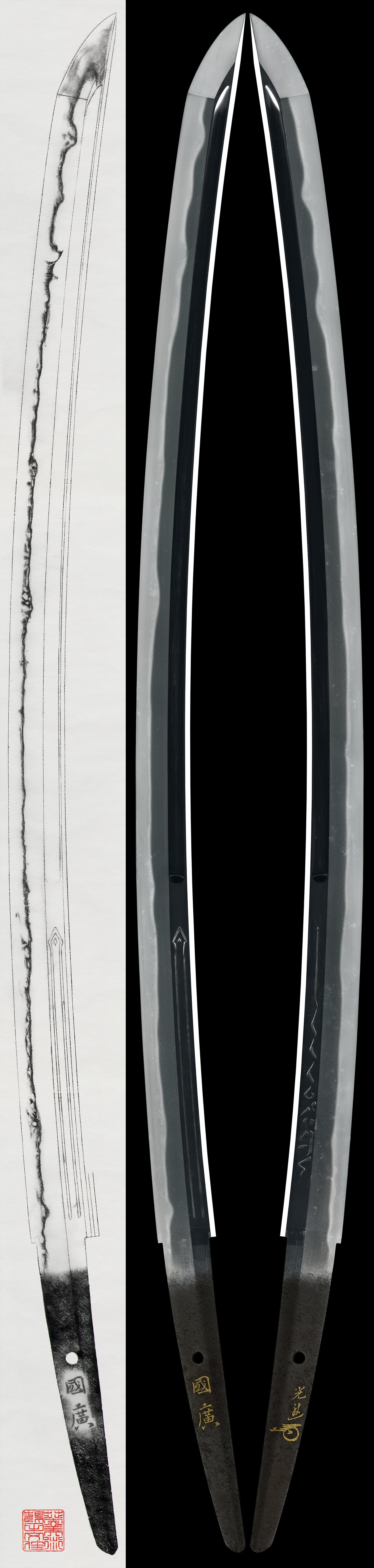
His recognized hand is a of standard width with shallow and a , forged in a tightly packed with abundant . From a straight at the base the temper opens into a mixed with and a small , deep in with well adhered, and entering, and running through, the turning into a . The prominence of clove within the is the very point on which the appraisal turns: where another blade might pass without a name, the published sources note that within the group the conspicuous is what marks the work as Kunisuke's. His manner stands extremely close to that of the elder Kunisada with whom he came south, the two reading as companions of one Ōsaka beginning.

The is where the second register declares itself. On a number of his blades, and most plainly on his , the stands and turns , the loose rustic of his master Kunihiro's school carried into Ōsaka, with thick and . Over that the temper centres on a mixed with , the deep within the edge, running well and entering, with appearing at times. One the published sources read as 'a style of strong colour' (堀川色の濃い作風), the standing and the -laden an accomplished demonstration of what he learned; a relief with a companion groove and, on his finest blades, goma-bashi carving accompany this manner. This is the hand of a pupil who never quite set down the Ishidō clove he was born to.

The second generation, son of the first and known to the world as Naka-Kawachi, turns the other way. He forges a tightly knit, beautiful and tempers a flamboyant clove centred on his own fist-shaped , mixed with and varied so as never to fall into monotony, often opening from a long straight , the tight, bright and clear, the to . The published sources call this 'the Ishidō house's own ' (石堂家本来の丁子を焼いて) and note that the manner of his father is scarcely seen in it; his forte, they say, 'lies in a of fist-shaped clove, the well-ordered, beautiful its point of appreciation' (拳形の丁子乱れにあり、地がねはよく整って美しい). His work was 'praised as a ' (新刀一文字と賞された) in its own day, and the sources add, with candour, that some pieces tempered motifs such as Mount or jewels and ran too far into technical display.

What separates the line from its neighbours is exactly what the judges name. Set against the Tsuda smiths, who tempered the brilliant billowing tōran, Naka-Kawachi stood as a standard-bearer of the Ishidō lineage's original clove, his bright, fist-shaped over a beautifully ordered the counter to that wave. The first generation, for his part, is distinguished within his own school by his clove rather than against it, the one pupil whose carries the old -derived clove of the Ishidō stock somewhere inside it. Father and son thus close the name from both sides: the a hand who kept the Ishidō clove, the nidai an Ishidō hand who put the manner down.

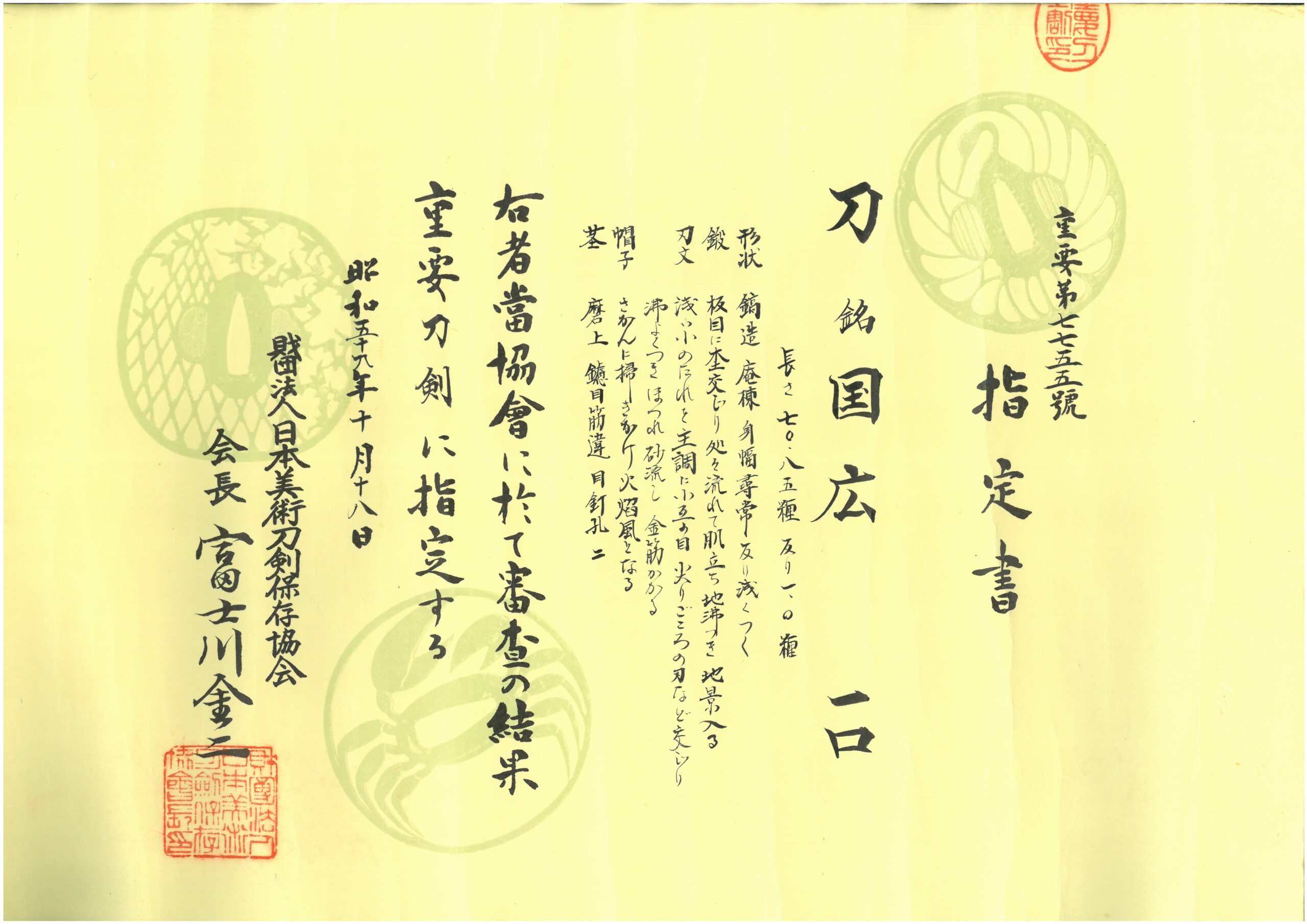
For the collector Kunisuke is one of the leading Ōsaka names, graded Jō-jō by Fujishiro. He has no National Treasures and no Important Cultural Properties; his record runs instead through the rank, forty-eight blades across the two generations, with one carried in the prewar Jūyō Bijutsuhin, and the published commentary calls the 's finest signed work 'the outstanding one among his works' (同作中の傑出の一). Provenance is recorded for only a few: the Itakura house and the Imperial Family appear among the holders of his blades, the rest in private hands of unrecorded whereabouts. Extant works by the are comparatively few, especially scarce, while Naka-Kawachi's survive in rather greater number. Only a handful fall in the tradeable tiers at any one time, so a signed Kawachi no Kami Kunisuke comes to market only from time to time, a well-made example of either generation a satisfying thing for a collector of Ōsaka to encounter and hold.
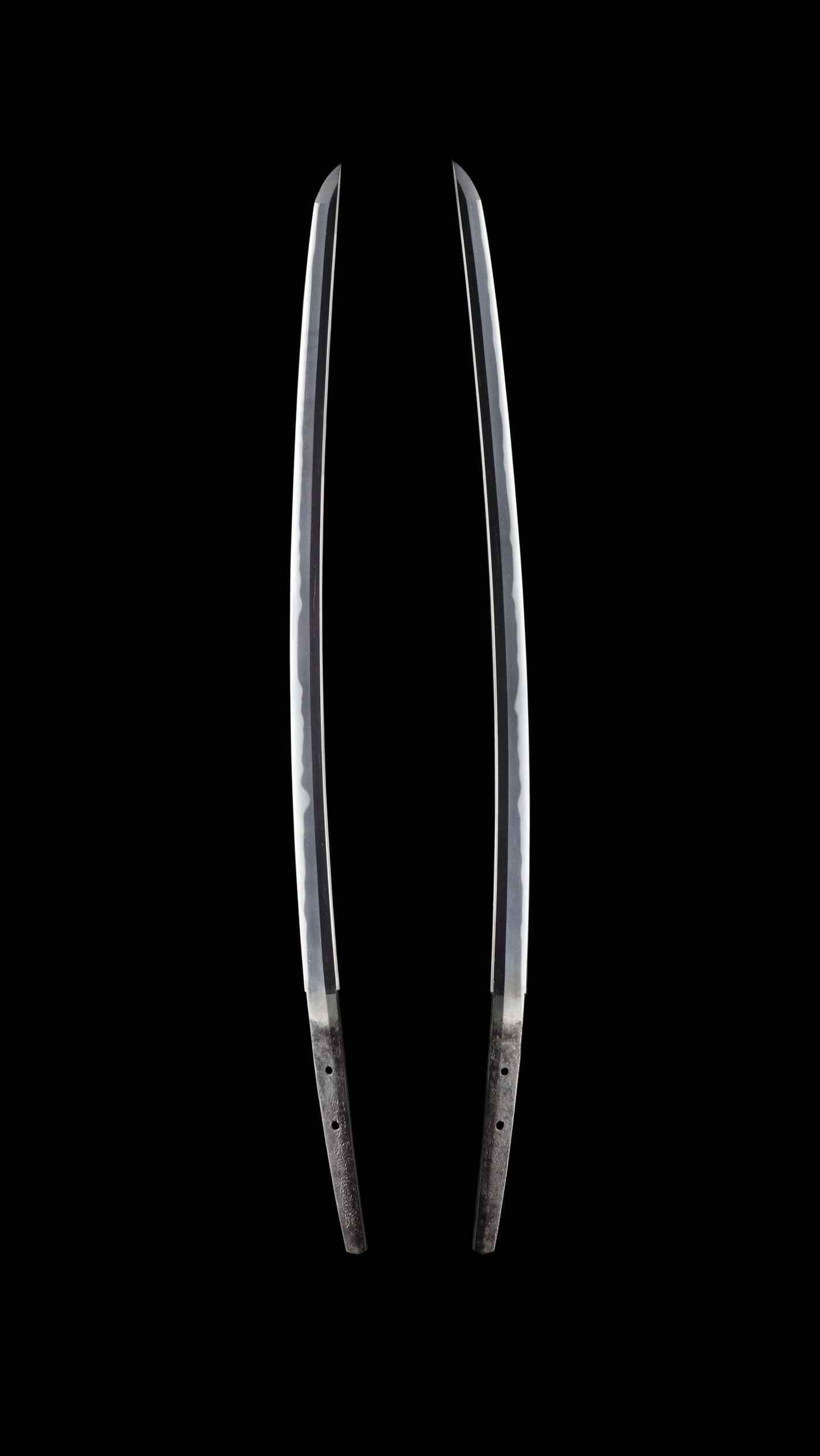
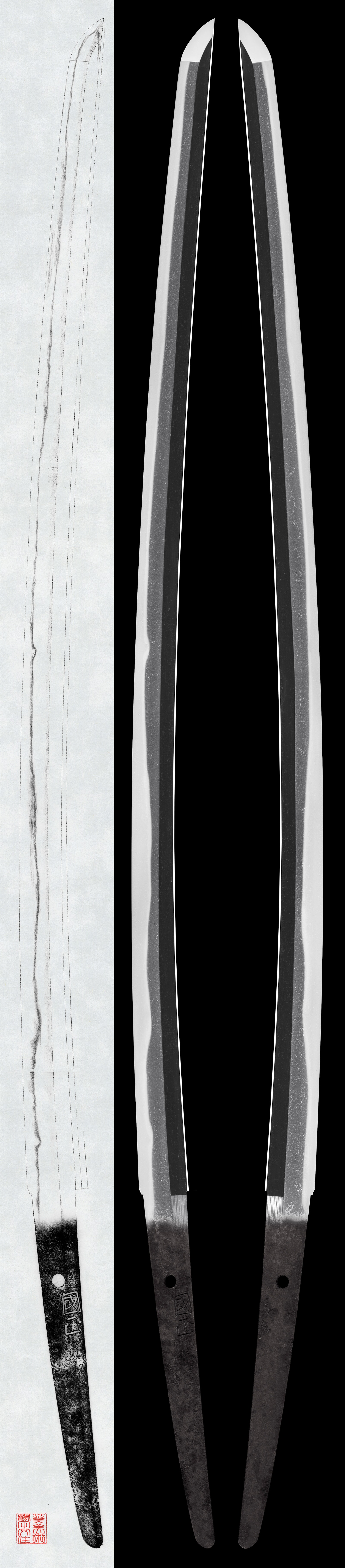
Kantei

one Osaka Shinto name read across two hands: the shodai, a Horikawa pupil of Ishido descent whose choji-midare from a straight yakidashi is his recognized prime and whose zanguri wakizashi show the Horikawa register he learned; and the nidai Naka-Kawachi, whose tightly forged ko-itame and flamboyant kobushi-gata choji, the shinto Ichimonji manner, stand apart from the Horikawa style

Kawachi no Kami Kunisuke is the name of an Osaka line whose corpus is read across two hands: the , a late disciple of Kunihiro, and his son the nidai, known to collectors as Naka-Kawachi. The published sources record that the first generation came originally from Kanbe in Province and inherited the stream of the Ishido smiths, so that within the group he was the most adept at , with some trace of it appearing somewhere in his irregular temper. After Kunihiro died in Keicho 19 he moved to Osaka together with Izumi no Kami Kunisada, the elder Kunisada, the two becoming pioneers of the Osaka tradition; several sources judge from his style and signature that his real teacher in practice was the senior fellow-disciple Echigo no Kami Kunitomo. His recognized hand is a of standard width, shallow and , forged in a tightly packed with abundant , opening from a straight into a mixed with and a small , deep in with , and entering, and running through, the to . A more strongly -flavored register survives on some of his , where the stands and turns with thick . The second generation, Naka-Kawachi, departs from his father in a beautiful, tightly forged and a flamboyant centered on his own , the fist-shaped , his work praised in its day as , with the Ishido choji standing apart from the manner.

Diagnostic discriminators

unique vs shodai's Horikawa-flavored notare-gunome

unique vs the nidai's tightly forged ko-itame

Observation by phase

Shodai prime: the choji-midare Osaka katana (Ishido within Horikawa)

The first generation's recognized prime is a of standard with shallow and a , forged in a tightly packed with abundant and entering. From a straight at the base the temper opens into a mixed with and a small , deep in with well adhered, and entering, and running through, the to a . The published sources hold the prominence of within the to be the very point by which a blade is appraised as Kunisuke within the group, since he came of Ishido stock and was the most adept at of all Kunihiro's pupils. The published sources call his manner extremely close to that of Kunisada, the elder Kunisada with whom he moved to Osaka, and call his best blades sound in and , representative work of his hand. Extant works by the are comparatively few, especially scarce.

Sugata 姿
Jigane 地鉄
Hamon 刃文
Bōshi 帽子

Shodai Horikawa register: zanguri itame, notare and nie (after Kunihiro and Kunitomo)

A second register on the first generation's work shows the manner he learned plainly. Here the stands and turns , the loose rustic texture of the school, with thick and ; the temper centers on a mixed with , deep within the edge, running well and entering, with appearing at times. The published sources read one as a strongly -flavored work, the standing and the -laden an accomplished demonstration of the style; they note that a relief with companion groove and, on his finest blades, a goma-bashi carving accompany this register. Several sources name his de-facto teacher Echigo no Kami Kunitomo here, judging from style and signature that his real guidance came from his senior fellow-disciple rather than from Kunihiro alone.

Jigane 地鉄
Hamon 刃文
Bōshi 帽子

Nidai Naka-Kawachi: kobushi-gata choji, the shinto Ichimonji

The second generation, son of the and known to the world as Naka-Kawachi, departs from his father's coloring. He forges a tightly knit, beautiful and tempers a flamboyant centered on his distinctive fist-shaped , the , mixed with and elements, often becoming a layered double-flower; enter long and well, the tight, bright and clear, the to , frequently opening from a long straight . The published sources call his work the Ishido house's own , scarcely showing the manner, and praise his beautiful, well-ordered as a principal point of appreciation. His blades were praised in their day as ; some, the sources note, tempered motifs such as Mount or jewels and ran too far into technical display. Set against the Tsuda line, who tempered brilliant billowing toran, Naka-Kawachi stood as a standard-bearer of the Ishido lineage's original .

Jigane 地鉄
Hamon 刃文
Bōshi 帽子
Scholarship

The published sources record that the shodai Kunisuke came originally from Kanbe in Ise Province and inherited the stream of the Ishido smiths, so that within the Horikawa group he was the most adept at choji, with some trace of it always appearing within his irregular temper; and that, although counted a disciple of Horikawa Kunihiro, his real teacher in practice is judged from his style and signature to have been the senior Echigo no Kami Kunitomo.

On the second generation the published sources record that he was the son of the shodai and is known to the world as Naka-Kawachi; that he tempered the Ishido house's own choji and scarcely shows the Horikawa manner; that his forte lies in the kobushi-gata choji-midare over a well-ordered, beautiful jigane; and that his blades were praised as shinto Ichimonji, some running too far into technical display with motifs such as Mount Fuji or jewels.

Designations

Kokuhō—
Jūyō Bunkazai—
Jūyō Bijutsuhin1
Gyobutsu1
Tokubetsu Jūyō—
Jūyō Tōken48

Elite Standing

0.16 across 50 designated works

Top 13% among smiths

Provenance

3 documented provenances across certified works by Kunisuke

Provenance Standing

1 works held in elite collections across 3 documented provenances

Top 89% among smiths

Raw score: 1.79 / 10

Blade Forms

Distribution across 50 ranked works

Signatures

Signature types across 50 ranked works

Currently Available

Lineage

TeacherKunihiro
Kunisuke
Students (6)
  1. 1.Kunisuke國助3 for sale9designated
  2. 2.Kuniyasu國康1 for sale7designated
  3. 3.Kuniteru國輝4designated
  4. 4.Kunisuke國助
  5. 5.Kunisuke國助
  6. 6.Kunisuke國助

Horikawa School

Other artisans of the Horikawa school

  1. 1.Kunihiro國廣6 for sale148designated
  2. 2.Kunimichi國路8 for sale74designated
  3. 3.Kunisada國貞4 for sale88designated
  4. 4.Kunitomo國儔1 for sale27designated
  5. 5.Masahiro正弘3 for sale14designated
  6. 6.Kuniyasu國安17designated
  7. 7.Hiroyuki弘幸17designated
  8. 8.Kunikiyo國清2 for sale14designated
  9. 9.Kunikiyo國清7designated
  10. 10.Kuniyuki國幸1 for sale6designated
  11. 11.Kunimasa國正6designated
  12. 12.Yoshitake吉武2 for sale4designated