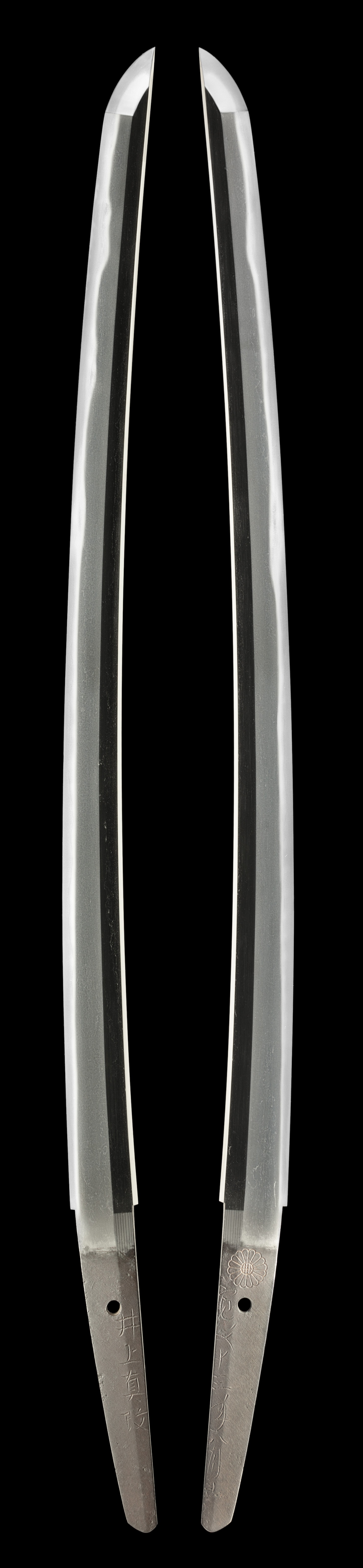
Kuniteru, personal name Kobayashi Hayanojo, was the fourth son of the first-generation Kunisuke and a younger brother of the second-generation Kunisuke, the smith called Nakagawachi. The published sources, following the Bengi, record that he received the court title no Daijo in 11, the year 1671, changed it to no Kami in the spring of the following year, and lived until around the Shotoku era of the early eighteenth century. From Genroku 10 to 12 he traveled to Awa province, where he forged signed work whose supplemental inscriptions name the place of making, such as at Tokushima and at Tsubaki-domari, inscriptions the published record treats as valuable documentary material.
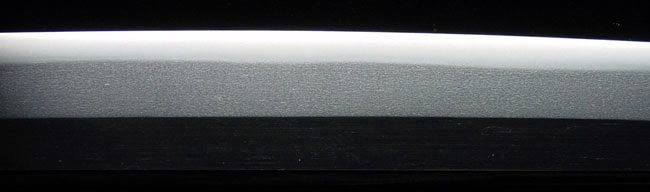
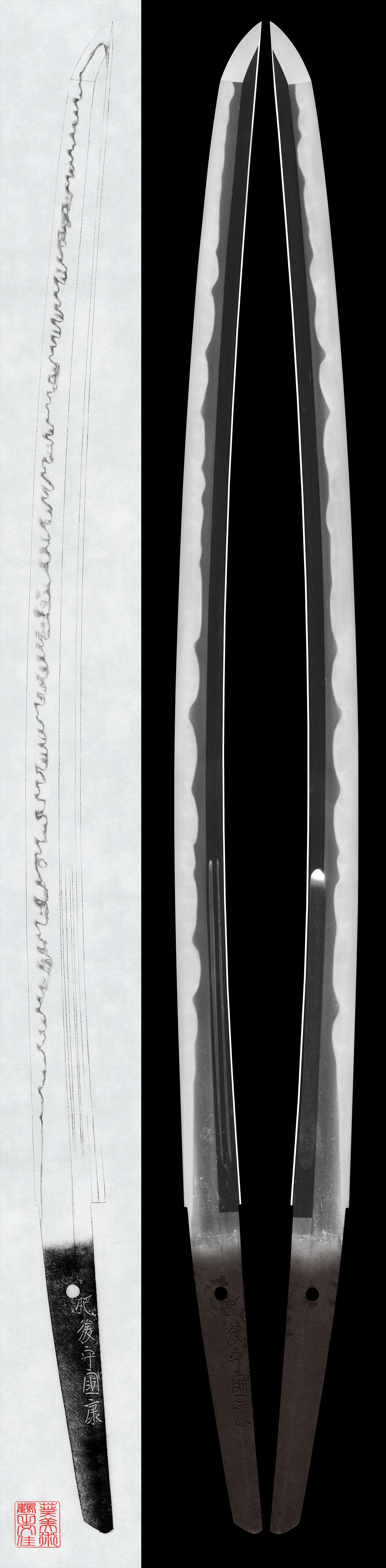
The hand by which he is known departs in feeling from his elder brother's. Over a densely forged whose gathers in fine, dust-like particles, with delicate entering throughout, he tempered the billowing toran (濤瀾) manner of the Tsuda house, a grand - modeled on the second Tsuda Sukehiro into which further is mixed; the published sources name this as the manner he was best at, in their words 『津田風の濤瀾乱に互の目を交じえた作風を得意とし』. On the representative of Enpo 5 the pattern runs with entering, the deep, thick, a slight drawn through and a bright, clear ; though a , the build is wide in the with a somewhat high and an extended , so that the whole reads as bold and powerful in the Osaka taste. The runs straight into a with a somewhat long return.
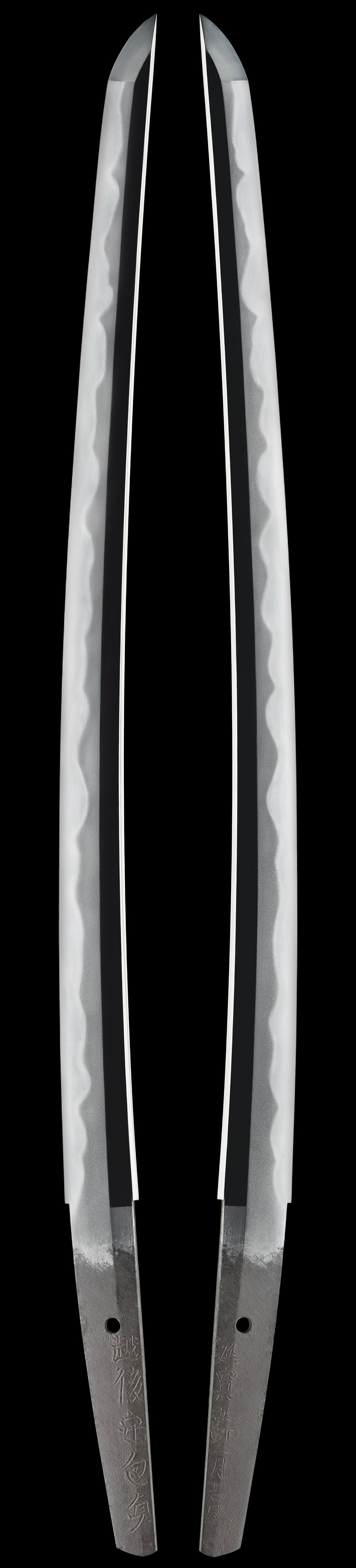
Alongside that flamboyant pattern he also worked a quieter manner the published sources set explicitly against his toran specialty, a temper based in and carrying a shallow tendency. On one late it begins with a and rises into a with only slight ; on another it takes a middle tone in which long enter and slant toward the base in the form called Kyo- (京逆足), the reverse of ordinary , a detail the published record singles out as worth noticing. Through both, the forms thickly and the runs especially deep, with and drawn well across the width, and a -like effect around the middle of one blade and a faint near the of the other; the stays bright and clear, and the is tempered rather deeply, becoming somewhat linear before turning back in a , at times with a pointed tendency and a deepish return, finely swept in .
The two manners are read by the published sources not as mere variety but as conscious model. They find the -based to recall Inoue Shinkai in the length and strength of its , its deep and bright clear , writing that it 『正に井上真改の作を髿髄とさせるものがある』, and they observe along the boundary of and the fine activity likened to torn hosho paper that is seen in the second Sukehiro's , so that the blade reads as forged with both masters in mind. The most reliable external mark of his late work is the tang itself: from the Genroku era his take the distinctive gohei-gata (御幣形) form, the tip flaring like the folded paper streamer of a wand, finished as a with large and , and all of his designated blades record it. The published sources note that his skill is understood not in the toran- alone but equally in this quieter domain, observing that 『濤瀾乱れの作柄のみならず、この手の作域に於ても彼の技術の高さが理解される』, and of a more -centered that it is more than usually bold and rich in rustic character, 『常にも増して放胆で野趣に富んだ作柄に仕上げている』. His carving, where it appears, is similarly individual: on that he cut a takemaki-ryu (竹巻龍), a bamboo-wrapped dragon conceived as a in which the bamboo stands for the sword, with an incised Marishi-sonten invocation on the reverse, and the published sources note that this specific composition 『この手の構図は本作以外には未見』, making the blade a precious reference for the study of his .
Kuniteru is a smith the connoisseur meets through his designated blades rather than through prestige, and the record is modest in scale and even in tone. His work stands at four pieces at the level, all signed and none raised higher, which fits a leading late-Osaka hand rather than one of the canonical masters; the Toko Taikan values him at a middle rank among smiths. Provenance, where it survives, is thin, as it usually is for a smith of this period and standing, and no descent or institutional holding can be claimed from his own record; what anchors his pieces instead are the inscriptions themselves, the bold thick-chisel long signature cut toward the , the Awa place-names, and the gohei-gata tang. After the deaths of Inoue Shinkai and the second Sukehiro the published sources describe him as the foremost figure remaining in the Osaka forging world, 『助広・真改の没した後は、大阪鍛刀界の第一人者として重きをなした』. A signed Kuniteru is not a blade that comes often to market, and when one does it is encountered as the work of the smith who held Osaka together after Shinkai and Sukehiro were gone, a robust Genroku blade in the Tsuda manner whose tang alone will tell a careful eye whose hand it is.