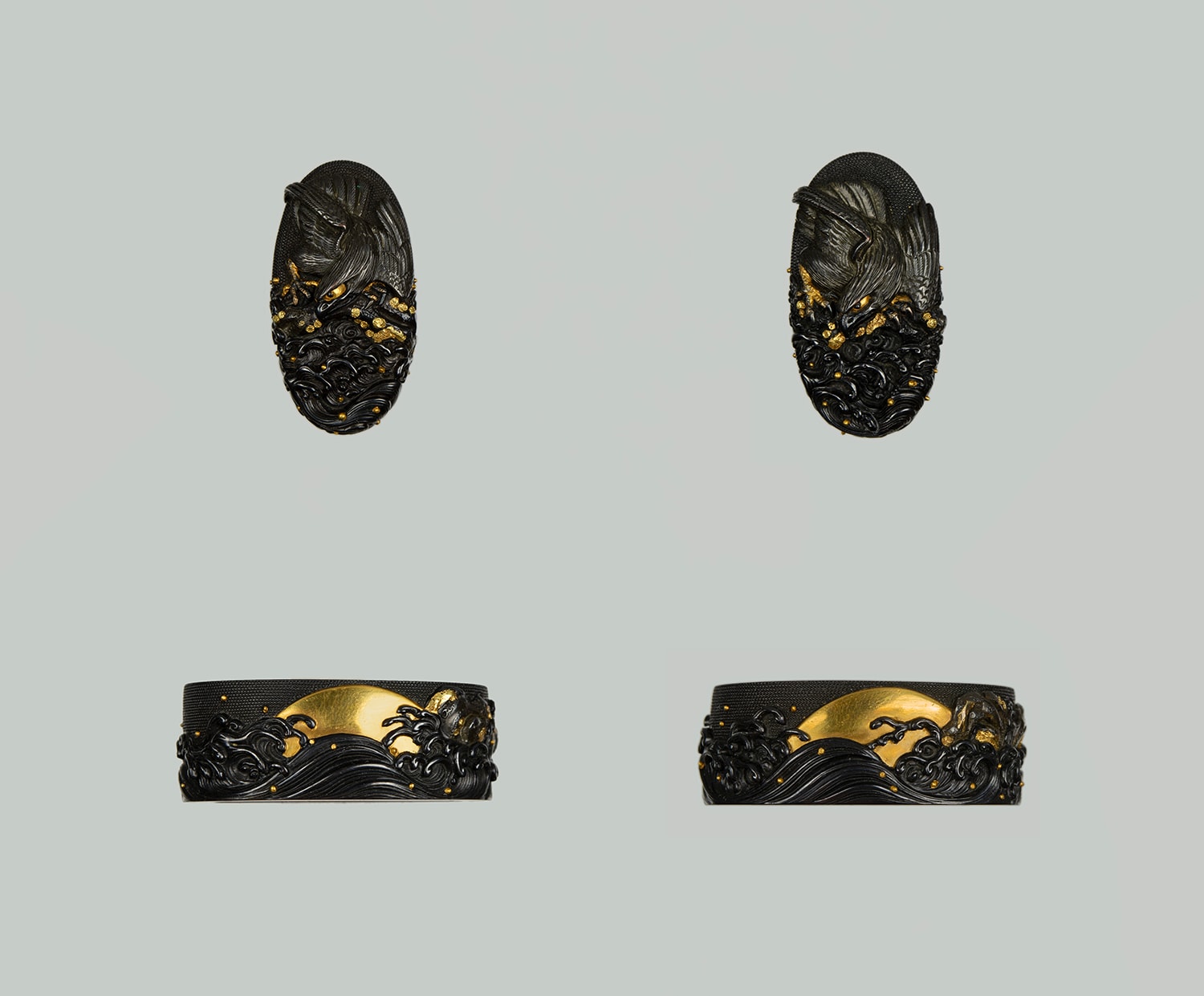
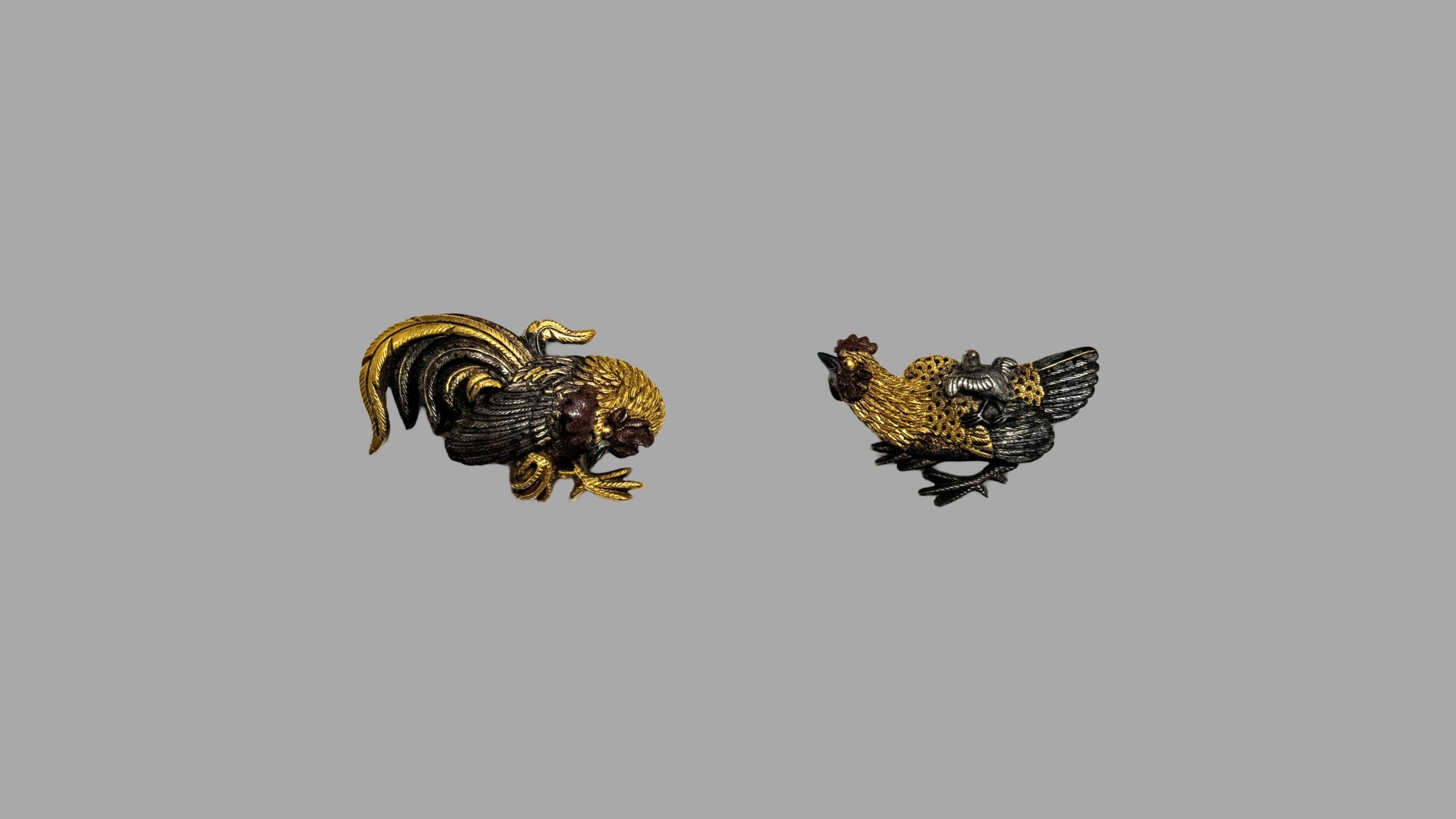
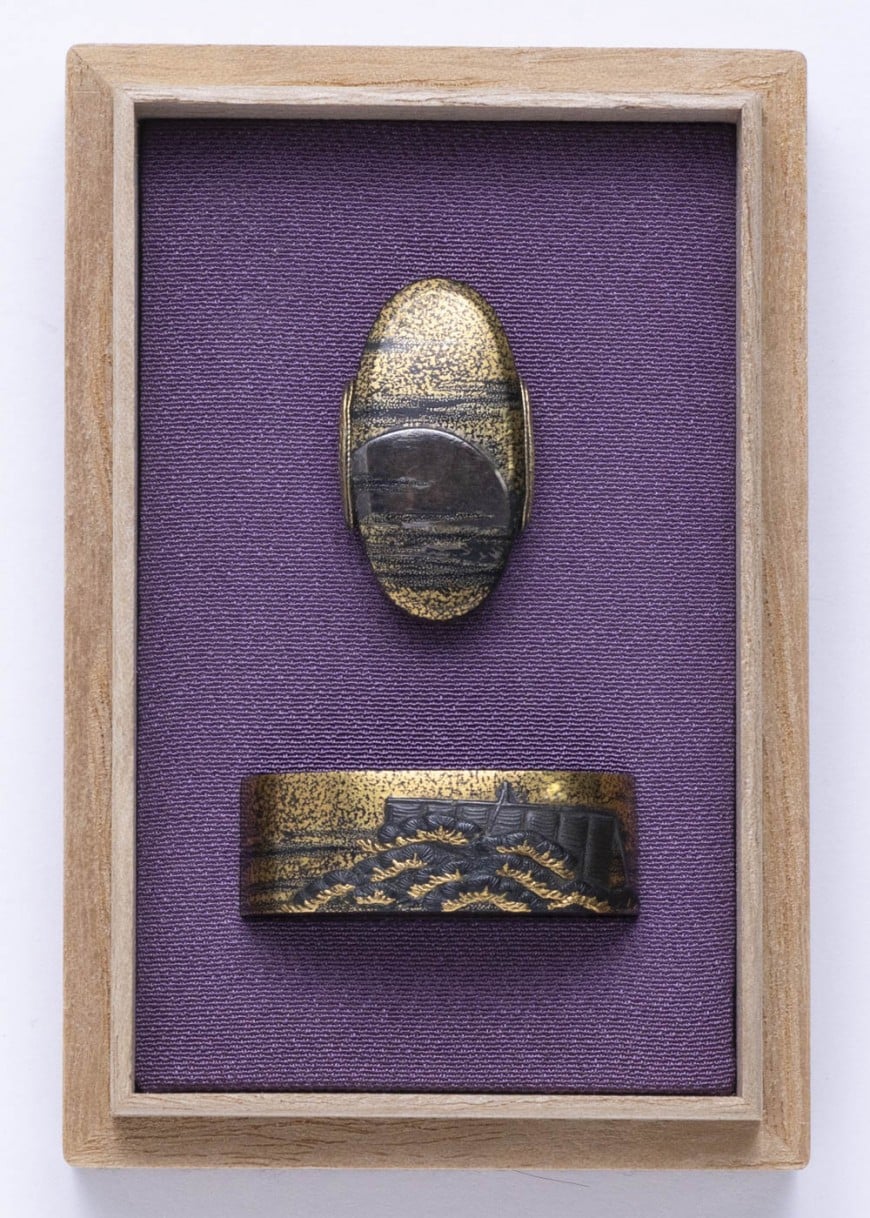
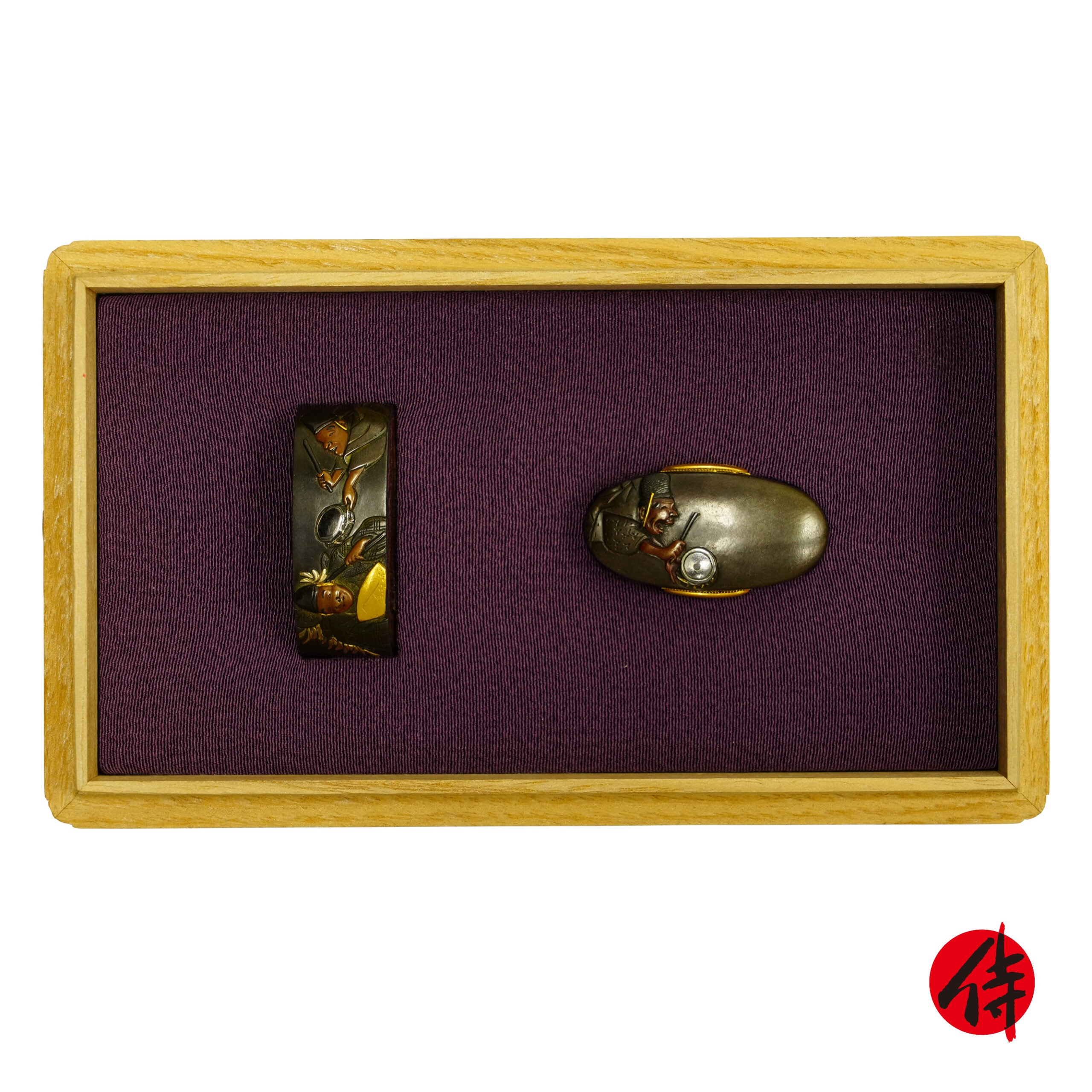
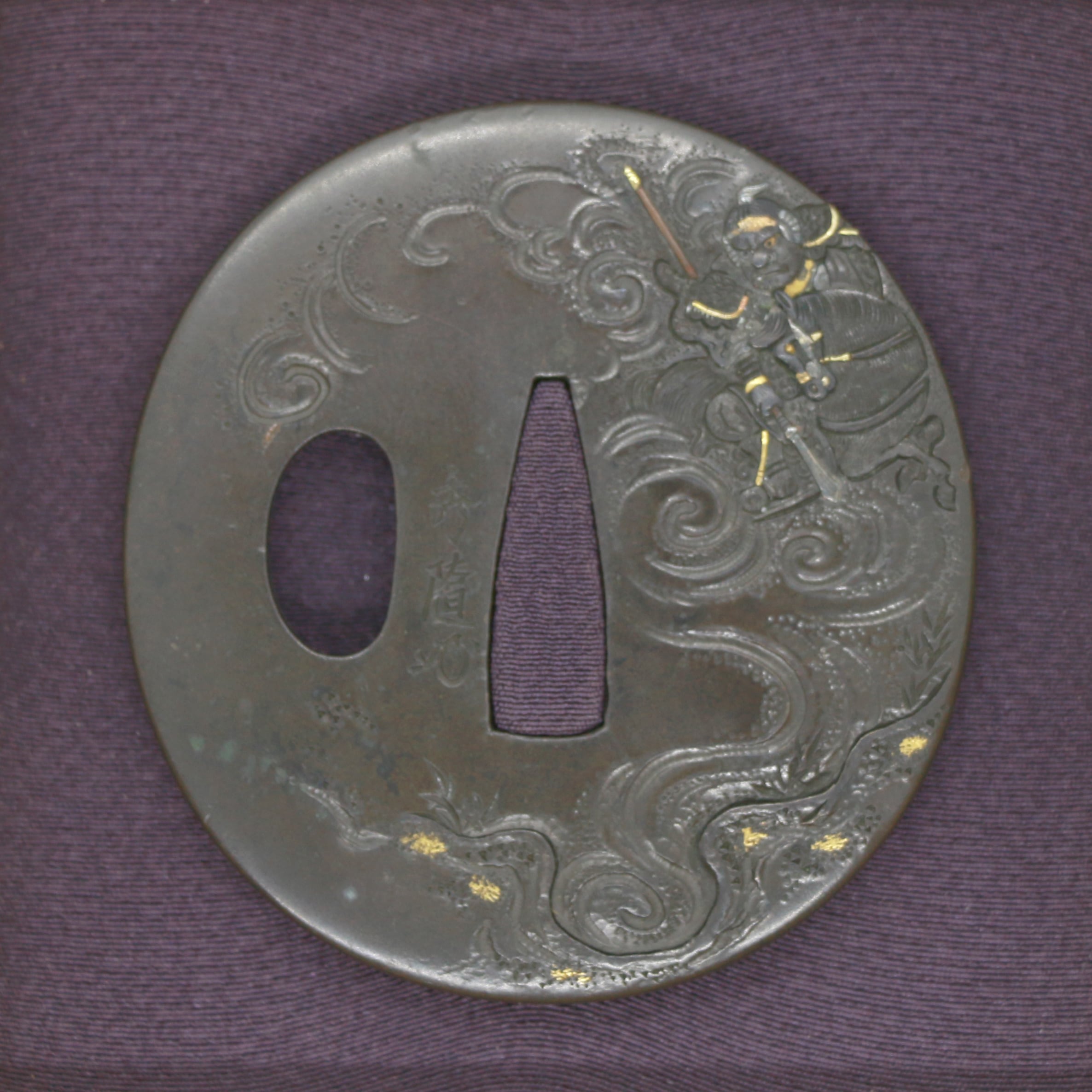
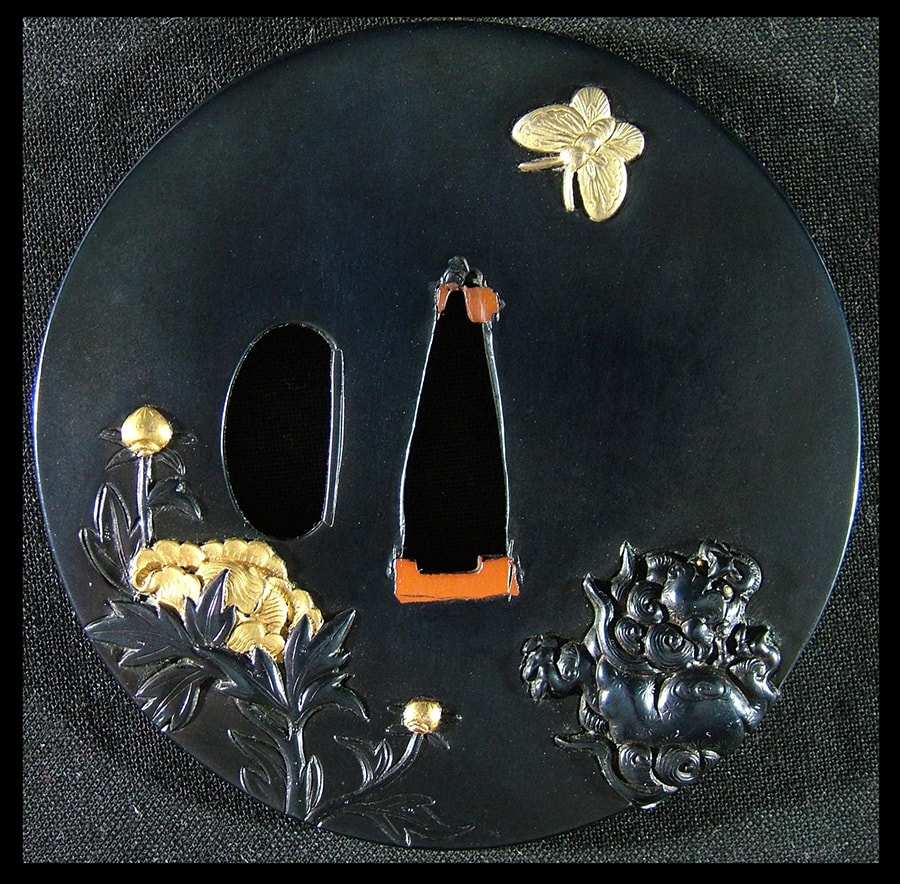
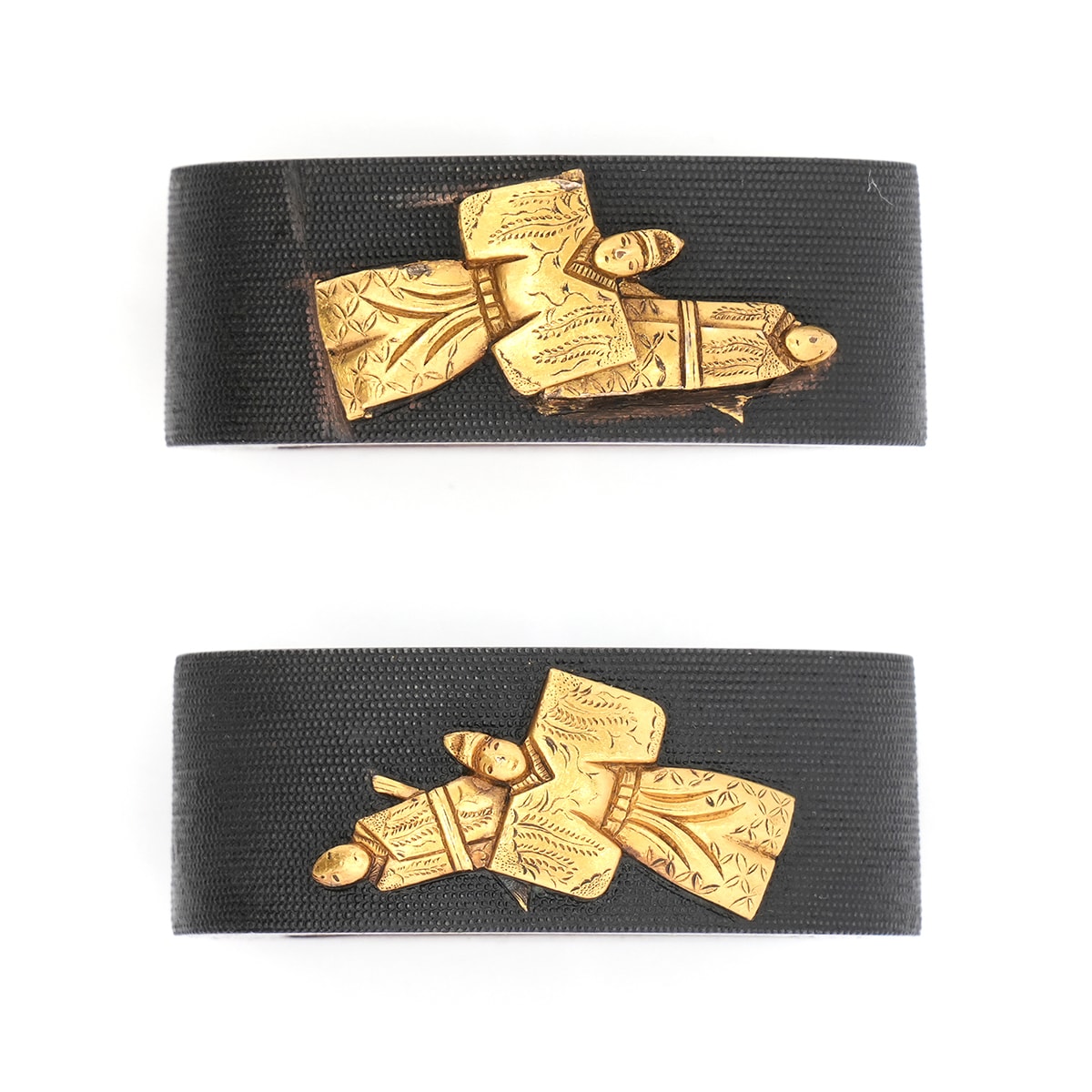
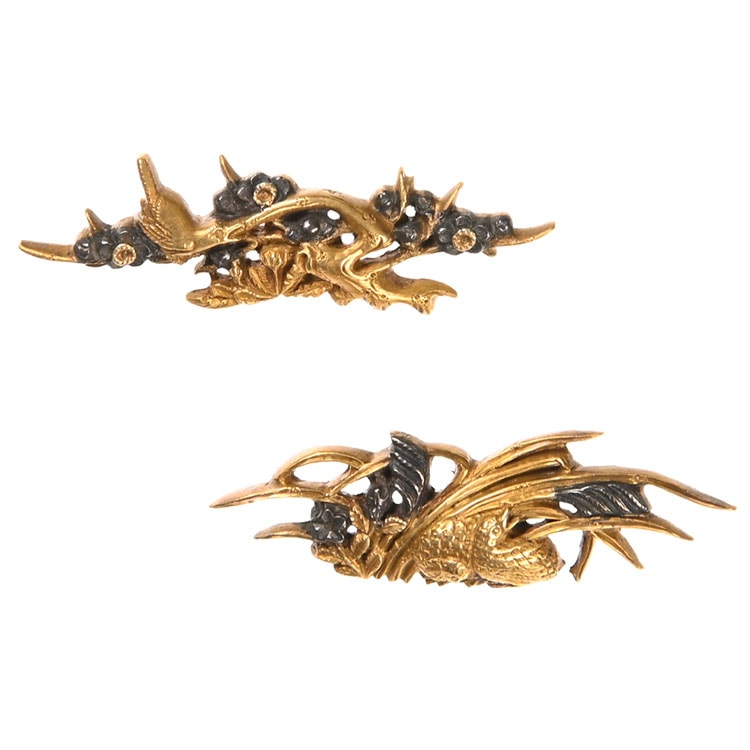
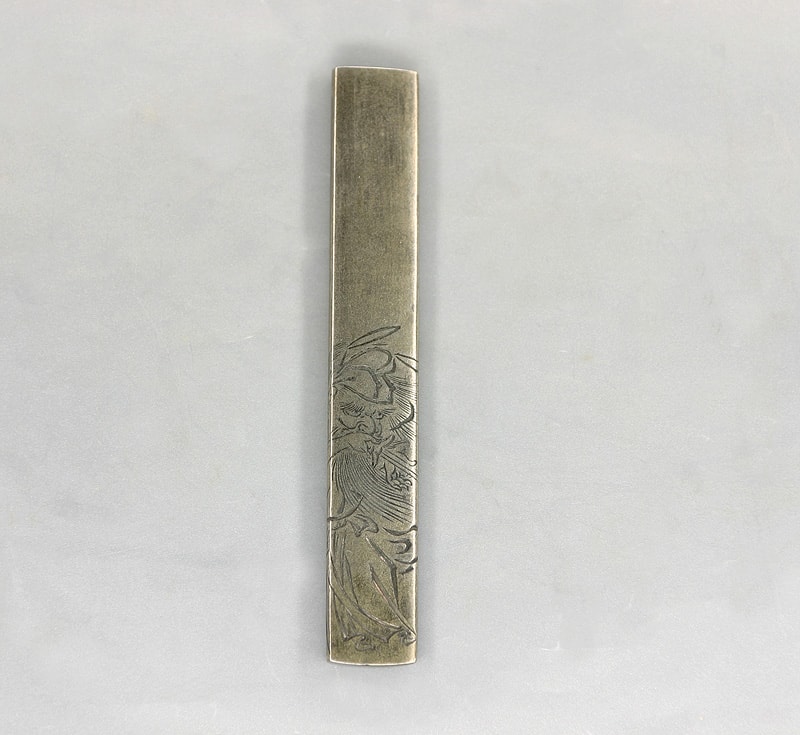
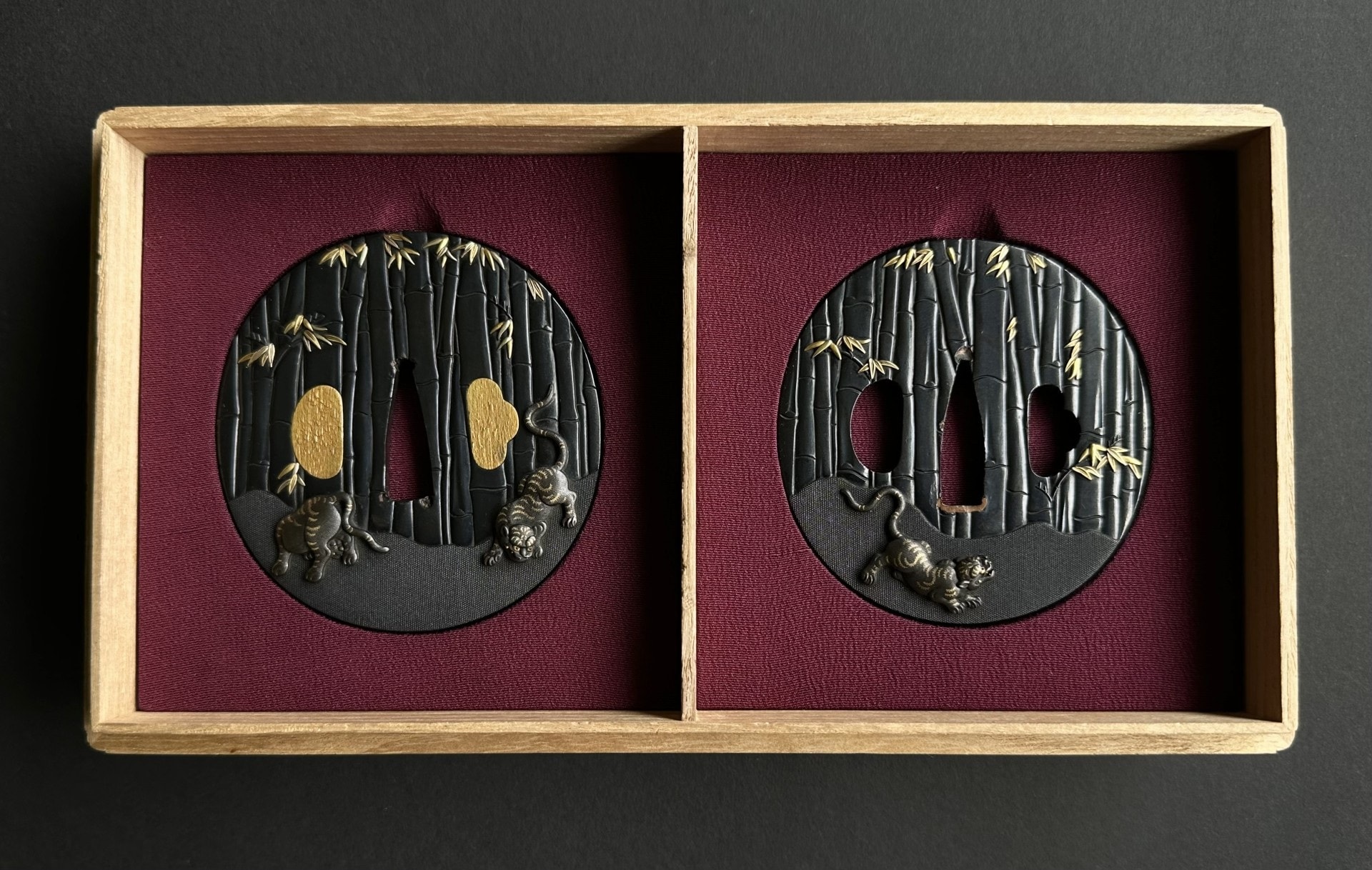
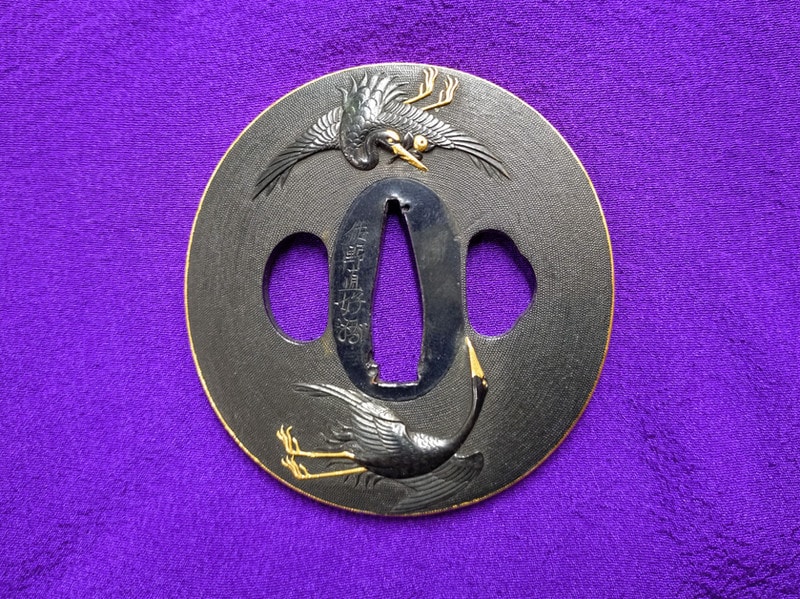
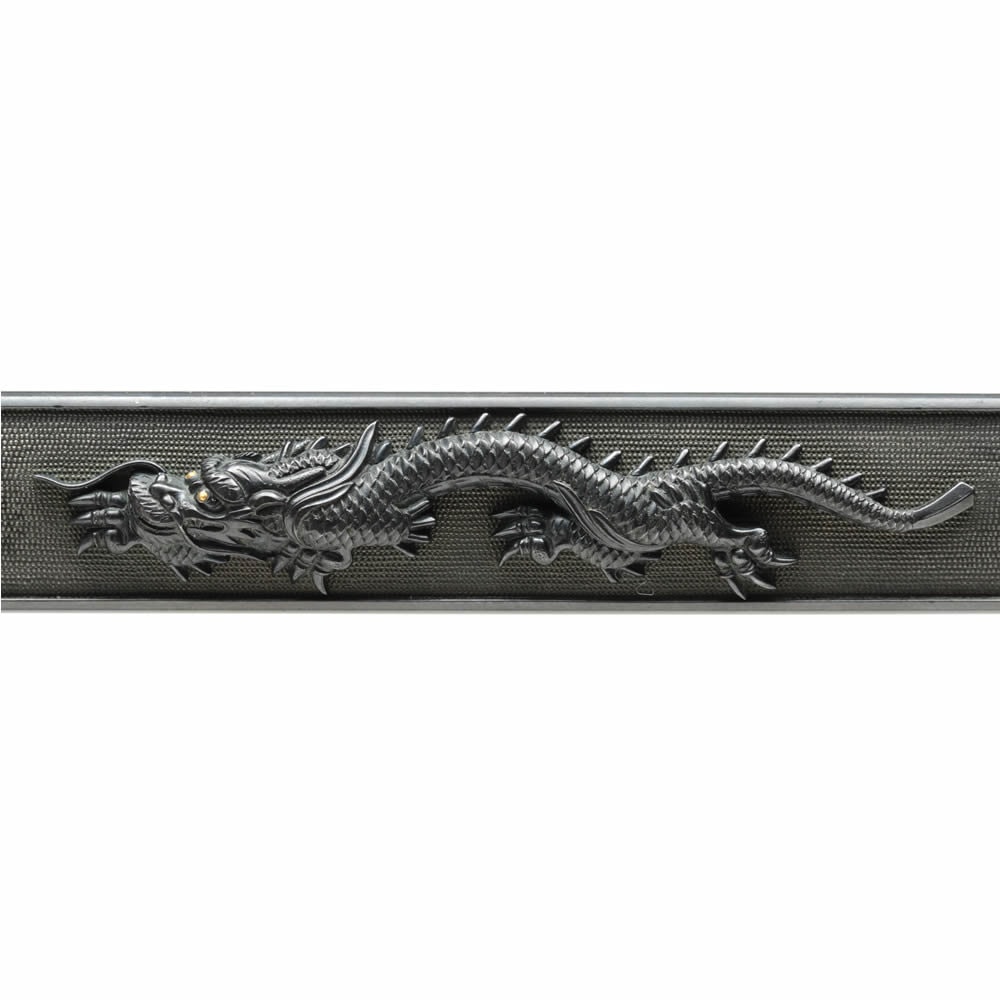
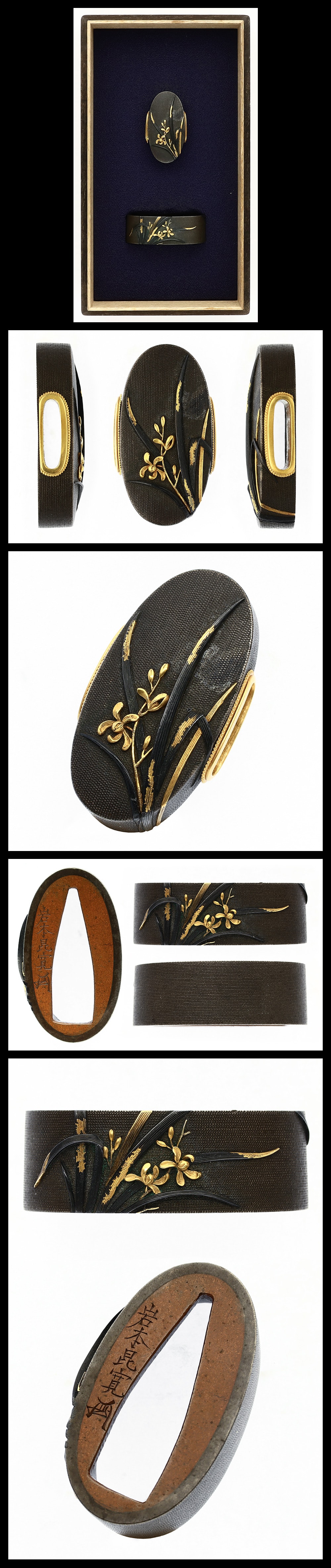
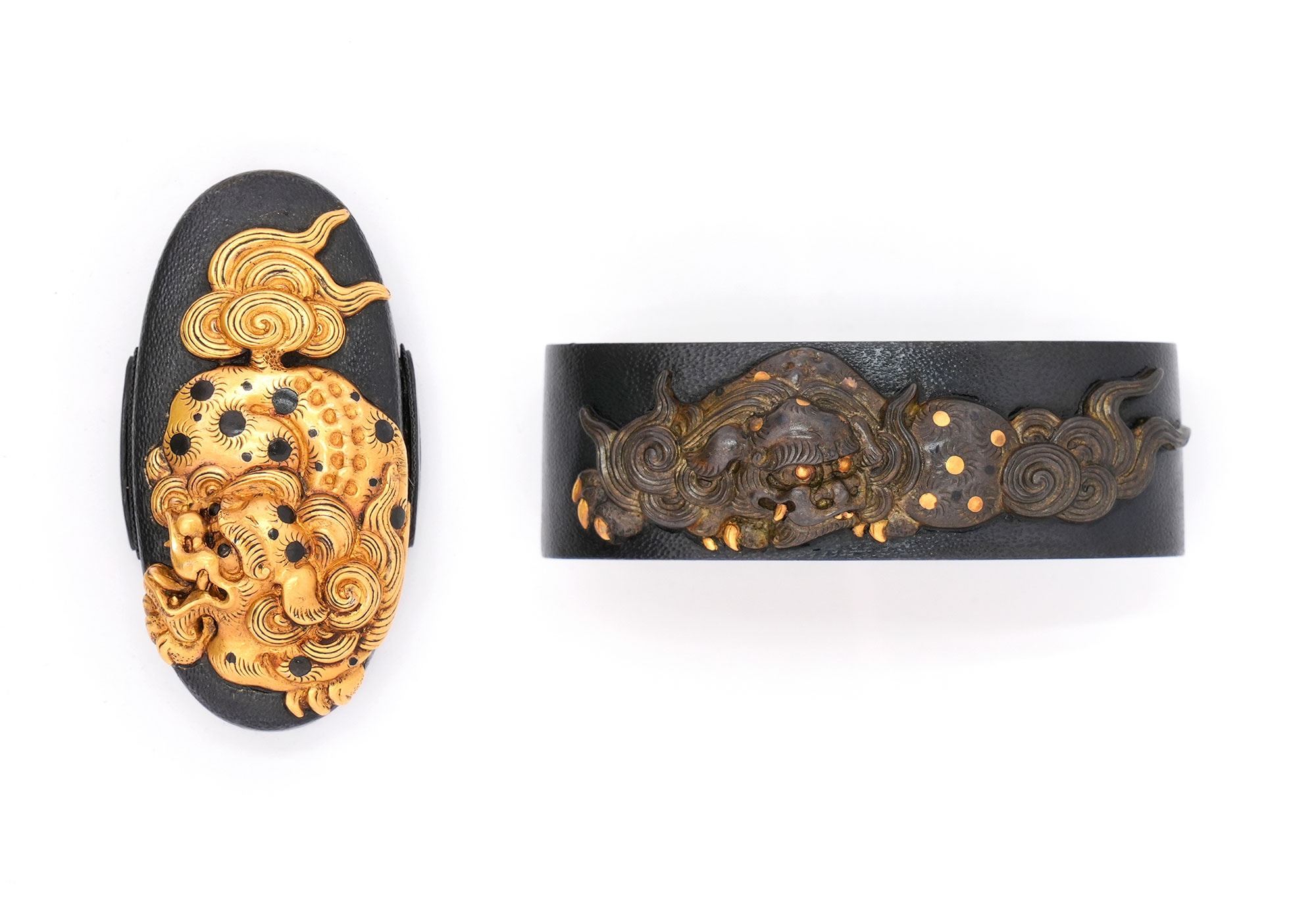
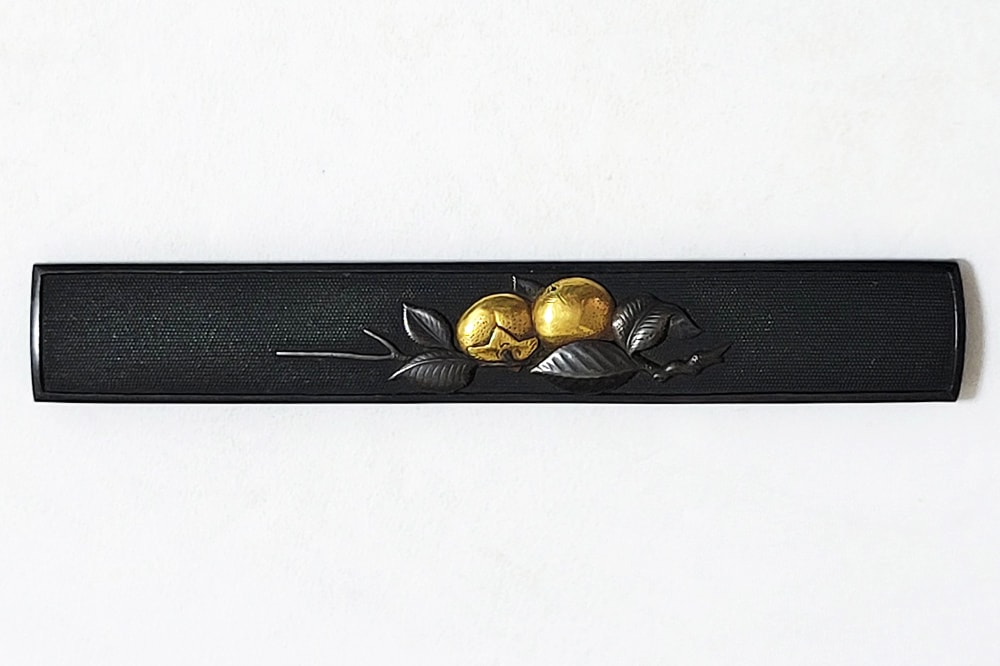
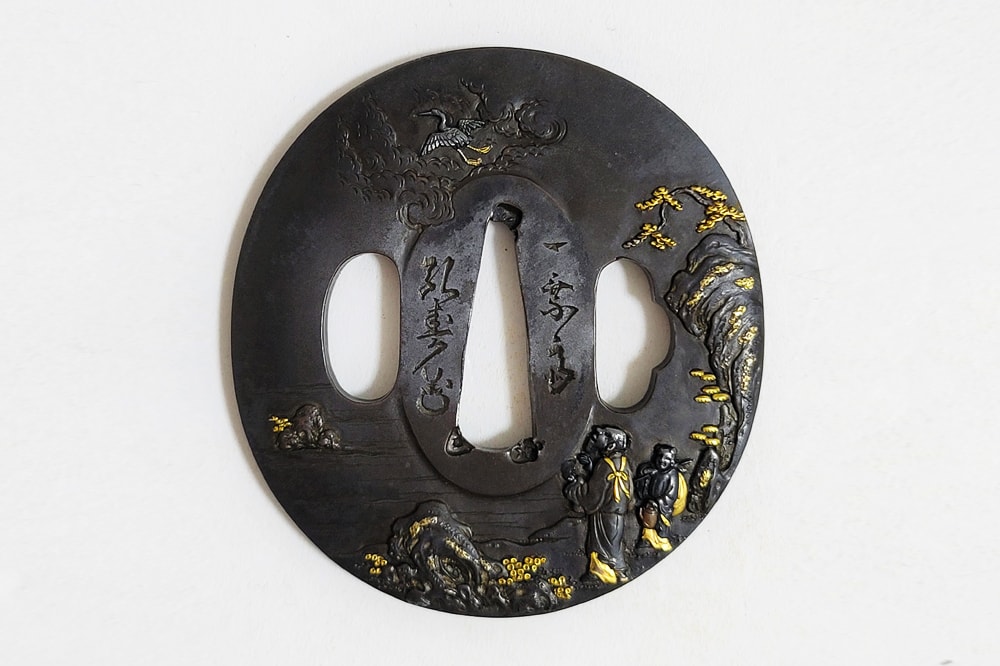
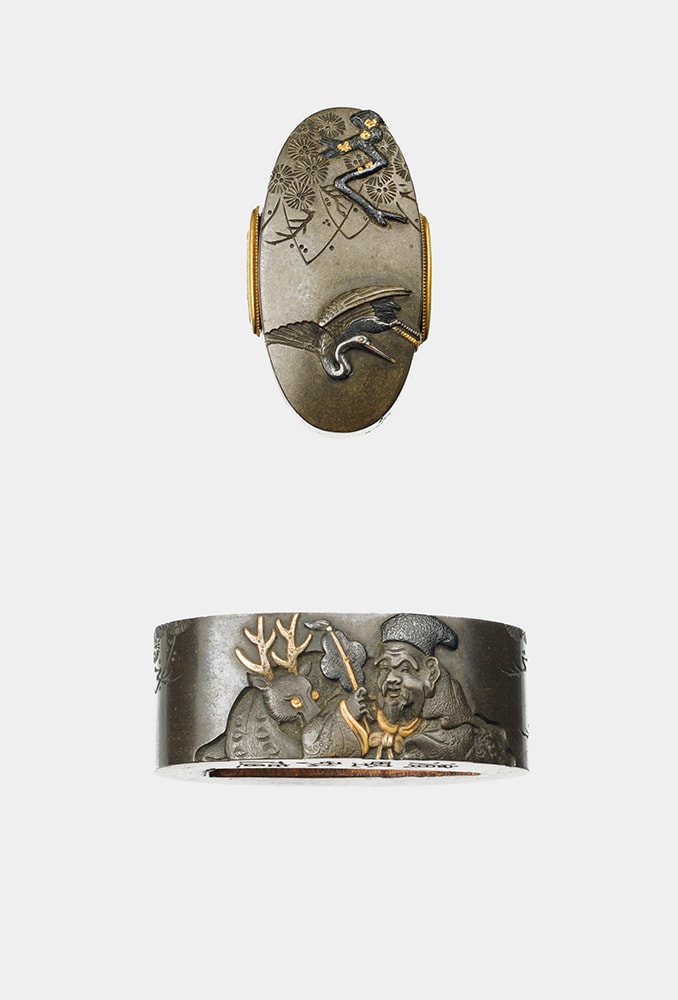
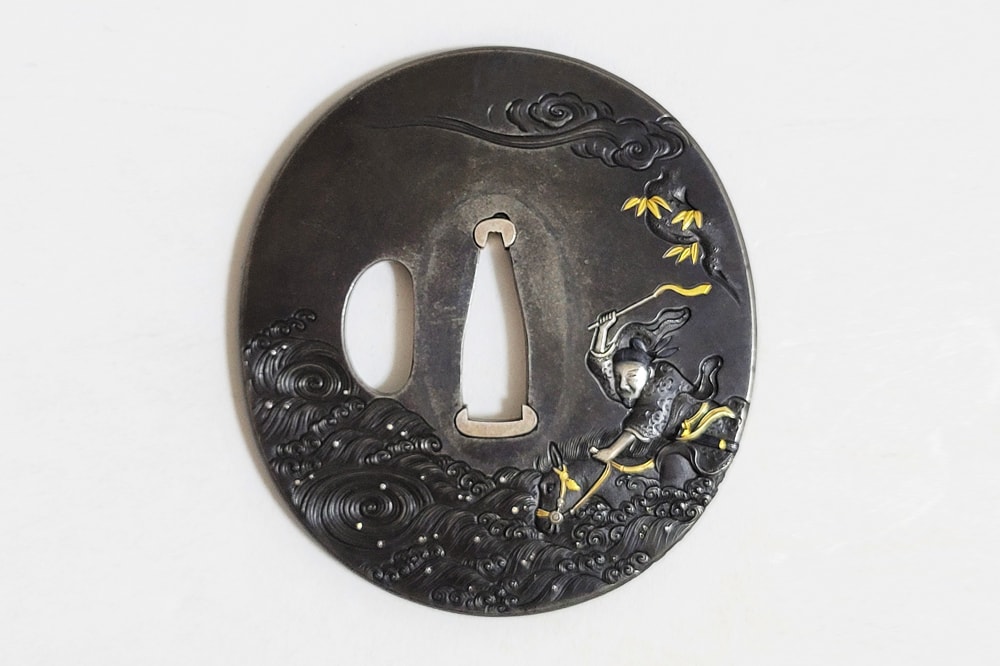
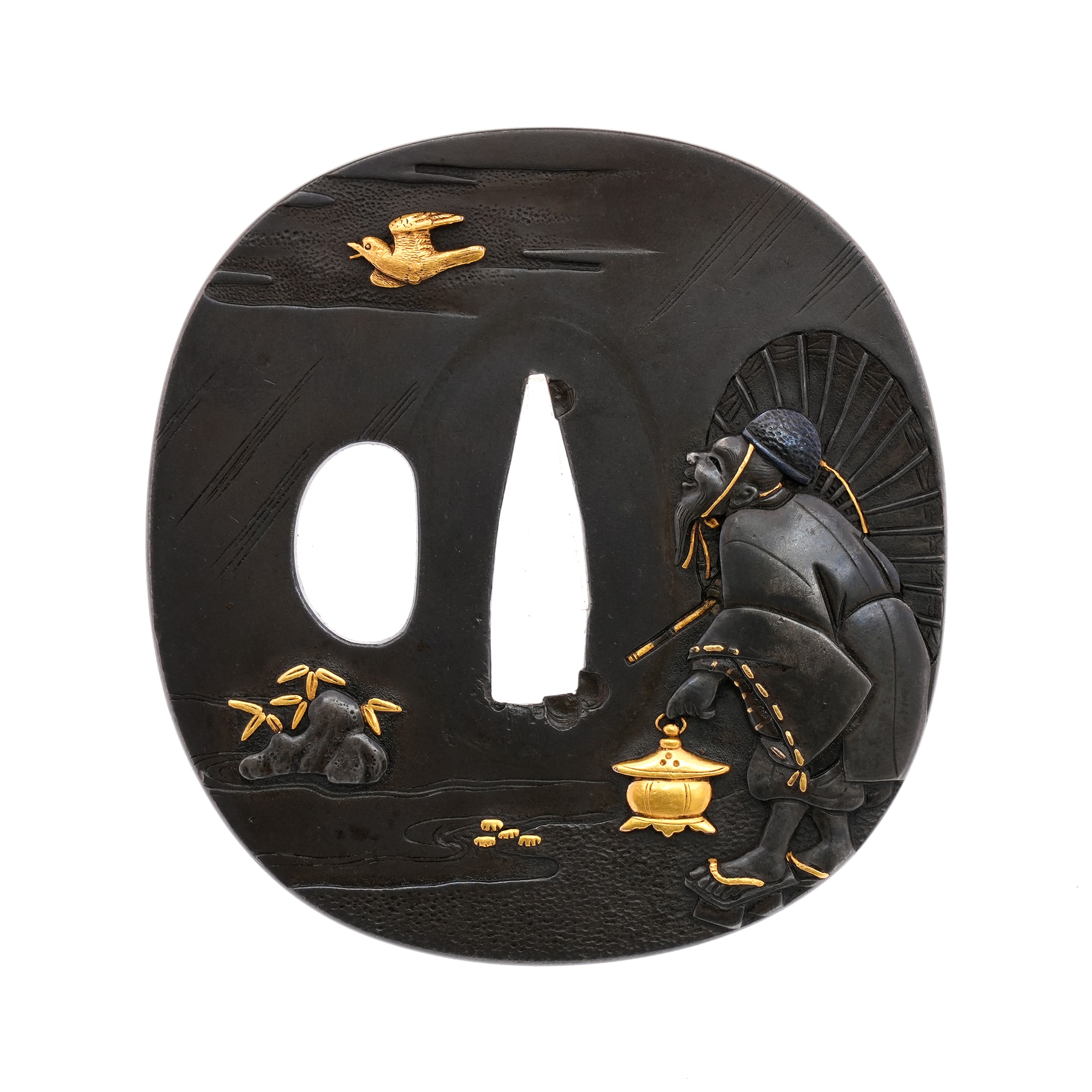
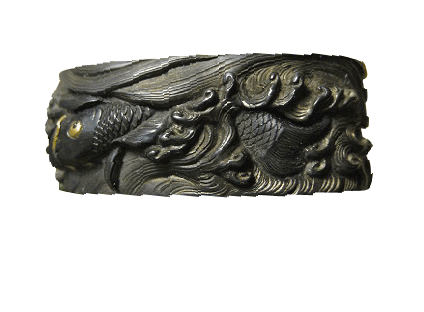
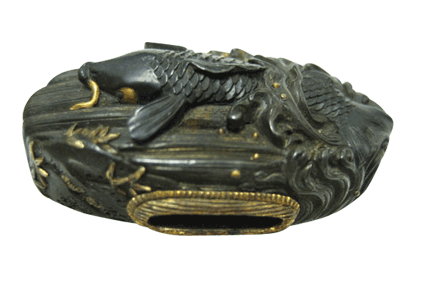
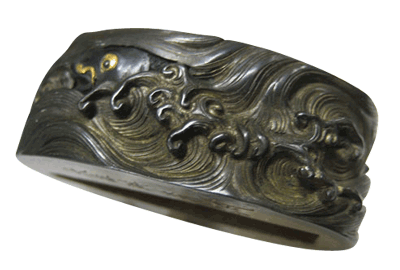
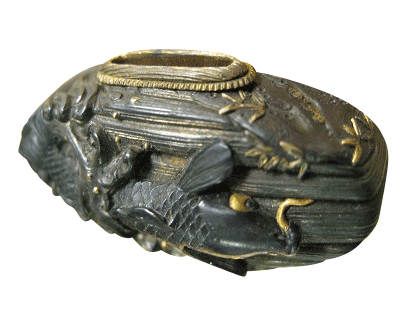
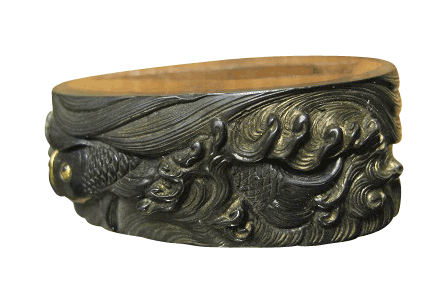
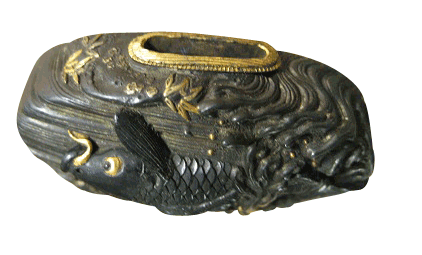
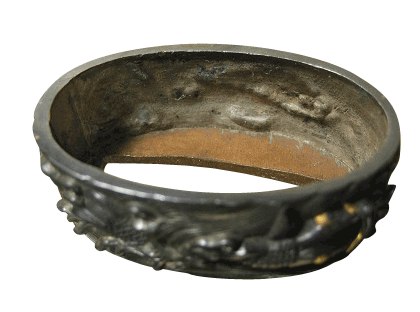
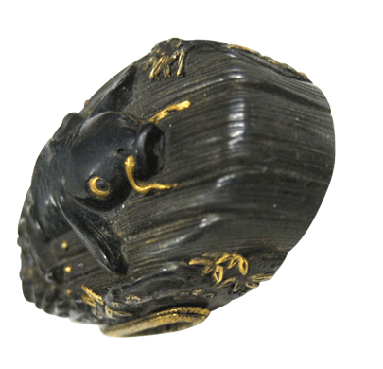
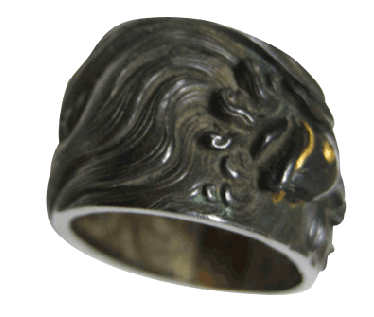
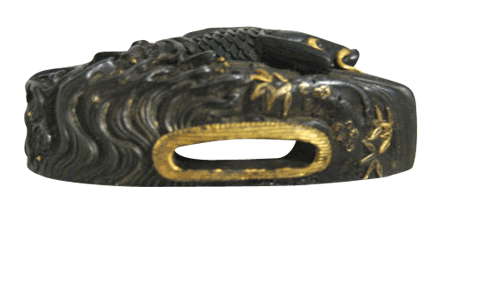
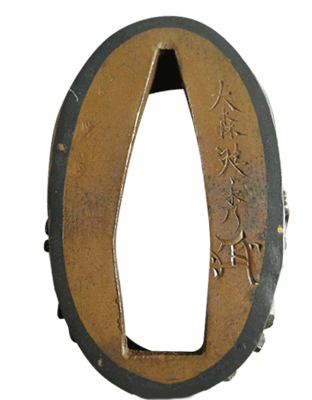
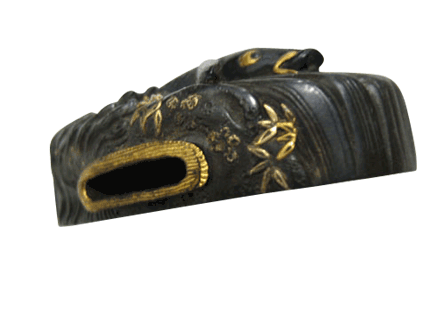
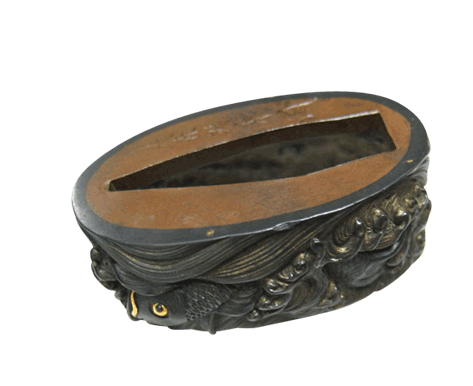
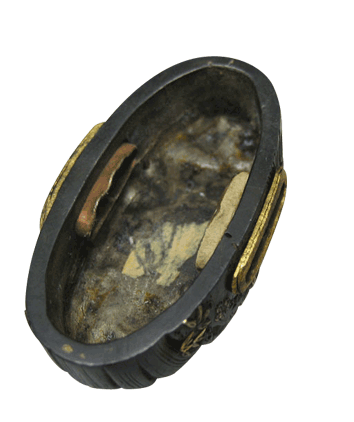
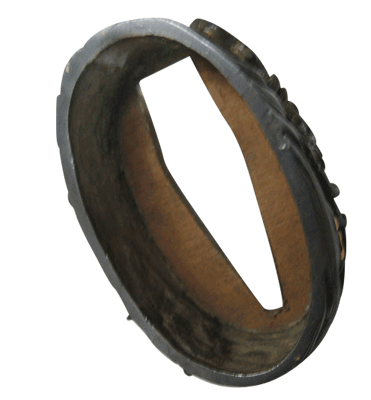
A set of fuchi-kashira featuring a design of a carp climbing a waterfall, made of shibuichi silver with the carp rendered in high relief using shakudo. The piece dates to the mid-Edo period, approximately 250 years ago. The signature reads Ohmori Hidehide, but its authenticity is uncertain. Sold with a box.
 NihontoWatch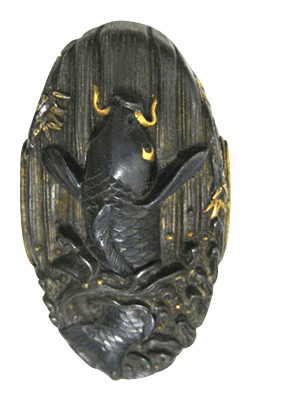
Edo
Signed
Machibori · Edo
1 piece on the market now
Omori Hideshu was the second-generation master of the Omori school, one of the most influential branches within the broader Yokoya lineage of Edo-period metalworkers. A nephew of the founding master Omori Eisho -- himself a direct disciple of the great Yokoya Somin -- Hideshu bore the personal name Kisoji and, after training under Eisho, succeeded him as head of the line. Under his leadership the Omori group attained a prosperity that rivaled the parent Yokoya tradition itself. Working in the mid to late Edo period from his atelier beneath Kinryuzan in Edo, Hideshu also used the art-name Ryuusai, and his output encompassed the full range of sword-fitting forms: tsuba, fuchi-kashira, menuki, kozuka, kogai, and complete unified suites of fittings known as issaku kanagu. Several of his documented commissions were executed for the Ii family of Hikone domain, including formal hosodachi and daisho koshirae bearing the Ii clan tachibana crest -- evidence of sustained patronage at the highest levels of daimyo society.
Hideshu's technical achievement is defined by a remarkable synthesis of sculptural ambition and decorative refinement. His preferred working method employed shakudo nanako-ji grounds upon which he carved in bold takabori (high relief) with polychrome iroe in gold, silver, shibuichi, suaka, and the rare hi-irodo (scarlet copper). He is most celebrated for originating the powerfully three-dimensional wave motif known as Omori nami -- surging, reverse-breaking crests rendered in sukidashi-bori that became the school's defining signature. Equally innovative were his inlay techniques: the sunago-zogan executed in a kinkeshi manner that scattered fine gold dust across the surface, and the method he termed nashiji-zogan (also called chirigami-zogan), a form of flat gold inlay that evokes the luminous depth of maki-e lacquerwork. His subject matter ranged across figural compositions drawn from Chinese and Japanese history and legend -- Fan Kuai forcing his way into the enemy ranks at the Banquet at Hongmen, warriors contesting the Uji River crossing, Shoki confronting demons -- as well as iconic motifs of shishi amid peonies, hawks and prey, sacred Buddhist figures, and auspicious themes such as the gohei-zaru. In at least one documented instance he worked from an underdrawing by the Kano painter Tsunenobu, demonstrating a scholarly engagement with painting traditions that informed his pictorial compositions.
Hideshu occupies a position of singular importance within the Edo kinko tradition. He transformed the Omori school from a secondary branch of the Yokoya lineage into a creative force of the first rank, and his technical innovations -- the Omori wave, the nashiji inlay method -- were perpetuated by subsequent generations and became hallmarks by which the school is identified. The NBTHK setsumei consistently characterize him as an artist who "brought renewed prosperity" to the lineage and whose chiselwork demonstrates "full mastery." His surviving oeuvre, spanning intimate menuki carved in solid gold yobori to monumental daisho suites unified by heraldic programs, reveals an artist equally capable of restrained courtly dignity and dramatic narrative force, one whose refined technique and compositional intelligence place him among the foremost practitioners of the Yokoya tradition.
Where Teruhide stands among comparable artisans: across all of nihontō, and within tradition, era, and period. The tiers (Foremost · Leading · Major · Notable) weigh official designations from the NBTHK and Japan's Agency for Cultural Affairs, together with historical honors of lasting repute such as the Sansaku and Meibutsu-chō.
Select a lens to see how it's measured.
Machibori · Edo
15 pieces on the market now
The Ōmori school was one of the great machibori (town-carving) lineages of Edo, founded in the first half of the eighteenth century by Ōmori Terumasa (大森英昌, also read Eishō), a direct disciple of Yokoya Sōmin. " A dated tsuba of Meiwa 7 (1770) anchors his mature activity, and the workshop remained rooted in the shogunal capital throughout its history — his pupil Hidetomo proudly signed works "Tōto, by the Sumida River"[[c:1]]. The headship then passed through Hidenaga to Hidemitsu (英満), Teruhide's fifth son, carrying the line deep into the late Edo period. " Its defining invention is the strikingly three-dimensional wave design known as Ōmori-nami (大森浪), the "Ōmori waves," together with sunago-zōgan gold-dust inlay executed in the kinkeshi manner and the flush gold inlay evocative of maki-e lacquer called nashiji-zōgan or chirigami-zōgan — techniques devised, the setsumei state, to heighten the elegant, courtly taste of the work. The judges single out "the weighty takabori carving characteristic of the Ōmori style," deployed across a repertoire spanning peony-and-shishi compositions, birds of prey amid rising sun and surging waves, tigers in bamboo, waves with myriad fish (uozukushi), the vanguard crossing of the Uji River, Fan Kuai at the Banquet at Hongmen, and the treasure ship of the Seven Lucky Gods.
Later generations show measured evolution: Hidemitsu "preserved the carving methods of his forebears while accepting changes in contemporary taste," turning also to iron ishime-ji grounds in sukidashi-bori and collaborating with the painter Kanō Dōhaku Aishin, whose preparatory drawings attest to exchange with the painting ateliers of the day; substitute works (daisaku) by his disciple Ōmori Mitsutoki under the master's signature reveal a flourishing workshop practice. The school's standing is confirmed at the highest levels of patronage: a ceremonial hosodachi mounting transmitted in the Ii family of Hikone, its entire suite of fittings by Teruhide with the clan's tachibana crest in takabori and gold iroe, documents the Ōmori masters as makers of daimyo ceremonial equipment. From the atelier radiated an exceptionally influential teaching lineage: Hidetomo (Ryūrinsai Ōmori Sadabei), recorded in the Kōto Kinkō Meifu as "a foremost disciple of Teruhide"; the Mito-branch Moriyama retainer Otsuzuka Hisanori, whose "dense, richly wrought inlay reached a uniquely individual realm" and drew praise in the Natsuo Chōkin-dan; Horie Kōsei, who entered the Ōmori school after Hamano Masayuki's death and later, as retained craftsman of the Hachisuka family of Awa, "trained many pupils of his own school"; and Izumi Hidetoshi, who studied under both Teruhide and Hidetomo. Through these channels the Ōmori manner — above all its sculptural waves and sumptuous relief — passed into the broader current of late-Edo machibori metalwork, securing the school's place as one of the most powerful branches of the Yokoya tradition in the tosogu canon. Learn more →
| Smith | Era | Designated |
|---|---|---|
| Teruhide英秀 | — | 15 |
| Chizuka Hisanori遅塚久則 | 1725-1795 | 9 |
| Horie Okinari堀江興成 | — | 7 |
| Terumitsu英満 | — | 4 |
| Horie Okiyoshi堀江興吉 | 1670 | 1 |
We could not find an authenticity certificate on the seller’s listing. Japanese swords and fittings are normally papered by the NBTHK (or the NTHK). Without one, the attribution is the seller’s own assessment and has not been independently verified — treat it with caution and ask the dealer about certification before buying.
A set of fuchi-kashira featuring a design of a carp climbing a waterfall, made of shibuichi silver with the carp rendered in high relief using shakudo. The piece dates to the mid-Edo period, approximately 250 years ago. The signature reads Ohmori Hidehide, but its authenticity is uncertain. Sold with a box.
NihontoWatchEdo
Signed
Machibori · Edo
1 piece on the market now
Omori Hideshu was the second-generation master of the Omori school, one of the most influential branches within the broader Yokoya lineage of Edo-period metalworkers. A nephew of the founding master Omori Eisho -- himself a direct disciple of the great Yokoya Somin -- Hideshu bore the personal name Kisoji and, after training under Eisho, succeeded him as head of the line. Under his leadership the Omori group attained a prosperity that rivaled the parent Yokoya tradition itself. Working in the mid to late Edo period from his atelier beneath Kinryuzan in Edo, Hideshu also used the art-name Ryuusai, and his output encompassed the full range of sword-fitting forms: tsuba, fuchi-kashira, menuki, kozuka, kogai, and complete unified suites of fittings known as issaku kanagu. Several of his documented commissions were executed for the Ii family of Hikone domain, including formal hosodachi and daisho koshirae bearing the Ii clan tachibana crest -- evidence of sustained patronage at the highest levels of daimyo society.
Hideshu's technical achievement is defined by a remarkable synthesis of sculptural ambition and decorative refinement. His preferred working method employed shakudo nanako-ji grounds upon which he carved in bold takabori (high relief) with polychrome iroe in gold, silver, shibuichi, suaka, and the rare hi-irodo (scarlet copper). He is most celebrated for originating the powerfully three-dimensional wave motif known as Omori nami -- surging, reverse-breaking crests rendered in sukidashi-bori that became the school's defining signature. Equally innovative were his inlay techniques: the sunago-zogan executed in a kinkeshi manner that scattered fine gold dust across the surface, and the method he termed nashiji-zogan (also called chirigami-zogan), a form of flat gold inlay that evokes the luminous depth of maki-e lacquerwork. His subject matter ranged across figural compositions drawn from Chinese and Japanese history and legend -- Fan Kuai forcing his way into the enemy ranks at the Banquet at Hongmen, warriors contesting the Uji River crossing, Shoki confronting demons -- as well as iconic motifs of shishi amid peonies, hawks and prey, sacred Buddhist figures, and auspicious themes such as the gohei-zaru. In at least one documented instance he worked from an underdrawing by the Kano painter Tsunenobu, demonstrating a scholarly engagement with painting traditions that informed his pictorial compositions.
Hideshu occupies a position of singular importance within the Edo kinko tradition. He transformed the Omori school from a secondary branch of the Yokoya lineage into a creative force of the first rank, and his technical innovations -- the Omori wave, the nashiji inlay method -- were perpetuated by subsequent generations and became hallmarks by which the school is identified. The NBTHK setsumei consistently characterize him as an artist who "brought renewed prosperity" to the lineage and whose chiselwork demonstrates "full mastery." His surviving oeuvre, spanning intimate menuki carved in solid gold yobori to monumental daisho suites unified by heraldic programs, reveals an artist equally capable of restrained courtly dignity and dramatic narrative force, one whose refined technique and compositional intelligence place him among the foremost practitioners of the Yokoya tradition.
Where Teruhide stands among comparable artisans: across all of nihontō, and within tradition, era, and period. The tiers (Foremost · Leading · Major · Notable) weigh official designations from the NBTHK and Japan's Agency for Cultural Affairs, together with historical honors of lasting repute such as the Sansaku and Meibutsu-chō.
Select a lens to see how it's measured.
Machibori · Edo
15 pieces on the market now
The Ōmori school was one of the great machibori (town-carving) lineages of Edo, founded in the first half of the eighteenth century by Ōmori Terumasa (大森英昌, also read Eishō), a direct disciple of Yokoya Sōmin. " A dated tsuba of Meiwa 7 (1770) anchors his mature activity, and the workshop remained rooted in the shogunal capital throughout its history — his pupil Hidetomo proudly signed works "Tōto, by the Sumida River"[[c:1]]. The headship then passed through Hidenaga to Hidemitsu (英満), Teruhide's fifth son, carrying the line deep into the late Edo period. " Its defining invention is the strikingly three-dimensional wave design known as Ōmori-nami (大森浪), the "Ōmori waves," together with sunago-zōgan gold-dust inlay executed in the kinkeshi manner and the flush gold inlay evocative of maki-e lacquer called nashiji-zōgan or chirigami-zōgan — techniques devised, the setsumei state, to heighten the elegant, courtly taste of the work. The judges single out "the weighty takabori carving characteristic of the Ōmori style," deployed across a repertoire spanning peony-and-shishi compositions, birds of prey amid rising sun and surging waves, tigers in bamboo, waves with myriad fish (uozukushi), the vanguard crossing of the Uji River, Fan Kuai at the Banquet at Hongmen, and the treasure ship of the Seven Lucky Gods.
Later generations show measured evolution: Hidemitsu "preserved the carving methods of his forebears while accepting changes in contemporary taste," turning also to iron ishime-ji grounds in sukidashi-bori and collaborating with the painter Kanō Dōhaku Aishin, whose preparatory drawings attest to exchange with the painting ateliers of the day; substitute works (daisaku) by his disciple Ōmori Mitsutoki under the master's signature reveal a flourishing workshop practice. The school's standing is confirmed at the highest levels of patronage: a ceremonial hosodachi mounting transmitted in the Ii family of Hikone, its entire suite of fittings by Teruhide with the clan's tachibana crest in takabori and gold iroe, documents the Ōmori masters as makers of daimyo ceremonial equipment. From the atelier radiated an exceptionally influential teaching lineage: Hidetomo (Ryūrinsai Ōmori Sadabei), recorded in the Kōto Kinkō Meifu as "a foremost disciple of Teruhide"; the Mito-branch Moriyama retainer Otsuzuka Hisanori, whose "dense, richly wrought inlay reached a uniquely individual realm" and drew praise in the Natsuo Chōkin-dan; Horie Kōsei, who entered the Ōmori school after Hamano Masayuki's death and later, as retained craftsman of the Hachisuka family of Awa, "trained many pupils of his own school"; and Izumi Hidetoshi, who studied under both Teruhide and Hidetomo. Through these channels the Ōmori manner — above all its sculptural waves and sumptuous relief — passed into the broader current of late-Edo machibori metalwork, securing the school's place as one of the most powerful branches of the Yokoya tradition in the tosogu canon. Learn more →
| Smith | Era | Designated |
|---|---|---|
| Teruhide英秀 | — | 15 |
| Chizuka Hisanori遅塚久則 | 1725-1795 | 9 |
| Horie Okinari堀江興成 | — | 7 |
| Terumitsu英満 | — | 4 |
| Horie Okiyoshi堀江興吉 | 1670 | 1 |
We could not find an authenticity certificate on the seller’s listing. Japanese swords and fittings are normally papered by the NBTHK (or the NTHK). Without one, the attribution is the seller’s own assessment and has not been independently verified — treat it with caution and ask the dealer about certification before buying.