 NihontoWatchNihontoWatch
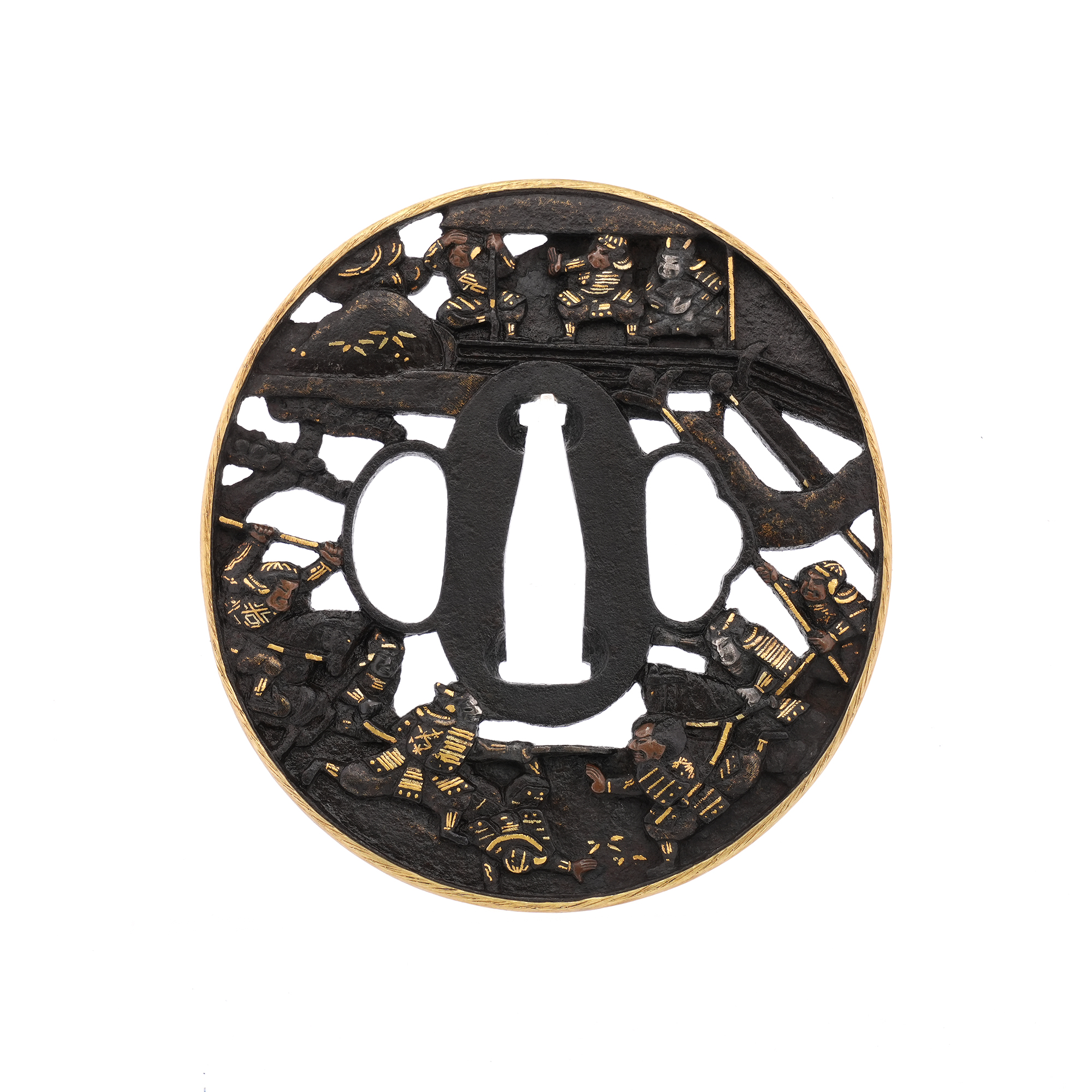
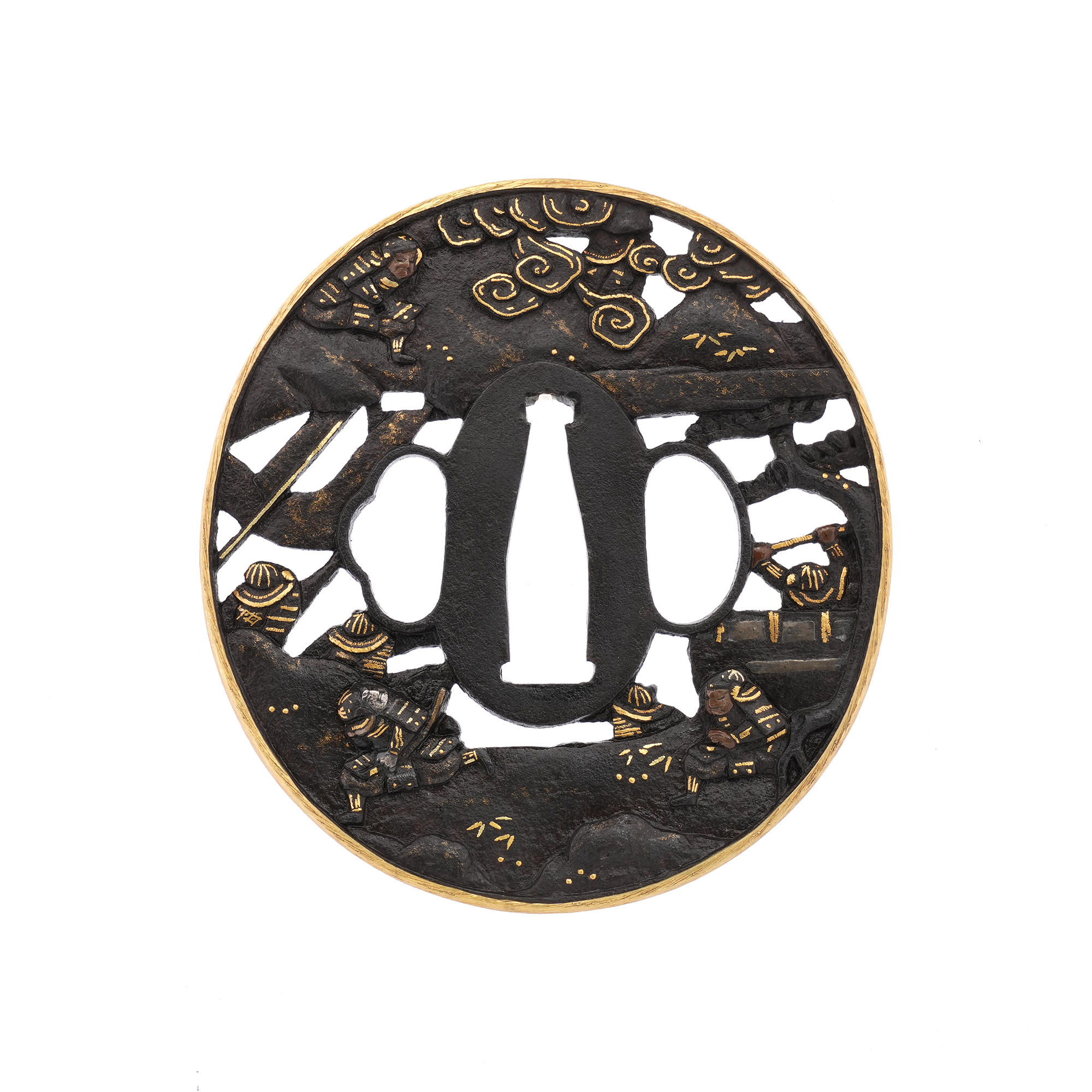
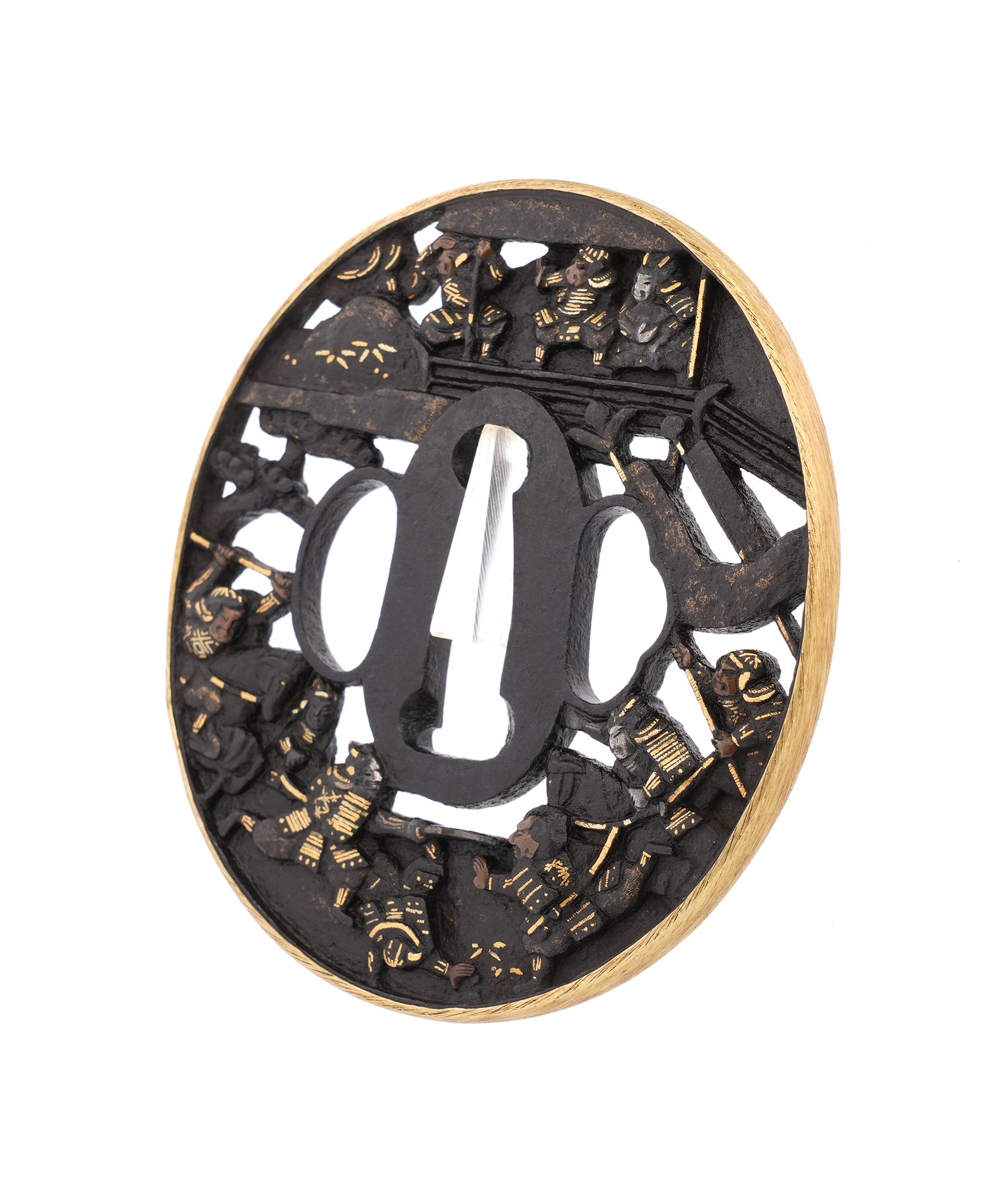
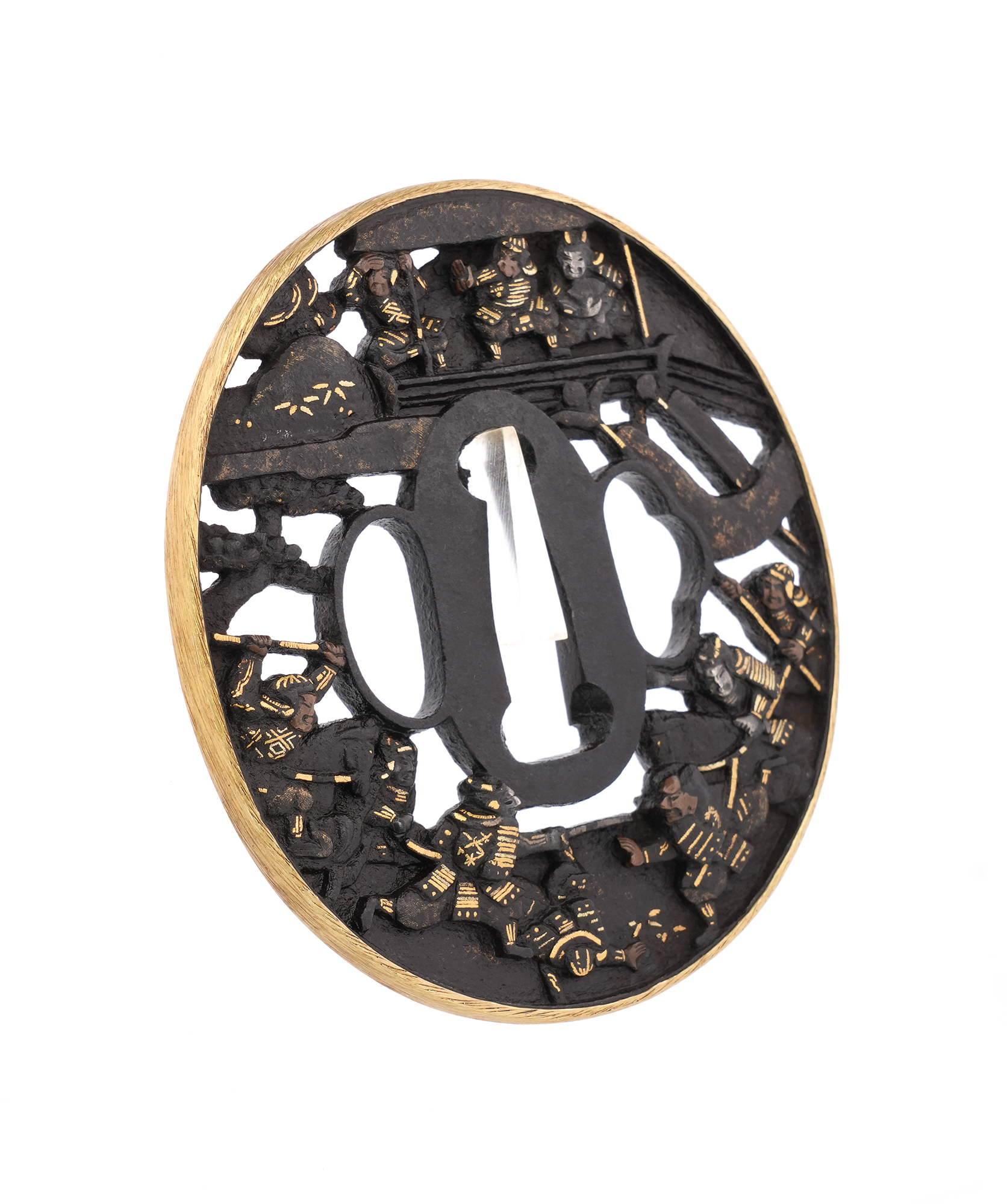
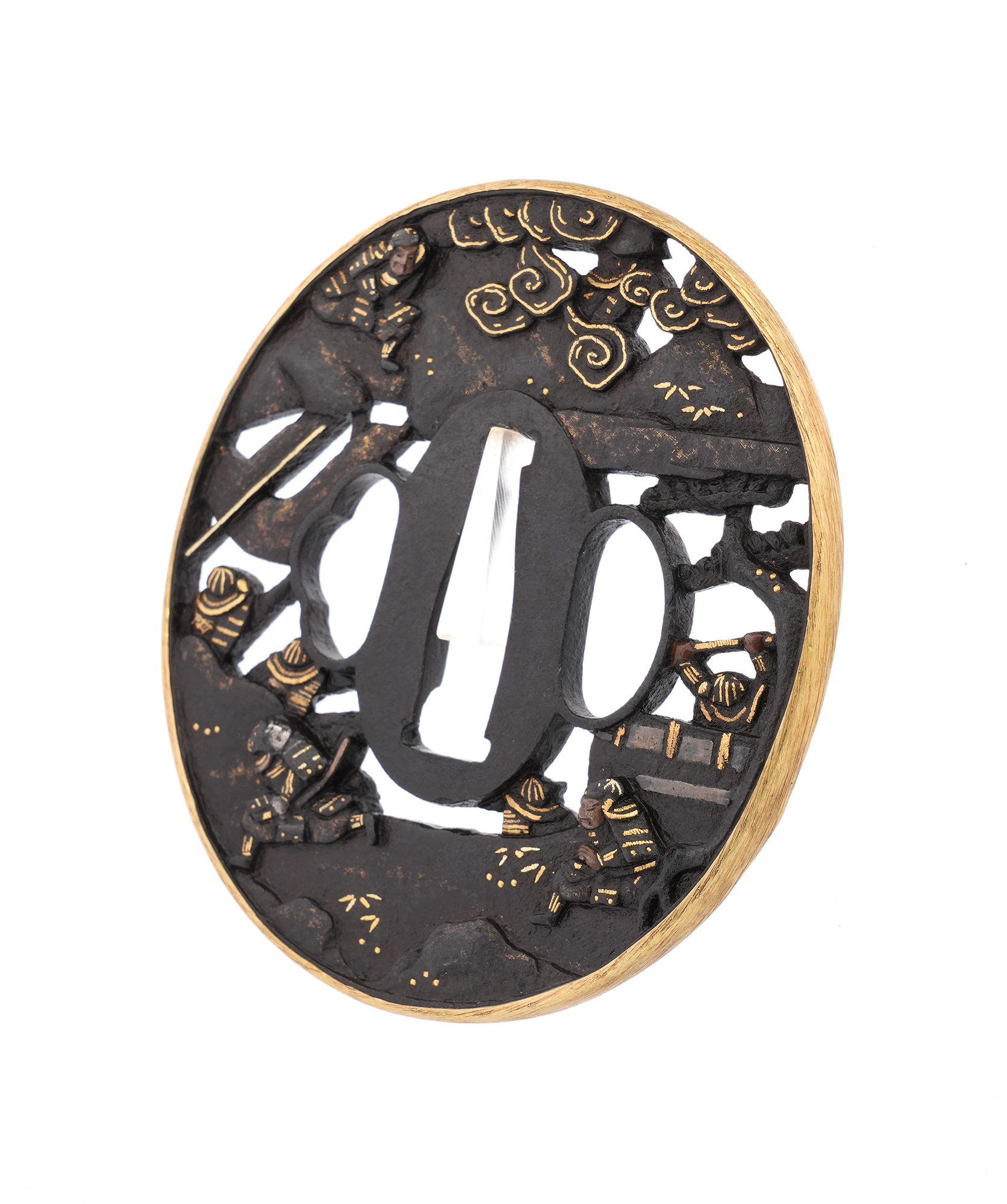
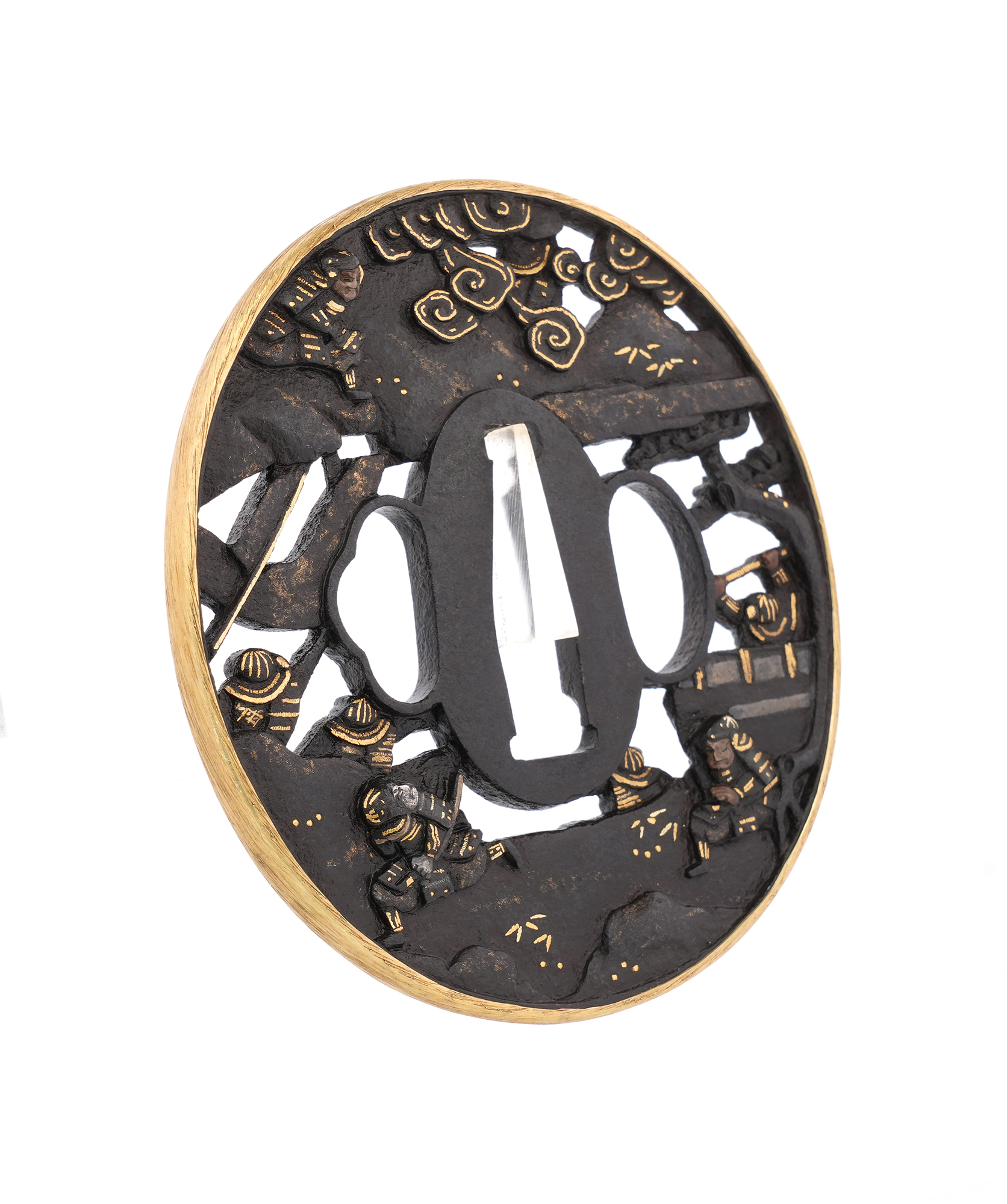
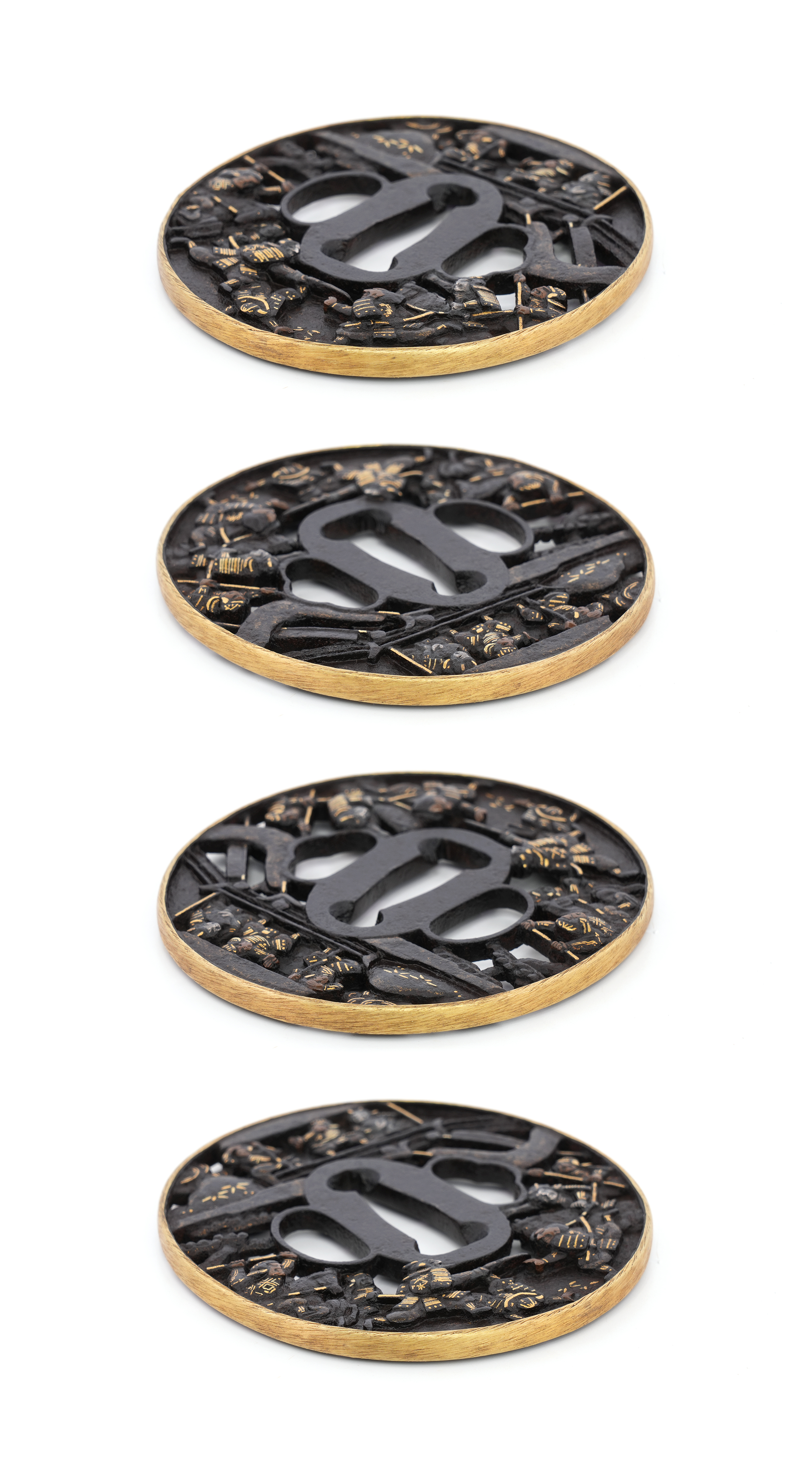
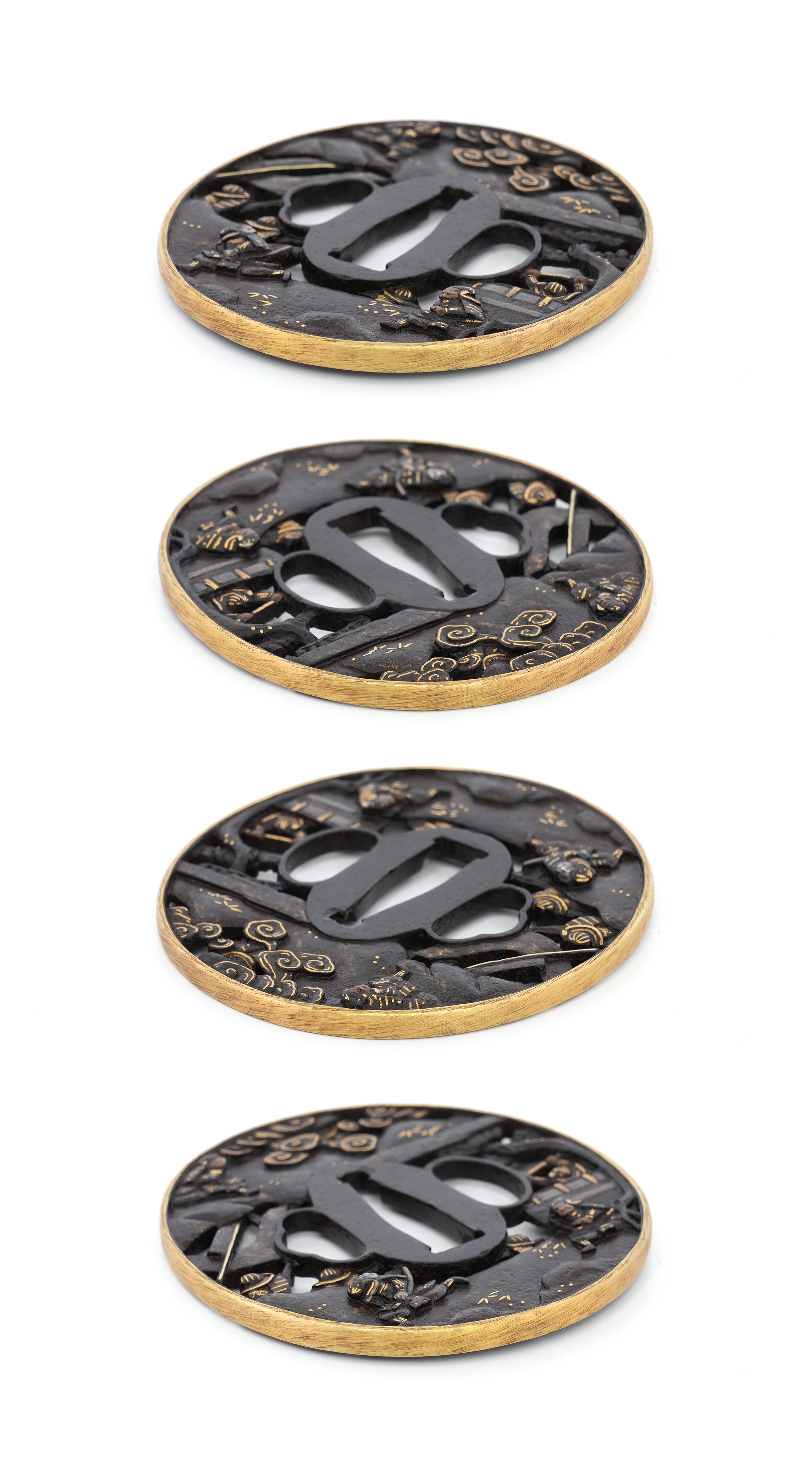
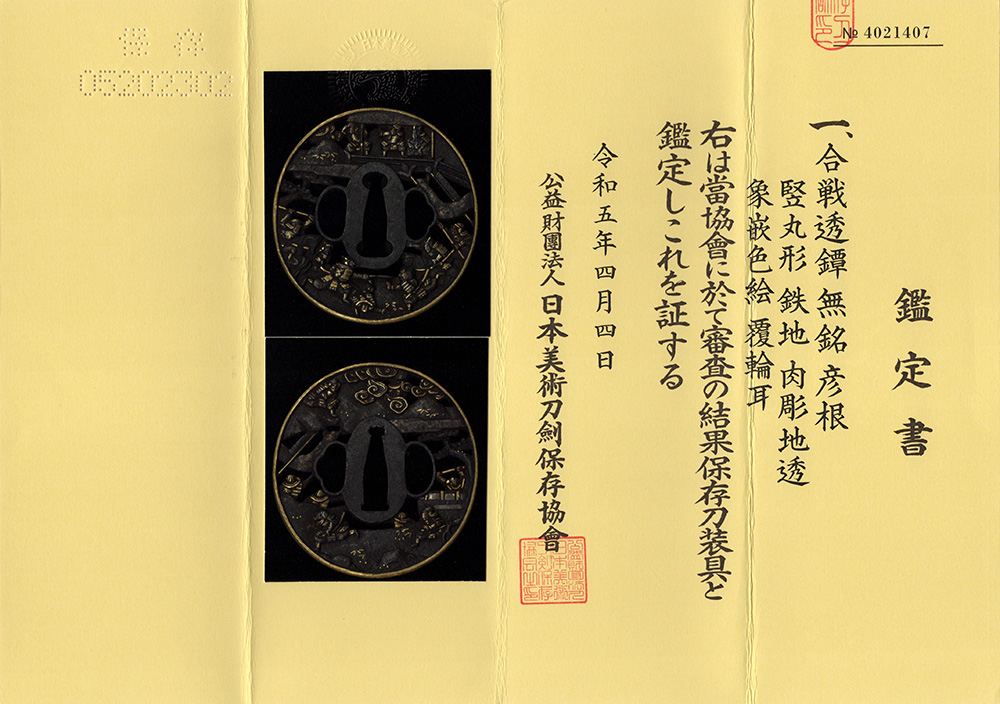
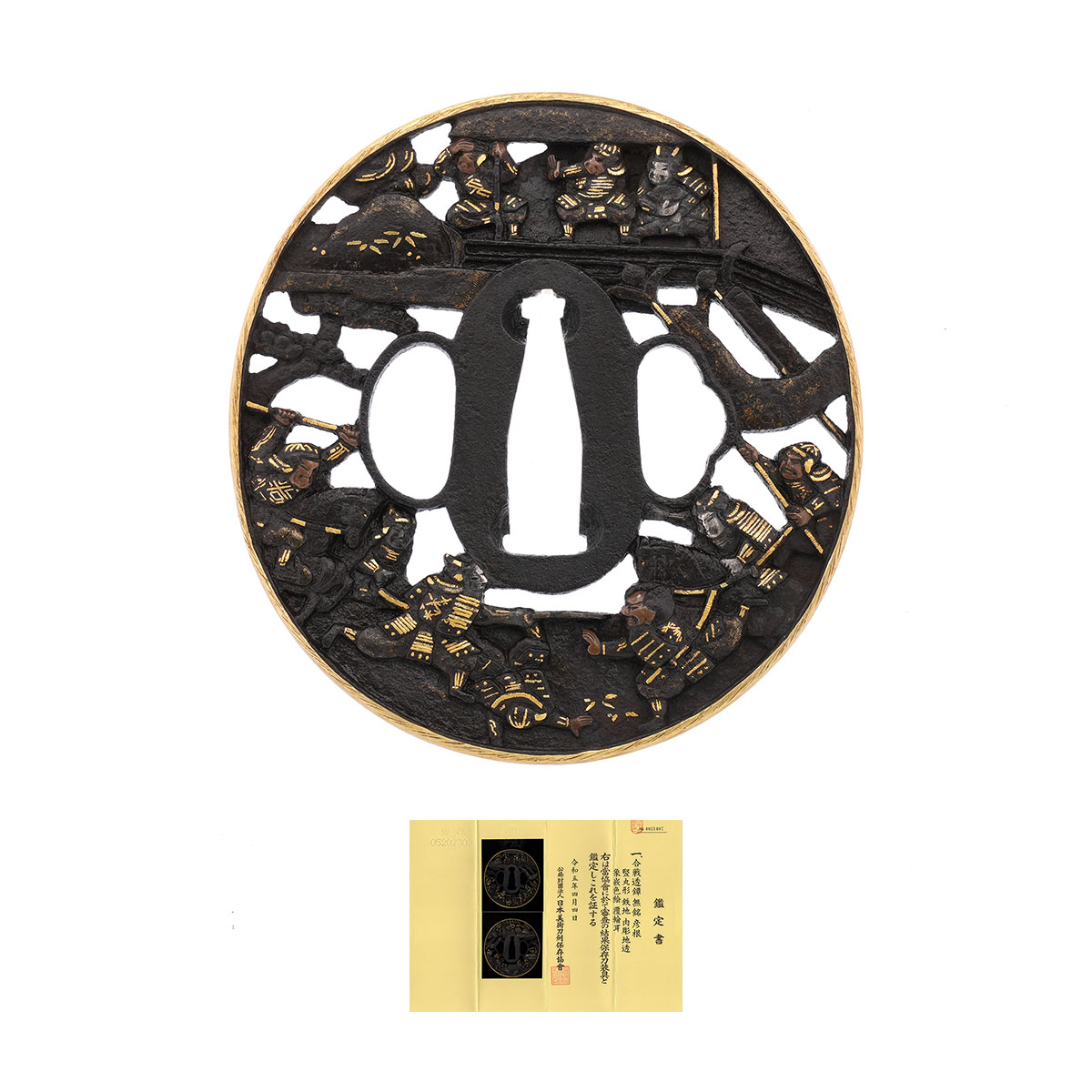
彦根では江戸中期に藻柄子入道宗典(そうへいしにゅうどうむねのり)およびその一門が活躍し、鉄地を肉彫地透として人物、武者、合戦、和漢の故事などを画面いっぱいに表し、金銀などの象嵌色絵を加えた華やかで細密な作風を展開したことから、この系統の鐔は彦根鐔、あるいは彦根彫として広く知られています。 本作は堅丸形の鉄地に多数の鎧武者が入り乱れる合戦の情景を肉彫地透で表し、人物、武具、陣屋、橋、岩山、樹木、雲などを表裏にわたって立体的に配置することで、小さな鐔面の中に奥行きのある壮大な戦場を作り上げています。 表では橋や陣屋をめぐって攻防を繰り広げる武者たちを上下左右へ密に配し、裏では岩山や雲を背景に武者を描き分け、甲冑の威し、武器、人物の顔や手足などへ施された金銀および赤銅色の象嵌色絵が、黒い鉄地の中から個々の姿と動きを鮮明に浮かび上がらせています。 外周には金覆輪を巡らせて画面を引き締め、中央の大きな切羽台と左右の両櫃穴を残しながらも、人物と風景を巧みに連結して鐔としての強度と透かしの軽快さを両立させており、彦根鐔ならではの精緻な人物表現と物語性、華やかな象嵌色絵を存分に鑑賞できる保存刀装具鑑定書付きの一枚です。
NihontoWatchOffered by Toushin

Machine translation of the shop's Japanese ·
(Translation unavailable) Shown in the shop's own words: we only show a translation once it passes our accuracy check.
Kinko · Omi
32 pieces on the market now
The Hikone school of sword fittings -- known as Hikone-bori -- was established at Nakayabu in Hikone, Omi Province, by Mogarashi Nyudo Soten, who settled there after leaving Kyoto and entered the service of the Kawakita family, hereditary vassals of the Hikone domain. One source records that Soten initially trained under the Goto family, citing the Kinko Soran for the existence of works signed "made by Kitagawa Hidenori, a disciple of the Goto," before developing the distinctive carving manner that would define his lineage. The school's connection to the broader Mino-bori tradition is also recognized. There were reportedly two generations working under Soten's name, with the first born in Joo 1 (1652) and active from the early through mid-Edo period. From his workshop emerged a circle of accomplished students, chief among them Nomura Kanenori and Munenori, who carried the Hikone-bori manner forward and established it as one of the most distinctive regional styles in the kinko tradition. The technical hallmark of Hikone-bori is sukidashi takabori -- richly modeled high-relief carving executed on generously proportioned iron plates, further enlivened through zogan iroe employing gold, silver, shakudo, and suaka. The NBTHK notes that even among the gold applications, "multiple types of gold are used," producing expansive pictorial fields of considerable chromatic variety.
Subjects encompass warriors, Daoist immortals, elder sages at elegant gatherings, and flowers-and-birds compositions, rendered across the entirety of both surfaces of the guard. The school's masters also demonstrated facility in shakudo work, including nanako-ji plates with high-relief compositions displaying a pronounced Goto-like flavor, as well as nikubori ji-sukashi and polychrome mitokoromono sets. What unifies the school's output is the synthesis of imposing compositional scale with refined polychrome technique. " Munenori's contribution is recognized for its assured command of shakudo nanako-ji ground preparation and boldly modeled takabori, enriched with polychrome iroe employing multiple varieties of gold across both faces -- a sumptuous, animated effect characteristic of the mature Hikone style. The Hikone school's significance within the broader kinko tradition rests on its creation of a distinctively pictorial approach to sword-fitting decoration that stands apart from both the restrained elegance of the Goto mainline and the narrative density of the Yokoya school. The NBTHK's evaluative language converges on a single defining quality: the school's ability to fill expansive iron and shakudo surfaces with ambitious narrative compositions while maintaining compositional coherence and chromatic refinement. " That Soten's overwhelming fame led later makers to adopt his signature on subsequent Hikone-carved works testifies to the enduring authority of the school's founding aesthetic, while the surviving origami documentation -- including one dated Kanbun 5 (1665) from Goto Mitsutomo -- provides valuable evidence for understanding workshop practices and the collaborative production that sustained the Hikone tradition across the early and mid-Edo period. Learn more →
| Smith | Era | Designated |
|---|---|---|
| Soten宗典 | Edo | 10 |
| Kanenori包教 | Edo | 3 |
| Masatsugu政次 | Edo | 0 |
| Mitsuyoshi光義 | Edo | 0 |
| Munekata宗賢 | Edo | 0 |
Certifies a genuine fitting worth preserving: a correct signature, or, if unsigned, an identifiable era and school, with recognized artistic and craft value.
The NBTHK (Nihon Bijutsu Tōken Hozon Kyōkai, the Society for the Preservation of Japanese Art Swords) is a public-interest incorporated foundation founded in 1948 and supervised by Japan’s Agency for Cultural Affairs (Bunkachō); it is based at the Japanese Sword Museum in Tokyo. Its expert panels physically examine each submitted work (shinsa) and issue a certificate (kanteishō) ranking it by artistic and historical merit. NBTHK papers are the most widely recognized standard of authentication for Japanese swords and fittings.
NBTHK official siteAs a rule we do not accept returns, except when we have sent a different item from the one ordered or when there is a significant discrepancy between the description and the item. If you wish to return an item, please contact us within 3 days of its arrival and then send it back.
¥352,000