 NihontoWatchNihontoWatch
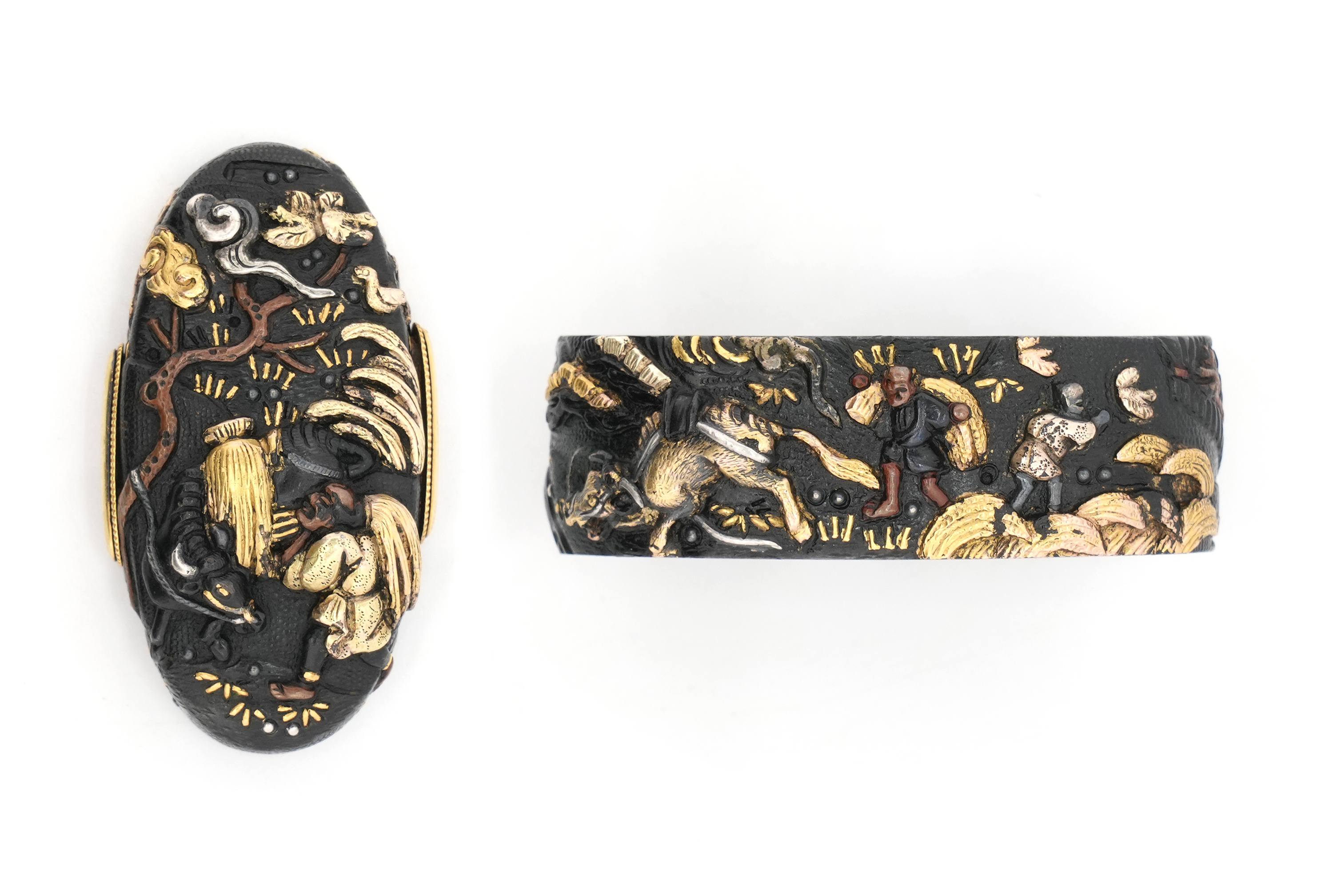
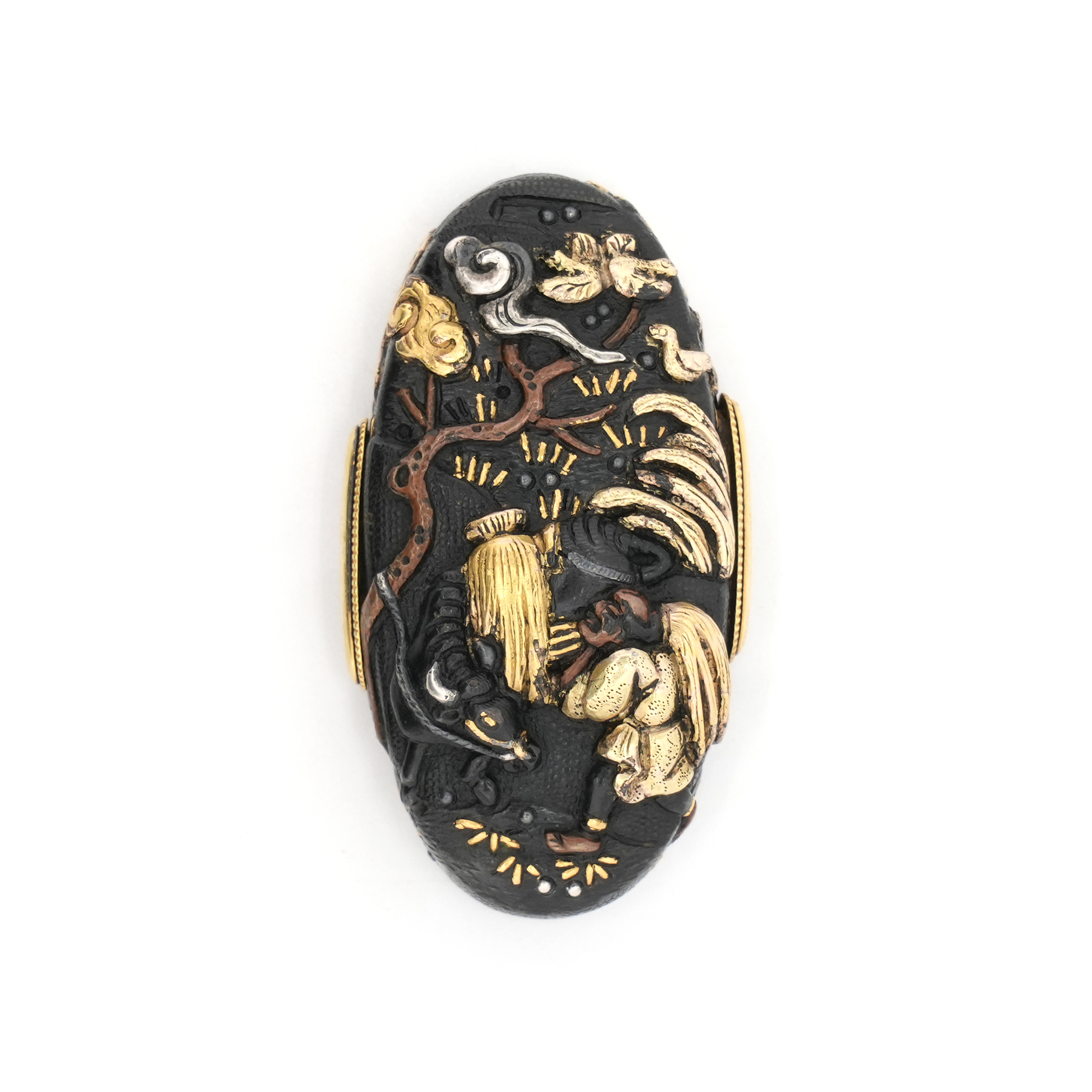
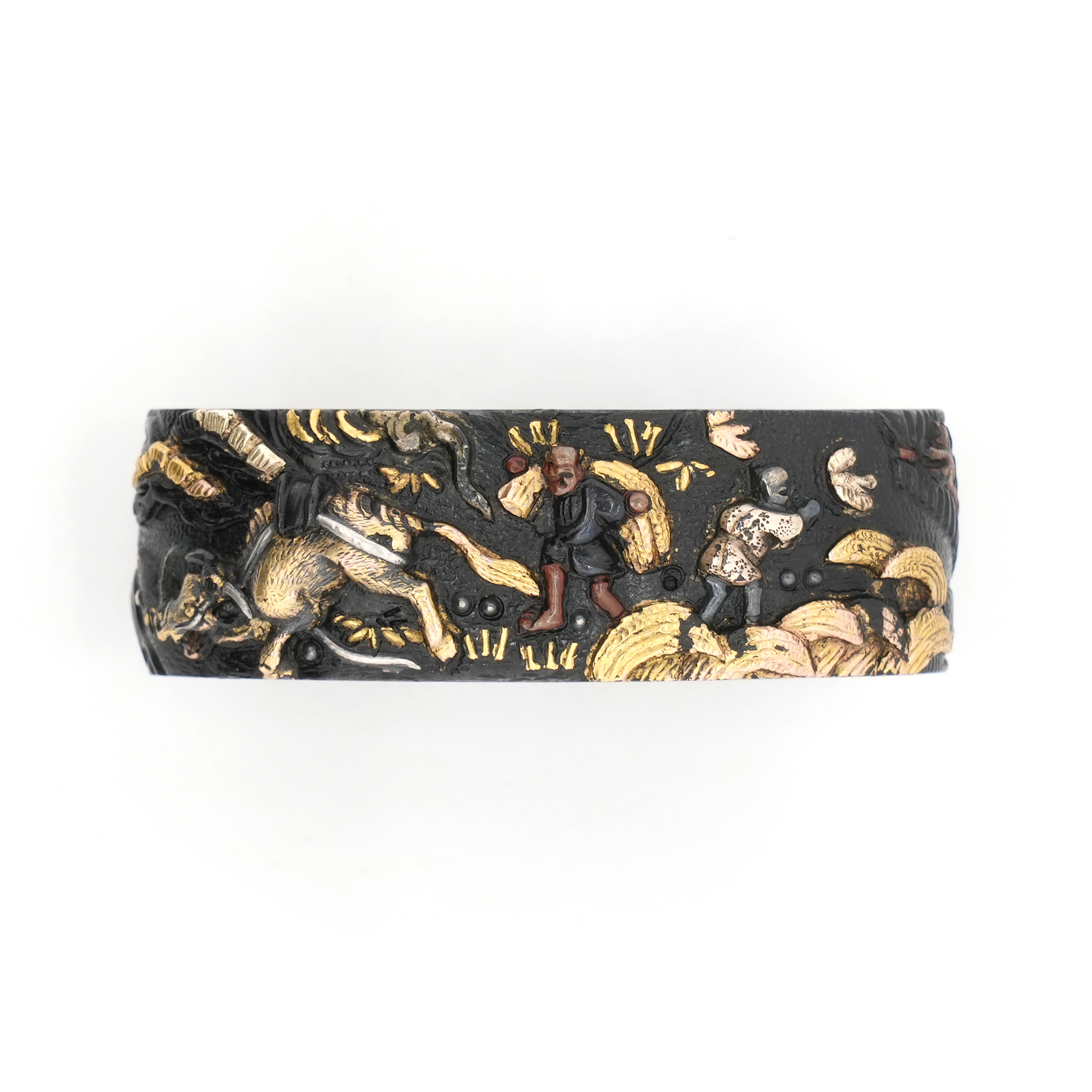
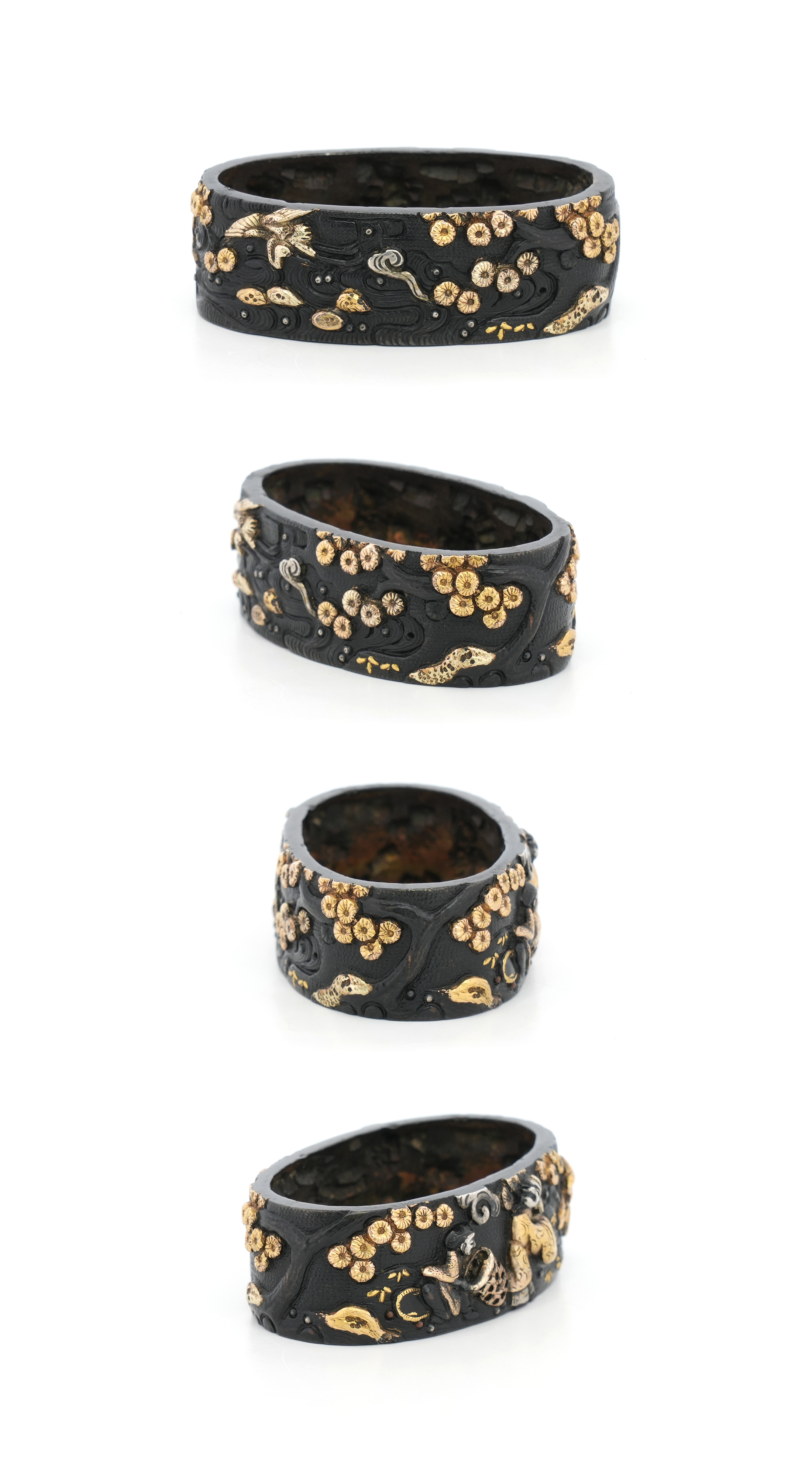
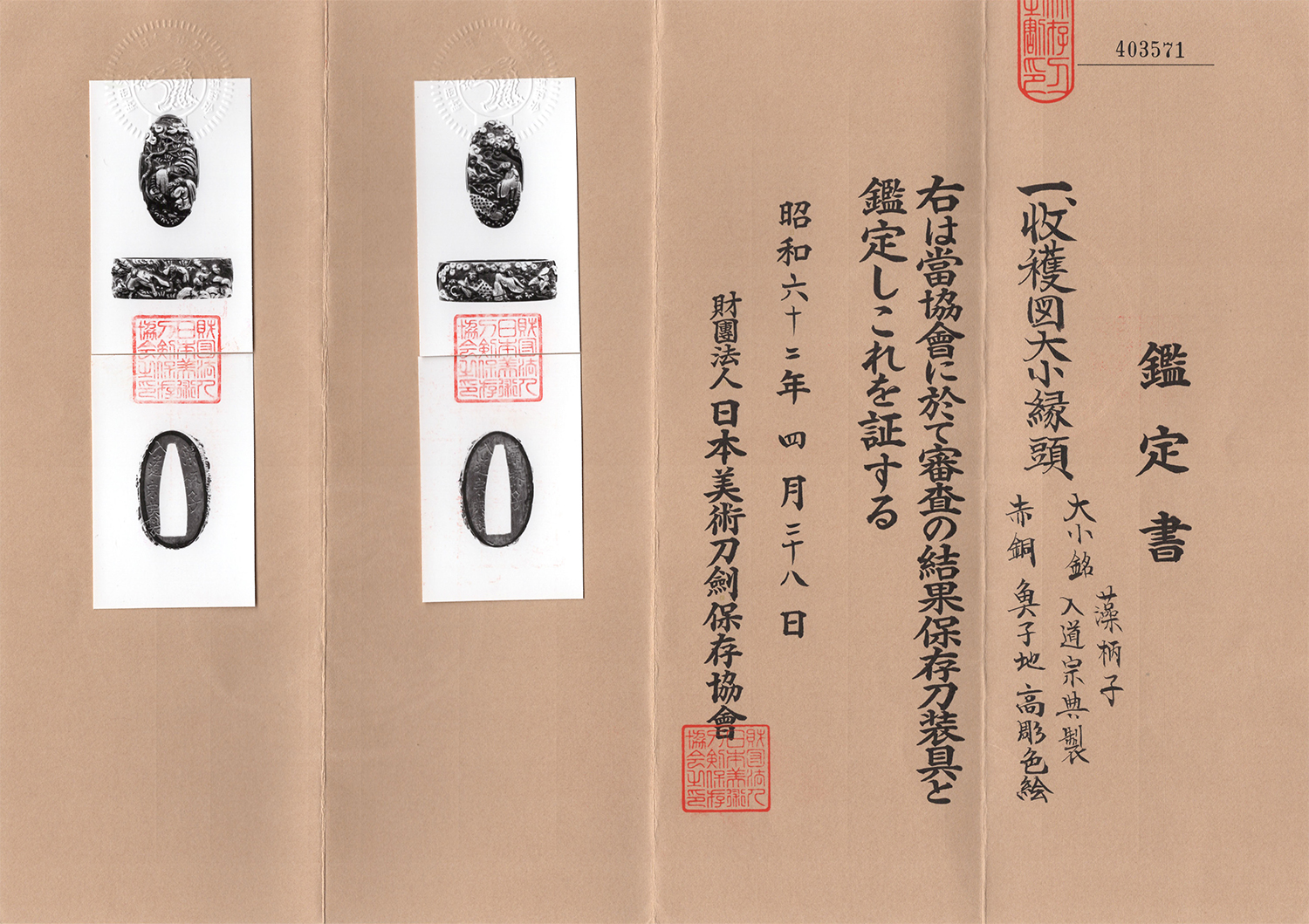
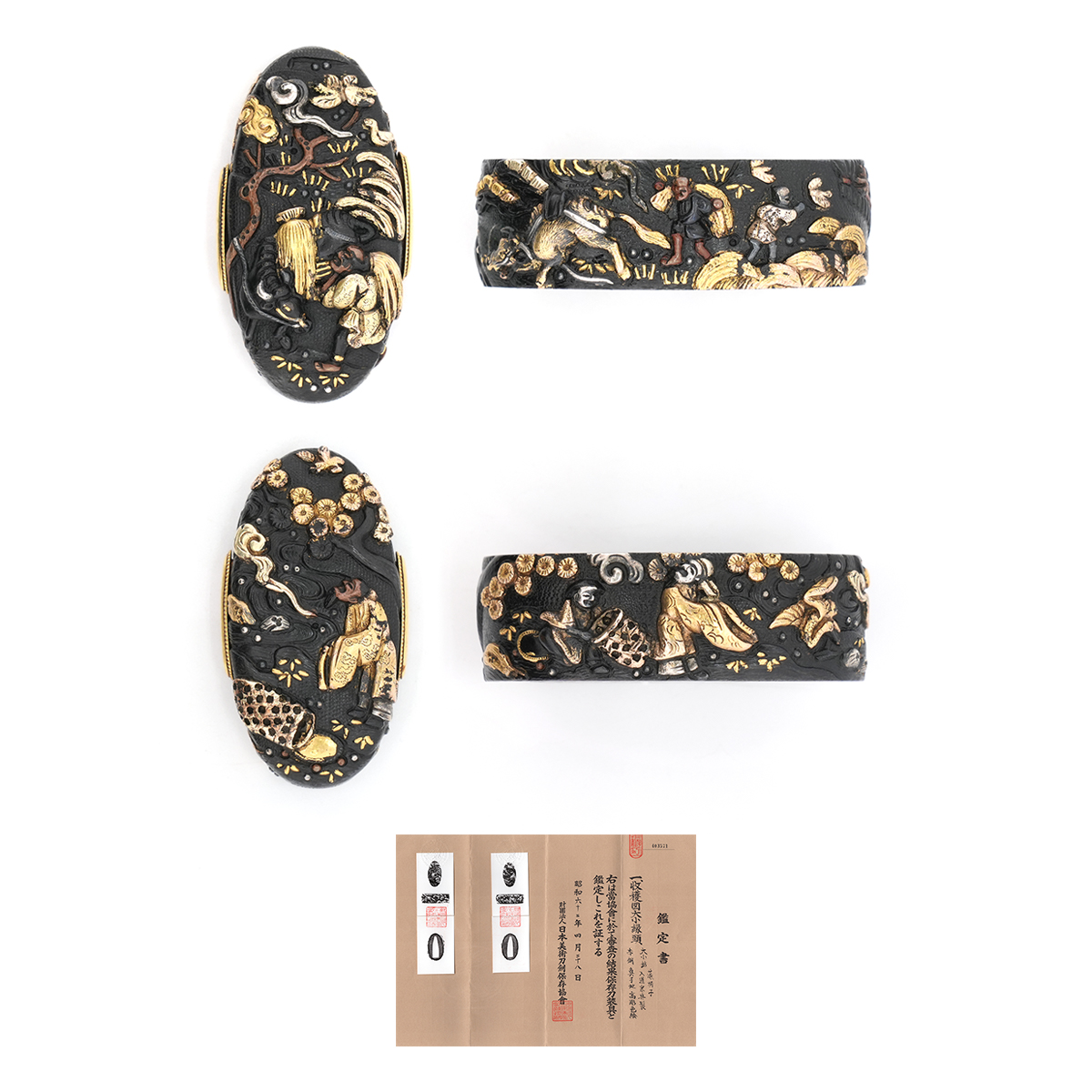
Includes Nihon Bijutsu Token Hozon Kyokai Hozon Tosogu Kanteisho, paulownia wood box. Mogarashi Soten was a metal artist active in Omi no Kuni Hikone during the mid-Edo period, and it is known from his signed works that he lived in Nakayabu, Hikone. His work, which involves carving figures and plants in high relief and skillfully combining iroe such as gold, silver, shakudo, and suaka, is called "Hikone-bori" and has been widely admired since his time. This item is a set of daisho fuchi-gashira with the harvest theme bearing his mei, consisting of four pieces for a daito and a wakizashi, depicting the movement of people working hard in the fields and the richness of the harvest through dense carving and vivid colours. On the larger fuchi, a person carrying harvested goods walks beside an ox carrying a load, and a person gathering harvested ears of grain and overlapping bundles continue across the horizontally long surface. Each time the gaze shifts between the people, whose stride lengths and body orientations are varied, the busyness of the harvest is vividly conveyed. The corresponding kashira features a person handling abundant ears of grain and an ox, and because the scenery, including pine trees and birds, is arranged along the curve of the kashira, there is the pleasure of not only viewing the small surface from the front but also tilting it to follow the carving that continues to the sides. On the smaller fuchi, the flow of a river is depicted under a pine tree, and gold and silver cranes are arranged in the waterside scenery, creating a quiet atmosphere different from the bustle of the harvest seen on the larger one. The kashira depicts a person and a basket under a pine tree, followed by the flowing river, and a bird flying in the upper part adds a light movement to the scene. When the four pieces are lined up, one can enjoy a composition where the harvest of the farming village and the waterside scenery are connected as a single story. The shakudo nanako-ji, filled with a black luster, clearly receives the iroe of the figures and plants. The fineness of the tagane appears as one follows the wrinkles of the clothing, hair, tips of the ears of grain, pine needles, and even the weave of the baskets. The carving, which expresses the faces and limbs of the people and the bodies of the oxen in takabori, has a depth that one would not expect from such small pieces. The gold ears of grain and pine needles, the gold and silver cranes, and the suaka-coloured branches and skin of the figures enhance each other's colours. When mounted, they give a unified elegance to a daisho koshirae, and when kept at hand, one can enjoy a day in a farming village while moving between the four surfaces; the charm unique to Hikone-bori is condensed here. It is valuable enough that a daisho set of fuchi-gashira is handed down with the same theme and technique, but this item is accompanied by a Hozon Tosogu Kanteisho. Combining an auspicious subject matter celebrating the harvest, a mei bearing the name of Soten, and detailed work that is uninterrupted across the two sets, this is a spectacular work that I recommend both to those who wish to complete a daisho koshirae and to those who wish to carefully appreciate the figure expression of Hikone metalwork.
Offered by Toushin

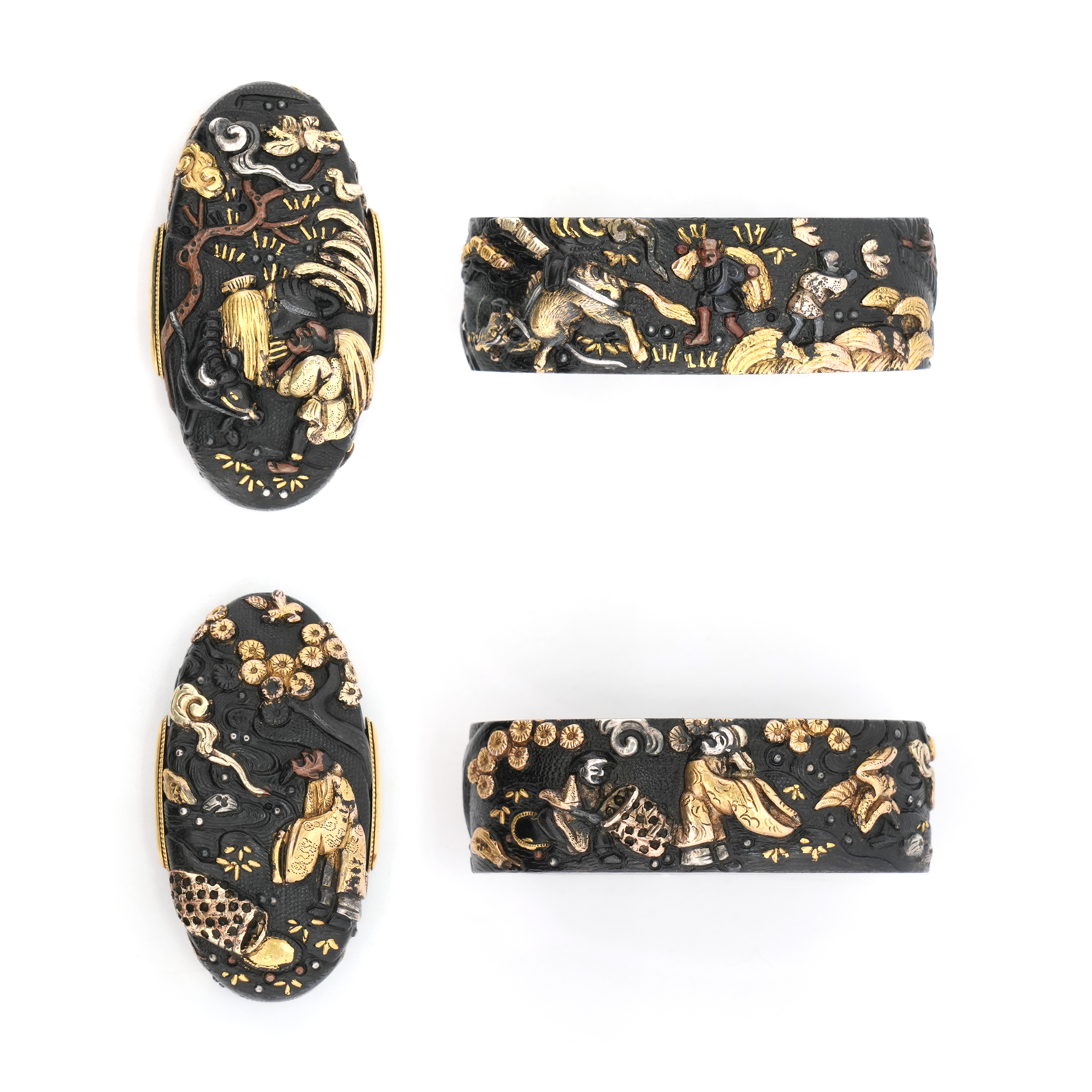
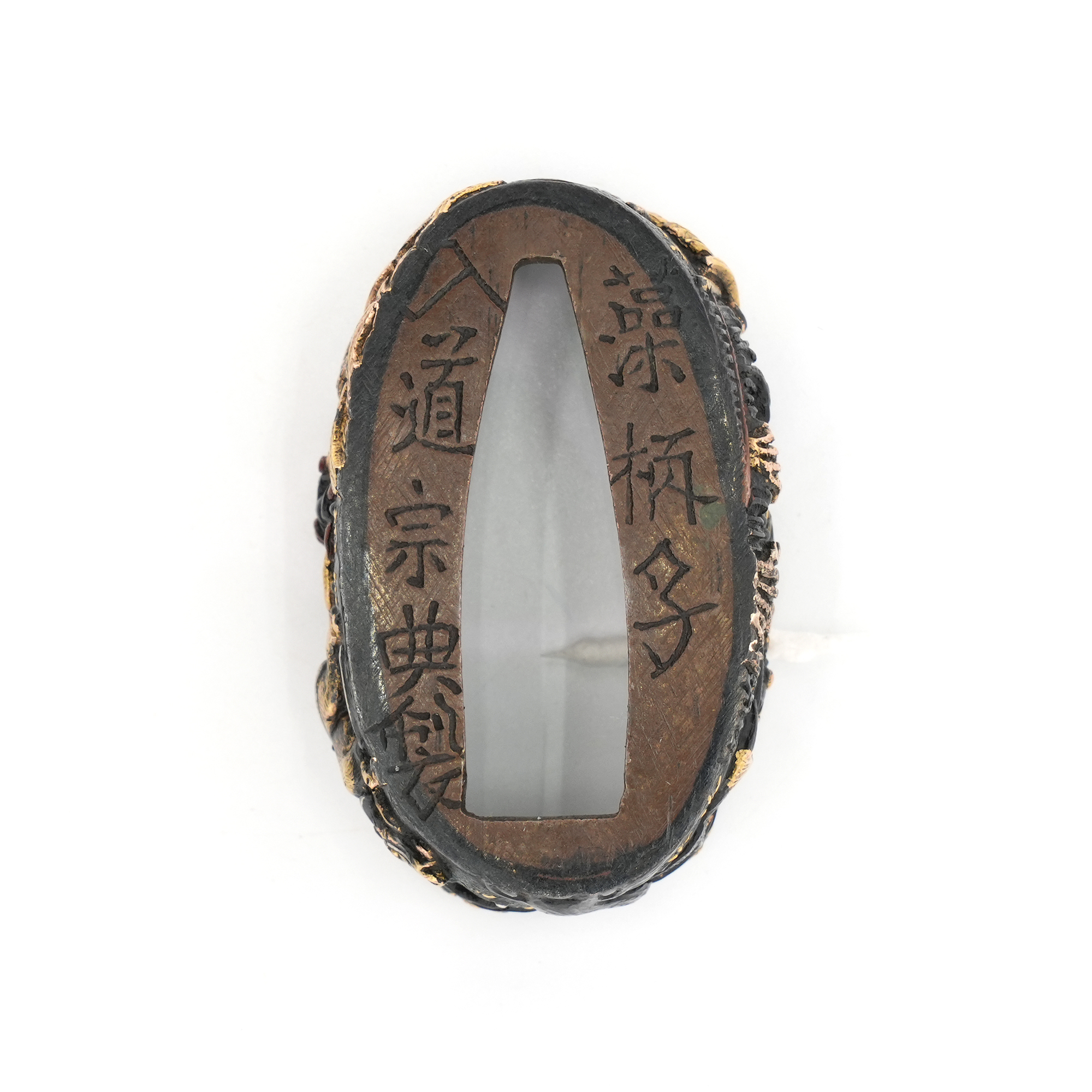
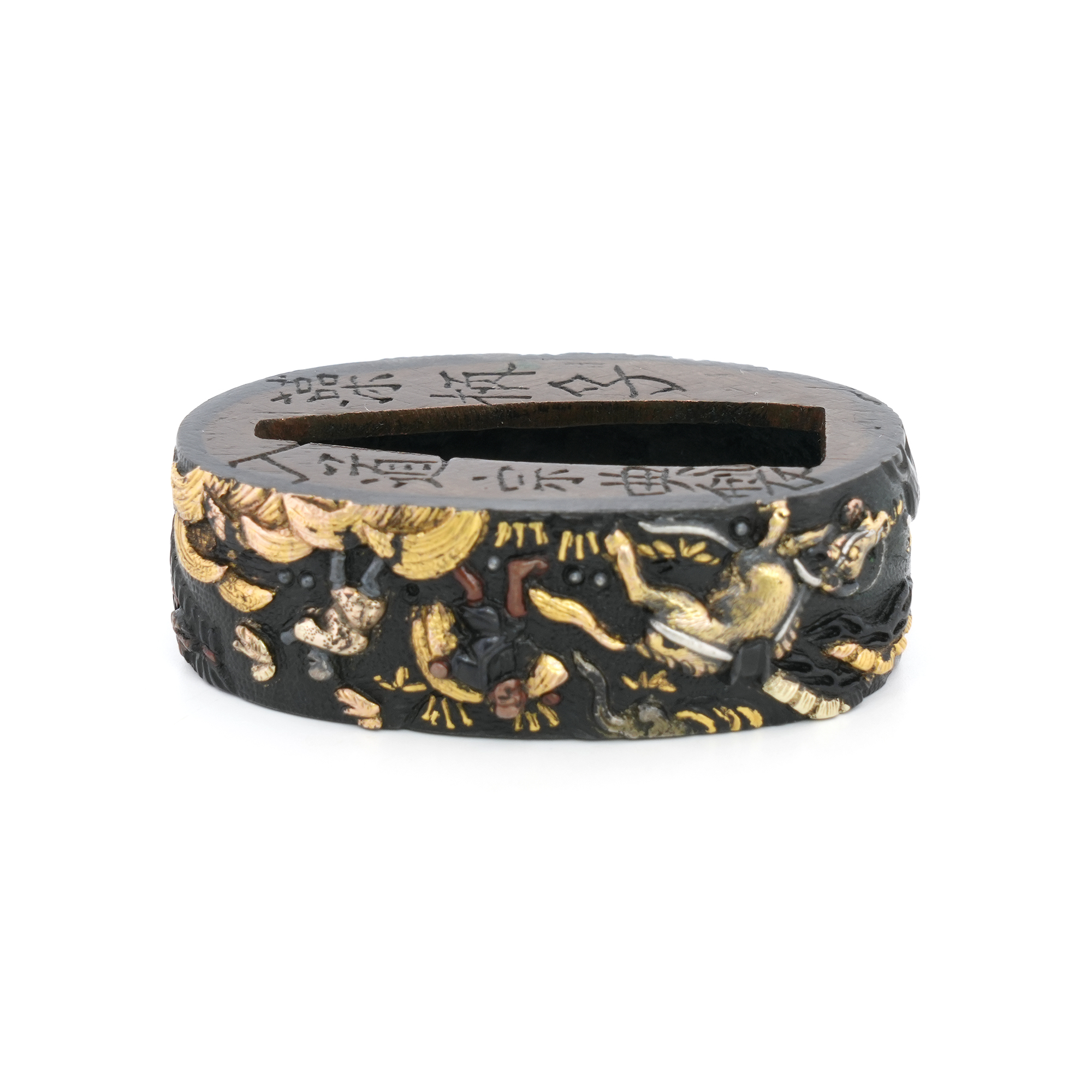
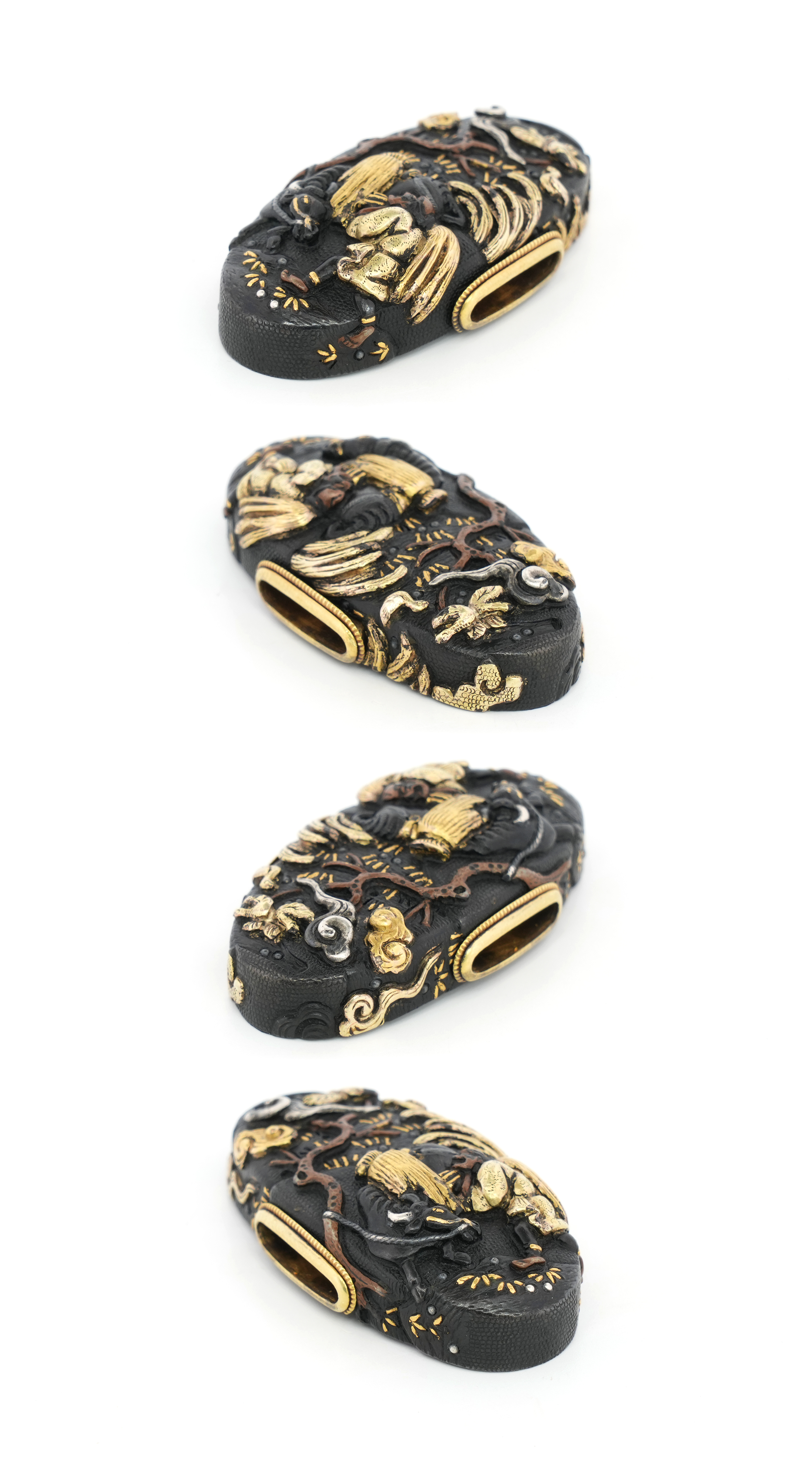
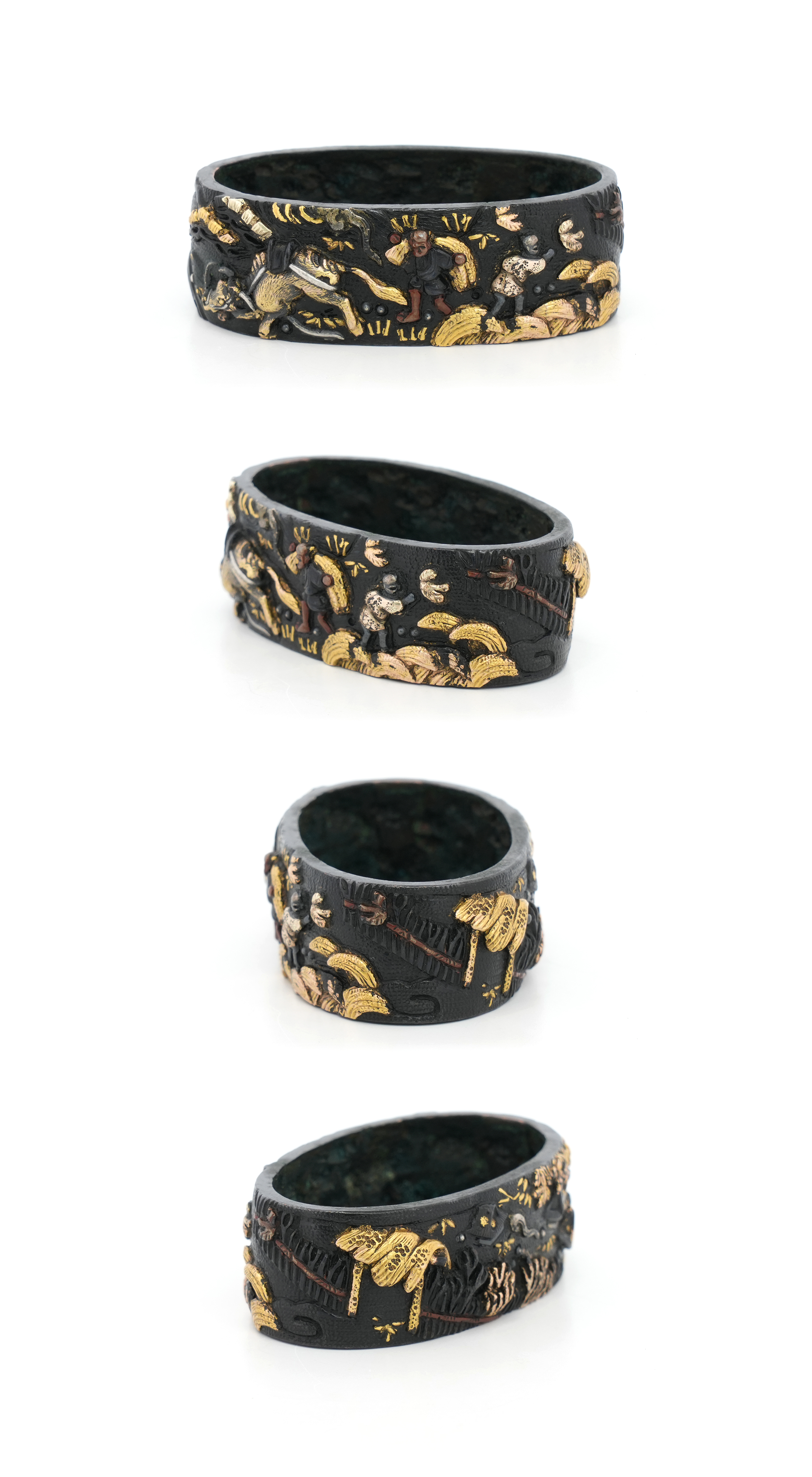
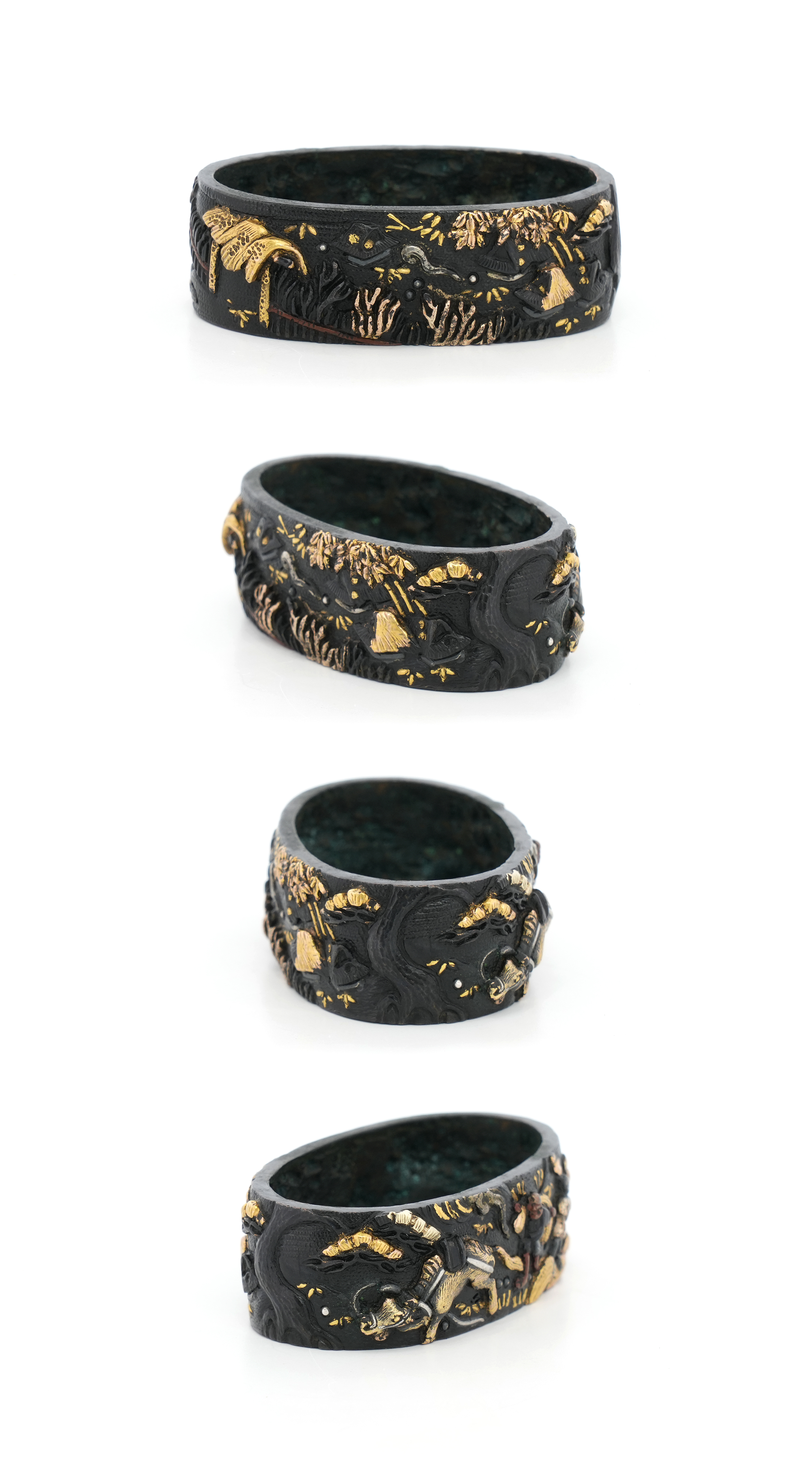
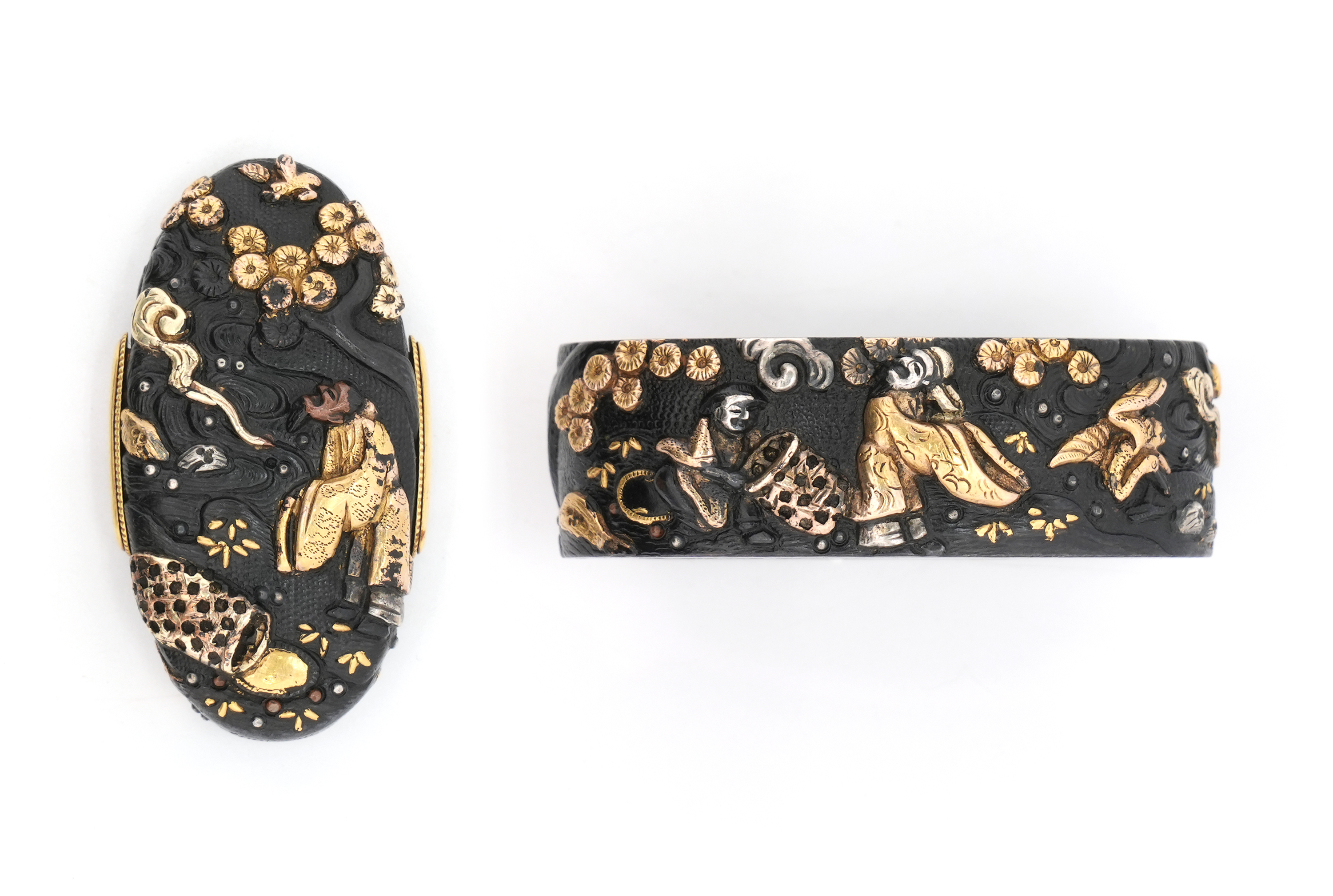
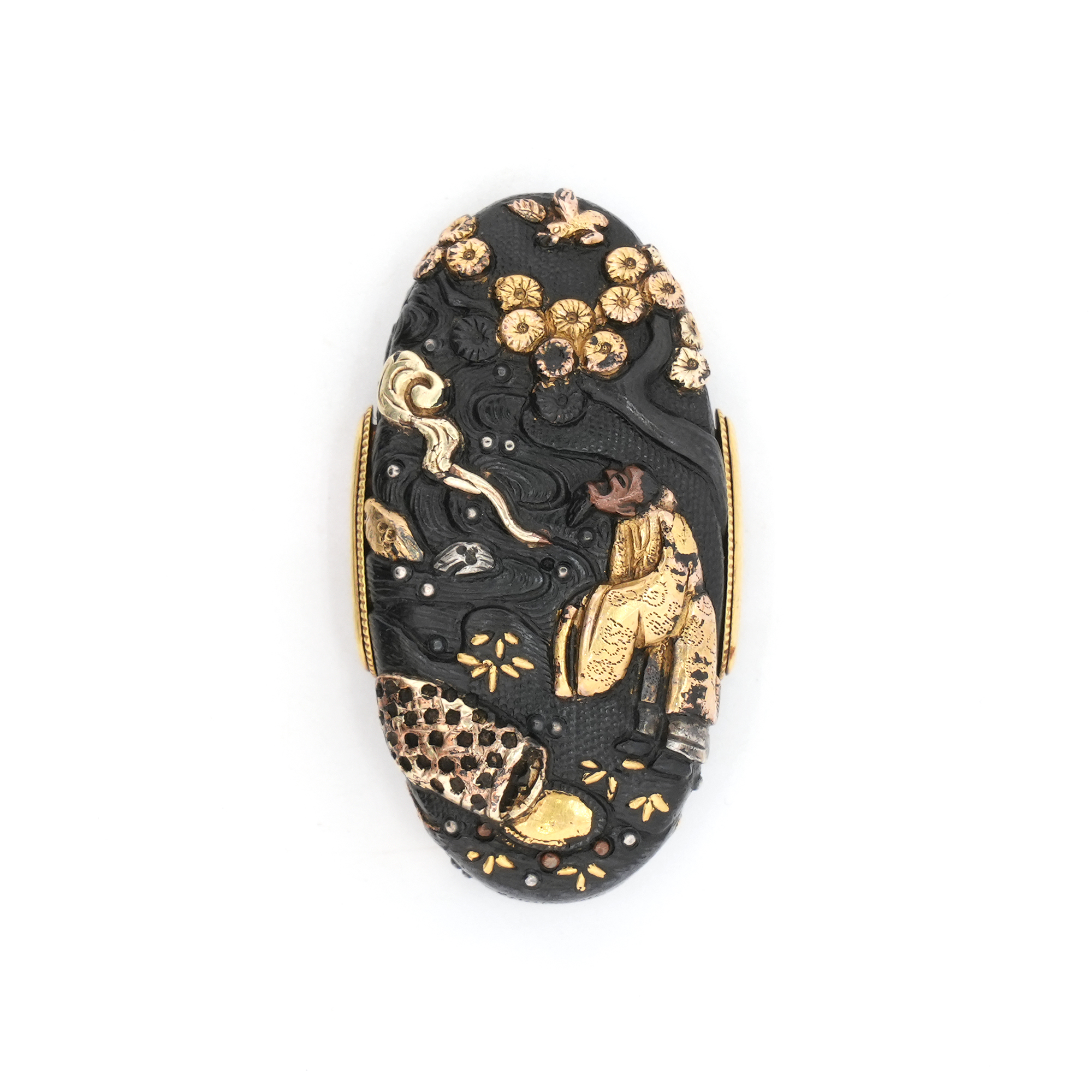
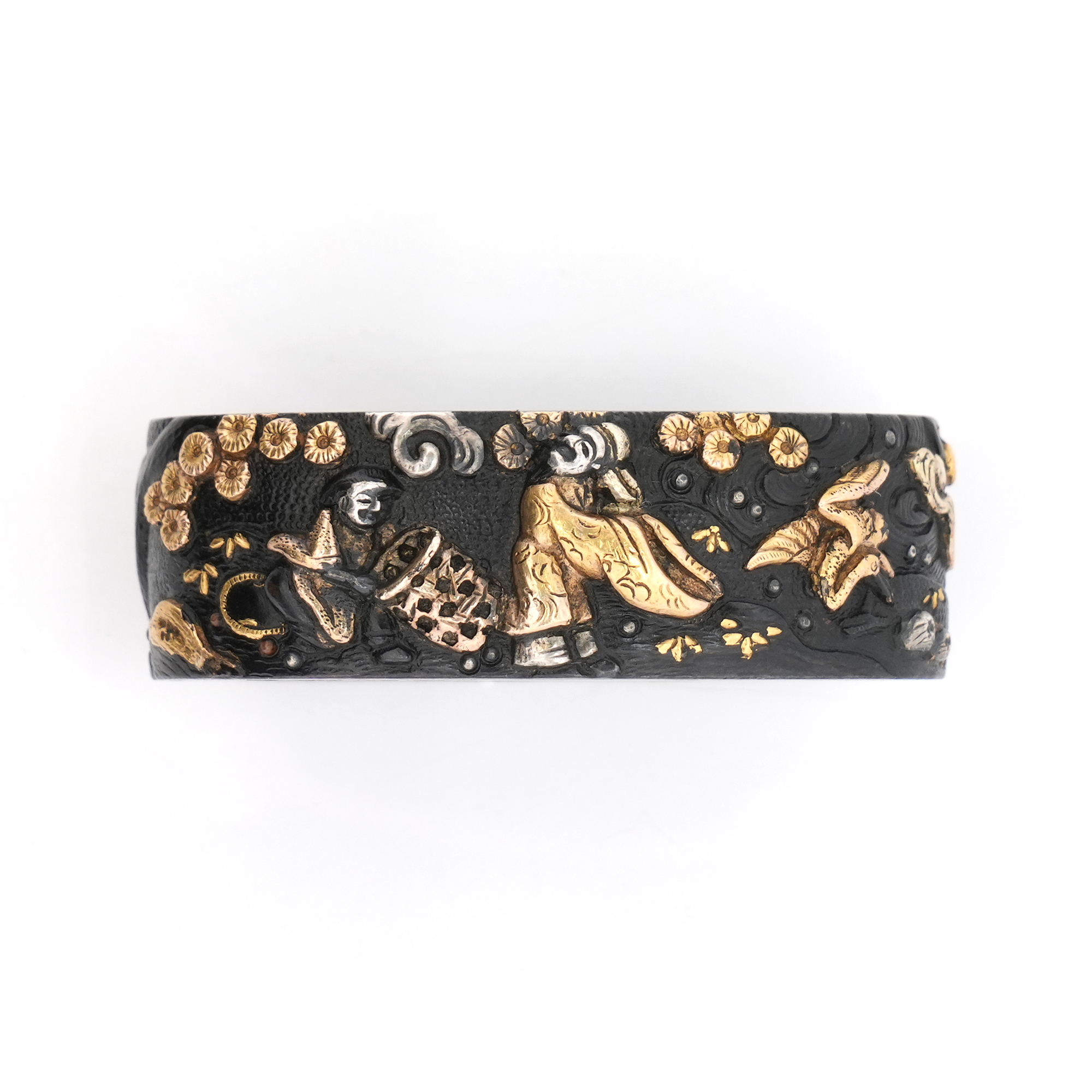
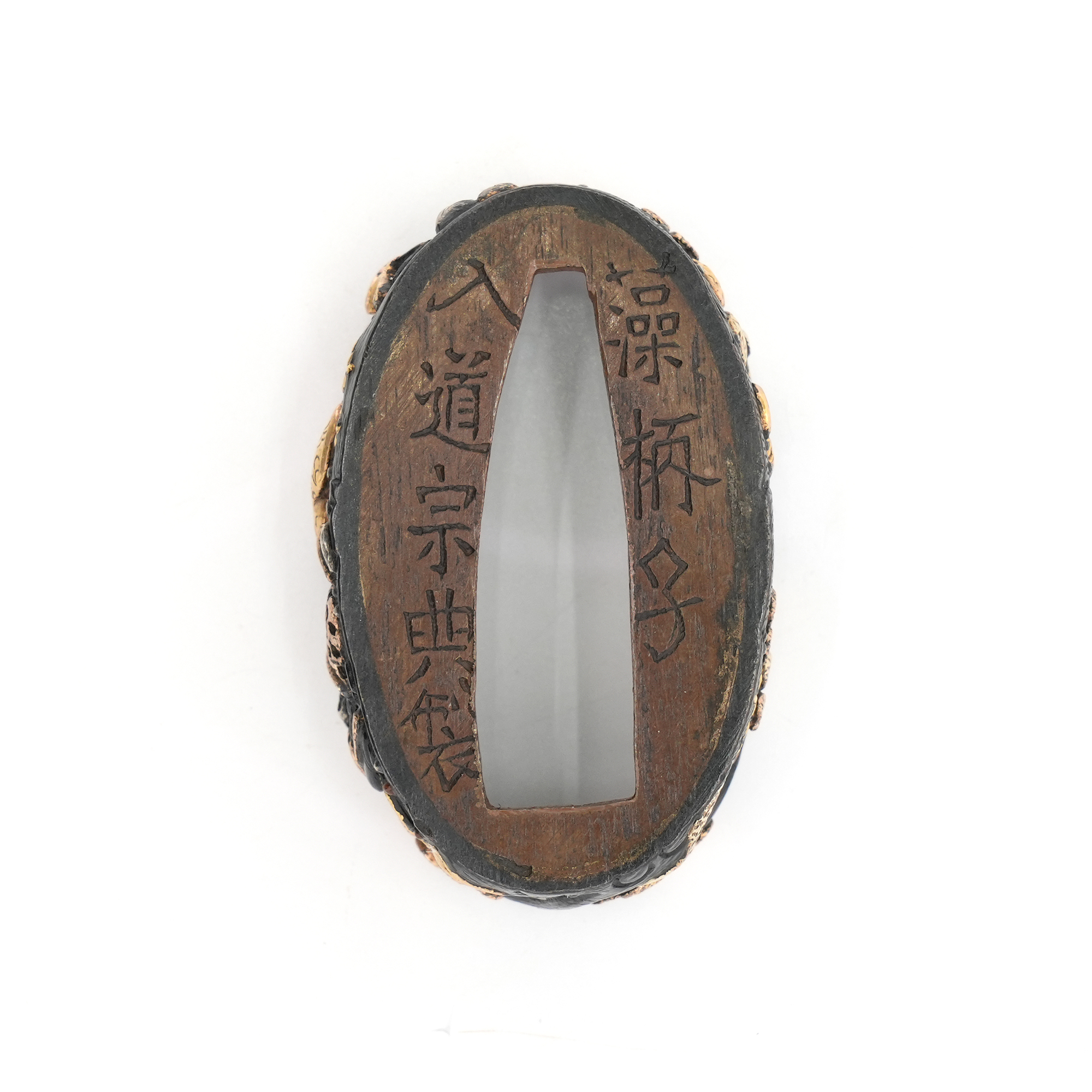
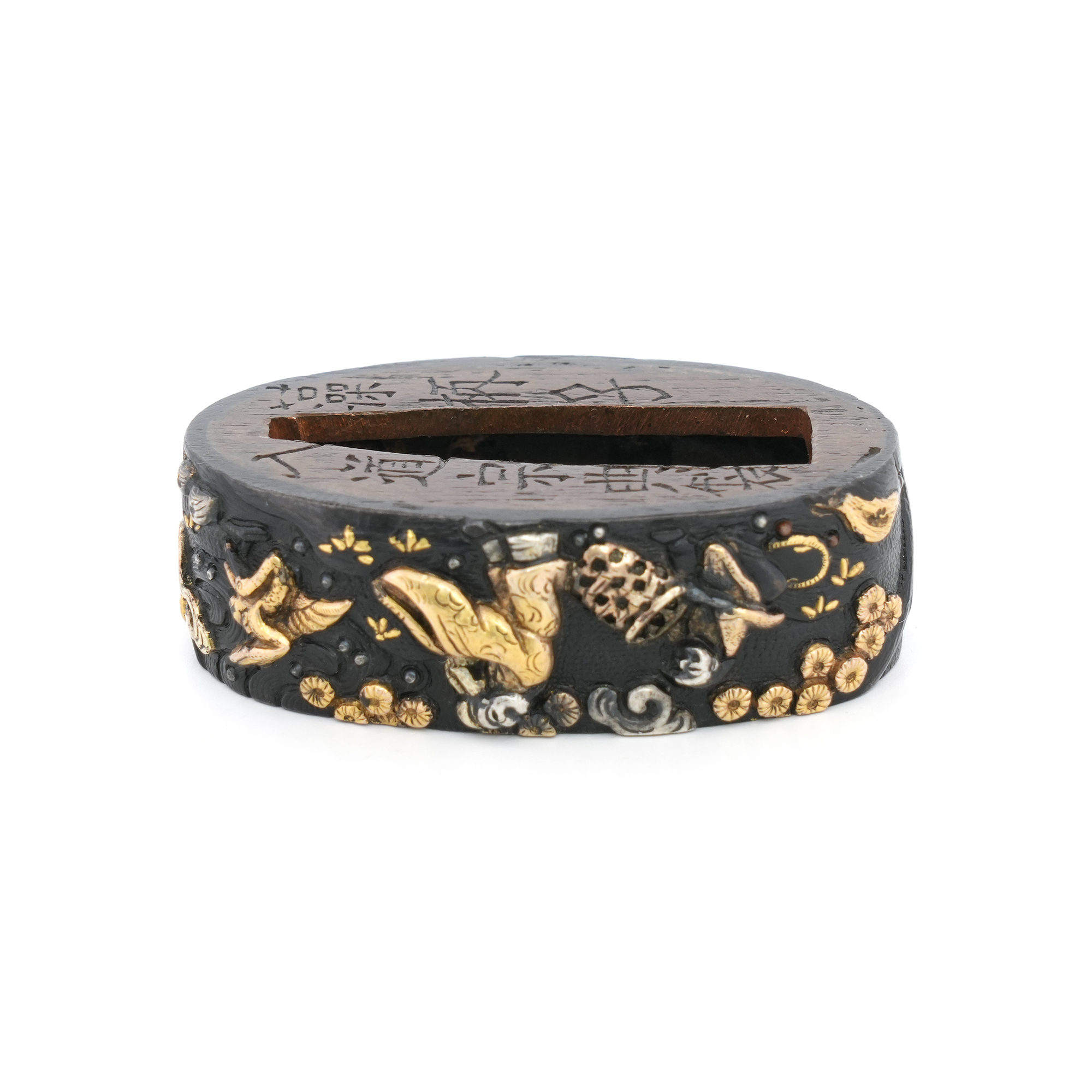
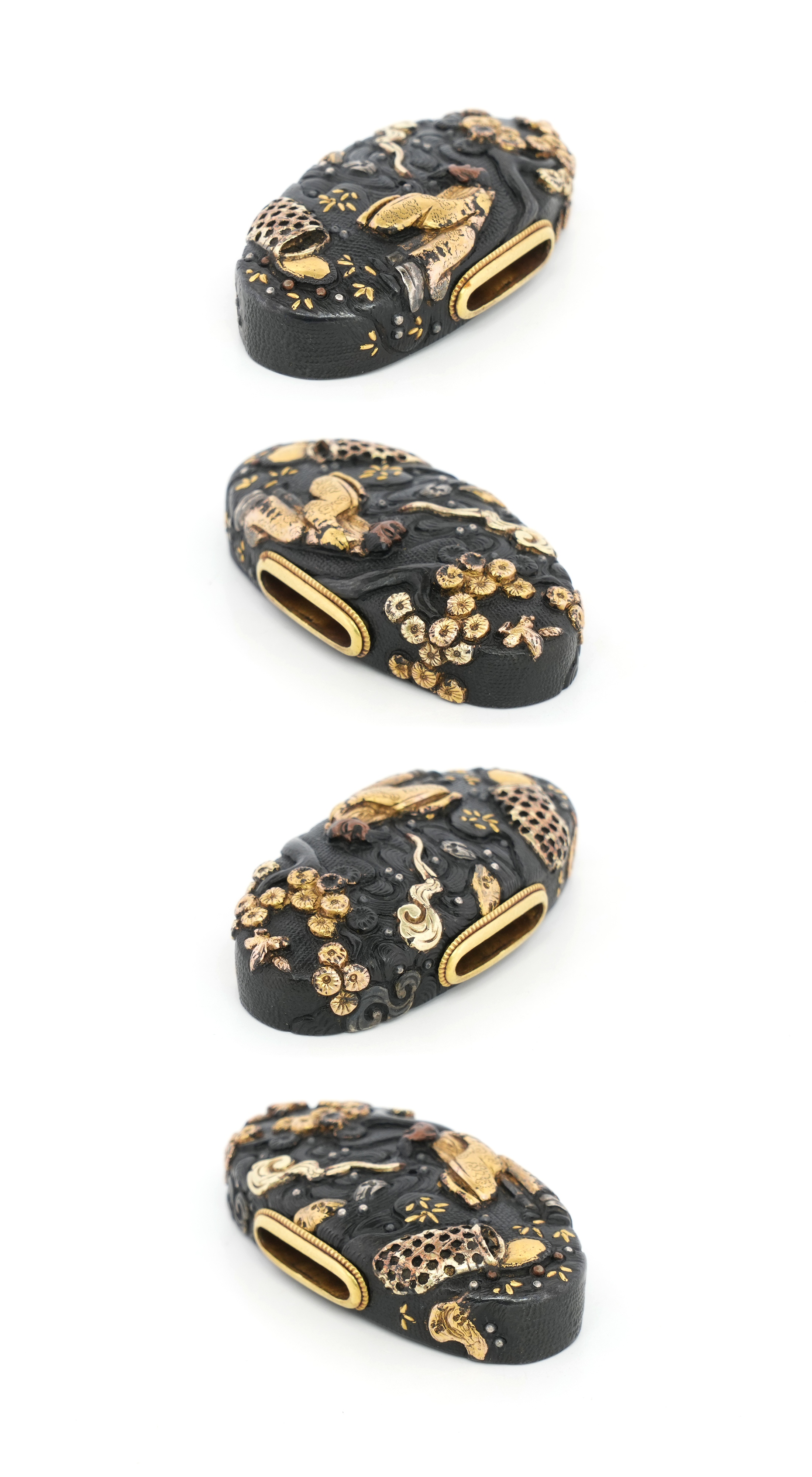
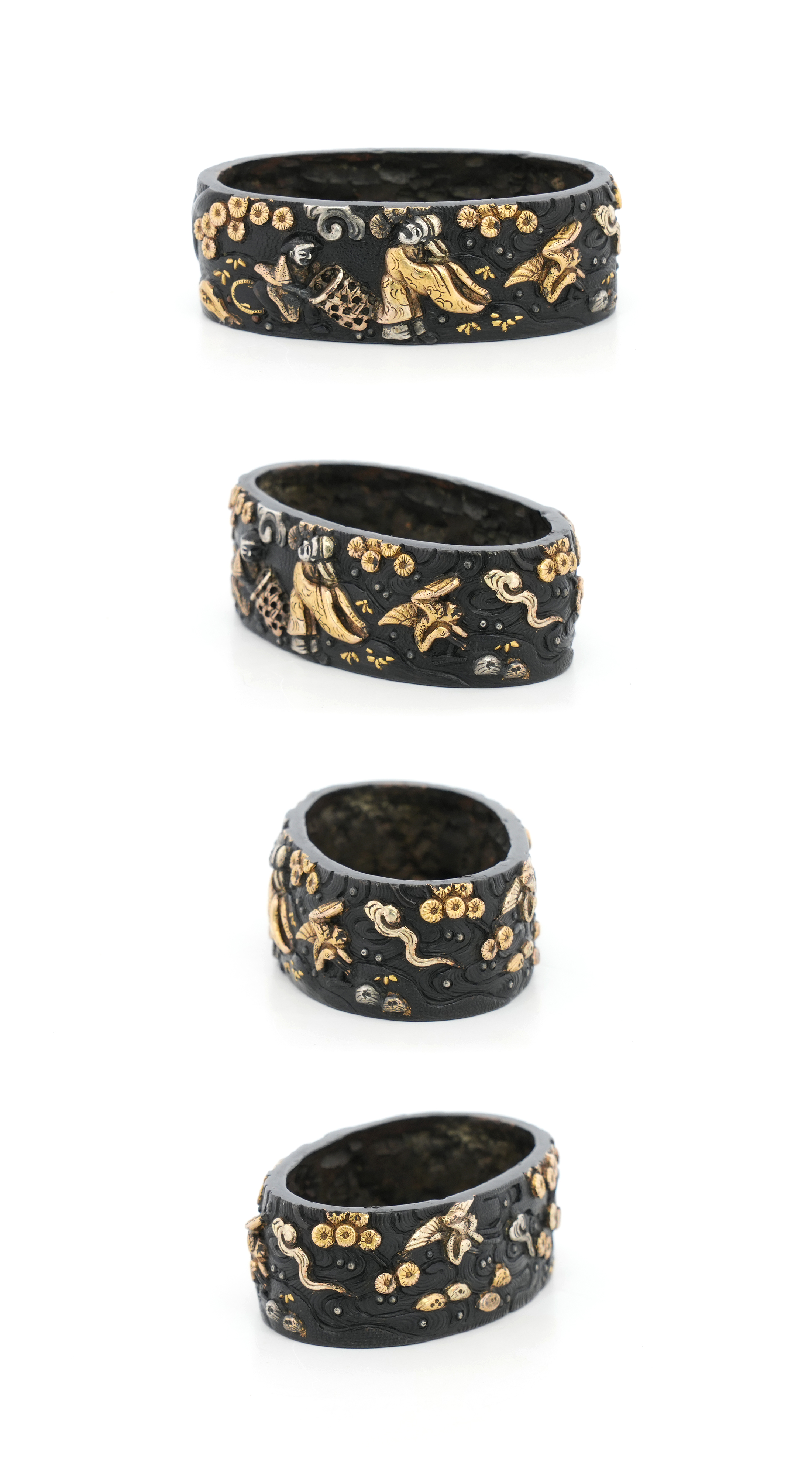
Hikone
Edo
Ōmi
Signed
Hozon (NBTHK)
Machine translation of the shop's Japanese ·
Machine translation from the shop's Japanese · may contain errors ·
Kinko · Omi
32 pieces on the market now
The Hikone school of sword fittings -- known as Hikone-bori -- was established at Nakayabu in Hikone, Omi Province, by Mogarashi Nyudo Soten, who settled there after leaving Kyoto and entered the service of the Kawakita family, hereditary vassals of the Hikone domain. One source records that Soten initially trained under the Goto family, citing the Kinko Soran for the existence of works signed "made by Kitagawa Hidenori, a disciple of the Goto," before developing the distinctive carving manner that would define his lineage. The school's connection to the broader Mino-bori tradition is also recognized. There were reportedly two generations working under Soten's name, with the first born in Joo 1 (1652) and active from the early through mid-Edo period. From his workshop emerged a circle of accomplished students, chief among them Nomura Kanenori and Munenori, who carried the Hikone-bori manner forward and established it as one of the most distinctive regional styles in the kinko tradition. The technical hallmark of Hikone-bori is sukidashi takabori -- richly modeled high-relief carving executed on generously proportioned iron plates, further enlivened through zogan iroe employing gold, silver, shakudo, and suaka. The NBTHK notes that even among the gold applications, "multiple types of gold are used," producing expansive pictorial fields of considerable chromatic variety.
Subjects encompass warriors, Daoist immortals, elder sages at elegant gatherings, and flowers-and-birds compositions, rendered across the entirety of both surfaces of the guard. The school's masters also demonstrated facility in shakudo work, including nanako-ji plates with high-relief compositions displaying a pronounced Goto-like flavor, as well as nikubori ji-sukashi and polychrome mitokoromono sets. What unifies the school's output is the synthesis of imposing compositional scale with refined polychrome technique. " Munenori's contribution is recognized for its assured command of shakudo nanako-ji ground preparation and boldly modeled takabori, enriched with polychrome iroe employing multiple varieties of gold across both faces -- a sumptuous, animated effect characteristic of the mature Hikone style. The Hikone school's significance within the broader kinko tradition rests on its creation of a distinctively pictorial approach to sword-fitting decoration that stands apart from both the restrained elegance of the Goto mainline and the narrative density of the Yokoya school. The NBTHK's evaluative language converges on a single defining quality: the school's ability to fill expansive iron and shakudo surfaces with ambitious narrative compositions while maintaining compositional coherence and chromatic refinement. " That Soten's overwhelming fame led later makers to adopt his signature on subsequent Hikone-carved works testifies to the enduring authority of the school's founding aesthetic, while the surviving origami documentation -- including one dated Kanbun 5 (1665) from Goto Mitsutomo -- provides valuable evidence for understanding workshop practices and the collaborative production that sustained the Hikone tradition across the early and mid-Edo period. Learn more →
| Smith | Era | Designated |
|---|---|---|
| Soten宗典 | Edo | 10 |
| Kanenori包教 | Edo | 3 |
| Masatsugu政次 | Edo | 0 |
| Mitsuyoshi光義 | Edo | 0 |
| Munekata宗賢 | Edo | 0 |
Certifies a genuine fitting worth preserving: a correct signature, or, if unsigned, an identifiable era and school, with recognized artistic and craft value.
The NBTHK (Nihon Bijutsu Tōken Hozon Kyōkai, the Society for the Preservation of Japanese Art Swords) is a public-interest incorporated foundation founded in 1948 and supervised by Japan’s Agency for Cultural Affairs (Bunkachō); it is based at the Japanese Sword Museum in Tokyo. Its expert panels physically examine each submitted work (shinsa) and issue a certificate (kanteishō) ranking it by artistic and historical merit. NBTHK papers are the most widely recognized standard of authentication for Japanese swords and fittings.
NBTHK official siteAs a rule we do not accept returns, except when we have sent a different item from the one ordered or when there is a significant discrepancy between the description and the item. If you wish to return an item, please contact us within 3 days of its arrival and then send it back.
¥550,000