 NihontoWatchNihontoWatch
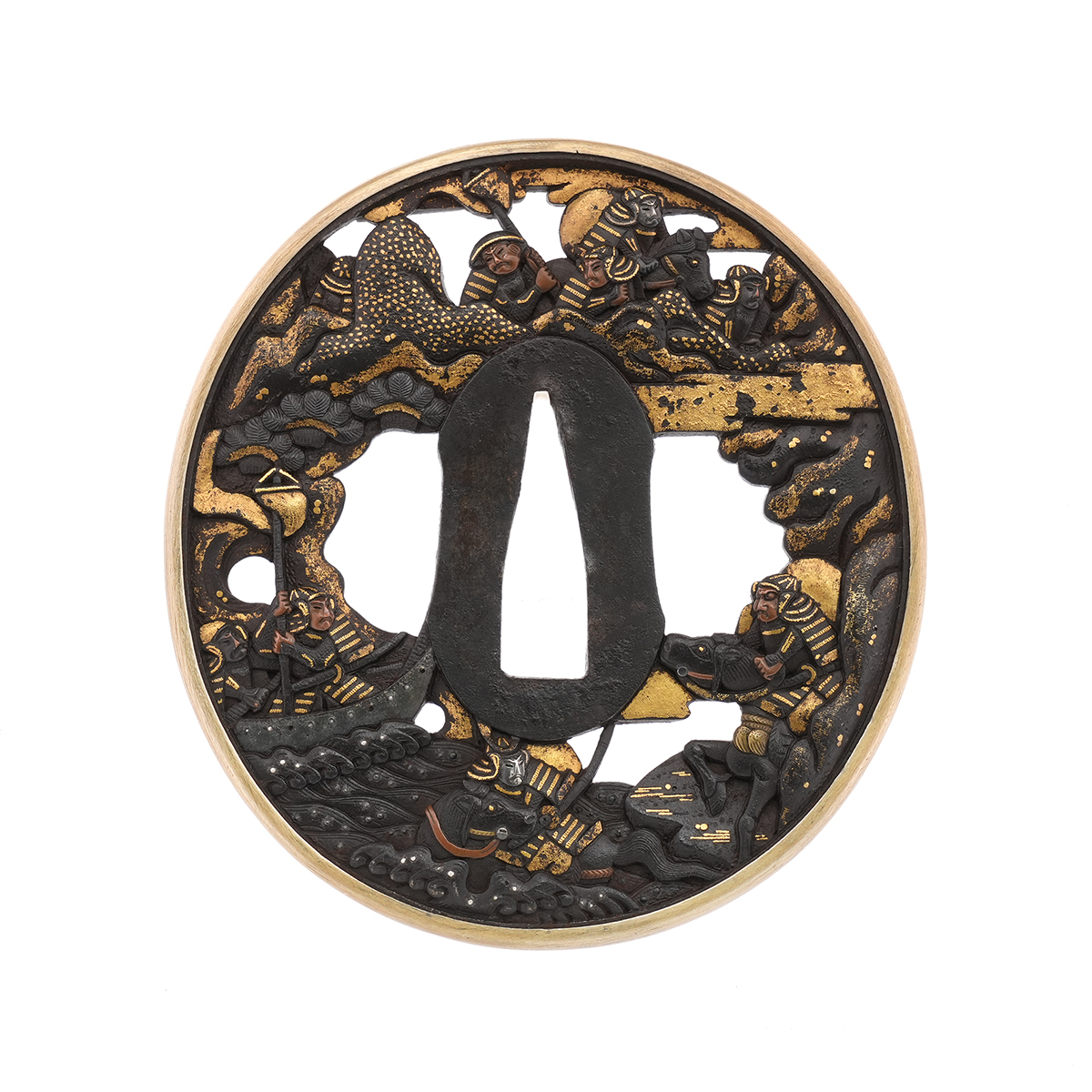
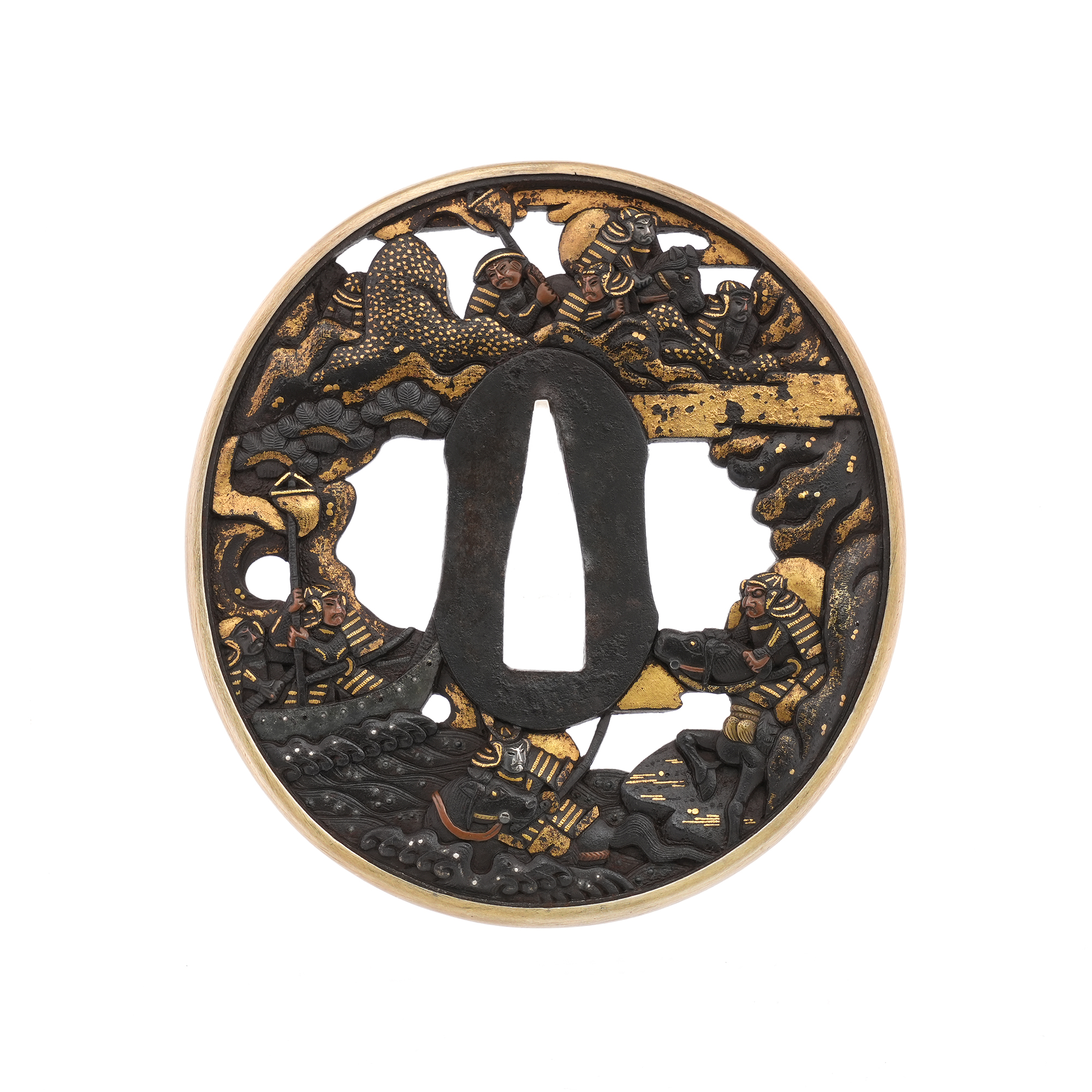
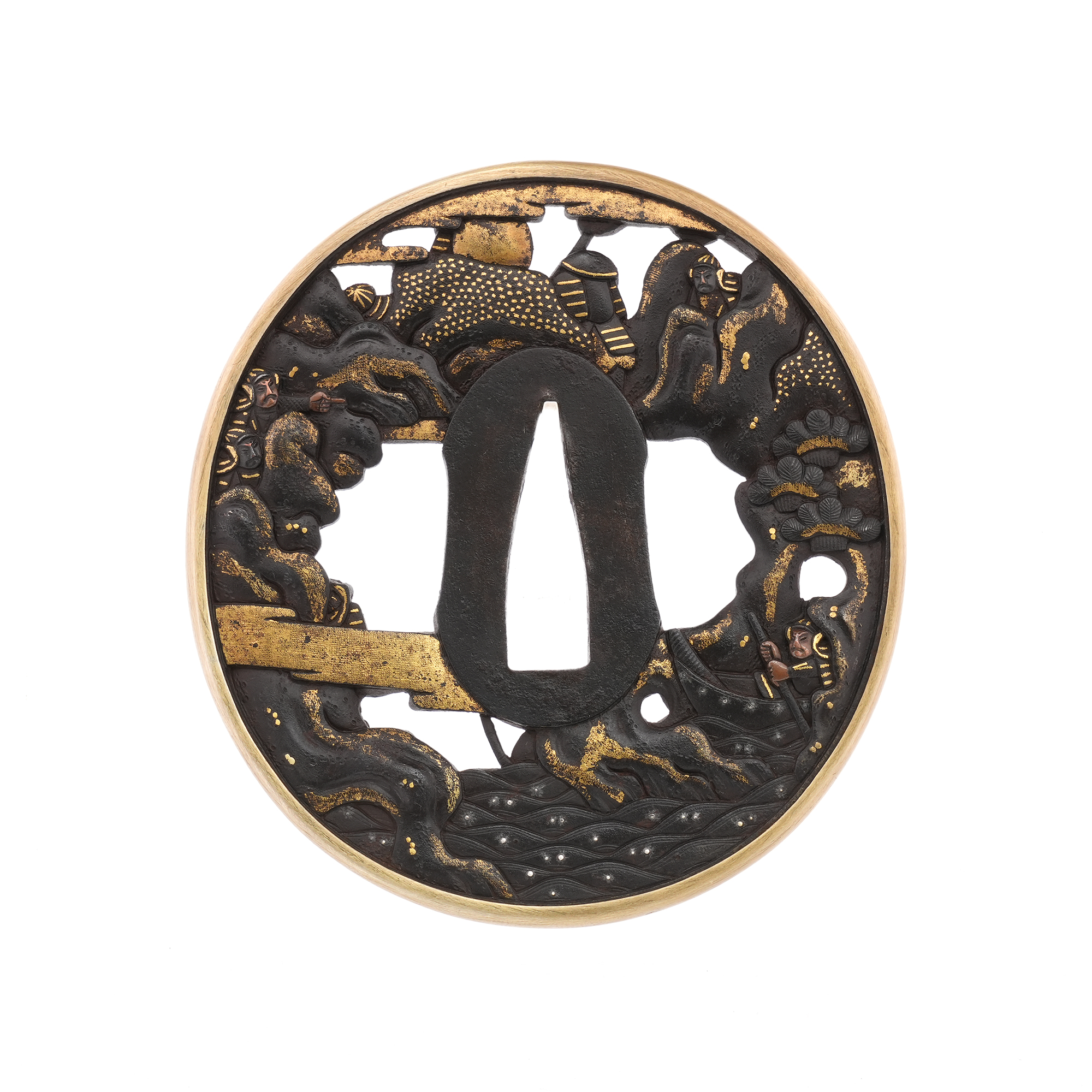
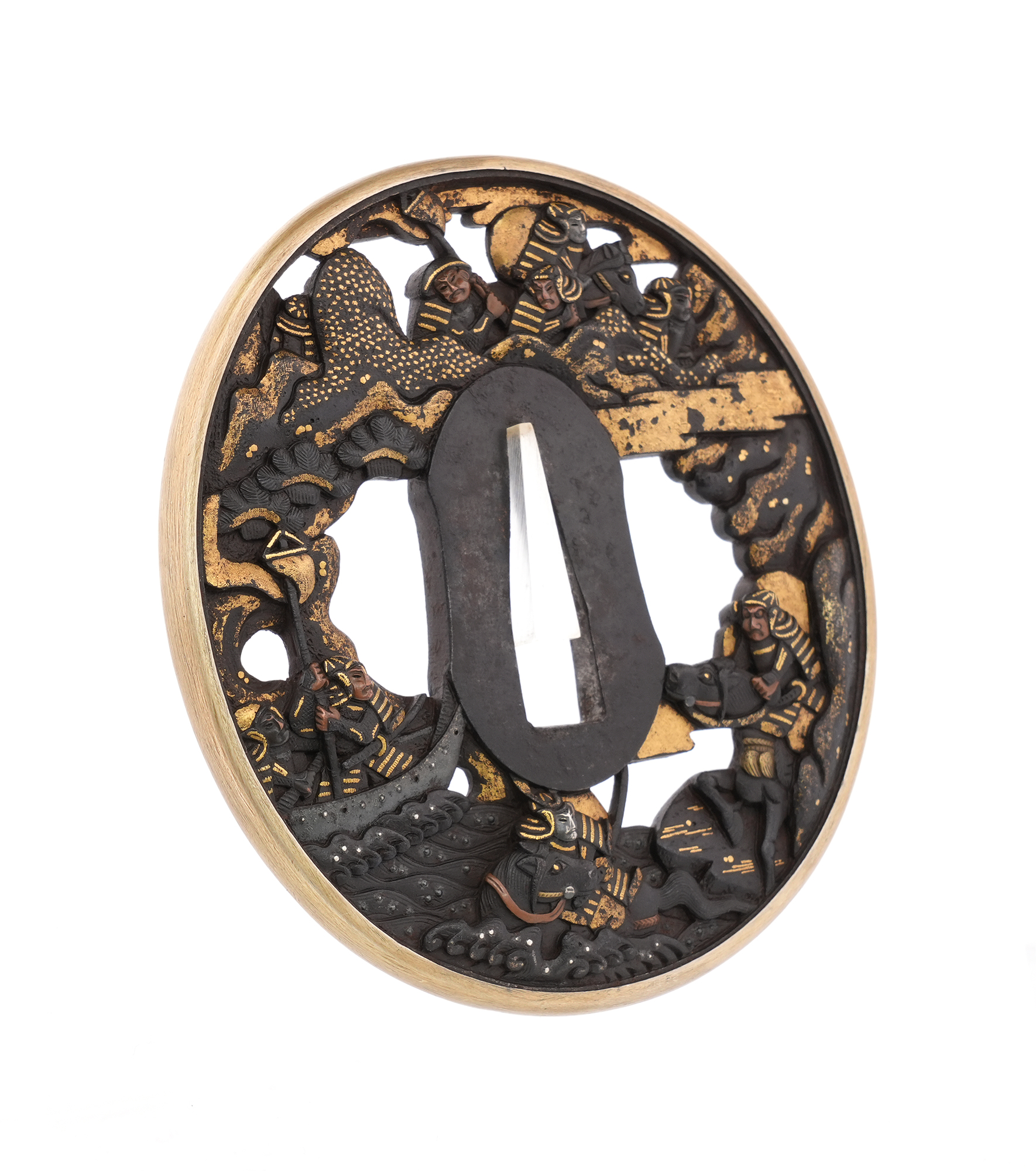
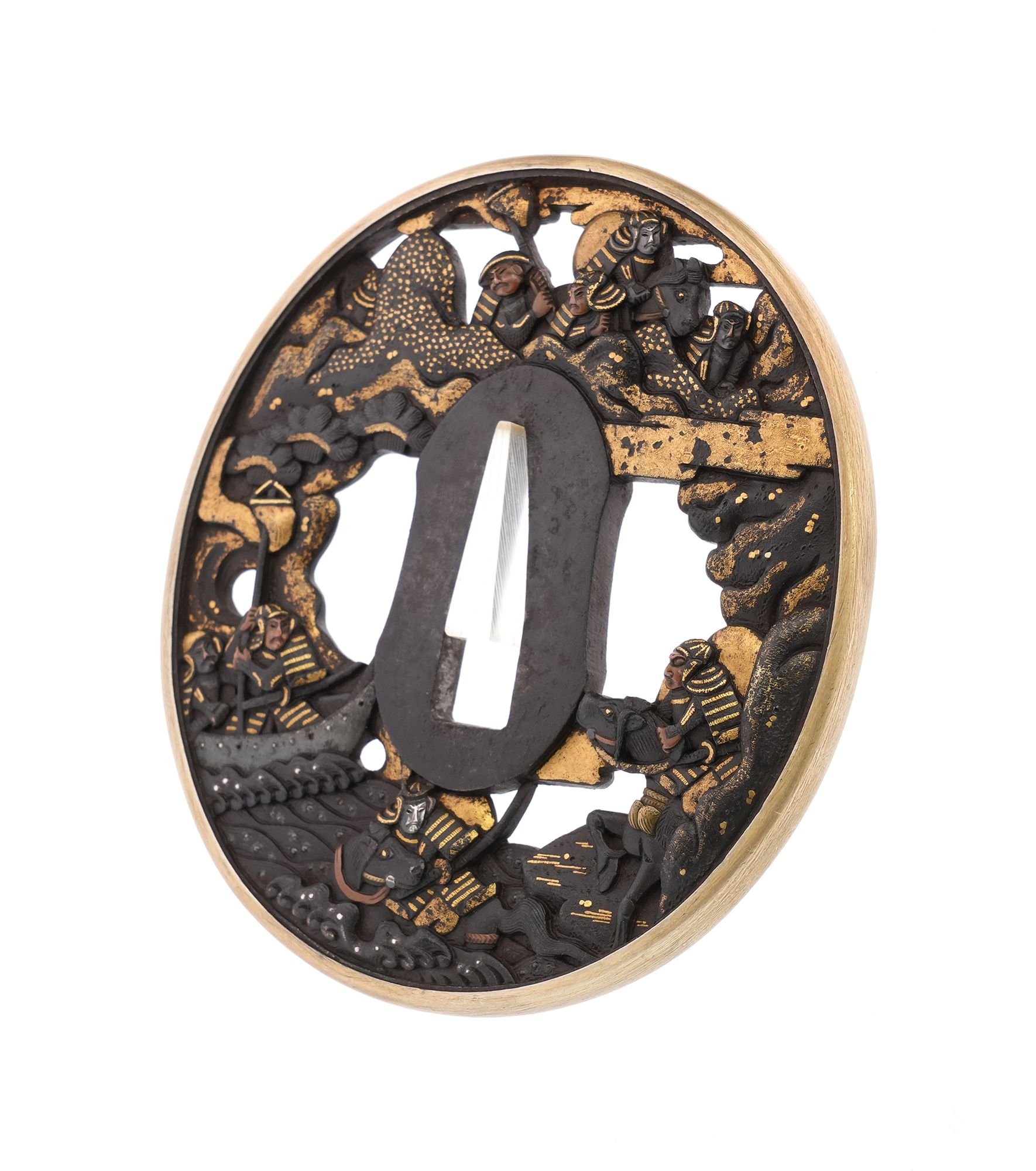
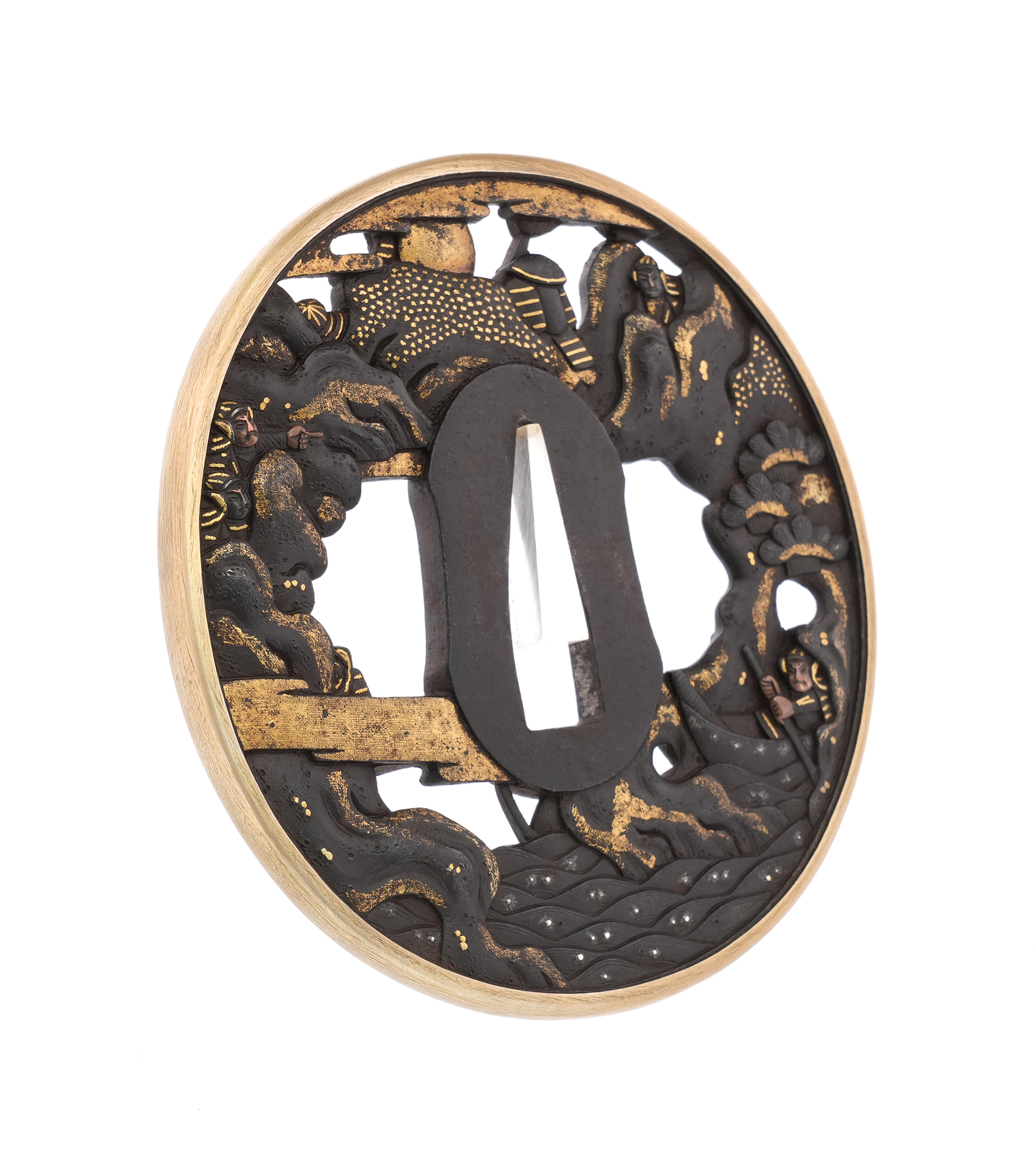
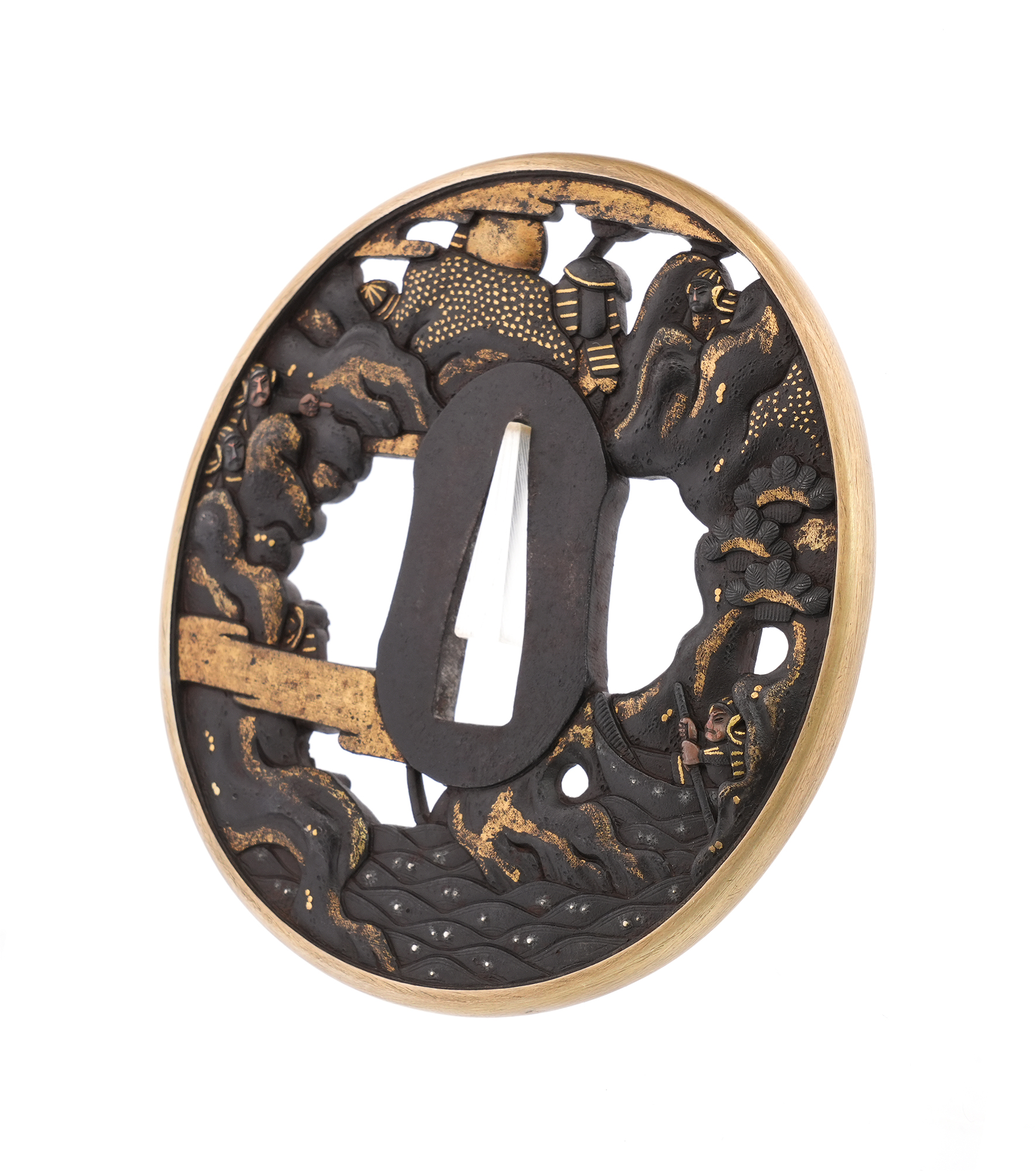
Ichinotani Kassen-zu Tsuba Mumei -Mumei- Tate 81.1 mm Yoko 75.6 mm Seppa-dai Atsu 4.4 mm Omasa 125.3 grams Edo Chuki The middle period of Edo era Fuzoku Kiri-bako This is a large-scale tsuba made of tetsu-ji with kin-fukurin, featuring the Battle of Ichinotani, known as a famous scene from the Genpei War, as its theme. By encircling the heavy tetsu-ji with a gorgeous kin-fukurin, it is composed into a high-style appearance, powerfully expressing the world of historical motifs favored by the buke. The scenes of the battle are skillfully arranged; on the lower right of the omote is the Genji warrior Kumagai Jiro Naozane, and in the lower center is Taira no Atsumori, famous as a young warrior of the Heike. Both are widely known through the tragic anecdote told in the "Heike Monogatari," and have long been featured as motifs in tosogu as figures symbolizing bravery and mujo. This work also condenses that narrative-rich scene onto the tsuba. The well-forged ji-tetsu is elaborated in detail as if viewing a narrative picture scroll, skillfully expressing the tension of the battlefield and the presence of the figures within the limited space. The kin-fukurin encircling the mimi does not stop at mere decoration but plays a role in tightening the entire composition, further highlighting the design through contrast with the sober texture of the tetsu-ji. A point of interest is that it combines the robustness of practical tosogu with the splendor of an art object for appreciation. Themed on the Battle of Ichinotani, which symbolizes the history of the rise and fall of the Genpei, and composed with a powerful tetsu-aji and high-style kin-fukurin, this work is a superior piece that conveys a longing for buke culture and respect for history to the present day, and is an impressive piece where one can enjoy a narrative-rich motif.
NihontoWatchOffered by Toushin

Machine translation from the shop's Japanese · may contain errors ·
Kinko · Omi
32 pieces on the market now
The Hikone school of sword fittings -- known as Hikone-bori -- was established at Nakayabu in Hikone, Omi Province, by Mogarashi Nyudo Soten, who settled there after leaving Kyoto and entered the service of the Kawakita family, hereditary vassals of the Hikone domain. One source records that Soten initially trained under the Goto family, citing the Kinko Soran for the existence of works signed "made by Kitagawa Hidenori, a disciple of the Goto," before developing the distinctive carving manner that would define his lineage. The school's connection to the broader Mino-bori tradition is also recognized. There were reportedly two generations working under Soten's name, with the first born in Joo 1 (1652) and active from the early through mid-Edo period. From his workshop emerged a circle of accomplished students, chief among them Nomura Kanenori and Munenori, who carried the Hikone-bori manner forward and established it as one of the most distinctive regional styles in the kinko tradition. The technical hallmark of Hikone-bori is sukidashi takabori -- richly modeled high-relief carving executed on generously proportioned iron plates, further enlivened through zogan iroe employing gold, silver, shakudo, and suaka. The NBTHK notes that even among the gold applications, "multiple types of gold are used," producing expansive pictorial fields of considerable chromatic variety.
Subjects encompass warriors, Daoist immortals, elder sages at elegant gatherings, and flowers-and-birds compositions, rendered across the entirety of both surfaces of the guard. The school's masters also demonstrated facility in shakudo work, including nanako-ji plates with high-relief compositions displaying a pronounced Goto-like flavor, as well as nikubori ji-sukashi and polychrome mitokoromono sets. What unifies the school's output is the synthesis of imposing compositional scale with refined polychrome technique. " Munenori's contribution is recognized for its assured command of shakudo nanako-ji ground preparation and boldly modeled takabori, enriched with polychrome iroe employing multiple varieties of gold across both faces -- a sumptuous, animated effect characteristic of the mature Hikone style. The Hikone school's significance within the broader kinko tradition rests on its creation of a distinctively pictorial approach to sword-fitting decoration that stands apart from both the restrained elegance of the Goto mainline and the narrative density of the Yokoya school. The NBTHK's evaluative language converges on a single defining quality: the school's ability to fill expansive iron and shakudo surfaces with ambitious narrative compositions while maintaining compositional coherence and chromatic refinement. " That Soten's overwhelming fame led later makers to adopt his signature on subsequent Hikone-carved works testifies to the enduring authority of the school's founding aesthetic, while the surviving origami documentation -- including one dated Kanbun 5 (1665) from Goto Mitsutomo -- provides valuable evidence for understanding workshop practices and the collaborative production that sustained the Hikone tradition across the early and mid-Edo period. Learn more →
| Smith | Era | Designated |
|---|---|---|
| Soten宗典 | Edo | 10 |
| Kanenori包教 | Edo | 3 |
| Masatsugu政次 | Edo | 0 |
| Mitsuyoshi光義 | Edo | 0 |
| Munekata宗賢 | Edo | 0 |
As a rule we do not accept returns, except when we have sent a different item from the one ordered or when there is a significant discrepancy between the description and the item. If you wish to return an item, please contact us within 3 days of its arrival and then send it back.