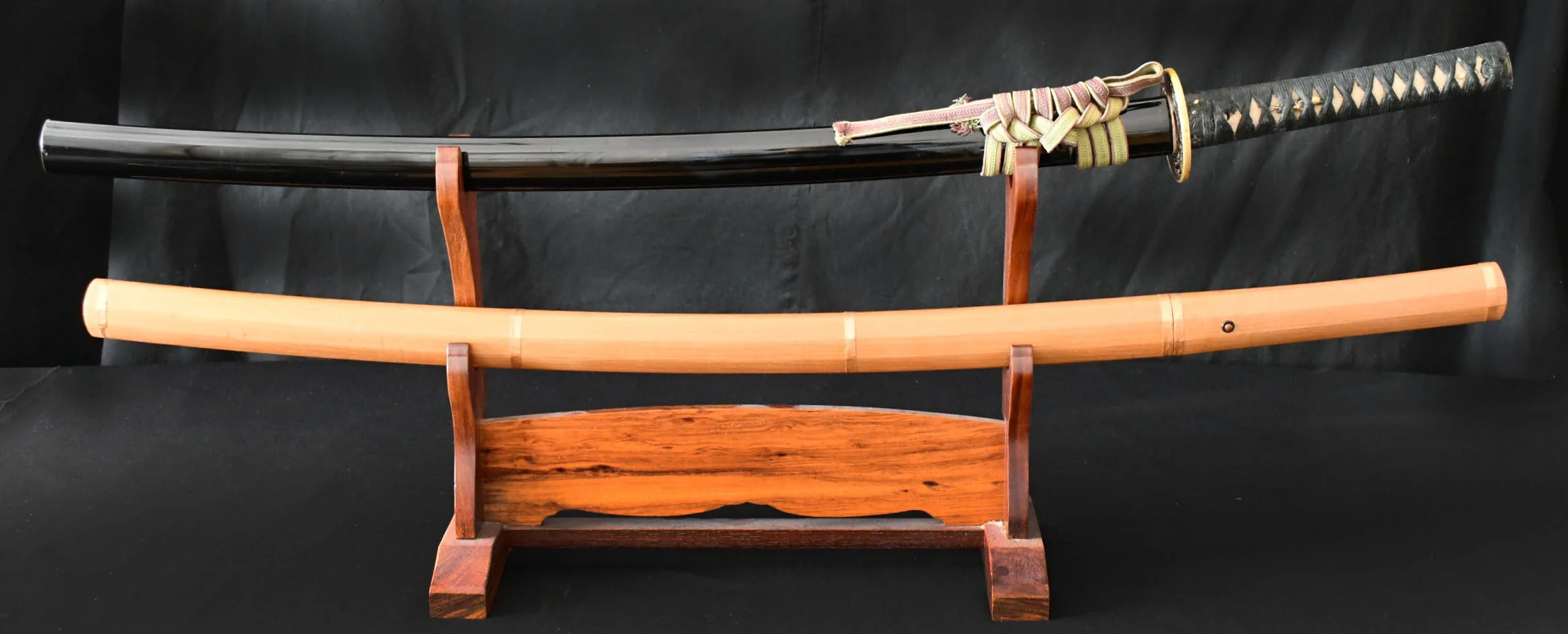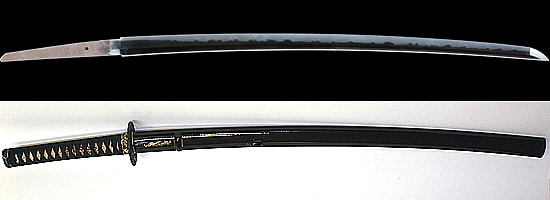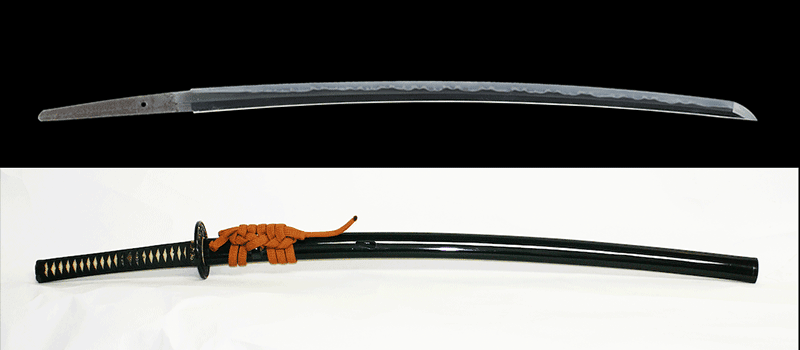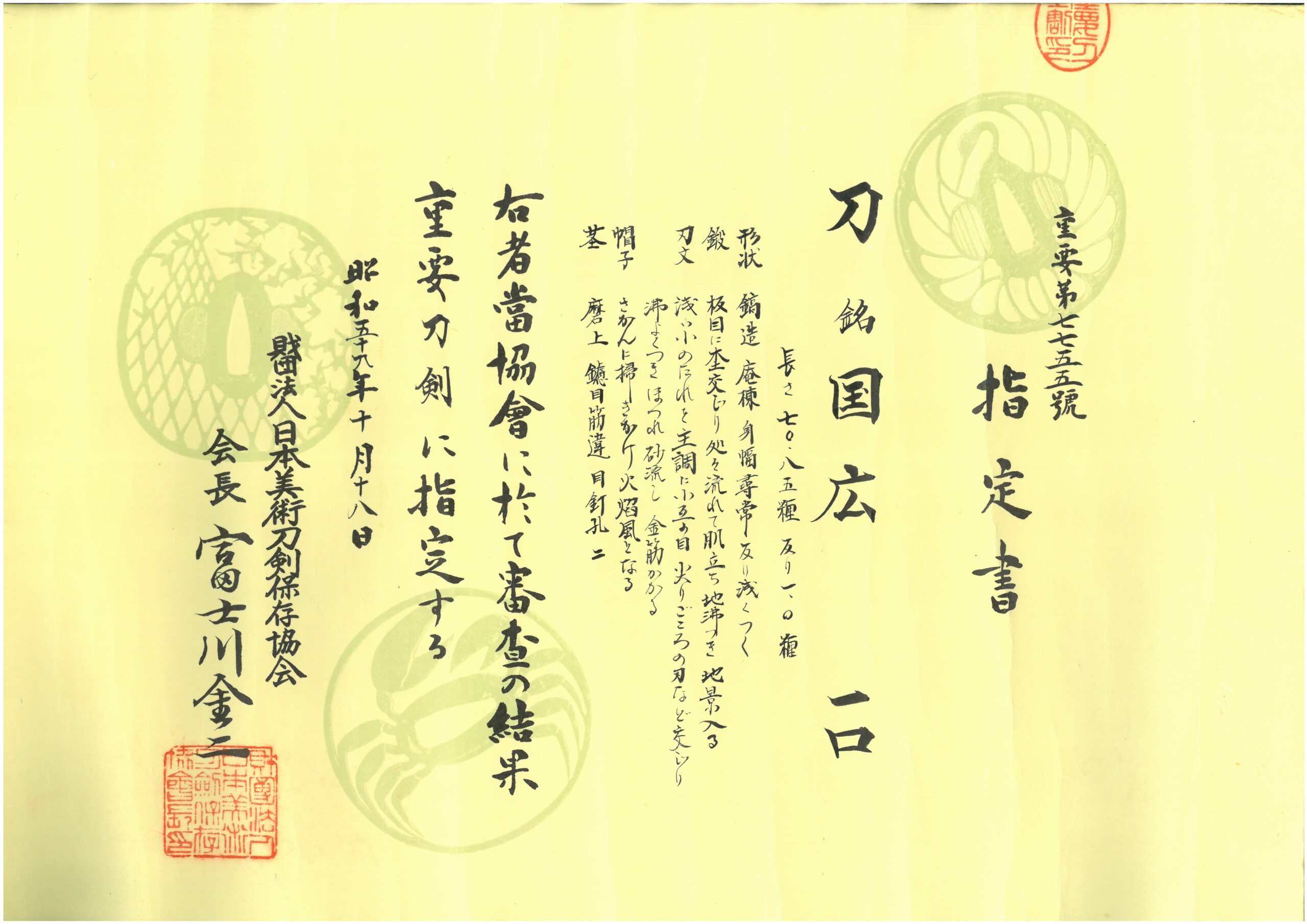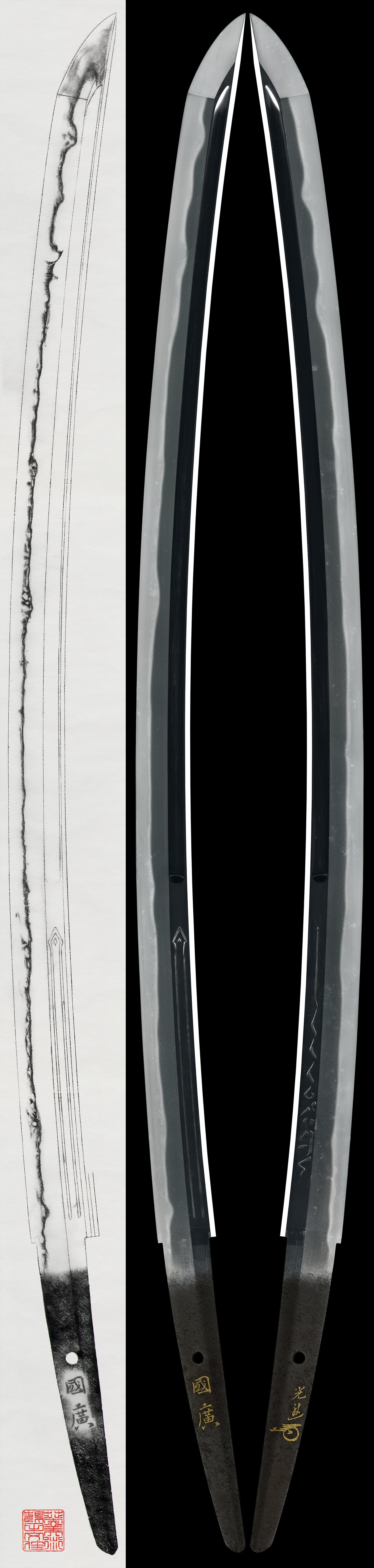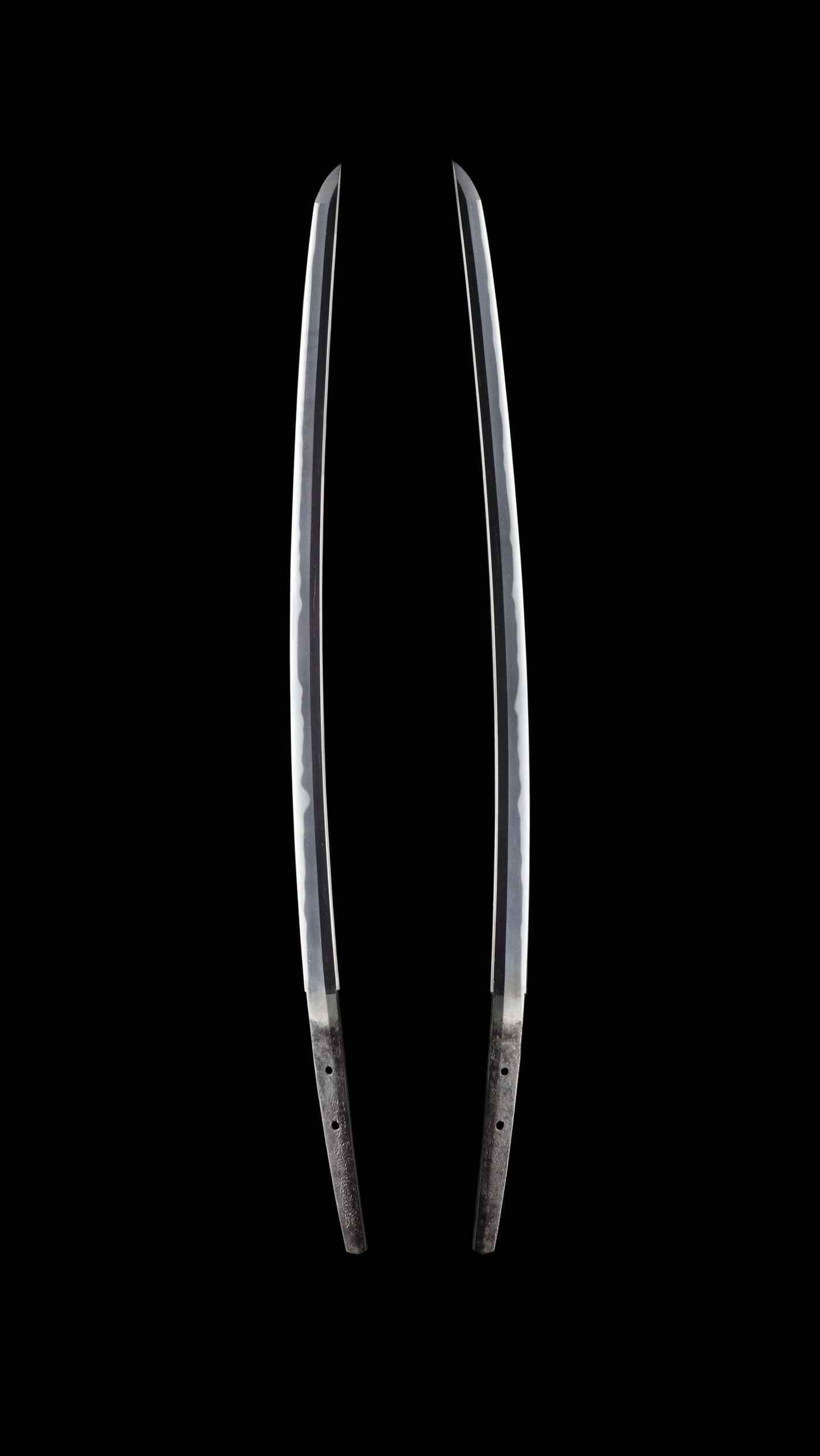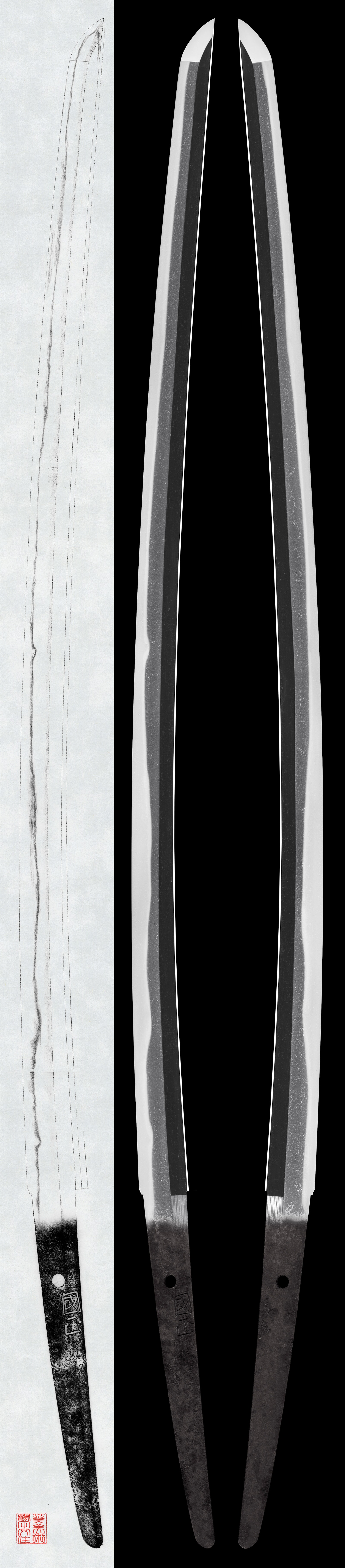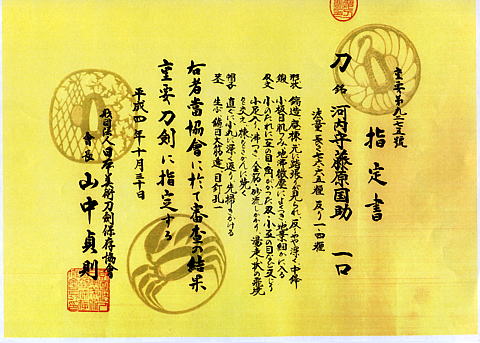
-, 38th Session — Designated October 30, 1992
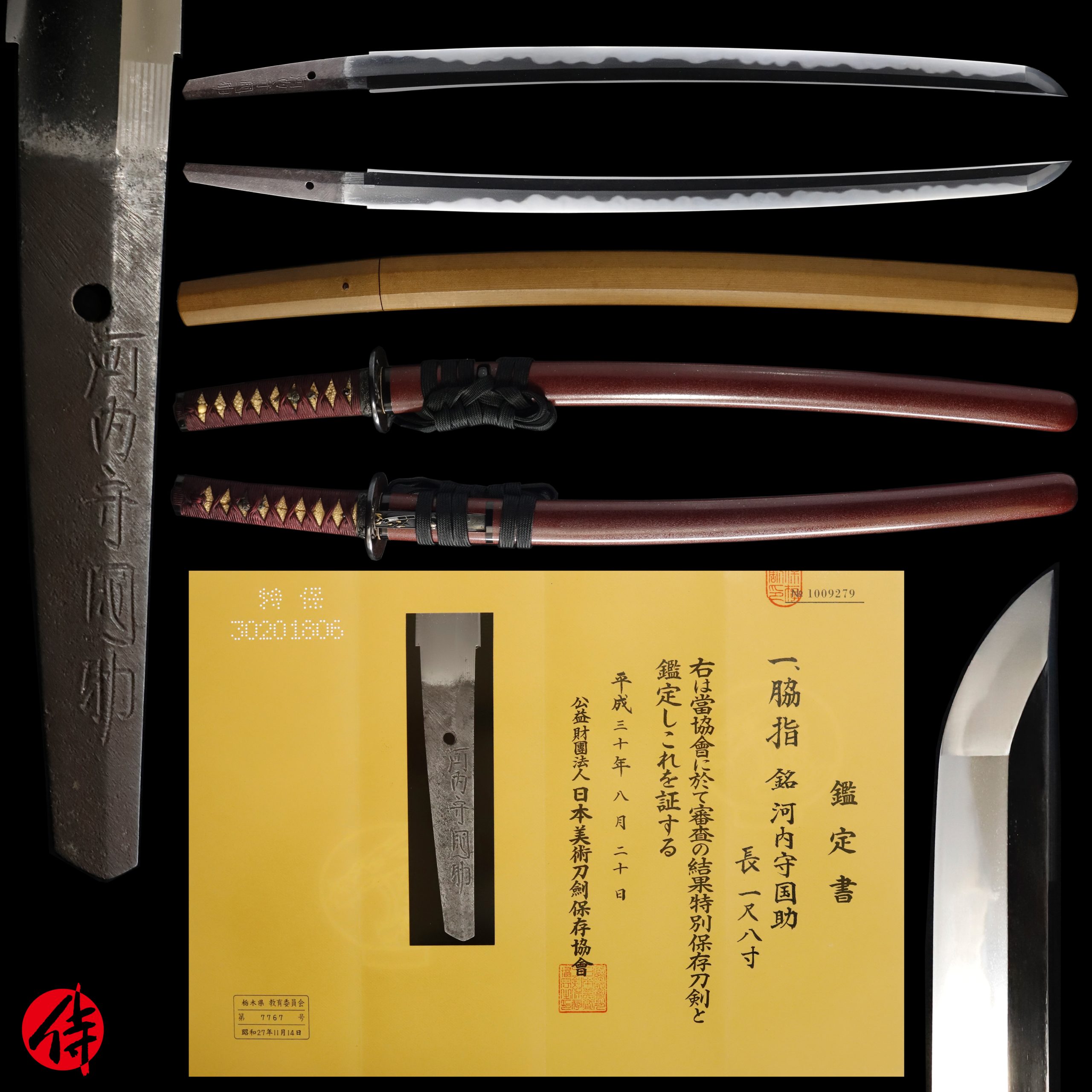
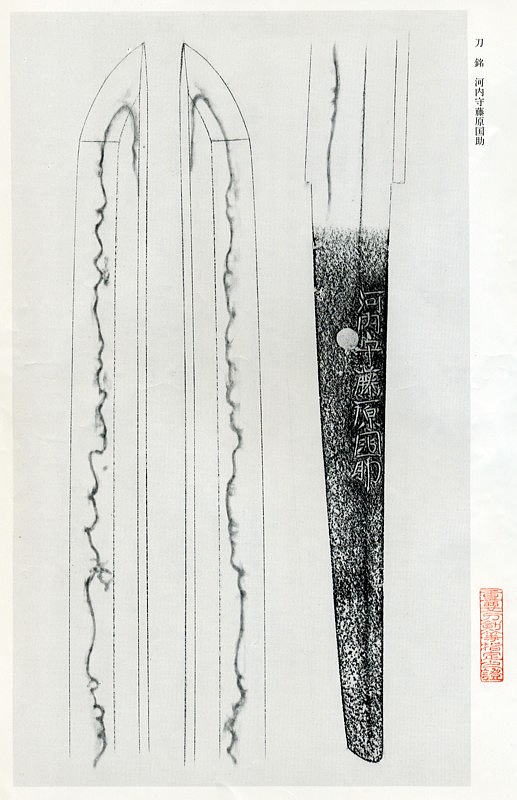
, : Kawachi no Kami Fujiwara Kunisuke (河内守藤原国助)
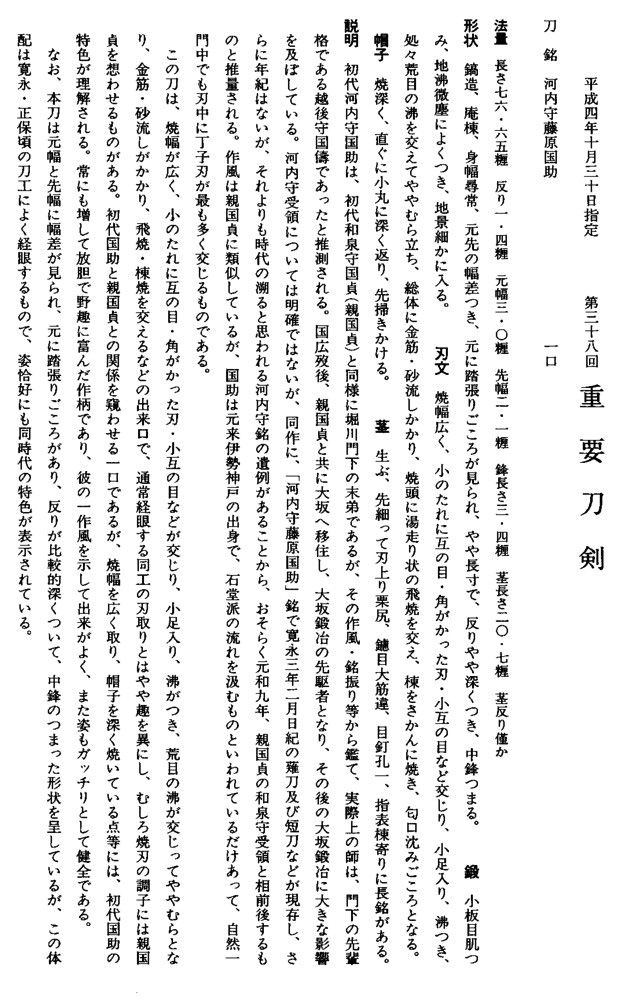
Measurements 76.65 cm, 1.4 cm, 3.0 cm, 2.1 cm, 3.4 cm, 20.7 cm, slight
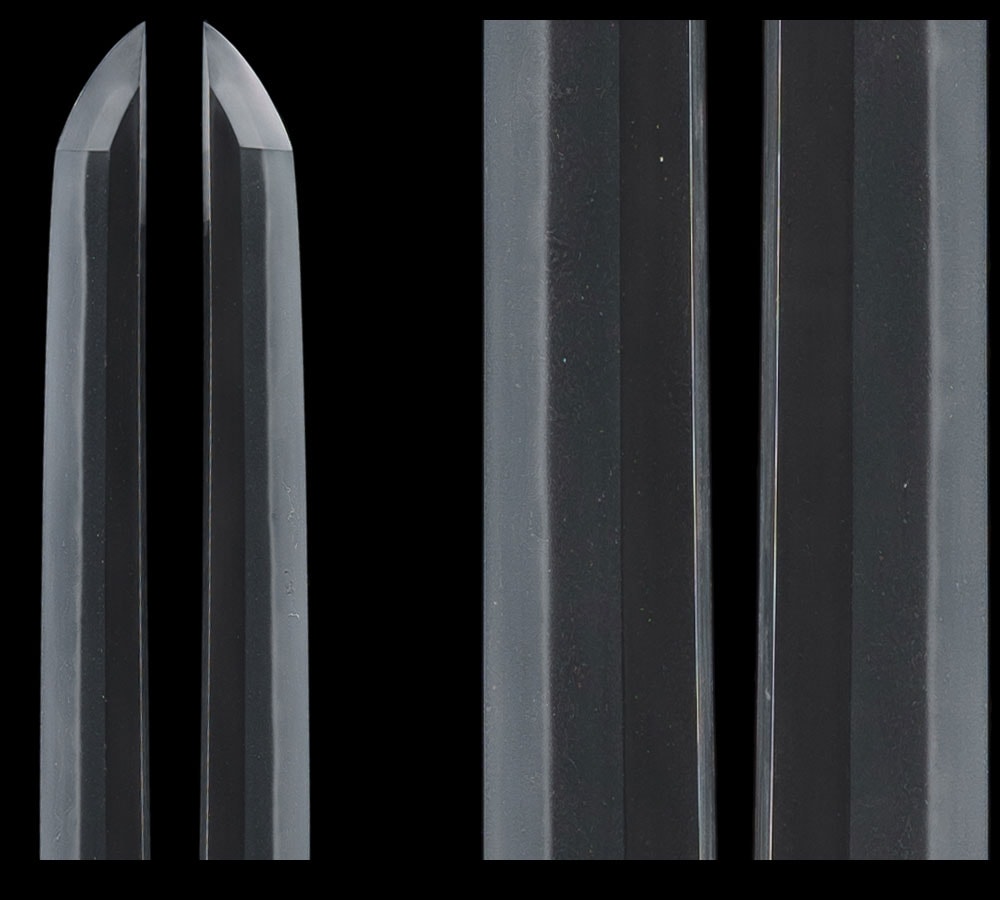
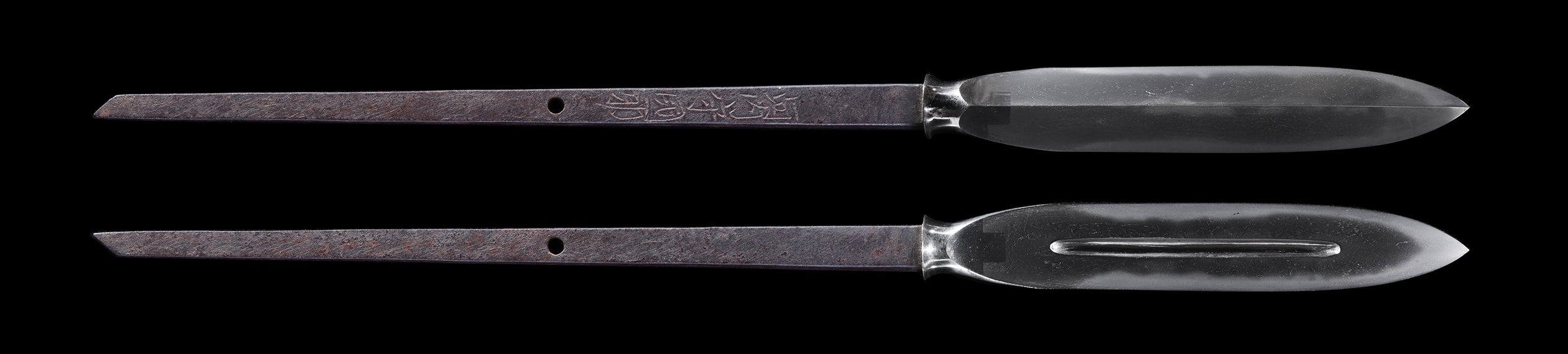
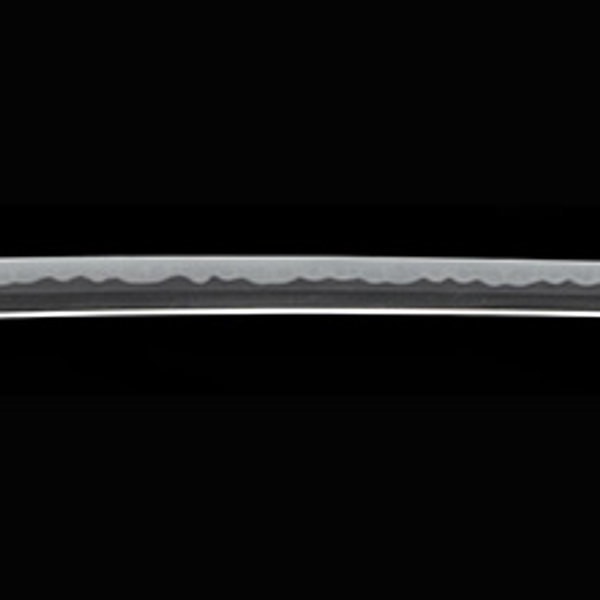
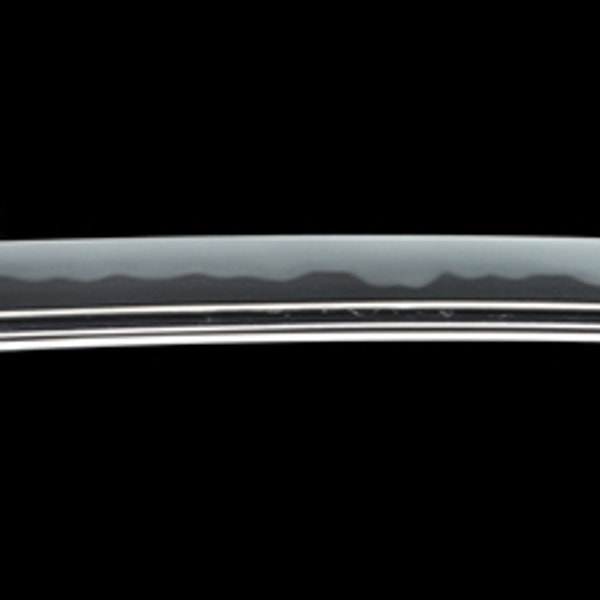
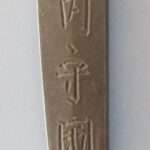
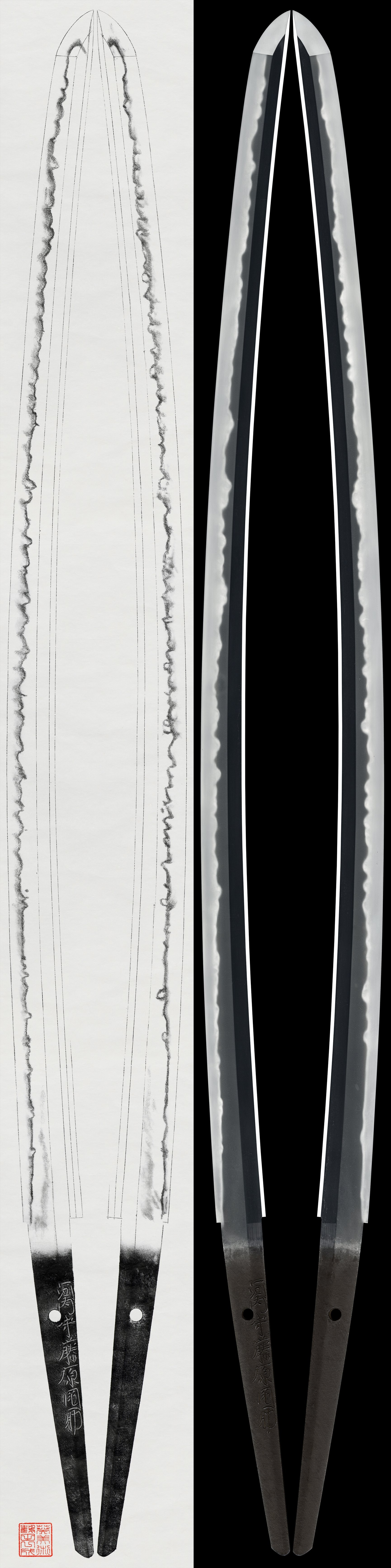
Description Keijō: , ; standard with a clear difference between base and tip widths; a suggestion of toward the base; somewhat long in proportion; is rather deep; is compact. : somewhat standing; extremely fine adheres well, and fine enter. : Wide ; mixed with , angular forms, and ; with ; attaches, and in places is intermingled, producing slight unevenness. Overall there are and ; along the crests of the temper there are in a -like appearance; is conspicuously vigorous; the shows a tendency toward (subdued). : Tempered deeply; essentially straight, forming and turning back deeply; the tip shows . : None. : ; tapering; ; file marks are large ; one ; a long signature is present on the , toward the side.
Artisan (first generation) Kawachi no Kami Fujiwara Kunisuke
Era Early period ()
Explanation The first-generation Kawachi no Kami Kunisuke was, like the first-generation Izumi no Kami Kunisada (Chika-Kunisada), the youngest disciple in the group. However, judging from his manner of workmanship and the form of his signature, it is conjectured that his practical master was in fact Echigo no Kami Kunitsugu, a senior figure among the group.
After Kunihiro’s death, Kunisuke relocated to Ōsaka together with Chika-Kunisada, becoming a pioneer among the Ōsaka smiths and exerting a major influence on subsequent Ōsaka swordmaking. Although the circumstances of his receiving the title “Kawachi no Kami” are not clearly established, extant works bearing the inscription “Kawachi no Kami Fujiwara Kunisuke”—including a and a dated ’ei 3 (1626), second month—are known. Furthermore, there are examples bearing the “Kawachi no Kami” signature that appear to predate those. From this, it is inferred that he likely received the title around Genna 9 (1623), roughly contemporaneous with Chika-Kunisada’s receipt of the title “Izumi no Kami.”
His style resembles that of Chika-Kunisada, yet because Kunisuke was originally from Kanbe in and is said to descend from the Ishidō lineage, it is natural that among the -derived elements in his work, chōji-ba tends to appear most frequently within the hardened edge.
This displays a wide in which is mixed with , angular forms, and . enter, attaches, and is interspersed to create a somewhat uneven texture. and appear; and are also intermingled. This manner differs somewhat from the treatment commonly encountered in this smith’s work; rather, the overall tone of the hardened edge calls Chika-Kunisada to mind. It is an example that suggests the relationship between Kunisuke and Chika-Kunisada. At the time, features such as taking the broadly and tempering the deeply are points through which Kunisuke’s own characteristics can be understood.
The workmanship is, more than usual, bold and rich in rustic flavor, showing one facet of his stylistic range; the quality is good, and the is firmly built and (sound and well-preserved).
In addition, this blade shows an evident difference between the base and tip widths, retains a suggestion of at the base, has comparatively deep , and presents a compact . This overall shape is frequently seen among smiths active around the ’ei–Shōhō era, and the sword’s form likewise displays the characteristics of that time.