Hida no Kami Fujiwara Ujifusa was the son of Wakasa no Kami Ujifusa, born at Seki in Mino and first called Kawamura Isechiyo, later Heijuro. Most of the published sources give his birth as Eiroku 10, though one entry places it in Tenbun 10. They follow his career closely. He served Oda Nobutaka as a page and became a ronin after his lord's death, then served under Sakuma Masakatsu in Owari, moved to Kiyosu and began forging from about Tensho 17. In Tensho 19, when the Kampaku Toyotomi Hidetsugu became lord of Kiyosu, Ujifusa, Masatsune and Nobutaka were received at Jurakudai and each presented a sword, and Ujifusa was granted the title Hida no Kami. About Keicho 15 or 16 he moved to Nagoya and served Tokugawa Yoshinao as a retained smith, then passed the headship to Bizen no Kami Ujifusa in Kan'ei 8 and died that year at sixty-five. Three generations bore the name, the first Hida no Kami, the second Bizen no Kami and the third again Hida no Kami, and this code is the first.
His characteristic hand is a broad, generous notare. On a wide-bodied katana with shallow sori and a large kissaki, the shape the published sources call "the typical sugata of Keicho shinto"[[c:1]], he tempers an o-notare as the main tone, mixing gunome and small notare, with ashi and yo entering and ko-nie well attached, and patches of mura-nie and yubashiri along the line. The same broad manner runs across his naginata and his sun-nobi hira-zukuri wakizashi. Of one such wakizashi the sources write that it "fully and without reserve displays this smith's forte"[[c:2]]. On a dated Keicho 11 katana the same open notare mixed with gunome is named a typical work.
The jigane of that broad work is most often a standing one: an itame that tends to rise, at times a large itame or a coarse zanguri jigane, mixed with mokume and flowing toward masame along the shinogi-ji, with ji-nie. His finest katana, however, are forged differently. Two of them show a well-packed ko-itame with ji-nie, and over it a ko-midare or small notare mixed with gunome and pointed teeth. The published sources call one the white eyebrow of his work, the piece that "most clearly shows the Shizu style"[[c:3]] of his native Mino, and the other an excellent work that shows the same Shizu manner. The boshi over his blades is tempered deep, turning in notare-komi to a ko-maru or o-maru with a long return and hakikake. On his tanto and several other blades it rises instead in tsukiage to a pointed tip, the boshi of the Sanpin manner.
Within the one hand the published sources draw out two further faces. The first is his most numerous, the wide, shallow-curved, large-pointed body that recalls a greatly shortened Nanbokucho blade, though the judges point to the sakizori that fixes it as Keicho work. Among such pieces, they note, some look at first sight like the work of Muramasa. The second is rare, and the sources twice call it unusual for him: a chu-suguha worked with small gunome, abundant ko-ashi, hotsure and fine activity over a well-forged jigane, the boshi deep and pointed. On these blades the judges read a private aspiration to the great Soshu masters, naming Go and Samonji, and find "an archaic flavour as though he had privately studied the superior Sagami smiths"[[c:4]]. A Keicho 7 tanto with the Sanpin boshi recalls Echizen Yasutsugu at first sight, yet its larger notare and stronger, uneven nie are read as Ujifusa's own.
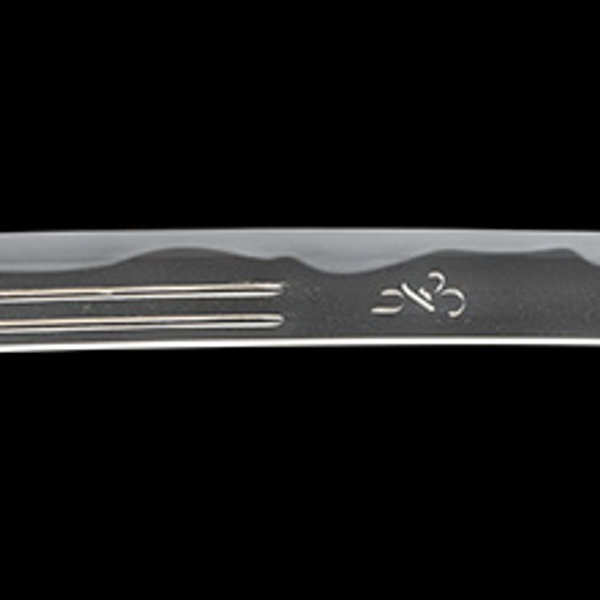
What sets him apart is the combination the judges keep returning to. He is a Seki smith by descent, and the standing, flowing jigane with masame along the shinogi-ji, the pointed Sanpin boshi and the Shizu manner of his best katana all carry that Mino root. The wide, powerful Keicho-shinto body, the deep nie and the reach toward Soshu in his suguha work mark the Owari smith who served the Tokugawa. Carving is uncommon on his blades beyond the bo-hi of the katana and the naginata-hi of the naginata, and the sources call it unusual when one sun-nobi hira-zukuri blade carries an inscription with Daruma carved in relief.
For the collector he is a well-documented founder rather than a rarity of legend. Fujishiro grades him Jo saku. He has no National Treasures and no Important Cultural Properties. His record runs through the Juyo tier, where sixteen of his works are held, all signed, among them katana, wakizashi, a tanto and naginata of the first generation. Several bear Keicho-era dates that the published sources prize as "good material for the study of Hida no Kami Ujifusa"[[c:5]], and they note that signatures with Fujiwara Ason are uncommon. Provenance for his work is little recorded, so it is best described simply as held in private hands. A signed first-generation Ujifusa, broad and vigorous with its long signature, comes to market only from time to time, and a dated example is the one a student of Owari shinto would most wish to encounter.
 NihontoWatch