The Shintō era was largely invented in Kyōto: Umetada Myōju’s workshop trained the movement, Horikawa Kunihiro raised a generation, and the Hon’ami appraisers, who held no forge, governed the meaning of famous blades.
 NihontoWatchNihontoWatch
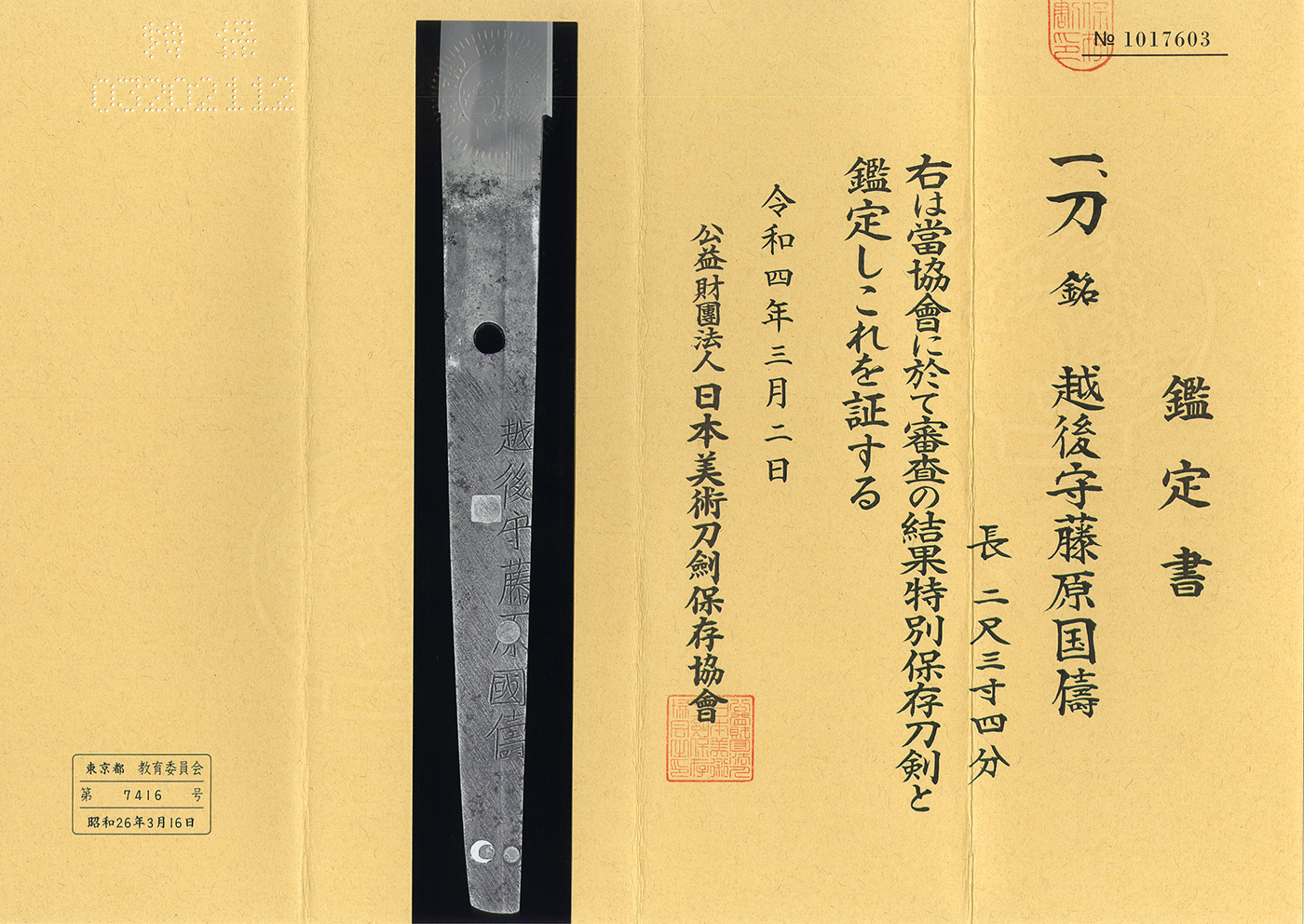
This katana by Echigo no Kami Fujiwara Kunitomo, a prominent disciple of Horikawa Kunihiro, is rated Jyojyo Saku. It features a fine jigane and dynamic gunome hamon, showcasing the smith's exceptional skill. The blade comes with both shirasaya and koshirae, and is accompanied by an NBTHK Tokubetsu Hozon certificate.
NihontoWatchOffered by Aoi Art





Horikawa (Yamashiro / Kyoto) · Yamashiro · around 1596-1615
Fujishiro Jo-jo saku · Tōken Taikan top 11%
3 pieces on the market now
Echigo no Kami Fujiwara Kunitomo was born at Obi in Hyūga and came up to the capital in the train of Horikawa Kunihiro, settling at Ichijō Horikawa in Kyoto, where he worked through the Keichō and Kan'ei years. The published record knows him as Kunihiro's pupil, by one tradition his nephew, and as the youngest of that circle, yet it is from his pupils rather than from documents that his standing is reconstructed. No work of his bears a date, and the Edo sword books pass on little beyond his birthplace and residence. What the judges do affirm is his place in the descent of the school: because the early manner and signatures of Izumi no Kami Kunisada and Kawachi no Kami Kunisuke so closely resemble his own, the published sources conclude that "their direct instruction was clearly carried out by Kunitomo"[[c:1]]. He is thus the hinge of the Horikawa line, the man who taught the two smiths from whom the great Osaka shintō tradition would descend.
His characteristic hand is the exception within his own school. Where most Horikawa work takes the superior Sōshū masters Shizu and Sadamune for its model, Kunitomo turns instead toward late Mino. Over a notare base he sets round-headed gunome, pointed togariba and ko-notare, and the nioiguchi tightens and sinks rather than opening bright, with nie that gathers at times coarse, sunagashi running through, and long kinsuji entering. The published sources name this their point of recognition for him: it is, they write, "the hallmark of Kunitomo to show, at a glance, workmanship reminiscent of late Seki, and of Kanenoshita above all"[[c:2]]. The bōshi follows the same quiet logic, a shallow notare turning ko-maru with hakikake and a deep return.
The jigane comes in two modes, and the judges are careful to distinguish them. One is the standing, dry itame the whole school shares, mixed with mokume and flowing grain, coarse in the zanguri manner, with ji-nie and chikei; the other is a tightly consolidated ko-itame, clean and beautiful even by Horikawa standards. The sinking nioiguchi is the constant across both, so much so that when one katana departs from it the change is worth remark, the published commentary singling out a Jūyō blade in which, against the subdued temper usual to his work, "the brightness of the nioiguchi is especially noteworthy"[[c:3]]. His wakizashi carry the Mino coloration more strongly still, often in hira-zukuri or kanmuri-otoshi shapes with su-ken and gomabashi carved into the base.
Within this one hand the published sources read two registers. The prime is the late-Seki manner just described, and it reaches its clearest statement in a Tokubetsu-Jūyō katana that copies, down to its compact one-handed tang and sakizori, the uchigatana shape of the late Muromachi, from which the judges venture that "it may well be imagined that Kunitomo's ideal lay in Kaneshiba"[[c:4]]. Beside it stands a calmer register in a wide suguha over the tighter ko-itame, gentle and dignified, that approaches his teacher; one Tokubetsu-Jūyō of this kind the commentary calls a masterpiece among his works, sound in both ji and ha. His signature is itself a kantei point. He invariably cuts the same seven characters and, as the sources note, "signs them without fail in seven characters, and no dated work is seen"[[c:5]], the chisel slightly distorted and growing larger as it descends.
What sets Kunitomo apart from his fellow Horikawa smiths is therefore not refinement of the Sōshū copy but the Mino strain he carried alone, and the precision of his chisel. Among the whole group, the published sources observe, "his is the finest chisel"[[c:6]], and where his fellow daisaku for Kunihiro, Ōsumi no Kami Masahiro, often cut a long tang, Kunitomo by contrast left works in which "the tang length is somewhat compact"[[c:7]]. The contrast is a working connoisseur's tell. His calm wide-suguha pieces are held apart from the school by the cleanliness of the ji; his sinking, Mino-tinged ones, by the round-headed gunome and tight habuchi that no Shizu copy would show.
For the collector Kunitomo is a substantial but rarely traded name. Fujishiro grades him Jō-jō saku. He has no National Treasures and no Important Cultural Properties; his record runs instead through the modern designation tiers, three katana at Tokubetsu-Jūyō and some twenty-three at Jūyō, together with a prewar Jūyō Bijutsuhin tachi once owned by Kishimoto Kannosuke of Kyoto. His blades are held in long-private hands, among them the Ikeda daimyō house, from whom one Tokubetsu-Jūyō descends. Signed works by him are not plentiful, and a designated example reaches the market only seldom, the more so because his finest pieces are held rather than traded. When one does appear it is a document of the Horikawa school at its hinge, the work of the quiet teacher who stood between Kunihiro and the founders of Osaka shintō.
Where Kunitomo stands among comparable artisans: across all of nihontō, and within tradition, era, and period. The tiers (Foremost · Leading · Major · Notable) weigh official designations from the NBTHK and Japan's Agency for Cultural Affairs, together with historical honors of lasting repute such as the Sansaku and Meibutsu-chō.
Select a lens to see how it's measured.
Shinto · Yamashiro
64 pieces on the market now
At Ichijo Horikawa in Kyoto, from Keicho 4 (1599), Horikawa Kunihiro gathered the pupils whose work the published sources name with his own as the opening of the shinto age. Kunihiro himself reached forging late and by a roundabout road. Born Tanaka and serving as a warrior under the Ito of Obi castle in Hyuga, he wandered the provinces after that house fell, forging where he stopped, his earliest dated blade cut in Hyuga in Tensho 4 (1576); his itinerant Tensho-uchi looked to late Soshu and late Seki, often run toward a hitatsura-like effect over devotional carving. The settlement in Kyoto changed that. There his stated aim, the sources write, lay in the revival of the Soshu-den tradition, the leaning strongest toward Shizu, and around that ideal he trained the men who carried his manner forward: Dewa no Kami Kunimichi, Kuniyasu, Osumi no Jo Masahiro, Echigo no Kami Kunitomo, the elder Kunisada and Kunisuke, with later and minor hands reaching Settsu, Echizen and Edo. Many of them, born like the master at Obi, followed him from Hyuga to the capital. The shared vocabulary is read first in the steel. The school forges an itame mixed with mokume that stands up, the grain raised into the loose, granular surface the commentaries name outright, the zanguri hada particular to Horikawa work, with ji-nie lying thick and chikei entering; on many blades a mizukage rises obliquely from the machi. Over that ground the prime manner is the Keicho-shinto sugata, wide with little taper and an extended chu-kissaki or o-kissaki, the build likened to a Nanbokucho odachi cut down, tempered in a notare and gunome with thick nie, sunagashi and long kinsuji, the nioiguchi often sinking into shizumi. Within that frame the pupils diverge sharply.
Kunimichi runs the flamboyant Shizu copy fully out and turns his boshi pointed in the Mishina manner, the Sanpin boshi the school otherwise does not show. Masahiro keeps the same Soshu-den worked at lower temperature, his temper calm and his mokume conspicuous; Kuniyasu and Kunitsugu stand closest of all to the master and signed for him. Kunitomo turns alone toward late Seki, his gunome round-headed and his chisel the finest in the group, and the elder Kunisada and Kunisuke carry the zanguri steel south into Osaka, the latter keeping the Ishido clove he was born to. Hiroyuki holds suguha over a blackish steel that recalls old Yamato, and the two Echizen Kunikiyo forge a dark, dense hokkoku-gane under a calm chu-suguha. A collector seeks Horikawa because the school stands at a hinge: Kunihiro is read as the first hand of the new-sword age, and the line he taught runs forward into the Osaka tradition through Kunisada and Kunisuke and into Echizen through Kunikiyo. To kantei the work, read the steel first, the standing zanguri surface and the oblique mizukage, then the sinking nioiguchi and the Soshu-revival notare with its sunagashi and kinsuji; the individual hand declares itself in the departures, Kunimichi's pointed boshi, Kunitomo's Seki gunome and compact tang, Kuniyasu's reversed file marks and two-character mei, Hiroyuki's kiri-yasuri. The founder and his closest pupils sit at the top of the line, Kunihiro signing almost everything he made, the large kata-ochi two-character mei beside his long residence signatures; because Kuniyasu, Masahiro, Kunitsugu and Hiromi worked as his daisaku, a share of the blades signed Kunihiro are in fact theirs. Provenance runs through the houses of the founder's own story and of the country, the Hyuga Ito he had served, the Shimazu of Kagoshima, the Imperial Family and Toyotomi Hideyori, with the tachi Kunihiro dedicated to the Hataeda Hachimangu still in the shrine's keeping. A signed Horikawa blade reaches a private collection only from time to time, carrying on its nakago the hand with which the new sword begins. Learn more →
| Smith | Era | Designated |
|---|---|---|
| Kunihiro國廣 | 1573-1613 | 147 |
| Kunimichi國路 | 1615-1624 | 75 |
| Kunisada國貞 | 1624-1646 | 87 |
| Kunitomo國儔 | 1596-1615 | 27 |
| Masahiro正弘 | 1596-1615 | 16 |
Kyōto: the revival workshop
The Shintō era was largely invented in Kyōto: Umetada Myōju’s workshop trained the movement, Horikawa Kunihiro raised a generation, and the Hon’ami appraisers, who held no forge, governed the meaning of famous blades.
A Hozon-certified blade judged to show notably superior workmanship and a better state of preservation. The bar is higher: re-tempered blades and most unsigned Muromachi/Edo works are excluded.
The NBTHK (Nihon Bijutsu Tōken Hozon Kyōkai, the Society for the Preservation of Japanese Art Swords) is a public-interest incorporated foundation founded in 1948 and supervised by Japan’s Agency for Cultural Affairs (Bunkachō); it is based at the Japanese Sword Museum in Tokyo. Its expert panels physically examine each submitted work (shinsa) and issue a certificate (kanteishō) ranking it by artistic and historical merit. NBTHK papers are the most widely recognized standard of authentication for Japanese swords and fittings.
NBTHK official siteIf you wish to return an item, please notify us within 3 days of receipt. After this period we cannot accept cancellations. Please ship the return to us within 5 business days. Cancellation is conditional on the item being kept in the same condition as at the time of sale, so please handle it with care.
¥1,200,000