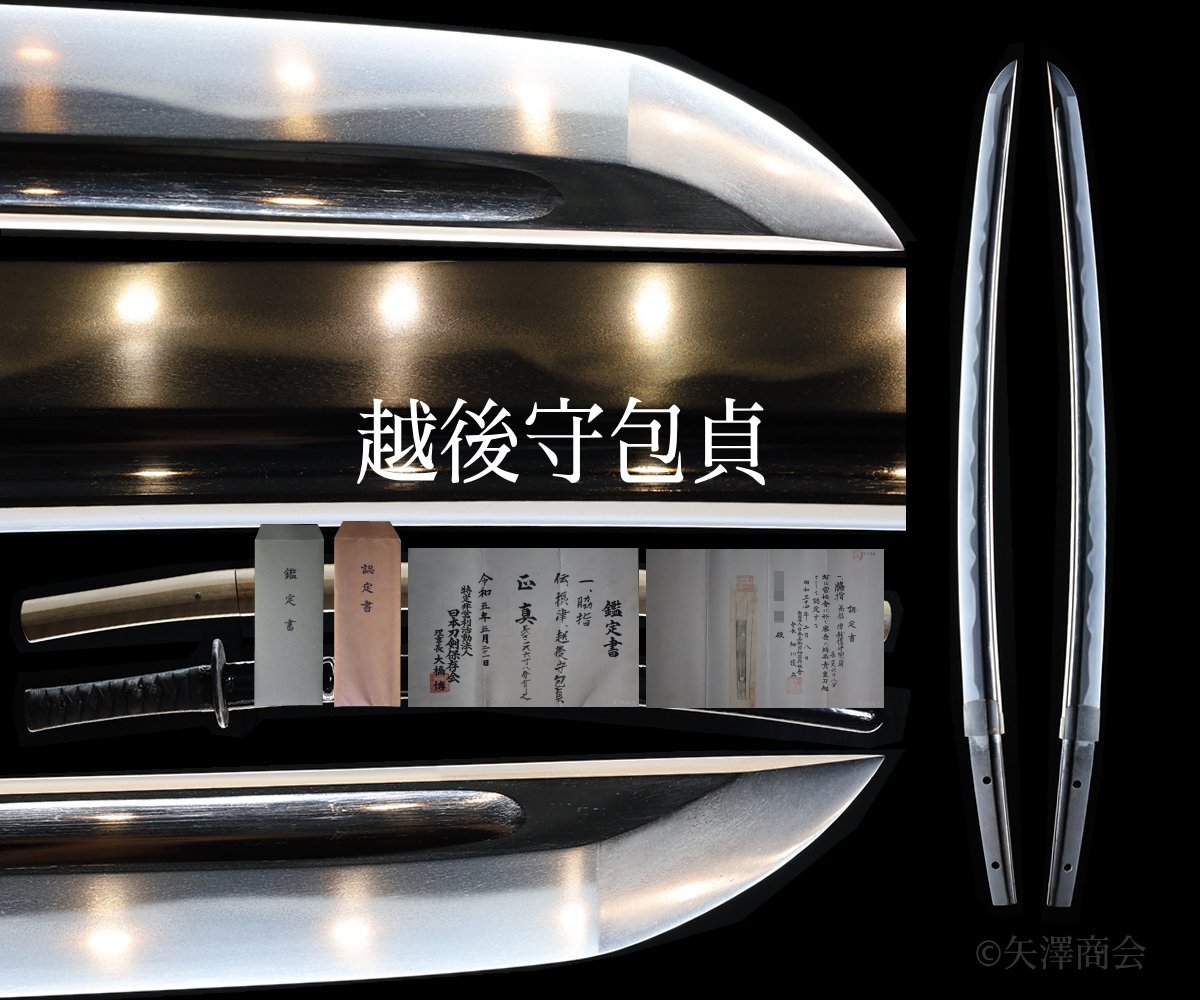
A katana signed Echigo no Kami Kanesada and dated the eighth month of Kanbun 4 is the only dated work of the first generation in the designated record, and the published sources value it for exactly that reason. The first Echigo no Kami Kanesada worked in Osaka under the common name Yamada Heidayu. The texts give him as born in Yamato and as a pupil of Iga no Kami Kanemichi, who had studied under the first Mutsu no Kami Kaneyasu, the smith called Sa Mutsu, so that he belongs among the Monju-group smiths. His working life is placed from the Keian years to the beginning of Kanbun. He first signed Sesshu Fujiwara Kanesada and, after receiving the court title, Echigo no Kami Kanesada.
The manner the texts call his forte is the gunome mixed with choji, "he excelled particularly in gunome-choji"[[c:1]]. Over a tightly forged ko-itame with ji-nie he lays a gunome-choji with abundant ashi. The nioi is deep and the nioiguchi bright and clear. Sunagashi run through the temper and the nie adhere well, while the boshi turns back as a ko-maru. In this, the published sources say, his work closely resembles that of Tsuda Sukehiro.
His surviving work is not large, and the texts say so directly: "extant works by the first generation are comparatively few"[[c:2]]. Within that small record one signed katana is called a representative work. Its ji and ha are notably clear, and the sources describe it as giving "almost the impression of viewing an early work by Tsuda Echizen no Kami Sukehiro"[[c:3]]. A broad hira-zukuri wakizashi shows the rest of his vocabulary. It has a short straight yakidashi at the base and above it a gunome-midare with round-headed gunome, with strong nie and conspicuous sunagashi. A tama-yaki sits above the monouchi on each side, and a carving rare for him completes the piece.
A small group of his blades stands close to the next generation, and the published record draws the line itself. One katana tempers a toran-style midare that "approaches the work of Tsuda Sukehiro"[[c:4]]. Another, a gunome-choji across which sunagashi fall repeatedly, is called "so brilliantly realized that it almost calls to mind the second-generation Kanesada"[[c:5]]. The Kanbun 4 katana differs from his usual work, with a large gunome mixed with ko-notare. The sources write that it recalls the second generation's presence and ask whether it is "perhaps his substitute work"[[c:6]]. The wakizashi's tama-yaki is read the same way, as "a foretaste of the later second-generation Kanesada's temper"[[c:7]].
The second generation was his pupil Sakakura Gonnoshin Terukane, who became his adopted son and succeeded to the name. When the first generation's own son came of age, the texts say, the pupil yielded the title Echigo no Kami Kanesada to him and thereafter signed Gonnoshin Terukane. The published sources tell the two hands apart chiefly by the signature. The second generation's characters have a rounded quality, while "the first generation's are linear and angular, a calligraphic style connecting to Sa Mutsu, the founder of the line"[[c:8]], a calligraphy that connects to Sa Mutsu, the founder of his line.
The first generation stands in the designated record with six Juyo works, every one of them signed, and none carrying a recorded provenance. Because his surviving output is small and his pupil's toran-midare dominates the Kanesada name, a papered first-generation blade is the rarer find of the two. It comes to light only from time to time, and the angular signature and the choji-leaning gunome are what set it apart from the second generation's work.




 NihontoWatch