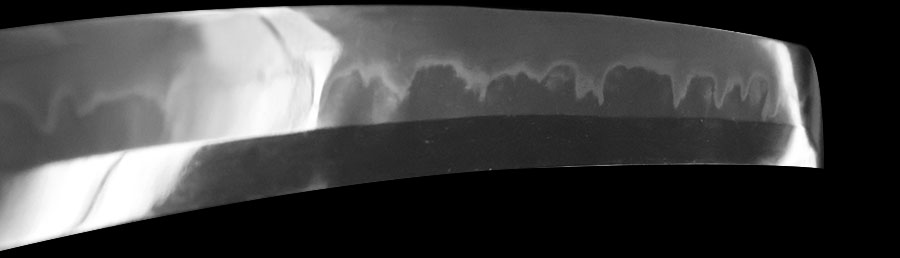
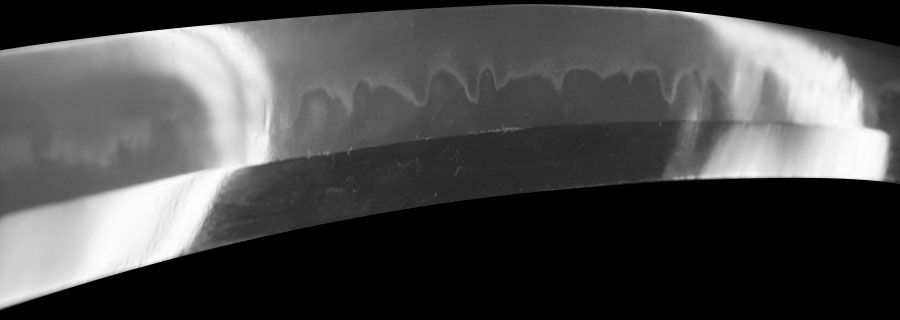
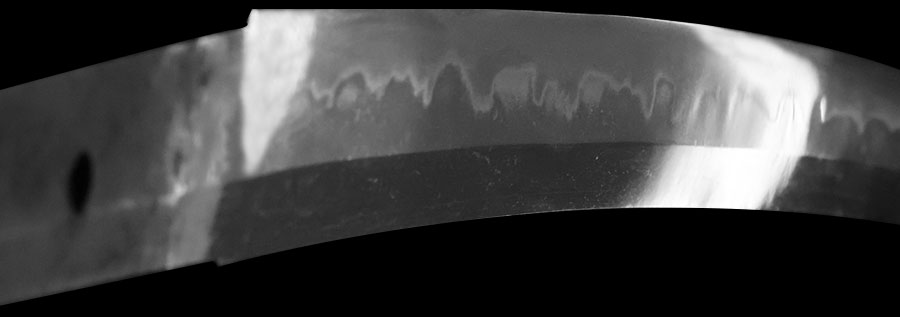
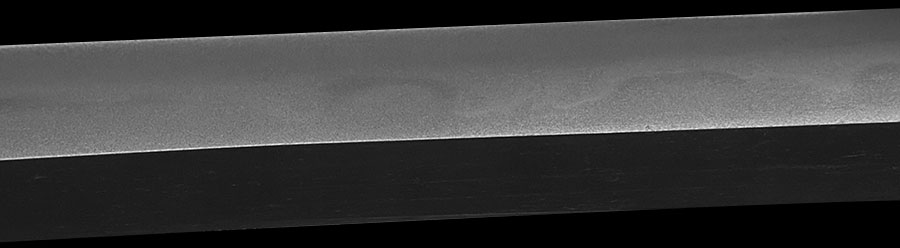
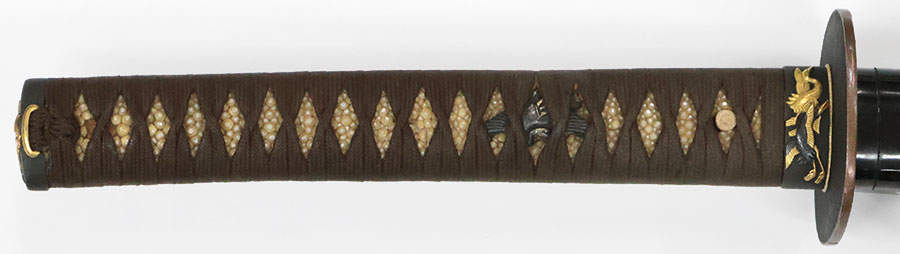
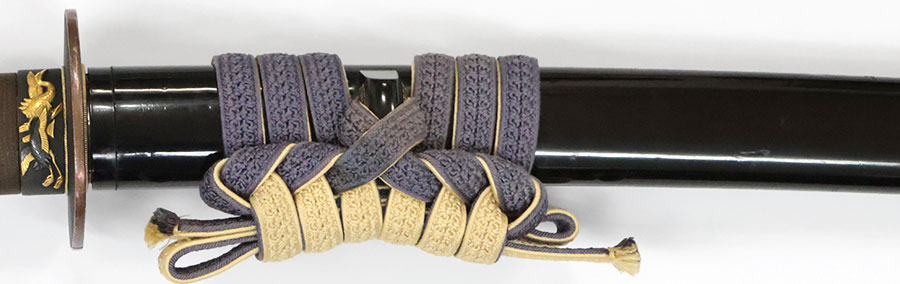
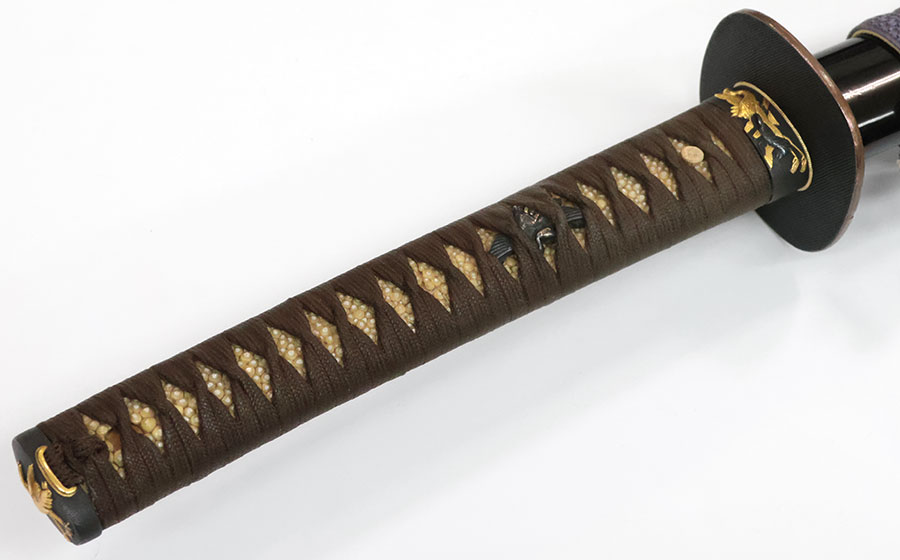
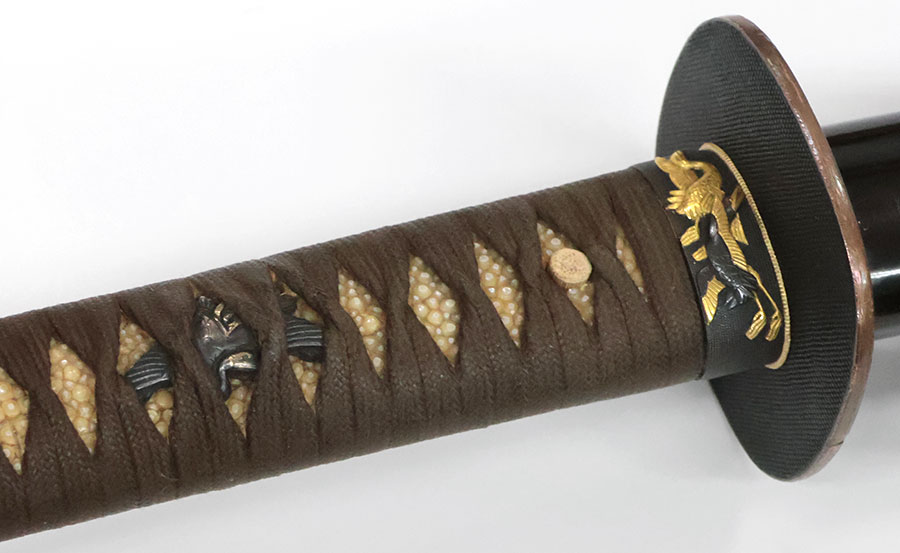
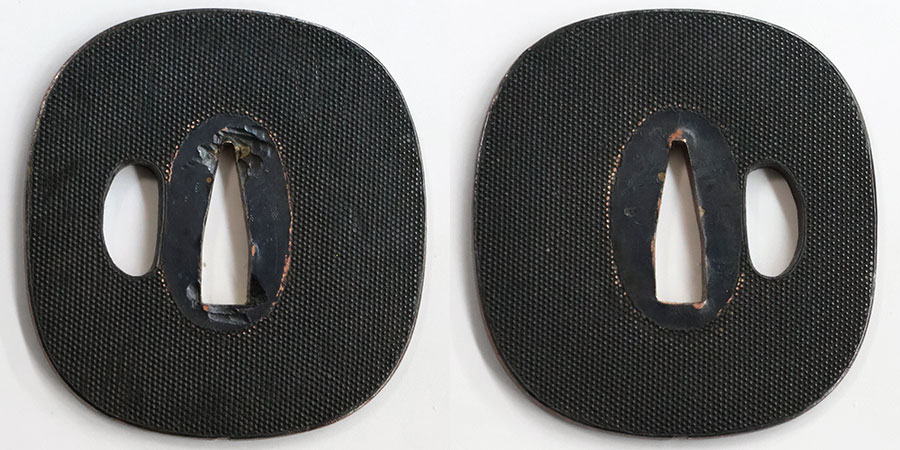
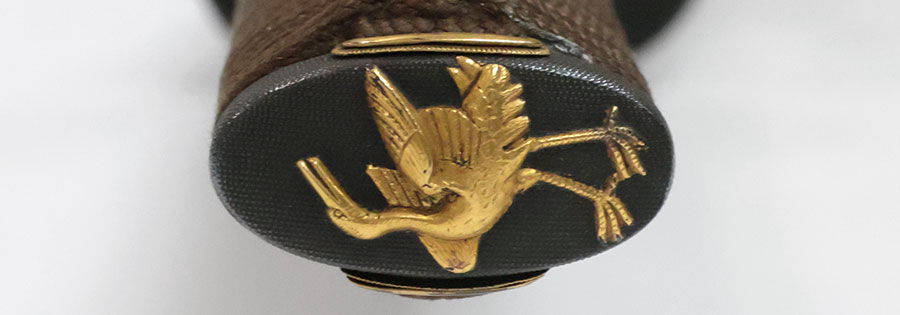
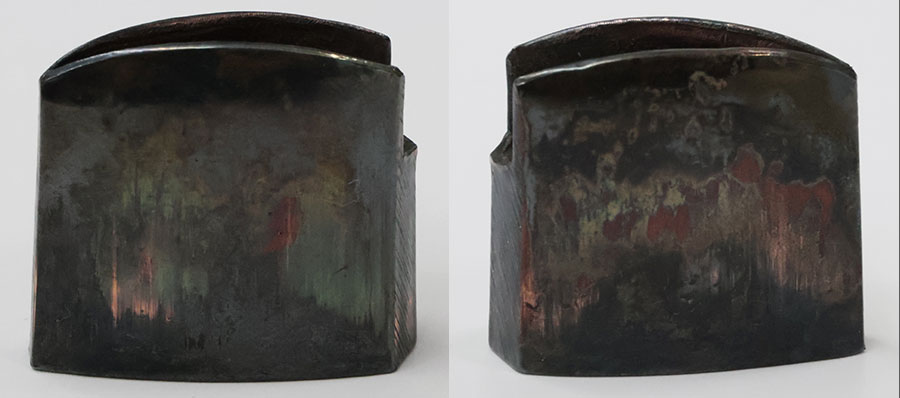
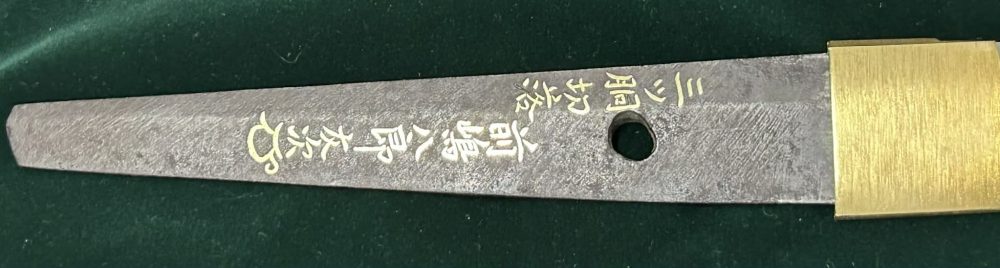
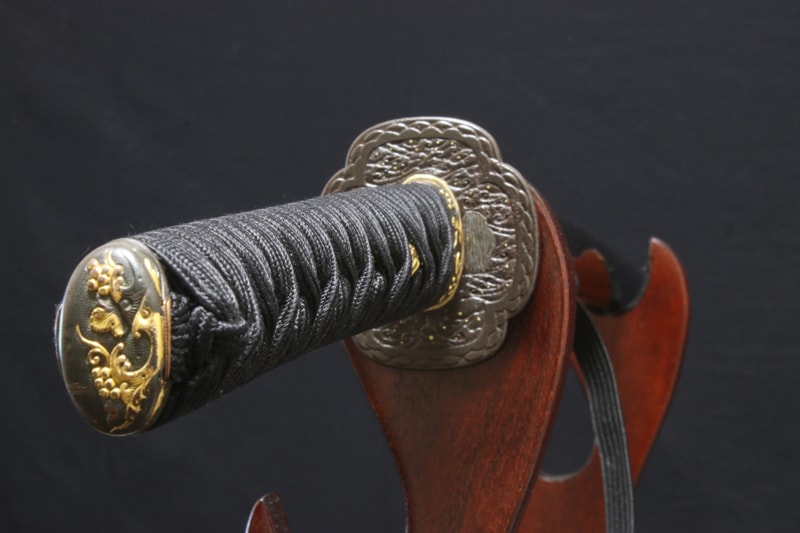
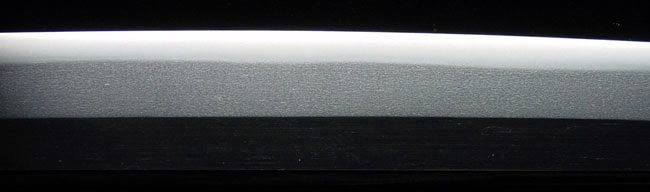
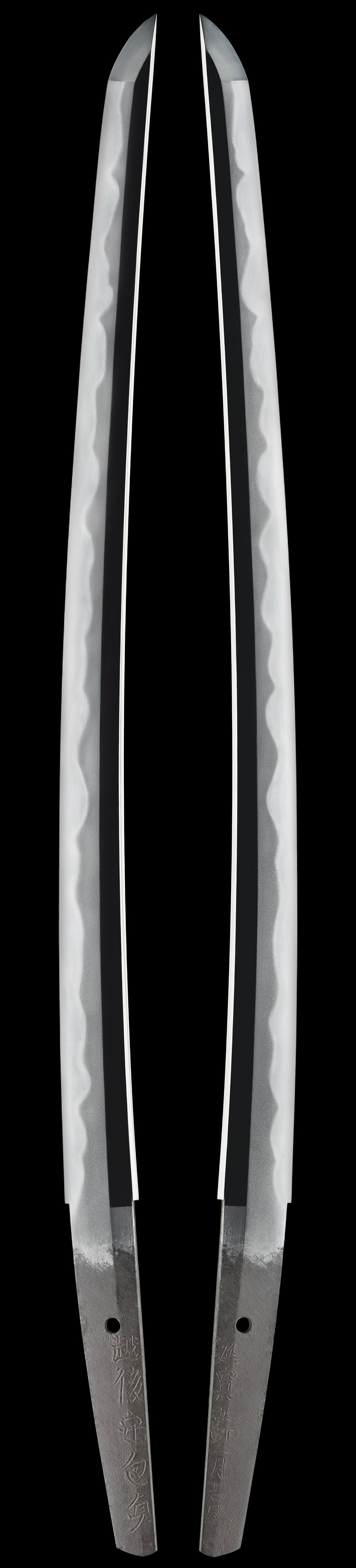
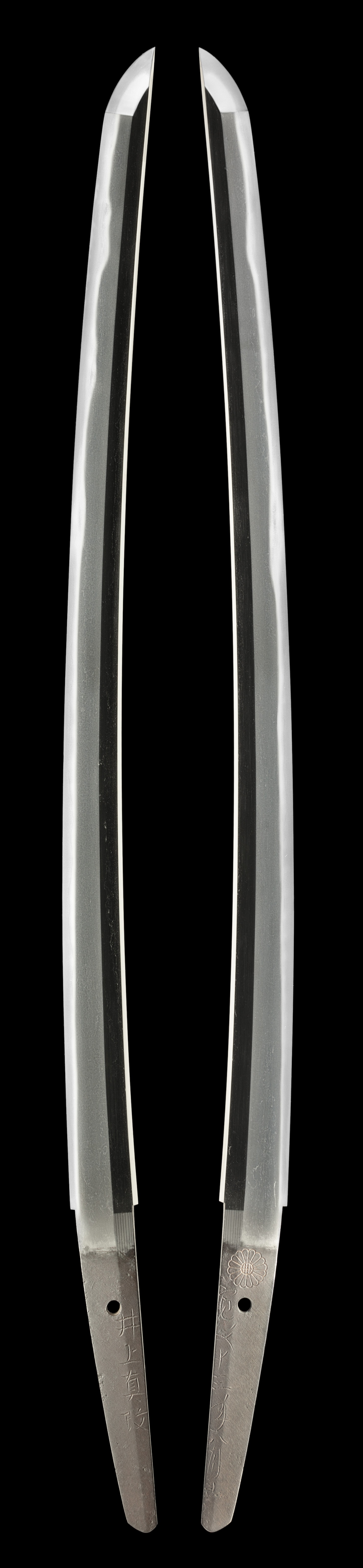
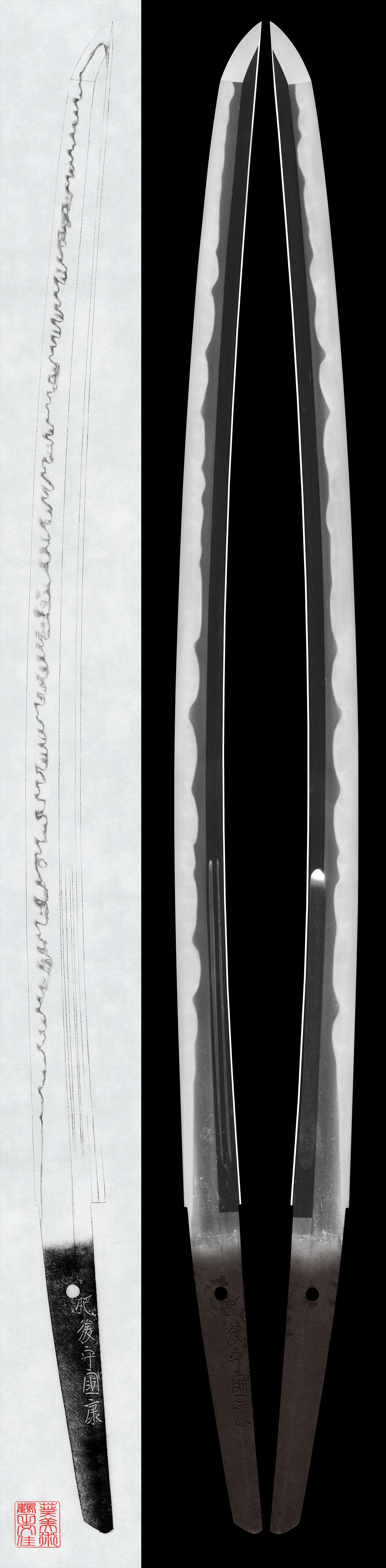
Weight (excluding saya): 1068g It has arrived—though mumei, this is a katana that has been cherished through generations of an old family as the work of the first generation Echigo no Kami Kanesada. Kanesada’s home province was Yamato, and his real name was Yamada Heitayu. Moving to Osaka, he entered the school of the first generation Iga no Kami Kanemichi (who was also from Yamato) and initially signed with the mei Yoshikane. From the 4th year of Kanbun (1664) in the early Edo period (362 years ago), he began signing as Echigo no Kami Kanesada and became famous as a Ryo-wazamono for crafting swords with exceptional cutting ability. He is also very well known for raising his adopted son—the second generation Echigo no Kami Kanesada, later known as Sakakura Gonnoshin Terukane—to become a representative swordsmith of Osaka Shinto, ranked alongside Tsuda Echizen no Kami Sukehiro and Inoue Shinkai. This sword became mumei because a long blade of approximately 2 shaku 5 sun was shortened. It exhibits a fine Kanbun Shinto sugata with a noticeable difference between the motohaba and sakihaba and shallow sori. This shape, similar to the works of Kotetsu in Edo, was suited for the thrusting techniques (tsuki-waza) that were popular in dojos at the time. The jigane is a powerfully forged ko-itame hada with ji-nie present on the ji. The hamon is a magnificent and spirited o-gunome midare in nioi-deki with ko-nie. The koshirae is luxurious and adds further elegance to the blade: a refined, thin-walled kuro-ro saya likely made by an Edo-period master, a tsuba of shakudo nanako-ji, and fuchi-kashira and menuki featuring water bird motifs on shakudo nanako-ji. On this occasion, the owners of the old family mentioned, "We have grown old, so please pass this on at a low price to someone who will cherish it." Because there is some slight cloudiness (kumori) on the ji, we are offering this at a special bargain price that could be considered the cost of the koshirae alone. Please enjoy this sword, which—though mumei—has been handed down as the work of the famous first generation Echigo no Kami Kanesada, one of the representative smiths of Osaka Shinto.
mumei · Edo · nagasa 70cm · sori 1.6cm


Osaka Shinto (Echigo no Kami Kanesada line) · Settsu · around 1648-1652
Tōken Taikan top 37%
3 pieces on the market now
A katana dated Kanbun 4, the eighth month, stands among the ten Echigo no Kami Kanesada blades the published record gathers under one signature, and it is the kind of dated piece that lets the two hands behind that name be told apart. Echigo no Kami Kanesada is an Osaka art name carried across two generations. The first was Yamada Heidayu, born in Yamato, a smith of the Monju group whom the published sources trace to Iga no Kami Kanemichi in the line of the first Mutsu no Kami Kaneyasu, the smith called Sa Mutsu; he signed Sesshu Fujiwara Kanesada at first and, on receiving the court title, Echigo no Kami Kanesada, working from the Keian years to the start of Kanbun. The second was his pupil and adopted son Sakakura Gonnoshin Terukane, who succeeded to the name, then ceded it when the founder's biological son Iwamatsu came of age, and signed Terukane from about Enpo 8. Within Osaka Shinto the line stands beside Tsuda Sukehiro, whose surging-wave temper the second generation made his own; the published sources rank him among the foremost masters of the school.
The most recognizable feature of the line is the second generation's toran-midare, the rolling-wave temper modeled on Tsuda Sukehiro. Over a base of large gunome the hamon surges in waves, the long ashi reaching down into it, the nioi deep and the ko-nie adhering well, with sunagashi running through the tempered area and a somewhat long yakidashi opening the edge at the base. Half the blades on record carry this manner and every securely second-generation piece does, a katana of the twentieth session showing the o-gunome roll in full. The published sources read it directly against its model: one katana, they say, with its toran tempering reaches the level of Tsuda Sukehiro, 「津田助広に迫る」, and they hold that the second generation came even closer to Sukehiro than the first. Where the wave alone might pass for the model, the published sources locate his own individuality in particulars, a tendency for the large gunome to take a yahazu, an arrow-nock, flavor, conspicuous sunagashi within the temper, and a robust, sturdy construction; a wakizashi of the twenty-seventh session, they note, shows these tells well, 「彼の見どころをよく示した」[[c:1]].
The jigane under both hands is a tightly forged ko-itame with ji-nie, the steel bright and clear, at times a fine chikei entering and the surface taking on the lustre Osaka work is known for. The nioiguchi over it is the constant of the school, deep in nioi and bright, clear and crisp at the habuchi, the quality the published sources name as saeru. The boshi runs straight and turns back in ko-maru, often tending to hakikake at the point, on occasion turning long. The first generation's hand is the more varied of the two: he places a short straight yakidashi at the base and forges above it suguha, choji, and a gunome-midare mixed with choji, the nioi deep and sunagashi present, the nie well developed. A hira-zukuri wakizashi of the fifty-second session shows this manner at full strength, a broad, slightly elongated, sun-nobi build with round-headed gunome, conspicuous sunagashi and kinsuji, a single tama-yaki burned above the monouchi on each side, and a standing Fudo carved with bonji, the published sources calling the tama-yaki a foretaste of the second generation's tempering, 「後の二代包貞の刃文のさきがけ」[[c:2]].
The two generations are told apart by the published sources along three lines. The temper is the first: the first generation's choji-leaning gunome over a yakidashi, against the second's surging toran-midare after Sukehiro, his forte the manner they call 「本領は助広に倣った濤瀾乱れ」[[c:3]]. The signature is the second: the first generation's inscription is linear and angular, a calligraphy the texts connect to the founder Sa Mutsu, while the second's is rounded, often a large five-character signature boldly cut with a thick chisel. The succession is the third and the matter the published record returns to most often, since it bears on which hand a blade is by. The second generation, the pupil and adopted son, took the Echigo no Kami Kanesada name and later gave it back when Iwamatsu came of age, reverting to Sakakura Gonnoshin Terukane; the published sources date the change to about Enpo 8 from an extant blade inscribed Terukane with the first generation recorded as retired. Extant first-generation works being comparatively few, a dated piece such as the Kanbun 4 katana is the more valued, the more so as its workmanship recalls the second generation and may, the texts allow, be a daisaku of that hand.
The line's whole bearing is read against Tsuda Sukehiro, the master who reshaped Osaka tempering, and the resemblance runs from the start. Already the first generation, with his deep nioiguchi and a gunome carrying a choji feeling, is read as close to Sukehiro, 「津田助広と近似」 in the words of the published record; the second generation followed the toran-midare so faithfully, and with such control, that the published sources set him beside the model and within the front rank of Osaka Shinto. His individuality is drawn not by departing from that manner but by the precise variants named above, the yahazu turn in the gunome, the visible sunagashi, the stout build, so that the kantei rests on his own grounded tells rather than on the borrowed wave. A representative wakizashi of the seventeenth session is called by the published sources a typical and representative work, 「典型的且つ代表作」[[c:4]], the workmanship in both ji and ha excellent.
The Kanesada name is held in ten Juyo blades on the record, seven katana and three wakizashi, all signed and none unsigned, a wholly signed corpus for a smith whose succession is otherwise a tangle of yielded names. He has no National Treasures or Important Cultural Properties, and none of the ten carries a recorded provenance, so the line is encountered through its designated Juyo blades rather than through any famous holding. Within that compass the second generation is the more sought, his toran-midare the manner collectors look for, his output judged even across pieces, the published sources observing that his work shows no unevenness and ranking him for it among the foremost masters of Osaka Shinto, 「作品に叢がなく」 and 「屈指の名工」. A signed Echigo no Kami Kanesada of either generation comes to market only from time to time, a katana or wakizashi at Juyo level being the realistic encounter, and the rarer prize is a dated or hira-zukuri piece, or one whose angular early signature and yakidashi-led choji mark it as the founder's own work rather than the celebrated second-generation wave.
Where Kanesada stands among comparable artisans: across all of nihontō, and within tradition, era, and period. The tiers (Foremost · Leading · Major · Notable) weigh official designations from the NBTHK and Japan's Agency for Cultural Affairs, together with historical honors of lasting repute such as the Sansaku and Meibutsu-chō.
Select a lens to see how it's measured.
Years he was demonstrably active, proven by signed-and-dated blades
Shinto · Settsu
75 pieces on the market now
Osaka in the early-to-mid Edo period was a merchant capital, a city of commerce and capital rather than a castle town tied to a single daimyo house, and the swordsmiths who gathered there worked for a wealthy townsman clientele as much as for warriors. The grouping known as Osaka Shinto (大坂新刀) took shape in Settsu from two feeder currents. Learn more →
| Smith | Era | Designated |
|---|---|---|
| Shinkai真改 | 1649-1682 | 79 |
| Tadatsuna忠綱 | 1673-1717 | 53 |
| Kanesada包貞 | 1673-1682 | 78 |
| Kanesada包貞 | 1648-1652 | 10 |
| Kunisuke國助 | 1658-1663 | 10 |
We could not find an authenticity certificate on the seller’s listing. Japanese swords and fittings are normally papered by the NBTHK (or the NTHK). Without one, the attribution is the seller’s own assessment and has not been independently verified — treat it with caution and ask the dealer about certification before buying.
For returns due to customer circumstances, the cost is the customer's responsibility. For returns due to our mis-shipment or a defective item, we bear the cost.
Weight (excluding saya): 1068g It has arrived—though mumei, this is a katana that has been cherished through generations of an old family as the work of the first generation Echigo no Kami Kanesada. Kanesada’s home province was Yamato, and his real name was Yamada Heitayu. Moving to Osaka, he entered the school of the first generation Iga no Kami Kanemichi (who was also from Yamato) and initially signed with the mei Yoshikane. From the 4th year of Kanbun (1664) in the early Edo period (362 years ago), he began signing as Echigo no Kami Kanesada and became famous as a Ryo-wazamono for crafting swords with exceptional cutting ability. He is also very well known for raising his adopted son—the second generation Echigo no Kami Kanesada, later known as Sakakura Gonnoshin Terukane—to become a representative swordsmith of Osaka Shinto, ranked alongside Tsuda Echizen no Kami Sukehiro and Inoue Shinkai. This sword became mumei because a long blade of approximately 2 shaku 5 sun was shortened. It exhibits a fine Kanbun Shinto sugata with a noticeable difference between the motohaba and sakihaba and shallow sori. This shape, similar to the works of Kotetsu in Edo, was suited for the thrusting techniques (tsuki-waza) that were popular in dojos at the time. The jigane is a powerfully forged ko-itame hada with ji-nie present on the ji. The hamon is a magnificent and spirited o-gunome midare in nioi-deki with ko-nie. The koshirae is luxurious and adds further elegance to the blade: a refined, thin-walled kuro-ro saya likely made by an Edo-period master, a tsuba of shakudo nanako-ji, and fuchi-kashira and menuki featuring water bird motifs on shakudo nanako-ji. On this occasion, the owners of the old family mentioned, "We have grown old, so please pass this on at a low price to someone who will cherish it." Because there is some slight cloudiness (kumori) on the ji, we are offering this at a special bargain price that could be considered the cost of the koshirae alone. Please enjoy this sword, which—though mumei—has been handed down as the work of the famous first generation Echigo no Kami Kanesada, one of the representative smiths of Osaka Shinto.
mumei · Edo · nagasa 70cm · sori 1.6cm


Osaka Shinto (Echigo no Kami Kanesada line) · Settsu · around 1648-1652
Tōken Taikan top 37%
3 pieces on the market now
A katana dated Kanbun 4, the eighth month, stands among the ten Echigo no Kami Kanesada blades the published record gathers under one signature, and it is the kind of dated piece that lets the two hands behind that name be told apart. Echigo no Kami Kanesada is an Osaka art name carried across two generations. The first was Yamada Heidayu, born in Yamato, a smith of the Monju group whom the published sources trace to Iga no Kami Kanemichi in the line of the first Mutsu no Kami Kaneyasu, the smith called Sa Mutsu; he signed Sesshu Fujiwara Kanesada at first and, on receiving the court title, Echigo no Kami Kanesada, working from the Keian years to the start of Kanbun. The second was his pupil and adopted son Sakakura Gonnoshin Terukane, who succeeded to the name, then ceded it when the founder's biological son Iwamatsu came of age, and signed Terukane from about Enpo 8. Within Osaka Shinto the line stands beside Tsuda Sukehiro, whose surging-wave temper the second generation made his own; the published sources rank him among the foremost masters of the school.
The most recognizable feature of the line is the second generation's toran-midare, the rolling-wave temper modeled on Tsuda Sukehiro. Over a base of large gunome the hamon surges in waves, the long ashi reaching down into it, the nioi deep and the ko-nie adhering well, with sunagashi running through the tempered area and a somewhat long yakidashi opening the edge at the base. Half the blades on record carry this manner and every securely second-generation piece does, a katana of the twentieth session showing the o-gunome roll in full. The published sources read it directly against its model: one katana, they say, with its toran tempering reaches the level of Tsuda Sukehiro, 「津田助広に迫る」, and they hold that the second generation came even closer to Sukehiro than the first. Where the wave alone might pass for the model, the published sources locate his own individuality in particulars, a tendency for the large gunome to take a yahazu, an arrow-nock, flavor, conspicuous sunagashi within the temper, and a robust, sturdy construction; a wakizashi of the twenty-seventh session, they note, shows these tells well, 「彼の見どころをよく示した」[[c:1]].
The jigane under both hands is a tightly forged ko-itame with ji-nie, the steel bright and clear, at times a fine chikei entering and the surface taking on the lustre Osaka work is known for. The nioiguchi over it is the constant of the school, deep in nioi and bright, clear and crisp at the habuchi, the quality the published sources name as saeru. The boshi runs straight and turns back in ko-maru, often tending to hakikake at the point, on occasion turning long. The first generation's hand is the more varied of the two: he places a short straight yakidashi at the base and forges above it suguha, choji, and a gunome-midare mixed with choji, the nioi deep and sunagashi present, the nie well developed. A hira-zukuri wakizashi of the fifty-second session shows this manner at full strength, a broad, slightly elongated, sun-nobi build with round-headed gunome, conspicuous sunagashi and kinsuji, a single tama-yaki burned above the monouchi on each side, and a standing Fudo carved with bonji, the published sources calling the tama-yaki a foretaste of the second generation's tempering, 「後の二代包貞の刃文のさきがけ」[[c:2]].
The two generations are told apart by the published sources along three lines. The temper is the first: the first generation's choji-leaning gunome over a yakidashi, against the second's surging toran-midare after Sukehiro, his forte the manner they call 「本領は助広に倣った濤瀾乱れ」[[c:3]]. The signature is the second: the first generation's inscription is linear and angular, a calligraphy the texts connect to the founder Sa Mutsu, while the second's is rounded, often a large five-character signature boldly cut with a thick chisel. The succession is the third and the matter the published record returns to most often, since it bears on which hand a blade is by. The second generation, the pupil and adopted son, took the Echigo no Kami Kanesada name and later gave it back when Iwamatsu came of age, reverting to Sakakura Gonnoshin Terukane; the published sources date the change to about Enpo 8 from an extant blade inscribed Terukane with the first generation recorded as retired. Extant first-generation works being comparatively few, a dated piece such as the Kanbun 4 katana is the more valued, the more so as its workmanship recalls the second generation and may, the texts allow, be a daisaku of that hand.
The line's whole bearing is read against Tsuda Sukehiro, the master who reshaped Osaka tempering, and the resemblance runs from the start. Already the first generation, with his deep nioiguchi and a gunome carrying a choji feeling, is read as close to Sukehiro, 「津田助広と近似」 in the words of the published record; the second generation followed the toran-midare so faithfully, and with such control, that the published sources set him beside the model and within the front rank of Osaka Shinto. His individuality is drawn not by departing from that manner but by the precise variants named above, the yahazu turn in the gunome, the visible sunagashi, the stout build, so that the kantei rests on his own grounded tells rather than on the borrowed wave. A representative wakizashi of the seventeenth session is called by the published sources a typical and representative work, 「典型的且つ代表作」[[c:4]], the workmanship in both ji and ha excellent.
The Kanesada name is held in ten Juyo blades on the record, seven katana and three wakizashi, all signed and none unsigned, a wholly signed corpus for a smith whose succession is otherwise a tangle of yielded names. He has no National Treasures or Important Cultural Properties, and none of the ten carries a recorded provenance, so the line is encountered through its designated Juyo blades rather than through any famous holding. Within that compass the second generation is the more sought, his toran-midare the manner collectors look for, his output judged even across pieces, the published sources observing that his work shows no unevenness and ranking him for it among the foremost masters of Osaka Shinto, 「作品に叢がなく」 and 「屈指の名工」. A signed Echigo no Kami Kanesada of either generation comes to market only from time to time, a katana or wakizashi at Juyo level being the realistic encounter, and the rarer prize is a dated or hira-zukuri piece, or one whose angular early signature and yakidashi-led choji mark it as the founder's own work rather than the celebrated second-generation wave.

Where Kanesada stands among comparable artisans: across all of nihontō, and within tradition, era, and period. The tiers (Foremost · Leading · Major · Notable) weigh official designations from the NBTHK and Japan's Agency for Cultural Affairs, together with historical honors of lasting repute such as the Sansaku and Meibutsu-chō.
Select a lens to see how it's measured.
Years he was demonstrably active, proven by signed-and-dated blades
Shinto · Settsu
75 pieces on the market now
Osaka in the early-to-mid Edo period was a merchant capital, a city of commerce and capital rather than a castle town tied to a single daimyo house, and the swordsmiths who gathered there worked for a wealthy townsman clientele as much as for warriors. The grouping known as Osaka Shinto (大坂新刀) took shape in Settsu from two feeder currents. Learn more →
| Smith | Era | Designated |
|---|---|---|
| Shinkai真改 | 1649-1682 | 79 |
| Tadatsuna忠綱 | 1673-1717 | 53 |
| Kanesada包貞 | 1673-1682 | 78 |
| Kanesada包貞 | 1648-1652 | 10 |
| Kunisuke國助 | 1658-1663 | 10 |
We could not find an authenticity certificate on the seller’s listing. Japanese swords and fittings are normally papered by the NBTHK (or the NTHK). Without one, the attribution is the seller’s own assessment and has not been independently verified — treat it with caution and ask the dealer about certification before buying.
For returns due to customer circumstances, the cost is the customer's responsibility. For returns due to our mis-shipment or a defective item, we bear the cost.