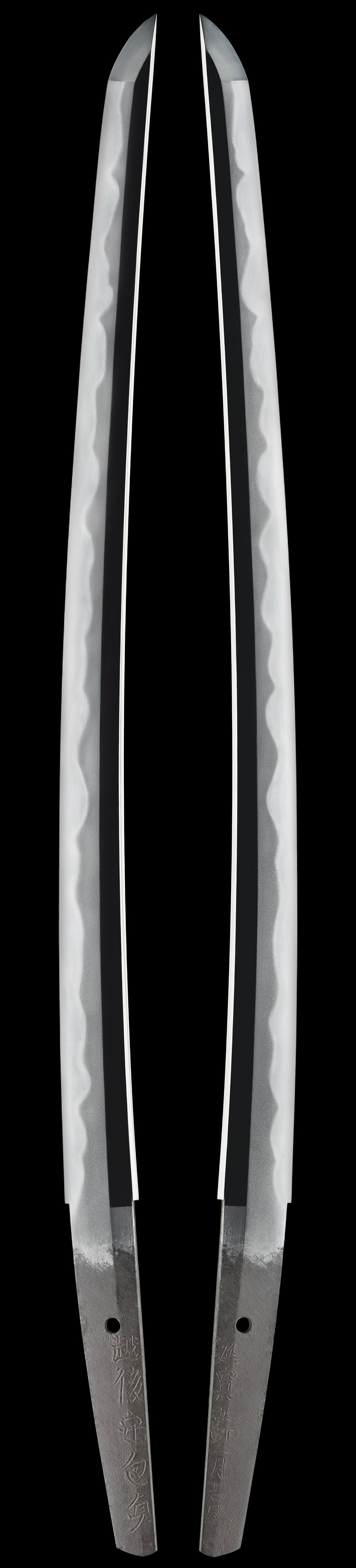
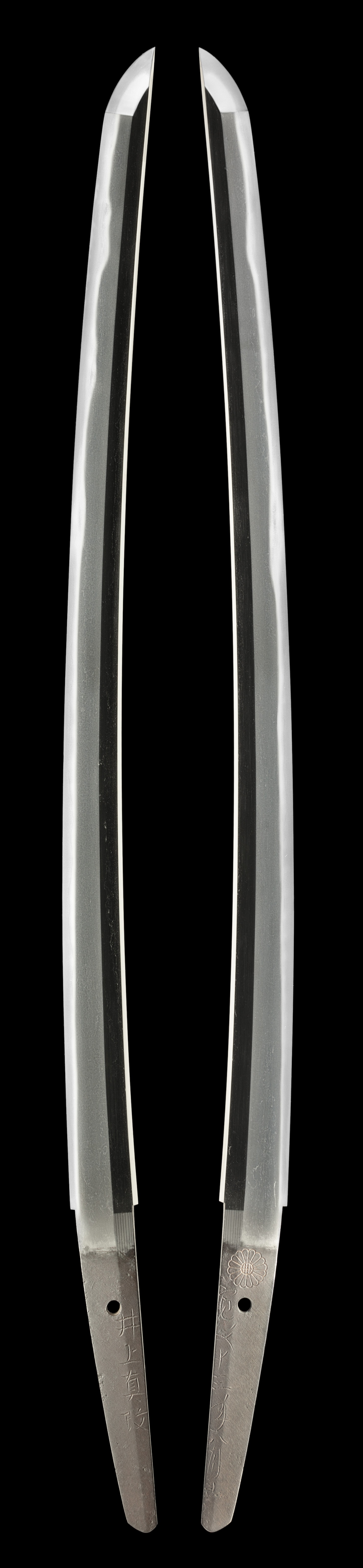
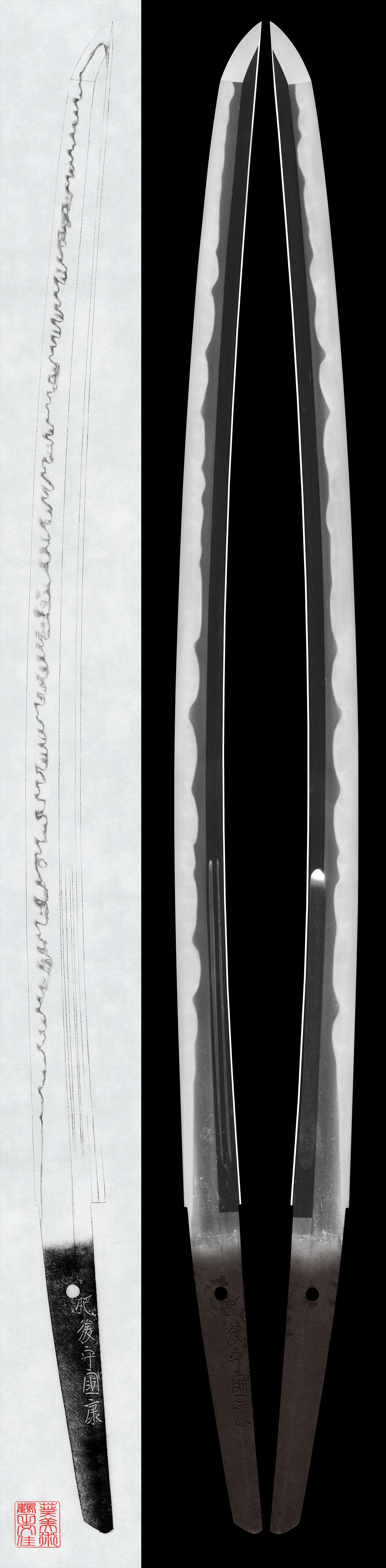
The nidai Kawachi no Kami Kunisuke, commonly called Naka-Kawachi (中河内), is the leading clove-temper master of the early Osaka and the figure who gave the school its single most recognisable temper. He was the son of the Kawachi no Kami Kunisuke, who is counted among the youngest disciples of Kunihiro and who relocated to Osaka together with Kunisada after Kunihiro's death in Keicho 19 (1614). The Kunisuke house, however, traced its origin not to the line but to the Ishido group of Seishu, and that descent shaped the second generation decisively. Working through the and Manji years of the mid-seventeenth century, he turned away from his father's manner and tempered a pure Ishido-style ; the published sources state the point flatly, that he forged the Ishido clove outright and that the style is not to be seen in his work. One of his carries a Manji 4 (1661) date, which fixes the working period of the name precisely and adds, as the published commentary notes, to its value as documentary material.
His characteristic hand is a brilliant into which he mixes a clove of his own devising: a clenched-fist-headed clove the published sources describe as the distinctive one he originated and which the world came to call - (拳形丁子). It is the central point of appreciation in his work and the feature by which he is known above all others. The temper is laid down -dominant with adhering, the are long and enter well, with intermingled, and the is bright and clear. A constant of his construction is the opening: however irregular the becomes above it, the blade begins from a long, straight at the base, an Osaka convention he keeps without exception. The answers it in kind, running and turning back in , the tip frequently becoming .
The is the second half of his signature and the half the judges most admired. It is a forged tightly and finely, with well adhering and at times fine entering, producing the refined and bright steel proper to Osaka, what the published sources call a that is 「大坂新刀らしい精美且つ明るいかね」, the lustrous and clear steel characteristic of Osaka . Of his typical work the published sources say simply that the is well-ordered and beautiful, a point of appreciation in itself; the recurring judgement is 「地がねはよく整って美しい点が見どころ」, that the well-arranged refinement of the steel is where one looks. This is the clean, packed Osaka , and it stands as the deliberate opposite of the loose, rustic forging his father had carried over from the school, the contrast the commentary draws when it sets the son apart from the father.
Within this one well-defined manner the published record marks his variations. The typical blade is read as a representative example, his true strengths shown to their fullest in a wide flamboyantly on a base of -. A smaller number of works depart from it: in these the fist-shaped clove recedes and the carries stronger , with and conspicuous standing out, the at times running through the long as if to cut across the -. In one such the published sources find in this manner 「同国の一竿子忠綱を想わせるもの」, something that calls to mind Isshoshi Tadatsuna of the province, and judge it an uncommon but well-controlled piece, the tempered without breakdown yet vividly flamboyant. On another the is stronger than usual and the shows more change than is his habit, features the commentary calls unusual for Naka-Kawachi. A further idiom recurs across the line: above the on both faces a temper occasionally rises in a shape that evokes Mount , something the sources note is seen from time to time in his work and in that of his successors.
What sets his blades apart is read entirely from their own traits rather than by appeal to what other schools lack. His is the bright, packed Osaka , the long straight , and above it the flamboyant clove crowned by the fist-shaped heads he alone made his own; the most recent designation commentary names them outright as 「本工の創始となる拳形丁子」, the - originated by this smith. The Tadatsuna resemblance is a recurring point of comparison, not a borrowing, drawn only on the rarer -laden works and always returned to his own well-ordered manner. Placed in the school, he is the celebrated peak of the Kunisuke name, which continued through several generations, and a central figure of the early Osaka tradition, the smith through whom the Ishido clove took its definitive Osaka form. The lowering of the temper below the and the forging of the in , the published sources add, is a habit frequently encountered in Osaka work, placing his hand squarely within that regional grammar.
The surviving record runs to nine designated on the rolls of the , all of them signed Kawachi no Kami Kunisuke and all in the broad, dignified - shape of shallow curvature and compact . He earns a Jo- rating in Fujishiro's ranking and a substantial valuation in the Toko Taikan, the marks of a master of the second tier of the great smiths. His blades carry no designation above and no recorded provenance; these are the well-made working of a productive Osaka master rather than heirloom . For a collector that places him within reach in a way the very greatest names are not. His designated blades appear from time to time and at the upper reaches of the market, and a signed that opens from the long straight into the unmistakable fist-shaped clove, over the bright and well-ordered Osaka , is among the most satisfying acquisitions the early Osaka can offer.