This is an introduction to a chuumon-uchi katana by the Army Commissioned Swordsmith Kanehide.
Kanehide forged swords for the three prime ministers: Hitler of Germany, Mussolini of Italy, and Tojo Hideki.
Furthermore, he was granted the honor of forging a presentation sword upon the occasion of the visit by Their Majesties the Emperor and Empress.
Please see the bottom of the description for details.
Now, let us look at this work.
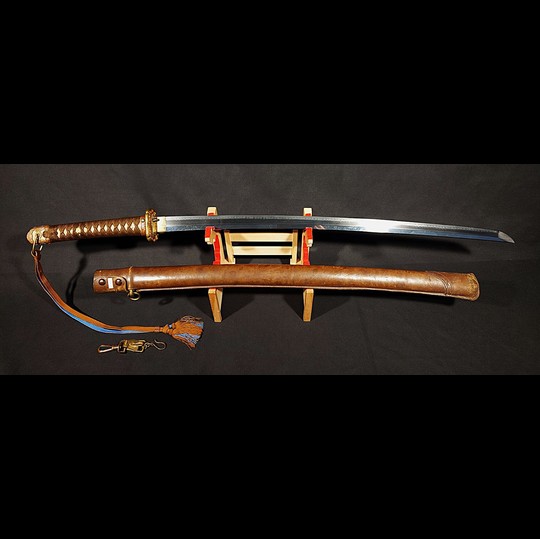
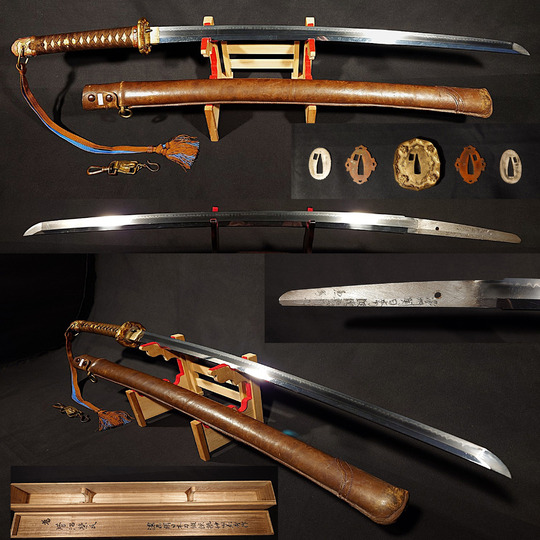
The sugata has sori placed slightly toward the koshi with the monouchi appearing somewhat prone, the shinogi is high, and the kissaki is tied in a chu-boushi.
The jigane is a well-packed itame, and the hamon is a fine sanbonsugi in nioi-deki with soft ashi entering down to the ha-saki, giving it an air of refinement. The kissaki enters with a midare feel and returns in komaru. Being a chuumon-to, the deki is very good.
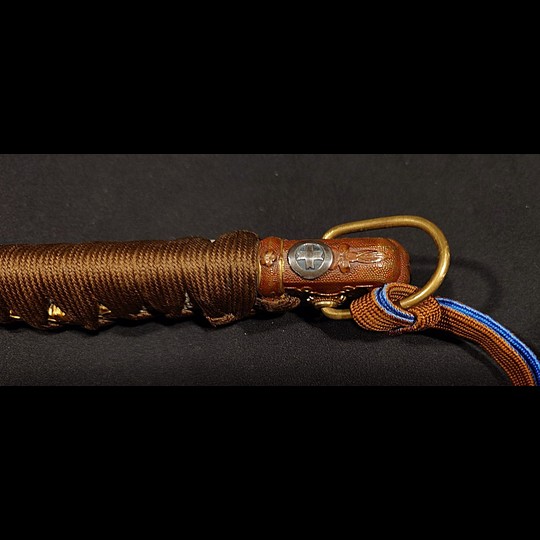
The koshirae comes with a Type 98 late-model simplified wooden leather-wrapped saya, but the tsuka features a family mon in silver zogan, and while the sarute is the standard copper, it is equipped with a field officer's tosho.
It is thought that originally a Type 98 early-model iron saya was attached. It likely suffered damage or destruction on the battlefield.
The included late-model saya has leather in good condition, and the chuso catch engages with a sharp snap.
What should be specially noted about this koshirae is the chuso.
The chuso refers to the locking catch located on the fuchi-kanagu unique to gunto; the koiguchi of a Type 98 late-model leather-wrapped saya type gunto should normally be the traditional habaki-dome, or a leather button-fastener, leather belt-fastener, etc., but this sword uses a chuso-dome, and it is thought to be a piece made during the transition period to the Type 3 gunto established later.
Additionally, a tsuri-kanagu is attached, which is interesting from a research perspective.
An original sword box is also included.
The sumigaki from that time remains. The box itself has sori to match the sori of the sword, making it a custom-made item.
At this time, Showa 13, swordsmiths and tosogu-related matters were not yet controlled by the military and were under free sale and free competition, so chuumon-uchi swords were extremely expensive items.
There is light rust on the toshin and the mune, but there is no problem if you maintain it by applying oil.
Even in its current state, it can be fully appreciated.
For those who like such items, I thank you.
Below, I have included descriptions regarding the "Nihonto Tanren Juku" and "Swordsmith Kanehide, Nakata Isamu."
Please refer to them.
* "Nihonto Tanren Juku"
Its predecessor began with the establishment of the Mino Tosho Yogo-kai (Chairman: Goto Jihei; Directors: Goto Senkichi, Yamada Chozo, Kanemura Toranosuke, Yamada Masaru, Ikoma Heijuro, Mori Yutaka) in Showa 7.
Volunteers organized a support group with the aim of inheriting the Mino Seki-den, which possesses seven hundred years of history and tradition, and improving the techniques of Nihonto forging.
Thereafter, in April of Showa 9, the "Nihonto Tanren Watanabe Kanenaga Shido-jo" was opened, and as supporters increased, it became the "Nihonto Tanren Juku" in April of Showa 12.
From the China Incident in Showa 12, they began manufacturing gunto in Seki.
Until the start of the Greater East Asia War on December 8, Showa 16, gunto, also called "Showa-to," were under free sale and free competition.
Once the war began, they came under the control of the Imperial Japanese Army, and all swordsmiths manufactured gunto for the Army and Navy, producing fifty thousand to sixty thousand swords per month at the peak. Among them, Seki Token Co., Ltd. became a military-managed factory.
Due to the end of the war following the defeat of Japan in the Greater East Asia War on August 15, Showa 20, the "Nihonto Tanren Juku" held its dissolution ceremony on the 20th.
Operated by Juku-cho Watanabe Kanenaga, Juku-to Yamada Chozo (Kanenaga), Juku-sei-cho Nakata Isamu (Kanehide),
Chairman Goto Jihei, Directors Kanemura Toranosuke, Kosaka Toshio, Shiina Takeshi,
Fukuda Yoshiji, Endo Saijiro, Kawada Shinji, Yoshida Kyozaburo, Ishida Seizaburo, and Executive Secretary/Accountant
Ohno Shoichi.
* Nakata Isamu, swordsmith mei "Kanehide," was born on August 24, Taisho 2 (1913), in Okuwa-mura, Kiso-gun, Nagano Prefecture.
In Showa 3 (1928), after graduating from the higher elementary school in Okuwa-mura, he spent eight years acquiring forging techniques as an apprentice at the 12th generation Kawashima Masahide Tanren-jo in Aki City, Kochi Prefecture. In February of Showa 12 (1937), he moved to Seki City, Gifu Prefecture, and began research into Nihonto Mino-den under the tutelage of Watanabe Kanenaga, serving as the Juku-sei-cho of the Nihonto Tanren Juku until October of Showa 15.
He presented Nihonto to the Prime Minister of Germany, Hitler, and the Prime Minister of Italy, Mussolini, who were allied nations (Tripartite Pact) at the time.
After joining Seki Token Co., Ltd. as an Army Designated Swordsmith in Showa 16 (1941), his excellent forging techniques were recognized, and he presented a gunto to Prime Minister Tojo Hideki, making him a representative swordsmith of the early Showa era.
He resumed sword making after the war, and in Showa 30 (1955), after his first acceptance into the Sword Making Technique Exhibition sponsored by the Nihon Bijutsu Token Hozon Kyokai, he consecutively won the Effort Prize 2 times and was accepted 13 times.
In Showa 32 (1957), he was granted the honor of forging a presentation sword for Their Majesties the Emperor and Empress.
In Showa 38 (1963), he established the "Kanehide Nihonto Tanren-jo," devoting himself to the forging and research of Nihonto, and also trained successors.
He was certified as a "Seki-shi Juyo Mukei Bunkazai" on November 22, Showa 51 (1976), and designated as a "Gifu-ken Juyo Mukei Bunkazai" on March 11 of the following year, Showa 52 (1977).
This is a photo of the mune side. There is light rust near the middle ↑.
Machine translation from the shop's Japanese · may contain errors ·
This is an introduction to a chuumon-uchi katana by the Army Commissioned Swordsmith Kanehide.
Kanehide forged swords for the three prime ministers: Hitler of Germany, Mussolini of Italy, and Tojo Hideki.
Furthermore, he was granted the honor of forging a presentation sword upon the occasion of the visit by Their Majesties the Emperor and Empress.
Please see the bottom of the description for details.
Now, let us look at this work.
The sugata has sori placed slightly toward the koshi with the monouchi appearing somewhat prone, the shinogi is high, and the kissaki is tied in a chu-boushi.
The jigane is a well-packed itame, and the hamon is a fine sanbonsugi in nioi-deki with soft ashi entering down to the ha-saki, giving it an air of refinement. The kissaki enters with a midare feel and returns in komaru. Being a chuumon-to, the deki is very good.
The koshirae comes with a Type 98 late-model simplified wooden leather-wrapped saya, but the tsuka features a family mon in silver zogan, and while the sarute is the standard copper, it is equipped with a field officer's tosho.
It is thought that originally a Type 98 early-model iron saya was attached. It likely suffered damage or destruction on the battlefield.
The included late-model saya has leather in good condition, and the chuso catch engages with a sharp snap.
What should be specially noted about this koshirae is the chuso.
The chuso refers to the locking catch located on the fuchi-kanagu unique to gunto; the koiguchi of a Type 98 late-model leather-wrapped saya type gunto should normally be the traditional habaki-dome, or a leather button-fastener, leather belt-fastener, etc., but this sword uses a chuso-dome, and it is thought to be a piece made during the transition period to the Type 3 gunto established later.
Additionally, a tsuri-kanagu is attached, which is interesting from a research perspective.
An original sword box is also included.
The sumigaki from that time remains. The box itself has sori to match the sori of the sword, making it a custom-made item.
At this time, Showa 13, swordsmiths and tosogu-related matters were not yet controlled by the military and were under free sale and free competition, so chuumon-uchi swords were extremely expensive items.
There is light rust on the toshin and the mune, but there is no problem if you maintain it by applying oil.
Even in its current state, it can be fully appreciated.
For those who like such items, I thank you.
Below, I have included descriptions regarding the "Nihonto Tanren Juku" and "Swordsmith Kanehide, Nakata Isamu."
Please refer to them.
* "Nihonto Tanren Juku"
Its predecessor began with the establishment of the Mino Tosho Yogo-kai (Chairman: Goto Jihei; Directors: Goto Senkichi, Yamada Chozo, Kanemura Toranosuke, Yamada Masaru, Ikoma Heijuro, Mori Yutaka) in Showa 7.
Volunteers organized a support group with the aim of inheriting the Mino Seki-den, which possesses seven hundred years of history and tradition, and improving the techniques of Nihonto forging.
Thereafter, in April of Showa 9, the "Nihonto Tanren Watanabe Kanenaga Shido-jo" was opened, and as supporters increased, it became the "Nihonto Tanren Juku" in April of Showa 12.
From the China Incident in Showa 12, they began manufacturing gunto in Seki.
Until the start of the Greater East Asia War on December 8, Showa 16, gunto, also called "Showa-to," were under free sale and free competition.
Once the war began, they came under the control of the Imperial Japanese Army, and all swordsmiths manufactured gunto for the Army and Navy, producing fifty thousand to sixty thousand swords per month at the peak. Among them, Seki Token Co., Ltd. became a military-managed factory.
Due to the end of the war following the defeat of Japan in the Greater East Asia War on August 15, Showa 20, the "Nihonto Tanren Juku" held its dissolution ceremony on the 20th.
Operated by Juku-cho Watanabe Kanenaga, Juku-to Yamada Chozo (Kanenaga), Juku-sei-cho Nakata Isamu (Kanehide),
Chairman Goto Jihei, Directors Kanemura Toranosuke, Kosaka Toshio, Shiina Takeshi,
Fukuda Yoshiji, Endo Saijiro, Kawada Shinji, Yoshida Kyozaburo, Ishida Seizaburo, and Executive Secretary/Accountant
Ohno Shoichi.
* Nakata Isamu, swordsmith mei "Kanehide," was born on August 24, Taisho 2 (1913), in Okuwa-mura, Kiso-gun, Nagano Prefecture.
In Showa 3 (1928), after graduating from the higher elementary school in Okuwa-mura, he spent eight years acquiring forging techniques as an apprentice at the 12th generation Kawashima Masahide Tanren-jo in Aki City, Kochi Prefecture. In February of Showa 12 (1937), he moved to Seki City, Gifu Prefecture, and began research into Nihonto Mino-den under the tutelage of Watanabe Kanenaga, serving as the Juku-sei-cho of the Nihonto Tanren Juku until October of Showa 15.
He presented Nihonto to the Prime Minister of Germany, Hitler, and the Prime Minister of Italy, Mussolini, who were allied nations (Tripartite Pact) at the time.
After joining Seki Token Co., Ltd. as an Army Designated Swordsmith in Showa 16 (1941), his excellent forging techniques were recognized, and he presented a gunto to Prime Minister Tojo Hideki, making him a representative swordsmith of the early Showa era.
He resumed sword making after the war, and in Showa 30 (1955), after his first acceptance into the Sword Making Technique Exhibition sponsored by the Nihon Bijutsu Token Hozon Kyokai, he consecutively won the Effort Prize 2 times and was accepted 13 times.
In Showa 32 (1957), he was granted the honor of forging a presentation sword for Their Majesties the Emperor and Empress.
In Showa 38 (1963), he established the "Kanehide Nihonto Tanren-jo," devoting himself to the forging and research of Nihonto, and also trained successors.
He was certified as a "Seki-shi Juyo Mukei Bunkazai" on November 22, Showa 51 (1976), and designated as a "Gifu-ken Juyo Mukei Bunkazai" on March 11 of the following year, Showa 52 (1977).
This is a photo of the mune side. There is light rust near the middle ↑.
About the school
Seki
関
Mino-den · Mino
125 pieces on the market now
›
Seki (関), in Mino Province, grew from two roots set down in the Nanbokuchō period and rose to become the great center of mass sword production in the late medieval age. The published sources trace the wellspring of Mino swordmaking to Kinju (whose name the commentary also reads Kaneshige), counted since antiquity among the Masamune Jittetsu, the ten disciples of Sōshū Masamune, and to Kaneuji of the Shizu line; the Kokon Meizukushi records Kinju as a native of Tsuruga in Echizen who "crossed over to Seki and resided there," carrying the Sōshū-den manner east. Beneath that Sagami inheritance lay a Yamato foundation, legible in the Tegai descent of the Seki Zensada line through Kaneyoshi, so that the Mino-den the Seki workshops forged stands as a fusion of Yamato grain and Sōshū activity in nie. From this Nanbokuchō founding the name multiplied across the Muromachi period into Sue-Seki, the last and largest body of the tradition; its representative masters at the close of the old-sword age were Magoroku Kanemoto, famed for the sanbonsugi, and Izumi no Kami Kanesada, the smith called Nosada, while the Kanefusa, Ujifusa and Daidō hands worked beside them and the move of Wakasa no Kami Ujifusa to Kiyosu carried the Mino body to the threshold of Owari shintō. A common Mino vocabulary binds the Seki body, however widely its members range. The forging is an itame that stands and runs to masame, often mixed with mokume and nagare, over which rises the cool whitish shirake-utsuri of Mino steel rather than the bright midare-utsuri of Bizen; this pale, standing jigane is the constant tell the judges read first, present alike on Kinju's Nanbokuchō katana, Kaneyoshi's Ōei tachi and Nosada's late-Muromachi blades. Over it the smiths temper gunome into which the pointed togariba of Mino enters, with ko-nie clinging to a tight nioiguchi, ashi and yō, and sunagashi streaming through; the bōshi answers in midare-komi turning to a pointed or jizō-cast ko-maru swept with hakikake. From this shared grammar the individual hands diverge.
Kanemoto fixed the regular three-cedar sanbonsugi of pointed teeth; Kanefusa devised the rounded-head, constricted-waist "Kanefusa midare"; Kinju and the early founders held a calmer, rounder gunome away from the restless Shizu line, their work laid with thicker ji-nie and dry, standing grain. The late masters carried the manner to a higher finish: Nosada wove togariba among rounder forms for a broader temper than Kanemoto's one-sided file, and turned at times to a slender Rai-styled suguha with a hidden gunome; Kaneyoshi held instead to a cool ito-suguha, the disciplined Yamato face of late Seki, lightly broken with ko-gunome. A collector seeks Seki because it is the connoisseur's ground for reading Mino-den across a vast body of signed and attributed work. The kantei runs through the jigane first: the standing, masame-leaning itame and the whitish shirake separate a Seki blade from Bizen and Yamashiro, after which the pointed togariba, the dry nie, and the pointed or jizō bōshi confirm the province; the discriminations the judges draw, Kinju held apart from Shizu by his rounder gunome, Nosada parted from Kanemoto by his breadth, give the eye its anchors. Within the school the standing of the best members is settled: Magoroku Kanemoto for the sanbonsugi, Nosada whom the swordbooks call simply "an excellent master" and the most accomplished of the several Kanesada hands, and the early Kinju as a rare and precious founding name, his record running through the Jūyō tier with the signed pieces few and the long blades attributed den. Signature works carry real provenance: a Kinju tantō presented to the Tokugawa shogunal house in 1679, a Nosada katana borne by a chief retainer of the Kii Tokugawa and a tachi forged for the father of Takeda Shingen, a Kaneyoshi tachi transmitted in the Chikuzen Kuroda family. Beyond connoisseurship, Seki's blades earned a battlefield reputation for cutting; the full hiraniku and stout build of the Sue-Seki katana, made to sever, set the wazamono standing that made Mino the working sword of its age. Learn more →
The twentieth century nearly killed the craft twice: wartime distortion, then the occupation ban. The NBTHK’s founding in 1948 and licensed forging from 1953 rebuilt the sword as an art, crowned by Living National Treasures and the mukansa rank.
We could not find an authenticity certificate on the seller’s listing. Japanese swords and fittings are normally papered by the NBTHK (or the NTHK). Without one, the attribution is the seller’s own assessment and has not been independently verified — treat it with caution and ask the dealer about certification before buying.
 NihontoWatch