NihontoWatch Mon

NihontoWatchBETA

Market
Encyclopedia
NihontoWatch Mon

NihontoWatchBETA

Market
Encyclopedia

Description

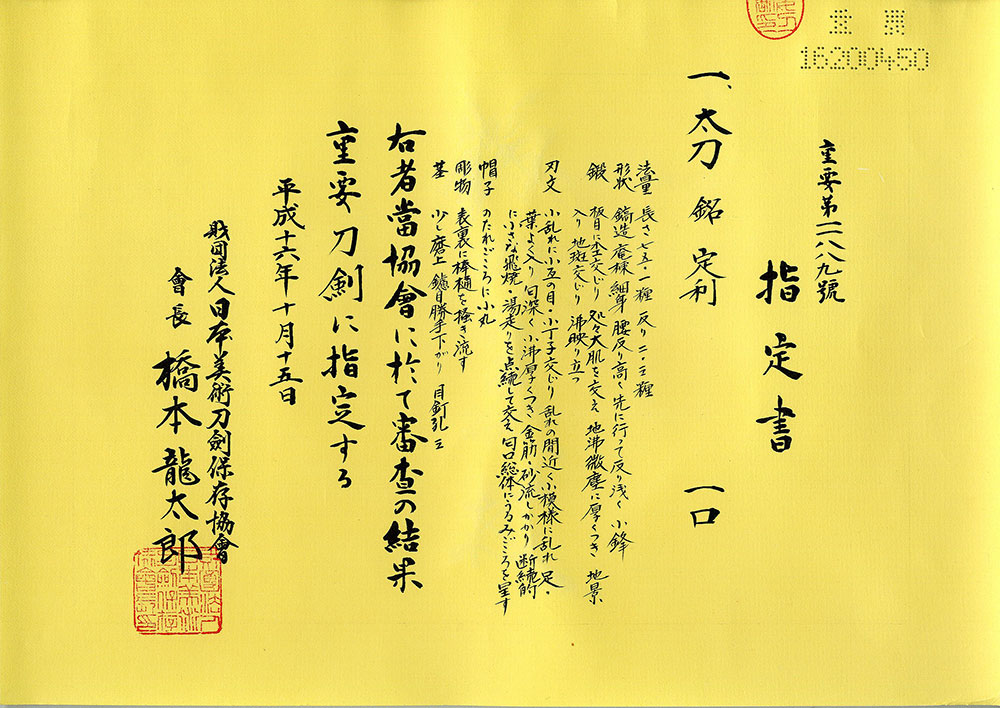
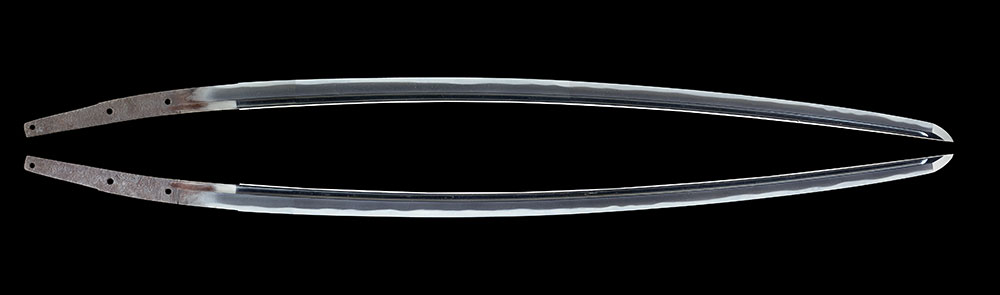
This is a signed tachi by Ayanokouji Sadatoshi, active in Kyoto during the early Kamakura period. It retains an elegant tachi-sugata with a high koshi-zori and small kissaki, despite being slightly suriage. The hamon features intricate ko-midare and ko-choji-midare mixed with niju-ba, deep nioi-guchi, and active ashi, yo, kinsuji, and sunagashi, characteristic of Sadatoshi's work.

NBTHK Setsumei

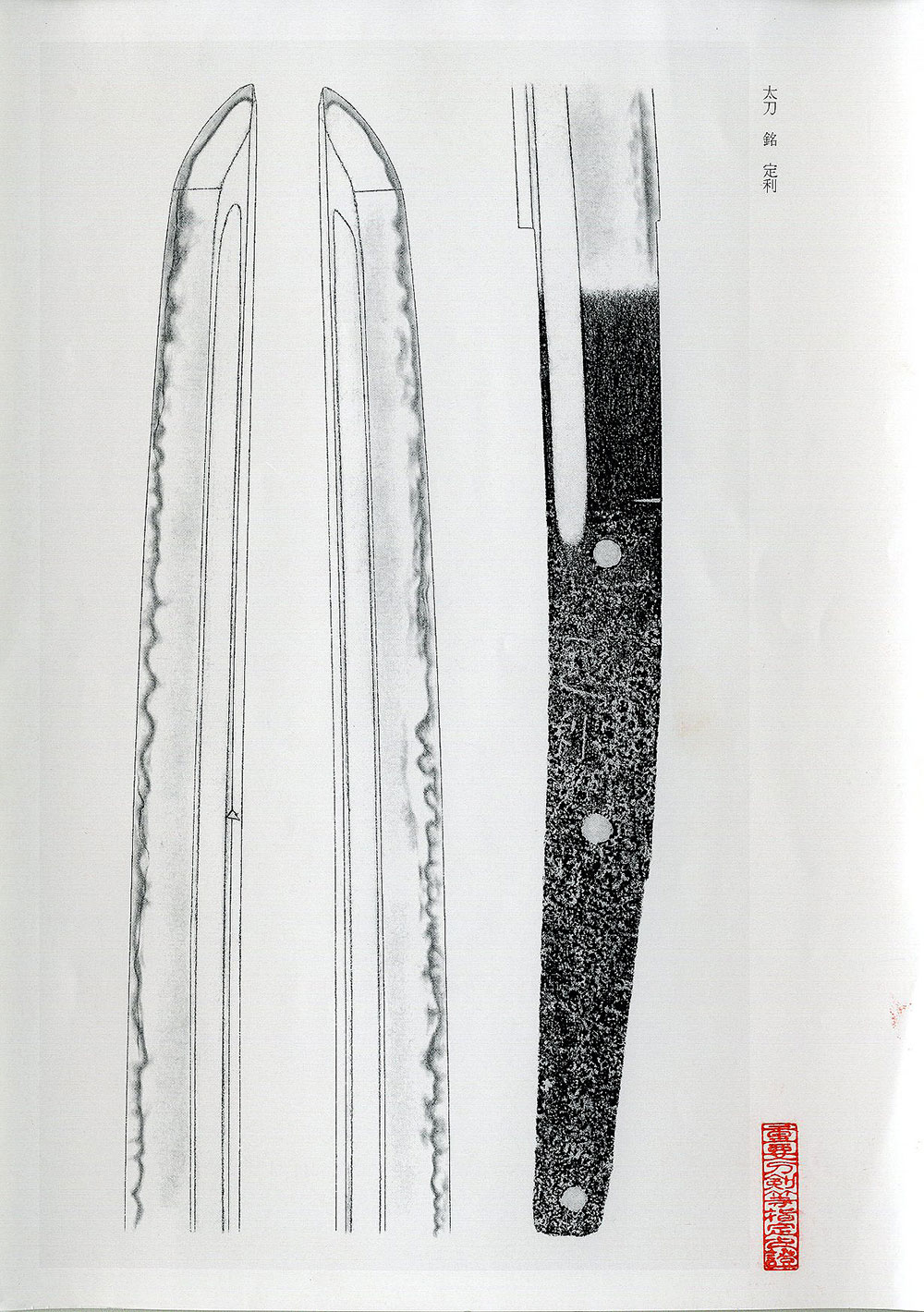
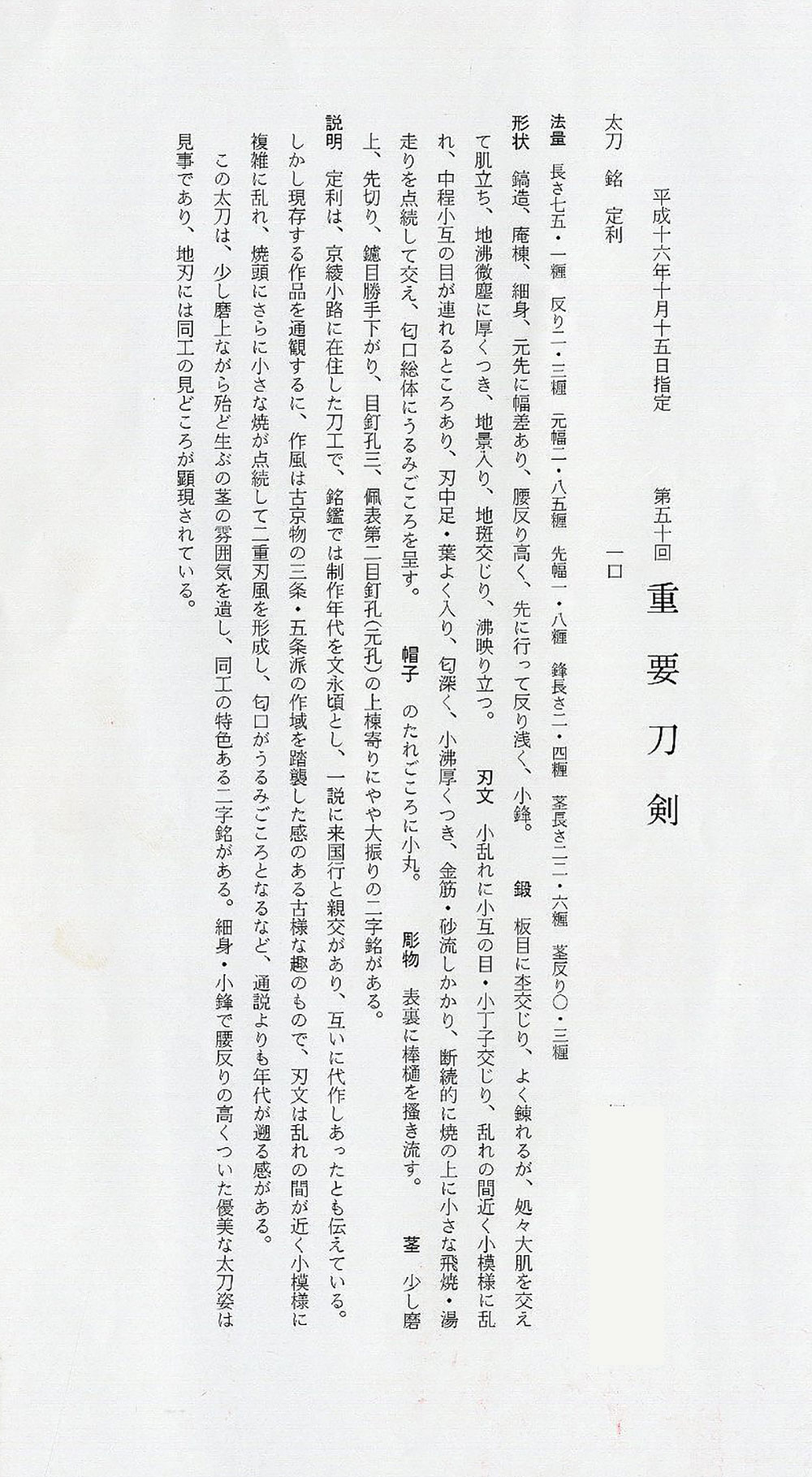
Jūyō-Tōken, 50th Session — Designated October 15, 2004 Tachi, mei: Sadatoshi (定利) Measurements Nagasa 75.1 cm, sori 2.3 cm, motohaba 2.85 cm, sakihaba 1.0 cm, kissaki-nagasa 2.4 cm, nakago-nagasa 22.6 cm, nakago-sori 0.3 cm Description Keijō: Shinogi-zukuri, iori-mune; slender, with a marked difference in width between the base and the tip; high koshizori with the curvature becoming shallower toward the tip; ko-kissaki. Kitae: Itame-hada mixed with mokume; well forged, but with areas of ō-hada that produce some standing grain; fine ji-nie adheres thickly, with chikei appearing; mixed with jihan; nie-utsuri stands out. Hamon: Ko-midare mixed with ko-gunome and ko-chōji; the intervals of the midare are tight and it becomes intricately patterned on a small scale; in the middle section there are places where ko-gunome runs consecutively; ashi and yō enter well; the nioi is deep and ko-nie adheres thickly; kinsuji and sunagashi appear; intermittently, small tobiyaki and yubashiri are dotted above the main yakiba; the nioiguchi overall shows an urumi-tendency (urumi = a moist/soft quality). Bōshi: With a notare-tendency, ending in ko-maru. Horimono: Bō-hi on both sides, carved kaki-nagashi. Nakago: Slightly shortened (suriage); tip cut straight (saki-kiri); file marks katte-sagari; three mekugi-ana; on the haki-omote, above the second mekugi-ana (the original hole), toward the mune side, there is a somewhat large two-character signature. Artisan Sadatoshi (定利) Era Kamakura period (inferred) Explanation Sadatoshi was a swordsmith who resided at Ayanokōji in Kyōto. Sword reference works place his period of production around the Bun’ei era (1264–1275). One tradition states that he was on friendly terms with Rai Kuniyuki, and that the two even produced substitute works for one another. However, when extant works are surveyed, his style has an archaic flavor that seems to follow the working range of early Kyōto makers of the Sanjō and Gojō groups. The hamon forms a complex midare of small-scale patterning with tight spacing, and, along the crest of the temper, still smaller patches of temper appear intermittently, creating an effect reminiscent of nijūba; moreover, the nioiguchi tends toward urumi. These features give the impression that his working date may in fact be earlier than the commonly accepted view. This tachi, though slightly shortened, largely retains the atmosphere of an almost ubu tang, and bears the smith’s characteristically distinctive two-character signature. Its graceful tachi form—slender with ko-kissaki and pronounced koshizori—is superb, and the jihada and hamon clearly manifest the points of interest for which this smith is valued.

NihontoWatch MonNihontoWatchBETA
MarketEncyclopedia
Swords›Yamashiro-den›Ayanokoji›Sadatoshi›Koto Tachi by Ayanokouji Sadatoshi
tachiJūyō
Ayanokoji Sadatoshi

Koto Tachi by Ayanokouji Sadatoshi

mei · Kamakura · nagasa 75.1cm · sori 2.3cm

SOLD
Ayanokoji Sadatoshi — 1 of 6
Ayanokoji Sadatoshi — 2 of 6
Ayanokoji Sadatoshi — 3 of 6
Ayanokoji Sadatoshi — 4 of 6
Ayanokoji Sadatoshi — 5 of 6
Ayanokoji Sadatoshi — 6 of 6
1 / 6
1 / 6
Ayanokoji Sadatoshi — 1 of 6Ayanokoji Sadatoshi — 2 of 6Ayanokoji Sadatoshi — 3 of 6Ayanokoji Sadatoshi — 4 of 6Ayanokoji Sadatoshi — 5 of 6Ayanokoji Sadatoshi — 6 of 6
Measurements & details
Smith
Ayanokoji Sadatoshi
Type
Tachi
School
Ayanokoji
Period
Around 1232–1233(Joei)
Province
Yamashiro
Signature
Signed(60% of this smith's designated works are signed)
Measurements
Nagasa 75.1cmSori 2.3cmMotohaba 2.8cmSakihaba 1.8cmKasane 0.6cm
Description

This is a signed tachi by Ayanokouji Sadatoshi, active in Kyoto during the early Kamakura period. It retains an elegant tachi-sugata with a high koshi-zori and small kissaki, despite being slightly suriage. The hamon features intricate ko-midare and ko-choji-midare mixed with niju-ba, deep nioi-guchi, and active ashi, yo, kinsuji, and sunagashi, characteristic of Sadatoshi's work.

NBTHK Zufu Commentary

Juyo #50

AI translation — may contain errors

-, 50th Session — Designated October 15, 2004

, : Sadatoshi (定利)

Measurements 75.1 cm, 2.3 cm, 2.85 cm, 1.0 cm, 2.4 cm, 22.6 cm, 0.3 cm

Description Keijō: , ; slender, with a marked difference in width between the base and the tip; high with the curvature becoming shallower toward the tip; . : mixed with ; well forged, but with areas of ō-hada that produce some standing grain; fine adheres thickly, with appearing; mixed with jihan; stands out. : mixed with and ; the intervals of the are tight and it becomes intricately patterned on a small scale; in the middle section there are places where runs consecutively; and enter well; the is deep and adheres thickly; and appear; intermittently, small and are dotted above the main ; the overall shows an -tendency ( = a moist/soft quality). : With a -tendency, ending in . : on both sides, carved kaki-nagashi. : Slightly shortened (); tip cut straight (); file marks ; three ; on the , above the second (the original hole), toward the side, there is a somewhat large two-character signature.

Artisan Sadatoshi (定利)

Era period (inferred)

Explanation Sadatoshi was a swordsmith who resided at Ayanokōji in Kyōto. Sword reference works place his period of production around the Bun’ei era (1264–1275). One tradition states that he was on friendly terms with Kuniyuki, and that the two even produced substitute works for one another.

However, when extant works are surveyed, his style has an archaic flavor that seems to follow the working range of early Kyōto makers of the and Gojō groups. The forms a complex of small-scale patterning with tight spacing, and, along the crest of the temper, still smaller patches of temper appear intermittently, creating an effect reminiscent of ; moreover, the tends toward . These features give the impression that his working date may in fact be earlier than the commonly accepted view.

This , though slightly shortened, largely retains the atmosphere of an almost tang, and bears the smith’s characteristically distinctive two-character signature. Its graceful form—slender with and pronounced —is superb, and the and clearly manifest the points of interest for which this smith is valued.

About the maker

Sadatoshi

定利

Ayanokoji (Yamashiro) · Yamashiro · around 1232-1233

Fujishiro Jo-jo saku · Tōken Taikan top 2%

2 pieces on the market now

›

The old registers list several smiths for the Ayanokoji school of Kyoto, Sukesada, Sadaie, a second Sadatoshi written with different characters, Sueyuki and Tadaie among them, yet of them all only Sadatoshi[[c:1]] survives in signed work. The published sources count the Ayanokoji, with Awataguchi and Rai, as one of the three lineages of Yamashiro swordsmiths in the Kamakura period; the school takes its name from the smiths resident on Ayanokoji street in Kyoto's Shijo quarter, and "its founder is Sadatoshi"[[c:2]]. On his date the registers do not agree: the Noami Meizukushi places him around Hoji (1247-48), the Kokon Kaji Meizukushi around Bun'ei (1264-75), and one tradition relates that he was on friendly terms with Rai Kuniyuki, the two even producing substitute works for one another as demand required. Within the school the only other hand attested in surviving work is Sadayoshi; the remaining register names survive in no blade at all.

Surveying the extant works as a whole, the published sources return to a single formulation: his manner follows the working range of the old Kyoto makers of the Sanjo and Gojo schools, an archaic elegance that calls Awataguchi Kuniyasu to mind. His classic tachi is slender, the taper from base to tip marked, the koshizori high with funbari, closing in a ko-kissaki. The hamon is a ko-midare mixed with ko-choji and ko-gunome over a suguha tone, the intervals of the undulations close, the pattern small and intricately complex. Along the yakigashira, still smaller patches of yaki, with yubashiri and tobiyaki, appear in dotted succession and build an effect akin to nijuba. Above all the nioiguchi clouds softly: this urumi is what the published record names "one of his viewing points"[[c:3]], and the rare blade without it is noted as the exception. From precisely these traits the NBTHK draws its chronological conclusion, the workmanship being "appraised as going back earlier than the conventional view"[[c:4]].

The jigane is a well-knit ko-itame, in places mixed with nagare or a slightly standing itame, with fine ji-nie lying thick, fine chikei, and a nie-utsuri that stands out; jifu-like patches mix in on some blades. At its best the jigane carries a moist, viscous quality, and of one Tokubetsu Juyo tachi the published sources write that it precisely accords with the phrase of the old tradition texts, "appearing viscous and sticky"[[c:5]]. Within the ha, ashi and yo enter frequently, ko-nie adheres, and fine kinsuji and sunagashi run through. The boshi continues the temper quietly with hakikake, at times taking on a flame-like appearance or finishing yakizume, on some blades entering midare-komi with a small ko-maru return.

Two registers carry the attribution. The signed tachi bear a two-character mei, the character Sada cut large in a cursive manner and the character Toshi smaller[[c:6]], set low on the nakago toward the mune and at times avoiding the groove, a placement the published sources note on the tachi designated National Treasure as well. Most signed blades are suriage; an ubu nakago is recorded as rare among his works, and one katana preserves the signature folded back as an orikaeshi-mei rather than lose it to the shortening. The o-suriage mumei katana are appraised by the same marks: the published sources speak of work that conforms to "the rules of Sadatoshi"[[c:7]], and the best of the unsigned blades are said to show "a style directly connected to his signed works"[[c:8]]. No dated work survives, and the scholarship turns on that absence. The registers' Bun'ei dating sits against the archaic cast of everything extant, so the NBTHK re-reads the old substitute-work legend rather than discard it, concluding that if there was indeed a point of contact between Sadatoshi and Kuniyuki, "it would fall at Sadatoshi's late years and the beginning of Kuniyuki's"[[c:9]].

A minority of blades departs from his usual make. In these the nioiguchi is bright and clear without urumi, the temper led by choji on a suguha tone, and the published sources read them toward the younger Kyoto master: one Tokubetsu Juyo tachi is described as "a make recalling Rai Kuniyuki, the nioiguchi brightly clear"[[c:10]], the activity within its ha splendid. His place among the Yamashiro smiths rests on his own tells, the tightly packed small-pattern midare, the dotted nijuba effect along the yakigashira, and the softly clouded nioiguchi, the very features the published record treats as evidence for setting him a generation before his registered date. At the other end of his range stands the blade the sources judge the most archaic of all his works, a grand ubu signed tachi read as probably of his initial period, in which the connection to Awataguchi Kuniyasu can be plainly discerned. The school he founded continued only narrowly; with Sadayoshi the sole other attested hand, the surviving Ayanokoji work is concentrated almost entirely in Sadatoshi's own name.

Fujishiro grades him Jo-jo saku, and forty-three designated works stand on record. One is a National Treasure, the tachi in the care of the Tokyo National Museum, of which Honma records that among all the Sadatoshi he had examined it is the finest; three more are Important Cultural Properties, and five hold Juyo Bijutsuhin certification, among them blades once owned by Maeda Toshinari and by Kurokawa Fukusaburo, the latter now in the Kurokawa Institute of Ancient Cultures. Twenty-five works on record are signed against seventeen unsigned. Seventeen blades carry recorded provenance, through the Kishu Tokugawa house, the Shimazu of Sadowara in Hyuga, the Maeda, the Matsudaira, and the Meiji statesman Ito Miyoji, a noted lover of swords; one tachi retains an origami of Shotoku 2 (1712) by Hon'ami Kochu valuing it at thirty gold pieces. The National Treasure and the Important Cultural Properties are patrimony, preserved in the museum and shrine collections that keep them, Hie Jinja and Ise Jingu among the recorded institutional owners. What a private collector may realistically encounter lies in the thirty-two blades of the Tokubetsu Juyo and Juyo tiers, though most of recorded whereabouts are held privately or institutionally and seldom move; a signed Ayanokoji tachi comes to the market only rarely, and is a landmark for Yamashiro connoisseurship when it does.

Historical importance

Where Sadatoshi stands among comparable artisans: across all of nihontō, and within tradition, era, and period. The tiers (Foremost · Leading · Major · Notable) weigh official designations from the NBTHK and Japan's Agency for Cultural Affairs, together with historical honors of lasting repute such as the Sansaku and Meibutsu-chō.

随一
Foremost
屈指
Leading
有数
Major
著名
Notable

Select a lens to see how it's measured.

Designation record
42 designated works
Kokuhō (National Treasure)
1
Jūyō Bunkazai
3
Jūyō Bijutsuhin
5
Gyobutsu (Imperial)
2
Tokubetsu Jūyō
8
Jūyō
23
2 works by Sadatoshi on the market→
Sadatoshi — full profileAyanokoji (Yamashiro) school
About the school

Ayanokoji

綾小路

Yamashiro-den · Yamashiro

10 pieces on the market now

›

The Ayanokoji school (綾小路) takes its name from the swordsmiths who lived along Ayanokoji street in the Shijo quarter of Kyoto, and the published sources count it, with Awataguchi and Rai, among the three lineages of Yamashiro-den smiths of the Kamakura period. Learn more →

7 recorded smiths87 designated works
Leading smiths
SmithEraDesignated
Sadatoshi定利1232-123342
Sueyuki末行1303-13063
Sadanari定業1278-12880
Sadanori定則1299-13020
Kuninobu國信1334-13380
Explore the Ayanokoji school →
NBTHK Certificate
Jūyō Tōken重要刀剣
Important Sword
›

A blade of top-grade workmanship and condition, formally judged to rank with a nationally recognized Important Art Object (Jūyō Bijutsuhin). Awarded only at the NBTHK’s competitive annual examination.

Of Japan’s roughly 2.5 million registered swords, only 12,307 (about 1 in 203) have ever attained Jūyō.

About the NBTHK›

The NBTHK (Nihon Bijutsu Tōken Hozon Kyōkai, the Society for the Preservation of Japanese Art Swords) is a public-interest incorporated foundation founded in 1948 and supervised by Japan’s Agency for Cultural Affairs (Bunkachō); it is based at the Japanese Sword Museum in Tokyo. Its expert panels physically examine each submitted work (shinsa) and issue a certificate (kanteishō) ranking it by artistic and historical merit. NBTHK papers are the most widely recognized standard of authentication for Japanese swords and fittings.

NBTHK official site→
Seller
I
Iida Koendo
Established 1880 · 146 yrs on the market
🇯🇵Ships from Japan
›
✓Verified dealeriidakoendo.com
✓Ships worldwide✓English supportWire transfer
Return policy

Customer-initiated returns accepted within two days of arrival; return shipping paid by customer and fees non-refundable. Returns/refunds unavailable for overseas deliveries.

View all of Iida Koendo’s listings→View this item on the dealer’s site→

More works by Ayanokoji Sadatoshi

View all →
Eirakudo
Jūyō
Tachi - Jūyō - by Ayanokoji Sadatoshi - Sadatoshi Tachi - Juyo TokenTachi - Jūyō - by Ayanokoji Sadatoshi - Sadatoshi Tachi - Juyo Token

Tachi

ByAyanokoji Sadatoshi
¥7,700,000
Kusanagi
Tokuho
Tokuho - by Ayanokoji Sadatoshi - Unique National Treasure Brand Ayanokoji School Founder 'Ayanokoji Sadatoshi' Flawless Masterpiece, Kamakura Period Early Tokubetsu Hozon Tachi with Tanobe Michihiro Sensei SayagakiTokuho - by Ayanokoji Sadatoshi - Unique National Treasure Brand Ayanokoji School Founder 'Ayanokoji Sadatoshi' Flawless Masterpiece, Kamakura Period Early Tokubetsu Hozon Tachi with Tanobe Michihiro Sensei Sayagaki

Unique National Treasure Brand Ayanokoji School Founder 'Ayanokoji Sadatoshi' Flawless Masterpiece, Kamakura Period Early Tokubetsu Hozon Tachi with Tanobe Michihiro Sensei Sayagaki

ByAyanokoji Sadatoshi
¥3,800,000

Previously sold by Ayanokoji Sadatoshi

Eirakudo
Tokuho
Tachi - Tokuho - by Ayanokoji Sadatoshi - Ayanokouji Sadatoshi - Tokubetsu Hozon TokenTachi - Tokuho - by Ayanokoji Sadatoshi - Ayanokouji Sadatoshi - Tokubetsu Hozon Token
Sold

Tachi

ByAyanokoji Sadatoshi
SOLD
Eirakudo
Jūyō
Tachi - Jūyō - by Ayanokoji Sadatoshi - Ayanokouji Sadatoshi - Juyo TokenTachi - Jūyō - by Ayanokoji Sadatoshi - Ayanokouji Sadatoshi - Juyo Token
Sold

Tachi

ByAyanokoji Sadatoshi
SOLD

More from the Ayanokoji school

View all →
Tosa Touken Do
Tokuho
Katana - Tokuho - by Ayanokoji School - Den AyanokojiKatana - Tokuho - by Ayanokoji School - Den Ayanokoji

Katana

ByAyanokoji School
Ask
Eirakudo
Tokuho
Katana - Tokuho - by Ayanokoji School - Ayanokouji Sadatoshi - Tokubetsu Hozon TokenKatana - Tokuho - by Ayanokoji School - Ayanokouji Sadatoshi - Tokubetsu Hozon Token

Katana

ByAyanokoji School
¥3,800,000
Nihonto Australia
Jūyō
Katana - Jūyō - by Ayanokoji Sadayoshi - Ayanokoji Sadayoshi - Rare Kamakura Juyo TokenKatana - Jūyō - by Ayanokoji Sadayoshi - Ayanokoji Sadayoshi - Rare Kamakura Juyo Token

Katana

ByAyanokoji Sadayoshi
Ask
Samurai Shokai
Tokuho
Katana - Tokuho - by Ayanokoji Sueyuki - Attributed to Joshu SueyukiKatana - Tokuho - by Ayanokoji Sueyuki - Attributed to Joshu Sueyuki

Katana

ByAyanokoji Sueyuki
¥1,580,000
Nihonto Australia
Jūyō
Katana - Jūyō - by Ayanokoji School - Juyo Token Rare Ayanokoji Kamakura KatanaKatana - Jūyō - by Ayanokoji School - Juyo Token Rare Ayanokoji Kamakura Katana

Katana

ByAyanokoji School
Ask
Samurai Nippon
Jūyō
Katana - Jūyō - by Ayanokoji School - Mumei (Attributed to Ayanokoji)Katana - Jūyō - by Ayanokoji School - Mumei (Attributed to Ayanokoji)

Katana

ByAyanokoji School
¥4,900,000
Nihonto Australia
Tokuho
Katana - Tokuho - by Ayanokoji Sueyuki - Koto Kamakura Ayanokoji Katana mounted in Kenuki Tachi koshirae with Tokubetsu Hozon CertificateKatana - Tokuho - by Ayanokoji Sueyuki - Koto Kamakura Ayanokoji Katana mounted in Kenuki Tachi koshirae with Tokubetsu Hozon Certificate

Katana

ByAyanokoji Sueyuki
Ask
Aoi Art
Tokuho
Katana - Tokuho - by Ayanokoji School - Mumei (attributed to Den Ayakoji) (Koshirae: NBTHK Tokubetsu Kicho Tosogu)Katana - Tokuho - by Ayanokoji School - Mumei (attributed to Den Ayakoji) (Koshirae: NBTHK Tokubetsu Kicho Tosogu)

Katana

ByAyanokoji School
¥2,200,000

More from the Yamashiro tradition

View all →
Aoi Art
Tokuho
Wakizashi - Tokuho - by Enju Kunitoki - Kunitoki (Enju school) dated Gentoku 4 Nen (1332)Wakizashi - Tokuho - by Enju Kunitoki - Kunitoki (Enju school) dated Gentoku 4 Nen (1332)

Wakizashi

ByEnju Kunitoki
Starting Bid¥1,350,000
Samurai Nippon
Tokujū
Katana - Tokuju - by Awataguchi Kuniyoshi - Mumei (Attributed to Awataguchi Kuniyoshi)Katana - Tokuju - by Awataguchi Kuniyoshi - Mumei (Attributed to Awataguchi Kuniyoshi)

Katana

ByAwataguchi Kuniyoshi
Ask
Eirakudo
Tokuho
Katana - Tokuho - by Shintogo Kunimitsu - Shintogo Kunimitsu Katana - Tokubetsu Hozon TokenKatana - Tokuho - by Shintogo Kunimitsu - Shintogo Kunimitsu Katana - Tokubetsu Hozon Token

Katana

ByShintogo Kunimitsu
¥7,500,000
Yazawa Shokai
Tokuho
Tachi - Tokuho - by Rai Kuniyuki - Consignment: Rai Kuniyuki Mid-Kamakura Period - Blade Length 69.7cm, Sori 1.9cm, in Shirasaya with Tachi KoshiraeTachi - Tokuho - by Rai Kuniyuki - Consignment: Rai Kuniyuki Mid-Kamakura Period - Blade Length 69.7cm, Sori 1.9cm, in Shirasaya with Tachi Koshirae

Tachi

ByRai Kuniyuki
¥3,000,000
Eirakudo
Jūyō
Katana - Jūyō - by Rai Kunimitsu - Rai Kunimitsu - Juyo TokenKatana - Jūyō - by Rai Kunimitsu - Rai Kunimitsu - Juyo Token

Katana

ByRai Kunimitsu
¥7,800,000
Bushido Antique Japanese Swords
Tokuho
Katana - Tokuho - by Rai Kunitsugu - Rai Kunitsugu DaitoKatana - Tokuho - by Rai Kunitsugu - Rai Kunitsugu Daito

Katana

ByRai Kunitsugu
¥35,000
Choshuya
Tanto - by Rai Kunitoshi - Japanese Sword for Sale | Ginza Choshuya | Mei: Rai Kunitoshi (O-wazamono), 1746Tanto - by Rai Kunitoshi - Japanese Sword for Sale | Ginza Choshuya | Mei: Rai Kunitoshi (O-wazamono), 1746

Tantō

ByRai Kunitoshi
¥12,000,000
Giheiya
Tanto - by Enju School - Koto Mumei Kikuchi-yari naosi tanto with Aikuchi Koshirae and ShirasayaTanto - by Enju School - Koto Mumei Kikuchi-yari naosi tanto with Aikuchi Koshirae and Shirasaya

Tantō

ByEnju School
¥300,000

Swords

  • Katana
  • Wakizashi
  • Tantō
  • Tachi
  • Naginata
  • Yari

Fittings

  • Tsuba
  • Fuchi-Kashira
  • Kozuka
  • Menuki

Armor

  • Kabuto
  • Samurai Armor

By Certification

  • Tokujū
  • Jūyō
  • Tokuho
  • Hozon

Resources

  • Dealer Directory
  • Artist Directory
  • Glossary
  • Browse All
Nihontowatch© 2026
TermsPrivacyCookiesAbout

Description

This is a signed tachi by Ayanokouji Sadatoshi, active in Kyoto during the early Kamakura period. It retains an elegant tachi-sugata with a high koshi-zori and small kissaki, despite being slightly suriage. The hamon features intricate ko-midare and ko-choji-midare mixed with niju-ba, deep nioi-guchi, and active ashi, yo, kinsuji, and sunagashi, characteristic of Sadatoshi's work.

NBTHK Setsumei

Jūyō-Tōken, 50th Session — Designated October 15, 2004 Tachi, mei: Sadatoshi (定利) Measurements Nagasa 75.1 cm, sori 2.3 cm, motohaba 2.85 cm, sakihaba 1.0 cm, kissaki-nagasa 2.4 cm, nakago-nagasa 22.6 cm, nakago-sori 0.3 cm Description Keijō: Shinogi-zukuri, iori-mune; slender, with a marked difference in width between the base and the tip; high koshizori with the curvature becoming shallower toward the tip; ko-kissaki. Kitae: Itame-hada mixed with mokume; well forged, but with areas of ō-hada that produce some standing grain; fine ji-nie adheres thickly, with chikei appearing; mixed with jihan; nie-utsuri stands out. Hamon: Ko-midare mixed with ko-gunome and ko-chōji; the intervals of the midare are tight and it becomes intricately patterned on a small scale; in the middle section there are places where ko-gunome runs consecutively; ashi and yō enter well; the nioi is deep and ko-nie adheres thickly; kinsuji and sunagashi appear; intermittently, small tobiyaki and yubashiri are dotted above the main yakiba; the nioiguchi overall shows an urumi-tendency (urumi = a moist/soft quality). Bōshi: With a notare-tendency, ending in ko-maru. Horimono: Bō-hi on both sides, carved kaki-nagashi. Nakago: Slightly shortened (suriage); tip cut straight (saki-kiri); file marks katte-sagari; three mekugi-ana; on the haki-omote, above the second mekugi-ana (the original hole), toward the mune side, there is a somewhat large two-character signature. Artisan Sadatoshi (定利) Era Kamakura period (inferred) Explanation Sadatoshi was a swordsmith who resided at Ayanokōji in Kyōto. Sword reference works place his period of production around the Bun’ei era (1264–1275). One tradition states that he was on friendly terms with Rai Kuniyuki, and that the two even produced substitute works for one another. However, when extant works are surveyed, his style has an archaic flavor that seems to follow the working range of early Kyōto makers of the Sanjō and Gojō groups. The hamon forms a complex midare of small-scale patterning with tight spacing, and, along the crest of the temper, still smaller patches of temper appear intermittently, creating an effect reminiscent of nijūba; moreover, the nioiguchi tends toward urumi. These features give the impression that his working date may in fact be earlier than the commonly accepted view. This tachi, though slightly shortened, largely retains the atmosphere of an almost ubu tang, and bears the smith’s characteristically distinctive two-character signature. Its graceful tachi form—slender with ko-kissaki and pronounced koshizori—is superb, and the jihada and hamon clearly manifest the points of interest for which this smith is valued.

NihontoWatch MonNihontoWatchBETA
MarketEncyclopedia
Swords›Yamashiro-den›Ayanokoji›Sadatoshi›Koto Tachi by Ayanokouji Sadatoshi
tachiJūyō
Ayanokoji Sadatoshi

Koto Tachi by Ayanokouji Sadatoshi

mei · Kamakura · nagasa 75.1cm · sori 2.3cm

SOLD
Ayanokoji Sadatoshi — 1 of 6
Ayanokoji Sadatoshi — 2 of 6
Ayanokoji Sadatoshi — 3 of 6
Ayanokoji Sadatoshi — 4 of 6
Ayanokoji Sadatoshi — 5 of 6
Ayanokoji Sadatoshi — 6 of 6
1 / 6
1 / 6
Ayanokoji Sadatoshi — 1 of 6Ayanokoji Sadatoshi — 2 of 6Ayanokoji Sadatoshi — 3 of 6Ayanokoji Sadatoshi — 4 of 6Ayanokoji Sadatoshi — 5 of 6Ayanokoji Sadatoshi — 6 of 6
Measurements & details
Smith
Ayanokoji Sadatoshi
Type
Tachi
School
Ayanokoji
Period
Around 1232–1233(Joei)
Province
Yamashiro
Signature
Signed(60% of this smith's designated works are signed)
Measurements
Nagasa 75.1cmSori 2.3cmMotohaba 2.8cmSakihaba 1.8cmKasane 0.6cm
Description

This is a signed tachi by Ayanokouji Sadatoshi, active in Kyoto during the early Kamakura period. It retains an elegant tachi-sugata with a high koshi-zori and small kissaki, despite being slightly suriage. The hamon features intricate ko-midare and ko-choji-midare mixed with niju-ba, deep nioi-guchi, and active ashi, yo, kinsuji, and sunagashi, characteristic of Sadatoshi's work.

NBTHK Zufu Commentary

Juyo #50

AI translation — may contain errors

-, 50th Session — Designated October 15, 2004

, : Sadatoshi (定利)

Measurements 75.1 cm, 2.3 cm, 2.85 cm, 1.0 cm, 2.4 cm, 22.6 cm, 0.3 cm

Description Keijō: , ; slender, with a marked difference in width between the base and the tip; high with the curvature becoming shallower toward the tip; . : mixed with ; well forged, but with areas of ō-hada that produce some standing grain; fine adheres thickly, with appearing; mixed with jihan; stands out. : mixed with and ; the intervals of the are tight and it becomes intricately patterned on a small scale; in the middle section there are places where runs consecutively; and enter well; the is deep and adheres thickly; and appear; intermittently, small and are dotted above the main ; the overall shows an -tendency ( = a moist/soft quality). : With a -tendency, ending in . : on both sides, carved kaki-nagashi. : Slightly shortened (); tip cut straight (); file marks ; three ; on the , above the second (the original hole), toward the side, there is a somewhat large two-character signature.

Artisan Sadatoshi (定利)

Era period (inferred)

Explanation Sadatoshi was a swordsmith who resided at Ayanokōji in Kyōto. Sword reference works place his period of production around the Bun’ei era (1264–1275). One tradition states that he was on friendly terms with Kuniyuki, and that the two even produced substitute works for one another.

However, when extant works are surveyed, his style has an archaic flavor that seems to follow the working range of early Kyōto makers of the and Gojō groups. The forms a complex of small-scale patterning with tight spacing, and, along the crest of the temper, still smaller patches of temper appear intermittently, creating an effect reminiscent of ; moreover, the tends toward . These features give the impression that his working date may in fact be earlier than the commonly accepted view.

This , though slightly shortened, largely retains the atmosphere of an almost tang, and bears the smith’s characteristically distinctive two-character signature. Its graceful form—slender with and pronounced —is superb, and the and clearly manifest the points of interest for which this smith is valued.

About the maker

Sadatoshi

定利

Ayanokoji (Yamashiro) · Yamashiro · around 1232-1233

Fujishiro Jo-jo saku · Tōken Taikan top 2%

2 pieces on the market now

›

The old registers list several smiths for the Ayanokoji school of Kyoto, Sukesada, Sadaie, a second Sadatoshi written with different characters, Sueyuki and Tadaie among them, yet of them all only Sadatoshi[[c:1]] survives in signed work. The published sources count the Ayanokoji, with Awataguchi and Rai, as one of the three lineages of Yamashiro swordsmiths in the Kamakura period; the school takes its name from the smiths resident on Ayanokoji street in Kyoto's Shijo quarter, and "its founder is Sadatoshi"[[c:2]]. On his date the registers do not agree: the Noami Meizukushi places him around Hoji (1247-48), the Kokon Kaji Meizukushi around Bun'ei (1264-75), and one tradition relates that he was on friendly terms with Rai Kuniyuki, the two even producing substitute works for one another as demand required. Within the school the only other hand attested in surviving work is Sadayoshi; the remaining register names survive in no blade at all.

Surveying the extant works as a whole, the published sources return to a single formulation: his manner follows the working range of the old Kyoto makers of the Sanjo and Gojo schools, an archaic elegance that calls Awataguchi Kuniyasu to mind. His classic tachi is slender, the taper from base to tip marked, the koshizori high with funbari, closing in a ko-kissaki. The hamon is a ko-midare mixed with ko-choji and ko-gunome over a suguha tone, the intervals of the undulations close, the pattern small and intricately complex. Along the yakigashira, still smaller patches of yaki, with yubashiri and tobiyaki, appear in dotted succession and build an effect akin to nijuba. Above all the nioiguchi clouds softly: this urumi is what the published record names "one of his viewing points"[[c:3]], and the rare blade without it is noted as the exception. From precisely these traits the NBTHK draws its chronological conclusion, the workmanship being "appraised as going back earlier than the conventional view"[[c:4]].

The jigane is a well-knit ko-itame, in places mixed with nagare or a slightly standing itame, with fine ji-nie lying thick, fine chikei, and a nie-utsuri that stands out; jifu-like patches mix in on some blades. At its best the jigane carries a moist, viscous quality, and of one Tokubetsu Juyo tachi the published sources write that it precisely accords with the phrase of the old tradition texts, "appearing viscous and sticky"[[c:5]]. Within the ha, ashi and yo enter frequently, ko-nie adheres, and fine kinsuji and sunagashi run through. The boshi continues the temper quietly with hakikake, at times taking on a flame-like appearance or finishing yakizume, on some blades entering midare-komi with a small ko-maru return.

Two registers carry the attribution. The signed tachi bear a two-character mei, the character Sada cut large in a cursive manner and the character Toshi smaller[[c:6]], set low on the nakago toward the mune and at times avoiding the groove, a placement the published sources note on the tachi designated National Treasure as well. Most signed blades are suriage; an ubu nakago is recorded as rare among his works, and one katana preserves the signature folded back as an orikaeshi-mei rather than lose it to the shortening. The o-suriage mumei katana are appraised by the same marks: the published sources speak of work that conforms to "the rules of Sadatoshi"[[c:7]], and the best of the unsigned blades are said to show "a style directly connected to his signed works"[[c:8]]. No dated work survives, and the scholarship turns on that absence. The registers' Bun'ei dating sits against the archaic cast of everything extant, so the NBTHK re-reads the old substitute-work legend rather than discard it, concluding that if there was indeed a point of contact between Sadatoshi and Kuniyuki, "it would fall at Sadatoshi's late years and the beginning of Kuniyuki's"[[c:9]].

A minority of blades departs from his usual make. In these the nioiguchi is bright and clear without urumi, the temper led by choji on a suguha tone, and the published sources read them toward the younger Kyoto master: one Tokubetsu Juyo tachi is described as "a make recalling Rai Kuniyuki, the nioiguchi brightly clear"[[c:10]], the activity within its ha splendid. His place among the Yamashiro smiths rests on his own tells, the tightly packed small-pattern midare, the dotted nijuba effect along the yakigashira, and the softly clouded nioiguchi, the very features the published record treats as evidence for setting him a generation before his registered date. At the other end of his range stands the blade the sources judge the most archaic of all his works, a grand ubu signed tachi read as probably of his initial period, in which the connection to Awataguchi Kuniyasu can be plainly discerned. The school he founded continued only narrowly; with Sadayoshi the sole other attested hand, the surviving Ayanokoji work is concentrated almost entirely in Sadatoshi's own name.

Fujishiro grades him Jo-jo saku, and forty-three designated works stand on record. One is a National Treasure, the tachi in the care of the Tokyo National Museum, of which Honma records that among all the Sadatoshi he had examined it is the finest; three more are Important Cultural Properties, and five hold Juyo Bijutsuhin certification, among them blades once owned by Maeda Toshinari and by Kurokawa Fukusaburo, the latter now in the Kurokawa Institute of Ancient Cultures. Twenty-five works on record are signed against seventeen unsigned. Seventeen blades carry recorded provenance, through the Kishu Tokugawa house, the Shimazu of Sadowara in Hyuga, the Maeda, the Matsudaira, and the Meiji statesman Ito Miyoji, a noted lover of swords; one tachi retains an origami of Shotoku 2 (1712) by Hon'ami Kochu valuing it at thirty gold pieces. The National Treasure and the Important Cultural Properties are patrimony, preserved in the museum and shrine collections that keep them, Hie Jinja and Ise Jingu among the recorded institutional owners. What a private collector may realistically encounter lies in the thirty-two blades of the Tokubetsu Juyo and Juyo tiers, though most of recorded whereabouts are held privately or institutionally and seldom move; a signed Ayanokoji tachi comes to the market only rarely, and is a landmark for Yamashiro connoisseurship when it does.
Historical importance

Where Sadatoshi stands among comparable artisans: across all of nihontō, and within tradition, era, and period. The tiers (Foremost · Leading · Major · Notable) weigh official designations from the NBTHK and Japan's Agency for Cultural Affairs, together with historical honors of lasting repute such as the Sansaku and Meibutsu-chō.

随一
Foremost
屈指
Leading
有数
Major
著名
Notable

Select a lens to see how it's measured.

Designation record
42 designated works
Kokuhō (National Treasure)
1
Jūyō Bunkazai
3
Jūyō Bijutsuhin
5
Gyobutsu (Imperial)
2
Tokubetsu Jūyō
8
Jūyō
23
2 works by Sadatoshi on the market→
Sadatoshi — full profileAyanokoji (Yamashiro) school
About the school

Ayanokoji

綾小路

Yamashiro-den · Yamashiro

10 pieces on the market now

›

The Ayanokoji school (綾小路) takes its name from the swordsmiths who lived along Ayanokoji street in the Shijo quarter of Kyoto, and the published sources count it, with Awataguchi and Rai, among the three lineages of Yamashiro-den smiths of the Kamakura period. Learn more →

7 recorded smiths87 designated works
Leading smiths
SmithEraDesignated
Sadatoshi定利1232-123342
Sueyuki末行1303-13063
Sadanari定業1278-12880
Sadanori定則1299-13020
Kuninobu國信1334-13380
Explore the Ayanokoji school →
NBTHK Certificate
Jūyō Tōken重要刀剣
Important Sword
›

A blade of top-grade workmanship and condition, formally judged to rank with a nationally recognized Important Art Object (Jūyō Bijutsuhin). Awarded only at the NBTHK’s competitive annual examination.

Of Japan’s roughly 2.5 million registered swords, only 12,307 (about 1 in 203) have ever attained Jūyō.

About the NBTHK›

The NBTHK (Nihon Bijutsu Tōken Hozon Kyōkai, the Society for the Preservation of Japanese Art Swords) is a public-interest incorporated foundation founded in 1948 and supervised by Japan’s Agency for Cultural Affairs (Bunkachō); it is based at the Japanese Sword Museum in Tokyo. Its expert panels physically examine each submitted work (shinsa) and issue a certificate (kanteishō) ranking it by artistic and historical merit. NBTHK papers are the most widely recognized standard of authentication for Japanese swords and fittings.

NBTHK official site→
Seller
I
Iida Koendo
Established 1880 · 146 yrs on the market
🇯🇵Ships from Japan
›
✓Verified dealeriidakoendo.com
✓Ships worldwide✓English supportWire transfer
Return policy

Customer-initiated returns accepted within two days of arrival; return shipping paid by customer and fees non-refundable. Returns/refunds unavailable for overseas deliveries.

View all of Iida Koendo’s listings→View this item on the dealer’s site→

More works by Ayanokoji Sadatoshi

View all →
Eirakudo
Jūyō
Tachi - Jūyō - by Ayanokoji Sadatoshi - Sadatoshi Tachi - Juyo TokenTachi - Jūyō - by Ayanokoji Sadatoshi - Sadatoshi Tachi - Juyo Token

Tachi

ByAyanokoji Sadatoshi
¥7,700,000
Kusanagi
Tokuho
Tokuho - by Ayanokoji Sadatoshi - Unique National Treasure Brand Ayanokoji School Founder 'Ayanokoji Sadatoshi' Flawless Masterpiece, Kamakura Period Early Tokubetsu Hozon Tachi with Tanobe Michihiro Sensei SayagakiTokuho - by Ayanokoji Sadatoshi - Unique National Treasure Brand Ayanokoji School Founder 'Ayanokoji Sadatoshi' Flawless Masterpiece, Kamakura Period Early Tokubetsu Hozon Tachi with Tanobe Michihiro Sensei Sayagaki

Unique National Treasure Brand Ayanokoji School Founder 'Ayanokoji Sadatoshi' Flawless Masterpiece, Kamakura Period Early Tokubetsu Hozon Tachi with Tanobe Michihiro Sensei Sayagaki

ByAyanokoji Sadatoshi
¥3,800,000

Previously sold by Ayanokoji Sadatoshi

Eirakudo
Tokuho
Tachi - Tokuho - by Ayanokoji Sadatoshi - Ayanokouji Sadatoshi - Tokubetsu Hozon TokenTachi - Tokuho - by Ayanokoji Sadatoshi - Ayanokouji Sadatoshi - Tokubetsu Hozon Token
Sold

Tachi

ByAyanokoji Sadatoshi
SOLD
Eirakudo
Jūyō
Tachi - Jūyō - by Ayanokoji Sadatoshi - Ayanokouji Sadatoshi - Juyo TokenTachi - Jūyō - by Ayanokoji Sadatoshi - Ayanokouji Sadatoshi - Juyo Token
Sold

Tachi

ByAyanokoji Sadatoshi
SOLD

More from the Ayanokoji school

View all →
Tosa Touken Do
Tokuho
Katana - Tokuho - by Ayanokoji School - Den AyanokojiKatana - Tokuho - by Ayanokoji School - Den Ayanokoji

Katana

ByAyanokoji School
Ask
Eirakudo
Tokuho
Katana - Tokuho - by Ayanokoji School - Ayanokouji Sadatoshi - Tokubetsu Hozon TokenKatana - Tokuho - by Ayanokoji School - Ayanokouji Sadatoshi - Tokubetsu Hozon Token

Katana

ByAyanokoji School
¥3,800,000
Nihonto Australia
Jūyō
Katana - Jūyō - by Ayanokoji Sadayoshi - Ayanokoji Sadayoshi - Rare Kamakura Juyo TokenKatana - Jūyō - by Ayanokoji Sadayoshi - Ayanokoji Sadayoshi - Rare Kamakura Juyo Token

Katana

ByAyanokoji Sadayoshi
Ask
Samurai Shokai
Tokuho
Katana - Tokuho - by Ayanokoji Sueyuki - Attributed to Joshu SueyukiKatana - Tokuho - by Ayanokoji Sueyuki - Attributed to Joshu Sueyuki

Katana

ByAyanokoji Sueyuki
¥1,580,000
Nihonto Australia
Jūyō
Katana - Jūyō - by Ayanokoji School - Juyo Token Rare Ayanokoji Kamakura KatanaKatana - Jūyō - by Ayanokoji School - Juyo Token Rare Ayanokoji Kamakura Katana

Katana

ByAyanokoji School
Ask
Samurai Nippon
Jūyō
Katana - Jūyō - by Ayanokoji School - Mumei (Attributed to Ayanokoji)Katana - Jūyō - by Ayanokoji School - Mumei (Attributed to Ayanokoji)

Katana

ByAyanokoji School
¥4,900,000
Nihonto Australia
Tokuho
Katana - Tokuho - by Ayanokoji Sueyuki - Koto Kamakura Ayanokoji Katana mounted in Kenuki Tachi koshirae with Tokubetsu Hozon CertificateKatana - Tokuho - by Ayanokoji Sueyuki - Koto Kamakura Ayanokoji Katana mounted in Kenuki Tachi koshirae with Tokubetsu Hozon Certificate

Katana

ByAyanokoji Sueyuki
Ask
Aoi Art
Tokuho
Katana - Tokuho - by Ayanokoji School - Mumei (attributed to Den Ayakoji) (Koshirae: NBTHK Tokubetsu Kicho Tosogu)Katana - Tokuho - by Ayanokoji School - Mumei (attributed to Den Ayakoji) (Koshirae: NBTHK Tokubetsu Kicho Tosogu)

Katana

ByAyanokoji School
¥2,200,000

More from the Yamashiro tradition

View all →
Aoi Art
Tokuho
Wakizashi - Tokuho - by Enju Kunitoki - Kunitoki (Enju school) dated Gentoku 4 Nen (1332)Wakizashi - Tokuho - by Enju Kunitoki - Kunitoki (Enju school) dated Gentoku 4 Nen (1332)

Wakizashi

ByEnju Kunitoki
Starting Bid¥1,350,000
Samurai Nippon
Tokujū
Katana - Tokuju - by Awataguchi Kuniyoshi - Mumei (Attributed to Awataguchi Kuniyoshi)Katana - Tokuju - by Awataguchi Kuniyoshi - Mumei (Attributed to Awataguchi Kuniyoshi)

Katana

ByAwataguchi Kuniyoshi
Ask
Eirakudo
Tokuho
Katana - Tokuho - by Shintogo Kunimitsu - Shintogo Kunimitsu Katana - Tokubetsu Hozon TokenKatana - Tokuho - by Shintogo Kunimitsu - Shintogo Kunimitsu Katana - Tokubetsu Hozon Token

Katana

ByShintogo Kunimitsu
¥7,500,000
Yazawa Shokai
Tokuho
Tachi - Tokuho - by Rai Kuniyuki - Consignment: Rai Kuniyuki Mid-Kamakura Period - Blade Length 69.7cm, Sori 1.9cm, in Shirasaya with Tachi KoshiraeTachi - Tokuho - by Rai Kuniyuki - Consignment: Rai Kuniyuki Mid-Kamakura Period - Blade Length 69.7cm, Sori 1.9cm, in Shirasaya with Tachi Koshirae

Tachi

ByRai Kuniyuki
¥3,000,000
Eirakudo
Jūyō
Katana - Jūyō - by Rai Kunimitsu - Rai Kunimitsu - Juyo TokenKatana - Jūyō - by Rai Kunimitsu - Rai Kunimitsu - Juyo Token

Katana

ByRai Kunimitsu
¥7,800,000
Bushido Antique Japanese Swords
Tokuho
Katana - Tokuho - by Rai Kunitsugu - Rai Kunitsugu DaitoKatana - Tokuho - by Rai Kunitsugu - Rai Kunitsugu Daito

Katana

ByRai Kunitsugu
¥35,000
Choshuya
Tanto - by Rai Kunitoshi - Japanese Sword for Sale | Ginza Choshuya | Mei: Rai Kunitoshi (O-wazamono), 1746Tanto - by Rai Kunitoshi - Japanese Sword for Sale | Ginza Choshuya | Mei: Rai Kunitoshi (O-wazamono), 1746

Tantō

ByRai Kunitoshi
¥12,000,000
Giheiya
Tanto - by Enju School - Koto Mumei Kikuchi-yari naosi tanto with Aikuchi Koshirae and ShirasayaTanto - by Enju School - Koto Mumei Kikuchi-yari naosi tanto with Aikuchi Koshirae and Shirasaya

Tantō

ByEnju School
¥300,000

Swords

  • Katana
  • Wakizashi
  • Tantō
  • Tachi
  • Naginata
  • Yari

Fittings

  • Tsuba
  • Fuchi-Kashira
  • Kozuka
  • Menuki

Armor

  • Kabuto
  • Samurai Armor

By Certification

  • Tokujū
  • Jūyō
  • Tokuho
  • Hozon

Resources

  • Dealer Directory
  • Artist Directory
  • Glossary
  • Browse All
Nihontowatch© 2026
TermsPrivacyCookiesAbout
NihontoWatch Mon

NihontoWatchBETA

Market
Encyclopedia
NihontoWatch Mon

NihontoWatchBETA

Market
Encyclopedia