Perry’s arrival in 1853 unraveled the Tokugawa peace and created the first mass demand for working swords in two centuries. Kiyomaro, called the Masamune of Yotsuya, died on its eve; Munetsugu and Yukihide carried the boom to the end.
 NihontoWatchNihontoWatch
Gassan Sadayoshi (1781-1870) was one of the pivotal figures of the Shinshintô period, the smith who brought the ancient Gassan school back to life. After training in Edo under the celebrated Suishinshi Masahide, he absorbed a wide range of classical techniques before settling in Ôsaka, where he re-established the Gassan tradition. Together with his adopted son, Gassan Sadakazu, he revived the school’s hallmark ayasugi-hada – the rolling, wave-like grain that had been all but lost since the medieval era. This tanto is signed and dated Genji 1 (February 1864), placing it firmly among Sadayoshi’s mature works, made only a few years before the fall of the Tokugawa shogunate. The blade runs 28.2cm in an ubu (unaltered) state and shows an expertly forged straight-grain nagare-hada with plentiful chikei. Above it stands a bright gunome-chôji-midare hamon worked with kinsuji and long ashi reaching toward the edge – a confident, lively temper that rewards close inspection. The blade is housed in an exceptional aikuchi-koshirae: a saya lacquered in brown and black with a snake-skin texture, mounted with a mizuchiryû (rain dragon) plaque and gold family-crest menuki, over a tsuka of exposed same (ray skin) showing prominent oyatsubu. The blade carries NBTHK Tokubetsu Hozon papers and the koshirae an NTHK-NPO Kanteisho, with a confirming sayagaki by Nozomi-san. A complete and characterful Gassan piece from the very end of the samurai age.
Offered by Unique Japan
This piece has sold
Get an email when a new Gassan Sadayoshi piece hits the market.
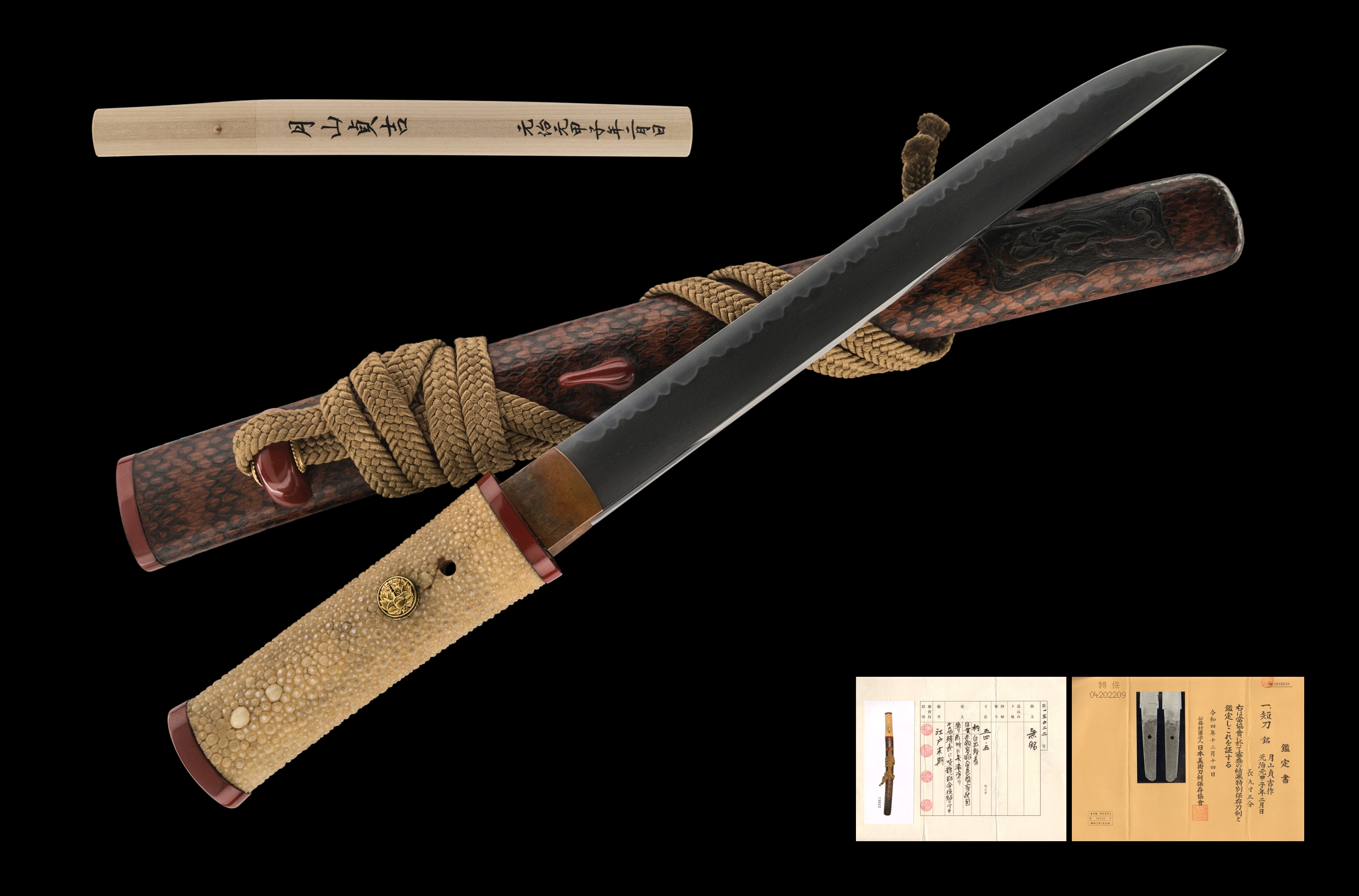
As written by the shop
Shinshinto · Settsu · around 1830-1863
Fujishiro Jo saku · Tōken Taikan top 49%
1 piece on the market now
Shinshinto · Settsu
28 pieces on the market now
| Smith | Era | Designated |
|---|---|---|
| Sadaharu貞晴 | 1865-1868 | 0 |
| Sadayoshi貞吉 | 1926-1989 | 0 |
| Yoshiaki吉明 | 1844-1848 | 0 |
| Naonobu直信 | 1854-1860 | 0 |
| Sadayoshi貞吉 | 1830-1863 | 0 |
Bakumatsu: the last war market
Perry’s arrival in 1853 unraveled the Tokugawa peace and created the first mass demand for working swords in two centuries. Kiyomaro, called the Masamune of Yotsuya, died on its eve; Munetsugu and Yukihide carried the boom to the end.
A Hozon-certified blade judged to show notably superior workmanship and a better state of preservation. The bar is higher: re-tempered blades and most unsigned Muromachi/Edo works are excluded.
The NBTHK (Nihon Bijutsu Tōken Hozon Kyōkai, the Society for the Preservation of Japanese Art Swords) is a public-interest incorporated foundation founded in 1948 and supervised by Japan’s Agency for Cultural Affairs (Bunkachō); it is based at the Japanese Sword Museum in Tokyo. Its expert panels physically examine each submitted work (shinsa) and issue a certificate (kanteishō) ranking it by artistic and historical merit. NBTHK papers are the most widely recognized standard of authentication for Japanese swords and fittings.
NBTHK official siteAll swords come with a three-day inspection period beginning from the date of delivery. If not satisfied, the sword may be returned within this period for a full refund of the purchase price. Outside of this period, all sales are final. Swords purchased on a layaway payment plan are not eligible for the three-day inspection period.