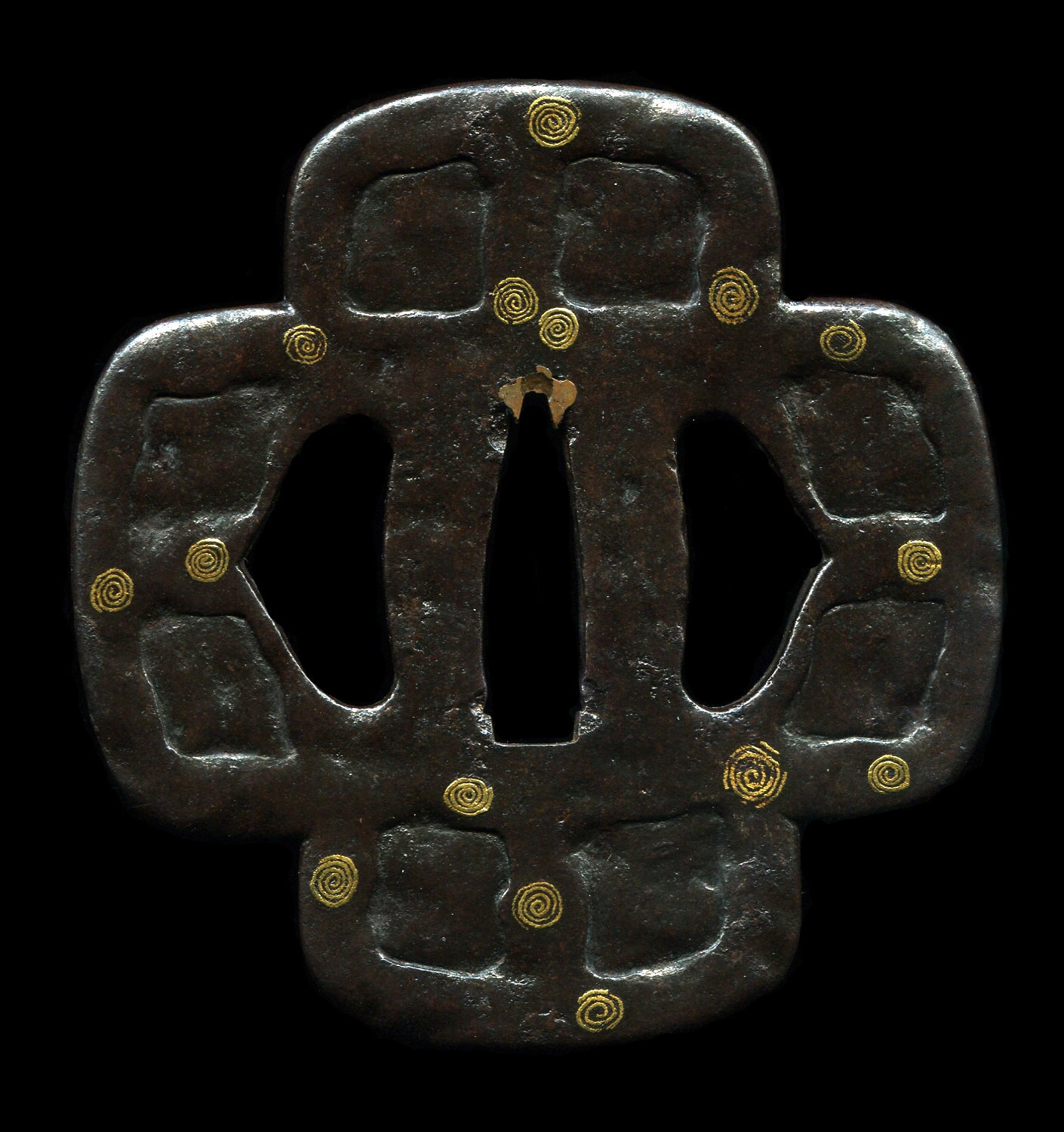
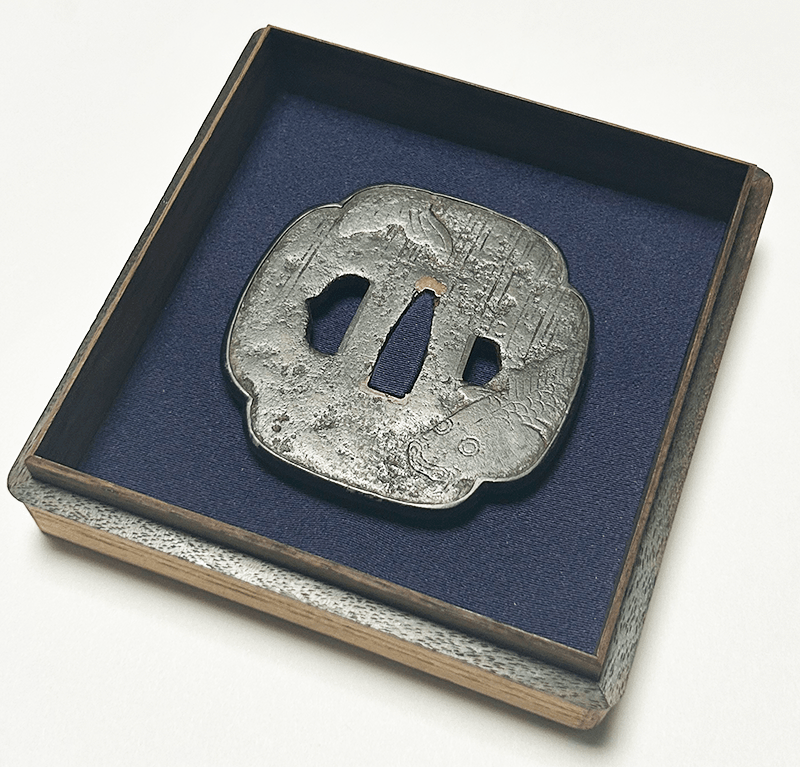
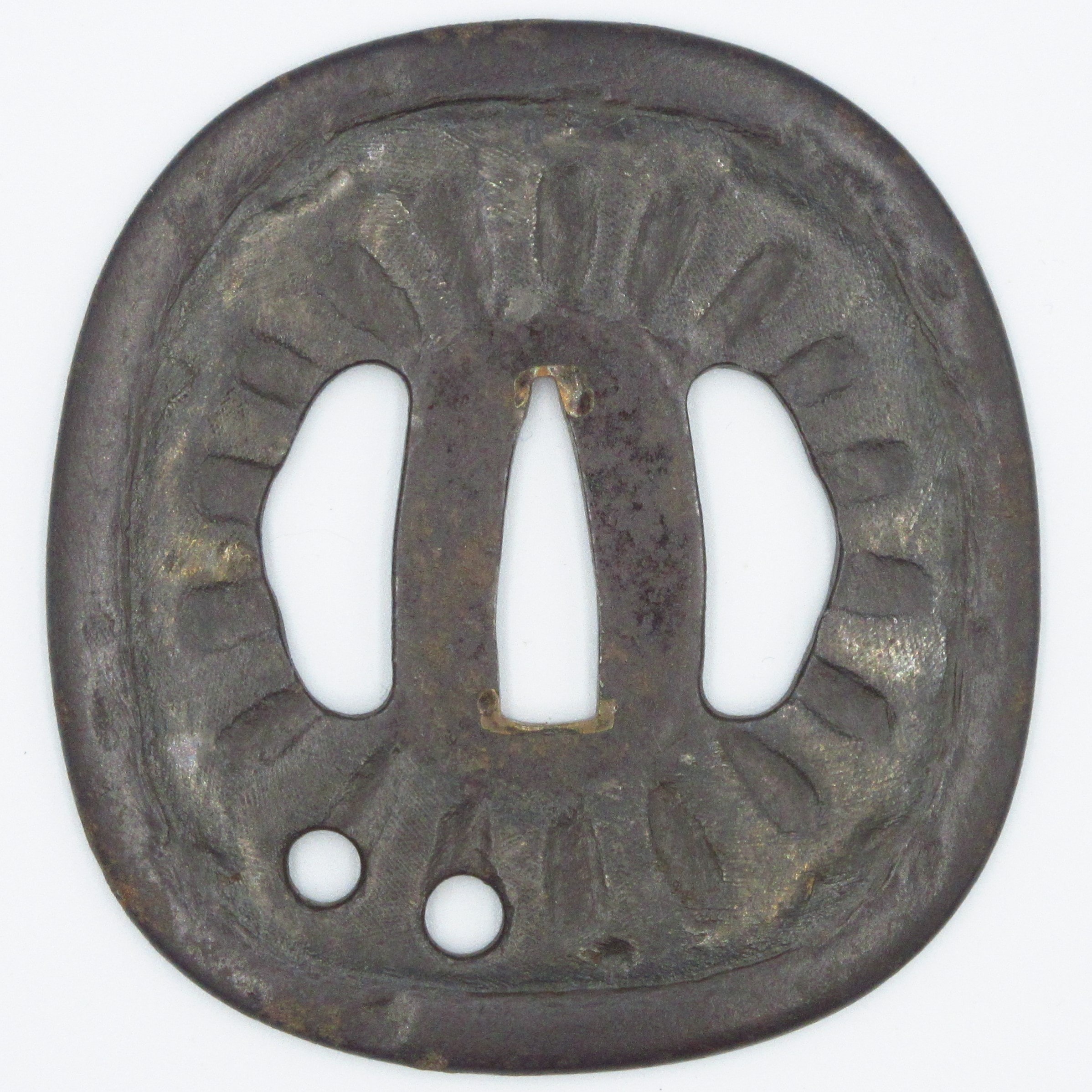
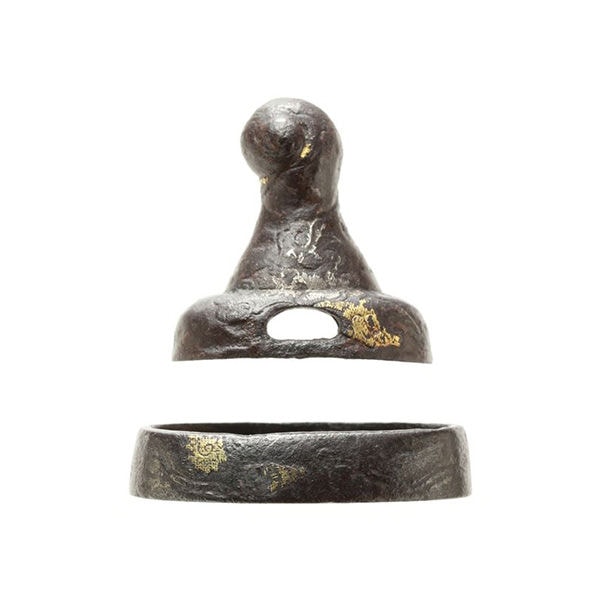
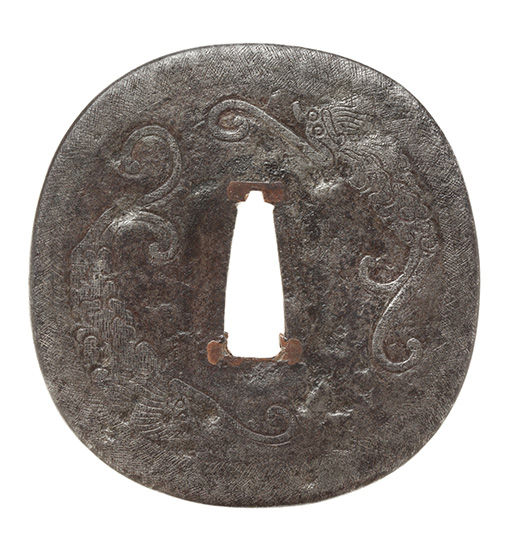
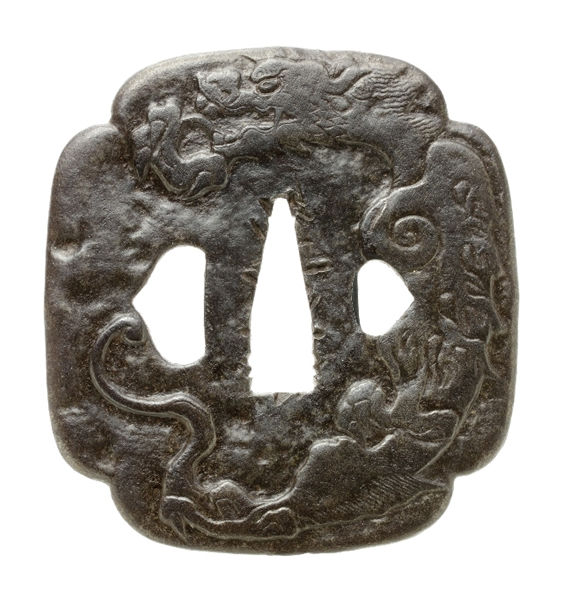
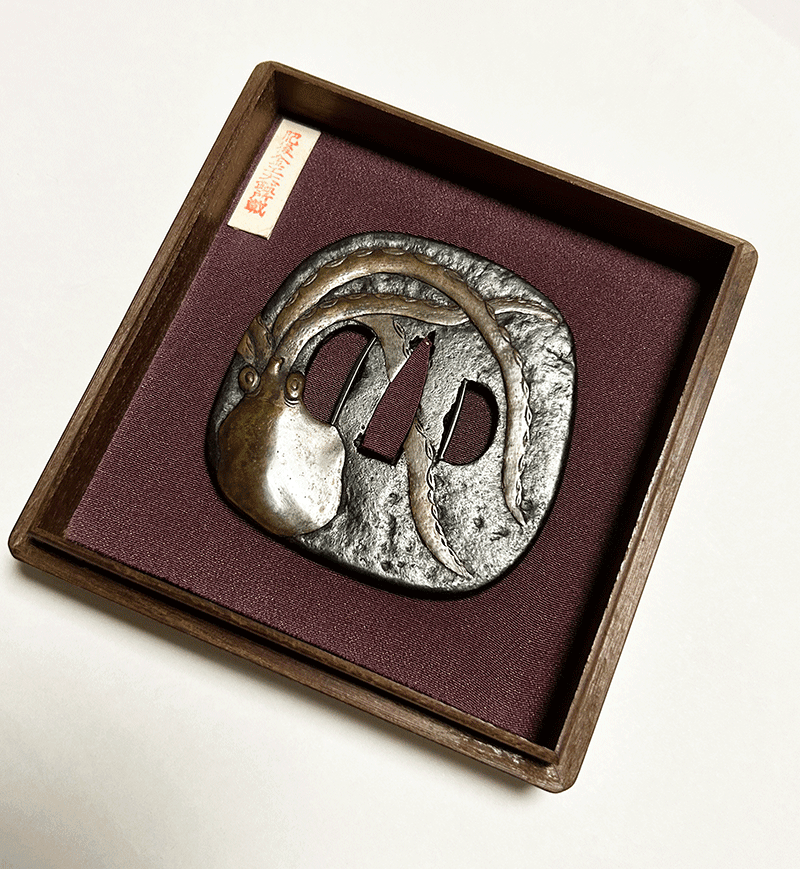
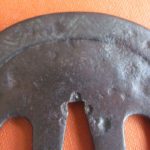
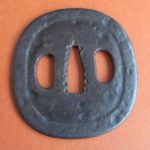
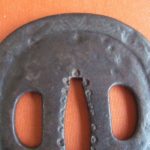
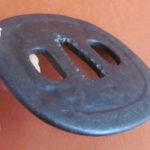
This is an iron tsuba with silver inlay, attributed to Nidai Jingo. It features a raised rim with silver nunome hira-zogan in an ayasugi pattern, with intentionally discontinuous and patinated silver. The plate is extensively hammer-worked and comes with both NTHK-NPO and NBTHK Hozon papers, and a fitted box.
 NihontoWatch

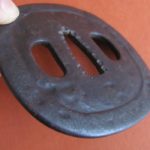
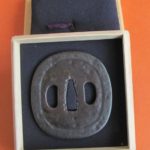
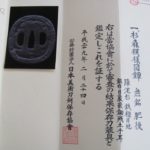
Jingo
Edo
Higo
Unsigned
Hozon (NBTHK)
Higo · Higo
2 pieces on the market now
Shimizu Jingo, also read Shimizu Jingo (志水甚五), was the founder of the Shimizu lineage, one of the four principal houses — alongside Hayashi, Hirata, and Nishigaki — that constitute the orthodox mainline of Higo metalwork. Said to have been a nephew of Hirata Hikozo, the first-generation Jingo entered the service of Hosokawa Sansai Tadaoki, the cultured daimyo renowned equally for military prowess and mastery of the tea ceremony as a leading disciple of Sen no Rikyu. When Hosokawa Tadatoshi was enfeoffed with 540,000 koku at Kumamoto following the dispossession of the Kato family in Kan'ei 9 (1632), Sansai retired to Yatsushiro Castle in Higo Province. Jingo accompanied Hirata Hikozo in following Sansai to Yatsushiro, where he established his workshop and began producing the distinctive guard forms that would define his school for generations. No signed works by the first generation are known; attribution rests on connoisseurship of his highly individual manner, and the Jingo line continued to prosper as a major Higo lineage well into the mid-Edo period.
Among Higo metalworkers, Jingo's technical manner exhibits the most intense individuality. His preferred medium was an iron plate finished in tsuchime-ji — a hammered ground augmented by a fired surface treatment known as yakite — upon which he executed large-scale pictorial compositions in brass suemon-zogan[[c:1]], a flush-inlay technique that he elevated to an art of exceptional boldness. His characteristic forms include the nadekaku-gata (rounded-square) and aori-gata (flared) silhouettes, and his decorative repertoire extended to sukidashi-takabori (raised relief carving), kebori (hairline engraving), silver nunome-zogan (cloth-pattern inlay), and occasional black lacquer coating. The hallmark of his compositional method lies in a deliberate asymmetry between obverse and reverse: on the front, he renders his subjects — raptors, owls, roosters, rain dragons, octopi — with commanding scale and forceful presence; on the reverse, he intentionally reserves broad expanses of open space, arranging motifs in diminished scale with subdued coloring and softer modeling. Though this contrast may at first appear unbalanced, it is precisely through this tension that Jingo achieves an overall harmony imbued with a profound sense of sabi, the quiet, austere beauty central to the Hosokawa aesthetic tradition.
Jingo's achievement stands apart within the Higo metalworking tradition as the fullest artistic expression of the shibumi — understated elegance — cultivated under Sansai's personal guidance. His pictorial approach, likely modeled on the inlay conventions of the Heianjo school yet far surpassing them in boldness and scale, introduced a painterly sensibility to iron guard-making[[c:2]] that remained without parallel. The owl perched in a pine, the eagle with talons clenched upon a branch, the rain dragon twisting across a hammered ground — these became iconic subjects inseparable from Jingo's name. Designation records consistently praise the extraordinary force of his artistic vision: a manner in which, to borrow the classical phrase invoked by the NBTHK, "great skill appears clumsy" — seemingly artless yet transcending ordinary expectation. His works fuse martial vigor with contemplative restraint, embodying the warrior-aesthete ideal that Sansai himself personified.
Where Jingo stands among comparable artisans: across all of nihontō, and within tradition, era, and period. The tiers (Foremost · Leading · Major · Notable) weigh official designations from the NBTHK and Japan's Agency for Cultural Affairs, together with historical honors of lasting repute such as the Sansaku and Meibutsu-chō.
Select a lens to see how it's measured.
Higo · Higo
26 pieces on the market now
The Shimizu school is one of the four mainline houses -- together with Hayashi, Hirata, and Nishigaki -- that represent the orthodox tradition of Higo kinko (肥後金工). Its founder, the first-generation Shimizu Jinbei, is traditionally said to have been a nephew of Hirata Hikozo, and to have studied under him. All four founding masters were retained by the great tea-master and warrior Hosokawa Sansai (Tadaoki) and received his direct guidance. In Kan'ei 9 (1632), following the dispossession of the Kato family, Sansai's son Tadatoshi was enfeoffed with 540,000 koku at Kumamoto; Sansai then withdrew to Yatsushiro Castle in the same province as his place of retirement. The first-generation Jingo accompanied Hikozo in following Sansai to Yatsushiro, where the Shimizu line would flourish through successive generations as retained metalworkers under Hosokawa patronage. From the second generation onward, the heads of the house took the professional name Jingo (甚五), which was "succeeded by multiple generations," though no signed works by the first or second generation are known. Among the Higo metalworkers, the Shimizu school stands out for what the NBTHK setsumei consistently describe as "the most intense individuality" (hitokirwa kyoretsu na kosei). The technical hallmark of the school is bold brass suemon-zogan (据紋象嵌, raised inlay) executed on iron plates finished in a hammered ground with a yakite (burnt-hammer) surface treatment.
On the obverse, subjects such as fierce birds of prey, roosters, owls (mimizuku), ameryu (rain dragons), octopi, and crabs are rendered on a large scale with powerful relief. In deliberate contrast, the reverse is composed with broad expanses of open space, the motifs placed in smaller scale with gentler coloration and more restrained modeling, thereby balancing the two sides and deepening a quiet, austere atmosphere of sabi (寂). This asymmetrical yet harmonious interplay of obverse animation and reverse stillness is the school's most recognizable compositional device, described in setsumei after setsumei as producing works that are "overall remarkably well-balanced" despite their apparent asymmetry. While brass suemon-zogan on iron constitutes the dominant mode -- an approach "probably modeled on Heianjō-style inlay, yet what distinguishes it from Heianjō work is the boldness of the designs" -- the school's repertoire also encompassed sukidashi-takabori (raised carving) enriched with gold and silver nunome-zogan, as well as works on suaka (plain copper) ground, proving that its masters could convey the same weighty profundity regardless of the base metal. The Shimizu school occupies a singular position within the Higo kinko tradition as its most unconventional and artistically forceful lineage. " His owl-on-pine and hawk-on-pine compositions are so closely identified with his name as to be "virtually synonymous" with it, and the NBTHK has described his finest works as possessing a quality whereby "great skill appears clumsy" (taiko wa setsu naru ga gotoshi): what looks artless is not artless, but rather the expression of a technique so consummate that it surpasses conventional craft. Among his signed works, the rare mei "Uokin Jingo"[[c:1]] attests to his artistic identity, while the school's later use of diverse materials -- silver nunome-zogan, kebori (hairline engraving), and colored metals -- demonstrates the lineage's evolving technical range. The distinctive pictorial quality of the Shimizu manner, with its daring compositions, striking contrast between dark iron and bright brass, and an "open, generous atmosphere not encountered in the work of other metalworkers," answers to a sensibility that the setsumei note "also appeals to a modern sensibility" -- a testament to the enduring vitality of this Higo school's artistic vision. Learn more →
| Smith | Era | Designated |
|---|---|---|
| Jingo甚五 | — | 14 |
| Nagatsugu永次 | 1691-1777 | 0 |
| Shigenaga茂永 | 1795-1854 | 0 |
| Jingo甚吾 | 1746-1823 | 0 |
| Jingo甚吾 | — | 0 |
Certifies a genuine blade worth preserving: a signature confirmed correct, or, if unsigned, an era, province, and school that the NBTHK can reliably identify.
The NBTHK (Nihon Bijutsu Tōken Hozon Kyōkai, the Society for the Preservation of Japanese Art Swords) is a public-interest incorporated foundation founded in 1948 and supervised by Japan’s Agency for Cultural Affairs (Bunkachō); it is based at the Japanese Sword Museum in Tokyo. Its expert panels physically examine each submitted work (shinsa) and issue a certificate (kanteishō) ranking it by artistic and historical merit. NBTHK papers are the most widely recognized standard of authentication for Japanese swords and fittings.
NBTHK official site3-day return window from receipt.
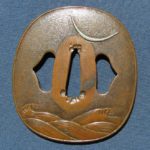
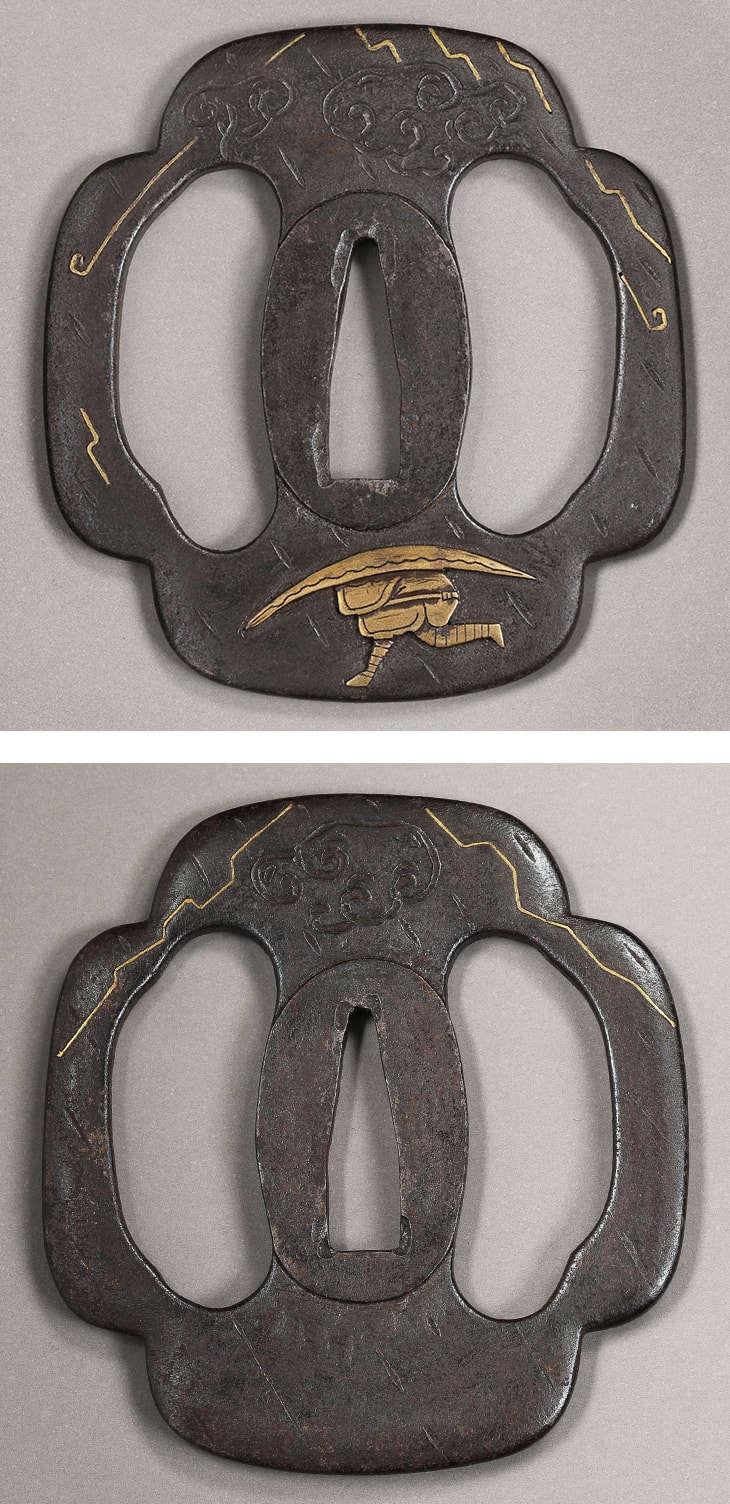
This is an iron tsuba with silver inlay, attributed to Nidai Jingo. It features a raised rim with silver nunome hira-zogan in an ayasugi pattern, with intentionally discontinuous and patinated silver. The plate is extensively hammer-worked and comes with both NTHK-NPO and NBTHK Hozon papers, and a fitted box.
NihontoWatchJingo
Edo
Higo
Unsigned
Hozon (NBTHK)
Higo · Higo
2 pieces on the market now
Shimizu Jingo, also read Shimizu Jingo (志水甚五), was the founder of the Shimizu lineage, one of the four principal houses — alongside Hayashi, Hirata, and Nishigaki — that constitute the orthodox mainline of Higo metalwork. Said to have been a nephew of Hirata Hikozo, the first-generation Jingo entered the service of Hosokawa Sansai Tadaoki, the cultured daimyo renowned equally for military prowess and mastery of the tea ceremony as a leading disciple of Sen no Rikyu. When Hosokawa Tadatoshi was enfeoffed with 540,000 koku at Kumamoto following the dispossession of the Kato family in Kan'ei 9 (1632), Sansai retired to Yatsushiro Castle in Higo Province. Jingo accompanied Hirata Hikozo in following Sansai to Yatsushiro, where he established his workshop and began producing the distinctive guard forms that would define his school for generations. No signed works by the first generation are known; attribution rests on connoisseurship of his highly individual manner, and the Jingo line continued to prosper as a major Higo lineage well into the mid-Edo period.
Among Higo metalworkers, Jingo's technical manner exhibits the most intense individuality. His preferred medium was an iron plate finished in tsuchime-ji — a hammered ground augmented by a fired surface treatment known as yakite — upon which he executed large-scale pictorial compositions in brass suemon-zogan[[c:1]], a flush-inlay technique that he elevated to an art of exceptional boldness. His characteristic forms include the nadekaku-gata (rounded-square) and aori-gata (flared) silhouettes, and his decorative repertoire extended to sukidashi-takabori (raised relief carving), kebori (hairline engraving), silver nunome-zogan (cloth-pattern inlay), and occasional black lacquer coating. The hallmark of his compositional method lies in a deliberate asymmetry between obverse and reverse: on the front, he renders his subjects — raptors, owls, roosters, rain dragons, octopi — with commanding scale and forceful presence; on the reverse, he intentionally reserves broad expanses of open space, arranging motifs in diminished scale with subdued coloring and softer modeling. Though this contrast may at first appear unbalanced, it is precisely through this tension that Jingo achieves an overall harmony imbued with a profound sense of sabi, the quiet, austere beauty central to the Hosokawa aesthetic tradition.
Jingo's achievement stands apart within the Higo metalworking tradition as the fullest artistic expression of the shibumi — understated elegance — cultivated under Sansai's personal guidance. His pictorial approach, likely modeled on the inlay conventions of the Heianjo school yet far surpassing them in boldness and scale, introduced a painterly sensibility to iron guard-making[[c:2]] that remained without parallel. The owl perched in a pine, the eagle with talons clenched upon a branch, the rain dragon twisting across a hammered ground — these became iconic subjects inseparable from Jingo's name. Designation records consistently praise the extraordinary force of his artistic vision: a manner in which, to borrow the classical phrase invoked by the NBTHK, "great skill appears clumsy" — seemingly artless yet transcending ordinary expectation. His works fuse martial vigor with contemplative restraint, embodying the warrior-aesthete ideal that Sansai himself personified.
Where Jingo stands among comparable artisans: across all of nihontō, and within tradition, era, and period. The tiers (Foremost · Leading · Major · Notable) weigh official designations from the NBTHK and Japan's Agency for Cultural Affairs, together with historical honors of lasting repute such as the Sansaku and Meibutsu-chō.
Select a lens to see how it's measured.
Higo · Higo
26 pieces on the market now
The Shimizu school is one of the four mainline houses -- together with Hayashi, Hirata, and Nishigaki -- that represent the orthodox tradition of Higo kinko (肥後金工). Its founder, the first-generation Shimizu Jinbei, is traditionally said to have been a nephew of Hirata Hikozo, and to have studied under him. All four founding masters were retained by the great tea-master and warrior Hosokawa Sansai (Tadaoki) and received his direct guidance. In Kan'ei 9 (1632), following the dispossession of the Kato family, Sansai's son Tadatoshi was enfeoffed with 540,000 koku at Kumamoto; Sansai then withdrew to Yatsushiro Castle in the same province as his place of retirement. The first-generation Jingo accompanied Hikozo in following Sansai to Yatsushiro, where the Shimizu line would flourish through successive generations as retained metalworkers under Hosokawa patronage. From the second generation onward, the heads of the house took the professional name Jingo (甚五), which was "succeeded by multiple generations," though no signed works by the first or second generation are known. Among the Higo metalworkers, the Shimizu school stands out for what the NBTHK setsumei consistently describe as "the most intense individuality" (hitokirwa kyoretsu na kosei). The technical hallmark of the school is bold brass suemon-zogan (据紋象嵌, raised inlay) executed on iron plates finished in a hammered ground with a yakite (burnt-hammer) surface treatment.
On the obverse, subjects such as fierce birds of prey, roosters, owls (mimizuku), ameryu (rain dragons), octopi, and crabs are rendered on a large scale with powerful relief. In deliberate contrast, the reverse is composed with broad expanses of open space, the motifs placed in smaller scale with gentler coloration and more restrained modeling, thereby balancing the two sides and deepening a quiet, austere atmosphere of sabi (寂). This asymmetrical yet harmonious interplay of obverse animation and reverse stillness is the school's most recognizable compositional device, described in setsumei after setsumei as producing works that are "overall remarkably well-balanced" despite their apparent asymmetry. While brass suemon-zogan on iron constitutes the dominant mode -- an approach "probably modeled on Heianjō-style inlay, yet what distinguishes it from Heianjō work is the boldness of the designs" -- the school's repertoire also encompassed sukidashi-takabori (raised carving) enriched with gold and silver nunome-zogan, as well as works on suaka (plain copper) ground, proving that its masters could convey the same weighty profundity regardless of the base metal. The Shimizu school occupies a singular position within the Higo kinko tradition as its most unconventional and artistically forceful lineage. " His owl-on-pine and hawk-on-pine compositions are so closely identified with his name as to be "virtually synonymous" with it, and the NBTHK has described his finest works as possessing a quality whereby "great skill appears clumsy" (taiko wa setsu naru ga gotoshi): what looks artless is not artless, but rather the expression of a technique so consummate that it surpasses conventional craft. Among his signed works, the rare mei "Uokin Jingo"[[c:1]] attests to his artistic identity, while the school's later use of diverse materials -- silver nunome-zogan, kebori (hairline engraving), and colored metals -- demonstrates the lineage's evolving technical range. The distinctive pictorial quality of the Shimizu manner, with its daring compositions, striking contrast between dark iron and bright brass, and an "open, generous atmosphere not encountered in the work of other metalworkers," answers to a sensibility that the setsumei note "also appeals to a modern sensibility" -- a testament to the enduring vitality of this Higo school's artistic vision. Learn more →
| Smith | Era | Designated |
|---|---|---|
| Jingo甚五 | — | 14 |
| Nagatsugu永次 | 1691-1777 | 0 |
| Shigenaga茂永 | 1795-1854 | 0 |
| Jingo甚吾 | 1746-1823 | 0 |
| Jingo甚吾 | — | 0 |
Certifies a genuine blade worth preserving: a signature confirmed correct, or, if unsigned, an era, province, and school that the NBTHK can reliably identify.
The NBTHK (Nihon Bijutsu Tōken Hozon Kyōkai, the Society for the Preservation of Japanese Art Swords) is a public-interest incorporated foundation founded in 1948 and supervised by Japan’s Agency for Cultural Affairs (Bunkachō); it is based at the Japanese Sword Museum in Tokyo. Its expert panels physically examine each submitted work (shinsa) and issue a certificate (kanteishō) ranking it by artistic and historical merit. NBTHK papers are the most widely recognized standard of authentication for Japanese swords and fittings.
NBTHK official site3-day return window from receipt.