 NihontoWatchNihontoWatch
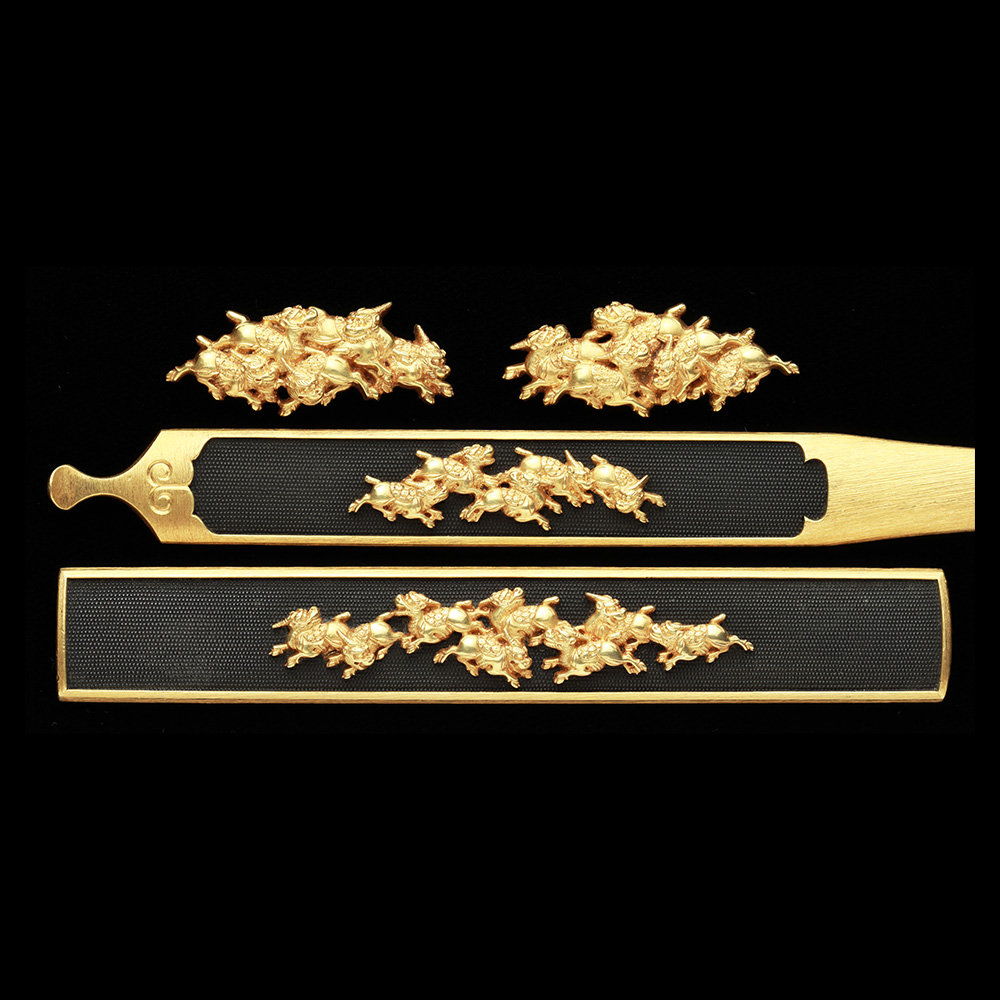
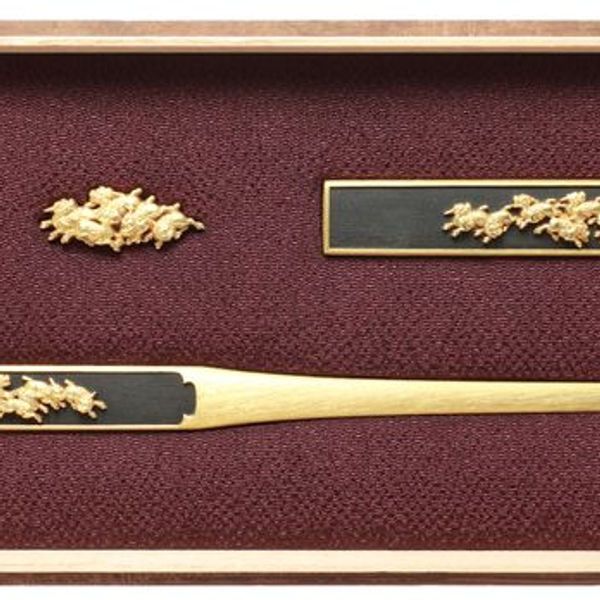
後藤宗家四代光乗作、群犀図の三所物。描かれているのは水犀(通天犀とも)という想像上の瑞獣。「体は馬、四肢と尾は牛、背には亀の甲羅を持ち、額には大きく鋭い一本角を生やす」と描写されている。龍や獅子、鳳凰や麒麟ほど周知されてはいないが、日光東照宮の霊獣、瑞獣の彫刻にも水犀が見られる。一説には火伏の役割があるといわれている。「鳥獣人物戯画」制作以前に渡来した正倉院御物、「平螺鈿背円鏡」には獅子と共に私たちがよく知っている姿に近いサイ(おそらく二本角のスマトラサイであろう)が螺鈿細工で描かれている。また、今から三千年以上前の中国商代晩期に制作された青銅器の酒杯、「小臣艅犀尊」にも二本角で体毛のあるスマトラサイが写実的に表現されている。この時代には中国南部にもまだサイが生息していたのである。水犀のモデルはスマトラサイだったのであろうか。この金無垢地容彫陰陽根の目貫は光乗らしい引き締まった造形で、掌にすればずっしりと重い。表目貫、裏目貫にそれぞれ五頭、笄にも五頭、小柄には八頭、計二十三頭の水犀が互いに目を見交わし、跳ねるように躍るように駆けている。初代祐乗に次ぐ上手といわれる四代光乗の見事な三所物に十四代桂乗光守が代七百貫という高額な値を付けて折紙を発行している。代付をして折り紙を発行するという行為は刀剣鑑定の本阿弥家と装剣小道具の後藤家しかなかった。織田信長に仕え世界最大の金貨である大判を造り、激動の時代に才能を発揮した光乗。その光乗の手になる瑞獣水犀の稀有な三所物である。
NihontoWatchOffered by Choshuya
This piece has sold
Get an email when a new Goto Mitsutaka piece hits the market.

Goto Mitsutaka
Momoyama
Yamashiro
Signed
As written by the shop
Iebori · Nagato · around 1588
1 piece on the market now
Iebori · Yamashiro
317 pieces on the market now
The Goto house stands as the preeminent dynasty of sword-fitting makers in the history of Japanese metalwork, an unbroken lineage of seventeen generations spanning from the founding master Yujo (1440--1512), who served Ashikaga Yoshimasa amid the refined culture of Higashiyama, through the final head Hojo (1816--1856) in the closing years of the Tokugawa shogunate. From its inception the house served successive rulers -- Ashikaga shoguns, Oda Nobunaga, Toyotomi Hideyoshi, and the Tokugawa -- and its productions became known as iebori, the "house carving" distinguished from machibori made for ordinary public demand. The fourth master Kojo first introduced warrior subjects and employed preparatory drawings by Kano Motonobu and Eitoku; the fifth master Tokujo struck the celebrated "Tokujo kiri" hallmark upon oban gold coinage for Hideyoshi; the third master Joshin -- "not only a metalworker but also a warrior" -- was killed in battle against the Azai clan in 1562. The seventh master Kenjo, praised since ancient times as a restorer of the house's fortunes (the finest exponents being termed Yuko-ken), traveled to Kaga and laid the foundations for the later flourishing of the Kaga-Goto tradition, while the tenth master Renjo carried the mainline from Kyoto to Edo, where it would remain through the seventeenth generation. The eleventh master Tsujo bridged the formal tradition with the expressive spirit of the Genroku era, and the thirteenth master Enjo served as an authoritative appraiser, authenticating works by earlier masters across the entire succession. The collective technical vocabulary of the Goto house is built upon shakudo nanako-ji grounds of extraordinarily minute and dense stippling, upon which motifs are rendered in takabori with kin-iroe and gin-iroe, frequently supplemented by solid gold (kinmuku) construction and kin'ura gilt backing. The sculptural manner is characterized by what the NBTHK repeatedly describes as "high mountains and deep valleys" -- a modulation of volume in which modeling rises emphatically while recesses are cut deep and clean, producing forceful and crisply articulated relief.
" Sojo inherited and tightened these forms with controlled elegance; Joshin amplified them to conspicuously larger scale with claws that are "characteristically large and long, with the tips splayed open"; Eijo brought a finer, more delicate precision to compositions of equally grand ambition; and Kenjo introduced a distinctive shosha quality -- austere and urbane -- that distinguished his work from the first six generations. The later masters sustained this discipline: Teijo's calm restraint and distinctive coloristic effects, Renjo's forty-five years of deeply worked takabori capturing instantaneous warrior movements, Tsujo's innovative left-right spreading compositions, and Hojo's reintroduction of machibori aesthetics into the official house style all demonstrate the lineage's capacity for renewal within tradition. The Goto house's enduring significance resides not merely in the technical excellence of individual masters but in the institutional continuity of a critical tradition sustained across four centuries. Works from the "upper six generations" (kami roku-dai) through Eijo established the canonical repertoire of prescribed okitemono motifs -- dragons, lions, paulownia crests, Kurikara, and auspicious figures -- while successive heads served simultaneously as makers and authenticators, issuing origami certificates and kiwame-mei inscriptions that themselves constitute important documents of connoisseurship. Valuations reaching one thousand kan and transmission through such distinguished collections as the Konoike, Shimazu, Tokugawa, and Maeda houses attest to the unrivaled esteem in which Goto metalwork has been held. Even Sokujo, whose tenure lasted barely four years before his death at thirty-two, left a small but distinguished body of work authenticated across eight subsequent generations of headmasters. From Yujo's founding vision through Hojo's final flowering -- whose technical command the NBTHK judges the finest from the twelfth master onward, betraying "not the slightest hint of the approaching conclusion" of the unbroken line -- the Goto house represents the defining standard against which all Japanese metalwork is measured, the wellspring from which the entire sokeN kinkO tradition flows. Learn more →
| Smith | Era | Designated |
|---|---|---|
| Goto Joshin後藤乗真 | 1512-1562 | 68 |
| Goto Yujo後藤祐乗 | 1440-1512 | 41 |
| Goto Kenjo後藤顕乗 | 1586-1663 | 46 |
| Goto Sojo後藤宗乗 | 1461-1538 | 56 |
| Goto Teijo後藤程乗 | 1603-1673 | 42 |
If, due to our fault, the item differs significantly from its proper condition, the item may be returned. Cooling-off is within one week of the item's arrival.