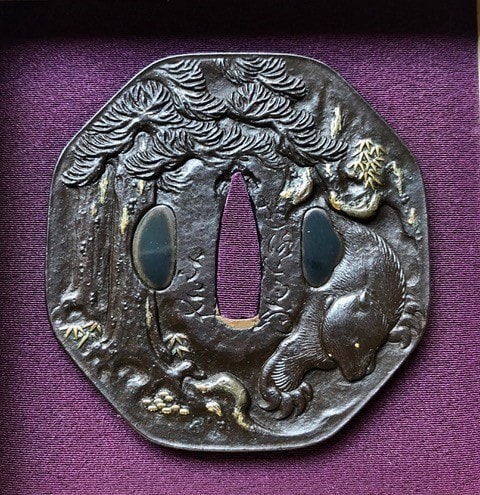
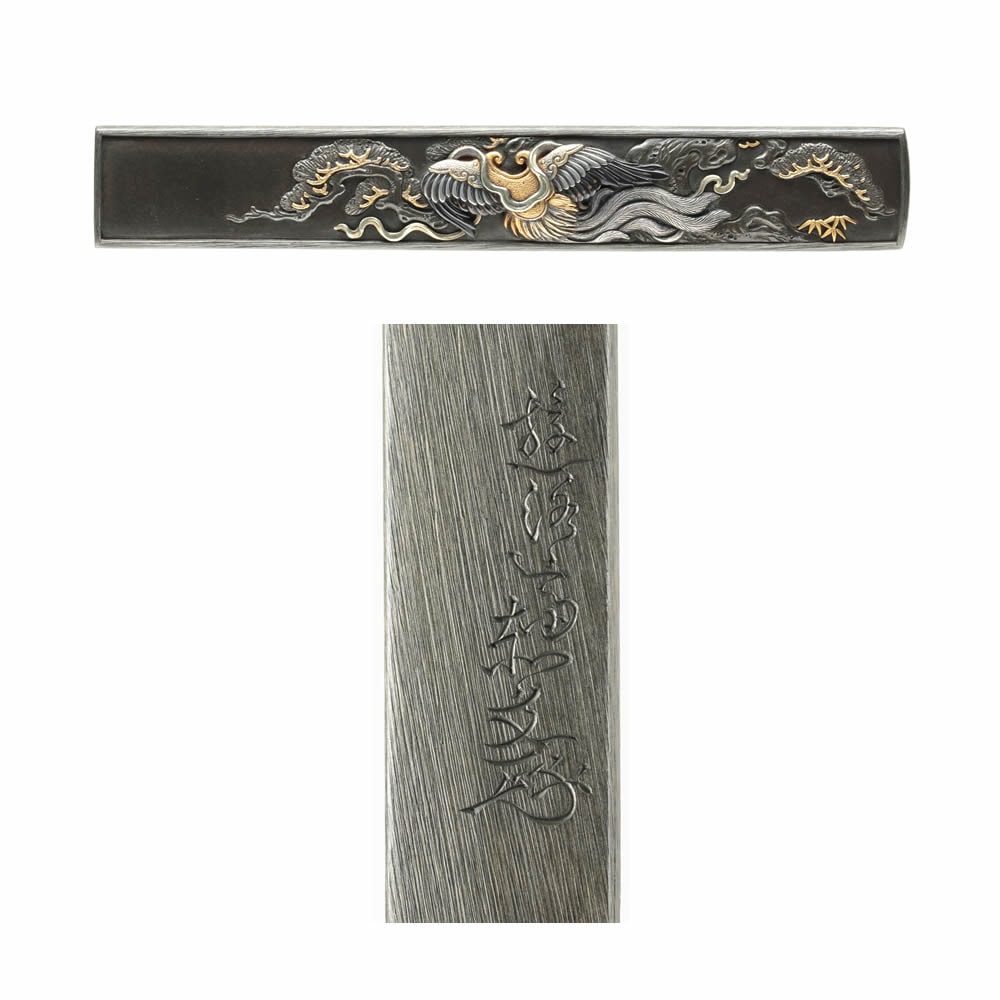
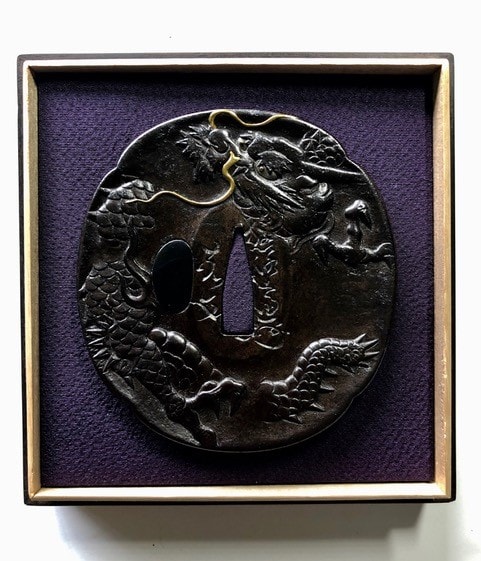
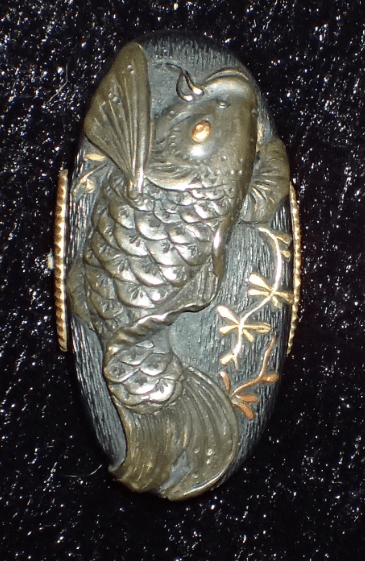
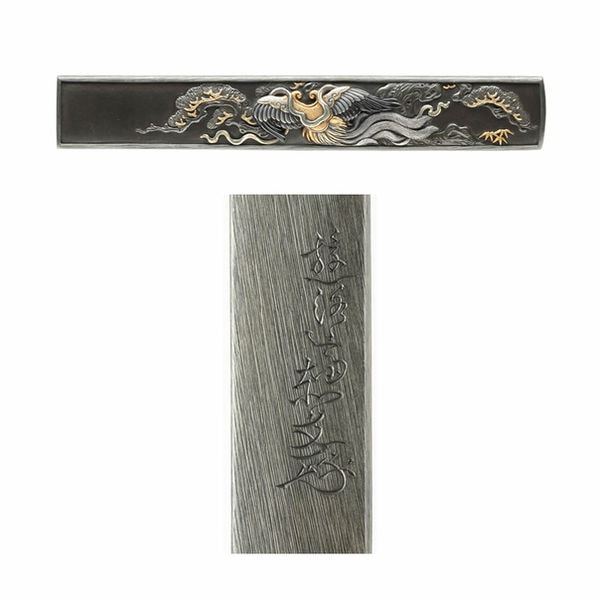
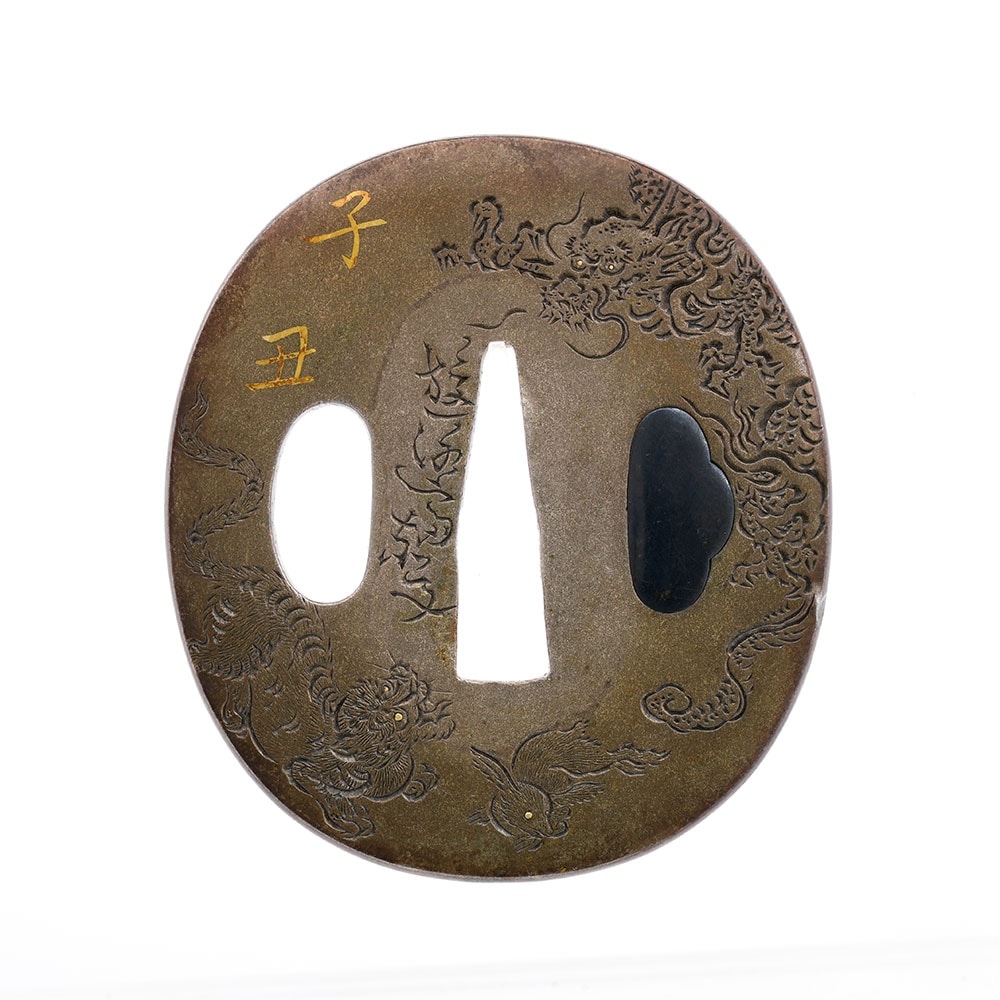
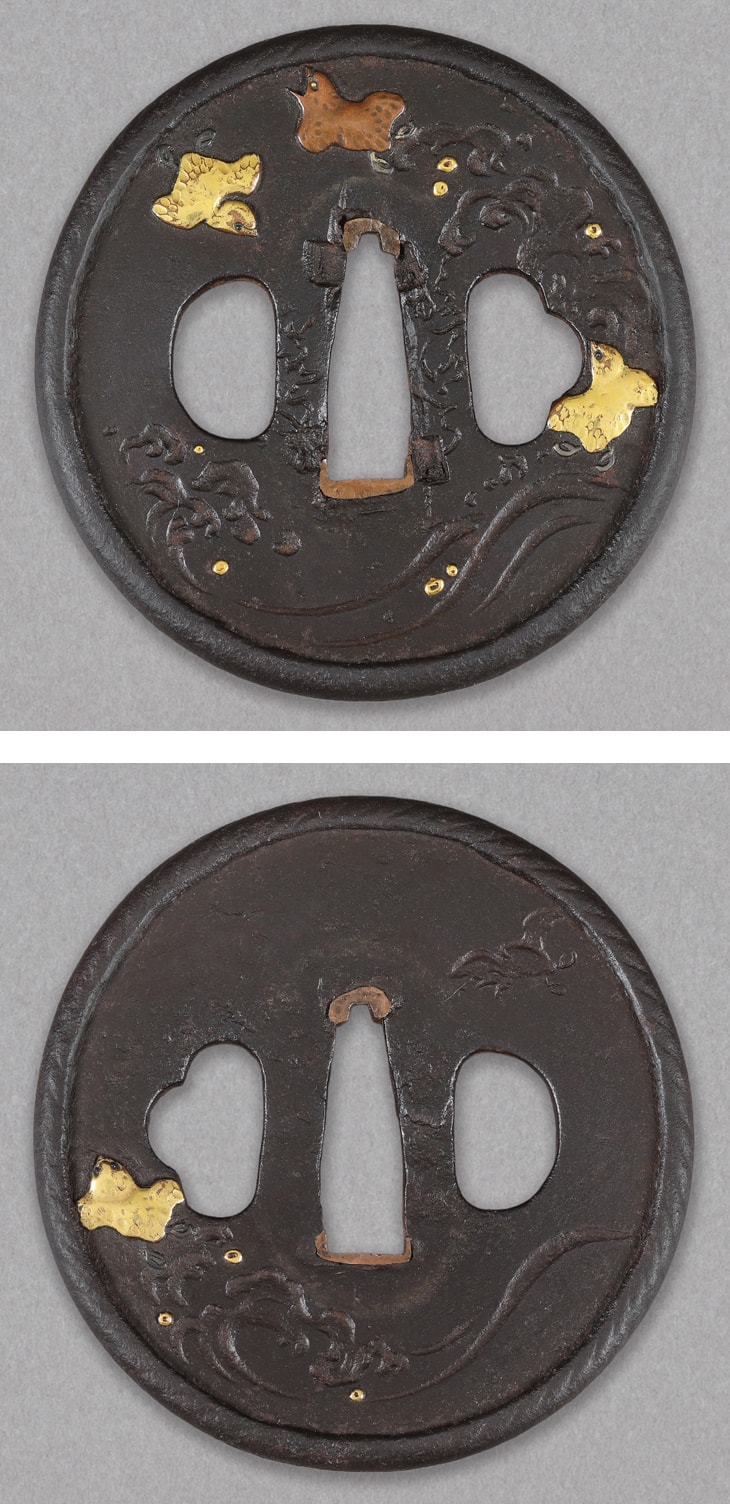
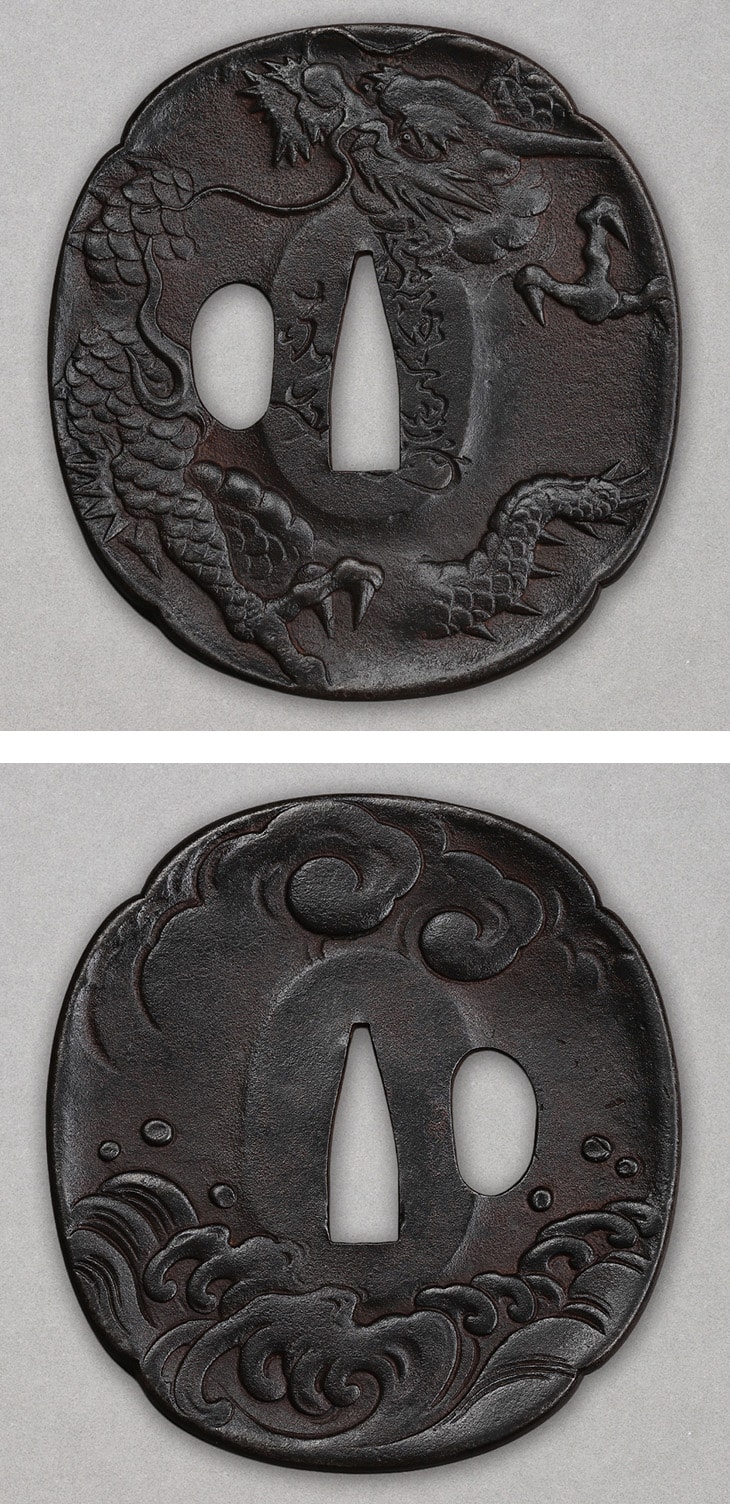
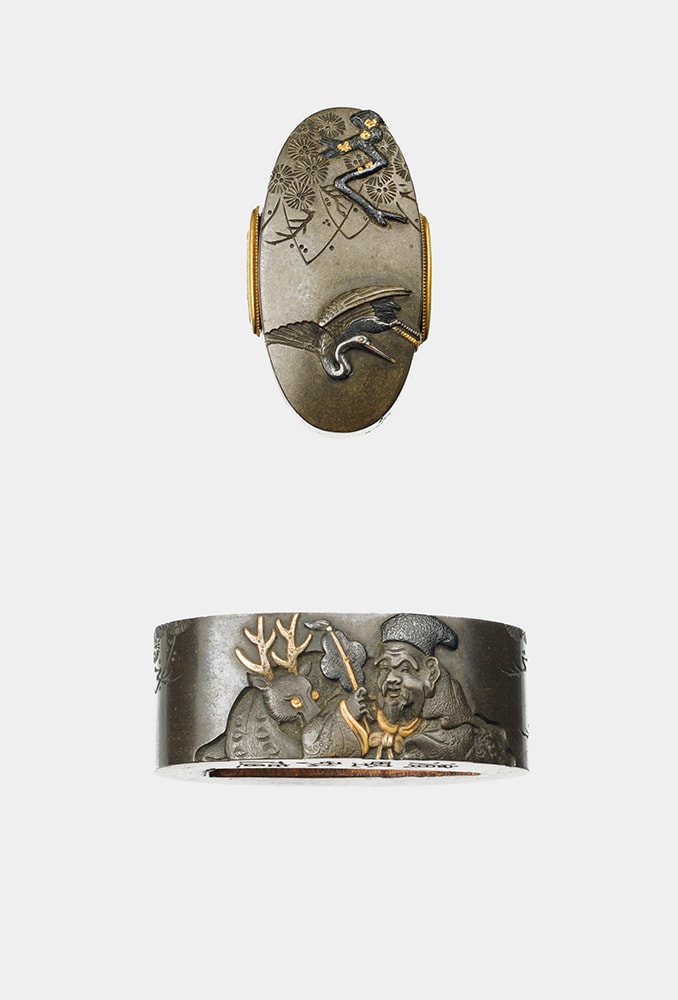
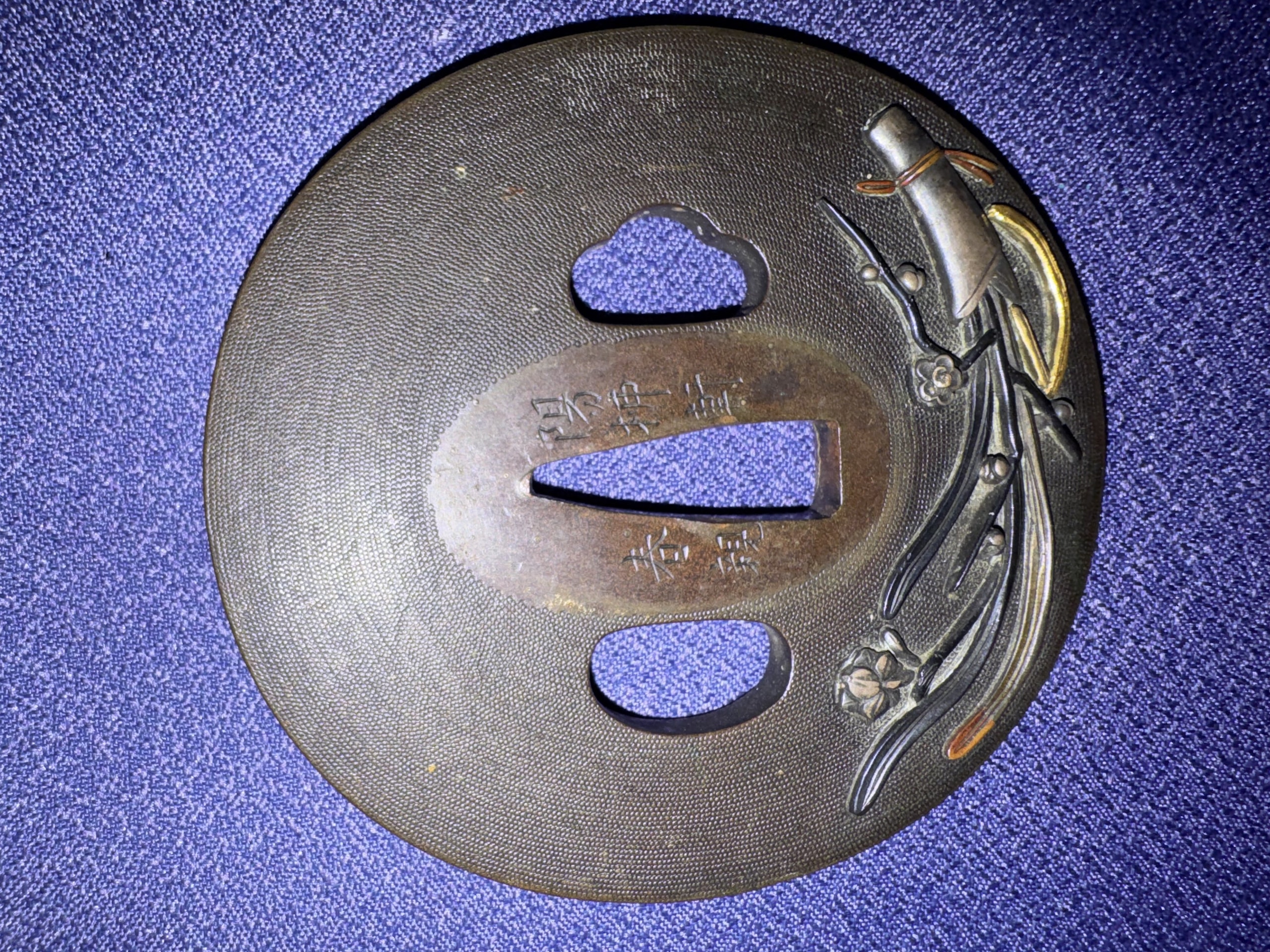
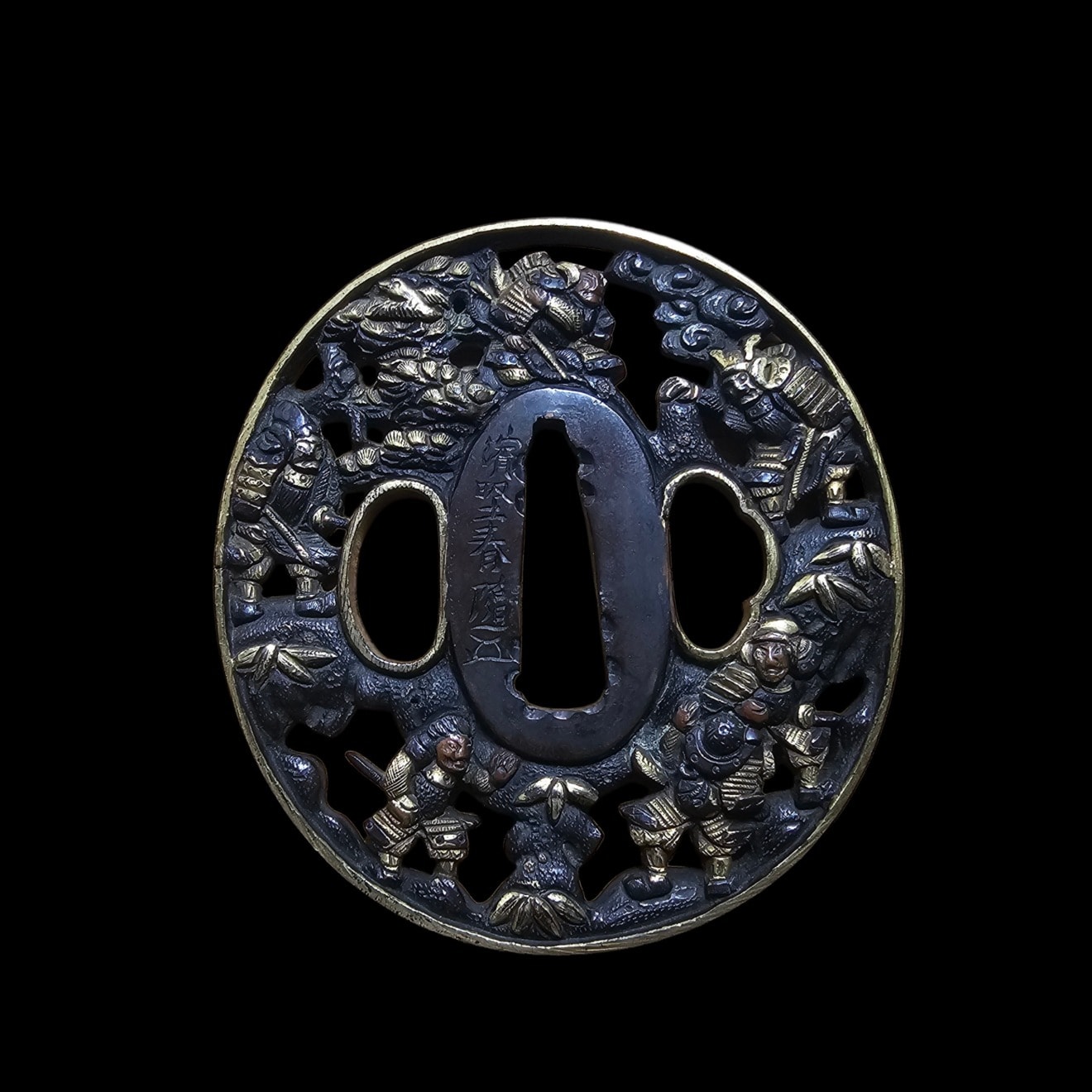
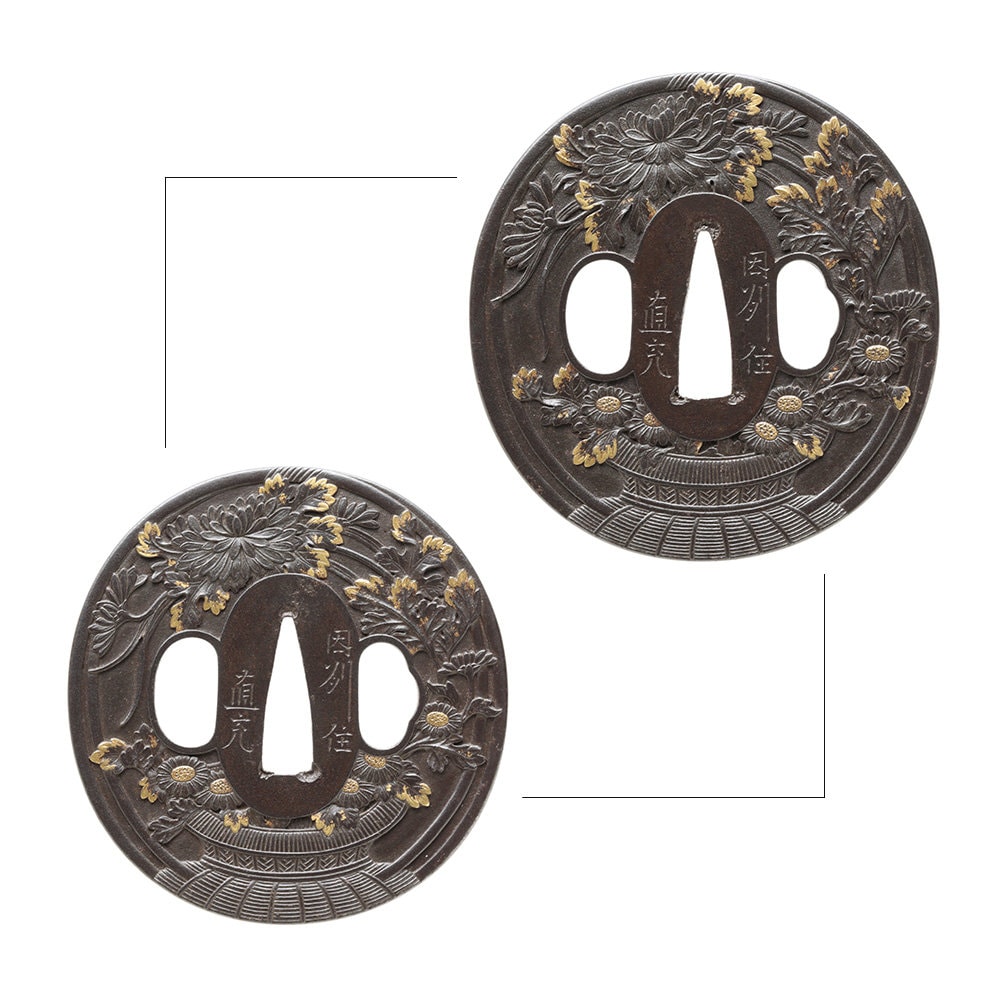
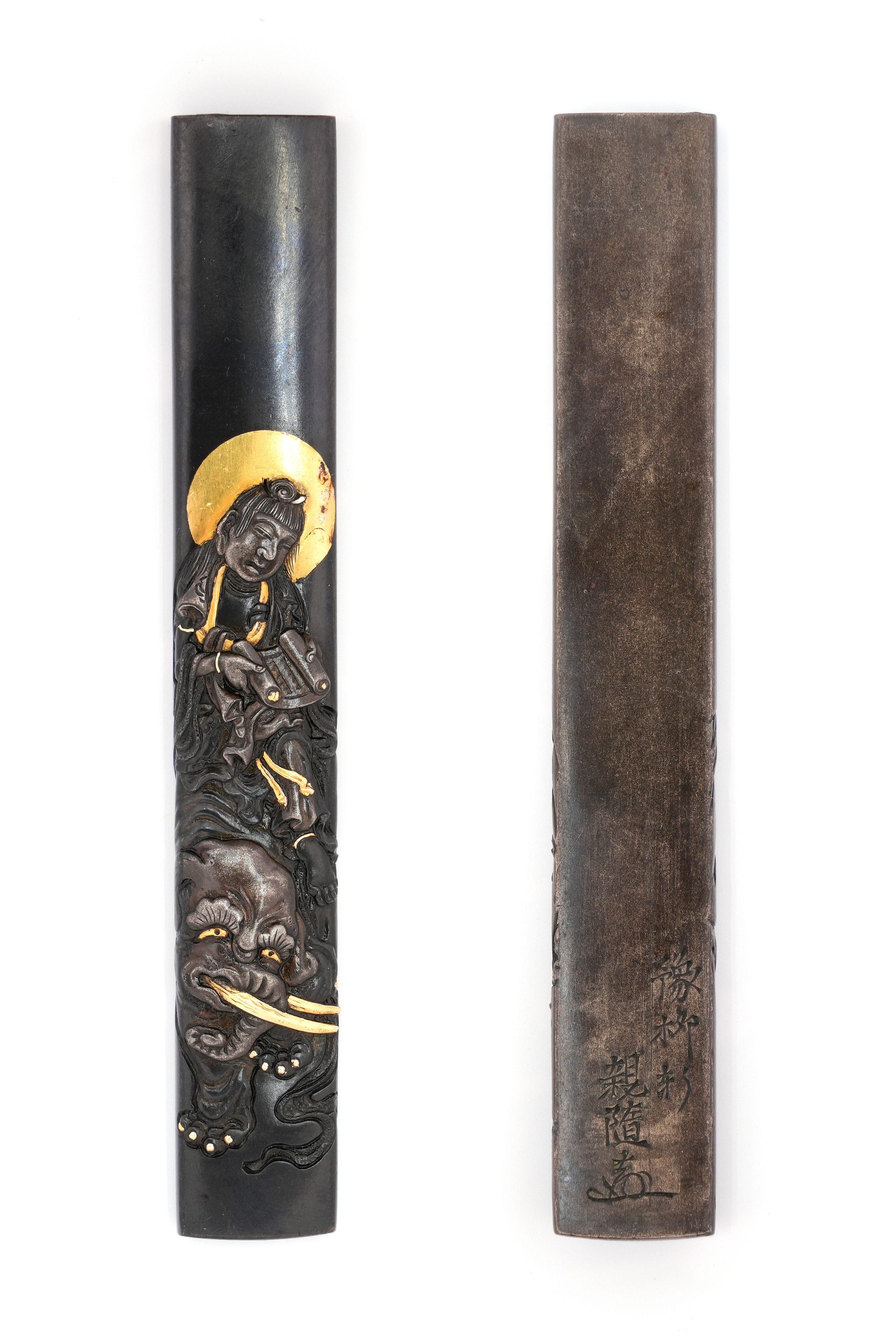
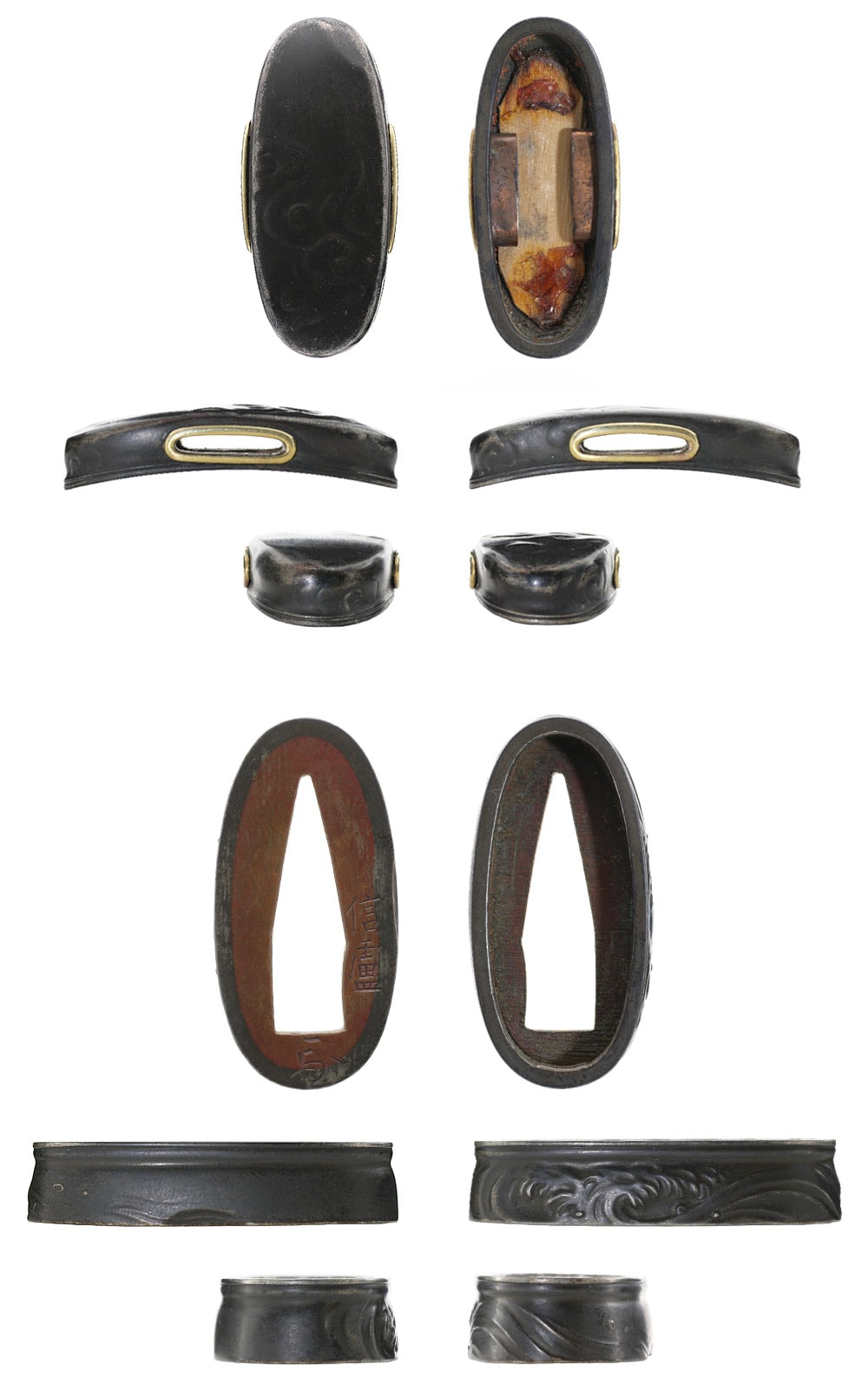
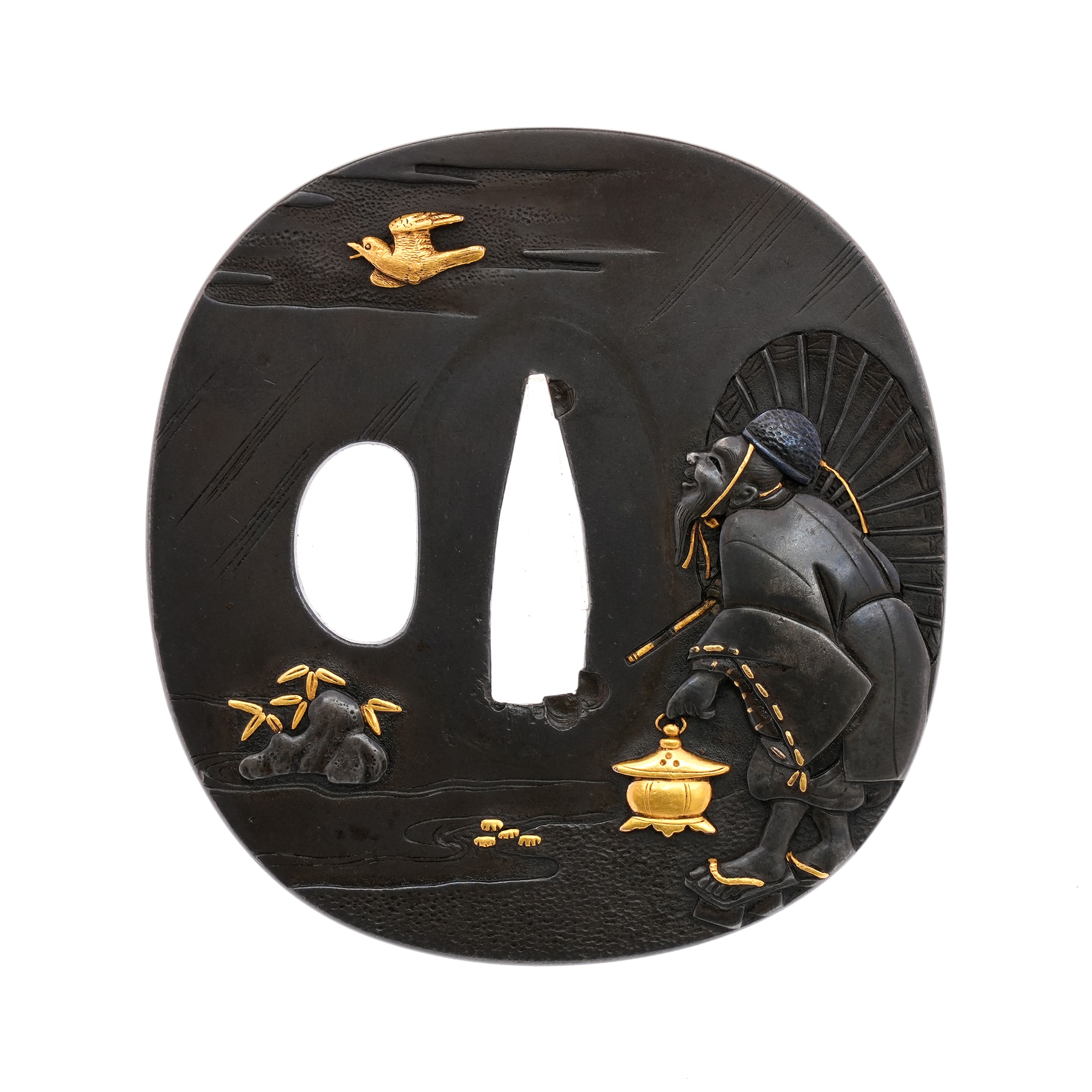
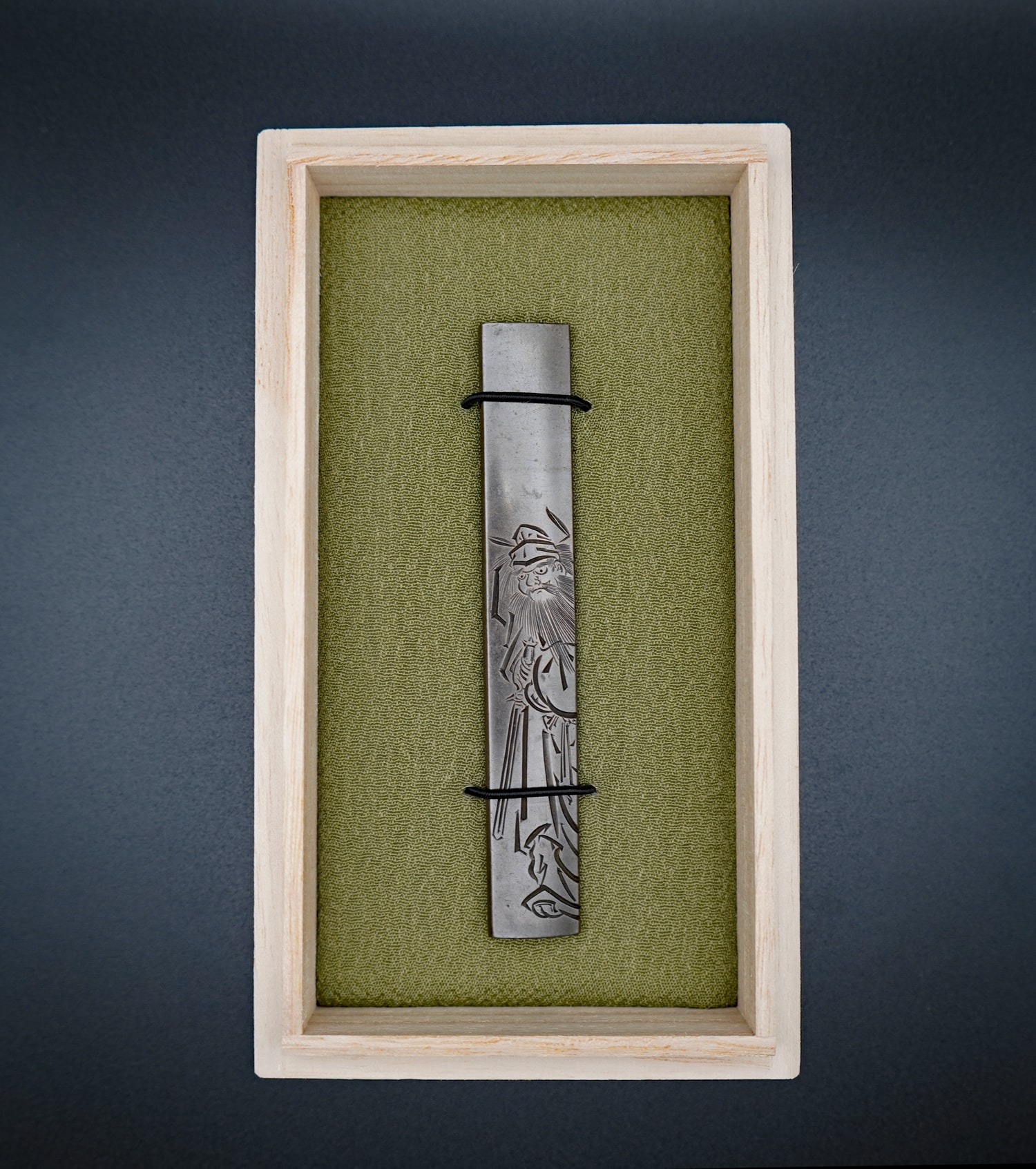
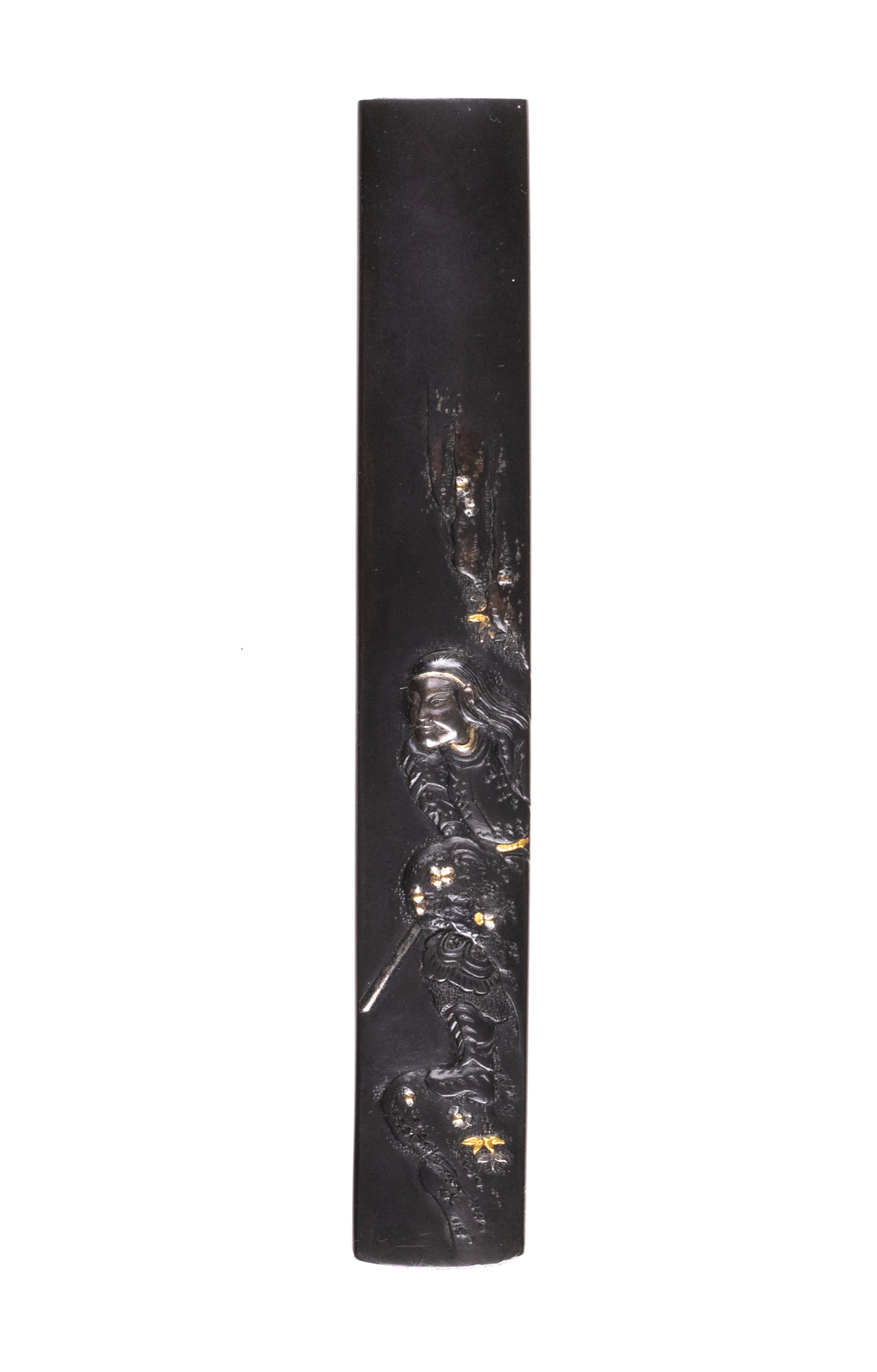
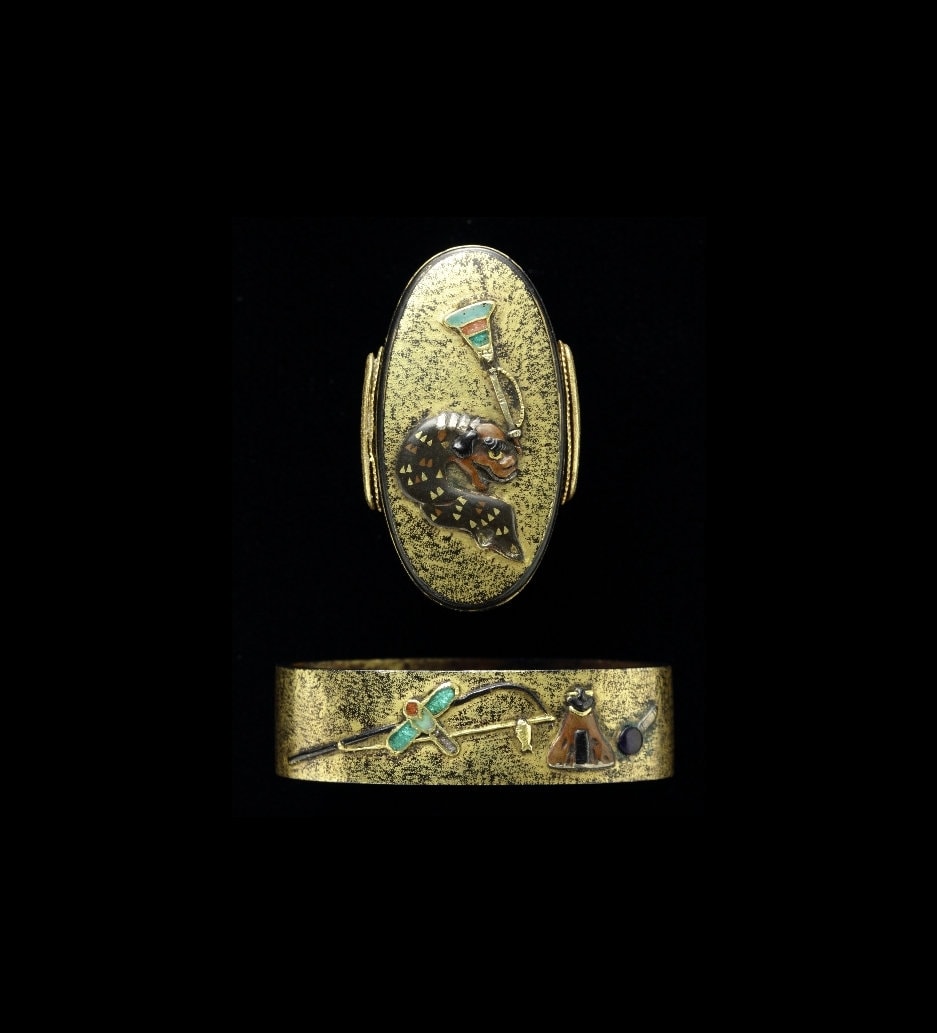
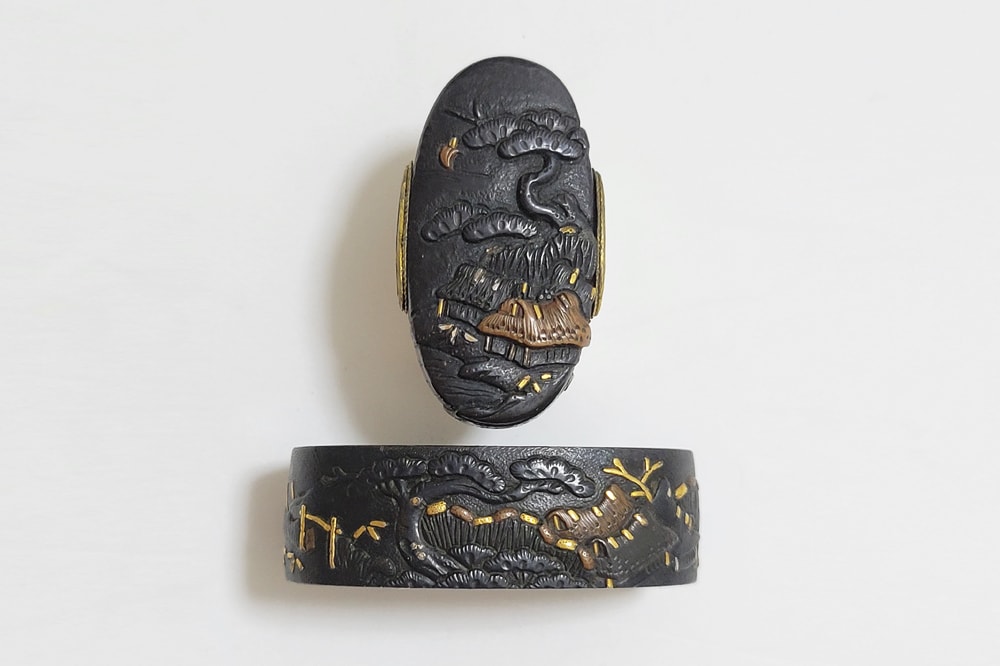
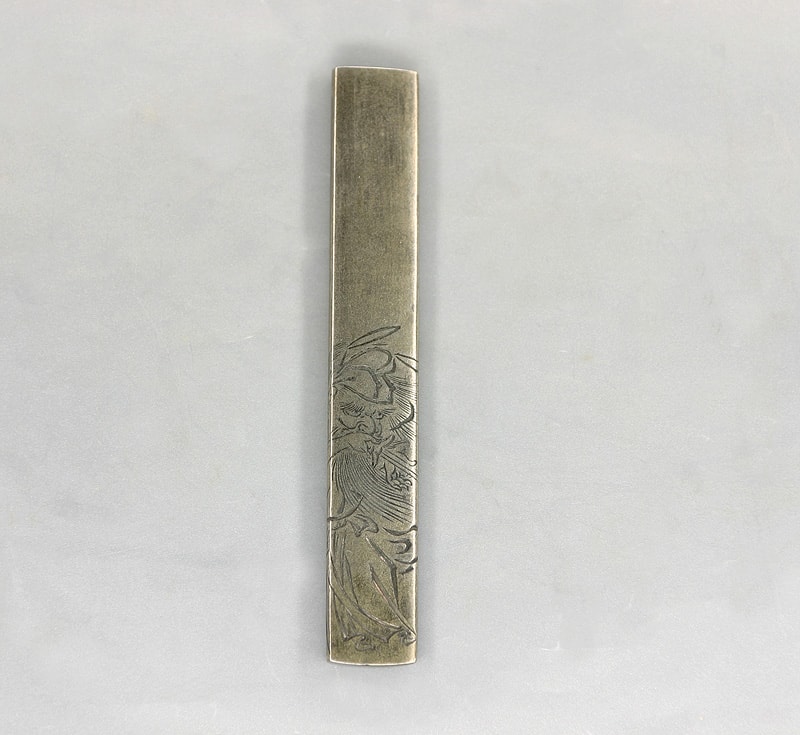
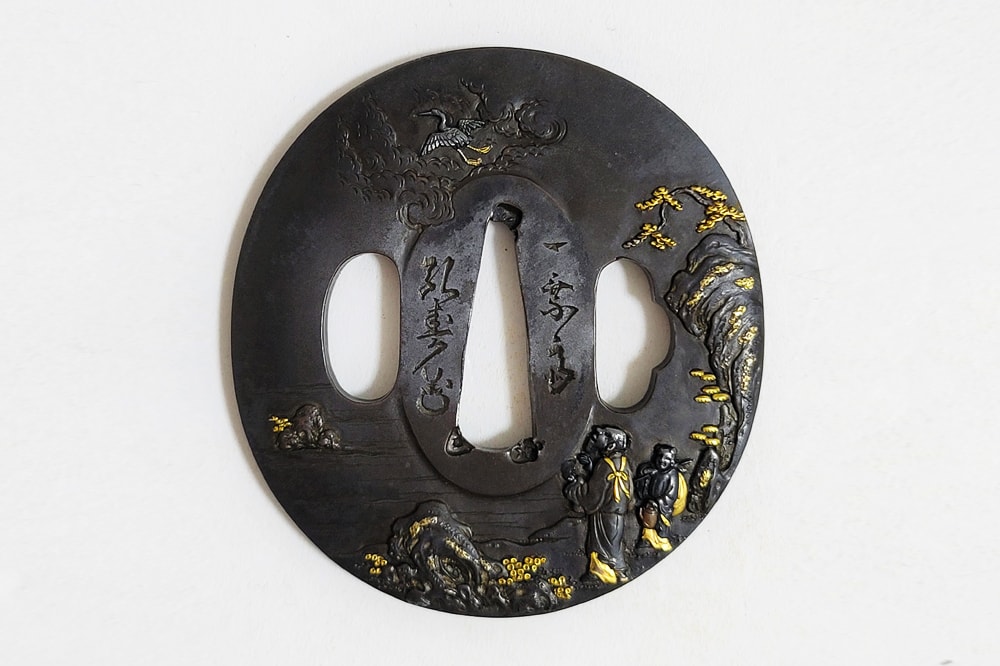
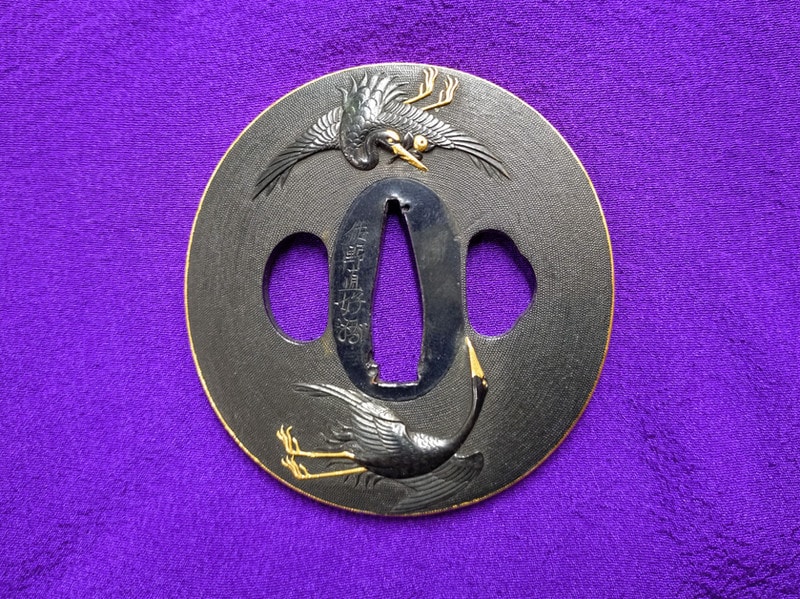
This is a tsuba featuring a gansho (雁書) design, made by Yurakusai Sekibun in the Late Edo period. The tsuba depicts a scene based on the ancient Chinese legend of the wild goose carrying letters. The artist, Katsurano Sekibun, was born in Echigo province and studied under the Hamano family in Edo, later serving the Sakai family in Shonai.
 NihontoWatch
Machibori · Dewa · around 1670
4 pieces on the market now
Katsurano Sekibun, who employed the art name Yurakusai, was born in Kansei 2 (1790) at Murakami in Echigo Province. As a young man he traveled to Edo and studied under the Hamano family, acquiring the foundational discipline of that distinguished lineage. From his adoption of the art name Yurakusai, it is further conjectured that he undertook training in Kyoto, broadening his technical and aesthetic formation beyond a single school. In Bunsei 7 (1824) he entered the service of the Sakai family of Shonai domain as a retained artisan (kakae-ko), and from Koka 2 (1845) onward he settled permanently in Tsuruoka, where he continued to work until his death in Meiji 8 (1875) at the remarkable age of eighty-seven. For his inscriptions he used a distinctive cursive hand modeled on the calligraphic style of Kameda Bosai, the celebrated scholar of his native Echigo.
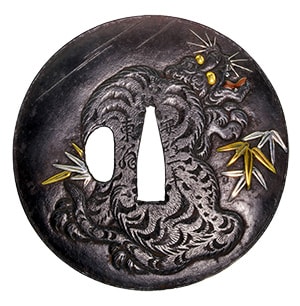
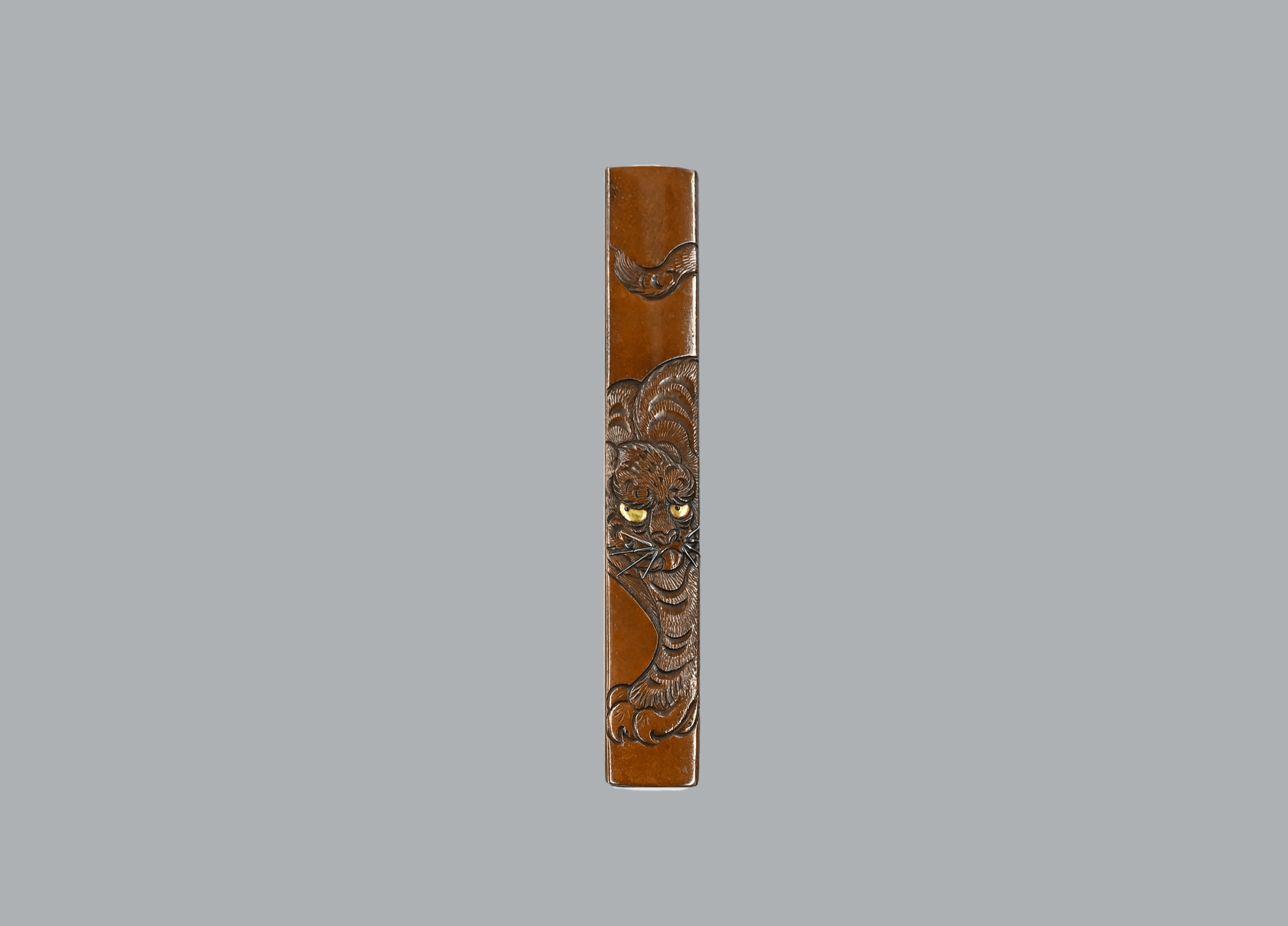
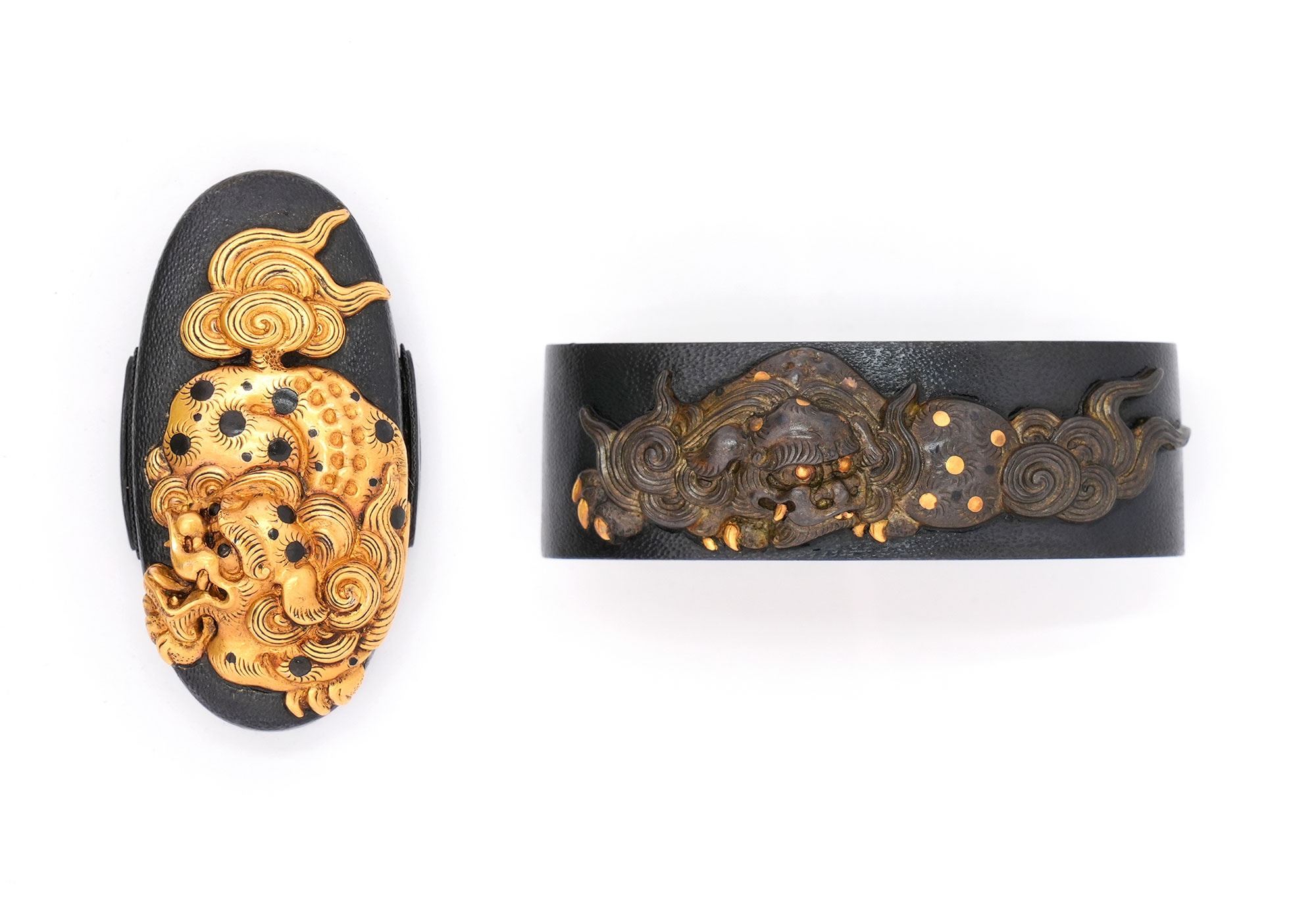
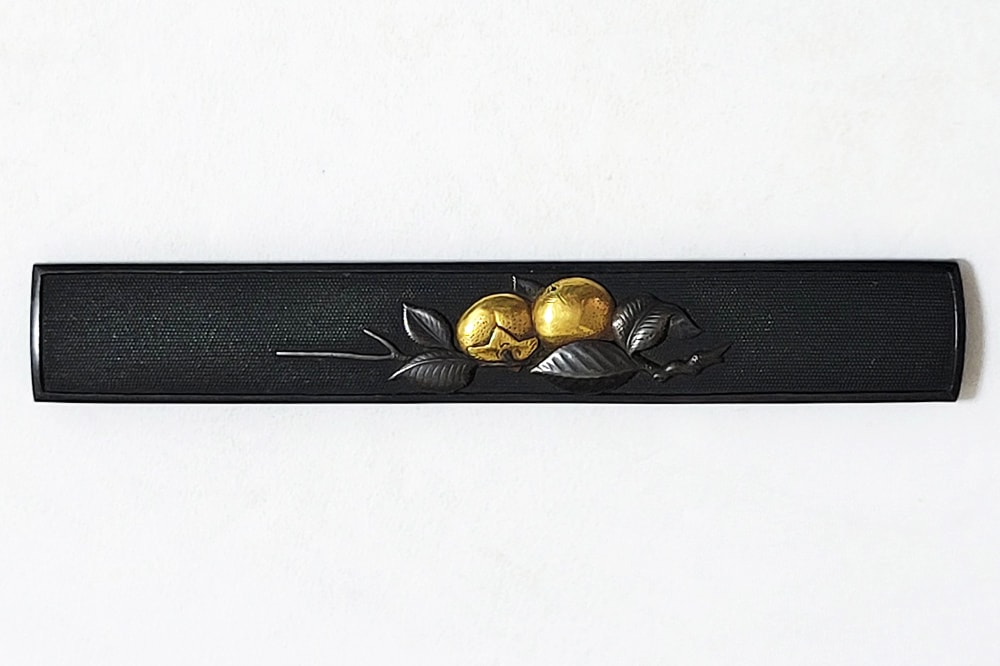
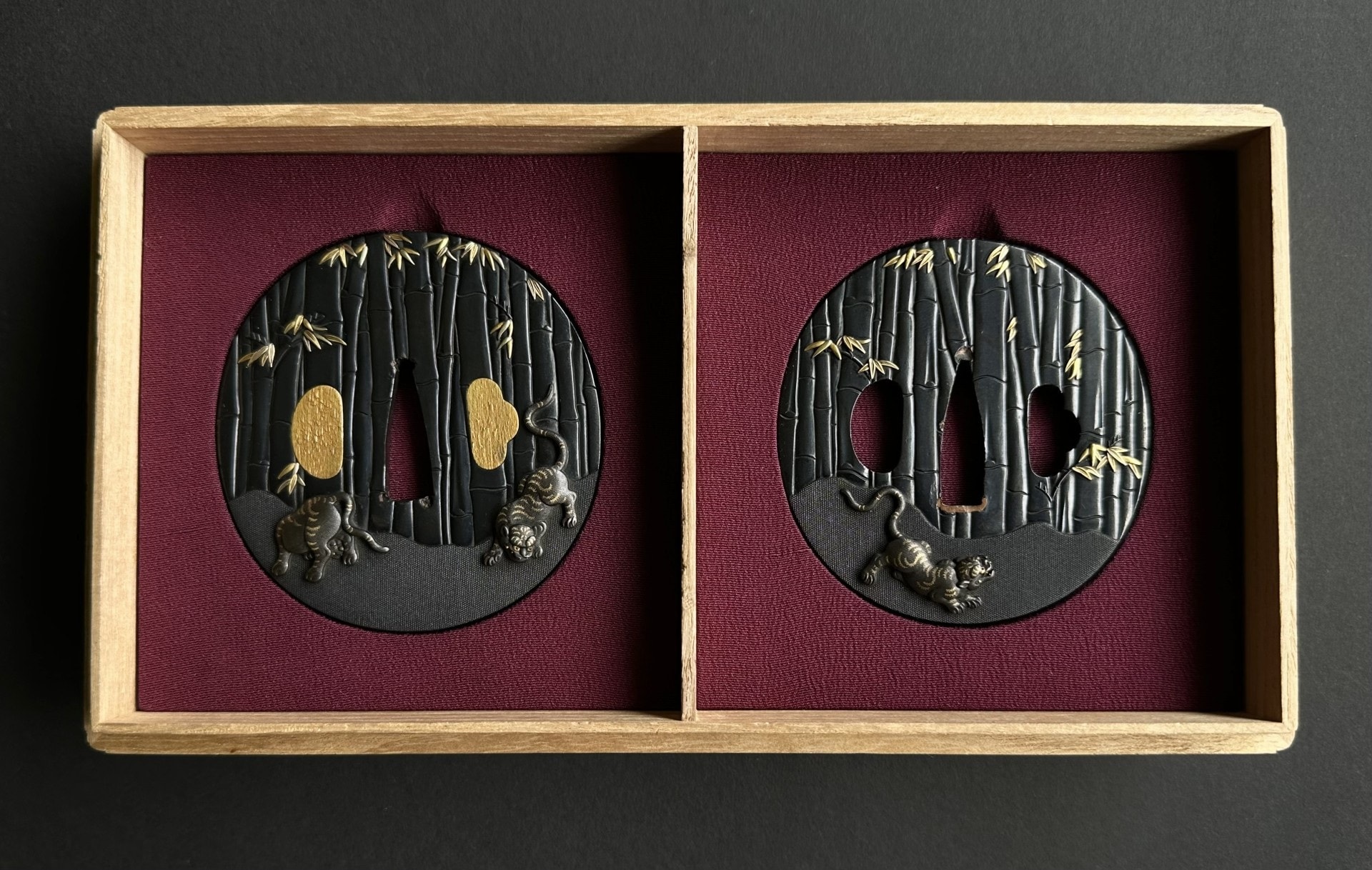
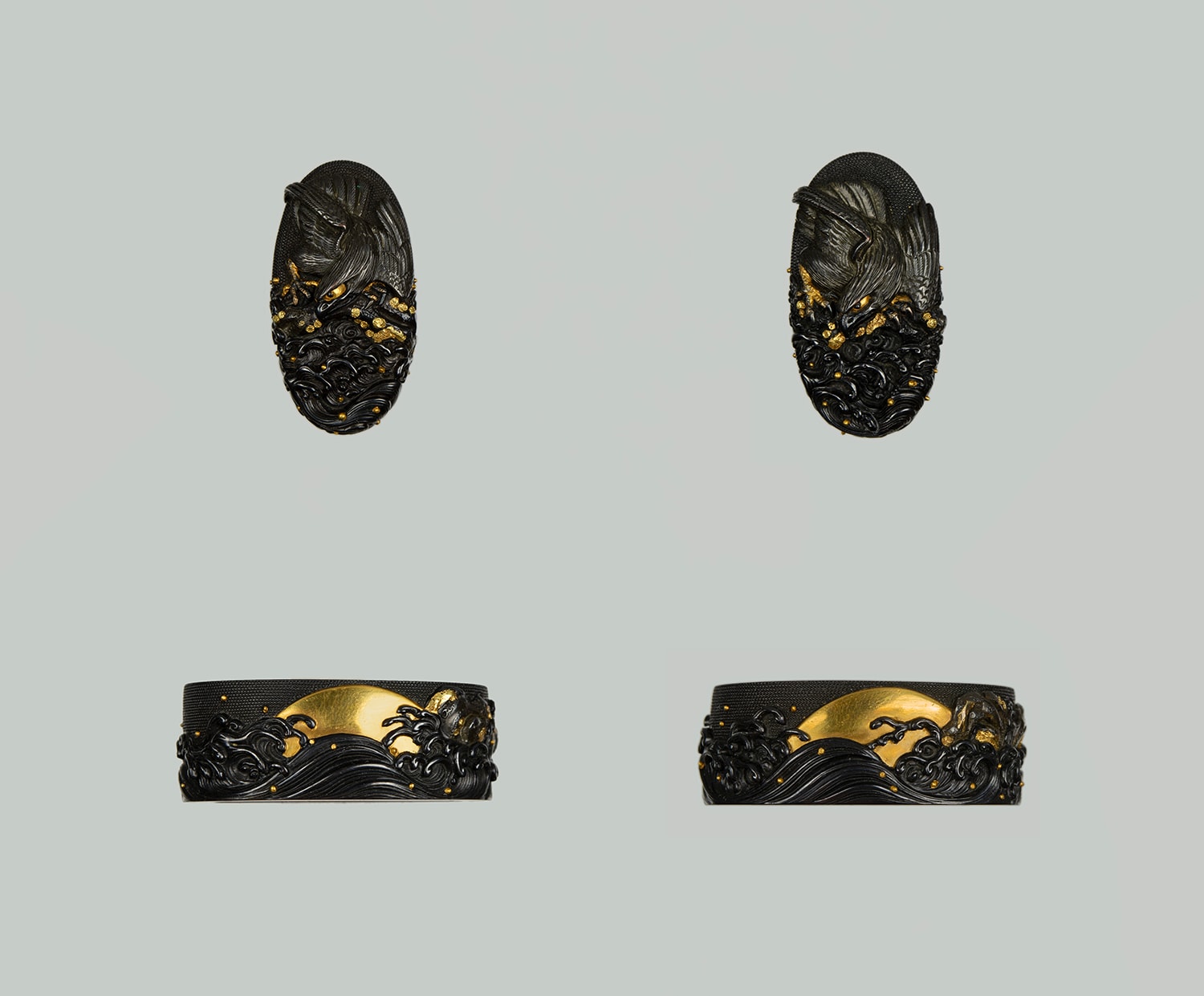
Sekibun devoted himself to the study of Tsuchiya Yasuchika, refining his skills with that master's example as his ideal, and produced an oeuvre in which tsuba are especially numerous. For the ground metal he frequently employed iron and shakudo, and he "excelled especially at applying iroe to a style of strongly modeled high-relief carving." His technical repertoire further encompassed sukidashi-bori, katakiribori, nikuai-bori, and various forms of zogan (inlay). Among pictorial subjects he favored animals and birds, with tigers and newts (imori) counted as particular strengths. His celebrated "Dawn Crow" (Akegarasu) tsuba, conceived as the sky at daybreak with suaka ground and shakudo suemon-zogan crows beating toward the sun, is singled out by the NBTHK alongside his octagonal newt-design tsuba as among his finest achievements.
The NBTHK consistently characterizes Sekibun's work as possessing a "high degree of refinement" in both composition and carving method, praising his "compositional command and carving skill" as "truly superb." His productions are recognized for their distinctive vitality -- an intensity of expression deemed "indeed characteristic of Akafumi" -- realized through the full mobilization of a wide range of carving methods together with inlay and polychrome metalwork techniques[[c:2]]. Whether working on intimate tsuba or ambitious multi-component soroi kanagu such as his Twelve Zodiac fitting set, Sekibun's works are commended as fully demonstrating the "sharpness of the maker's abilities[[c:3]]," securing his place as one of the most accomplished provincial metalworkers of the late Edo period.
Where Sekibun stands among comparable artisans: across all of nihontō, and within tradition, era, and period. The tiers (Foremost · Leading · Major · Notable) weigh official designations from the NBTHK and Japan's Agency for Cultural Affairs, together with historical honors of lasting repute such as the Sansaku and Meibutsu-chō.
Select a lens to see how it's measured.
Machibori · Edo
33 pieces on the market now
The Hamano school of machibori carving was established in mid-Edo Edo by Hamano Masazui (浜野政隨), commonly known as Tarōbei, an exceptionally gifted pupil of Nara Toshihisa. As the Edo Kinkō Meifu states of him that he "thunders through the world," Masazui won widespread renown as one of the "Four Guardian Kings of Nara" (Nara Shitennō). Training many disciples and employing numerous art names—including Otsuryūken, Aji-zumi, Kankei, Rifūdō, Yūkotei, Shūhōsai, Hankei-shi, and Isshunan—he formed what came to be known as the Hamano school, establishing one of the principal lineages of machibori artistry and founding an independent house. " Works are rendered by means of yōbori (sculptural carving) upon varied grounds—gold-and-silver imo-tsugi-ji, solid gold (kinmuku)—with details frequently treated in the in'yō-kon mode, suggesting the early Gotō masters as models.
The carving is executed with "ample, well-judged volume (nikudori)" and "exceptionally full, weighty presence," while applied metal (okigane) in silver and shakudō with shakudō iroe tightens pictorial fields and imparts additional movement. Later Hamano artists such as Katsurano Akafumi maintained this technical versatility, favoring polychrome inlay applied to high-relief compositions. " The NBTHK repeatedly notes that works "clearly demonstrate the high level of technique," "amply demonstrate advanced technical mastery," and possess "a composed dignity"—attestations to the school's sustained excellence across generations and its enduring place within the broader machibori tradition. Learn more →
| Smith | Era | Designated |
|---|---|---|
| Shozui政随 | — | 17 |
| Sekibun赤文 | 1670 | 8 |
| Noriyuki矩随 | — | 4 |
| Naotoshi直寿 | — | 0 |
| Masayoshi政盧 | — | 0 |
We could not find an authenticity certificate on the seller’s listing. Japanese swords and fittings are normally papered by the NBTHK (or the NTHK). Without one, the attribution is the seller’s own assessment and has not been independently verified — treat it with caution and ask the dealer about certification before buying.
If, due to our fault, the item differs significantly from its proper condition, the item may be returned. Cooling-off is within one week of the item's arrival.
This is a tsuba featuring a gansho (雁書) design, made by Yurakusai Sekibun in the Late Edo period. The tsuba depicts a scene based on the ancient Chinese legend of the wild goose carrying letters. The artist, Katsurano Sekibun, was born in Echigo province and studied under the Hamano family in Edo, later serving the Sakai family in Shonai.
NihontoWatchMachibori · Dewa · around 1670
4 pieces on the market now
Katsurano Sekibun, who employed the art name Yurakusai, was born in Kansei 2 (1790) at Murakami in Echigo Province. As a young man he traveled to Edo and studied under the Hamano family, acquiring the foundational discipline of that distinguished lineage. From his adoption of the art name Yurakusai, it is further conjectured that he undertook training in Kyoto, broadening his technical and aesthetic formation beyond a single school. In Bunsei 7 (1824) he entered the service of the Sakai family of Shonai domain as a retained artisan (kakae-ko), and from Koka 2 (1845) onward he settled permanently in Tsuruoka, where he continued to work until his death in Meiji 8 (1875) at the remarkable age of eighty-seven. For his inscriptions he used a distinctive cursive hand modeled on the calligraphic style of Kameda Bosai, the celebrated scholar of his native Echigo.
Sekibun devoted himself to the study of Tsuchiya Yasuchika, refining his skills with that master's example as his ideal, and produced an oeuvre in which tsuba are especially numerous. For the ground metal he frequently employed iron and shakudo, and he "excelled especially at applying iroe to a style of strongly modeled high-relief carving." His technical repertoire further encompassed sukidashi-bori, katakiribori, nikuai-bori, and various forms of zogan (inlay). Among pictorial subjects he favored animals and birds, with tigers and newts (imori) counted as particular strengths. His celebrated "Dawn Crow" (Akegarasu) tsuba, conceived as the sky at daybreak with suaka ground and shakudo suemon-zogan crows beating toward the sun, is singled out by the NBTHK alongside his octagonal newt-design tsuba as among his finest achievements.
The NBTHK consistently characterizes Sekibun's work as possessing a "high degree of refinement" in both composition and carving method, praising his "compositional command and carving skill" as "truly superb." His productions are recognized for their distinctive vitality -- an intensity of expression deemed "indeed characteristic of Akafumi" -- realized through the full mobilization of a wide range of carving methods together with inlay and polychrome metalwork techniques[[c:2]]. Whether working on intimate tsuba or ambitious multi-component soroi kanagu such as his Twelve Zodiac fitting set, Sekibun's works are commended as fully demonstrating the "sharpness of the maker's abilities[[c:3]]," securing his place as one of the most accomplished provincial metalworkers of the late Edo period.
Where Sekibun stands among comparable artisans: across all of nihontō, and within tradition, era, and period. The tiers (Foremost · Leading · Major · Notable) weigh official designations from the NBTHK and Japan's Agency for Cultural Affairs, together with historical honors of lasting repute such as the Sansaku and Meibutsu-chō.
Select a lens to see how it's measured.
Machibori · Edo
33 pieces on the market now
The Hamano school of machibori carving was established in mid-Edo Edo by Hamano Masazui (浜野政隨), commonly known as Tarōbei, an exceptionally gifted pupil of Nara Toshihisa. As the Edo Kinkō Meifu states of him that he "thunders through the world," Masazui won widespread renown as one of the "Four Guardian Kings of Nara" (Nara Shitennō). Training many disciples and employing numerous art names—including Otsuryūken, Aji-zumi, Kankei, Rifūdō, Yūkotei, Shūhōsai, Hankei-shi, and Isshunan—he formed what came to be known as the Hamano school, establishing one of the principal lineages of machibori artistry and founding an independent house. " Works are rendered by means of yōbori (sculptural carving) upon varied grounds—gold-and-silver imo-tsugi-ji, solid gold (kinmuku)—with details frequently treated in the in'yō-kon mode, suggesting the early Gotō masters as models.
The carving is executed with "ample, well-judged volume (nikudori)" and "exceptionally full, weighty presence," while applied metal (okigane) in silver and shakudō with shakudō iroe tightens pictorial fields and imparts additional movement. Later Hamano artists such as Katsurano Akafumi maintained this technical versatility, favoring polychrome inlay applied to high-relief compositions. " The NBTHK repeatedly notes that works "clearly demonstrate the high level of technique," "amply demonstrate advanced technical mastery," and possess "a composed dignity"—attestations to the school's sustained excellence across generations and its enduring place within the broader machibori tradition. Learn more →
| Smith | Era | Designated |
|---|---|---|
| Shozui政随 | — | 17 |
| Sekibun赤文 | 1670 | 8 |
| Noriyuki矩随 | — | 4 |
| Naotoshi直寿 | — | 0 |
| Masayoshi政盧 | — | 0 |
We could not find an authenticity certificate on the seller’s listing. Japanese swords and fittings are normally papered by the NBTHK (or the NTHK). Without one, the attribution is the seller’s own assessment and has not been independently verified — treat it with caution and ask the dealer about certification before buying.
If, due to our fault, the item differs significantly from its proper condition, the item may be returned. Cooling-off is within one week of the item's arrival.