In the Sengoku era the school served a second warrior court: the Later Hōjō at Odawara, whose patronage kept the Tsunahiro line forging hitatsura for the uchigatana age until the castle fell to Hideyoshi in 1590.
 NihontoWatchNihontoWatch
室町時代末期。若狭国。「冬広作」「若州住冬広」「冬広藤左衛門尉」「備中国於松山若州住人冬広作」「備中之国冬広」。文明年間(1469~1487)に相模国から若狭国小浜に移住した次広の子を祖とする。作風は、末相州伝に備前伝の鍛法を加味した沸出来の互の目乱を焼き、金線・砂流し・湯走りが層をなして迫力がある。備中松山城主三村元親の招聘で備中において作刀したほか、伯耆、出雲、備前においても駐槌した。
NihontoWatchOffered by Choshuya
This piece has sold
7 on the market
Get an email when new Wakasa Fuyuhiro School work hits the market.

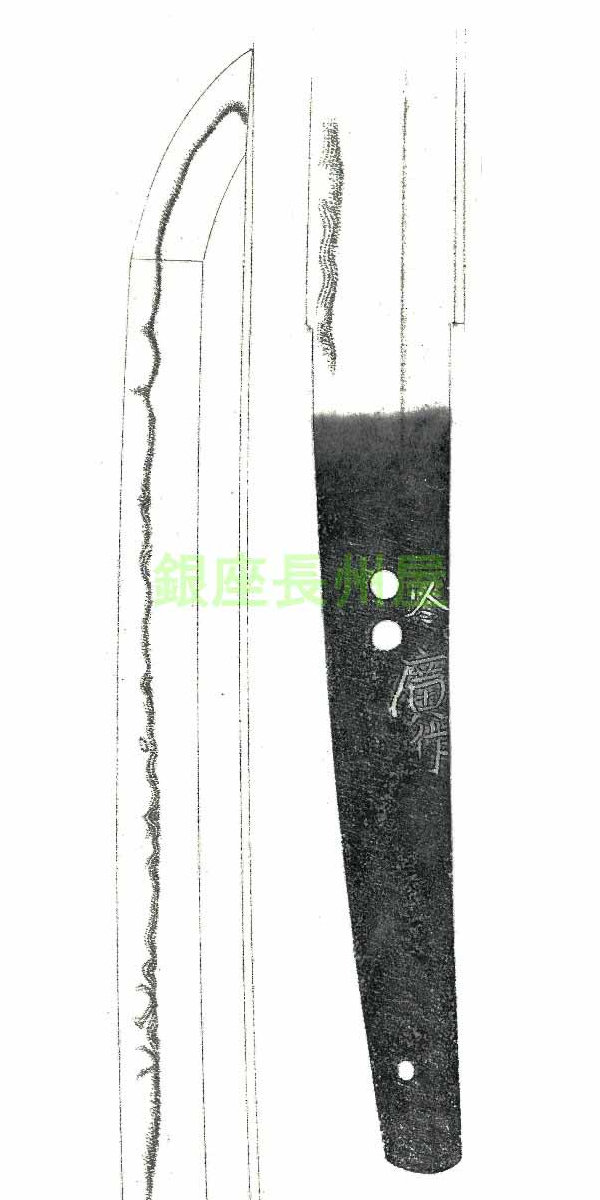
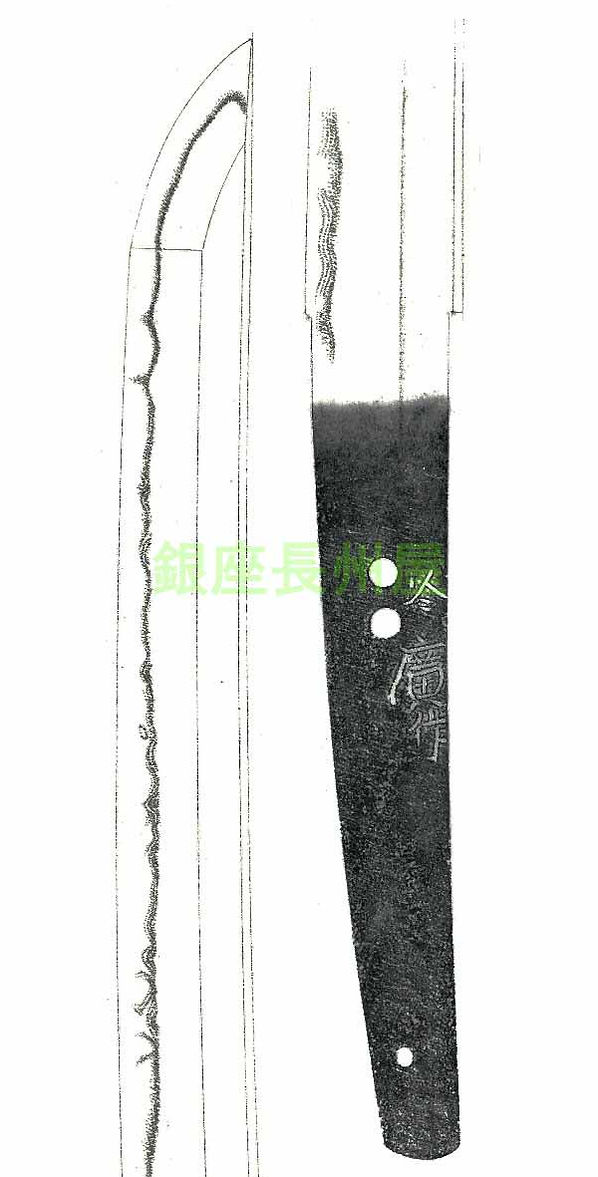
As written by the shop
Soshu-den · Wakasa
7 pieces on the market now
The Fuyuhiro line worked at Obama in Wakasa Province, and the setsumei consistently trace its founder to Sagami. He is recorded as the son of the third-generation Hirotsugu of Sagami, said to have relocated to Obama around the Kōshō era (1455 to 1457), with one blade instead reporting that he studied under Tsunahiro of Sagami. The earliest hand is identified on a two-character mei attributed to the first-generation Wakasa Fuyuhiro, and the name continued thereafter, the lineage held to have run for some five generations and the signature extending into the shinshintō period and the closing years of the Edo period. " Several blades carry residence inscriptions for places far from Wakasa, among them Hōki, Unshū, Izumo, Bizen, and Bitchū, including a katana made at Matsuyama in Bitchū; whether these issued from one man or several is left by the setsumei as a matter for further study. The descent from Sagami places the line within the Soshu-den, working its late, provincial idiom. Across these blades the forging is itame mixed with mokume and nagare, repeatedly described as inclining toward hada-dachi, or standing grain, with ji-nie and frequent chikei. Two tempering modes recur. One follows late Sōshū and Sue-Sōshū taste, a wide notare or ō-notare mixed with ko-gunome, ko-chōji, and togariba, carrying ashi and yō, nie that adheres thickly and at times coarsely, with sunagashi and kinsuji, and in the most active examples tobiyaki and muneyaki that build into hitatsura. The other approaches Sue-Bizen, seen in a gunome-midare with koshi-biraki tendency or a tighter nioiguchi over ko-nie.
A third register appears as a broad suguha-chō set with ko-gunome and ko-notare. The bōshi is typically midare-komi, turning ko-maru or pointed with hakikake. To read the hand, the setsumei point to the standing grain and bright nioiguchi, the often grand sakizori construction with extended or ō-kissaki, and the carving: bō-hi with soe-hi, and on one blade a kurikara with bonji and goma-bashi whose manner is likened to Heianjō Nagayoshi rather than to Sōshū. Generations and modes separate by whether the workmanship leans Sue-Sōshū or Sue-Bizen. For kantei, the setsumei treat the place-stating signatures and dated tangs as the principal documentary value, several blades singled out for the clarity their inscriptions bring to the line's chronology and geographic reach; one Tenshō 8 katana adds the invocation "Hachiman Daibosatsu" beside the mekugi-ana and "Jūdai" cut on the mune. The recurring open question of the far-flung residence signatures, Hōki through Bitchū, frames the standing of the name as one whose precise membership the register still weighs. Among individual works, the writers name a suriage katana as a kessaku, a wholly hardened blade close to late Bizen, and a two-character first-generation piece judged the finest in jigane and hamon. Accompanying uchigatana koshirae survive on two katana, one with shakudō nanako fittings bearing the "Misu aoi" crest, the other a black-lacquered leather katate-maki mounting whose saya is held close in date to the blade. The setsumei present Fuyuhiro as a capable smith adept in both suguha and midare and in horimono, his Wakasa workshop carrying the Soshu-den into the late Muromachi and beyond. Learn more →
| Smith | Era | Designated |
|---|---|---|
| Fuyuhiro冬廣 | 1521-1568 | 5 |
| Fuyuhiro冬廣 | 1624-1644 | 0 |
| Fuyuhiro冬廣 | 1487-1489 | 0 |
| Fuyuhiro冬廣 | 1661-1673 | 0 |
| Fuyuhiro冬廣 | 1532-1555 | 1 |
Sōshū in the Muromachi period
In the Sengoku era the school served a second warrior court: the Later Hōjō at Odawara, whose patronage kept the Tsunahiro line forging hitatsura for the uchigatana age until the castle fell to Hideyoshi in 1590.
If, due to our fault, the item differs significantly from its proper condition, the item may be returned. Cooling-off is within one week of the item's arrival.