NihontoWatch Mon

NihontoWatch

MarketAuctions
Encyclopedia
NihontoWatch Mon

NihontoWatch

MarketAuctions
Encyclopedia

Description

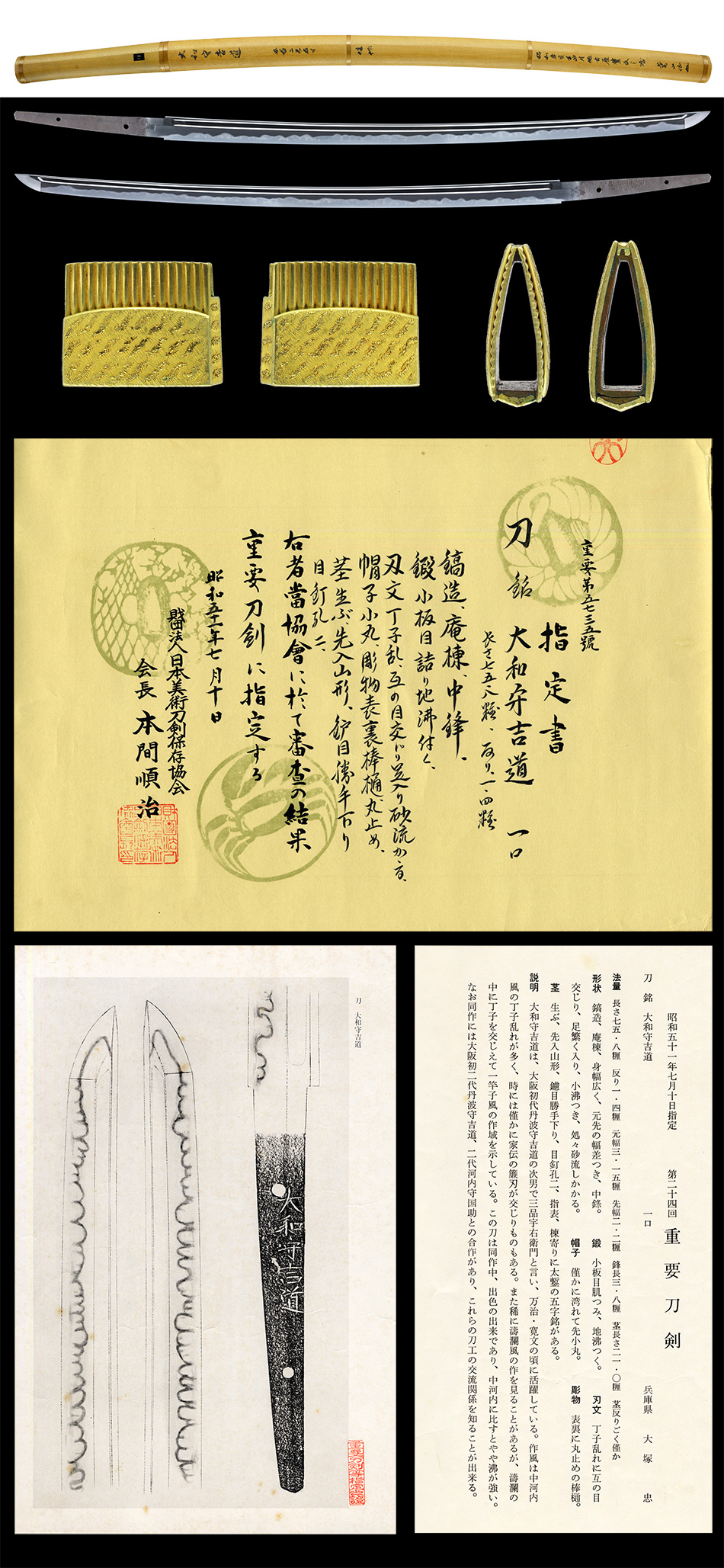
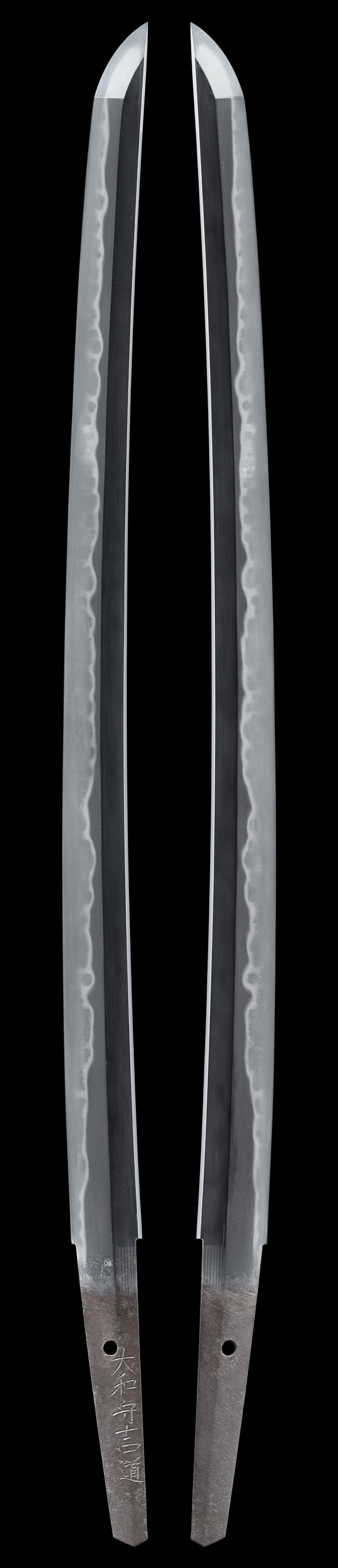
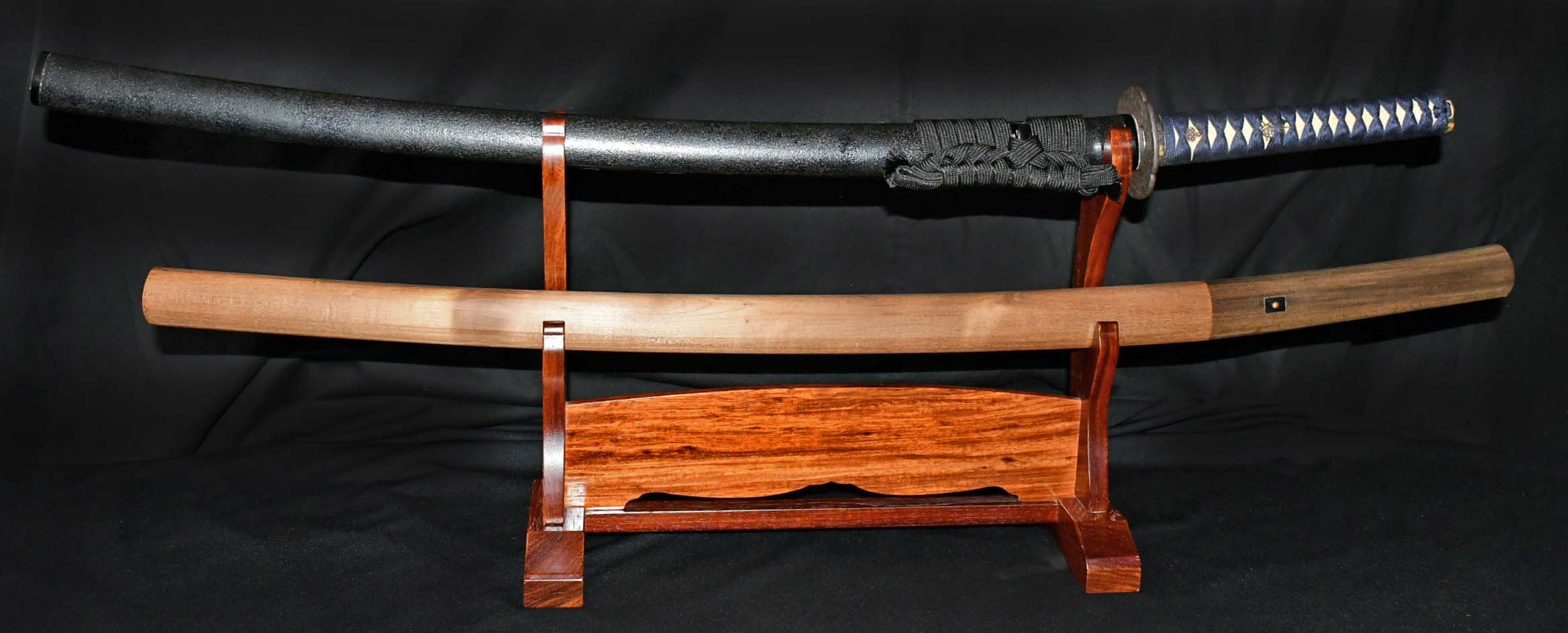
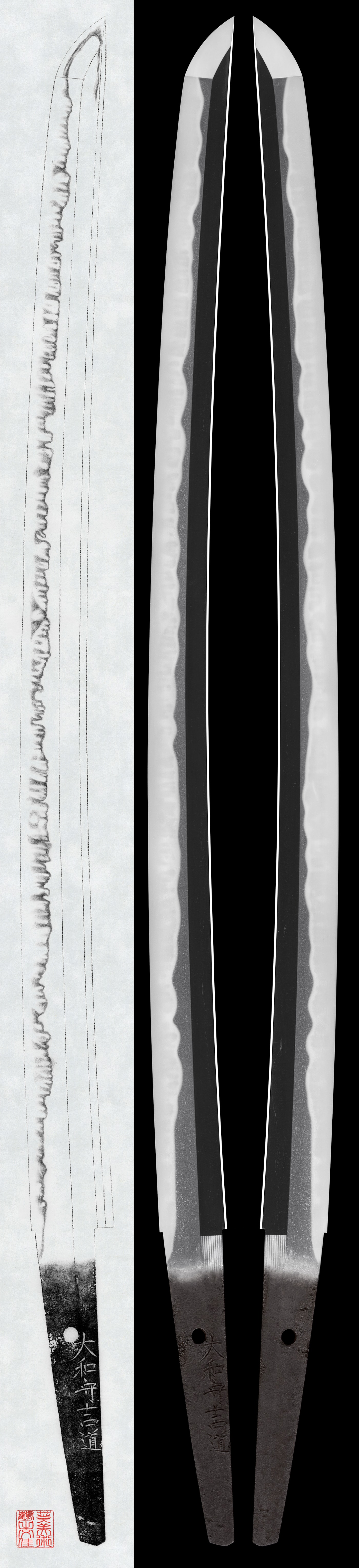
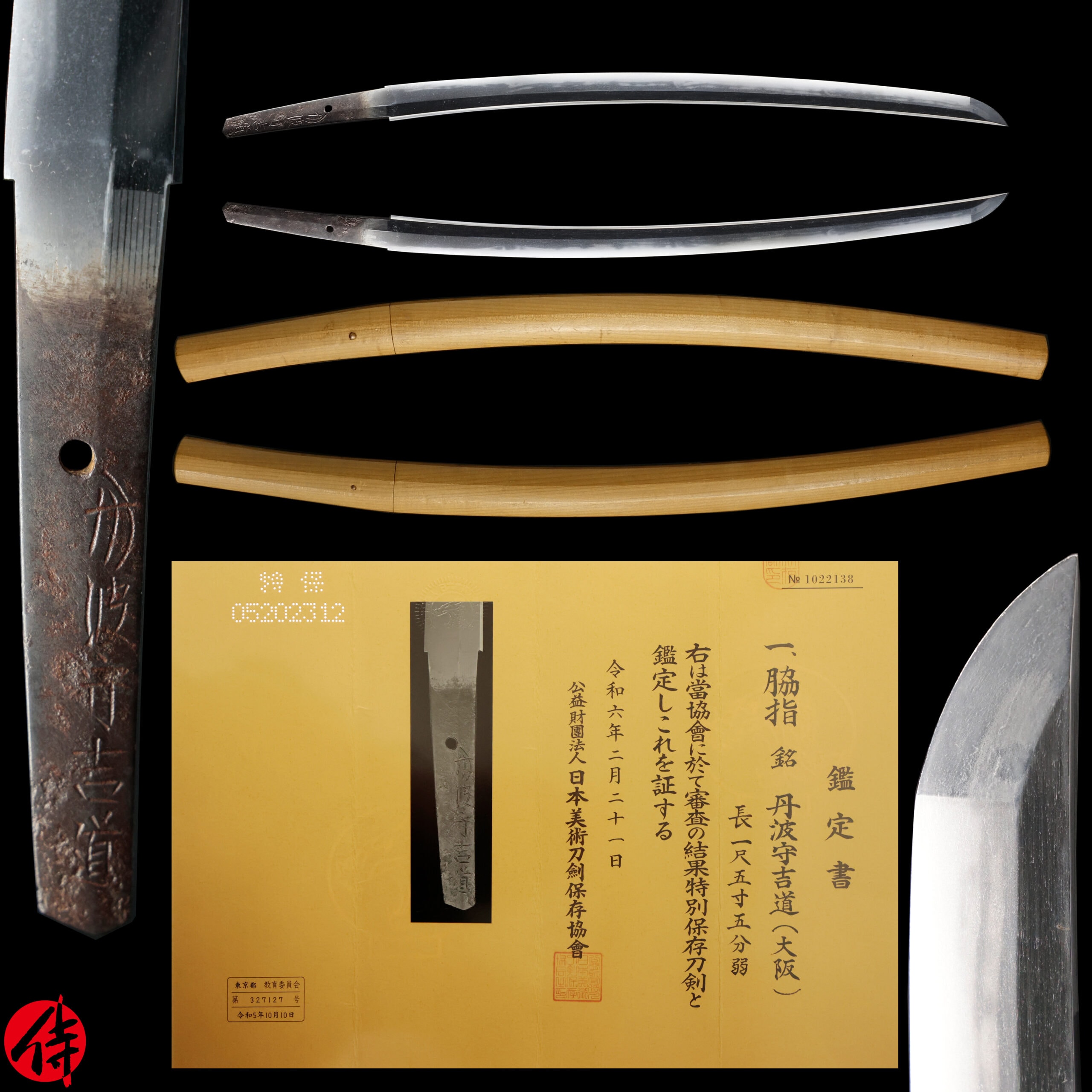
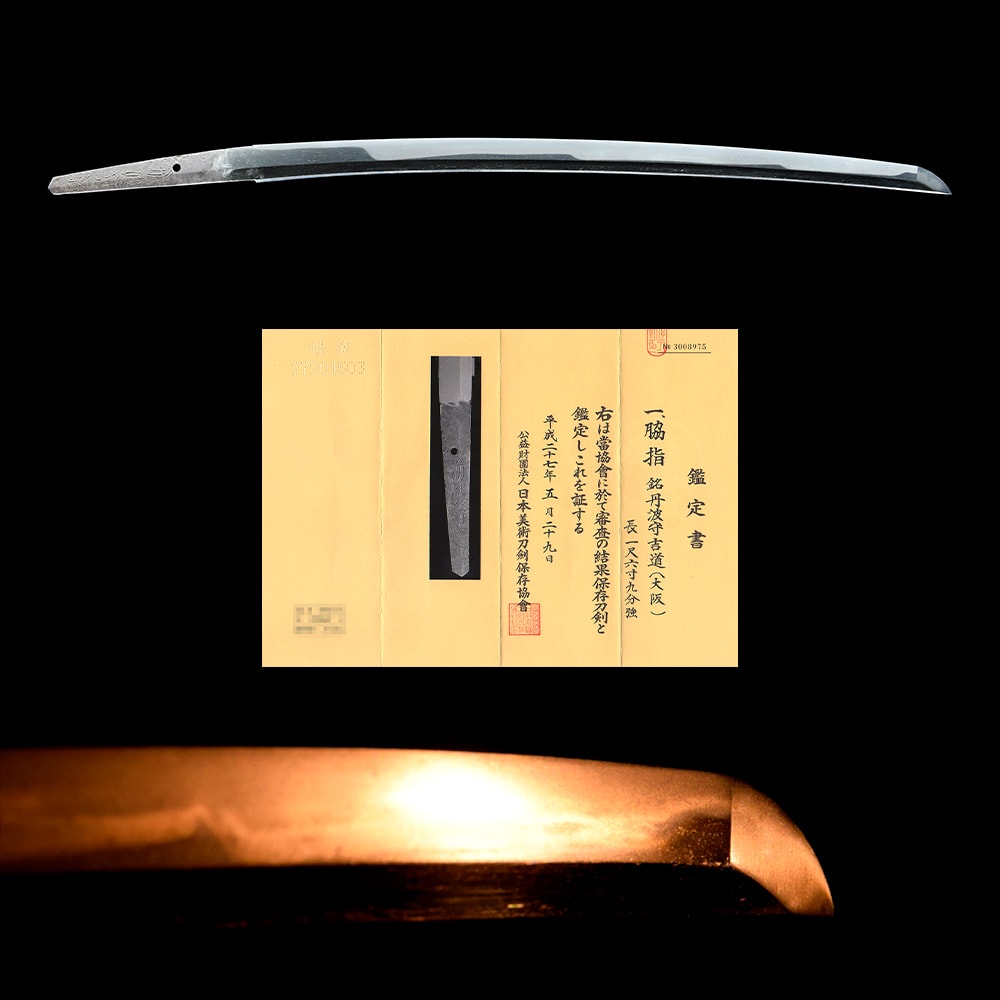
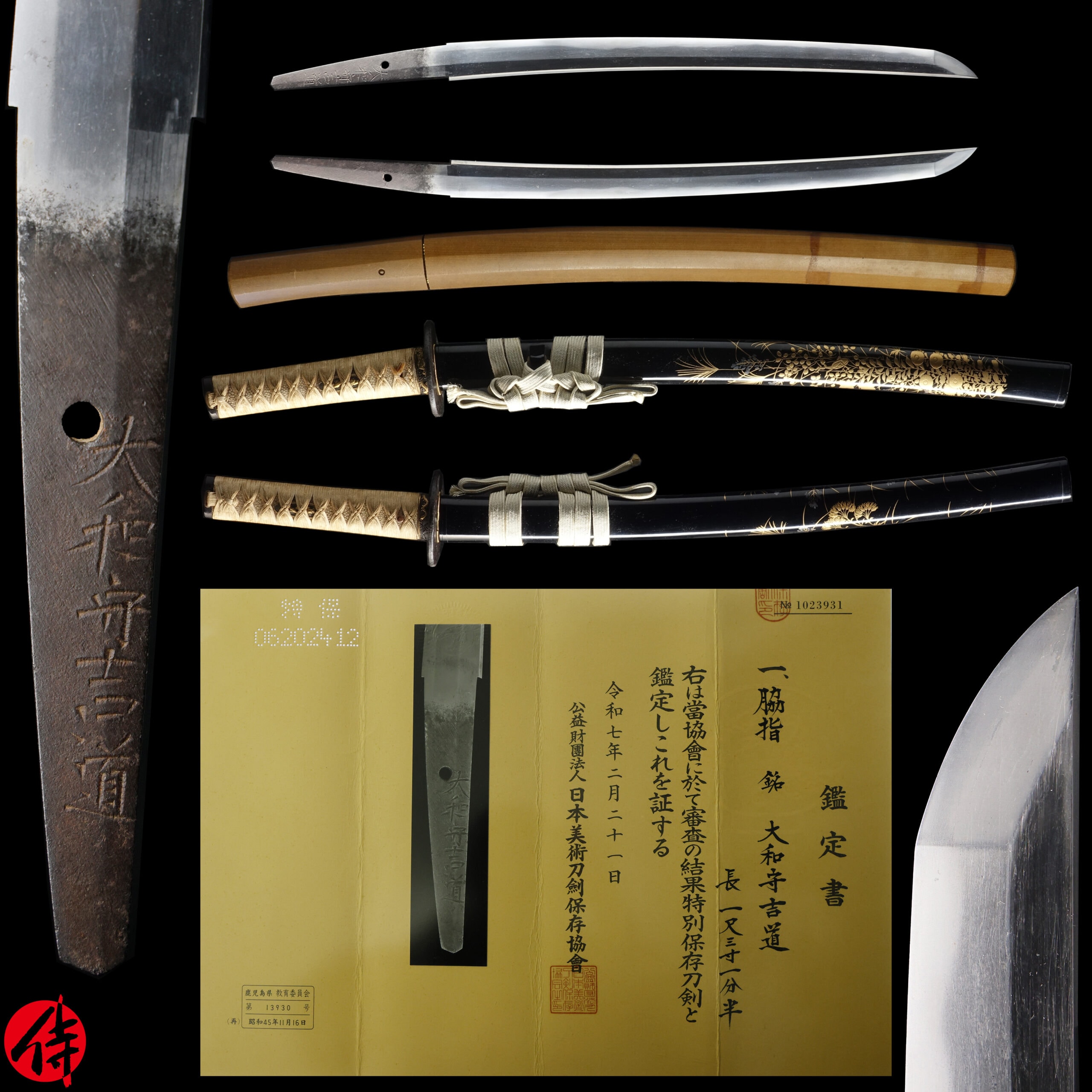
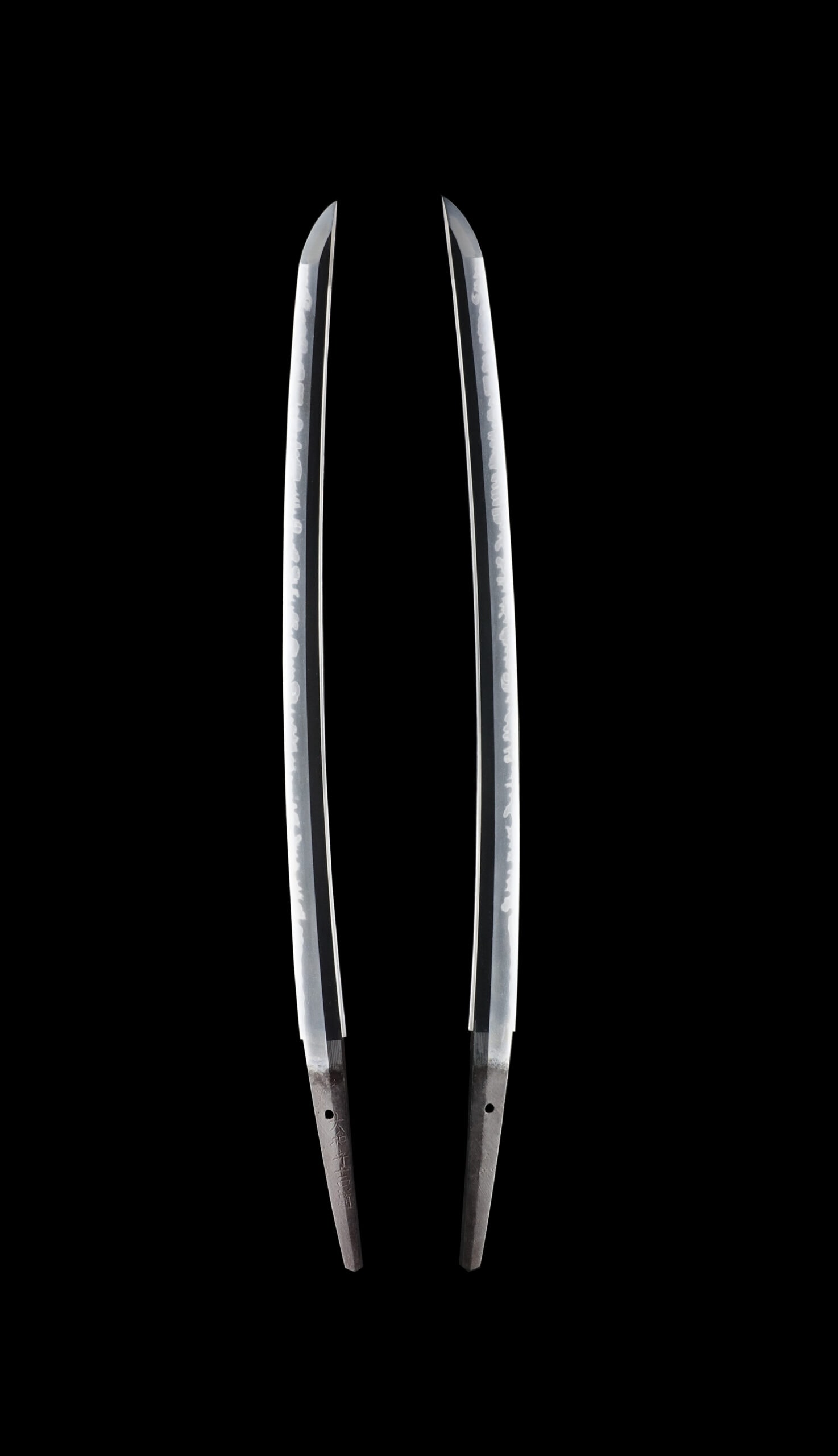
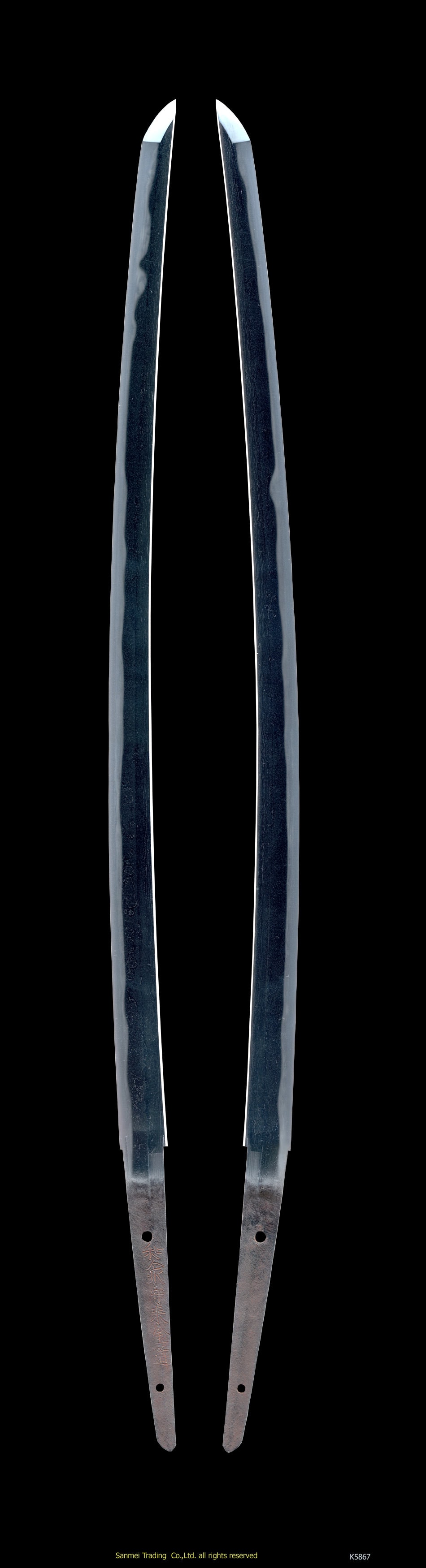
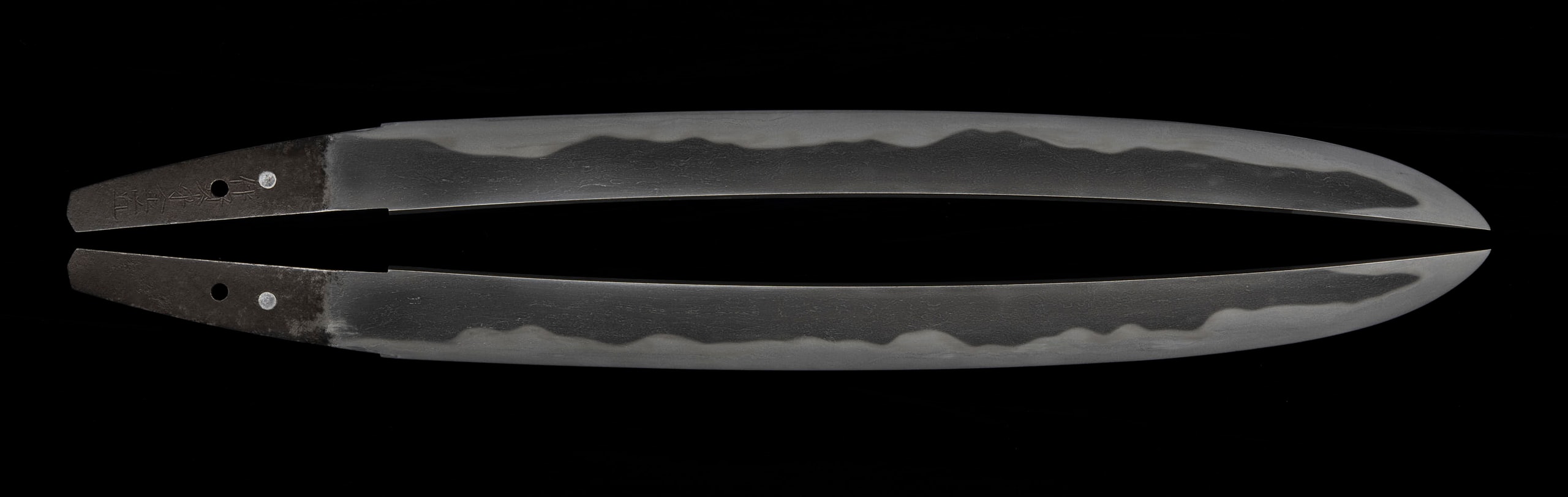
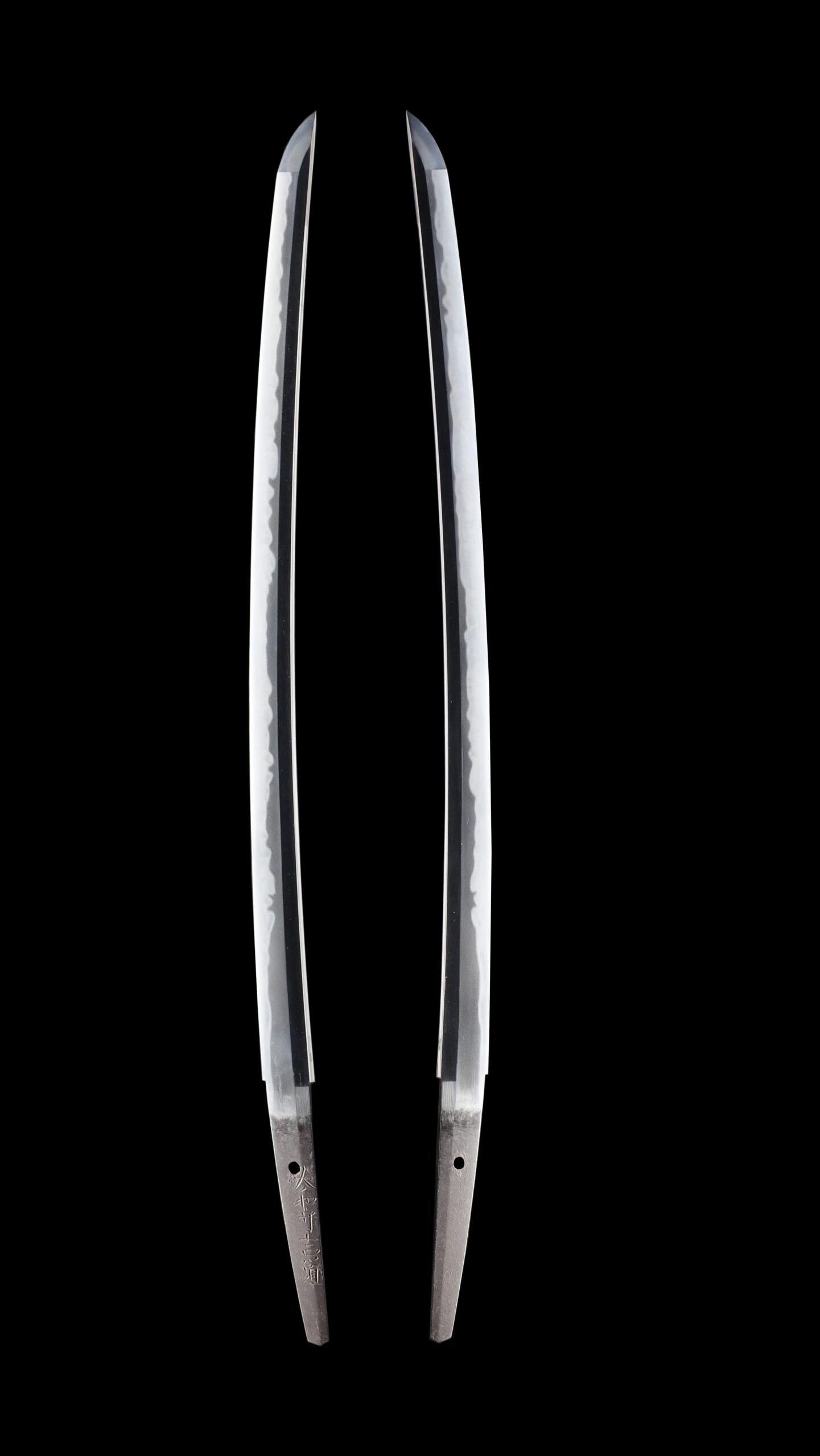
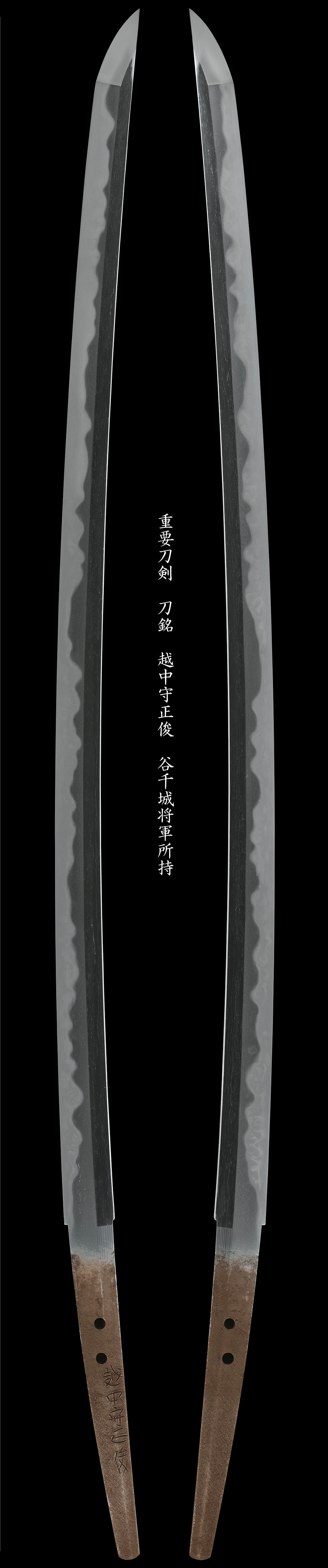
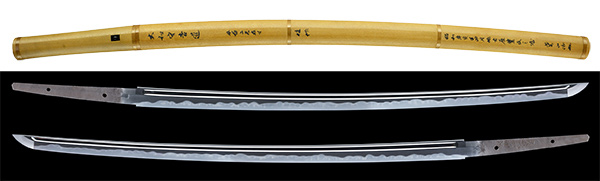
This is a katana made by Yamatonokami Yoshimichi in Settsu province during the Edo era (around 1661~). The blade has a length of 75.8cm and features a Choji-midare and Gunome hamon with Konie. It comes with a two-part gold foil Habaki and has been certified as a Juyo Token by the NBTHK.

NBTHK Setsumei

Juyo-Token, 24th Session — Designated July 10, 1976 Katana, mei: Yamato no Kami Yoshimichi (大和守吉道) Setsumei by Otsuka Tadashi (大塚忠) Measurements Nagasa 75.8 cm, sori 1.4 cm, motohaba 3.15 cm, sakihaba 2.2 cm, kissaki-nagasa 3.8 cm, nakago-nagasa 20.0 cm, nakago-sori very slight Description Keijo: shinogi-zukuri, iori-mune; wide mihaba with noticeable taper from base to tip; chu-kissaki. Kitae: Dense ko-itame-hada; ji-nie present. Hamon: choji-midare mixed with gunome; ashi enter frequently; ko-nie; with places showing sunagashi. Boshi: Slightly midare, turning back in ko-maru. Horimono: Bo-hi on both sides, with maru-dome terminations. Nakago: Ubu; iriyama-gata nakago-jiri; katte-sagari yasurime; two mekugi-ana; on the omote, a five-character signature cut with thick chisel strokes, placed toward the mune. Artisan Yamato no Kami Yoshimichi (大和守吉道) Era Mid Edo period, circa the Manji–Kanbun eras (1658–1673) Explanation Yamato no Kami Yoshimichi was the second son of the first-generation Osaka Tanba no Kami Yoshimichi, and was known by the name Sanpin Uemon. He was active around the Manji and Kanbun eras. In his workmanship, choji-midare in the Nakagawachi style is frequently seen, and at times works appear in which a faint admixture of the family’s traditional wanba (undulating temper) is present. In rare instances one encounters a Yamato-flavored approach; within a fundamentally suguha (straight temper) he mixes choji, revealing a distinctive personal range. This katana is an especially outstanding work among his extant pieces, and, in comparison with Nakagawachi-style examples, shows somewhat stronger nie. It may also be noted that works exist produced as collaborations with the second-generation Osaka-resident Tanba no Kami Yoshimichi and with the second-generation Kawachi no Kami Kunisuke; through these, one can understand the network of exchange among these smiths.

NihontoWatch MonNihontoWatch
MarketAuctionsEncyclopedia
Swords›Mishina›Yoshimichi›Katana: Yamatonokami Yoshimichi - Juyo Token
katanaJūyō
Mishina Yoshimichi

Katana: Yamatonokami Yoshimichi - Juyo Token

mei · Shinto · nagasa 75.8cm · sori 1.4cm

SOLD
Mishina Yoshimichi — 1 of 3
Mishina Yoshimichi — 2 of 3
Mishina Yoshimichi — 3 of 3
1 / 3
1 / 3
Mishina Yoshimichi — 1 of 3Mishina Yoshimichi — 2 of 3Mishina Yoshimichi — 3 of 3
Measurements & details
Smith
Mishina Yoshimichi
Type
Katana
School
Mishina
Period
Around 1661–1673(Kanbun)
Province
Settsu
Signature
Signed(100% of this smith's designated works are signed)
Measurements
Nagasa 75.8cmSori 1.4cmMotohaba 3.15cmSakihaba 2.2cm
Description

This is a katana made by Yamatonokami Yoshimichi in Settsu province during the Edo era (around 1661~). The blade has a length of 75.8cm and features a Choji-midare and Gunome hamon with Konie. It comes with a two-part gold foil Habaki and has been certified as a Juyo Token by the NBTHK.

NBTHK Zufu Commentary

Juyo #24

AI translation — may contain errors

-, 24th Session — Designated July 10, 1976

, : Yamato no Kami Yoshimichi (大和守吉道)

by Otsuka Tadashi (大塚忠)

Measurements 75.8 cm, 1.4 cm, 3.15 cm, 2.2 cm, 3.8 cm, 20.0 cm, very slight

Description Keijo: , ; wide with noticeable taper from base to tip; . : Dense ; present. : mixed with ; enter frequently; ; with places showing . : Slightly , turning back in . : on both sides, with terminations. : ; ; ; two ; on the , a five-character signature cut with thick chisel strokes, placed toward the .

Artisan Yamato no Kami Yoshimichi (大和守吉道)

Era Mid period, circa the Manji– eras (1658–1673)

Explanation Yamato no Kami Yoshimichi was the second son of the first-generation Osaka Tanba no Kami Yoshimichi, and was known by the name Uemon. He was active around the Manji and eras. In his workmanship, in the Nakagawachi style is frequently seen, and at times works appear in which a faint admixture of the family’s traditional wanba (undulating temper) is present. In rare instances one encounters a Yamato-flavored approach; within a fundamentally (straight temper) he mixes , revealing a distinctive personal range.

This is an especially outstanding work among his extant pieces, and, in comparison with Nakagawachi-style examples, shows somewhat stronger . It may also be noted that works exist produced as collaborations with the second-generation Osaka-resident Tanba no Kami Yoshimichi and with the second-generation Kawachi no Kami Kunisuke; through these, one can understand the network of exchange among these smiths.

About the maker

Yoshimichi

吉道

Settsu (Osaka), the Mishina school, the Tanba no Kami Yoshimichi name-line · Settsu · around 1661-1673

Fujishiro Jo saku · Tōken Taikan top 31%

4 pieces on the market now

›

Yoshimichi is the most celebrated name of the Mishina school, the Kyoto-rooted shinto line founded by a son of Kanemichi of Seki. The first-generation Tanba no Kami Yoshimichi and his brothers Iga no Kami Kinmichi and Etchu no Kami Masatoshi are named together in the published sources as masters of the Sanpin lineage, the three smiths who carried Mishina work to the front rank of the early Edo period. This record gathers the Osaka branch of that name. At its center stands the shodai Osaka Tanba no Kami Yoshimichi, born in Keicho 3 and styled Sanpin Kin'emon, the second son of the Kyoto shodai who moved to Osaka and became the founder of the Osaka-Tanba line, around whom are set his son Yamato no Kami Yoshimichi, known as Mishina Uemon, and a blade the published record assigns to the second generation. Where the elder Kinmichi and the younger Masatoshi worked diversely, Yoshimichi held to one signature manner, and it is that manner the school is remembered by.

That manner is the sudare-ba, the bamboo-blind temper. Layered sunagashi and kinsuji are drawn through a notare and gunome midare until the temper stripes into parallel bands like the slats of a hanging reed blind, and the published sources call it the school's hallmark, the Osaka-Tanba line handling it more often and more skilfully than any other style. On a wide, slightly elongated, thick-kasane hira-zukuri wakizashi of Keicho-shinto shape, the shodai opens the temper with a long straight yakidashi at the koshimoto and then widens the yakihaba above it, building over a ko-notare base mixed with gunome into a flamboyant large midare. Long, vigorous yubashiri run through it, the sunagashi layers in double and triple bands until it stripes into the sudare-ba, ashi enter, strong nie gathers and clumps unevenly, long kinsuji appear in places, and muneyaki and tobiyaki are added. The boshi rises shallow and pointed in a tsukiage, swept with frequent hakikake into a flame shape and run down long. The published sources read the whole as bolder and more flamboyant than usual, of his hallmark style yet pressing on the work of the Kyoto shodai[[c:1]].

The jigane carries the temper. On the shodai's wakizashi the kitae is a compact ko-itame mixed with mokume, the ji-nie adhering thickly and exceedingly fine, fine chikei entering well, the hada flowing and standing a little in places. The yakidashi itself is a study of its own. The published sources distinguish the shodai's straight sudare-ba yakidashi from the broadening Osaka yakidashi, noting that here the yakihaba keeps an even width as it rises rather than spreading toward the upper blade, a point of recognition within the Osaka-Tanba hand. The slender katana assigned to the second generation shows the same vocabulary in lower key, an itame tending to nagare with ji-nie, a large midare with sunagashi and gunome and ashi resolving into sudare-ba, the boshi a shallow, moist o-maru swept at the tip. The temper is the constant, the build and the strength of the nie the variables across the hands gathered here.

The name is read by hand and by signature rather than by a single dated chronology. The shodai Osaka Tanba stands as the prime sudare-ba hand, his son Yamato no Kami Yoshimichi forms a parallel and contrasting one. On a wide shinogi-zukuri katana with a clear difference between base and point width, Yamato no Kami forges not the family blind-temper but a choji-midare in what the published sources call 「中河内風の丁子乱れ」[[c:2]], frequent ashi entering, ko-nie adhering, sunagashi scattered, the boshi a slight notare ending in ko-maru; at times a little of the family temper is mixed in, and rarely he works a rolling-wave manner within which choji are set, a range the sources liken to Ikkanshi. The published record judges this katana an outstanding example among his works, its nie somewhat stronger than on Nakagawachi pieces, and it notes his collaborative blades with the first and second Osaka Tanba Yoshimichi and with the second-generation Kawachi no Kami Kunisuke, by which the exchange among these Osaka smiths can be followed. The second-generation blade closes the descent: the published sources write that 「同工の特色ある簾刃を焼いて」[[c:3]] without vulgarity, sound in workmanship though slender in build.

Within the school the line is best placed by its own signature. The shodai's sudare-ba 「一派のお家芸である簾刃を最も得意としており」[[c:4]], and his straight, even yakidashi and pointed, flame-swept boshi distinguish his hand from the broadening Osaka yakidashi of his neighbours and from the choji his own son preferred. Against the Kyoto shodai he is most easily confused and most carefully separated: because the Osaka line cut no chrysanthemum crest while the Kyoto line did from the second generation on, the published sources give the character 守 of the signature as the decisive point, its 寸 element cut straight down on Osaka work and slanting on Kyoto work. The sources are honest about the line's later course, observing that 「代が下るに従って」[[c:5]] the manner grew more technical and more uniform, the temper settling toward a single pattern as the individuality of the founders thinned.

The Osaka shodai is rated Jo-saku by Fujishiro, and four of these blades are held in the Juyo tier, none higher on this record. Provenance is sparse but distinguished: one blade descends through the Imperial collection, the kind of patrimony that is preserved rather than traded, and a second carries recorded provenance as well. There are no National Treasures or Important Cultural Properties on this record to speak of, and the holdings are modest in number, so a designated Osaka-Tanba Yoshimichi is not a blade that appears often. When one does, it is most often a Juyo wakizashi or katana of the hira-zukuri Keicho-shinto build, and it comes to a private collection only from time to time and with patience. For a name carried by several generations to one signature, the surviving designated works are few enough that each is a documented point on the line rather than a routine example, and the sudare-ba on a sound blade remains the surest mark by which this Osaka branch of the Mishina school is known.

Historical importance

Where Yoshimichi stands among comparable artisans: across all of nihontō, and within tradition, era, and period. The tiers (Foremost · Leading · Major · Notable) weigh official designations from the NBTHK and Japan's Agency for Cultural Affairs, together with historical honors of lasting repute such as the Sansaku and Meibutsu-chō.

随一
Foremost
屈指
Leading
有数
Major
著名
Notable

Select a lens to see how it's measured.

Designation record
6 designated works
Gyobutsu (Imperial)
2
Jūyō
4
4 works by Yoshimichi on the market→
Yoshimichi — full profileSettsu (Osaka), the Mishina school, the Tanba no Kami Yoshimichi name-line school
About the school

Mishina

三品

Shinto · Yamashiro

62 pieces on the market now

›

The Mishina school (三品), one of the two dominant smithing groups of early Edo Kyoto beside the Horikawa, grew from the late-Mino workshop of Kanemichi of Seki, whose dated blades run through the Tenbun, Eiroku, and Tenshō eras. During the closing decades of the sixteenth century Kanemichi came up to the capital with his four sons and settled at Nishinotōin Ebisugawa, where the eldest, Iga no Kami Kinmichi, is recorded as having greatly raised the name of the line. Learn more →

14 recorded smiths118 designated works
Leading smiths
SmithEraDesignated
Kinmichi金道1596-161523
Yoshimichi吉道1596-161536
Masatoshi正俊1596-161531
Kanemichi兼道1681-17045
Yoshimichi吉道1661-16736
Explore the Mishina school →
NBTHK Certificate
Jūyō Tōken重要刀剣
Important Sword
›

A blade of top-grade workmanship and condition, formally judged to rank with a nationally recognized Important Art Object (Jūyō Bijutsuhin). Awarded only at the NBTHK’s competitive annual examination.

Of Japan’s roughly 2.5 million registered swords, only 12,307 (about 1 in 203) have ever attained Jūyō.

About the NBTHK›

The NBTHK (Nihon Bijutsu Tōken Hozon Kyōkai, the Society for the Preservation of Japanese Art Swords) is a public-interest incorporated foundation founded in 1948 and supervised by Japan’s Agency for Cultural Affairs (Bunkachō); it is based at the Japanese Sword Museum in Tokyo. Its expert panels physically examine each submitted work (shinsa) and issue a certificate (kanteishō) ranking it by artistic and historical merit. NBTHK papers are the most widely recognized standard of authentication for Japanese swords and fittings.

NBTHK official site→
Seller
W
World Seiyudo
Established 2008 · 18 yrs on the market
🇯🇵Ships from Japan
›
✓Verified dealerworld-seiyudo.com
✓Ships worldwide✓English supportWire transferPayPalCredit card
Return policy

No cooling-off period or returns; refund only if the purchased sword is proven fake, capped at purchase price (excludes commission sales, accessories, auction items).

View all of World Seiyudo’s listings→View this item on the dealer’s site→

More works by Mishina Yoshimichi

View all →
Toyuukai
Tokuho
Katana - Tokuho - by Mishina Yoshimichi - Tanbano Kami YoshimichiKatana - Tokuho - by Mishina Yoshimichi - Tanbano Kami Yoshimichi

Katana

ByMishina Yoshimichi
¥1,200,000
Nipponto
Tokuho
Katana - Tokuho - by Mishina Yoshimichi - Katana by Tanbanokami Yoshimichi (Osaka First Generation) with Showa Meibutsu Cho ListingKatana - Tokuho - by Mishina Yoshimichi - Katana by Tanbanokami Yoshimichi (Osaka First Generation) with Showa Meibutsu Cho Listing

Katana

ByMishina Yoshimichi
¥2,500,000
Samurai Museum
Tokuho
Wakizashi - Tokuho - by Mishina Yoshimichi - Antique Japanese Sword Wakizashi Signed by Tanba no Kami Yoshimichi NBTHK Tokubetsu Hozon CertificateWakizashi - Tokuho - by Mishina Yoshimichi - Antique Japanese Sword Wakizashi Signed by Tanba no Kami Yoshimichi NBTHK Tokubetsu Hozon Certificate

Wakizashi

ByMishina Yoshimichi
¥5,451
Samurai Museum
Tokuho
Katana - Tokuho - by Mishina Yoshimichi - Antique Japanese Sword Katana Signed by Yamato no Kami Yoshimichi NBTHK Tokubetsu Hozon CertificateKatana - Tokuho - by Mishina Yoshimichi - Antique Japanese Sword Katana Signed by Yamato no Kami Yoshimichi NBTHK Tokubetsu Hozon Certificate

Katana

ByMishina Yoshimichi
¥13,977

Previously sold by Mishina Yoshimichi

World Seiyudo
Tokuho
Wakizashi - Tokuho - by Mishina Yoshimichi - Yamatonokami Yoshimichi - Tokubetsu Hozon TokenWakizashi - Tokuho - by Mishina Yoshimichi - Yamatonokami Yoshimichi - Tokubetsu Hozon Token
Sold

Wakizashi

ByMishina Yoshimichi
SOLD
Toushin
Wakizashi - by Mishina Yoshimichi - Tanba no Kami Yoshimichi (Osaka)Wakizashi - by Mishina Yoshimichi - Tanba no Kami Yoshimichi (Osaka)
Sold

Wakizashi

ByMishina Yoshimichi
SOLD
Nipponto
Hozon
Katana - Hozon - by Mishina Yoshimichi - Katana by Tanbanokami Yoshimichi (Osaka First Generation) made with Nanban Tetsu (imported steel)Katana - Hozon - by Mishina Yoshimichi - Katana by Tanbanokami Yoshimichi (Osaka First Generation) made with Nanban Tetsu (imported steel)
Sold

Katana

ByMishina Yoshimichi
SOLD
Samurai Museum
Tokuho
Wakizashi - Tokuho - by Mishina Yoshimichi - Antique Japanese Sword Wakizashi Signed by Yamato no Kami Yoshimichi NBTHK Tokubetsu Hozon CertificateWakizashi - Tokuho - by Mishina Yoshimichi - Antique Japanese Sword Wakizashi Signed by Yamato no Kami Yoshimichi NBTHK Tokubetsu Hozon Certificate
Sold

Wakizashi

ByMishina Yoshimichi
SOLD
World Seiyudo
Hozon
Katana - Hozon - by Mishina Yoshimichi - Yamato-No-Kami YoshimichiKatana - Hozon - by Mishina Yoshimichi - Yamato-No-Kami Yoshimichi
Sold

Katana

ByMishina Yoshimichi
SOLD
Samurai Museum
Tokuho
Wakizashi - Tokuho - by Mishina Yoshimichi - Antique Japanese Sword Wakizashi Signed by Tanba no Kami Yoshimichi NBTHK Tokubetsu Hozon CertificateWakizashi - Tokuho - by Mishina Yoshimichi - Antique Japanese Sword Wakizashi Signed by Tanba no Kami Yoshimichi NBTHK Tokubetsu Hozon Certificate
Sold

Wakizashi

ByMishina Yoshimichi
SOLD
Token Bizenya
Tokubetsu Kichō
Wakizashi - Tokubetsu Kichō - by Mishina Yoshimichi - Tanba no Kami YoshimichiWakizashi - Tokubetsu Kichō - by Mishina Yoshimichi - Tanba no Kami Yoshimichi
Sold

Wakizashi

ByMishina Yoshimichi
SOLD
Samurai Museum
Hozon
Katana - Hozon - by Mishina Yoshimichi - Antique Japanese Sword Katana attributed to Tanba no Kami Yoshimichi NBTHK Hozon CertificateKatana - Hozon - by Mishina Yoshimichi - Antique Japanese Sword Katana attributed to Tanba no Kami Yoshimichi NBTHK Hozon Certificate
Sold

Katana

ByMishina Yoshimichi
SOLD

More from the Mishina school

View all →
Aoi Art
Tokuho
Katana - Tokuho - by Mishina School - Echigo-no-kami Fujiwara Rai KinmichiKatana - Tokuho - by Mishina School - Echigo-no-kami Fujiwara Rai Kinmichi

Katana

ByMishina School
¥800,000
Token-Net
Tokuho
Wakizashi - Tokuho - by Mishina School - Echizen no Kami Masatoshi (Yamashiro)Wakizashi - Tokuho - by Mishina School - Echizen no Kami Masatoshi (Yamashiro)

Wakizashi

ByMishina School
¥1,950,000
Katana Yamadaiya
Tokuho
Katana - Tokuho - by Mishina Hisamichi - Tokubetsu Hozon Token / Koshu Tokubetsu Kicho Token: Omi no Kami Minamoto Hisamichi (with Edagiku Mon)Katana - Tokuho - by Mishina Hisamichi - Tokubetsu Hozon Token / Koshu Tokubetsu Kicho Token: Omi no Kami Minamoto Hisamichi (with Edagiku Mon)

Katana

ByMishina Hisamichi
¥1,000,000
Choshuya
Tokuho
Katana - Tokuho - by Mishina School - Iga no Kami Fujiwara KinmichiKatana - Tokuho - by Mishina School - Iga no Kami Fujiwara Kinmichi

Katana

ByMishina School
¥1,700,000
Tsuruginoya
Tokujū
Katana - Tokuju - by Mishina Yoshimichi - Tanba no Kami Yoshimichi 1stKatana - Tokuju - by Mishina Yoshimichi - Tanba no Kami Yoshimichi 1st

Katana

ByMishina Yoshimichi
Ask
Nipponto
Hozon
Katana - Hozon - by Mishina Kinmichi - Katana Mumei Shodai Iganokami Kinmichi (Sayagaki is Shinoarare Shizu)Katana - Hozon - by Mishina Kinmichi - Katana Mumei Shodai Iganokami Kinmichi (Sayagaki is Shinoarare Shizu)

Katana

ByMishina Kinmichi
¥650,000
Choshuya
Tokuho
Katana - Tokuho - by Mishina Hisamichi - Omi no Kami Minamoto no HisamichiKatana - Tokuho - by Mishina Hisamichi - Omi no Kami Minamoto no Hisamichi

Katana

ByMishina Hisamichi
¥1,400,000
Goushuya
Jūyō
Katana - Jūyō - by Mishina Masatoshi - Etchu no Kami Masatoshi, owned by General Tani TatekiKatana - Jūyō - by Mishina Masatoshi - Etchu no Kami Masatoshi, owned by General Tani Tateki

Katana

ByMishina Masatoshi
Ask

Swords

  • Katana
  • Wakizashi
  • Tantō
  • Tachi
  • Naginata
  • Yari

Fittings

  • Tsuba
  • Fuchi-Kashira
  • Kozuka
  • Menuki

By Certification

  • Tokujū
  • Jūyō
  • Tokuho
  • Hozon

Resources

  • Dealer Directory
  • Artist Directory
  • Glossary
  • Browse All
Nihontowatch© 2026
TermsPrivacyCookiesAbout

Description

This is a katana made by Yamatonokami Yoshimichi in Settsu province during the Edo era (around 1661~). The blade has a length of 75.8cm and features a Choji-midare and Gunome hamon with Konie. It comes with a two-part gold foil Habaki and has been certified as a Juyo Token by the NBTHK.

NBTHK Setsumei

Juyo-Token, 24th Session — Designated July 10, 1976 Katana, mei: Yamato no Kami Yoshimichi (大和守吉道) Setsumei by Otsuka Tadashi (大塚忠) Measurements Nagasa 75.8 cm, sori 1.4 cm, motohaba 3.15 cm, sakihaba 2.2 cm, kissaki-nagasa 3.8 cm, nakago-nagasa 20.0 cm, nakago-sori very slight Description Keijo: shinogi-zukuri, iori-mune; wide mihaba with noticeable taper from base to tip; chu-kissaki. Kitae: Dense ko-itame-hada; ji-nie present. Hamon: choji-midare mixed with gunome; ashi enter frequently; ko-nie; with places showing sunagashi. Boshi: Slightly midare, turning back in ko-maru. Horimono: Bo-hi on both sides, with maru-dome terminations. Nakago: Ubu; iriyama-gata nakago-jiri; katte-sagari yasurime; two mekugi-ana; on the omote, a five-character signature cut with thick chisel strokes, placed toward the mune. Artisan Yamato no Kami Yoshimichi (大和守吉道) Era Mid Edo period, circa the Manji–Kanbun eras (1658–1673) Explanation Yamato no Kami Yoshimichi was the second son of the first-generation Osaka Tanba no Kami Yoshimichi, and was known by the name Sanpin Uemon. He was active around the Manji and Kanbun eras. In his workmanship, choji-midare in the Nakagawachi style is frequently seen, and at times works appear in which a faint admixture of the family’s traditional wanba (undulating temper) is present. In rare instances one encounters a Yamato-flavored approach; within a fundamentally suguha (straight temper) he mixes choji, revealing a distinctive personal range. This katana is an especially outstanding work among his extant pieces, and, in comparison with Nakagawachi-style examples, shows somewhat stronger nie. It may also be noted that works exist produced as collaborations with the second-generation Osaka-resident Tanba no Kami Yoshimichi and with the second-generation Kawachi no Kami Kunisuke; through these, one can understand the network of exchange among these smiths.

NihontoWatch MonNihontoWatch
MarketAuctionsEncyclopedia
Swords›Mishina›Yoshimichi›Katana: Yamatonokami Yoshimichi - Juyo Token
katanaJūyō
Mishina Yoshimichi

Katana: Yamatonokami Yoshimichi - Juyo Token

mei · Shinto · nagasa 75.8cm · sori 1.4cm

SOLD
Mishina Yoshimichi — 1 of 3
Mishina Yoshimichi — 2 of 3
Mishina Yoshimichi — 3 of 3
1 / 3
1 / 3
Mishina Yoshimichi — 1 of 3Mishina Yoshimichi — 2 of 3Mishina Yoshimichi — 3 of 3
Measurements & details
Smith
Mishina Yoshimichi
Type
Katana
School
Mishina
Period
Around 1661–1673(Kanbun)
Province
Settsu
Signature
Signed(100% of this smith's designated works are signed)
Measurements
Nagasa 75.8cmSori 1.4cmMotohaba 3.15cmSakihaba 2.2cm
Description

This is a katana made by Yamatonokami Yoshimichi in Settsu province during the Edo era (around 1661~). The blade has a length of 75.8cm and features a Choji-midare and Gunome hamon with Konie. It comes with a two-part gold foil Habaki and has been certified as a Juyo Token by the NBTHK.

NBTHK Zufu Commentary

Juyo #24

AI translation — may contain errors

-, 24th Session — Designated July 10, 1976

, : Yamato no Kami Yoshimichi (大和守吉道)

by Otsuka Tadashi (大塚忠)

Measurements 75.8 cm, 1.4 cm, 3.15 cm, 2.2 cm, 3.8 cm, 20.0 cm, very slight

Description Keijo: , ; wide with noticeable taper from base to tip; . : Dense ; present. : mixed with ; enter frequently; ; with places showing . : Slightly , turning back in . : on both sides, with terminations. : ; ; ; two ; on the , a five-character signature cut with thick chisel strokes, placed toward the .

Artisan Yamato no Kami Yoshimichi (大和守吉道)

Era Mid period, circa the Manji– eras (1658–1673)

Explanation Yamato no Kami Yoshimichi was the second son of the first-generation Osaka Tanba no Kami Yoshimichi, and was known by the name Uemon. He was active around the Manji and eras. In his workmanship, in the Nakagawachi style is frequently seen, and at times works appear in which a faint admixture of the family’s traditional wanba (undulating temper) is present. In rare instances one encounters a Yamato-flavored approach; within a fundamentally (straight temper) he mixes , revealing a distinctive personal range.

This is an especially outstanding work among his extant pieces, and, in comparison with Nakagawachi-style examples, shows somewhat stronger . It may also be noted that works exist produced as collaborations with the second-generation Osaka-resident Tanba no Kami Yoshimichi and with the second-generation Kawachi no Kami Kunisuke; through these, one can understand the network of exchange among these smiths.

About the maker

Yoshimichi

吉道

Settsu (Osaka), the Mishina school, the Tanba no Kami Yoshimichi name-line · Settsu · around 1661-1673

Fujishiro Jo saku · Tōken Taikan top 31%

4 pieces on the market now

›

Yoshimichi is the most celebrated name of the Mishina school, the Kyoto-rooted shinto line founded by a son of Kanemichi of Seki. The first-generation Tanba no Kami Yoshimichi and his brothers Iga no Kami Kinmichi and Etchu no Kami Masatoshi are named together in the published sources as masters of the Sanpin lineage, the three smiths who carried Mishina work to the front rank of the early Edo period. This record gathers the Osaka branch of that name. At its center stands the shodai Osaka Tanba no Kami Yoshimichi, born in Keicho 3 and styled Sanpin Kin'emon, the second son of the Kyoto shodai who moved to Osaka and became the founder of the Osaka-Tanba line, around whom are set his son Yamato no Kami Yoshimichi, known as Mishina Uemon, and a blade the published record assigns to the second generation. Where the elder Kinmichi and the younger Masatoshi worked diversely, Yoshimichi held to one signature manner, and it is that manner the school is remembered by.

That manner is the sudare-ba, the bamboo-blind temper. Layered sunagashi and kinsuji are drawn through a notare and gunome midare until the temper stripes into parallel bands like the slats of a hanging reed blind, and the published sources call it the school's hallmark, the Osaka-Tanba line handling it more often and more skilfully than any other style. On a wide, slightly elongated, thick-kasane hira-zukuri wakizashi of Keicho-shinto shape, the shodai opens the temper with a long straight yakidashi at the koshimoto and then widens the yakihaba above it, building over a ko-notare base mixed with gunome into a flamboyant large midare. Long, vigorous yubashiri run through it, the sunagashi layers in double and triple bands until it stripes into the sudare-ba, ashi enter, strong nie gathers and clumps unevenly, long kinsuji appear in places, and muneyaki and tobiyaki are added. The boshi rises shallow and pointed in a tsukiage, swept with frequent hakikake into a flame shape and run down long. The published sources read the whole as bolder and more flamboyant than usual, of his hallmark style yet pressing on the work of the Kyoto shodai[[c:1]].

The jigane carries the temper. On the shodai's wakizashi the kitae is a compact ko-itame mixed with mokume, the ji-nie adhering thickly and exceedingly fine, fine chikei entering well, the hada flowing and standing a little in places. The yakidashi itself is a study of its own. The published sources distinguish the shodai's straight sudare-ba yakidashi from the broadening Osaka yakidashi, noting that here the yakihaba keeps an even width as it rises rather than spreading toward the upper blade, a point of recognition within the Osaka-Tanba hand. The slender katana assigned to the second generation shows the same vocabulary in lower key, an itame tending to nagare with ji-nie, a large midare with sunagashi and gunome and ashi resolving into sudare-ba, the boshi a shallow, moist o-maru swept at the tip. The temper is the constant, the build and the strength of the nie the variables across the hands gathered here.

The name is read by hand and by signature rather than by a single dated chronology. The shodai Osaka Tanba stands as the prime sudare-ba hand, his son Yamato no Kami Yoshimichi forms a parallel and contrasting one. On a wide shinogi-zukuri katana with a clear difference between base and point width, Yamato no Kami forges not the family blind-temper but a choji-midare in what the published sources call 「中河内風の丁子乱れ」[[c:2]], frequent ashi entering, ko-nie adhering, sunagashi scattered, the boshi a slight notare ending in ko-maru; at times a little of the family temper is mixed in, and rarely he works a rolling-wave manner within which choji are set, a range the sources liken to Ikkanshi. The published record judges this katana an outstanding example among his works, its nie somewhat stronger than on Nakagawachi pieces, and it notes his collaborative blades with the first and second Osaka Tanba Yoshimichi and with the second-generation Kawachi no Kami Kunisuke, by which the exchange among these Osaka smiths can be followed. The second-generation blade closes the descent: the published sources write that 「同工の特色ある簾刃を焼いて」[[c:3]] without vulgarity, sound in workmanship though slender in build.

Within the school the line is best placed by its own signature. The shodai's sudare-ba 「一派のお家芸である簾刃を最も得意としており」[[c:4]], and his straight, even yakidashi and pointed, flame-swept boshi distinguish his hand from the broadening Osaka yakidashi of his neighbours and from the choji his own son preferred. Against the Kyoto shodai he is most easily confused and most carefully separated: because the Osaka line cut no chrysanthemum crest while the Kyoto line did from the second generation on, the published sources give the character 守 of the signature as the decisive point, its 寸 element cut straight down on Osaka work and slanting on Kyoto work. The sources are honest about the line's later course, observing that 「代が下るに従って」[[c:5]] the manner grew more technical and more uniform, the temper settling toward a single pattern as the individuality of the founders thinned.

The Osaka shodai is rated Jo-saku by Fujishiro, and four of these blades are held in the Juyo tier, none higher on this record. Provenance is sparse but distinguished: one blade descends through the Imperial collection, the kind of patrimony that is preserved rather than traded, and a second carries recorded provenance as well. There are no National Treasures or Important Cultural Properties on this record to speak of, and the holdings are modest in number, so a designated Osaka-Tanba Yoshimichi is not a blade that appears often. When one does, it is most often a Juyo wakizashi or katana of the hira-zukuri Keicho-shinto build, and it comes to a private collection only from time to time and with patience. For a name carried by several generations to one signature, the surviving designated works are few enough that each is a documented point on the line rather than a routine example, and the sudare-ba on a sound blade remains the surest mark by which this Osaka branch of the Mishina school is known.

Historical importance

Where Yoshimichi stands among comparable artisans: across all of nihontō, and within tradition, era, and period. The tiers (Foremost · Leading · Major · Notable) weigh official designations from the NBTHK and Japan's Agency for Cultural Affairs, together with historical honors of lasting repute such as the Sansaku and Meibutsu-chō.

随一
Foremost
屈指
Leading
有数
Major
著名
Notable

Select a lens to see how it's measured.

Designation record
6 designated works
Gyobutsu (Imperial)
2
Jūyō
4
4 works by Yoshimichi on the market→
Yoshimichi — full profileSettsu (Osaka), the Mishina school, the Tanba no Kami Yoshimichi name-line school
About the school

Mishina

三品

Shinto · Yamashiro

62 pieces on the market now

›

The Mishina school (三品), one of the two dominant smithing groups of early Edo Kyoto beside the Horikawa, grew from the late-Mino workshop of Kanemichi of Seki, whose dated blades run through the Tenbun, Eiroku, and Tenshō eras. During the closing decades of the sixteenth century Kanemichi came up to the capital with his four sons and settled at Nishinotōin Ebisugawa, where the eldest, Iga no Kami Kinmichi, is recorded as having greatly raised the name of the line. Learn more →

14 recorded smiths118 designated works
Leading smiths
SmithEraDesignated
Kinmichi金道1596-161523
Yoshimichi吉道1596-161536
Masatoshi正俊1596-161531
Kanemichi兼道1681-17045
Yoshimichi吉道1661-16736
Explore the Mishina school →
NBTHK Certificate
Jūyō Tōken重要刀剣
Important Sword
›

A blade of top-grade workmanship and condition, formally judged to rank with a nationally recognized Important Art Object (Jūyō Bijutsuhin). Awarded only at the NBTHK’s competitive annual examination.

Of Japan’s roughly 2.5 million registered swords, only 12,307 (about 1 in 203) have ever attained Jūyō.

About the NBTHK›

The NBTHK (Nihon Bijutsu Tōken Hozon Kyōkai, the Society for the Preservation of Japanese Art Swords) is a public-interest incorporated foundation founded in 1948 and supervised by Japan’s Agency for Cultural Affairs (Bunkachō); it is based at the Japanese Sword Museum in Tokyo. Its expert panels physically examine each submitted work (shinsa) and issue a certificate (kanteishō) ranking it by artistic and historical merit. NBTHK papers are the most widely recognized standard of authentication for Japanese swords and fittings.

NBTHK official site→
Seller
W
World Seiyudo
Established 2008 · 18 yrs on the market
🇯🇵Ships from Japan
›
✓Verified dealerworld-seiyudo.com
✓Ships worldwide✓English supportWire transferPayPalCredit card
Return policy

No cooling-off period or returns; refund only if the purchased sword is proven fake, capped at purchase price (excludes commission sales, accessories, auction items).

View all of World Seiyudo’s listings→View this item on the dealer’s site→

More works by Mishina Yoshimichi

View all →
Toyuukai
Tokuho
Katana - Tokuho - by Mishina Yoshimichi - Tanbano Kami YoshimichiKatana - Tokuho - by Mishina Yoshimichi - Tanbano Kami Yoshimichi

Katana

ByMishina Yoshimichi
¥1,200,000
Nipponto
Tokuho
Katana - Tokuho - by Mishina Yoshimichi - Katana by Tanbanokami Yoshimichi (Osaka First Generation) with Showa Meibutsu Cho ListingKatana - Tokuho - by Mishina Yoshimichi - Katana by Tanbanokami Yoshimichi (Osaka First Generation) with Showa Meibutsu Cho Listing

Katana

ByMishina Yoshimichi
¥2,500,000
Samurai Museum
Tokuho
Wakizashi - Tokuho - by Mishina Yoshimichi - Antique Japanese Sword Wakizashi Signed by Tanba no Kami Yoshimichi NBTHK Tokubetsu Hozon CertificateWakizashi - Tokuho - by Mishina Yoshimichi - Antique Japanese Sword Wakizashi Signed by Tanba no Kami Yoshimichi NBTHK Tokubetsu Hozon Certificate

Wakizashi

ByMishina Yoshimichi
¥5,451
Samurai Museum
Tokuho
Katana - Tokuho - by Mishina Yoshimichi - Antique Japanese Sword Katana Signed by Yamato no Kami Yoshimichi NBTHK Tokubetsu Hozon CertificateKatana - Tokuho - by Mishina Yoshimichi - Antique Japanese Sword Katana Signed by Yamato no Kami Yoshimichi NBTHK Tokubetsu Hozon Certificate

Katana

ByMishina Yoshimichi
¥13,977

Previously sold by Mishina Yoshimichi

World Seiyudo
Tokuho
Wakizashi - Tokuho - by Mishina Yoshimichi - Yamatonokami Yoshimichi - Tokubetsu Hozon TokenWakizashi - Tokuho - by Mishina Yoshimichi - Yamatonokami Yoshimichi - Tokubetsu Hozon Token
Sold

Wakizashi

ByMishina Yoshimichi
SOLD
Toushin
Wakizashi - by Mishina Yoshimichi - Tanba no Kami Yoshimichi (Osaka)Wakizashi - by Mishina Yoshimichi - Tanba no Kami Yoshimichi (Osaka)
Sold

Wakizashi

ByMishina Yoshimichi
SOLD
Nipponto
Hozon
Katana - Hozon - by Mishina Yoshimichi - Katana by Tanbanokami Yoshimichi (Osaka First Generation) made with Nanban Tetsu (imported steel)Katana - Hozon - by Mishina Yoshimichi - Katana by Tanbanokami Yoshimichi (Osaka First Generation) made with Nanban Tetsu (imported steel)
Sold

Katana

ByMishina Yoshimichi
SOLD
Samurai Museum
Tokuho
Wakizashi - Tokuho - by Mishina Yoshimichi - Antique Japanese Sword Wakizashi Signed by Yamato no Kami Yoshimichi NBTHK Tokubetsu Hozon CertificateWakizashi - Tokuho - by Mishina Yoshimichi - Antique Japanese Sword Wakizashi Signed by Yamato no Kami Yoshimichi NBTHK Tokubetsu Hozon Certificate
Sold

Wakizashi

ByMishina Yoshimichi
SOLD
World Seiyudo
Hozon
Katana - Hozon - by Mishina Yoshimichi - Yamato-No-Kami YoshimichiKatana - Hozon - by Mishina Yoshimichi - Yamato-No-Kami Yoshimichi
Sold

Katana

ByMishina Yoshimichi
SOLD
Samurai Museum
Tokuho
Wakizashi - Tokuho - by Mishina Yoshimichi - Antique Japanese Sword Wakizashi Signed by Tanba no Kami Yoshimichi NBTHK Tokubetsu Hozon CertificateWakizashi - Tokuho - by Mishina Yoshimichi - Antique Japanese Sword Wakizashi Signed by Tanba no Kami Yoshimichi NBTHK Tokubetsu Hozon Certificate
Sold

Wakizashi

ByMishina Yoshimichi
SOLD
Token Bizenya
Tokubetsu Kichō
Wakizashi - Tokubetsu Kichō - by Mishina Yoshimichi - Tanba no Kami YoshimichiWakizashi - Tokubetsu Kichō - by Mishina Yoshimichi - Tanba no Kami Yoshimichi
Sold

Wakizashi

ByMishina Yoshimichi
SOLD
Samurai Museum
Hozon
Katana - Hozon - by Mishina Yoshimichi - Antique Japanese Sword Katana attributed to Tanba no Kami Yoshimichi NBTHK Hozon CertificateKatana - Hozon - by Mishina Yoshimichi - Antique Japanese Sword Katana attributed to Tanba no Kami Yoshimichi NBTHK Hozon Certificate
Sold

Katana

ByMishina Yoshimichi
SOLD

More from the Mishina school

View all →
Aoi Art
Tokuho
Katana - Tokuho - by Mishina School - Echigo-no-kami Fujiwara Rai KinmichiKatana - Tokuho - by Mishina School - Echigo-no-kami Fujiwara Rai Kinmichi

Katana

ByMishina School
¥800,000
Token-Net
Tokuho
Wakizashi - Tokuho - by Mishina School - Echizen no Kami Masatoshi (Yamashiro)Wakizashi - Tokuho - by Mishina School - Echizen no Kami Masatoshi (Yamashiro)

Wakizashi

ByMishina School
¥1,950,000
Katana Yamadaiya
Tokuho
Katana - Tokuho - by Mishina Hisamichi - Tokubetsu Hozon Token / Koshu Tokubetsu Kicho Token: Omi no Kami Minamoto Hisamichi (with Edagiku Mon)Katana - Tokuho - by Mishina Hisamichi - Tokubetsu Hozon Token / Koshu Tokubetsu Kicho Token: Omi no Kami Minamoto Hisamichi (with Edagiku Mon)

Katana

ByMishina Hisamichi
¥1,000,000
Choshuya
Tokuho
Katana - Tokuho - by Mishina School - Iga no Kami Fujiwara KinmichiKatana - Tokuho - by Mishina School - Iga no Kami Fujiwara Kinmichi

Katana

ByMishina School
¥1,700,000
Tsuruginoya
Tokujū
Katana - Tokuju - by Mishina Yoshimichi - Tanba no Kami Yoshimichi 1stKatana - Tokuju - by Mishina Yoshimichi - Tanba no Kami Yoshimichi 1st

Katana

ByMishina Yoshimichi
Ask
Nipponto
Hozon
Katana - Hozon - by Mishina Kinmichi - Katana Mumei Shodai Iganokami Kinmichi (Sayagaki is Shinoarare Shizu)Katana - Hozon - by Mishina Kinmichi - Katana Mumei Shodai Iganokami Kinmichi (Sayagaki is Shinoarare Shizu)

Katana

ByMishina Kinmichi
¥650,000
Choshuya
Tokuho
Katana - Tokuho - by Mishina Hisamichi - Omi no Kami Minamoto no HisamichiKatana - Tokuho - by Mishina Hisamichi - Omi no Kami Minamoto no Hisamichi

Katana

ByMishina Hisamichi
¥1,400,000
Goushuya
Jūyō
Katana - Jūyō - by Mishina Masatoshi - Etchu no Kami Masatoshi, owned by General Tani TatekiKatana - Jūyō - by Mishina Masatoshi - Etchu no Kami Masatoshi, owned by General Tani Tateki

Katana

ByMishina Masatoshi
Ask

Swords

  • Katana
  • Wakizashi
  • Tantō
  • Tachi
  • Naginata
  • Yari

Fittings

  • Tsuba
  • Fuchi-Kashira
  • Kozuka
  • Menuki

By Certification

  • Tokujū
  • Jūyō
  • Tokuho
  • Hozon

Resources

  • Dealer Directory
  • Artist Directory
  • Glossary
  • Browse All
Nihontowatch© 2026
TermsPrivacyCookiesAbout
NihontoWatch Mon

NihontoWatch

MarketAuctions
Encyclopedia
NihontoWatch Mon

NihontoWatch

MarketAuctions
Encyclopedia