NihontoWatch MonNihontoWatchBETA
MarketEncyclopedia
NihontoWatch Mon

NihontoWatchBETA

Market
Encyclopedia
Overview·Kantei·Designations·Provenance·Blade Forms·Signatures·Lineage·School
OverviewKanteiDesignationsProvenanceBlade FormsSignaturesLineageSchool
  1. Schools
  2. Mishina
  3. Yoshimichi

Mishina Yoshimichi

吉道

Jūyō
Vol. 47, No. 166 · Wakizashi

Mishina Yoshimichi

吉道

6 ranked works

ProvinceSettsuEraKanbun (1661–1673)PeriodEdoSchoolMishinaTraditionShintoGeneration1stFujishiroJo sakuToko Taikan450(top 31%)TypeSwordsmithCodeYOS391
2Gyobutsu
4Jūyō Tōken

Overview

Yoshimichi is the most celebrated name of the school, the Kyoto-rooted line founded by a son of Kanemichi of Seki. The first-generation Tanba no Kami Yoshimichi and his brothers Iga no Kami Kinmichi and no Kami Masatoshi are named together in the published sources as masters of the lineage, the three smiths who carried work to the front rank of the early period. This record gathers the Osaka branch of that name. At its center stands the Osaka Tanba no Kami Yoshimichi, born in Keicho 3 and styled 'emon, the second son of the Kyoto who moved to Osaka and became the founder of the Osaka-Tanba line, around whom are set his son Yamato no Kami Yoshimichi, known as Uemon, and a blade the published record assigns to the second generation. Where the elder Kinmichi and the younger Masatoshi worked diversely, Yoshimichi held to one signature manner, and it is that manner the school is remembered by.

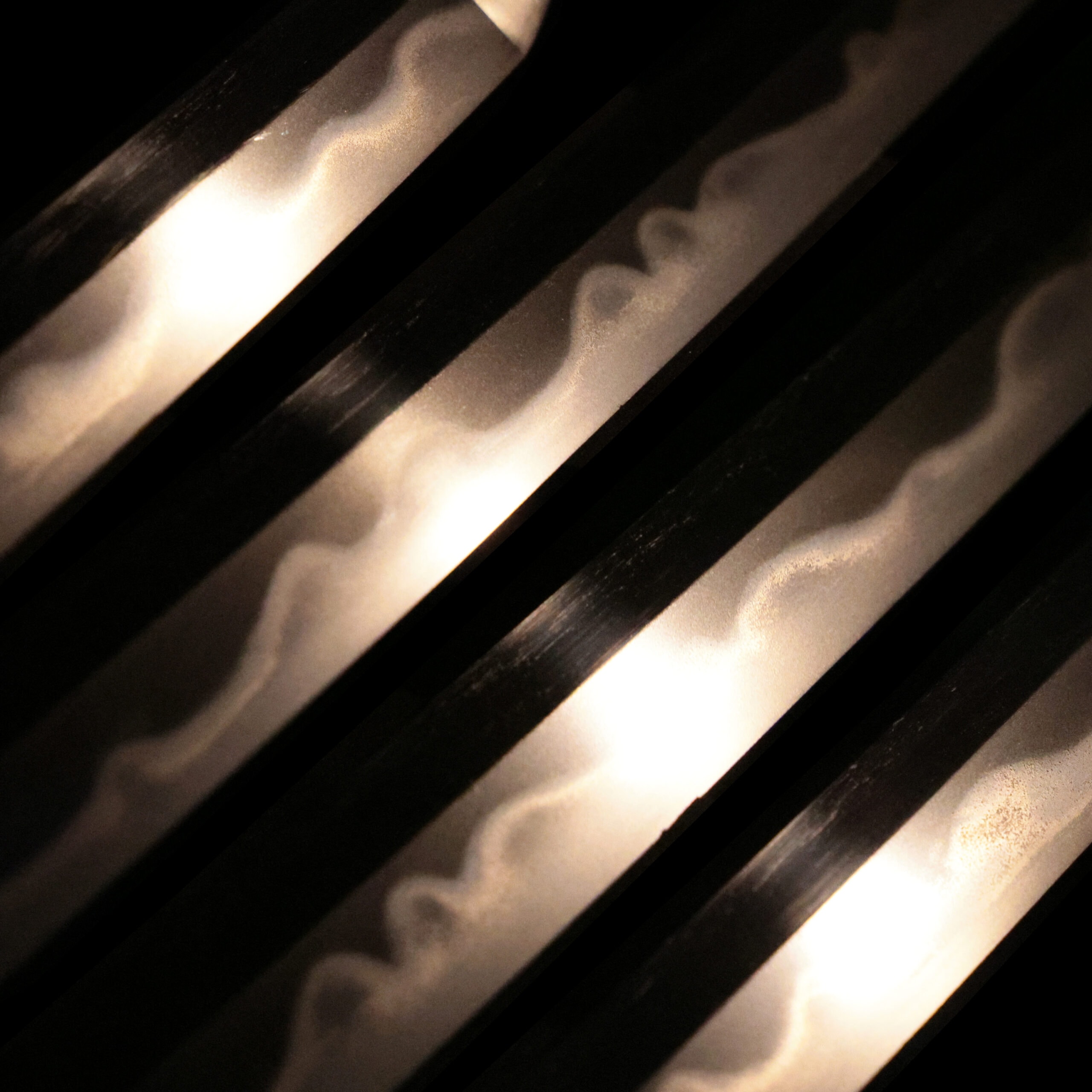
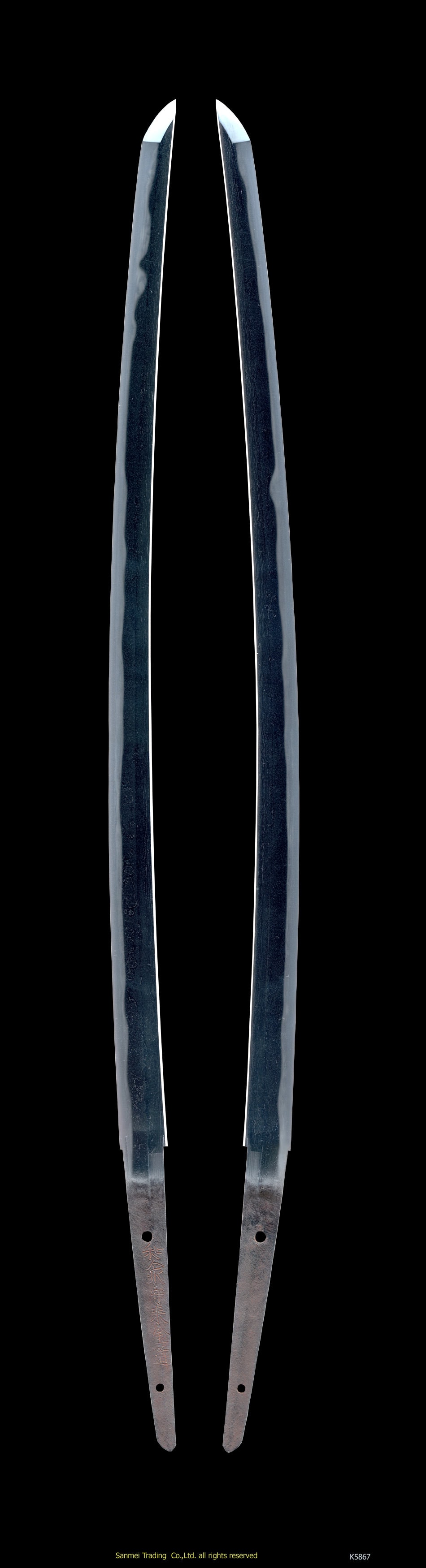
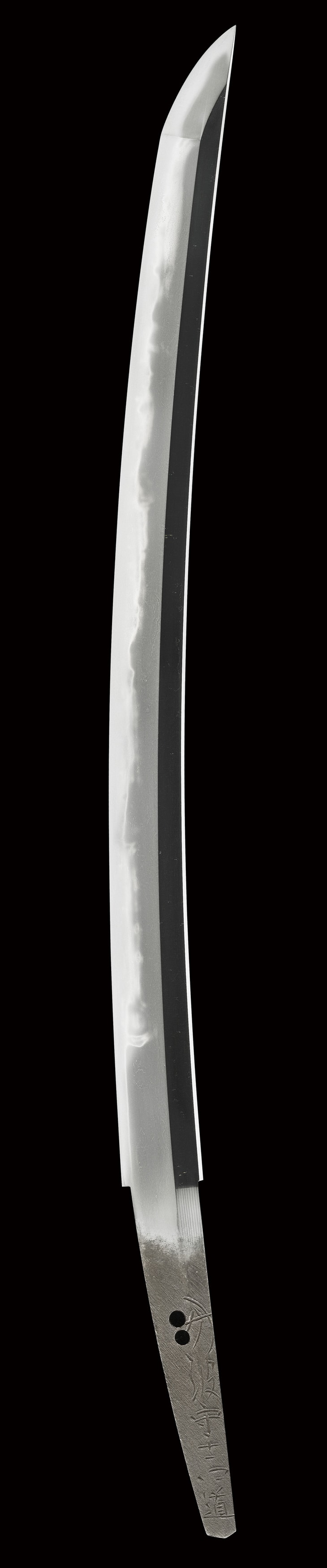
That manner is the , the bamboo-blind temper. Layered and are drawn through a and until the temper stripes into parallel bands like the slats of a hanging reed blind, and the published sources call it the school's hallmark, the Osaka-Tanba line handling it more often and more skilfully than any other style. On a wide, slightly elongated, thick- of Keicho- shape, the opens the temper with a long straight at the and then widens the above it, building over a base mixed with into a flamboyant large . Long, vigorous run through it, the layers in double and triple bands until it stripes into the , enter, strong gathers and clumps unevenly, long appear in places, and and are added. The rises shallow and pointed in a , swept with frequent into a flame shape and run down long. The published sources read the whole as bolder and more flamboyant than usual, of his hallmark style yet pressing on the work of the Kyoto .

The carries the temper. On the 's the is a compact mixed with , the adhering thickly and exceedingly fine, fine entering well, the flowing and standing a little in places. The itself is a study of its own. The published sources distinguish the 's straight from the broadening Osaka , noting that here the keeps an even width as it rises rather than spreading toward the upper blade, a point of recognition within the Osaka-Tanba hand. The slender assigned to the second generation shows the vocabulary in lower key, an tending to with , a large with and and resolving into , the a shallow, moist swept at the tip. The temper is the constant, the build and the strength of the the variables across the hands gathered here.

The name is read by hand and by signature rather than by a single dated chronology. The Osaka Tanba stands as the prime hand, his son Yamato no Kami Yoshimichi forms a parallel and contrasting one. On a wide with a clear difference between base and point width, Yamato no Kami forges not the family blind-temper but a in what the published sources call 「中河内風の丁子乱れ」, frequent entering, adhering, scattered, the a slight ending in ; at times a little of the family temper is mixed in, and rarely he works a rolling-wave manner within which are set, a range the sources liken to Ikkanshi. The published record judges this an outstanding example among his works, its somewhat stronger than on Nakagawachi pieces, and it notes his collaborative blades with the first and second Osaka Tanba Yoshimichi and with the second-generation Kawachi no Kami Kunisuke, by which the exchange among these Osaka smiths can be followed. The second-generation blade closes the descent: the published sources write that 「同工の特色ある簾刃を焼いて」 without vulgarity, sound in workmanship though slender in build.

Within the school the line is best placed by its own signature. The 's 「一派のお家芸である簾刃を最も得意としており」, and his straight, even and pointed, flame-swept distinguish his hand from the broadening Osaka of his neighbours and from the his own son preferred. Against the Kyoto he is most easily confused and most carefully separated: because the Osaka line cut no chrysanthemum crest while the Kyoto line did from the second generation on, the published sources give the character 守 of the signature as the decisive point, its 寸 element cut straight down on Osaka work and slanting on Kyoto work. The sources are honest about the line's later course, observing that 「代が下るに従って」 the manner grew more technical and more uniform, the temper settling toward a single pattern as the individuality of the founders thinned.

The Osaka is rated Jo- by Fujishiro, and four of these blades are held in the tier, none higher on this record. Provenance is sparse but distinguished: one blade descends through the Imperial collection, the kind of patrimony that is preserved rather than traded, and a second carries recorded provenance as well. There are no National Treasures or Important Cultural Properties on this record to speak of, and the holdings are modest in number, so a designated Osaka-Tanba Yoshimichi is not a blade that appears often. When one does, it is most often a or of the Keicho- build, and it comes to a private collection only from time to time and with patience. For a name carried by several generations to one signature, the surviving designated works are few enough that each is a documented point on the line rather than a routine example, and the on a sound blade remains the surest mark by which this Osaka branch of the school is known.
Kantei

a name-line read by hand and signature, not a single dated chronology: the corpus is the Osaka branch of the Mishina-Yoshimichi succession, so the published sources order it by who held the name. The Osaka Tanba shodai stands at the center, his sudare-ba the school hallmark; his son Yamato no Kami Yoshimichi forms a chronologically parallel hand whose temper leans to Nakagawachi-manner choji rather than sudare-ba; and a sudare-ba katana judged to the nidai shows the manner passing down. The signature itself is read, the published sources warning that the Osaka shodai is easily confused with the Kyo shodai and giving the 守 character as the decisive tell

Yoshimichi is the most celebrated name of the school, the Kyoto-rooted line whose first generation was a son of Kanemichi of Seki and brother to Iga no Kami Kinmichi and no Kami Masatoshi, the three together called master smiths of the lineage. This code gathers the Osaka branch of that name: the Osaka Tanba no Kami Yoshimichi, born Keicho 3 (1598) as the second son of the Kyo and styled 'emon, who moved to Osaka and founded the Osaka-Tanba line, together with his second son Yamato no Kami Yoshimichi ( Uemon) and a work judged to the nidai. The school's hallmark is the , the bamboo-blind temper in which layered and are drawn through a so the reads like the slats of a reed blind, and the Osaka line handled it more often and more skilfully than any other style. On the wide, , thick- of Keicho- shape the forges a compact with , fine and , begins the with a long , then widens it into a flamboyant that layers into the striped , with strong , , and , and a pointed, swept into a flame shape. The published sources distinguish the Kyo and Osaka lines by the character 守 and note that the Osaka line, unlike the Kyo line from the nidai on, cut no chrysanthemum crest.

Diagnostic discriminators

75% of his works

50% of his works

100% of his works

中河内

25% of his works · 3.0× vs the shodai's sudare-ba prime

Observation by phase

The Osaka Tanba shodai, the sudare-ba prime (the school hallmark at full power)

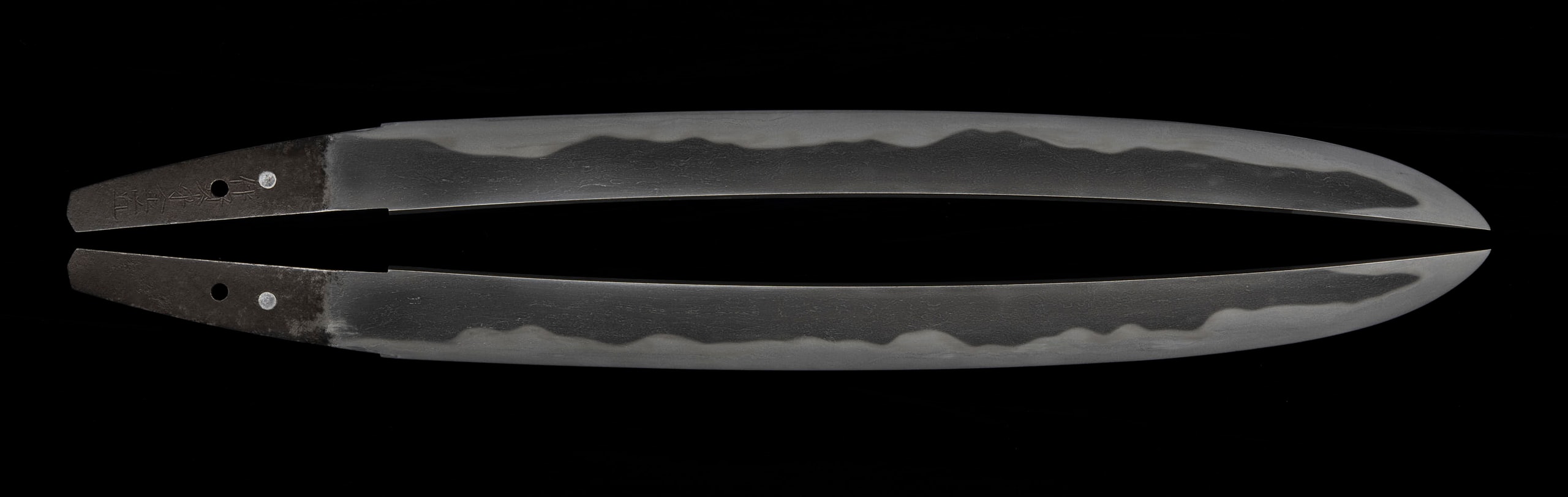
the wide, sun-nobi, thick-kasane hira-zukuri wakizashi of Keicho-shinto shape, signed Tanba no Kami Yoshimichi (Osaka shodai); the published sources note katana and wakizashi are common in this line while tanto are few and almost all work is shinogi- or hira-zukuri, and they set apart his sudare-ba yakidashi, which keeps a uniform width as it rises rather than broadening into the Osaka yakidashi

The 's prime is the Keicho- : wide in , slightly elongated, thick in , with and a somewhat deep . The is a dense mixed with , exceedingly fine adhering thickly and fine entering well, a flowing tending to and standing in places. The opens with a long at the ; above it the widens distinctly, and over a base mixed with the temper breaks into a flamboyant large . Long, vigorous are interwoven; layers in double and triple bands until it stripes and assumes the , the bamboo-blind temper that is the school's hallmark; enter, strong attaches and clumps unevenly, long appear in places, and and are added. The is a shallow that rises in to a pointed tip, swept with frequent into a flame shape and run down long. The published sources read the whole as more flamboyant than usual, the strong and the and conspicuous, a bold and unrestrained aspect that calls to mind the Kyo and presses on his father's achievement.

Sugata 姿
Jigane 地鉄
Hamon 刃文
Bōshi 帽子

Yamato no Kami Yoshimichi, the choji register (the Nakagawachi-manner hand)

the Yamato no Kami Yoshimichi signature, the shodai Osaka Tanba's second son, called Mishina Uemon and active around the Manji-Kanbun eras; the published sources record his collaborative works with the Osaka first and second Tanba Yoshimichi and the nidai Kawachi no Kami Kunisuke, evidence of the exchange among these smiths

Yamato no Kami Yoshimichi forges a different temper from the family hallmark. On a of wide with a clear difference between and and a , the is a tightly forged with . The is a mixed with , entering frequently, adhering, with here and there, and the is a slightly . The published sources place his style in the Nakagawachi manner of , with at times a slight admixture of the family's traditional temper, and note that rarely he works in a toran manner, though within those waves he mixes to show a working range akin to Ikkanshi. This is judged an especially outstanding example among his works, the somewhat stronger than on Nakagawachi pieces. The with carved on both sides is a feature of this hand.

Sugata 姿
Jigane 地鉄
Hamon 刃文
Bōshi 帽子

The nidai sudare-ba and the descent of the name (the manner passing down)

less firmly establisheda slender katana signed Tanba no Kami Yoshimichi judged to the nidai, set against the school context: the published sources state the shodai most often forged sudare-ba and rarely suguha, while as the generations descended the manner grew more technical and uniform, lacking individuality

On a slender of shallow and , the is tending to with , and the is a large with and , entering, that becomes ; the is a shallow with at the tip. The published sources name the first-generation Kyo Tanba Yoshimichi as a son of Kanemichi of Seki and one of the masters, note that his brothers Kinmichi and Masatoshi worked diversely while he most often forged the -like temper, and judge this blade the work of the nidai Yoshimichi, displaying the distinctive associated with this smith without vulgarity, the workmanship good though the build slender. It marks the boundary at which the school's hallmark is carried forward by the successors even as, by the testimony of the sources, the later hands settle toward a more uniform and mannered temper.

Sugata 姿
Jigane 地鉄
Hamon 刃文
Bōshi 帽子
Scholarship

The Kyo and Osaka lines are told apart by a single character: the published sources give the 守 of the signature as the decisive point, cut straight on Osaka work and slanting on Kyo work, because the Osaka line cut no chrysanthemum crest while the Kyo line did from the nidai on.

The sudare-ba yakidashi is itself a study: the published sources distinguish it from the Osaka yakidashi, noting that here the yakihaba keeps a uniform width as it rises rather than broadening toward the upper blade.

The nidai attribution is explicit: a slender katana with the distinctive sudare-ba is judged the work of the second-generation Yoshimichi, sound in workmanship though slim in build.

Designations

Kokuhō—
Jūyō Bunkazai—
Jūyō Bijutsuhin—
Gyobutsu2
Tokubetsu Jūyō—
Jūyō Tōken4

Elite Standing

0.02 across 6 designated works

Top 28% among smiths

Provenance

2 documented provenances across certified works by Yoshimichi

Provenance Standing

2 works held in elite collections across 2 documented provenances

Top 68% among smiths

Raw score: 1.92 / 10

Blade Forms

Distribution across 6 ranked works

Signatures

Signature types across 6 ranked works

Currently Available

Lineage

Yoshimichi
Students (14)
  1. 1.Yoshimichi吉道
  2. 2.Yoshimichi吉道
  3. 3.Yoshimichi吉道
  4. 4.Yoshimichi吉道
  5. 5.Yoshimichi吉道3 for sale
  6. 6.Yoshimichi吉道
  7. 7.Yoshimichi吉道
  8. 8.Yoshimichi吉道
  9. 9.Yoshimichi吉道
  10. 10.Yoshimichi吉道1 for sale
  11. 11.Yoshimichi吉道
  12. 12.Yoshimichi吉道
  13. 13.Yoshimichi吉道3 for sale
  14. 14.Yoshimichi吉道

Mishina School

Other artisans of the Mishina school

  1. 1.Kinmichi金道5 for sale23designated
  2. 2.Yoshimichi吉道3 for sale36designated
  3. 3.Masatoshi正俊5 for sale31designated
  4. 4.Kanemichi兼道1 for sale5designated
  5. 5.Eisen来栄泉3designated
  6. 6.Kinmichi来金道2 for sale1designated
  7. 7.Hisamichi久道5 for sale2designated
  8. 8.Kanemichi兼道1designated
  9. 9.Kanemichi兼道1designated
  10. 10.Kanemichi兼道1designated
  11. 11.Masatoshi正俊5designated
  12. 12.Kanemichi兼道2designated