The Shintō era was largely invented in Kyōto: Umetada Myōju’s workshop trained the movement, Horikawa Kunihiro raised a generation, and the Hon’ami appraisers, who held no forge, governed the meaning of famous blades.
 NihontoWatchNihontoWatch
Shinto Yamashiro, early Edo, Wazamono, with koshirae. Hira-zukuri, low iori-mune. Kitae, ko-itame with itame, mixed with nagare-kokoro hada and standing out, ji-nie attaches thickly, chikei enters, jitetsu is good. Hamon, gunome-midare with choji, ko-gunome, mixed with slightly hako-gakkata ha, the habuchi has ara-nie and is very sae, inside the ha there are gunome-ashi, kinsuji and sunagashi appear frequently, there are fine tobiyaki in the ji. Boshi, notare-konde, the tip is slightly togari-gokoro with hakikake and kaeru. Nakago ubu, tip is kurijiri, yasurime is o-sujikai. Copper with kin-kise habaki. Period polishing. In shirasaya. With wakizashi koshirae (total length 61, late Edo, saya: black ro-saya, shakudo ishime-ji, suemon kin-zogan, kiri-mon design sageo, light brown and dark green; tsuka: oyasame with black tsuka-maki; fuchi-kashira: shakudo kenma-ji takabori iroe, design of herons; dashi-menuki: shakudo katachibori kin-iroe, unknown; tsuba: shakudo kenma-ji, sukesage-bori, kebori, kin-iroe, design of bats; kin-kise seppa). Kunimichi was born in Tensho 4, a high-ranking disciple of Horikawa Kunihiro, and is a master smith with two Important Cultural Properties and five Important Art Objects to his name. His first mei was "Kunimichi" (国道), and based on points such as his use of the character "michi" (道) like Iga no Kami Kinmichi and Tanba no Kami Yoshimichi, and his use of the character "Rai" as a prefix in his late years to sign "Rai Kunimichi"—a character not used by anyone outside the Mishina lineage at that time—it is said he had deep connections with the Mishina smiths; in particular, it is known he had a very close relationship with Etchu no Kami Masatoshi. It is attributed that he received the title "Dewa no Daijo" around Keicho 19 when his master passed away, and until then he signed "Heianjo-ju Kunimichi" and similar. His period of activity was from the middle of Keicho to around the first year of Kanbun; dated works are very few. Among the Kunihiro school, he was the most versatile person and mastered each denpo, but perhaps due to the influence of the Mishina smiths, he was particularly skilled in Mino-den, and among those, many masterpieces aiming for the Shizu style remain; rarely, there are also skillful horimono such as Kurikara, Fudo Myoo, Nobori-ryu, and so on. This work has no nenkisaku, but from the style of the mei, it is appraised as a work from around Kan'ei, when the smith was in his fifties. A hira-wakizashi with dimensions of 1 shaku 2 sun 6 bun, it has an elegant and supple style with a length extended relative to its mihaba. On the slightly zanguri jitetsu characteristic of Horikawa-mono, he has skillfully tempered a blade full of the spirit of the Shizu style. There is a little kitae-hada in the ji, but the ha works intensely, making this a very charming and typical work of the smith.
Offered by Samurai Nippon

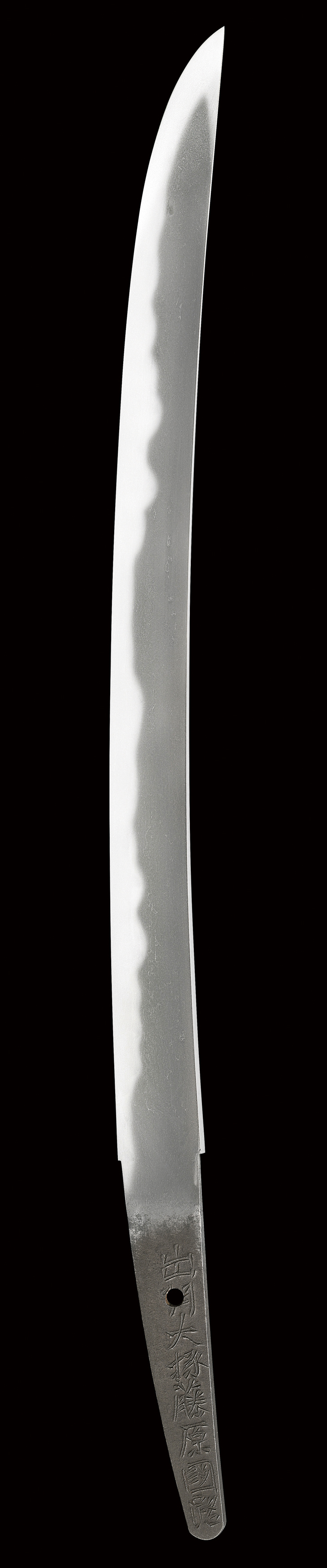
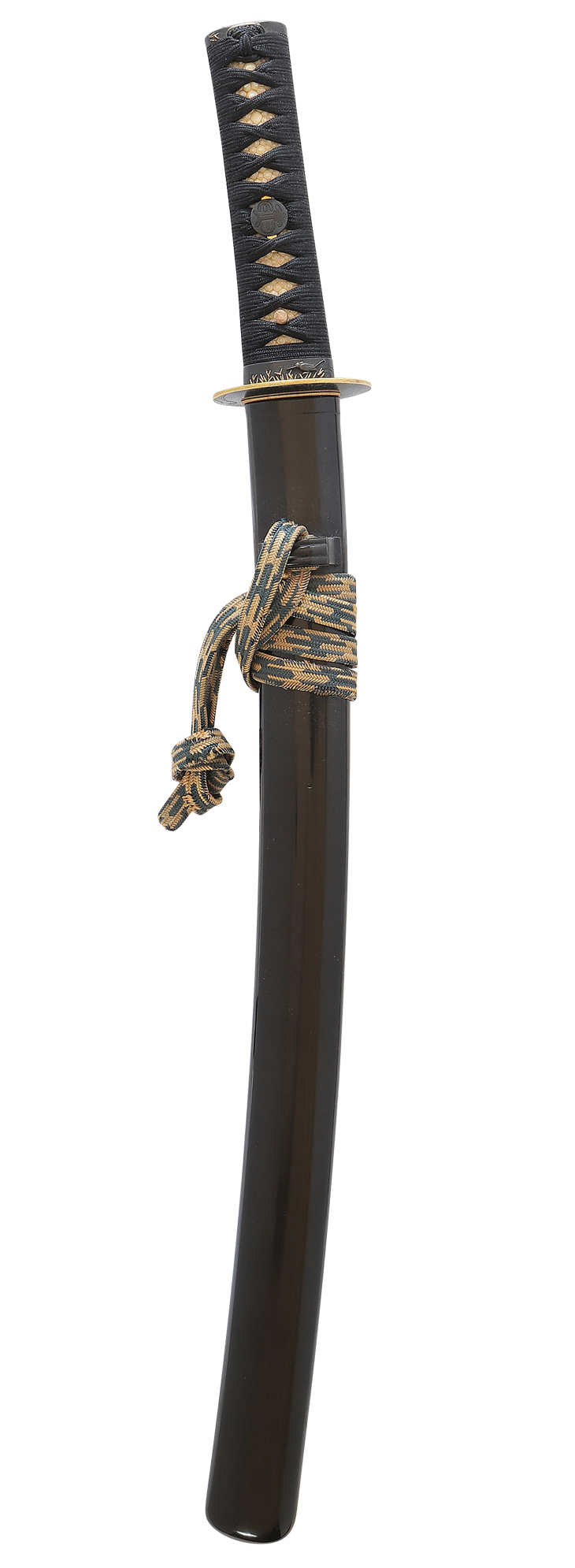
Machine translation of the shop's Japanese ·
Machine translation from the shop's Japanese · may contain errors ·
Shinto · Yamashiro
65 pieces on the market now
At Ichijo Horikawa in Kyoto, from Keicho 4 (1599), Horikawa Kunihiro gathered the pupils whose work the published sources name with his own as the opening of the shinto age. Kunihiro himself reached forging late and by a roundabout road. Born Tanaka and serving as a warrior under the Ito of Obi castle in Hyuga, he wandered the provinces after that house fell, forging where he stopped, his earliest dated blade cut in Hyuga in Tensho 4 (1576); his itinerant Tensho-uchi looked to late Soshu and late Seki, often run toward a hitatsura-like effect over devotional carving. The settlement in Kyoto changed that. There his stated aim, the sources write, lay in the revival of the Soshu-den tradition, the leaning strongest toward Shizu, and around that ideal he trained the men who carried his manner forward: Dewa no Kami Kunimichi, Kuniyasu, Osumi no Jo Masahiro, Echigo no Kami Kunitomo, the elder Kunisada and Kunisuke, with later and minor hands reaching Settsu, Echizen and Edo. Many of them, born like the master at Obi, followed him from Hyuga to the capital. The shared vocabulary is read first in the steel. The school forges an itame mixed with mokume that stands up, the grain raised into the loose, granular surface the commentaries name outright, the zanguri hada particular to Horikawa work, with ji-nie lying thick and chikei entering; on many blades a mizukage rises obliquely from the machi. Over that ground the prime manner is the Keicho-shinto sugata, wide with little taper and an extended chu-kissaki or o-kissaki, the build likened to a Nanbokucho odachi cut down, tempered in a notare and gunome with thick nie, sunagashi and long kinsuji, the nioiguchi often sinking into shizumi. Within that frame the pupils diverge sharply.
Kunimichi runs the flamboyant Shizu copy fully out and turns his boshi pointed in the Mishina manner, the Sanpin boshi the school otherwise does not show. Masahiro keeps the same Soshu-den worked at lower temperature, his temper calm and his mokume conspicuous; Kuniyasu and Kunitsugu stand closest of all to the master and signed for him. Kunitomo turns alone toward late Seki, his gunome round-headed and his chisel the finest in the group, and the elder Kunisada and Kunisuke carry the zanguri steel south into Osaka, the latter keeping the Ishido clove he was born to. Hiroyuki holds suguha over a blackish steel that recalls old Yamato, and the two Echizen Kunikiyo forge a dark, dense hokkoku-gane under a calm chu-suguha. A collector seeks Horikawa because the school stands at a hinge: Kunihiro is read as the first hand of the new-sword age, and the line he taught runs forward into the Osaka tradition through Kunisada and Kunisuke and into Echizen through Kunikiyo. To kantei the work, read the steel first, the standing zanguri surface and the oblique mizukage, then the sinking nioiguchi and the Soshu-revival notare with its sunagashi and kinsuji; the individual hand declares itself in the departures, Kunimichi's pointed boshi, Kunitomo's Seki gunome and compact tang, Kuniyasu's reversed file marks and two-character mei, Hiroyuki's kiri-yasuri. The founder and his closest pupils sit at the top of the line, Kunihiro signing almost everything he made, the large kata-ochi two-character mei beside his long residence signatures; because Kuniyasu, Masahiro, Kunitsugu and Hiromi worked as his daisaku, a share of the blades signed Kunihiro are in fact theirs. Provenance runs through the houses of the founder's own story and of the country, the Hyuga Ito he had served, the Shimazu of Kagoshima, the Imperial Family and Toyotomi Hideyori, with the tachi Kunihiro dedicated to the Hataeda Hachimangu still in the shrine's keeping. A signed Horikawa blade reaches a private collection only from time to time, carrying on its nakago the hand with which the new sword begins. Learn more →
| Smith | Era | Designated |
|---|---|---|
| Kunihiro國廣 | 1573-1613 | 147 |
| Kunimichi國路 | 1615-1624 | 75 |
| Kunisada國貞 | 1624-1646 | 87 |
| Kunitomo國儔 | 1596-1615 | 27 |
| Masahiro正弘 | 1596-1615 | 16 |
Kyōto: the revival workshop
The Shintō era was largely invented in Kyōto: Umetada Myōju’s workshop trained the movement, Horikawa Kunihiro raised a generation, and the Hon’ami appraisers, who held no forge, governed the meaning of famous blades.
A Hozon-certified blade judged to show notably superior workmanship and a better state of preservation. The bar is higher: re-tempered blades and most unsigned Muromachi/Edo works are excluded.
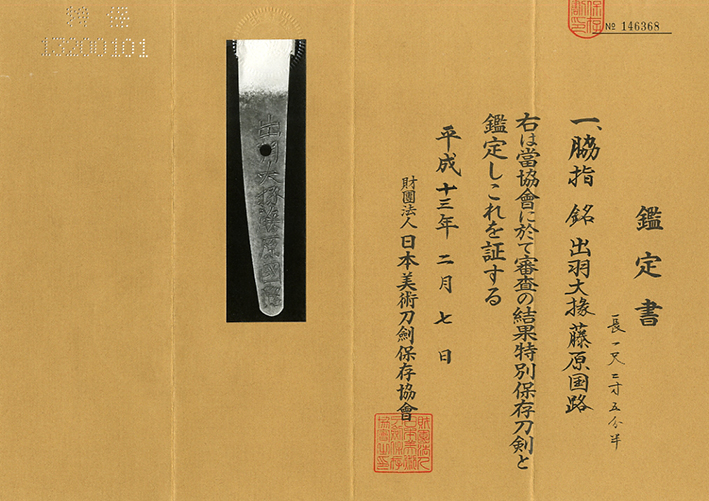
The NBTHK (Nihon Bijutsu Tōken Hozon Kyōkai, the Society for the Preservation of Japanese Art Swords) is a public-interest incorporated foundation founded in 1948 and supervised by Japan’s Agency for Cultural Affairs (Bunkachō); it is based at the Japanese Sword Museum in Tokyo. Its expert panels physically examine each submitted work (shinsa) and issue a certificate (kanteishō) ranking it by artistic and historical merit. NBTHK papers are the most widely recognized standard of authentication for Japanese swords and fittings.
NBTHK official siteFor one-of-a-kind items such as swords, sword fittings and antiques, other customers may be waiting for the item, so please contact us about a return within 3 days of its arrival and ship it back within 8 days. Refunds are made on the day the returned item arrives.
Certificate reading — 銘 出羽大掾藤原国路