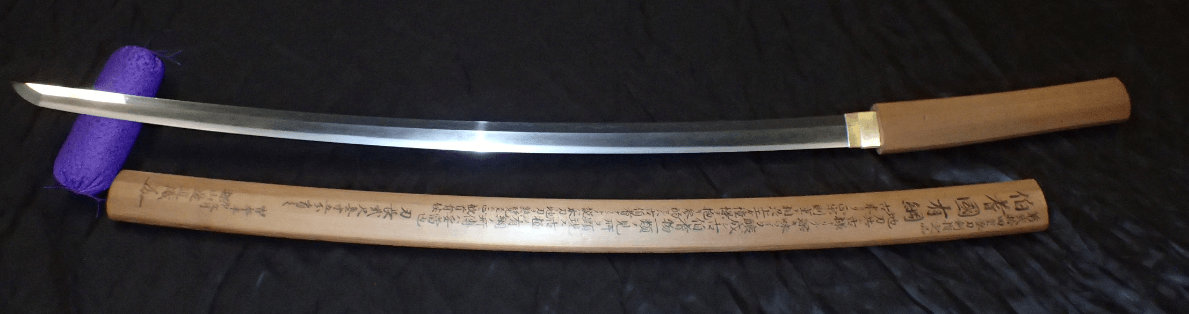
Ohara Sanemori (大原真守) of Hoki Province is traditionally transmitted as a son of Yasutsuna, the founding figure of the Ko-Hoki school. Together with related smiths--Aritsuna, Sadatsuna, Yasuie, and Sanekage--this group flourished from the late period into the early period. Sanemori's signed works employ a comparatively long inscription, characteristically a six-character cut with a thick chisel, of which the variant closely resembling the preserved at Wakayama Toshogu (Important Cultural Property) is the most frequently cited. Extant signed works are "exceedingly rare," and the several signature variants make definitive authentication a continuing subject of study.
The consistently distinguishes Ko-Hoki from contemporaneous , noting that while both schools temper predominantly small-pattern , "upon closer examination their character differs somewhat." Sanemori's is mixed with , with the grain tending to stand; fine adheres, enters, and -like textures are intermingled with standing out. A defining feature is that "the steel often takes on a blackish tone." His is based on mixed with , , and --"overall a fine-patterned irregularity"--with and entering well. The tends toward (a moist, soft quality) and at times shows (subdued character), while , , and appear with frequency. The is typically to , and carved works--placed characteristically at the --include , , and , providing "valuable material for understanding the distinctive nature of Sanemori's carvings." Within the Ko-Hoki group, Sanemori's tempering is noted for presenting "somewhat smaller-scale patterns of irregularity" compared to Yasutsuna.
The repeatedly invoke an atmosphere of "archaic, artless dignity" and "rustic, provincial flavor" when describing these works, a quality that "in one vein recalls Kuniyasu and Ayanokoji Sadatoshi." The classical --slender, with , high , and --is described as appearing "more frequently in this smith's work" than in his father's. Multiple blades bear the addendum character "Katsu" (勝) on the of the , a feature of unknown meaning that is "valuable as documentary material," also recorded in the Tsuchiya .