 NihontoWatchNihontoWatch
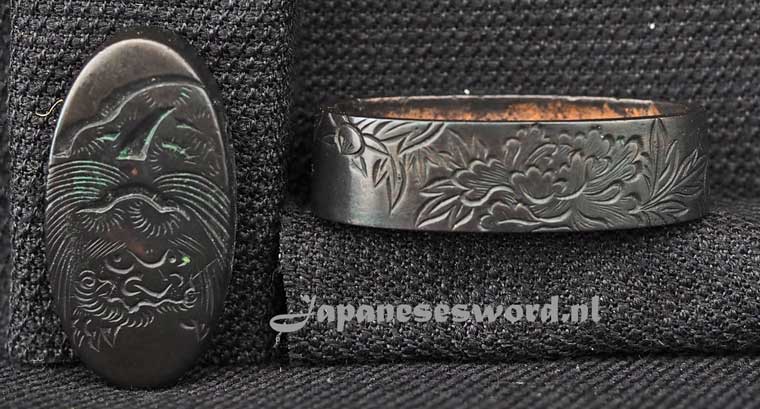
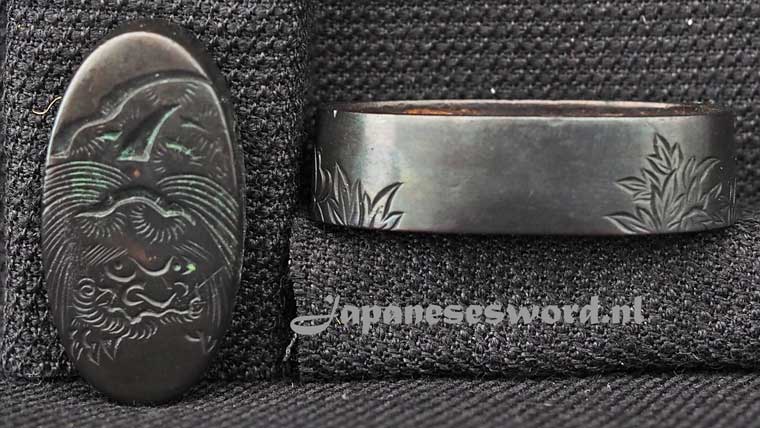
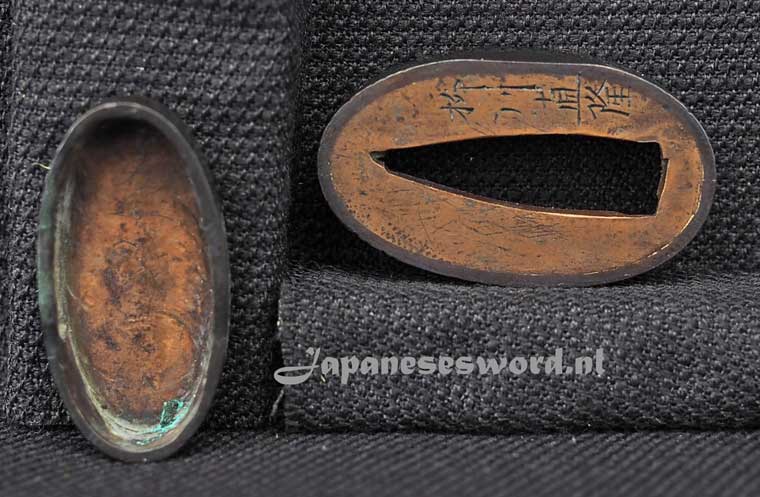
uit privé collectie : Edo periode Fuchi kashira van Yamagane / Sentuku in Katakiri bori grafeer techniek met ShiShi-Lion en Pioenroos motief , Gesigneerd YANAGAWA NAOTAKA van de Yanagawa School goede conditie 3.7 x 2.2cm.
NihontoWatchOffered by Japanszwaard
We couldn’t find current papers for this piece. Ask the dealer whether it has been, or can be, submitted to shinsa. — Hoshi
Yanagawa
Edo
Signed
Machibori · Edo
59 pieces on the market now
The Yanagawa (柳川) school ranks among the principal machibori ("town carving") lineages of Edo metalwork, arising in the mid-Edo period as a direct offshoot of the Yokoya house. Its founder, Yanagawa Naomasa (1692–1757), studied under Yoshioka Inaba-no-suke and under Yokoya Sōmin, and established himself in the Otamagaike district of Edo. The NBTHK setsumei consistently locate the school within this filiation, styling it "the Yanagawa branch within the Yokoya lineage" (横谷門下柳川派) and naming Naomasa as the family founder (家祖). Naomasa had no biological heirs and devoted himself to the training of disciples, and the successive heads of the house inherited the character nao (直). " The collective idiom of the school is the classic Yokoya-derived vocabulary of Edo kinkō work: grounds of shakudō (赤銅) dressed in nanako-ji (魚子地), high-relief carving (takabori) — frequently executed as applied motifs (suemon) — and polychrome inlay (zōgan iroe) in gold, silver, and shibuichi, deployed across kozuka, kōgai, fuchi-kashira, menuki, and tsuba. The school was likewise renowned for excellent katakiribori (single-cut carving), and its repertoire favored classical subjects: shishi (lions) with peonies, tigers, Chinese sages, and figural themes such as the Seven Lucky Gods.
Fidelity to the manner of Sōmin remained the school's touchstone across generations. " Equally characteristic is the school's mode of transmission, whereby pupils composed their art-names from characters granted by the Yanagawa masters. The measure of the Yanagawa school's significance lies as much in what it engendered as in its own production. Ishiguro Masatsune, a pupil of Katō Naotsune of the Yanagawa school, formed his name by combining masa (政) from Naomasa and tsune (常) from Naotsune; the setsumei record that he "moved beyond the manner of the Yanagawa school, devising innovative treatments particularly within bird-and-flower subjects," founding the Ishiguro lineage, which "continued to prosper through successive generations until the Meiji period" and produced the celebrated "twin peaks" Masayoshi and Masaaki. " Through these ramifying lines, the Yanagawa school served as the essential conduit by which the Yokoya manner of takabori iroe on shakudō nanako-ji grounds was disseminated across the late-Edo metalworking world. Learn more →
| Smith | Era | Designated |
|---|---|---|
| Haruaki春明 | — | 18 |
| Naoharu直春 | — | 7 |
| Naomasa直政 | — | 5 |
| Akinori/Meijo明乗 | — | 0 |
| Akio明雄 | — | 0 |
We could not find an authenticity certificate on the seller’s listing. Japanese swords and fittings are normally papered by the NBTHK (or the NTHK). Without one, the attribution is the seller’s own assessment and has not been independently verified — treat it with caution and ask the dealer about certification before buying.
Swords only: if a sword does not match the description, the buyer must report it by e-mail within 48 hours of receipt, after which the sale is final. Returns only after agreement, safely packed and in exactly the condition delivered; the refund is the purchase price minus shipping/transport and bank costs, and return shipping and its risk are for the buyer. Consignment items carry no guarantee and cannot be returned.