War at home and trade abroad made Muromachi Bizen the busiest forge region in Japan: a century of Sengoku demand after the Ōnin War, and export missions to Ming China carrying blades by the tens of thousands.
 NihontoWatchNihontoWatch
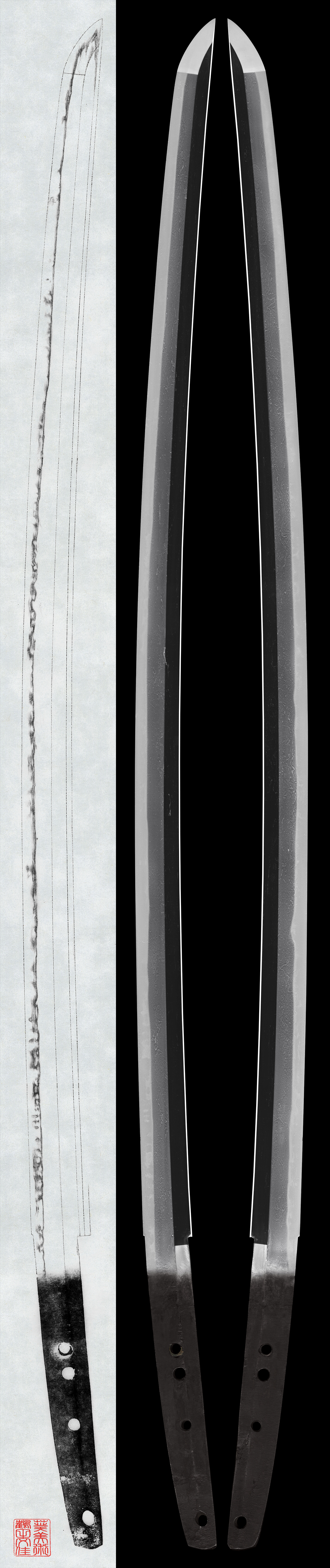
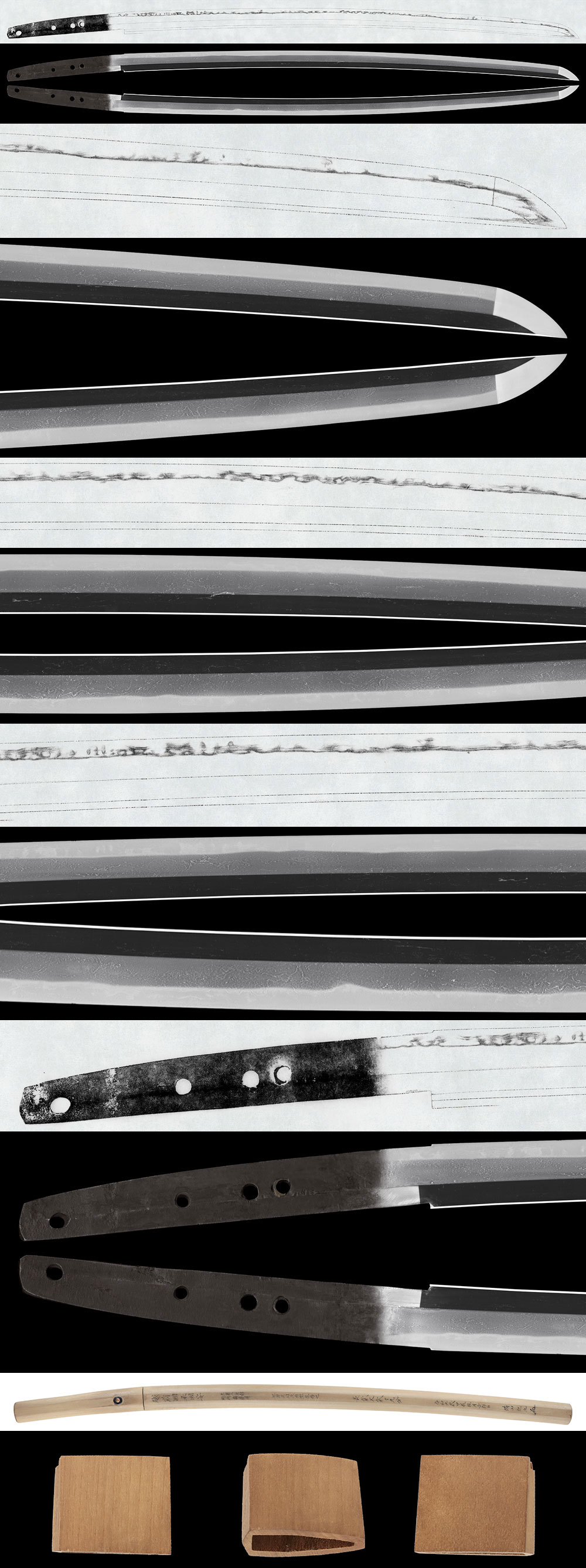
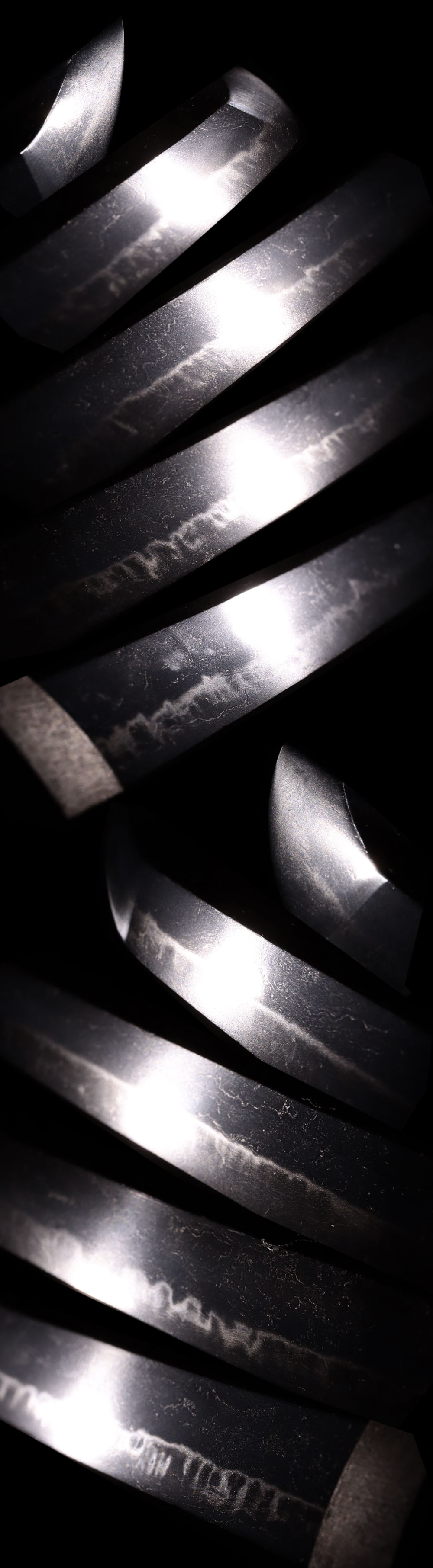
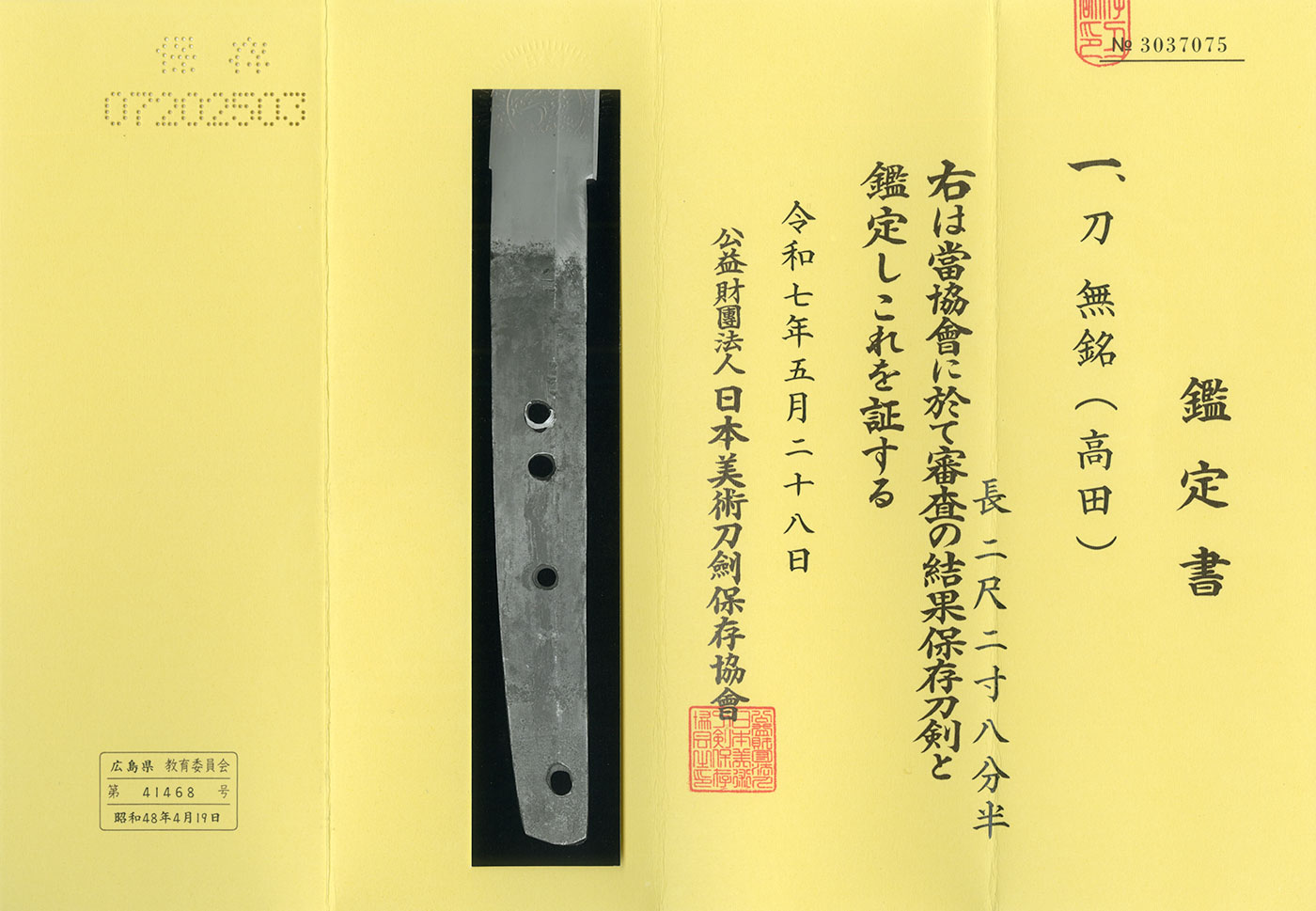
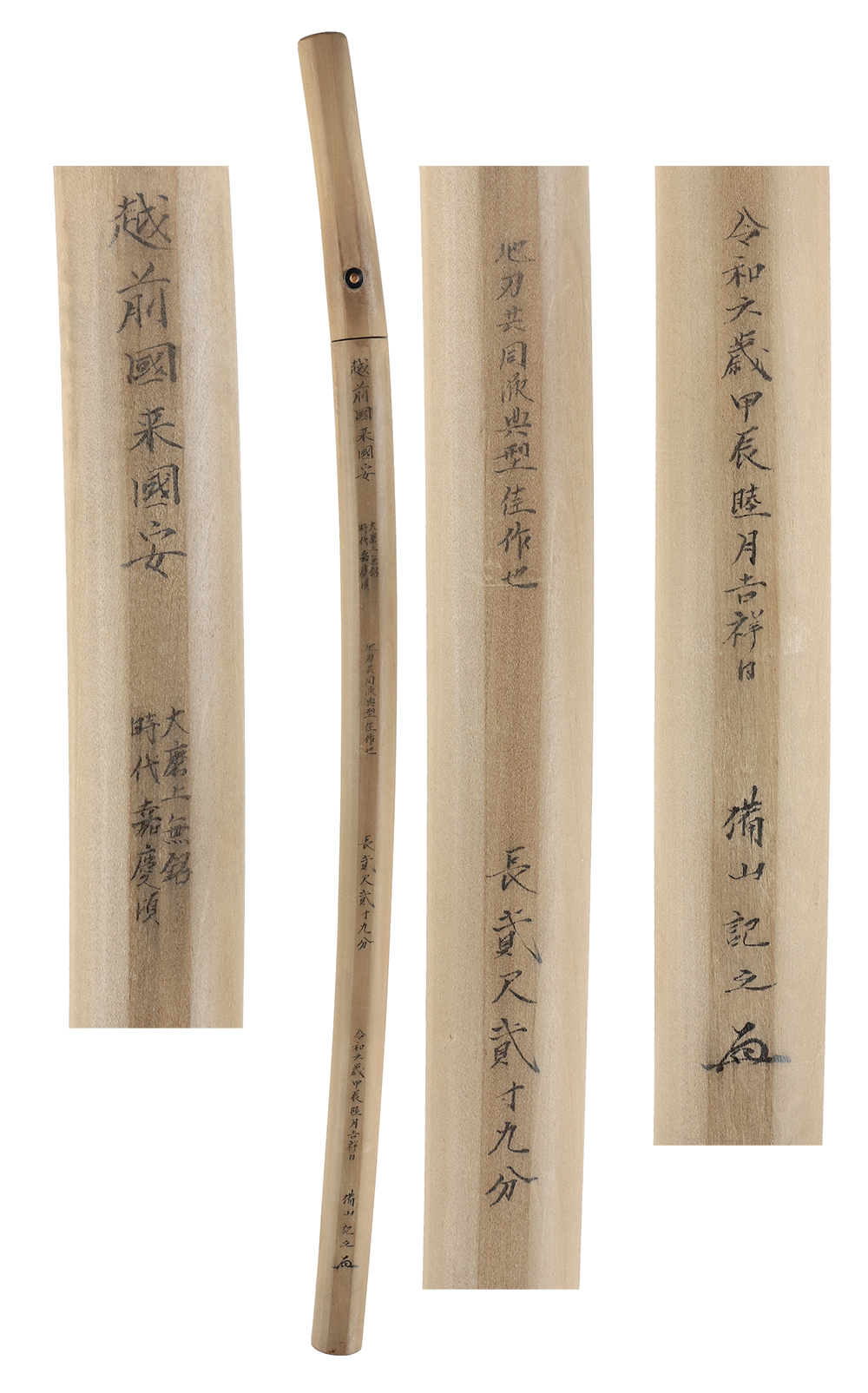
Katana in Shirasaya (NBTHK Hozon Token) (We divide 4 sections for each sword as Saijyo Saku, Jyojyo Saku, Jyo Saku and Regular Saku). This blade is ranked as Jyojyo Saku amongMumei (Attributed to Takada) swords. Shape: Suriage mumei (shortened and unsigned). Jigane: Well-forged ko-itame hada with a slightly pronounced grain pattern. Hamon: Suguha with abundant ashi activity. The boshi forms a rounded tip with a turnback. Features: This is an unsigned blade from the Muromachi period, attributed to the Takada school. Occasionally, we encounter exceptionally fine unsigned Takada blades whose workmanship is so outstanding that they could be mistaken for works of the Ichimonji school. This demonstrates the high quality of workmanship often found among unsigned Takada blades. We believe this particular sword was most likely made around the Bunmei era (1469–1487). Historical Background: In 1467, the first year of the Onin era, Japan entered a period of prolonged conflict during the Muromachi period. Disputes over succession to the Ashikaga shogunate, inheritance struggles within powerful daimyo families, and rivalries among influential military leaders developed into a major civil war that lasted approximately 11 years. This conflict eventually paved the way for the Sengoku (Warring States) period. Main Events of the Onin War: - Causes of the Conflict: The succession dispute involving Shogun Ashikaga Yoshimasa coincided with a power struggle between Hosokawa Katsumoto, the Kanrei (shogunal deputy), and Yamana Sozen (Mochitoyo), a powerful shugo daimyo. - Two Rival Armies: Daimyo from across Japan were divided into the Eastern Army, led by Hosokawa Katsumoto, and the Western Army, led by Yamana Sozen. - Devastation of Kyoto: Kyoto became the principal battlefield, with numerous temples and residences destroyed by fire, leaving large parts of the city in ruins. NBTHK Hozon Token.
Offered by Aoi Art

Machine translation of the shop's Japanese ·
Bizen-den · Bungo
31 pieces on the market now
In Bungo Province on Kyushu, the early Kamakura masters Sadahide and Yukihira appeared and then, for a span, distinguished makers ceased; the setsumei repeatedly mark this gap before the line that became the Takada school took hold. The school was founded in the Nanbokuchō period by Tomoyuki, who arose at Takada Manor (Takada-shō) and signed in the long form "Hōshū Takada-shō Fujiwara Tomoyuki," with dated work surviving from the Shōhei (1349) and Jōji eras into the 1360s. Beside him the registers place Tokiyuki, said to be his son or disciple, and Masayuki, thought to belong to a separate line, whose Kentoku 2 (1371) tantō carries Southern Court dating and a Kurikara relief following the example of Yukihira. From these Nanbokuchō roots the lineage ran continuously through Muromachi and on into the shintō era. The naming itself tracks the periods: Nanbokuchō smiths prefixed Fujiwara; from Muromachi they signed Taira and shared the characters 盛・守・鎮・統, so the group is broadly called Taira-Takada (Heike or Hira-Takada); late in the line they returned to Fujiwara, and that stream, carried into the Edo period, is distinguished as Fujiwara-Takada. Named Muromachi hands in the setsumei include Taira Naomori (a ken dated Ōnin 3, 1469), Taira Nagamori, Takada Tatemori (Meiō 10, 1501), Taira Shizunori, and Fujiwara Shinkiyo. Across the blades a consistent vocabulary recurs. The jihada is itame mixed with mokume, frequently tending toward standing grain (hada-dachi) and, in the early work, drifting toward masame or nagare; ji-nie and chikei appear, the steel often carries a darkish kanagu tone with patches of jifu, and a whitish shirake-utsuri (sometimes a faint midare-utsuri) stands out conspicuously.
The temper runs from suguha and chū-suguha mixed with ko-gunome up to gunome-midare, with nie adhering and ashi and yō entering; kinsuji and sunagashi run through, and in fuller-tempered work tobiyaki, muneyaki and hitatsura develop (as in Nagamori's Eishō wakizashi). Founder-period Tomoyuki work is recognized by angular gunome spaced at wide intervals, an overall subdued (shizumi) impression, strong shirake with jifu, and a manner the setsumei liken to Sue-Sa and the Samonji group; the school as a whole shows Bizen-leaning utsuri, Yamato-tinged masame and nagare, and at its summit, in Shizunori, work judged to take Rai Kuniyuki as its model. Branch and period read off the signature prefix and the shape: deep curvature with an arched, upturned profile through mid-Muromachi, then broader blades with shallower sori and an extended chū-kissaki in the later phase. " Among the smiths the setsumei single out Nagamori as the most accomplished of the Heike-Takada, a suguha specialist with notably good jigane and skilled horimono, his name carried across several generations and dated freely in the Eishō and Daiei eras; one of his blades was bestowed by Shimazu Tsugutoyo of Kagoshima on the retainer Honda Chikaaki, and Tatemori is rated near him. The line reached into early shintō through Kunifusa, a disciple of Shizumasa of Takada who moved to Uwajima in Iyo, served Date Hidemune, and worked in a Horikawa manner. Provenance runs through the descriptions: Masayuki's tantō was transmitted in the Shōnai Sakai family with a Hon'ami Kōchū origami of Kyōhō 6 and recorded in the Kōzan oshigata and Umetada Meikan, and Nagamori's tachi survives with a maki-e and raden scabbard. The cutting-oriented robustness of the work, weighty in hand with thick kasane and a sturdy build, reflects the taste of an age of warfare, and these blades served as practical arms across Kyushu. The setsumei are candid that Takada has drawn a generally low evaluation in the field, and several of the registered pieces are framed expressly as answering that judgment, restoring the standing of a long lineage on the strength of its best surviving work. Learn more →
| Smith | Era | Designated |
|---|---|---|
| Tomoyuki友行 | 1350-1367 | 15 |
| Kunifusa國房 | 1615-1624 | 5 |
| Akiyuki鑑行 | 1532-1555 | 0 |
| Kagenari景也 | 1661-1673 | 0 |
| Chikayuki及行 | 1661-1673 | 0 |
Bizen in the Muromachi period
War at home and trade abroad made Muromachi Bizen the busiest forge region in Japan: a century of Sengoku demand after the Ōnin War, and export missions to Ming China carrying blades by the tens of thousands.
Certifies a genuine blade worth preserving: a signature confirmed correct, or, if unsigned, an era, province, and school that the NBTHK can reliably identify.
The NBTHK (Nihon Bijutsu Tōken Hozon Kyōkai, the Society for the Preservation of Japanese Art Swords) is a public-interest incorporated foundation founded in 1948 and supervised by Japan’s Agency for Cultural Affairs (Bunkachō); it is based at the Japanese Sword Museum in Tokyo. Its expert panels physically examine each submitted work (shinsa) and issue a certificate (kanteishō) ranking it by artistic and historical merit. NBTHK papers are the most widely recognized standard of authentication for Japanese swords and fittings.
NBTHK official siteIf you wish to return an item, please notify us within 3 days of receipt. After this period we cannot accept cancellations. Please ship the return to us within 5 business days. Cancellation is conditional on the item being kept in the same condition as at the time of sale, so please handle it with care.