Perry’s arrival in 1853 unraveled the Tokugawa peace and created the first mass demand for working swords in two centuries. Kiyomaro, called the Masamune of Yotsuya, died on its eve; Munetsugu and Yukihide carried the boom to the end.
 NihontoWatchNihontoWatch
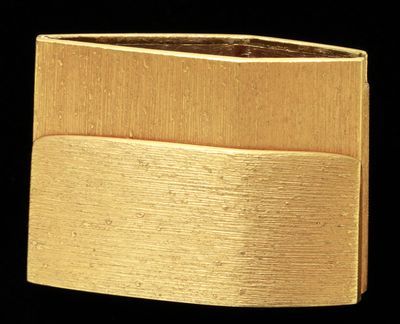
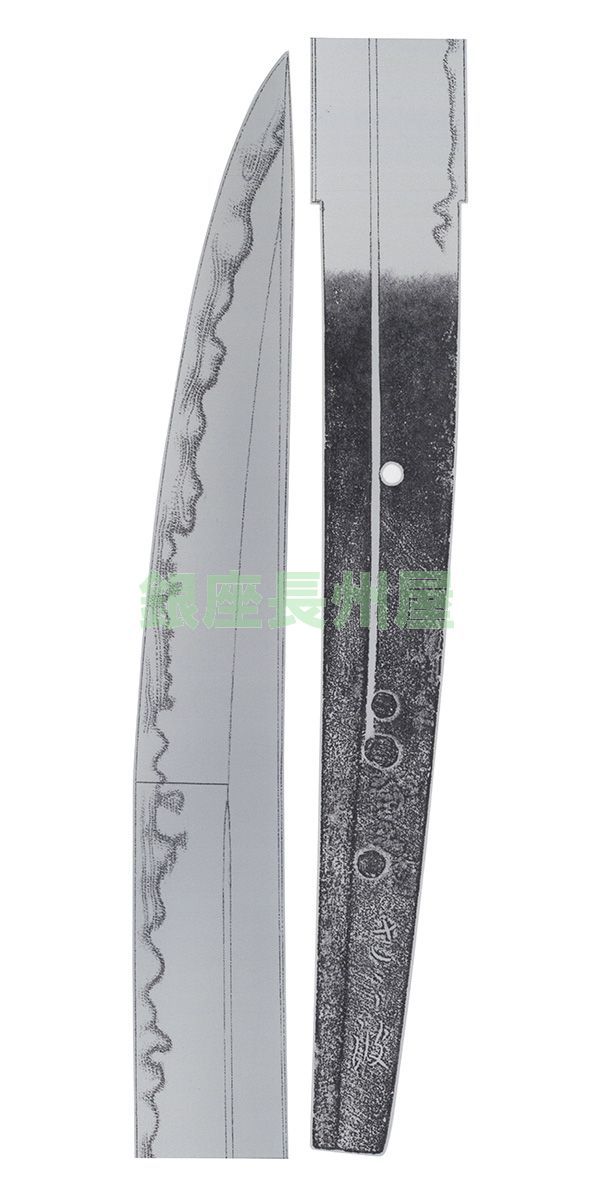
A grand and powerful sword that calls to mind the nagamaki of Shizu Saburo Kaneuji from the Nanbokucho era, or perhaps the Hojo-ji school of Tajima Province. It is wide with little difference between the moto-haba and saki-haba, the meat of the shinogi-ji has been scraped away making the mune-kasane extremely thin, and the kissaki is greatly extended and sharp. A structural test was performed, and because it cut without a sound, a go-mei likening its outstanding sharpness to "Sazanami" (rippling waves) has been engraved. The jigane shows a strong flowing masame in the shinogi-ji, while the hiraji mixes itame with moku and flowing textures where chikei writhe; granular jinie attaches thickly with moisture, creating a powerful, fresh, and vivid texture. The brightness of the yakiba is exceedingly high, changing in a wild and magnificent manner with gunome mixed with choji, pointed ha, and angular ha; bright snow-like nie attaches, and long kinsuji run through the thick ashi and the nie within the ha, crossing the yokote and avalanching into the kissaki. The boshi is violently midare-komi and becomes yakitsume. It is a heart-stirring sword with a powerful sugata and clear ji-ha. This sword was originally a prized possession of the Shizuoka Prefecture collector Yabe Toshio (Note 1), who believed it to be a sword by Shizu Saburo Kaneuji, but it was appraised as "Kiyomaro" (Note 2) in a Tokubetsu Kicho Token shinsa in Showa 34. The outstanding state of preservation, the moisture and clarity of the ji-ha, and the violent kinsuji can certainly be seen as Kiyomaro, though the owner was convinced it was a work of the Nanbokucho era. In today's appraisals, it is attributed to Kiyomaro's older brother Yamaura Masao, but the workmanship of both is identical, and this work is close to Kiyomaro. In an era when mumei Shizu, Samonji, or Hojo-ji swords were more expensive than swords with a Minamoto Kiyomaro mei, perhaps the mei and ura-nenki of Minamoto Kiyomaro were removed; this is a matter of great regret. Note 1... Yabe Toshio was one of the leading sword lovers in the country, possessing numerous famous swords including the National Treasure Ichimonji tachi bestowed by Oda Nobunaga upon Okudaira Nobumasa, who defended Nagashino Castle against the fierce attack of the Takeda army in the Battle of Nagashino. Note 2... A Tokubetsu Kicho Token certificate issued on October 4, Showa 34 exists, stating "O-suriage mumei den Kiyomaro, with a kiritsuke-mei reading Sazanami."
NihontoWatchOffered by Choshuya








Machine translation from the shop's Japanese · may contain errors ·
Yamaura (Kiyomaro circle, Shinano) · Shinano · around 1844-1866
Tōken Taikan top 21%
1 piece on the market now
Yamaura Masao (山浦真雄) was born in Bunka 1 (1804) at Akaiwa village in the Komoro district of Shinano, the eldest son of the country gentry-warrior (gōshi) Yamaura Nobukaze (山浦信風), and his younger brother was Minamoto Kiyomaro (清麿), the most celebrated swordsmith of the late Edo Sōshū revival. His personal name was Noboru (昇). In Bunsei 12 (1829), in his twenties, he entered together with Kiyomaro the school of the Ueda-domain smith Kawamura Toshitaka (河村寿隆), and from that shared apprenticeship the two brothers set out on the same path. He signed first as Kanri (完利) and Jushō (寿昌), then took the names Masao (正雄) and Masao (真雄), and in his late years changed his signature again to Toshinaga (寿長); during his Jushō period he used the art-name Tennenshi (天然子), and across the long span of his Masao years the art-names Yūshaken (遊射軒) and others. He lived to an advanced age and died in Meiji 7 (1874) at seventy-one. The published sources fix his development in a single recurring sentence, that his manner, like Kiyomaro's, 「作風は清麿と同じく, 寿隆風の丁子に始まって相州伝に転じている」, beginning with chōji in the style of Toshitaka and then turning to Sōshū-den.
It is the Sōshū-den manner of his maturity that the published record calls his favored field, his 得意の相州伝, and it is the work on which his designations rest. Over an itame jigane he tempers a gunome mixed with notare and ko-notare, richly covered in nie with coarse ara-nie at times, the ashi and yō entering, and across it the sunagashi and kinsuji run with force; sunagashi appears in nearly all of his recorded blades and the kinsuji follow it in the Sōshū way. The bōshi turns back in a midare-komi with a pointed tendency, at times a ko-maru, and where the work is at its boldest the point shows vigorous hakikake. A residual chōji flavor from the early manner persists into these later blades as a faint admixture, 僅かに丁子風の刃交じり, so that the two phases are never wholly separate but shade one into the other.
The jigane is an itame that takes thick ji-nie throughout and draws chikei, at times piling into mokume and ō-itame and tending to flow into nagare-hada toward the shinogi. The published commentary measures him candidly against his brother on exactly this point, observing that 「清麿に較べて地には地景が刃中には砂流し・金筋が少なく出来が及ばない」, that his chikei in the ji and his sunagashi and kinsuji within the hardened area are fewer than Kiyomaro's and the overall quality does not reach his brother's level. Yet on his best blades the same activities gather in strength: of one late katana the sources say 「金筋・砂流しの働きも同工の作としては常以上に豊富であり」, that the kinsuji and sunagashi are richer than usual even for this maker, and that 「地景を頻りに交えて地沸の厚くついた強い鍛えがよく」, the chikei frequently interwoven and the ji-nie thickly gathered into a strong forging.
His two manners answer the development the sources describe, and they answer also to the form of the blade. The early phase is the Toshitaka chōji, a chōji-midare mixed with gunome over an itame with plentiful ji-nie, the nioiguchi bright and clear with ko-nie, the bōshi running midare-komi to ko-maru; of one such katana the sources write 「この刀は真雄の本領が発揮された一口であり, 鍛えが非常によい」, that here his true strengths are fully brought forth and the forging is exceptionally good. The mature Sōshū-den is the field of his wakizashi as much as his katana, and a characteristic vehicle for it is the shōbu-zukuri wakizashi with a withered, sharpened fukura (fukura). Of one such blade the published account remarks that 「これは同工によく見られる姿であり」, that this is a form frequently seen in his work, and that 「ふくらの枯れた姿にも同工の特徴がよく表われている」, the characteristic traits of the smith clearly manifest even in that faded silhouette. His signatures track the same biography the texts recite, the long inscriptions running from the Masao readings through the formal 山浦昇源正雄 of his commissioned pieces.
Masao's place is settled by his brother and by their shared teacher. He stands at the head of the Yamaura household and at the senior edge of the Kiyomaro circle, the elder who took the same instruction and walked the same course from Toshitaka's chōji into the Sōshū revival, and the sources weigh the two brothers as a matter of course, marking where his ji and ha fall short of Kiyomaro's while crediting the strong, nie-laden forging that is his own. His distinction is carried by his own grounded traits rather than by the comparison: the thick ji-nie and frequent chikei of his itame, the forceful sunagashi and kinsuji of his Sōshū temper, and the pointed midare-komi bōshi that recurs across his work. Where a blade is wide in the mihaba and carries an ō-kissaki, the sources call the construction bold and heroic and the whole 「極めて覇気にみちた作である」, a work filled with an exceptionally forceful spirit.
For the collector, Masao is a late Shinshintō name whose record runs through the Jūyō tier rather than the higher designations; his blades hold no National Treasure or Important Cultural Property standing, and the seven on record are Jūyō-Tōken. The provenance that survives is modest and personal, the commissions of the Shinano gentry he served, a katana of Ka'ei 2 (1849) forged for Aoki Yasuei (青木安栄) among them, the sources noting plainly that 「この刀は青木安栄のために作刀したもの」 and judging its ji and ha especially outstanding among his works. As the elder brother of Kiyomaro, whose own blades are rare and closely held, Masao offers a way into the Yamaura workshop and the Sōshū revival that comes to market from time to time rather than never; a signed Jūyō wakizashi or katana of his appears with patience, and a strong example, well covered in nie with the kinsuji and sunagashi at full strength, is a substantial acquisition for a collector of the bakumatsu masters.
Where Masao stands among comparable artisans: across all of nihontō, and within tradition, era, and period. The tiers (Foremost · Leading · Major · Notable) weigh official designations from the NBTHK and Japan's Agency for Cultural Affairs, together with historical honors of lasting repute such as the Sansaku and Meibutsu-chō.
Select a lens to see how it's measured.
Years he was demonstrably active, proven by signed-and-dated blades
Shinshinto · Musashi
17 pieces on the market now
The Kiyomaro school gathered in the workshops of Yotsuya in Edo around the middle of the nineteenth century, its founder Yamaura Kiyomaro (清麿) born in Bunka 10 (1813) at Akaiwa village in the Komoro district of Shinano, the second son of the country gentry-warrior Yamaura Nobukaze. He learned forging first under the Ueda-domain smith Kawamura Toshitaka, signing his early blades Masayuki, went up to Edo in Tenpo 6 (1835) under the patronage of the military scholar Kubota Kiyone, and in the autumn of Koka 3 (1846) settled at Iga-cho in Yotsuya and changed his signature to Kiyomaro; he died by his own hand at forty-two in Kaei 7 (1854). Around him moved his elder brother Yamaura Masao (真雄/正雄), who took the same instruction from Toshitaka and walked the same course from choji into Soshu-den, and the pupils who entered the Yotsuya forge in its final years: Kurihara Nobuhide (信秀), a mirror-maker from Sanjo in Echigo whom the published sources place nearest the master's hand; Saito Kiyondo (清人) of Dewa, who afterward settled his teacher's sword debts and carried the manner into early Meiji; and the wider circle of associates and patrons through which the line passed. The shared vocabulary of the school is a powerful Soshu-revival manner. Over an itame that flows and stands a little, well packed and at times opening into mokume and o-itame, the smiths lay thick ji-nie with frequent chikei, the steel clear and without utsuri, for this is a late hand reaching back five centuries to Sagami rather than a Bizen revival. The temper is an o-midare or gunome-midare mixed with ko-notare, the ashi and yo entering, the nie thick and gathering coarse in clusters of ara-nie, with long kinsuji and streaming sunagashi running through nearly every blade; the boshi answers in a midare-komi turning pointed with hakikake. A Bizen-leaning side survives from the early years in the residual choji that shades into the mature work. Within this common ground the hands diverge. Kiyomaro's is read as the overwhelming one, his Soshu-den reaching the upper transmission with the Shizu vein as his forte of fortes, the NBTHK calling his work 「覇気に満ちている」, filled with commanding spirit.
Masao's grounded forging is candidly weighed against his brother's, the texts noting that his chikei, sunagashi, and kinsuji run fewer and the quality does not reach Kiyomaro's level. Nobuhide is named the closest approach to the master and is alone in the school for his carving, a mirror-maker's hand that set kurikara, dragons, and bonji into blades the others left plain. Kiyondo holds the round-headed gunome-midare at full strength and adds a manner of his own, a bright suguha aligned with the Yamato tradition that Kiyomaro never worked. To kantei the school, read first the imposing shape particular to the Yamaura line: a wide body with little taper, the sori toward the point, a chu-kissaki extended or run to an o-kissaki whose fukura is allowed to wither for a sharp impression, often a shobu-zukuri or kanmuri-otoshi wakizashi. Read then the nie, thick in ji and ha, the chikei and the conspicuous kinsuji and sunagashi that mark the force of the steel rather than any borrowed pattern. Carving narrows the field to Nobuhide; a Yamato suguha narrows it to Kiyondo. Kiyomaro stands at the head of the line, ranked by the published sources as high as Kotetsu and named without question the leading master among the shinshinto, the smith called the Yotsuya Masamune (四谷正宗). His extant work is scarce and closely held, passing through documented hands such as the Iwasaki family and the Seikado Bunko, and reaches the market only from time to time and at the very top of it. The pupils and the elder brother offer the more attainable face of the circle, signed and dated blades that come to a collector with patience; a signed example of any of these hands is a document of the moment when Soshu was reborn in Edo. Learn more →
| Smith | Era | Designated |
|---|---|---|
| Kiyomaro清麿 | 1839-1854 | 73 |
| Nobuhide信秀 | 1857-1867 | 34 |
| Kiyondo清人 | 1848-1868 | 10 |
| Masao真雄 | 1844-1866 | 7 |
| Masanao正直 | 1865-1868 | 3 |
Bakumatsu: the last war market
Perry’s arrival in 1853 unraveled the Tokugawa peace and created the first mass demand for working swords in two centuries. Kiyomaro, called the Masamune of Yotsuya, died on its eve; Munetsugu and Yukihide carried the boom to the end.
Certifies a genuine blade worth preserving: a signature confirmed correct, or, if unsigned, an era, province, and school that the NBTHK can reliably identify.
The NBTHK (Nihon Bijutsu Tōken Hozon Kyōkai, the Society for the Preservation of Japanese Art Swords) is a public-interest incorporated foundation founded in 1948 and supervised by Japan’s Agency for Cultural Affairs (Bunkachō); it is based at the Japanese Sword Museum in Tokyo. Its expert panels physically examine each submitted work (shinsa) and issue a certificate (kanteishō) ranking it by artistic and historical merit. NBTHK papers are the most widely recognized standard of authentication for Japanese swords and fittings.
NBTHK official siteIf, due to our fault, the item differs significantly from its proper condition, the item may be returned. Cooling-off is within one week of the item's arrival.