The swordsmith Takahashi Yoshimune was born in Meiji 30 (1897) in Omachi Village, Nii District, Ehime Prefecture (present-day Saijo City). In Taisho 2 (1913), at the age of 16, he became a pupil of the Bizen Osafune swordsmith Yokoyama Senryushi Minamoto Sukesada and began his apprenticeship in sword making. He studied Bizen-den techniques for approximately 8 years, and subsequently refined his skills under Henmi Chikukansai Yoshitaka in Okayama. Furthermore, he went to Osaka and learned Yamashiro-den sword making techniques and sword appraisal studies from Enju Taro Kunitoshi.
Yoshimune excelled in Bizen-den, and in Showa 10 (1935), he received the Minister of Education Award at the 1st New Japanese Sword Exhibition held in Ueno, Tokyo. In Showa 17 (1942), in the "Seidai Tosho Iretsu Ichiran" (List of Swordsmith Rankings of the Imperial Era) by Kurihara Hikosaburo Akihide, he was selected as one of the 12 members of the highest rank, "Shinpin no Retsu," alongside Gassan Sadakatsu, Horii Toshihide, Miyaguchi Toshihiro, Shibata Kan, and his younger biological brother Takahashi Sadatsugu.
Yoshimune was the elder brother of Living National Treasure Takahashi Sadatsugu, and is also known for having taught sword making to his younger brother Sadatsugu. After the war, he returned to his hometown of Saijo, Ehime, and established a forge, but passed away on February 27, Showa 21 (1946) at the age of 49. He is one of the master smiths representing the pre-war Showa period, demonstrating particularly excellent skill in Bizen-den.
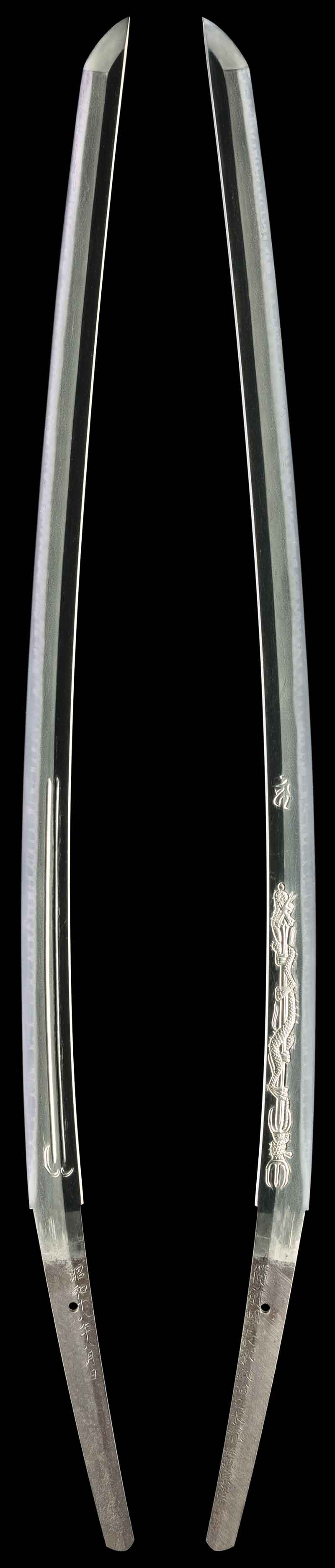
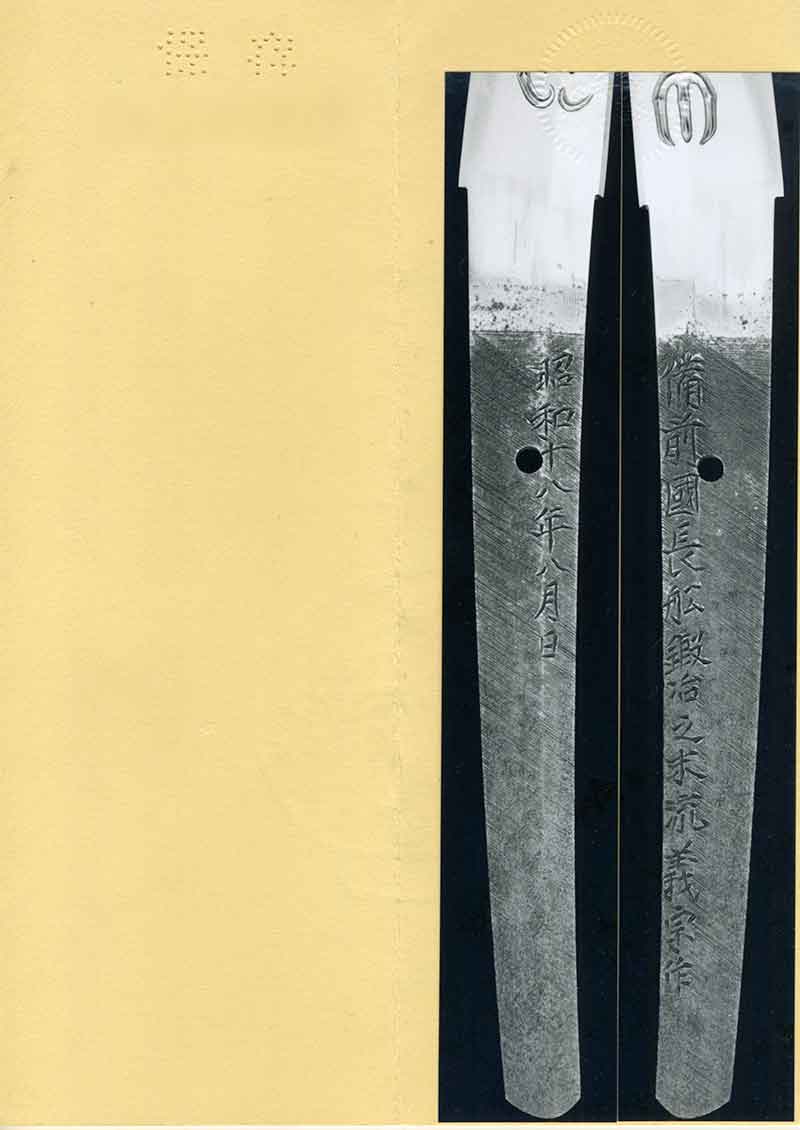
In this work, the hamon is ko-gunome with somewhat aligned yakigashira, mixed with a few angular blades, generally slanting (sakagakari), with ashi, well-covered in ko-nie, and showing excellent workmanship such as sunagashi. It is reminiscent of the kataochi-gunome hamon of the old work Bizen Kagemitsu, which is also occasionally seen in the works of his younger brother Sadatsugu. Regarding the horimono, a dense Kurikara is placed on the sashi-ura, which was likely inspired by the likes of Sue-Bizen Hikobe-jo Sukesada.
The accompanying kuro-roiro-nuri saya aikuchi uchigatana koshirae features a kuro-roiro lacquered saya, with a kozuka and kogai on the omote and ura. The tsuka is covered in black-lacquered same with ai-kawa hira-maki, and the shape of the tsuka is a thick, round rikko-gata. The sageo is also matching ai-kawa, the same as the tsuka-maki leather. It is an aikuchi uchigatana koshirae without a tsuba; several aikuchi uchigatana koshirae of this style without tsuba exist in the Uesugi family. This type of koshirae is almost unseen outside of the Uesugi family and is handed down as the preferred koshirae of Lord Uesugi Kenshin. Among similar examples, the aikuchi uchigatana koshirae accompanying Lord Uesugi Kagekatsu's "Otesen Sanjugo-goshirae" (Thirty-five Selected Swords): Tachi: Ichi (Himetsuru Ichimonji), Tachi: Mumei Ichimonji (Yamatorige), and Tachi: Nagamitsu (Takagi Nagamitsu) are widely known to the world, and among aikuchi wakizashi koshirae, the one accompanying the wakizashi: Soshu Hiromitsu, which Uesugi Kenshin received from the Koga Kubo, has been confirmed. This koshirae was produced in the modern era at the request of a connoisseur; the kozuka, kogai, and menuki are all unified with a motif of ayu (sweetfish), and while understated, it is a high-standard item with refined taste.
Fine hike are visible.
Machine translation from the shop's Japanese · may contain errors ·
The swordsmith Takahashi Yoshimune was born in Meiji 30 (1897) in Omachi Village, Nii District, Ehime Prefecture (present-day Saijo City). In Taisho 2 (1913), at the age of 16, he became a pupil of the Bizen Osafune swordsmith Yokoyama Senryushi Minamoto Sukesada and began his apprenticeship in sword making. He studied Bizen-den techniques for approximately 8 years, and subsequently refined his skills under Henmi Chikukansai Yoshitaka in Okayama. Furthermore, he went to Osaka and learned Yamashiro-den sword making techniques and sword appraisal studies from Enju Taro Kunitoshi.
Yoshimune excelled in Bizen-den, and in Showa 10 (1935), he received the Minister of Education Award at the 1st New Japanese Sword Exhibition held in Ueno, Tokyo. In Showa 17 (1942), in the "Seidai Tosho Iretsu Ichiran" (List of Swordsmith Rankings of the Imperial Era) by Kurihara Hikosaburo Akihide, he was selected as one of the 12 members of the highest rank, "Shinpin no Retsu," alongside Gassan Sadakatsu, Horii Toshihide, Miyaguchi Toshihiro, Shibata Kan, and his younger biological brother Takahashi Sadatsugu.
Yoshimune was the elder brother of Living National Treasure Takahashi Sadatsugu, and is also known for having taught sword making to his younger brother Sadatsugu. After the war, he returned to his hometown of Saijo, Ehime, and established a forge, but passed away on February 27, Showa 21 (1946) at the age of 49. He is one of the master smiths representing the pre-war Showa period, demonstrating particularly excellent skill in Bizen-den.
In this work, the hamon is ko-gunome with somewhat aligned yakigashira, mixed with a few angular blades, generally slanting (sakagakari), with ashi, well-covered in ko-nie, and showing excellent workmanship such as sunagashi. It is reminiscent of the kataochi-gunome hamon of the old work Bizen Kagemitsu, which is also occasionally seen in the works of his younger brother Sadatsugu. Regarding the horimono, a dense Kurikara is placed on the sashi-ura, which was likely inspired by the likes of Sue-Bizen Hikobe-jo Sukesada.
The accompanying kuro-roiro-nuri saya aikuchi uchigatana koshirae features a kuro-roiro lacquered saya, with a kozuka and kogai on the omote and ura. The tsuka is covered in black-lacquered same with ai-kawa hira-maki, and the shape of the tsuka is a thick, round rikko-gata. The sageo is also matching ai-kawa, the same as the tsuka-maki leather. It is an aikuchi uchigatana koshirae without a tsuba; several aikuchi uchigatana koshirae of this style without tsuba exist in the Uesugi family. This type of koshirae is almost unseen outside of the Uesugi family and is handed down as the preferred koshirae of Lord Uesugi Kenshin. Among similar examples, the aikuchi uchigatana koshirae accompanying Lord Uesugi Kagekatsu's "Otesen Sanjugo-goshirae" (Thirty-five Selected Swords): Tachi: Ichi (Himetsuru Ichimonji), Tachi: Mumei Ichimonji (Yamatorige), and Tachi: Nagamitsu (Takagi Nagamitsu) are widely known to the world, and among aikuchi wakizashi koshirae, the one accompanying the wakizashi: Soshu Hiromitsu, which Uesugi Kenshin received from the Koga Kubo, has been confirmed. This koshirae was produced in the modern era at the request of a connoisseur; the kozuka, kogai, and menuki are all unified with a motif of ayu (sweetfish), and while understated, it is a high-standard item with refined taste.
Fine hike are visible.
The twentieth century nearly killed the craft twice: wartime distortion, then the occupation ban. The NBTHK’s founding in 1948 and licensed forging from 1953 rebuilt the sword as an art, crowned by Living National Treasures and the mukansa rank.
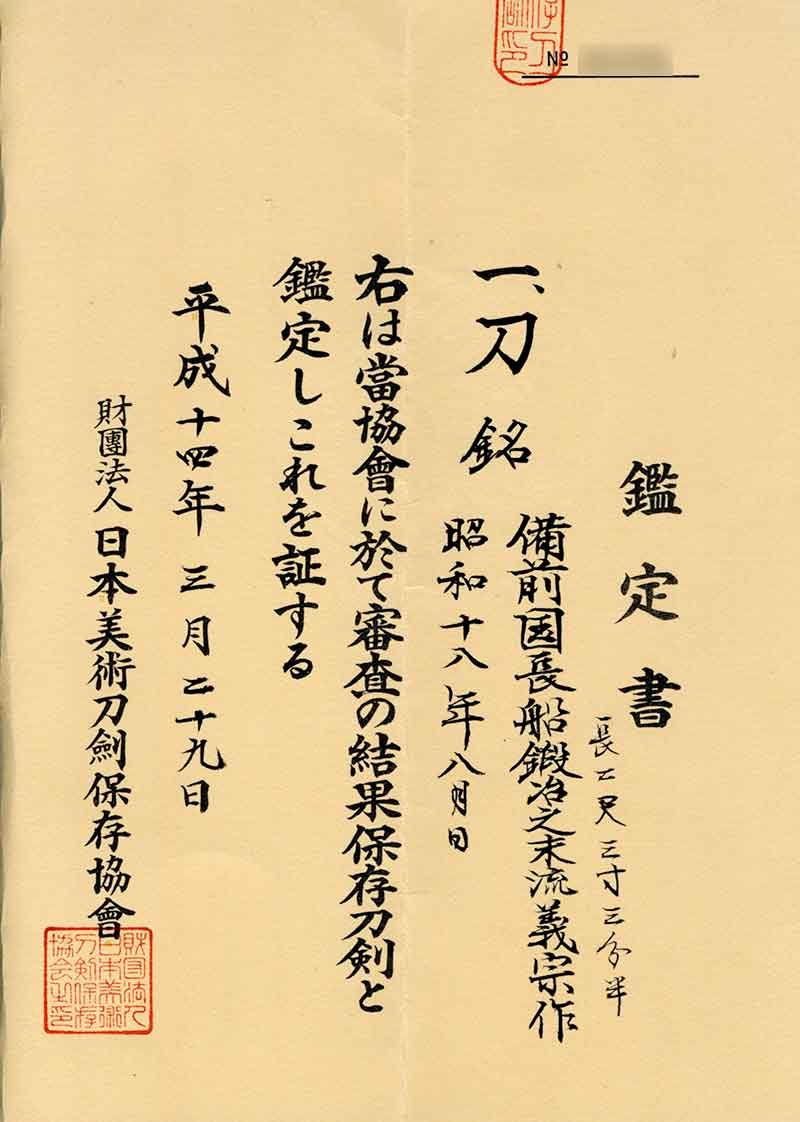
Certifies a genuine blade worth preserving: a signature confirmed correct, or, if unsigned, an era, province, and school that the NBTHK can reliably identify.
About the NBTHK›
The NBTHK (Nihon Bijutsu Tōken Hozon Kyōkai, the Society for the Preservation of Japanese Art Swords) is a public-interest incorporated foundation founded in 1948 and supervised by Japan’s Agency for Cultural Affairs (Bunkachō); it is based at the Japanese Sword Museum in Tokyo. Its expert panels physically examine each submitted work (shinsa) and issue a certificate (kanteishō) ranking it by artistic and historical merit. NBTHK papers are the most widely recognized standard of authentication for Japanese swords and fittings.
Please exercise cooling-off within 8 days of the item's arrival.
(1) We cannot accept items that have been altered or worked on in any way (e.g. test cutting, polishing or other work, display at viewing meetings, photography, taking oshigata rubbings, use for appreciation, copying of books).
(2) Return shipping is at the customer's expense.
(3) Costs other than the item price (bank transfer fees, cash-on-delivery fees, installment fees, etc.) cannot be refunded.
(4) For cash-on-delivery and similar payments, the refund is made after the payment has reached us.
(5) We cannot accept a return when a trade-in item is involved.
(6) Items delivered overseas cannot be returned or refunded (because of the time involved and, for swords, the surrender of the registration certificate and other circumstances).






 NihontoWatch