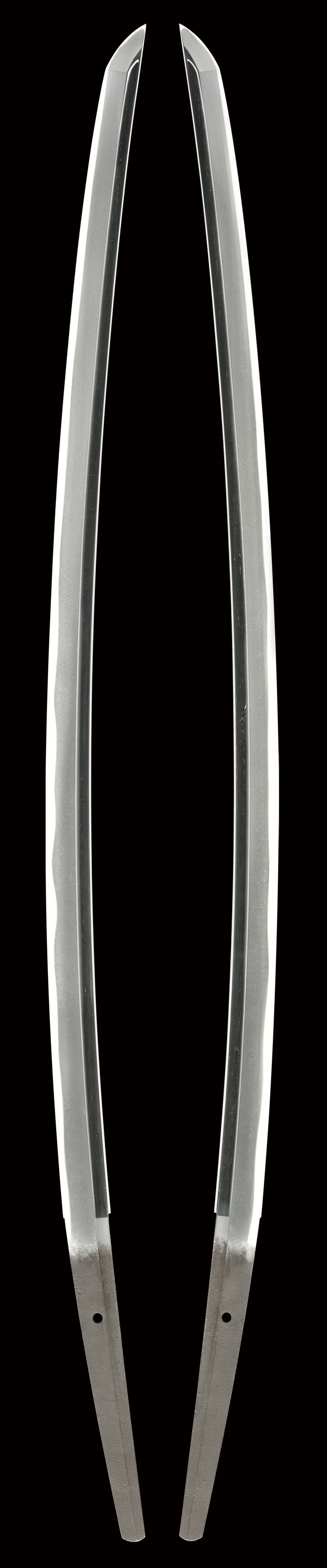
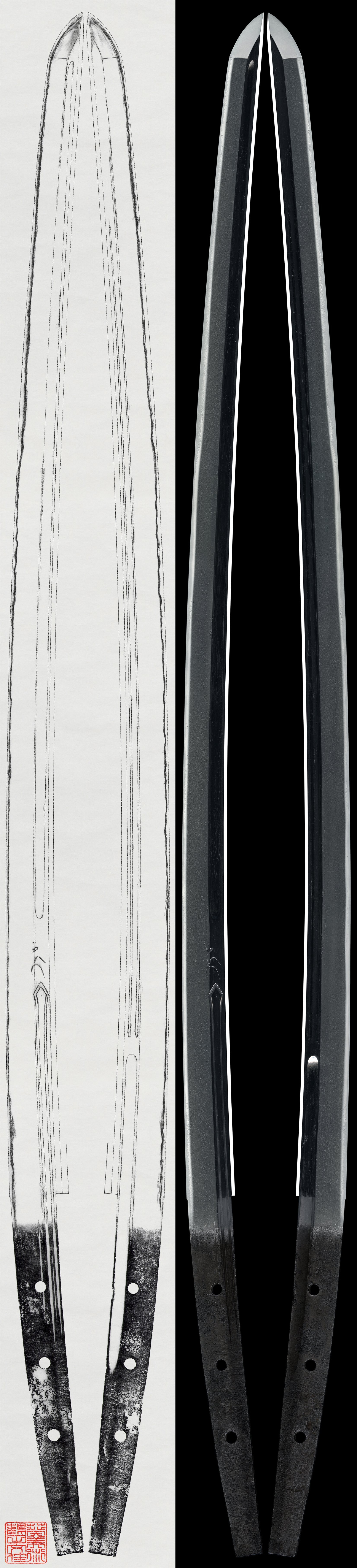
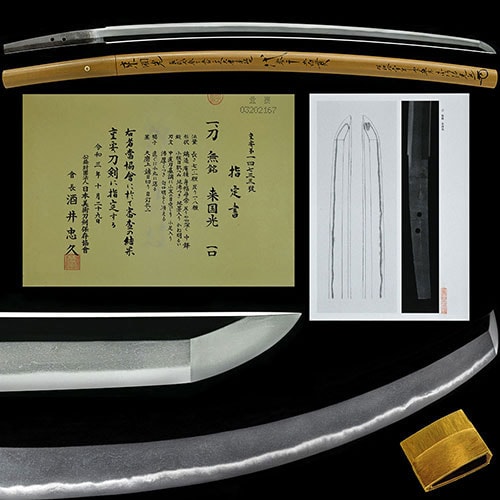
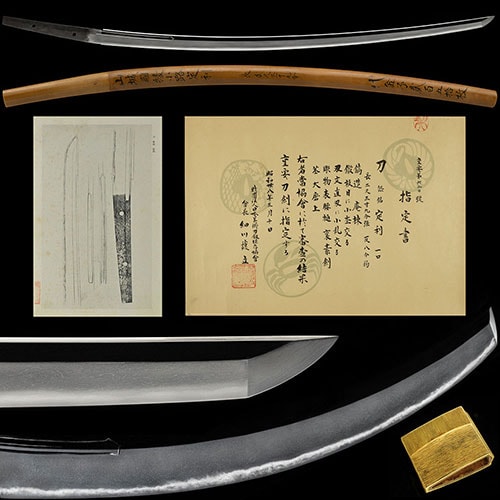
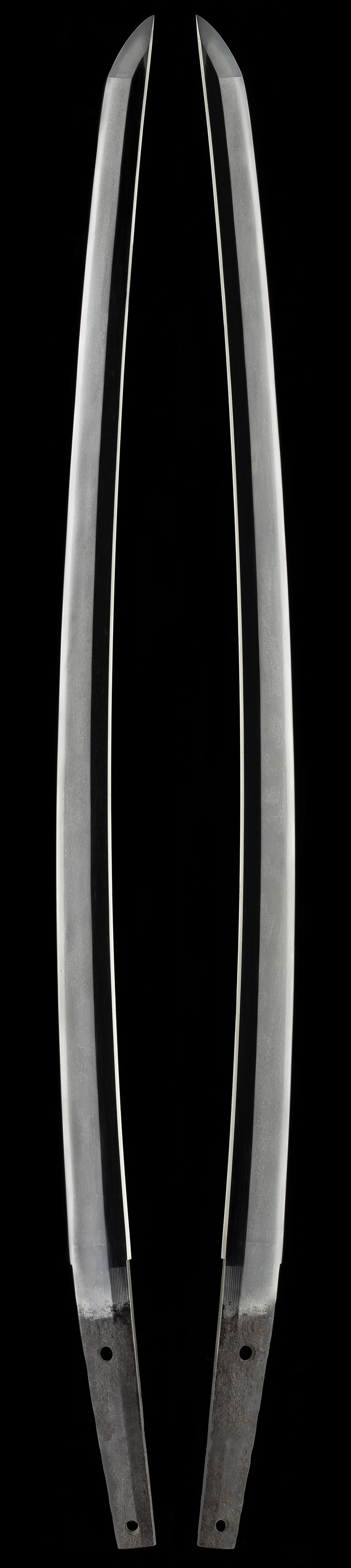
Kunisada (国定) is traditionally identified as a disciple of Kuninobu of the Yamashiro Awataguchi school, and it is transmitted that around the Bun'ei era (1264–1275) he relocated to Tanba Province. His workmanship continues the Awataguchi tradition, and his blades at first glance possess what the NBTHK describes as "the dignified quality characteristic of Kyo work." A separate line of attribution links the name to the Rai school under the reading Rai Kunisada, recorded in sword catalogs as a student of Rai Kunitoshi, though the relationship between the two lineages remains a subject for further research.
In his Awataguchi-line tachi, the forging shows itame-hada with plentiful ji-nie, and the temper is fundamentally suguha mixed with small midare, into which ashi and yo enter strongly. A recurring feature across these works is a feeling of nijubba — a doubled or layered effect in the hardened edge — intermingled within the temper pattern. One tachi displays a choji-like intent recalling Ayakoji Sadatoshi together with a pronounced jubba tendency. Works attributed to the Rai school line show a markedly different character: hira-zukuri with thin kasane and wide mihaba in sunnobi proportions, ko-itame hada well-forged with ji-nie, and a hamon of gunome-midare with ko-notare intermixed that becomes hitatsura in the upper half — characteristics described as typical of Nanbokucho period workmanship and comparable in hamon style to Hasebe Kunishige.
The NBTHK's assessments emphasize the continuity of Awataguchi school aesthetics in the tachi attributed to this smith, noting in particular the dignified quality of Kyoto tradition forging and the distinctive nijubba character of the temper. The presence of works in the Imperial Household collection and transmission through the Tayasu Tokugawa family attests to the historical esteem in which blades bearing this name have been held. Published references include the Kozan Oshigata, Kanto Zuiroku, and Kusanagi no Ya Oshigata.